Supply Chain Partner: What It Means, How to Choose One & Build Global Collaboration
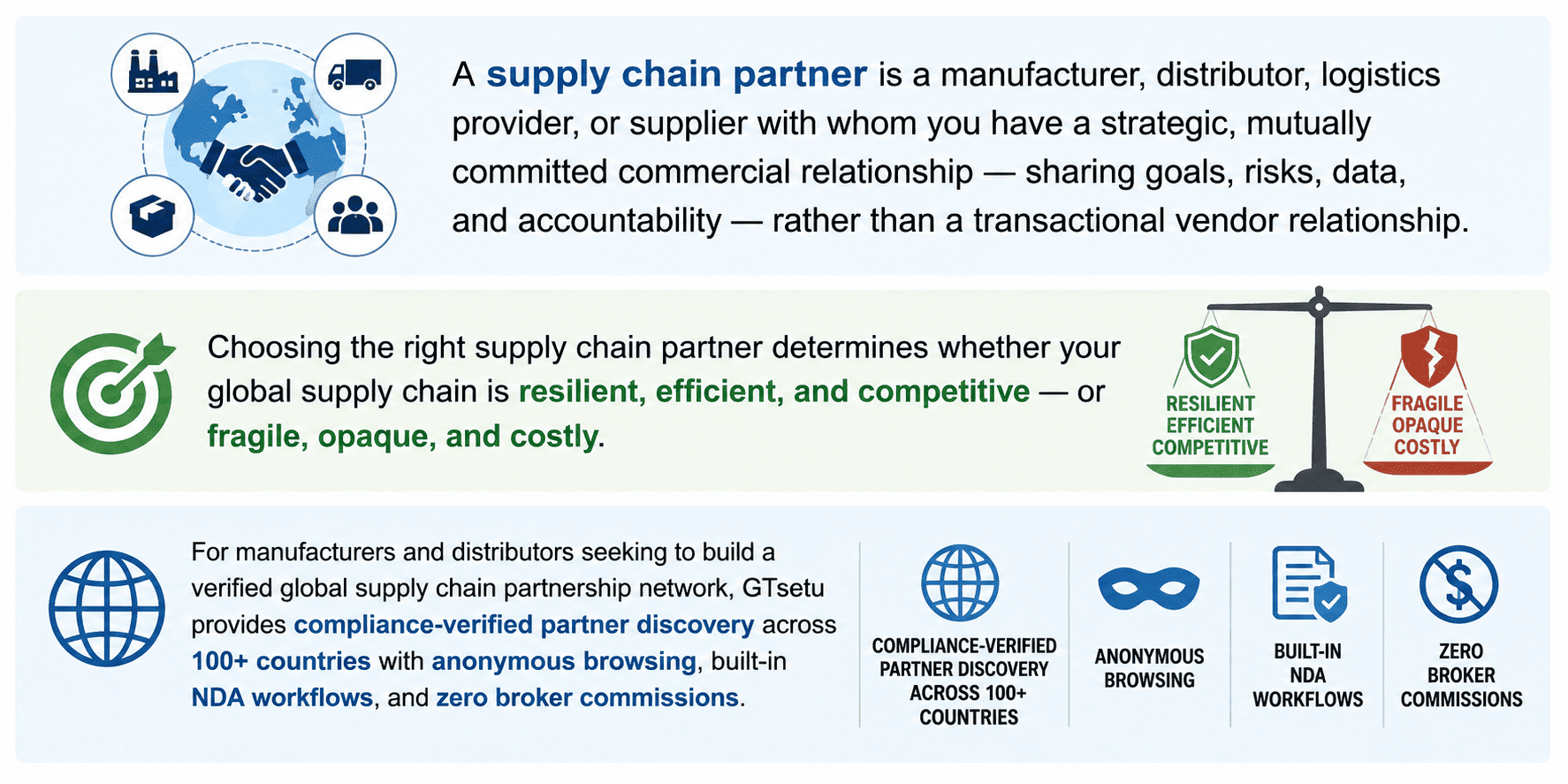
Direct Answer: A supply chain partner is a manufacturer, distributor, logistics provider, or supplier with whom you have a strategic, mutually committed commercial relationship, sharing goals, risks, data, and accountability, rather than a transactional vendor relationship. Choosing the right supply chain partner determines whether your global supply chain is resilient, efficient, and competitive, or fragile, opaque, and costly. For manufacturers and distributors seeking to build a verified global supply chain partnership network, GTsetu provides government‑tie‑up verified company credentials (legal name, registered address, registration number, company status, type, incorporation date) across 100+ countries, with anonymous browsing, built‑in NDA workflows, encrypted document exchange, and zero broker commissions.
📅 March 28, 2026⏱ 19 min read✍️ GTsetu Editorial Team🔄 Updated regularly
500+
Verified Companies
100+
Countries
6-Point
Govt Tie‑Up Verification
0%
Broker Commission
Every product that reaches a consumer passes through a chain of companies, raw material providers, component manufacturers, assemblers, distributors, logistics operators, and retailers. Each link in that chain is, at minimum, a supplier. But the companies that build genuinely resilient, cost-efficient, and competitive supply chains do something different: they transform selected suppliers into supply chain partners, relationships built on shared goals, mutual investment, open data, and joint accountability.
The difference between a vendor-managed supply chain and a partner-driven one is not semantic. Research consistently shows that companies operating collaborative supply chain partnerships generate measurably superior outcomes: lower costs, faster fulfilment, better demand forecasting, reduced inventory waste, and higher customer satisfaction. This guide covers every dimension of the topic, what a supply chain partner is, how it differs from a vendor, the criteria for selecting and evaluating partners across single and multi-location distribution networks, and how GTsetu helps manufacturers and distributors build verified global supply chain partnerships across 100+ countries with zero broker commissions. You may also find our guides on supplier collaboration platforms and global collaboration examples useful context.
💡 Who Is This Guide For?
This guide is written for manufacturers building or restructuring their global distribution network, distributors evaluating new manufacturer principals, supply chain directors managing multi-location partner networks, and procurement leaders seeking to elevate key supplier relationships to strategic partnerships. It is also relevant for anyone studying cross-border business partnerships, industrial business collaboration, or B2B network strategy.
SECTION 1
1 What Is a Supply Chain Partner?
🎯 Definition
A supply chain partner is a company that occupies a node in your supply chain, manufacturer, distributor, raw material supplier, logistics provider, or third-party processor, with whom you have a structured, strategic, and mutually committed commercial relationship. Unlike a transactional vendor relationship, a supply chain partnership involves shared objectives, open data exchange, joint performance planning, mutual investment in improvement, and a formalised accountability framework that benefits both parties when the partnership performs, and exposes both when it doesn’t.
The term supply chain business partner is used across industries to describe this elevated form of commercial relationship. What elevates a supplier to a partner is not tenure or transaction volume, a company can purchase from the same vendor for a decade without forming a partnership. What creates a partnership is the structural difference: both parties have skin in the game, both share information they would withhold from a transactional vendor, and both invest resources, in joint planning, system integration, or operational improvement, that they would not invest in a purely transactional relationship.
In the context of international distribution, a manufacturer’s supply chain partner is not just a company that buys their products, it is a distribution partner that co-invests in market development, shares sell-through data, participates in joint forecasting, and commits to performance targets that are enforced through the partnership agreement. This is qualitatively different from a distributor that simply places purchase orders.
SECTION 2
2 Partner vs. Supplier: The Critical Distinction
The supplier vs. partner distinction is one of the most commercially important, and most frequently blurred, in supply chain management. Many companies use the terms interchangeably, which leads to misaligned expectations, underinvestment in strategic relationships, and over-investment in transactional ones. Here is the precise distinction.
Dimension
Supplier (Transactional)
Supply Chain Partner (Strategic)
Relationship orientation
Transaction-by-transaction; each order evaluated independently
Long-term commitment; relationship managed holistically across a planning horizon
Goal alignment
Each party optimises for its own outcome per transaction
Shared objectives defined jointly; both parties measured against mutual KPIs
Information sharing
Minimal, order quantities, delivery dates, invoice amounts
Open, demand forecasts, inventory levels, production capacity, promotional plans
Risk distribution
One party typically absorbs most risk (buyer holds inventory risk; supplier absorbs cost volatility)
Risk shared by design, both parties absorb and benefit proportionally
Deep verification including government‑tie‑up checks on legal name, address, registration number, status, type, incorporation date, plus independent review of licences and certifications
Renewable per order or per contract term; easily switched
Multi-year commitment; significant switching cost and transition investment
Review cadence
None or annual performance review
Quarterly joint business reviews; monthly KPI tracking; shared dashboard access
⚡ The Strategic Implication
Not every supplier should be a partner, and attempting to manage all suppliers as partners is operationally unsustainable. The highest-impact supply chain strategy segments the supply base: identify the 15–20% of supplier relationships that are strategically critical (by volume, uniqueness, or risk concentration) and elevate those to genuine partnership, with the investment, framework, and accountability that entails. Manage the remaining 80% transactionally with clean purchase order terms. The relationship between distributors and manufacturers specifically benefits most from the partnership model because of the mutual market development investment required.
SECTION 3
3 Types of Supply Chain Partners
Supply chain partnerships exist at every node in the product journey from raw material to end consumer. Understanding the distinct role and requirements of each type of supply chain partner is essential for building the right relationship structure and verification standards for each category.
🏭
Manufacturer Partners
Companies that produce finished goods or sub-assemblies for a brand or principal. The partnership model here involves shared product specifications, quality standards, IP frameworks, and capacity planning. Key agreement type: contract manufacturing agreement.
Production
🚚
Distribution Partners
Companies that purchase, stock, and sell a manufacturer’s products in a defined territory. The partnership model requires joint market development investment, shared sell-through data, and performance against territory volume commitments. The foundation of most international supply chains. Learn how to find international distributors.
Distribution
⚙️
Component & Raw Material Suppliers
Companies providing the inputs, components, packaging, raw materials, that a manufacturer requires. Strategic partnerships here involve capacity reservation, quality co-development, shared demand forecasting, and volume commitments that enable the supplier to plan production and investment with confidence.
Inputs
📦
Logistics & 3PL Partners
Third-party logistics providers managing warehousing, fulfilment, and transportation. Partnership model requires shared inventory visibility, aligned SLA frameworks, joint capacity planning for peak periods, and technology integration for real-time tracking and reporting.
Logistics
🔬
Co-Development Partners
Companies that jointly develop new products, formulations, or processes with a manufacturer or brand. The partnership requires clear IP ownership frameworks, defined contribution obligations, and joint commercialisation rights. See our guide on co-development partnerships.
Innovation
🏷️
Private Label / OEM Partners
Manufacturers producing products under a retailer’s or brand’s own label. Partnership model here involves MOQ management, quality standards adherence, formula or specification confidentiality, and tooling ownership agreements. See white label vs. private label.
Manufacturing
SECTION 4
4 Benefits of Strategic Supply Chain Partnerships
The commercial case for investing in strategic supply chain partnerships, rather than managing all suppliers transactionally, is well-documented. Research consistently shows that companies with collaborative supply chain partner relationships outperform transactionally managed peers on cost, service level, and resilience.
20%
revenue increase reported by grocery and drug retailers that invested in supplier collaboration, Coresite research
44%
of companies struggle to analyse supply chain disruptions due to lack of visibility with partners, Hubs Supply Chain Resilience Report
3–5×
faster market entry for manufacturers using established verified distribution partnerships vs. building direct channels from scratch
💰
Shared Cost Reduction
Partners share costs and risks across the chain, joint purchasing, co-investment in automation, and shared logistics infrastructure, producing savings neither party could achieve independently.
⚡
Faster Order Fulfilment
Open inventory visibility, aligned replenishment triggers, and joint production planning compress the time between order and delivery, improving customer satisfaction and reducing expediting costs.
📊
Improved Demand Forecasting
Partners sharing sell-through data, promotional plans, and seasonal demand signals enable suppliers to plan production more accurately, reducing both stockouts and excess inventory waste.
🛡️
Supply Chain Resilience
Partners that communicate disruptions proactively, capacity constraints, logistics delays, raw material shortages, give each other lead time to respond. Transactional vendors disclose disruptions only when they have already caused a failure.
🌱
Sustainability Alignment
Supply chain partners can jointly commit to sustainability targets, shared packaging standards, carbon reduction programmes, ethical sourcing certification, creating credible ESG supply chain narratives that resonate with end customers.
🏆
Competitive Differentiation
A supply chain built on deep partner relationships, with superior data flows, aligned incentives, and joint innovation capability, is significantly harder for competitors to replicate than a cost-optimised transactional supply base.
🤝
Stronger Promotions Execution
Partners who share promotional calendars enable the supply chain to prepare for demand spikes in advance, preventing the stockouts and late fulfilment that undermine promotional ROI and retail relationships.
🔬
Quality Co-Improvement
Partners collaborate on quality standards, specification development, and root cause analysis for quality failures, driving systematic improvement rather than reactive blame allocation between independent companies.
SECTION 5
5 Criteria for Selecting a Supply Chain Partner
Choosing a supply chain partner is one of the highest-stakes commercial decisions a manufacturer or distributor makes. The wrong choice, a partner with inflated credentials, misaligned values, or insufficient operational capability, creates years of underperformance, costly contract disputes, and the reputational damage of supply failures that reach your customers. Here is the complete quality-first evaluation framework.
🏛️
Verified Business Identity & Compliance Credentials
The non-negotiable foundation: business registration, tax identification, import/export licences, relevant industry certifications, and an authorised representative confirmation. Any candidate partner who cannot provide these with documentation, not just claims, should be disqualified immediately. GTsetu provides government‑tie‑up verification of six core credentials: legal name, registered address, registration number, company status, company type, and date of certificate of incorporation. Import licences and industry certifications must be exchanged and verified directly between parties. See the full business verification requirements.
Foundation
📦
Operational Capability & Capacity
Does the partner have the operational infrastructure to handle your volume, warehouse capacity, fleet, cold chain if required, fulfilment technology, and coverage of the territories in the partnership scope? Verify against actual capability, not claimed capacity. Request site visits, throughput data, or third-party audits for high-value partnerships.
Operations
💳
Financial Stability & Creditworthiness
A supply chain partner who cannot absorb a demand spike, fund initial inventory, or sustain operations through a seasonal trough creates supply disruption risk regardless of their goodwill. Request financial statements, bank references, or credit bureau reports for any partner taking significant inventory risk or receiving substantial payment terms.
Financial
⏱️
Reliability & On-Time Performance Track Record
Consistent, predictable performance is the single most operationally important quality in a supply chain partner. Late deliveries, order accuracy failures, and stockouts cascade through your supply chain and reach your customers. Request OTD (on-time delivery) metrics, order fill rate data, and references from three current customers before committing to any strategic partnership.
Performance
🔄
Flexibility & Adaptability
In today’s volatile supply environment, a partner’s ability to respond to disruption, demand spikes, raw material shortages, logistics constraints, regulatory changes, is as important as their baseline performance. Ask specifically how they have responded to past disruptions. Rigid partners who cannot flex will fail you precisely when supply chain resilience matters most.
Resilience
📡
Transparency & Communication Standards
A partner who communicates proactively, providing real-time inventory visibility, flagging potential disruptions before they materialise, and sharing data you need to make decisions, is structurally more valuable than a technically superior but opaque partner. Evaluate communication culture during the onboarding process itself: how quickly do they respond, how specific are their answers, and how readily do they share operational data?
Does the partner use WMS, ERP, or TMS systems that can share data with your own? Can they integrate via EDI, API, or at minimum provide structured reporting in formats your team can process? Technology compatibility determines whether the partnership can achieve operational integration, or whether every data exchange will require manual intervention. See our discussion of supplier collaboration platforms.
Technology
🌱
Strategic & Cultural Alignment
Long-term supply chain partnerships require alignment on values, not just on commercial terms. A partner whose approach to quality, sustainability, labour standards, and regulatory compliance diverges from yours creates reputational and operational risk that no contract can fully mitigate. Assess cultural fit during the discovery and negotiation process, how a partner behaves before signing a contract tells you how they will behave after.
Culture
SECTION 6
6 Evaluating Supply Chain Partners for Multi-Location Distribution
Criteria for selecting a supply chain partner for multi-location distribution introduces additional complexity beyond single-location evaluation. A partner operating across multiple warehouses, regions, or countries must demonstrate not just local operational capability but network-level coordination, data visibility across all locations, and consistent service quality regardless of the fulfilment node serving a given order.
Evaluation Dimension
Single-Location Standard
Multi-Location Additional Requirements
Inventory Visibility
Real-time stock levels at one facility
Unified inventory view across all nodes, with accurate ATP (available-to-promise) at each location and inter-location transfer visibility
Order Routing Intelligence
Single fulfilment point, all orders from one location
Rule-based or AI-driven order routing that optimises fulfilment by proximity, stock availability, and delivery cost, with fallback logic for stockout scenarios
Consistent Service Standards
SLA compliance at one facility
Demonstrated SLA consistency across all locations, not just headline averages that mask poor performance in specific nodes
Regulatory Compliance by Location
Single jurisdiction, one regulatory framework
Multi-jurisdiction compliance capability, import/export licences, local distribution licences, cold chain certification, and tax registration across each operating country or region
Technology Integration
One WMS/ERP integration point
Consistent data feed from all locations, unified API/EDI interface rather than separate integrations per facility that produce inconsistent data formats
Management Structure
Single management team accountable for performance
Clear network-level governance, who is accountable for overall network performance vs. individual site performance, with defined escalation paths
Financial Exposure
Single entity credit assessment
Group-level financial assessment, understanding which entity holds inventory, which issues invoices, and whether inter-company receivables create hidden financial risk
Clear delineation of territory rights per location, preventing channel conflict between locations and ensuring your exclusivity clauses are honoured network-wide
⚠️ The Multi-Location Visibility Gap
The most common failure mode in multi-location distribution partnerships is the inventory visibility gap: individual locations report accurate local stock, but there is no consolidated network view, meaning your planning team cannot see total available inventory or intelligently route orders. Before committing to a multi-location supply chain partner, require a live demonstration of their consolidated inventory reporting across all locations. A partner who cannot demonstrate this capability during evaluation will not provide it post-signature.
SECTION 7
7 Global Supply Chain Collaboration: What It Requires
Global supply chain collaboration is the practice of companies at different nodes of an international supply chain, manufacturers, distributors, logistics providers, and suppliers across different countries, working together with shared data, aligned objectives, and coordinated planning to improve end-to-end performance. It is the most complex and most strategically valuable form of supply chain partnership, and the one that requires the most deliberate infrastructure to execute effectively.
The Five Pillars of Effective Global Supply Chain Collaboration
✅
Verified Partner Identities Across All Nodes
Every company in a global supply chain, from Tier 1 distributor to Tier 3 raw material supplier, should have verified credentials. Unverified participants create quality, fraud, and regulatory risk at every handoff. GTsetu verifies six core company credentials via government tie‑ups (legal name, address, registration number, status, type, incorporation date), while licences and certifications must be exchanged directly between parties.
📊
Real-Time Shared Data Infrastructure
Global supply chain collaboration requires shared visibility into inventory levels, order status, production capacity, and demand signals, updated in near-real-time. Partners operating on weekly batch reporting create information lags that produce the bullwhip effect and supply disruptions.
Commercially sensitive supply chain data, production schedules, pricing, capacity plans, demand forecasts, exchanged across borders must be encrypted, access-controlled, and audit-trailed. GDPR in Europe, DPDPA in India, and similar frameworks impose legal requirements on cross-border data transfer that must be addressed. See B2B secure collaboration standards.
🌍
Geographic Diversification Strategy
A resilient global supply chain does not concentrate sourcing or distribution in a single geography. A structured diversification strategy, understood and agreed by all partners, enables rapid rerouting when country-specific disruptions occur. See global expansion risks and mitigation.
📋
Joint Performance Framework
Global supply chain partnerships require explicitly negotiated KPIs, fill rate, on-time delivery, order accuracy, forecast accuracy, quality compliance rates, agreed at contract formation and tracked through shared dashboards. Without this, “collaboration” is a label, not a practice.
SECTION 8
8 International Supply Chain Partner: Unique Considerations
An international supply chain partner, one operating in a different country from your home market, introduces a specific set of challenges that domestic partnerships do not face. These are not reasons to avoid international partnerships (the strategic advantages are too significant) but they are requirements that must be addressed structurally to prevent predictable failures.
Challenge
Why It’s Harder Cross-Border
How to Address It
Identity Verification
Business registration systems, document formats, and verification processes differ by country, making independent validation difficult without local expertise
Use platforms like GTsetu where six core credentials (legal name, address, registration number, status, type, incorporation date) are verified via government tie‑ups, then independently validate licences and certifications with the partner directly
Regulatory Compliance Across Markets
Import licences, product registrations, labelling requirements, and distribution regulations vary significantly, what is compliant in one market is non-compliant in another
Require documented evidence of all relevant regulatory compliance in the partner’s operating territory as part of the verification process. Reference licensing vs. distribution agreements for compliance implications of each model.
Currency and Payment Risk
Exchange rate volatility, payment delays, and international wire fraud create financial risk not present in domestic relationships
Define payment terms and payment instrument selection explicitly; use Letters of Credit for high-value initial transactions; establish Incoterms that correctly allocate cost and risk transfer
Cultural Communication Norms
Communication styles, hierarchy expectations, and negotiation norms differ across cultures, creating misunderstandings that erode trust without either party recognising the cause
Invest in cultural briefings before engaging new markets; default to written documentation for all commitments; use structured platform profiles that reduce reliance on cultural interpretation for key commercial data
Legal Enforceability
Contracts governed by your home law may be unenforceable in your partner’s jurisdiction, meaning a breach leaves you without practical legal remedy
Always specify governing law and jurisdiction; engage local legal counsel in the partner’s country for contract review; understand international dispute resolution options
IP and Data Protection
IP protection frameworks and data privacy laws vary, what is adequately protected in one jurisdiction may be exposed in another
Enforce mutual NDA execution before sharing any sensitive data; address IP ownership explicitly in partnership agreements; use encrypted channels for all sensitive data exchange
Lead Times and Logistics Complexity
International logistics adds lead time variability, customs clearance risk, and documentation requirements not present in domestic supply chains
Negotiate lead time commitments explicitly; agree on Incoterms that appropriately allocate logistics risk; build safety stock levels that account for international lead time variability
SECTION 9
9 What Is an Integrated Supply Chain Partner?
🎯 Definition
An integrated supply chain partner is a company that is deeply connected into your supply chain operations through shared systems, processes, and data flows, operating as a functional extension of your supply chain rather than as an external vendor. Integration can mean real-time inventory visibility, shared demand forecasting, co-managed replenishment, joint S&OP processes, or EDI/API connectivity between ERP and WMS systems. The defining characteristic is that operational boundaries between the two companies become deliberately permeable, each party can see, plan against, and respond to the other’s operational reality without waiting for periodic reports or reactive communication.
Levels of Supply Chain Integration
Integration Level
Characteristics
Data Shared
Technology Required
Best For
Level 1, Transactional
Purchase orders, invoices, delivery notes exchanged, no operational visibility between companies
Order quantities, delivery dates, invoice amounts
Email, EDI for PO/invoice exchange
Non-strategic, commodity suppliers
Level 2, Informational
Periodic reporting of key metrics, inventory levels, sales data, quality results, shared at agreed intervals
CPFR platforms, shared S&OP tools, API integration
Key supply chain partners with high volume or strategic importance
Level 4, Integrated
Real-time system-to-system connectivity, orders triggered automatically by inventory signals; production schedules visible to downstream partners
Real-time inventory ATP, production schedules, shipment tracking, quality alerts
Full ERP/WMS/TMS API integration; IoT for real-time tracking
Tier 1 strategic partners; high-velocity or perishable categories
Level 5, Synchronised
End-to-end supply chain visibility and coordinated decision-making across all nodes in near-real-time
Full supply chain data visibility: raw material → manufacturing → distribution → retail
Supply chain control tower platforms; shared data lakes; AI-driven planning
Complex multi-tier global supply chains; FMCG leaders; automotive OEMs
💡 Integration Investment Principle
Integration investment should be proportional to strategic importance. Achieving Level 4 integration with every supplier is neither economically justified nor operationally feasible. The optimal strategy: Level 4–5 integration with your top 5–10% of supply chain partners by strategic importance; Level 3 with the next 20%; Level 2 with the remainder. This tiered approach concentrates integration investment where it generates the greatest supply chain performance return.
SECTION 10
10 Finding the Right Consulting Partner for Supply Chain Maturity
As supply chains grow in geographic complexity and partner diversity, many manufacturers and distributors reach a point where internal capability is insufficient to drive supply chain maturity to the next level, and engaging an external consulting partner becomes strategically justified. The challenge is identifying the right consulting partner, given the enormous quality variance in the supply chain consulting market.
How to Identify a Consulting Partner with Vertical-Specific Supply Chain Knowledge
01
Define the Maturity Gap You Are Solving
Before engaging any consulting partner, define precisely where your supply chain maturity is deficient and what outcome you need: is it partner discovery and verification, demand forecasting accuracy, distribution network design, technology integration, or compliance and risk management? A generic “supply chain improvement” brief attracts generalist consultants. A specific maturity gap statement attracts specialists who have solved exactly this problem before. The more specific your brief, the easier it is to evaluate whether a consulting candidate has the relevant vertical experience.
02
Require Demonstrated Vertical-Specific Case Studies
Supply chain knowledge is not generic, the best practices for a pharmaceutical cold chain are entirely different from those for a fast-moving consumer goods distribution network or an industrial equipment supply chain. When evaluating consulting candidates, require specific case studies from your vertical (product category) and your target geographies. Ask not just what they recommended, but what was implemented and what was measurably improved, with specific metrics. Consultants with genuine vertical experience can answer this immediately. Generalists will produce vague claims of “best practice” transfer.
03
Assess Their Partner Network Quality
If you are engaging a consulting partner specifically to help you find, verify, or improve relationships with supply chain partners, the quality of their partner network is the primary evaluation criterion. Ask: how many verified contacts do they have in your target geography in your product category? Are those contacts verified or are they unverified LinkedIn connections? Can they provide warm introductions with documented company credentials, or only cold email introductions to contacts who may or may not be qualified? GTsetu’s platform provides a government‑tie‑up verified (six points) network alternative to consulting introductions.
04
Evaluate Technology and Data Capability
Modern supply chain consulting requires competence in the technology and data infrastructure that drives supply chain performance, not just process frameworks from the 1990s. Ask whether the consulting candidate can assess your ERP/WMS integration maturity, recommend supply chain technology platforms appropriate for your scale and complexity, and support implementation, not just advise at the strategy level. A supply chain consulting partner who cannot demonstrate fluency in modern supply chain technology is limited to delivering strategy documents that no one can implement.
05
Check for Conflict-of-Interest in Partner Recommendations
Some supply chain consultants have commercial relationships, referral fees, partnership agreements, or equity stakes, with the technology vendors or logistics providers they recommend. This creates a structural conflict of interest: their recommendation is influenced by their commercial relationship, not your optimal solution. Always ask directly: “Do you have any commercial relationship with any supplier, platform, or vendor you might recommend to us?” A consultant who is unwilling to answer this question directly should not be engaged. GTsetu takes zero commission from any partnership formed, eliminating this conflict entirely.
SECTION 11
11 Where Supply Chain Partnerships Go Wrong, and How to Avoid It
Most supply chain partnerships that fail do not fail because the parties lacked goodwill. They fail because structural problems, missing verification, vague contract terms, misaligned incentives, or absent performance management, were present from the beginning and grew until they became irrecoverable. Here are the most common failure modes and how to prevent each one.
🚨
Skipping Partner Verification
Accepting self-reported credentials, unverified website claims, or informal references as sufficient basis for a strategic partnership. Always require documented proof of business registration, regulatory licences, and certifications. Use platforms like GTsetu where six core company credentials (legal name, address, registration number, status, type, incorporation date) are verified via government tie‑ups, and licences/certifications are exchanged directly. See business verification requirements.
📄
Vague or Incomplete Contract Terms
Leaving key commercial terms, territory scope, exclusivity triggers, volume commitments, price review mechanisms, termination notice periods, undefined or ambiguous. Every vague term in a supply chain partnership agreement eventually becomes a dispute. Address all terms explicitly at contract formation. Key references: exclusivity clauses, termination clauses, territory rights.
📊
No Joint Performance Framework
Forming a partnership without agreed, measurable KPIs and a regular joint review process. Without defined performance benchmarks, neither party knows when the partnership is succeeding or failing, until the failure is severe enough to cause commercial damage. Negotiate KPIs at contract formation and schedule quarterly joint reviews from day one.
🔐
Sharing Sensitive Data Without NDA
Exchanging product specifications, pricing, or demand forecasts before a signed NDA is in place, particularly during the evaluation phase when the partnership has not been confirmed. On GTsetu, the NDA workflow is activated before the encrypted workspace unlocks, making this structurally impossible.
⚖️
Misaligned Incentives
Structuring the partnership so that one party benefits from actions that harm the other, e.g., a distributor whose margin increases when they delay payment, or a manufacturer whose per-unit margin increases when they ship below-specification product. All partnership incentives should be designed so that both parties benefit most when the overall supply chain performs best.
🌊
Information Withholding During Disruption
Partners who conceal supply problems, production delays, quality failures, logistics disruptions, until they have already caused customer impact. This is the most trust-destroying behaviour in supply chain partnerships and is almost always caused by cultural norms around bad-news communication. Address this explicitly in the partnership onboarding: early, honest disclosure of potential problems is a contractual and cultural expectation, not optional transparency.
SECTION 12
12 How GTsetu Powers Verified Global Supply Chain Partnerships
🌐 Platform Spotlight, GTsetu
Government‑Tied Verification for Global Supply Chain Partner Discovery
GTsetu was built to solve the hardest problem in global supply chain partnership formation: finding the right manufacturer or distributor in the right market, with verified credentials and genuine operational capability, without leaking your commercial strategy in the process, and without paying broker commissions on every partnership you form. GTsetu verifies every company on its platform using direct government tie‑ups across six essential credentials: legal name, registered address, registration number, company status, company type, and date of certificate of incorporation. This verification is mandatory before any company can appear in the network. Import licences, industry certifications, and financial standing are not verified by GTsetu; those must be exchanged and validated directly between partners.
🏛️
Government Tie‑Up Verification
6‑point verification: legal name, registered address, registration number, company status, company type, date of certificate of incorporation. Verified via direct government sources, not self‑declared.
📜
Licences & Certifications
GTsetu does not verify import licences, industry certifications, or financial standing. These must be exchanged and validated directly between partners during due diligence.
🕵️
Anonymous Discovery
Browse verified manufacturer and distributor profiles across 100+ countries without revealing your own identity. Your supply chain expansion strategy stays private until you choose to engage.
📄
Built-In NDA Workflow
Digital NDA execution with timestamped signatures and permanent audit trail, activated automatically before sensitive supply chain data can be exchanged between parties.
🔐
Encrypted Document Workspace
AES-256 encryption at rest, TLS in transit. Role-based access controls per user and per document. Full audit trail of every access event. No unprotected email attachments for supply chain data exchange.
📋
Full Audit Trail
Every access, document view, NDA signature, and communication logged with timestamp, downloadable for compliance, regulatory, or legal reference across any jurisdiction.
🚫
Zero Commission
GTsetu charges zero broker commission on any supply chain partnership formed. All commercial value stays between the manufacturer and distributor, no intermediary taking a percentage of your distribution economics.
🌍
100+ Countries
Active, verified network spanning Asia, Middle East, Europe, Africa, Australia, and the Americas. The geographic reach required for genuine global supply chain collaboration.
⟡ Not verified; exchanged directly between parties
✗ Not collected or verified
Anonymous partner discovery
✓ Identity protected during browsing
✗ Identity exposed from first contact
NDA before data exchange
✓ Platform-enforced before workspace unlocks
✗ No mechanism, user’s responsibility
Encrypted document sharing
✓ AES-256 + TLS, no email attachments
✗ Email-based sharing, uncontrolled forwarding
Full audit trail
✓ Automated, every access event logged
✗ No record beyond email thread
Fraud risk (basic identity)
✓ Eliminated by government‑tie‑up verification
✗ High, fabricated profiles common on open platforms
Broker / success commission
✓ Zero, always
~ Variable, often 3–15% of deal value
100+ country coverage
✓ Active verified members across all regions
~ Claims broad coverage; verification absent
💡 For a broader view of the alternatives landscape
If you are currently evaluating open marketplace platforms for supply chain partner discovery, see our comparison guides: alternatives to Alibaba, alternatives to IndiaMart, and alternatives to TradeIndia, each covering the verification, security, and commission trade-offs between GTsetu and the major open marketplace platforms.
FAQ
? Frequently Asked Questions
QWhat is a supply chain partner?
A supply chain partner is a company at any node in your supply chain, manufacturer, distributor, logistics provider, or supplier, with whom you have a strategic, mutually committed commercial relationship built on shared goals, open data exchange, joint planning, and mutual accountability. A supply chain partner differs from a transactional vendor in that both parties invest in the relationship’s performance, share risks and benefits proportionally, and engage in regular joint review of how the partnership is serving both companies’ interests. Not all suppliers should be partners, partnership investment should be concentrated on the 15–20% of supply chain relationships that are strategically critical.
QWhat is the difference between a supplier and a supply chain partner?
A supplier provides goods or services transactionally, each interaction is independent, each party optimises for their own outcome per transaction, and information sharing is minimal. A supply chain partner is a supplier with whom you have an elevated, strategic relationship: shared objectives, open data on demand, inventory, and capacity; joint investment in improvement; mutual risk-sharing; and a formalised performance management framework. All supply chain partners are suppliers, but not all suppliers are partners. The distinction is depth of alignment, mutual commitment, and structural investment in the relationship’s long-term performance, not simply tenure or transaction volume.
QWhat is global supply chain collaboration?
Global supply chain collaboration is the practice of companies at different nodes in an international supply chain, manufacturers, distributors, logistics providers, and suppliers in different countries, working together with shared data, aligned objectives, and joint planning processes to optimise end-to-end supply chain performance. It requires verified partner identities across all nodes, secure cross-border data exchange infrastructure (encryption, access controls, audit trail), contractual frameworks for shared accountability, multi-jurisdiction legal enforceability, and technology platforms providing real-time visibility across geographies. The most common enabler of global supply chain collaboration is a verified B2B platform, like GTsetu, that provides partner discovery, government‑tie‑up verification of six core credentials, and secure data exchange infrastructure.
QWhat are the criteria for selecting a supply chain partner?
The core criteria for selecting a supply chain partner are: (1) Verified business identity and compliance credentials, documented registration, licences, certifications. (2) Operational capability, genuine capacity, geographic coverage, and infrastructure to deliver your requirements. (3) Financial stability, ability to fund inventory, absorb demand variability, and sustain operations through disruption. (4) Reliability track record, demonstrated OTD, fill rate, and quality compliance metrics with callable references. (5) Transparency and communication standards, proactive disclosure of problems and willingness to share operational data. (6) Technology compatibility, ERP/WMS integration capability and data sharing willingness. (7) Flexibility, ability to adapt to demand volatility and market change. (8) Strategic and cultural alignment, shared values on quality, compliance, and long-term commitment. For multi-location distribution specifically, add: network-wide inventory visibility, consistent SLA performance across all nodes, and clear network-level governance accountability.
QWhat is an integrated supply chain partner?
An integrated supply chain partner is a company that is connected into your operations through shared systems, processes, and data flows, not just connected by purchase orders. Integration means real-time inventory visibility, shared demand forecasting, co-managed replenishment, or API/EDI connectivity between ERP and WMS systems. Integrated partners operate as functional extensions of your supply chain, enabling faster response times, lower inventory carrying costs, and reduced operational friction. Integration levels range from informational (periodic reporting) to fully synchronised (real-time bidirectional data flow across all supply chain nodes). Optimal strategy: Level 4–5 integration with your top 5–10% of partners by strategic importance; lighter integration for the remainder.
QHow do I find an international supply chain partner?
To find a qualified international supply chain partner: (1) Define your ideal partner profile, target geography, operational capability requirements, required certifications, financial standing, and product category specialisation. (2) Use a platform like GTsetu where six core company credentials (legal name, address, registration number, status, type, incorporation date) are verified via government tie‑ups, eliminating the identity fraud risk of open marketplaces. (3) Supplement with targeted trade show attendance, bilateral chamber engagement, and referral requests from existing supply chain partners. (4) Independently verify licences, certifications, and financial standing directly with the candidate partner. (5) Execute a mutual NDA before sharing any commercially sensitive supply chain data. (6) Exchange product and commercial information through encrypted channels, not unprotected email. (7) Formalise the relationship with a partnership agreement covering all key commercial terms before committing inventory or market exclusivity. For open marketplace comparison, see our guides on Alibaba alternatives and IndiaMart alternatives.
QHow do I choose the right supply chain technology partner?
When choosing a supply chain technology partner, whether a WMS provider, TMS platform, demand planning tool, or supply chain visibility platform, evaluate: (1) Functional fit against your specific supply chain maturity requirements, not against all possible capabilities. (2) Integration capability with your existing ERP, WMS, and partner systems. (3) Vertical-specific experience in your product category and geographic footprint. (4) Implementation track record, references from comparable deployments in terms of scale, category, and complexity. (5) Total cost of ownership over 5 years, not just licence fees. (6) Data security and regulatory compliance standards, particularly for cross-border data transfer. (7) Vendor financial stability, a technology partner who is acquired, pivoted, or shut down mid-implementation creates significant operational risk. (8) Conflict-of-interest transparency, ask directly whether the vendor or their consultants have referral relationships that influence their recommendations.
QHow does GTsetu support supply chain partner discovery?
GTsetu is a verified B2B platform that provides government‑tie‑up verification of six core company credentials (legal name, registered address, registration number, company status, company type, date of certificate of incorporation) for every company in its network. This verification is mandatory before any company appears on the platform. Manufacturers and distributors discover each other anonymously, confirm mutual interest, execute digital NDAs before sensitive supply chain data is shared, and collaborate via an encrypted document workspace with role‑based access controls and a full audit trail. GTsetu does not verify import licences, industry certifications, or financial standing; those must be exchanged and validated directly between partners. Zero broker commissions on any partnership formed, all commercial value stays between the manufacturer and distributor. GTsetu covers 100+ countries and provides the partner discovery, basic identity verification, and secure collaboration infrastructure that forms the foundation of verified global supply chain partnerships. See the B2B business network guide for broader context.
Connect with 500+ manufacturers and distributors across 100+ countries on GTsetu, with government‑tie‑up verification of six core company credentials, anonymous discovery, built‑in NDA workflows, encrypted document collaboration, and zero broker commissions on every supply chain partnership you form.
They represents the product, and research team behind GTsetu, a global B2B collaboration platform built to help companies explore cross-border partnerships with clarity and trust. The team focuses on simplifying early-stage international business discovery by combining structured company profiles, verification-led access, and controlled collaboration workflows.
With a strong emphasis on trust, and disciplined engagement, Team GTsetu shares insights on global trade, partnerships, and cross-border collaboration, helping businesses make informed decisions before entering deeper commercial discussions.