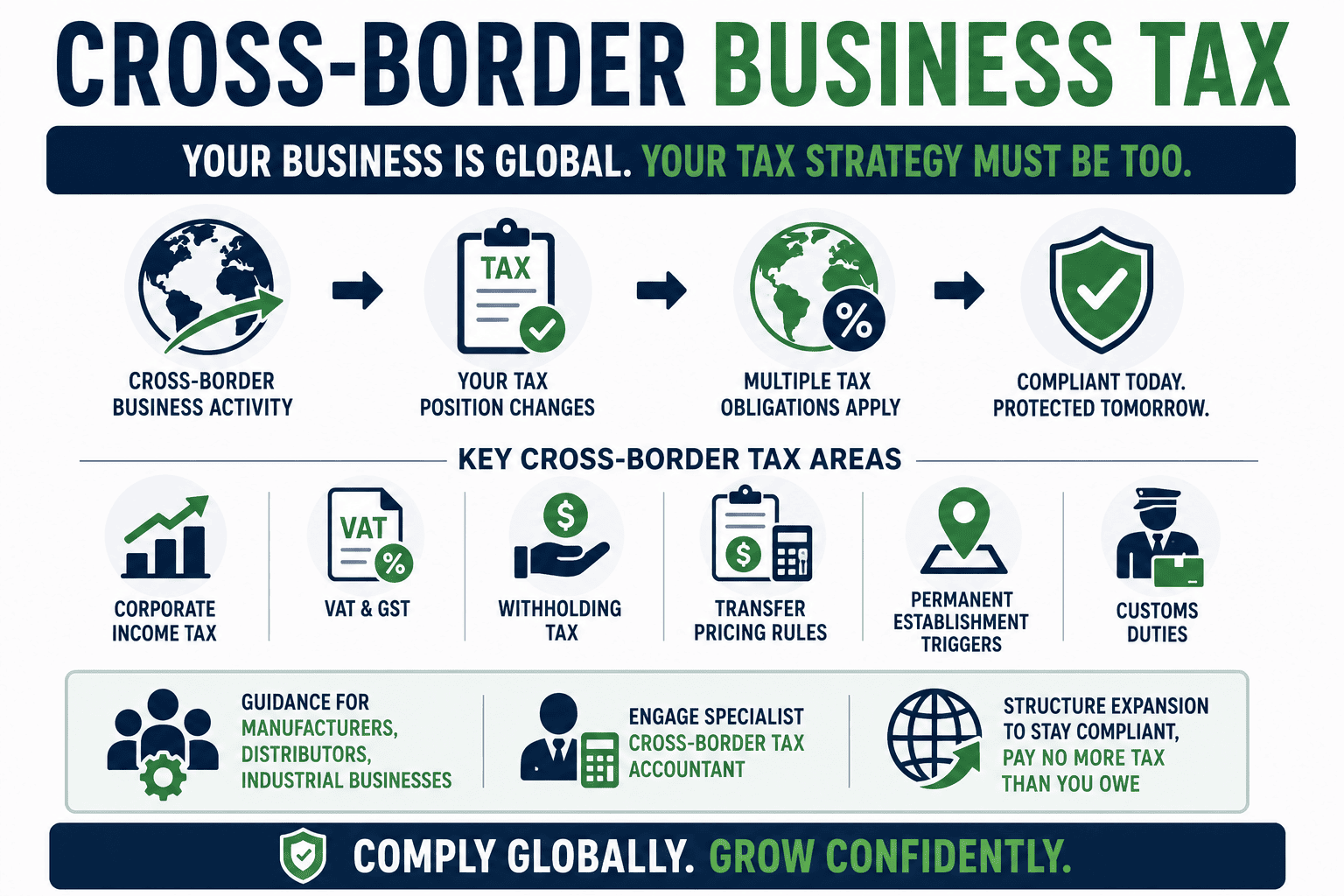
Cross-Border Business Tax: A Complete Guide for Manufacturers & Distributors
The moment you appoint a distributor in another country, ship goods across a border, or receive a royalty from a foreign licensee, your tax position changes. Cross-border business tax is not a single obligation, it is a web of corporate income tax, VAT and GST, withholding tax, customs duties, transfer pricing rules, and permanent establishment triggers that vary by jurisdiction, by transaction type, and by the structure of your commercial arrangements. This guide covers every layer, with specific guidance for manufacturers, distributors, and industrial businesses, including when to engage a specialist cross-border tax accountant and how to structure international expansion to remain fully compliant without paying more tax than you owe.
📅 May 20, 2026⏱ 20 min read✍️ GTsetu Editorial🔄 Updated regularly
90+
India DTAA Countries
15%
OECD Global Min. Tax
140+
BEPS-Committed Nations
4
Core Tax Categories
Cross-border business tax is one of the highest-impact and most consistently underestimated dimensions of international expansion for manufacturers and distributors. The companies that get it right from the start, who structure their international commercial arrangements with tax implications in mind before the first shipment leaves or the first distributor agreement is signed, avoid the expensive, sometimes irreversible consequences of triggering unexpected tax obligations in foreign jurisdictions.
This guide is written specifically for industrial businesses: manufacturers, distributors, and raw material suppliers who are entering or operating in international markets. It covers the tax categories that apply, the structural risks most commonly triggered by international commercial arrangements, the legal frameworks designed to prevent double taxation, and the compliance process that keeps multi-country operations organised and defensible.
💡 This is not tax advice
This guide provides educational information on cross-border business tax concepts and frameworks. It does not constitute tax or legal advice. The rules described vary significantly by jurisdiction, transaction type, and individual business circumstances. Always engage a qualified cross-border tax accountant before structuring international commercial arrangements.
Section 1
1 What Is Cross-Border Business Tax?
Cross-border business tax refers to the totality of tax obligations that arise when a business conducts commercial activity across national borders. This includes not just the taxes paid in foreign countries on profits earned there, but also indirect taxes collected on cross-border supplies of goods and services, taxes withheld at source on certain types of cross-border payments, customs duties on physical goods in transit, and the administrative compliance burden of meeting reporting, registration, and filing requirements in multiple jurisdictions simultaneously.
For manufacturers and distributors, the cross-border tax picture is particularly complex because the commercial arrangements most commonly used in international trade, appointing a distributor, establishing a warehouse, licensing a product, appointing a sales agent, or entering into contract manufacturing, each trigger different tax obligations in the country of operation, and sometimes unexpectedly in the home country as well.
The OECD, which coordinates international tax policy for over 140 member and partner countries, describes the core challenge as one of allocating taxing rights: which country gets to tax which slice of a business’s international profits, and on what basis. The frameworks it has developed, most notably the BEPS (Base Erosion and Profit Shifting) initiative, Transfer Pricing Guidelines, and Model Tax Convention, form the backbone of international tax law as it applies to businesses today.
📌 The key principle
Most countries tax based on some combination of residence (where the company is incorporated or managed) and source (where the income is earned or where the customer is located). Cross-border tax complexity arises because these two bases can produce overlapping or conflicting claims to the same income, which is precisely what double taxation treaties are designed to resolve.
Section 2
2 The Four Core Tax Categories in Cross-Border Trade
Every manufacturer or distributor operating across borders is potentially subject to four distinct categories of tax. Each has different triggers, rates, compliance requirements, and risk profiles. Understanding all four is essential before structuring any international commercial arrangement.
🏢
Corporate Income Tax
Tax levied on the profits a business earns in a given country. In an international context, this is triggered when a company has a taxable presence, a permanent establishment, in that country, or when domestic law deems certain income to be sourced from that country regardless of physical presence. Rates range from 9% (UAE) to over 30% in some jurisdictions. India’s domestic corporate tax rate is 22% for existing companies and 15% for new manufacturing entities.
High complexity, jurisdiction-dependent
🛒
VAT / GST (Indirect Tax)
Value Added Tax and Goods and Services Tax are consumption taxes collected at each stage of supply. Cross-border supplies of goods are typically zero-rated for export (the exporter pays no VAT but claims input tax credits), while imports are taxed at the destination. Services are increasingly taxed where the customer is located. India’s GST has five rate tiers (0%, 5%, 12%, 18%, 28%); B2B exports are zero-rated. Registration thresholds, filing frequencies, and e-invoicing requirements vary by country.
Medium, registration and filing burden
✂️
Withholding Tax
A tax deducted at source by the payer on certain types of cross-border payments, dividends paid to foreign shareholders, interest on cross-border loans, royalties on intellectual property licences, and fees for services rendered by foreign entities. Withholding tax rates are specified in domestic law but are frequently reduced by tax treaties. For Indian manufacturers receiving royalties from international licensees, the applicable withholding tax rate, and how to reduce it via India’s DTAA network, is a critical planning consideration.
Medium, treaty-reducible
📦
Customs Duties & Trade Taxes
Tariffs and customs duties applied to physical goods as they cross national borders. Rates depend on product classification (HS code), country of origin, and any applicable trade agreements (FTAs). Customs duties directly affect landed cost and therefore the competitiveness of a manufacturer’s products in the destination market. Misclassification of goods, using the wrong HS code, is one of the most common and costly customs compliance errors in international trade.
High, landed cost and compliance impact
👥
Payroll & Employment Taxes
When a manufacturer employs staff in a foreign country, or has employees who work remotely from another jurisdiction, payroll taxes, social security contributions, and income tax withholding obligations in that jurisdiction may arise. Even a single employee working long-term in a foreign country can trigger local payroll obligations and, in some cases, permanent establishment risk for the employer.
Medium, employment structure dependent
💻
Digital Services Taxes
A growing number of countries, including India (equalisation levy, recently abolished), France, the UK, and others, have implemented or proposed Digital Services Taxes targeting revenue from digital platforms and services. For manufacturers with digital offerings or software licensing arrangements, DSTs can create unexpected tax obligations in markets where they have no physical presence.
Lower for industrial manufacturers
Section 3
3 Permanent Establishment: The Most Misunderstood Risk
Permanent establishment (PE) is the concept that creates the most unexpected cross-border tax liability for manufacturers and distributors entering international markets. It is the threshold at which a foreign company is deemed to have a sufficient taxable presence in a country to be liable for corporate income tax there, even without a formally registered subsidiary or branch office.
What Triggers a Permanent Establishment?
Under the OECD Model Tax Convention (the framework on which most bilateral tax treaties are based), a PE is created when a company has a fixed place of business in a foreign country through which its business is wholly or partly carried on. This includes:
🏢
Fixed Place of Business
An office, branch, factory, workshop, warehouse, mine, or any other fixed location in the foreign country. Storing inventory at a third-party warehouse in some jurisdictions is sufficient to trigger PE.
🤝
Dependent Agent
An agent (individual or company) in the foreign country who habitually exercises authority to conclude contracts on behalf of the foreign enterprise. A distributor who negotiates and signs contracts in your name, rather than as an independent intermediary, may create PE.
🏗️
Construction or Installation Projects
Construction sites, installation projects, or supervisory activities lasting more than a defined period, typically 6 to 12 months under most treaties, create a PE in the country where the project is located.
👤
Remote Employees
Employees who work from home or a coworking space in a foreign country for extended periods can create PE risk for their employer, even without a formal office. This is an increasingly relevant risk for manufacturers with cross-border technical or sales teams.
⚠️ The distributor PE trap
The structure of your distributor relationship matters enormously for PE risk. An independent distributor who buys your goods and resells them on their own account generally does not create PE for you, they are acting as principal, not as your agent. A dependent agent who concludes contracts in your name does create PE risk. The distinction between these two structures must be clearly reflected in your manufacturer-distributor contract. Get this wrong and you may face unexpected corporate income tax obligations in every market where your distributor operates.
What Happens When PE Is Triggered?
Once PE is established, the host country has the right to tax the profits attributable to that permanent establishment, not the entire company’s profits, but the portion that can be allocated to the activities conducted through the PE. This requires profit attribution analysis, which is itself a complex exercise subject to transfer pricing principles. It also creates filing obligations in the host country, corporate tax returns, potentially local audit exposure, and ongoing administrative cost.
For manufacturers expanding into markets like Germany, the UK, or Australia, where corporate tax rates are significant and tax authority scrutiny is high, unintentional PE creation can represent a material, unbudgeted cost.
Section 4
4 Transfer Pricing: Rules for Related-Party Transactions
Transfer pricing is the set of rules governing the prices charged in transactions between related entities in different countries. If a manufacturer sells goods to its own subsidiary in Germany, or licenses its brand to a related distributor in the UAE, the price set for that transaction, the transfer price, determines how much profit is reported (and therefore taxed) in each jurisdiction. This creates an obvious incentive for multinational businesses to set transfer prices in ways that shift profits from high-tax to low-tax jurisdictions, which is exactly what tax authorities are vigilant against.
The Arm’s Length Principle
The universal standard for transfer pricing is the arm’s length principle: transactions between related parties must be priced as if they were conducted between independent parties under comparable conditions. This is the standard established in the OECD Transfer Pricing Guidelines and adopted in domestic law by the vast majority of countries. In India, transfer pricing rules are governed by Sections 92 to 92F of the Income Tax Act, 1961, and are administered by the Income Tax department with dedicated Transfer Pricing Officers.
Transfer Pricing Method
How It Works
Best For
Comparable Uncontrolled Price (CUP)
Compare the controlled transaction price to a comparable uncontrolled transaction price
Commodity goods, standardised products with observable market prices
Resale Price Method (RPM)
Start with the resale price of the product and work back to determine an arm’s length purchase price
Distribution arrangements where the distributor adds limited value
Cost Plus Method (CPM)
Start with the manufacturer’s cost and add an appropriate mark-up
Compare net profit margin of the controlled transaction to comparable uncontrolled transactions
Most commonly used in practice for its flexibility
Profit Split Method
Divide combined profits from a controlled transaction between related parties
Integrated operations where both parties contribute unique intangibles
Transfer Pricing for Manufacturers with International Distribution Structures
For an Indian manufacturer selling goods to a related distributor in another country, the transfer pricing analysis typically applies the Resale Price Method or the TNMM. The distributor’s gross or net margin is benchmarked against comparable independent distributors in the same market and sector. If the manufacturer is pricing too high (leaving too little margin in the distributor’s hands), the tax authority in the distributor’s country may make a downward adjustment. If pricing too low (shifting too much margin to the low-tax distributor), India’s Transfer Pricing Officer may make an upward adjustment.
Transfer pricing documentation requirements in India mandate that businesses with international transactions exceeding INR 1 crore prepare and maintain a Transfer Pricing Study. For businesses with international transactions exceeding INR 50 crore, a Master File and Country-by-Country Report may also be required. Non-compliance penalties are significant, up to 2% of transaction value for documentation failures, and additional penalties on transfer pricing adjustments.
💡 Safe Harbour and Advance Pricing Agreements
India’s Safe Harbour Rules (extended through FY 2025–26 and revised in March 2026 under the New Income-tax Act) provide pre-approved transfer pricing margins for specified categories of transactions, including software development services and IT-enabled services, reducing documentation burden and audit risk for qualifying businesses. Advance Pricing Agreements (APAs) provide binding certainty on transfer prices for future transactions for up to 5 years, with rollback provisions for up to 4 prior years. For manufacturers with significant and ongoing related-party cross-border transactions, APAs offer the highest level of transfer pricing certainty available.
Section 5
5 Double Taxation Treaties and How to Use Them
Double taxation, paying tax on the same income in two different countries, is the central cross-border tax problem that international commercial arrangements create. Double Taxation Avoidance Agreements (DTAAs), also called tax treaties or double tax treaties, are bilateral agreements between countries that allocate taxing rights and prevent the same income from being taxed twice.
India has entered into DTAAs with over 90 countries, covering most of the major markets relevant to Indian manufacturers and distributors. These treaties address: which country has the right to tax specific types of income; reduced withholding tax rates on dividends, interest, and royalties; the definition of permanent establishment in the bilateral context; residency tiebreaker rules; and the mechanism for resolving disputes between the two countries’ tax authorities (Mutual Agreement Procedure, or MAP).
How to Claim DTAA Benefits
DTAA benefits are not automatic, they must be actively claimed. For a foreign entity receiving income from India under reduced withholding tax rates under a DTAA, the following are typically required:
Tax Residency Certificate (TRC): A certificate from the foreign entity’s home country tax authority confirming its tax residency in the treaty country.
Form 10F: A prescribed form in India containing information about the foreign entity’s tax residency and the nature of the income.
No Permanent Establishment declaration: Confirmation that the foreign entity does not have a PE in India, if that is the basis for the treaty benefit being claimed.
Substance and beneficial ownership: Tax authorities are increasingly scrutinising whether DTAA benefits are being claimed by entities that actually have commercial substance in the treaty country, or whether the structure is a conduit arrangement to access treaty benefits without genuine residence.
📌 India-UAE Example
Under the India-UAE DTAA, withholding tax on dividends paid from an Indian company to a UAE company is reduced to 10% (versus the standard 20% under domestic law). For an Indian manufacturer with a UAE holding structure or a UAE-based distribution partner receiving service fees from India, claiming this treaty benefit requires a valid TRC from the UAE Federal Tax Authority and compliance with Form 10F requirements. For manufacturers expanding into the UAE market, understanding the India-UAE DTAA is an early tax planning priority.
Section 6
6 BEPS, Pillar Two, and the Evolving Global Tax Landscape
The global tax landscape is in the most significant period of change in a century. The OECD’s Base Erosion and Profit Shifting (BEPS) project, which over 140 countries have committed to implementing, is systematically closing the tax planning strategies that multinationals previously used to shift profits to low-tax jurisdictions. For manufacturers and distributors building international commercial structures, understanding where this reform is heading is as important as understanding the current rules.
BEPS 2.0: Pillar One and Pillar Two
The most consequential recent development is the OECD’s Two-Pillar Solution, commonly referred to as BEPS 2.0:
🏛️
Pillar One: Reallocating Taxing Rights
Allocates a portion of the profits of the largest and most profitable multinationals (revenue over €20 billion, profit margin above 10%) to the markets where their customers are located, regardless of physical presence. Primarily affects digital giants, but the principle extends the “source country” taxing right further than before.
🌍
Pillar Two: 15% Global Minimum Tax
Establishes a 15% global minimum effective tax rate for multinational groups with revenue exceeding €750 million. Countries can apply a Qualified Domestic Minimum Top-up Tax (QDMTT) to ensure their resident companies pay at least 15%, even if they have used incentives or special regimes to achieve a lower rate. Over 50 jurisdictions have enacted Pillar Two legislation as of 2026.
For most small and mid-sized manufacturers and distributors with revenue below €750 million, Pillar Two’s direct application is limited. However, its indirect effects, on the tax planning strategies available, on how low-tax jurisdictions restructure their incentive regimes, and on the general direction of international tax enforcement, affect every business with cross-border operations.
Digital Services Taxes (DSTs)
In the absence of full OECD consensus on Pillar One, many countries, including France, the UK, Spain, and others, have implemented unilateral Digital Services Taxes on revenue from digital platforms and services. India operated an Equalisation Levy (a form of DST) from 2016 until it was abolished in the 2025–26 budget, aligning with the OECD process. For manufacturers with digital service components or licensing arrangements in these markets, DSTs can create unexpected tax obligations that sit outside the standard DTAA framework.
Section 7
7 Cross-Border Tax in India: What Manufacturers Need to Know
For Indian manufacturers expanding internationally, and for international businesses entering India, the Indian tax framework has several features that are either unique or particularly consequential in a cross-border context.
Corporate Tax Rates
India’s domestic corporate tax rate for existing companies is 22% (plus surcharge and cess, effective rate approximately 25.17%). For new manufacturing companies incorporated after October 2019 and commencing production before March 2024 (extended to March 2025 in the Finance Act), a reduced rate of 15% applies. The corporate tax rate for foreign companies was recently reduced from 40% to 35%, making India-source income less penalised for foreign companies than before. India also abolished the Equalisation Levy effective April 2025 as part of its alignment with OECD Pillar One.
GST on Cross-Border Transactions
India’s GST framework treats cross-border transactions as follows: exports of goods are zero-rated (no GST output liability, with refund of input tax credits). Exports of services are also zero-rated where the place of supply is outside India and payment is received in convertible foreign exchange. Imports of goods attract IGST (Integrated GST) equivalent to the domestic GST rate plus Basic Customs Duty. Services imported from outside India by Indian businesses are subject to Reverse Charge Mechanism (RCM), where the Indian recipient pays GST rather than the foreign supplier.
From April 2025, businesses with multiple GST registrations must be Input Service Distributor (ISD)-registered to distribute Input Tax Credits across branches, an important compliance change for manufacturers with multi-state operations and international procurement.
India’s DTAA Network
India’s tax treaty network, covering over 90 countries, is one of the most extensive among emerging market economies. Key treaties with direct relevance for manufacturers expanding into priority international markets include those with the UAE, Germany, the UK, Australia, Vietnam, and Hong Kong. Each treaty sets specific withholding tax rates for dividends, interest, and royalties, and defines PE in the bilateral context, which may differ from India’s domestic PE definition.
Expanding into Key Markets from India
The tax implications of international expansion vary significantly by destination. The following GTsetu market expansion guides cover the business environment, including tax and regulatory frameworks, in each major manufacturing and distribution market:
The rates above are indicative and subject to change. Each GTsetu market expansion guide above covers the full business and regulatory environment, including tax framework, investment incentives, and key compliance requirements, for manufacturers and distributors entering that market. Always verify current rates with a qualified local tax advisor before structuring any cross-border commercial arrangement.
Section 8
8 Key Tax Considerations by Market Type
Beyond headline tax rates, the practical cross-border tax experience varies significantly by market type. The following groupings reflect the most common strategic patterns for manufacturers and distributors from India expanding internationally.
Market Type
Key Tax Features
Primary Compliance Risk
GTsetu Market Guide
Free Zone / Low-Tax Hubs UAE, Hong Kong
Low or zero corporate tax; minimal VAT; strong DTAA benefits; no withholding tax on dividends
The operational challenge of cross-border tax compliance is not just knowing the rules, it is building the internal processes, documentation, and advisory relationships that allow a manufacturer or distributor to meet obligations across multiple jurisdictions reliably, without dropping filings, missing deadlines, or creating avoidable audit exposure.
1
Map Your Cross-Border Tax Footprint
List every country where you have commercial operations, customers, employees, distributors, agents, or assets. For each jurisdiction, identify which tax categories apply (income tax, VAT/GST, withholding tax, customs), what your estimated tax obligation is, and what your filing and registration status is. This map is the foundation of any multi-country compliance programme and should be updated whenever your commercial structure changes.
2
Assess Permanent Establishment Risk Before Commercial Engagement
Before appointing a distributor, agent, or sales representative in any foreign country, conduct a PE risk assessment. Review the applicable tax treaty’s PE definition, assess whether the commercial arrangement as structured creates PE risk, and if necessary, restructure the arrangement or ensure the distributor is clearly acting as independent principal. This assessment should happen before any contract is signed, retrospective restructuring after PE has been triggered is expensive and often impossible.
3
Register for Taxes in Each Jurisdiction Where Required
Corporate income tax registration is typically required when a PE is established. VAT or GST registration may be required based on revenue thresholds in each country, regardless of whether a PE exists. Payroll registration is required where employees are based. Customs registrations may be required for repeated import/export activity. Each registration triggers filing obligations, failure to register before the threshold is reached is a common source of penalty exposure.
4
Prepare Transfer Pricing Documentation for All Related-Party Transactions
For any transaction between related entities in different countries, intercompany product sales, management fee charges, royalty payments, loan interest, transfer pricing documentation must be prepared contemporaneously (before or at the time of filing). This includes a functional analysis of each entity, selection and application of the most appropriate pricing method, and benchmarking against comparable independent transactions. In India, this must be reviewed by a Chartered Accountant who signs the transfer pricing certificate (Form 3CEB).
5
Build a Compliance Calendar Across All Jurisdictions
Filing deadlines, payment dates, and reporting requirements vary by country, tax type, and fiscal year. A consolidated multi-jurisdiction compliance calendar, maintained by an internal tax function or an external cross-border tax accountant, is the operational core of any effective compliance programme. Missed deadlines are the most common source of avoidable penalties in international tax compliance.
6
Leverage Technology for Indirect Tax Compliance
Multi-country VAT and GST compliance, with different rates, exemptions, invoice formats, e-invoicing mandates, and filing frequencies, is increasingly technology-driven. Platforms that automate tax calculation, generate compliant invoices, and manage multi-country filing obligations significantly reduce the risk of indirect tax non-compliance and the administrative burden of manual tracking across jurisdictions. India’s own GST infrastructure (GSTN, e-invoicing mandate, ISD reforms from April 2025) reflects the global direction toward real-time, technology-mediated tax compliance.
7
Claim Available DTAA Benefits Proactively
Do not wait for a foreign tax authority to apply withholding tax at the domestic rate before claiming the treaty-reduced rate. For recurring cross-border payments, royalties, service fees, dividends, prepare Tax Residency Certificates, Form 10F (where India is the source country), and PE declarations in advance. DTAA benefits claimed reactively after withholding tax has already been deducted are recoverable only through refund claims, which are time-consuming and administratively burdensome.
Section 10
10 When to Engage a Cross-Border Tax Accountant
Cross-border tax accountants and international tax advisors are specialists who combine knowledge of a home country’s tax framework with detailed expertise in the tax laws of specific foreign jurisdictions, international tax treaties, transfer pricing methodology, and the evolving OECD frameworks that shape global tax rules. For manufacturers and distributors with international operations, engaging the right cross-border tax accountant is one of the highest-return investments available in the international expansion process.
✅
Before Signing Any International Distribution Agreement
The structure of your distributor relationship, independent principal vs. dependent agent, is the primary PE risk determinant. Tax counsel should review commercial agreements before execution, not after.
✅
Before Making the First Cross-Border Payment
Royalties, service fees, dividends, and loan interest all attract withholding tax. The applicable rate and how to reduce it under DTAA should be determined before the first payment is made, not when the deduction has already been applied at the wrong rate.
✅
When Establishing Related-Party Transactions
Transfer pricing documentation must be prepared contemporaneously with the transactions. Engaging a tax advisor to prepare the initial benchmarking study and establish the pricing methodology before transactions begin is significantly less expensive than addressing a transfer pricing adjustment retrospectively.
✅
When Entering a Market with Significant VAT/GST Exposure
If your international expansion involves selling goods or services into a new country, VAT or GST registration requirements in that country should be assessed before the first supply is made. Thresholds and registration requirements vary widely.
✅
When Hiring in a Foreign Jurisdiction
Payroll compliance obligations, employer social security contributions, and PE risk from employee presence all arise from the moment of hiring in a foreign country. Early payroll tax advice prevents compounding non-compliance.
✅
Annually, as Part of International Tax Planning
The international tax landscape changes faster than domestic tax. Annual reviews with a cross-border tax accountant ensure that your structures remain efficient and compliant as laws evolve, including tracking BEPS implementation, DST developments, and treaty changes in your key markets.
⚠️ The cost of not engaging early
The most common pattern in cross-border tax problems is this: a manufacturer enters a foreign market commercially, appoints a distributor or agent, begins generating revenue, and only engages a tax advisor when a foreign tax authority makes contact. By this point, PE may have been established, filing obligations may have been missed for multiple years, and transfer pricing documentation that should have been prepared contemporaneously must now be reconstructed, all of which creates audit exposure and penalty risk that early advice would have avoided entirely.
Section 11
11 GTsetu: The Partner Discovery Platform Behind the Tax Structure
Cross-border tax compliance begins with the structure of your international commercial arrangements. The most important tax decisions, whether your distributor relationship creates PE, whether your transfer pricing is defensible, whether your intercompany agreement is structured to claim DTAA benefits, all depend on having the right commercial partner in each market and the right contractual framework governing that relationship.
GTsetu is the verified B2B partnership platform that manufacturers, distributors, and industrial businesses use to find and formally engage those partners across 100+ countries, with government-sourced identity verification, anonymous discovery, built-in NDA workflows, and encrypted document infrastructure. While GTsetu is not a tax advisory service, the quality of the partner relationships it enables, and the rigour of the contractual frameworks it supports, directly affect the tax compliance story in every market you enter.
🤝 Verified Partnership Infrastructure
GTsetu: Find Verified International Trade Partners, The Commercial Foundation of Any Cross-Border Tax Structure
Cross-border tax compliance depends on knowing exactly who you are doing business with and having clearly structured commercial agreements in place before any transaction occurs. GTsetu provides the verified partner discovery and engagement infrastructure that makes this possible for industrial manufacturers, distributors, and raw material suppliers operating across 100+ countries, with 6-point government-sourced company verification, anonymous browse, digital NDA execution, and encrypted commercial document sharing.
🏛️
6-Point Government-Sourced Verification
Know who your international partner really is, Name, Address, Registration Number, Company Status, Company Type, and Date of Incorporation verified via government tie-ups. The identity foundation every compliant cross-border commercial relationship requires.
🕵️
Anonymous Partner Discovery
Browse verified partner profiles across 100+ countries without revealing your commercial strategy. Assess partner fit before engaging, including the structural questions that affect your PE and transfer pricing position.
📄
Built-In NDA Workflow
Confidential commercial information, pricing, product specs, financial terms, is shared only after a legally executed NDA. The starting point for any compliant commercial relationship, built into GTsetu’s engagement sequence.
🔐
Encrypted Document Workspace
Distribution agreements, transfer pricing support documentation, and commercial proposals shared through AES-256 encrypted channels with a full access audit trail. The documentation trail that compliance requires.
🌍
100+ Countries Covered
Verified partners across all major manufacturing and distribution markets, UAE, Germany, UK, Vietnam, Australia, Hong Kong, Turkey, Africa, and more. Each market’s expansion tax framework is covered in our dedicated country guides above.
🚫
Zero Commission
No success fee or broker commission on any partnership formed. Your commercial economics, and your transfer pricing margins, remain entirely between you and your verified partner.
QWhat taxes apply when an Indian manufacturer sells goods to an international distributor?
Several tax categories potentially apply. In India: exports of goods are zero-rated under GST (no GST output, input tax credits refundable); customs export procedures apply; if the distributor is a related party, transfer pricing rules require the sale to be priced at arm’s length. In the destination country: import duties and GST/VAT at import apply; if the manufacturer is deemed to have PE in the destination country, corporate income tax on attributed profits may apply. If the distributor pays royalties or service fees back to the manufacturer, withholding tax in the destination country applies at the domestic rate, reducible by the applicable DTAA. Structuring the distributor relationship to avoid unintended PE creation, and pricing the arrangement in line with transfer pricing rules, are the two most critical early steps.
QWhat is permanent establishment and why does it matter for manufacturers?
Permanent establishment (PE) is the threshold at which a foreign company is deemed to have a sufficient taxable presence in a country to be liable for corporate income tax there. For manufacturers, PE is most commonly triggered by: a fixed place of business (warehouse, office, or factory) in the foreign country; a dependent agent who habitually concludes contracts in the manufacturer’s name; or construction and installation projects lasting more than the period defined in the applicable tax treaty (typically 6–12 months). Once PE is triggered, the foreign country can tax the profits attributable to the PE presence. The structure of your distributor agreement is the primary tool for managing PE risk, an independent distributor acting as principal generally does not create PE, while a dependent agent does.
QHow does transfer pricing apply to a manufacturer with an international distribution structure?
If you sell goods to a related distributor, your own subsidiary, a related company, or an entity under common control, in another country, transfer pricing rules require that the price reflects what unrelated parties would agree in comparable circumstances (the arm’s length principle). In practice, this means the distributor should earn a margin comparable to independent distributors in the same market and sector. India’s transfer pricing rules require a Transfer Pricing Study certified by a CA (Form 3CEB) for international related-party transactions exceeding INR 1 crore. Incorrect transfer pricing, prices that shift profits from high-tax to low-tax jurisdictions, can result in adjustments by either country’s tax authority, double taxation on the adjusted amount, and significant penalties.
QWhat withholding taxes apply to royalty payments received by an Indian manufacturer from a foreign licensee?
Withholding tax on royalties paid to an Indian company by a foreign licensee is governed by the tax laws of the country where the licensee is based. The domestic withholding tax rate in most countries ranges from 10% to 30% on royalty payments. Where India has a DTAA with the source country, the treaty may reduce this rate, typically to 10%–15% for royalties. To claim the treaty-reduced rate, the Indian manufacturer must typically provide a Tax Residency Certificate (TRC) issued by Indian tax authorities, and the foreign licensee must comply with their local withholding tax procedures before remitting the reduced amount. In countries without a DTAA with India, the full domestic withholding rate applies.
QDo I need to register for VAT or GST in foreign countries if I am exporting goods from India?
Exporting physical goods from India does not typically require VAT or GST registration in the destination country, because import VAT or GST is collected from the importer (your distributor or customer) by customs at the border, not from you as the foreign exporter. However, if you have a physical presence in the destination country (warehouse, branch, representative office), or if you are selling directly to consumers or businesses in that country without a local importer intermediary, you may trigger a VAT/GST registration obligation in that jurisdiction. The EU, Australia, New Zealand, and many other jurisdictions have introduced low-value import GST rules and “non-resident seller” registration requirements that can apply even without physical presence above defined revenue thresholds.
QWhen should I engage a cross-border tax accountant for international business expansion?
The answer is: before you need one. Specifically, before signing any international distribution or agency agreement (to assess PE risk in the contract structure); before making the first royalty, service fee, or dividend payment to or from a foreign party (to ensure correct withholding tax treatment and DTAA compliance); before establishing any related-party intercompany arrangement (to set up transfer pricing documentation); and before hiring staff in any foreign country (to address payroll and PE risk from employee presence). Cross-border tax advice is most valuable, and least expensive, when applied to a structure before it is implemented, rather than to a structure that has already triggered unintended obligations.
QHow does the OECD’s global minimum tax (Pillar Two) affect Indian manufacturers?
The OECD’s Pillar Two global minimum tax of 15% applies to multinational groups with consolidated global revenue exceeding €750 million. For most Indian SMEs and mid-sized manufacturers, the threshold means Pillar Two’s direct corporate income tax obligations do not yet apply. However, the indirect effects are significant: countries that have historically offered low-tax manufacturing incentives (special economic zones, tax holidays) are restructuring those incentives to remain BEPS-compliant; treaty benefit claims face increased scrutiny under anti-abuse rules embedded in BEPS Action 6 and 15 (the Multilateral Instrument, MLI); and the general direction of international tax reform is toward more transparency, more documentation, and less planning flexibility, trends that affect every business with international operations regardless of scale.
Building International Operations? Start with Verified Partners.
Cross-border tax compliance depends on having the right commercial partner and the right contractual structure in place from day one. GTsetu gives manufacturers, distributors, and industrial businesses verified partner discovery across 100+ countries, with government-sourced identity verification, NDA workflows, and encrypted document infrastructure, so the commercial foundation of your international tax structure is solid before the first transaction occurs.
They represents the product, and research team behind GTsetu, a global B2B collaboration platform built to help companies explore cross-border partnerships with clarity and trust. The team focuses on simplifying early-stage international business discovery by combining structured company profiles, verification-led access, and controlled collaboration workflows.
With a strong emphasis on trust, and disciplined engagement, Team GTsetu shares insights on global trade, partnerships, and cross-border collaboration, helping businesses make informed decisions before entering deeper commercial discussions.