Why the CSDDD Matters for Global Business
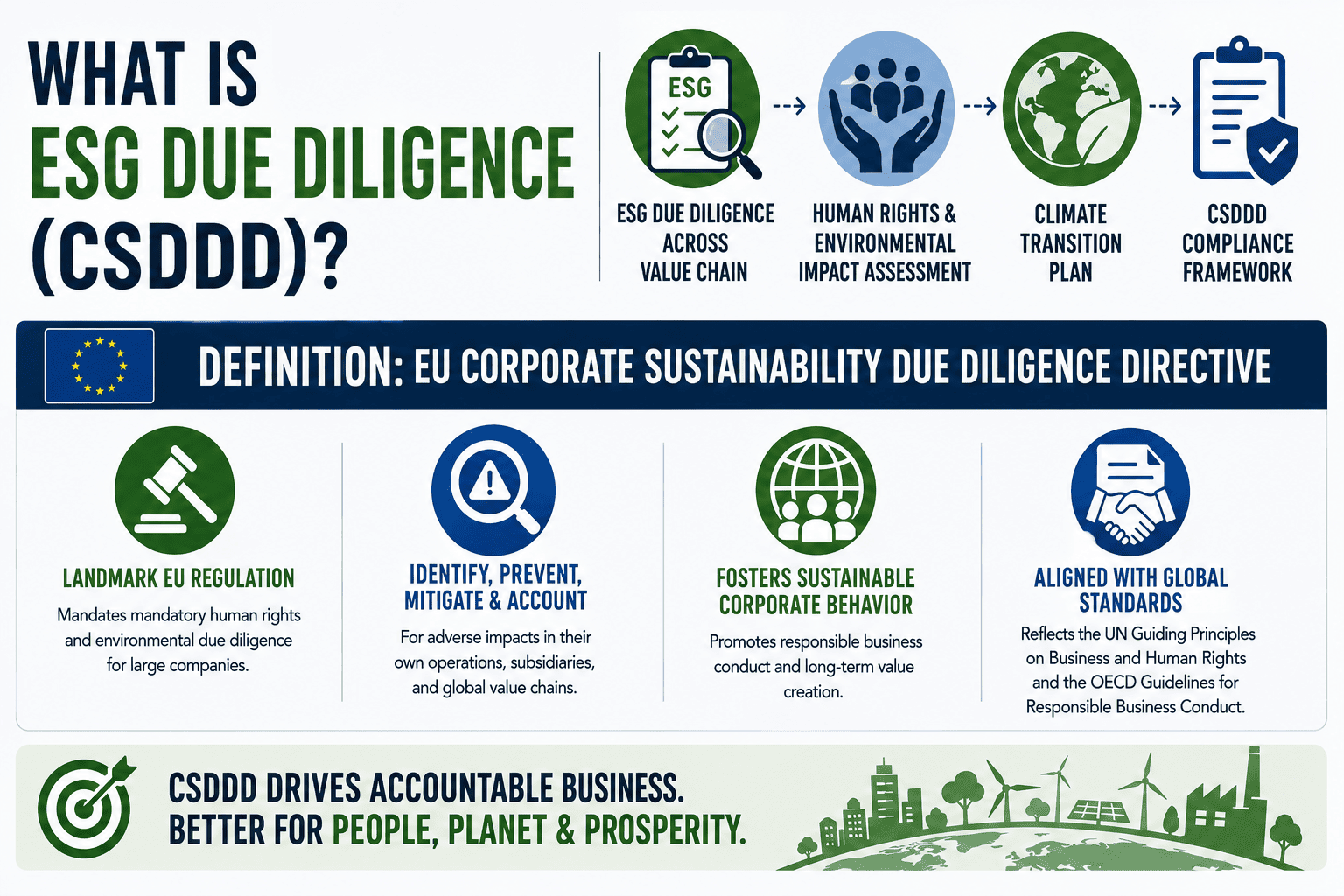
The CSDDD, which entered into force on July 25, 2024 (subsequently amended by Omnibus I and II), establishes a harmonized EU framework for corporate accountability. It is a crucial aspect of the EU’s commitment to sustainable development and the “just transition” towards a sustainable economy. The directive requires companies to conduct thorough due diligence on human rights and environmental impacts across their entire value chain, both upstream (suppliers) and downstream (distribution, use). It signals a global shift from voluntary CSR to mandatory, legally enforceable obligations, impacting not just EU companies but also non-EU businesses with significant operations or turnover in the EU.
📊 Key Statistic
Failure to comply with CSDDD can result in fines of up to at least 5% of a company’s net worldwide turnover, exclusion from public tenders, and civil liability for damages. This makes it one of the most significant ESG regulations globally.
Companies in Scope: Who Must Comply?
The CSDDD applies to both EU and non-EU companies that meet specific size and turnover thresholds. The scope has been adjusted following the Omnibus simplification initiatives. The directive applies to companies meeting the criteria for two consecutive financial years.
| Category | Thresholds (Post-Omnibus) | Application Date |
|---|
| EU Companies (Group 1) | 5,000+ employees & €1.5 billion+ net worldwide turnover | 2028 |
| EU Companies (Group 2) | 3,000+ employees & €900 million+ net worldwide turnover | 2028 |
| EU Companies (Group 3) | 1,000+ employees & €450 million+ net worldwide turnover | 2029 |
| Non-EU Companies | Net turnover in the EU of €450 million+ (or higher tier thresholds) | Staggered as above (2028-2029) |
| Franchise/Licensing | Royalties > €22.5 million in EU & group turnover > €80 million | As per applicable group size |
Companies that are ultimate parent companies of a group meeting these thresholds are also in scope. The directive also covers companies that have entered into franchising or licensing agreements in the EU meeting certain royalty and turnover criteria.
Core Due Diligence Obligations
The CSDDD establishes a comprehensive due diligence procedure that companies must integrate into their policies and risk management systems. Meaningful stakeholder engagement is required throughout this process.
1
Integrate due diligence into policies
Embed due diligence into all corporate policies and establish a risk management system to oversee the process.
2
Identify and assess adverse impacts
Identify actual and potential adverse human rights and environmental impacts across the value chain, prioritizing based on severity and likelihood.
3
Prevent or mitigate potential impacts
Take appropriate measures to prevent or mitigate potential impacts, such as developing action plans, obtaining contractual assurances, and making necessary investments.
4
Bring actual impacts to an end
Take action to bring actual adverse impacts to an end and minimize their extent, providing remediation where necessary.
5
Provide remediation
Contribute to remediation for actual adverse impacts, based on shared responsibility and proportionate to the company’s involvement.
6
Stakeholder engagement
Carry out meaningful engagement with stakeholders, including employees, affected communities, and their representatives, throughout the due diligence process.
7
Notification and complaints mechanism
Establish and maintain a notification mechanism and a complaints procedure for stakeholders to raise concerns.
8
Monitor effectiveness
Monitor the effectiveness of the due diligence policy and measures, with periodic assessments (frequency changed to every 5 years under Omnibus).
9
Publicly communicate
Publicly communicate on due diligence efforts and findings, often linked to reporting under the Corporate Sustainability Reporting Directive (CSRD).
Climate Transition Plan & Environmental Scope
Under the original directive, companies were required to adopt and implement a climate transition plan. Following Omnibus I, the obligation to “put it into effect” has been removed, but the obligation to adopt a transition plan remains. The plan must aim to ensure the company’s business model and strategy align with the transition to a sustainable economy and the goal of limiting global warming to 1.5°C in line with the Paris Agreement.
🌿 Environmental Impacts in Scope
The CSDDD covers a specific set of environmental topics, including: biodiversity loss, degradation of natural heritage sites and wetlands, pollution of seas/oceans, harmful soil alteration, water/air pollution, excessive water use, land degradation, and deforestation. Companies must also address the management of environmentally harmful substances like mercury and prohibited chemicals.
Enforcement, Penalties, and Civil Liability
The CSDDD is enforced through administrative supervision and civil liability. Member States designate supervisory authorities to monitor compliance, conduct investigations, and impose sanctions.
| Enforcement Mechanism | Details |
|---|
| Administrative Supervision | National supervisory authorities oversee compliance, can require information, conduct on-site inspections, and issue compliance orders. |
| Fines | Minimum cap of at least 5% of a company’s net worldwide turnover (under original directive; penalty amounts under review post-Omnibus). Fines are determined by Member States, with guidance from the Commission. |
| Exclusion from Public Tenders | Non-compliant companies may be excluded from public contracts and concessions. |
| Civil Liability | Companies can be held liable for damages caused by intentional or negligent failure to comply with due diligence obligations. EU-wide civil liability requirements have been removed post-Omnibus, leaving it to Member States’ discretion. |
| Complaints Mechanism | Affected parties (including, subject to national rules, NGOs and trade unions) can submit complaints to supervisory authorities. |
Practical Preparation
Preparing for CSDDD Compliance: A 7-Step Roadmap
Despite ongoing legislative developments (Omnibus), leading companies are moving forward with due diligence practices aligned with the UNGPs and OECD Guidelines. Early preparation is key to turning compliance into a competitive advantage.
1
Determine Compliance Strategy
Decide whether CSDDD compliance will be treated as a compliance-driven activity or integrated into a larger organizational transformation to support broader business and sustainability objectives.
2
Establish Governance and Stakeholders
Set up a governance structure and identify key stakeholders (legal, sustainability, procurement, HR) responsible for ensuring CSDDD compliance and taking ownership of required activities.
3
Perform a Gap Assessment
Conduct a gap assessment of current due diligence processes against the UNGPs, OECD Guidelines, and the current agreed text of the CSDDD to identify areas for improvement.
4
Conduct Value Chain Risk Assessment
Map your value chain and conduct a human rights and environmental risk assessment to identify and prioritize key risks based on severity and likelihood. This is a fundamental step.
5
Develop Prevention and Mitigation Measures
Based on the risk assessment, develop and implement a prevention action plan, obtain contractual assurances from business partners, and provide targeted support to SMEs in your value chain.
6
Establish Data and Reporting Systems
Ensure appropriate data management and transparency systems are in place to enable due diligence activities and required reporting, often leveraging data from other regulations like the CSRD.
7
Develop a Climate Transition Plan
If not already started, develop a climate transition plan in line with the Paris Agreement, including intermediate targets and alignment with achieving climate neutrality by 2050.
Beyond Compliance: Strategic Opportunities
Complying with the CSDDD presents several opportunities beyond avoiding penalties. Proactive compliance can position companies as leaders in sustainability and ethical business practices.
| Opportunity | Business Benefit |
|---|
| Enhanced Reputation & Trust | Build trust with customers, investors, and employees, attracting socially and environmentally conscious stakeholders. |
| Improved Risk Management | Identify and mitigate legal, reputational, and supply chain risks before they materialize. |
| Operational Efficiency | Streamline supply chains, increase transparency, and foster a culture of continuous improvement with suppliers. |
| Access to Finance | Meet the ESG criteria increasingly required by financial institutions and investors for favorable financing terms. |
| Competitive Advantage | Gain an edge in tenders and B2B relationships where customers already demand evidence of due diligence. |
| Innovation & Efficiency | Identify opportunities for innovation and efficiency through collaboration with suppliers on sustainability. |
Global Impact & Synergies
CSDDD in the Global Context and Synergies with Other Regulations
The CSDDD is part of a growing global movement towards mandatory human rights and environmental due diligence. It has strong synergies with and is closely linked to several other EU laws and international frameworks.
- UN Guiding Principles on Business and Human Rights (UNGPs) and OECD Guidelines for Responsible Business Conduct: The CSDDD operationalizes these soft-law frameworks into binding obligations.
- Corporate Sustainability Reporting Directive (CSRD): Complements CSDDD by focusing on reporting and disclosure of sustainability information. While CSRD has a broader scope, CSDDD imposes action-oriented obligations.
- EU Deforestation Regulation (EUDR), EU Conflict Minerals Regulation (EUCMR), EU Batteries Regulation, and proposed legislation banning forced labour: CSDDD sets a uniform standard for due diligence, but sector-specific regulations may require additional, more detailed compliance data.
- Implications for India and other non-EU countries: As Indian businesses are deeply integrated into European supply chains, alignment with CSDDD standards becomes an economic necessity. This may necessitate strengthening India’s voluntary ESG ecosystem, potentially paving the way for a mandatory human rights due diligence framework in India.
🤝 Impact on Financial Services Institutions (FSIs)
While corporates are mandated to implement due diligence across their value chain, FSIs primarily focus on upstream activities and integrating clients’ sustainability strategies for improved risk assessment. Aligning with client compliance efforts (CSRD, CSDDD) enhances transparency and risk management in lending and investment activities.
FAQ
Frequently Asked Questions, ESG Due Diligence (CSDDD/CS3D)
QWhat is the difference between CSDDD and CSRD?
The Corporate Sustainability Reporting Directive (CSRD) focuses on expanding and standardizing sustainability reporting requirements, ensuring companies provide detailed information on their environmental and social impacts. The Corporate Sustainability Due Diligence Directive (CSDDD) establishes rules for companies to identify, prevent, mitigate, and account for adverse impacts in their operations and value chains. Companies may be subject to both. The CSDDD does not impose new reporting requirements on companies already subject to CSRD, but they must describe how they carry out due diligence as provided for by the CSDDD.
QWhat does “value chain” mean under the CSDDD?
“Value chain” includes activities related to the production of goods or services by the company, including upstream (suppliers, design, raw materials) and downstream (distribution, transport, use, disposal) activities. It covers both direct (contracted) and indirect business partners. Following Omnibus, due diligence is limited to direct business partners, except when there is plausible information suggesting adverse impacts at the level of an indirect business partner, in which case an in-depth assessment is required.
QWhat is the timeline for CSDDD compliance?
The Directive entered into force on July 25, 2024. Following the Omnibus I delay, application is now staggered: 2028 for the largest companies (5,000+ employees and €1.5B turnover, and those with 3,000+ employees and €900M turnover), and 2029 for companies with 1,000+ employees and €450M turnover. Member States had to transpose the directive into national law by July 2026, but application deadlines have been shifted accordingly. Guidelines are expected to be published starting in July 2026.
QCan a company be held civilly liable under the CSDDD?
Yes, the directive provides for civil liability for damages caused by a company’s intentional or negligent failure to comply with its due diligence obligations. Affected persons have the right to full compensation for damages resulting from such failure. Following Omnibus, EU-wide civil liability requirements have been removed, leaving the specifics of civil liability regimes to the discretion of individual Member States.
QHow does the CSDDD affect SMEs?
While SMEs are not directly in scope (unless they meet the turnover/employee thresholds), they are significantly impacted as business partners of in-scope companies. Larger companies are expected to provide targeted and proportionate support to SME business partners, including financial or non-financial assistance, to help them comply with the code of conduct or prevention action plan. SMEs should anticipate increased requests for sustainability information and due diligence from their larger clients and may need to start building their capacity to respond.