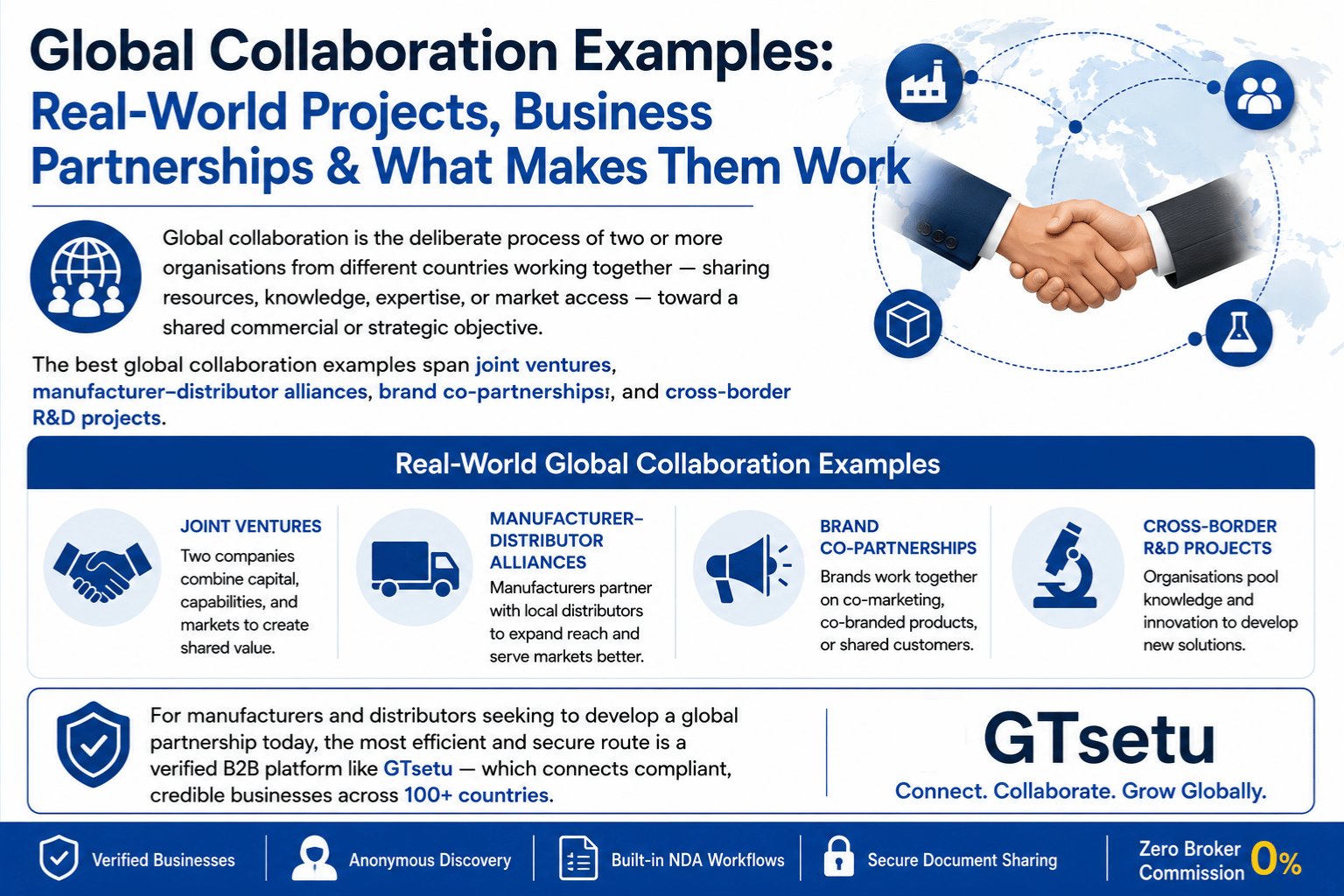
Global Collaboration Examples: Real-World Projects, Business Partnerships & What Makes Them Work
Direct Answer: Global collaboration is the deliberate process of two or more organisations from different countries working together, sharing resources, knowledge, expertise, or market access, toward a shared commercial or strategic objective. The best global collaboration examples span joint ventures, manufacturer–distributor alliances, brand co-partnerships, and cross-border R&D projects. For manufacturers and distributors seeking to develop a global partnership today, the most efficient and secure route is a verified B2B platform like GTsetu, which connects companies verified through government tie‑ups (6 key credentials: legal name, registered address, registration number, company status, company type, date of incorporation) across 100+ countries with anonymous discovery, built-in NDA workflows, and zero broker commissions.
📅 March 10, 2026⏱ 20 min read✍️ GTsetu Editorial Team🔄 Updated regularly
500+
Verified Companies
100+
Countries
6-Point
Govt Tie‑Up Verification
0%
Broker Commission
Every business that has ever entered a new market, launched a co-branded product, or built a cross-border supply chain has one thing in common: they didn’t do it alone. Global collaboration is the engine behind the world’s most consequential commercial breakthroughs, from the International Space Station to the iPhone’s global supply chain to thousands of manufacturer–distributor partnerships quietly opening new revenue streams every year.
This guide covers every dimension of the topic: what global collaboration means, how to define it with precision, the most instructive real-world business collaboration examples across categories, why global collaboration matters strategically, and how manufacturers and distributors can build verified cross-border business partnerships that generate durable revenue, using GTsetu‘s verified B2B platform across 100+ countries.
💡 Who Is This Guide For?
This guide is written for manufacturers seeking international distribution partners, distributors looking for manufacturer principals, business development leaders responsible for company global expansion, procurement teams building international supplier networks, and anyone studying global partnerships, global collaboration projects, or industrial business collaboration for commercial or academic purposes.
SECTION 1
1 What Is Global Collaboration?
🎯 Definition
Global collaboration is the deliberate process of two or more organisations, teams, or institutions located in different countries working together, sharing resources, knowledge, capabilities, or market access, toward a shared commercial, scientific, or social objective. It encompasses global partnerships, joint ventures, co-development partnerships, cross-border supply chain alliances, and international distribution agreements. What distinguishes it from domestic collaboration is the added complexity of operating across different legal systems, regulatory environments, time zones, languages, and cultural business norms.
The term “global collaboration” is used across very different contexts, from a pharmaceutical company co-developing a vaccine with a partner in another continent, to a small business collaborating with an overseas artisan supplier, to a manufacturer forming its first distribution partnership in Southeast Asia. What all of these share is the core structure: two parties from different countries contributing complementary value toward a goal neither could achieve as efficiently alone.
🏭
Manufacturer–Distributor Alliances
A manufacturer in Germany partners with a verified distributor in India to access the subcontinent’s retail and wholesale network, without establishing a local subsidiary.
🔬
Cross-Border R&D Projects
Pharmaceutical companies, tech firms, and academic institutions in different countries pool research assets to accelerate discovery timelines that no single organisation could fund alone.
🤝
Joint Ventures
Two companies form a legally distinct entity together, combining capital, market access, and operational expertise for a specific market entry or product category. See our guide on joint ventures vs. strategic alliances.
📦
Global Supply Chain Networks
Companies source raw materials, components, and contract manufacturing from a coordinated network of suppliers across multiple continents, as exemplified by the global electronics and automotive industries.
🏷️
Brand & Co-Development Collaborations
Companies co-develop products, co-brand limited editions, or license IP across borders, creating audience crossover and market buzz that neither brand could generate independently.
🌍
Multilateral Institutional Projects
Governments, universities, and NGOs in dozens of countries coordinate resources on challenges that transcend national borders, climate, health, infrastructure, and education.
SECTION 2
2 Global Collaboration Definition & Meaning
🎯 Global Collaboration Meaning
The global collaboration definition in a business context: a structured arrangement between two or more organisations in different countries, in which each party contributes resources, capabilities, or market access, and each receives value they could not generate as efficiently operating independently. Global collaboration meaning therefore encompasses both the process (working across borders) and the outcome (mutual value creation that exceeds what either party could achieve alone).
Global Collaboration vs. Similar Concepts
Concept
Key Distinction
Typical Structure
Examples
Global Collaboration
Working together across borders toward shared goals, both parties contribute and both benefit
Partnership, JV, alliance, co-development, distribution
One party pays another to execute a specific function, transactional, not relational
Service contract, staff augmentation
Offshore IT services, BPO
Global Partnership
A formalised version of global collaboration, typically governed by a legal agreement with defined contributions and returns
Distribution agreement, JV deed, licensing contract
Renault–Nissan Alliance, Nike–Apple
International Expansion
A company entering a new market, may or may not involve collaboration (can be done independently)
Subsidiary, branch office, acquisition
Starbucks entering China, IKEA entering India
Global Sourcing
Procuring materials or goods from international suppliers, buyer–seller transaction rather than strategic partnership
Purchase orders, supplier agreements
Retail brands sourcing from Asian manufacturers
The most commercially significant distinction for manufacturers and distributors: global collaboration is mutual and strategic, not transactional. A one-time purchase order is not global collaboration. A multi-year distribution agreement with shared territory planning, co-investment in market development, and joint performance tracking is. That structural difference is what separates partnerships that endure from those that dissolve after the first shipment.
SECTION 3
3 Types of Global Collaboration
Global collaboration takes many structural forms, each with different risk profiles, legal requirements, and strategic uses. Understanding which type fits your situation is the first decision in building a successful international partnership.
Collaboration Type
Structure
Best For
Key Legal Instrument
Learn More
Distribution Partnership
Manufacturer grants territory rights to a distributor in another country
4 10 Business Collaboration Examples That Changed Industries
The most instructive global collaboration examples are not the ones that simply “worked”, they are the ones where the collaboration produced something that neither party could have built alone, and where the structural principles behind their success can be applied to your own partnership strategy. Here are ten of the most significant.
🚗Automotive R&D
BMW & Toyota, Hydrogen & Sports Car Technology
Two of the world’s most competitive automotive brands formed a cross-border R&D alliance to develop hydrogen fuel cell technology and share sports car platforms. BMW brought hydrogen expertise; Toyota brought fuel cell manufacturing depth. Neither could justify the capital investment alone. The result was accelerated technology timelines and shared IP that strengthened both companies’ positions in zero-emission vehicles.
🏆 Outcome: Shared hydrogen platforms deployed in production vehicles; mutual R&D cost savings estimated in the billions.
🏎️Strategic Alliance
Renault–Nissan–Mitsubishi Alliance
One of the most studied strategic alliance examples in global business. Renault (France), Nissan (Japan), and Mitsubishi (Japan) formed a cross-shareholding alliance that enables shared platforms, joint purchasing power, common EV architecture, and coordinated global market coverage, while each brand maintains its own identity and commercial independence. The Alliance regularly ranks among the world’s largest automotive groups by volume.
🏆 Outcome: Combined annual volume exceeding 8 million vehicles; shared EV platform reduces development cost per vehicle by over 30%.
👟Brand Collaboration
Nike & Apple, Nike+
Nike brought athletic brand authority and consumer sports insight; Apple brought sensor technology and the iPod ecosystem. Their collaboration produced Nike+, one of the earliest successful connected fitness platforms, embedding Apple sensors into Nike footwear to track runs, syncing data to iPods and later iPhones. The collaboration created a new product category and deepened loyalty in both brands’ core demographics simultaneously.
🏆 Outcome: Tens of millions of devices sold; Nike+ became the foundation of Nike’s digital fitness ecosystem, including the Nike Run Club app.
🛸Automotive Design
Fiat & Chrysler Merger-Alliance
Fiat’s acquisition of a bankrupt Chrysler in 2009 created one of the most dramatic global collaboration examples in corporate history, turning a near-collapse into the Stellantis group. Fiat brought European platform efficiency and fuel economy expertise; Chrysler brought North American distribution, truck and Jeep brand strength. The combination produced synergies in purchasing, platform sharing, and manufacturing that neither could access independently.
🏆 Outcome: Stellantis became one of the world’s top 4 automakers; Jeep expanded into China and India using Fiat’s partner network.
☕Market Entry
Starbucks & Tata Global Beverages (India)
Starbucks entered India, a market where coffee culture was nascent and regulatory complexity was high, through a 50:50 joint venture with Tata Global Beverages. Starbucks brought its brand, store format, and coffee sourcing expertise; Tata brought local regulatory knowledge, supply chain infrastructure, and deep Indian consumer insight. The market entry partnership enabled a speed of scaling that solo entry would not have permitted.
🏆 Outcome: Over 400 stores across India within a decade; Tata partnership remains one of Starbucks’ most cited market entry templates.
💊Pharma R&D
BioNTech & Pfizer, COVID-19 Vaccine
BioNTech (Germany) had pioneered mRNA vaccine technology but lacked the global manufacturing, regulatory, and distribution infrastructure to bring a vaccine to scale. Pfizer (USA) had the infrastructure but not the mRNA IP. Their collaboration produced the world’s first authorised mRNA vaccine in under 12 months, a timeline that would have been decades otherwise. This is one of the most consequential successful business collaborations in recorded history.
🏆 Outcome: Over 3 billion doses delivered globally; mRNA technology unlocked for multiple future therapeutic applications.
🛋️Supply Chain
IKEA’s Global Supplier Network
IKEA’s entire business model depends on a global supplier collaboration platform connecting over 1,000 direct suppliers across 50+ countries. Each supplier is deeply integrated into IKEA’s design, quality, and sustainability standards, this is not transactional sourcing, it is structured global collaboration. IKEA co-invests in supplier capacity, shares production planning data, and co-develops materials with key partners, creating mutual dependency that has lasted decades.
🏆 Outcome: Supply chain enables prices 30–50% below competitors on comparable quality; top suppliers have multi-decade relationships with IKEA.
📱Technology Licensing
Qualcomm’s Global Licensing Network
Qualcomm’s business model is one of the most powerful examples of global collaboration through technology transfer agreements. Qualcomm develops foundational wireless technology IP and licenses it to device manufacturers worldwide, from Apple and Samsung to hundreds of mid-tier OEMs in Asia. Every smartphone that uses 3G, 4G, or 5G technology almost certainly runs on Qualcomm-licensed standards. The licensing network generates billions annually with relatively low capital requirements.
🏆 Outcome: Licensing revenues exceed $6 billion annually; Qualcomm’s technology underpins over 99% of 5G-capable devices worldwide.
✈️Airline Alliance
Star Alliance, 26-Nation Aviation Network
Star Alliance connects 26 member airlines across every continent, enabling shared routes, coordinated schedules, mutual frequent flyer recognition, and shared lounge infrastructure. No single airline could serve the full global network profitably. The alliance model, a form of structured global collaboration without equity merger, allows each carrier to maintain independence while accessing a combined network of over 1,300 destinations. It is one of the purest global partnership examples in service industries.
🏆 Outcome: Collectively the world’s largest airline alliance; member carriers collectively carry over 700 million passengers per year.
🍕Franchise Expansion
Domino’s Global Franchise Network
Domino’s global growth is one of the most instructive franchise model examples, entering 90+ countries through local master franchise partners who bring territory knowledge, capital, and regulatory navigation. Domino’s provides the brand, technology, supply chain systems, and training. Local partners provide market execution. The result is a brand with over 19,000 locations globally, scaled to a depth that would be impossible through wholly-owned expansion.
🏆 Outcome: 19,500+ stores across 90+ countries; international franchise royalties generate consistent high-margin revenue with minimal capex.
💡 The Common Thread
Every one of these successful business collaborations shares the same structural principle: each party brought something the other lacked, and each received something they could not generate alone. The BioNTech–Pfizer collaboration is the same principle as a manufacturer–distributor partnership, just at a different scale. The lesson for any company developing a global partnership: specificity of contribution and clarity of mutual return are the foundation, not optional additions.
SECTION 5
5 Small Business Collaboration Examples
Global collaboration is not reserved for multinationals. Some of the most effective small business collaboration examples involve companies with under 50 employees accessing markets, distribution channels, or capabilities that would be entirely out of reach operating independently. Here is how smaller businesses do it.
🌿
Artisan Producer + International Distributor
A small-batch olive oil producer in Greece partners with a specialty food distributor in Japan. The producer brings a certified PDO product; the distributor brings the importer relationships, customs clearance expertise, and shelf placement in premium Japanese retailers. Neither could execute the other’s role, the collaboration creates a revenue stream that transforms both businesses.
A small UK beauty brand sources private label manufacturing from a specialist Korean cosmetics manufacturer, gaining access to cutting-edge formulations and production quality that would cost 10× more to develop domestically. The manufacturer gains a stable export revenue stream and brand association with the European market.
Manufacturing
🛒
Two Non-Competing SMEs Co-Exhibiting at Trade Shows
Two small manufacturers in complementary categories, say, a sauce brand and a cookware brand, share trade show booth space and marketing costs internationally. Each company gains access to a new audience (the other’s buyer base) and halves the cost of international market testing. This is one of the most practical small business collaboration examples for companies with limited international marketing budgets.
Marketing
📦
Cross-Border Co-Shipment for MOQ
Two small importers in different product categories consolidate shipments to reach minimum order quantities and share freight costs. What would be uneconomic for each individually becomes viable through collaboration. This is a common logistics co-operation model among SMEs sourcing from Asia.
Logistics
💻
Tech Startup + International Reseller Network
A SaaS company in India builds a global reseller programme, onboarding verified distribution partners in 15 countries who sell localised versions of the product. The startup provides the software, training, and support infrastructure; resellers provide last-mile customer acquisition and local language support. This is the digital equivalent of a manufacturer–distributor alliance, and a classic example of global partner service models.
Technology
🍫
Complementary Brand Co-Packaging
A small chocolate brand and a specialty tea company, one from Belgium, one from Sri Lanka, collaborate on a co-branded gift box for the premium retail channel. Each brand’s packaging drives sales of the other in markets where they had no prior presence. The collaboration costs minimal additional marketing spend and generates a combined premium positioning neither could achieve alone.
Brand
⚡ The SME Collaboration Principle
For small businesses, the most accessible and highest-ROI global collaborations are those that solve a specific constraint, production capacity, market access, distribution reach, or working capital, by partnering with a company that has a surplus of exactly what you lack. The key is finding that company through a verified channel, not cold outreach to unscreened directories. Platforms like GTsetu make this accessible to SMEs with the same security infrastructure used by large enterprises. You can also explore alternatives to Alibaba and alternatives to IndiaMart for more verified discovery options.
SECTION 6
6 Global Collaboration Projects: Science, Education & Society
Beyond commercial business partnerships, some of the most structurally instructive global collaboration examples come from science, education, and civil society, where the stakes are highest and the coordination challenges are most visible.
Permanent human presence in low-Earth orbit since 2000; 250+ experiments annually
Even strategic rivals can sustain functional collaboration when the framework is clear, contributions are defined, and mutual dependency is acknowledged
Human Genome Project
20 countries, 20 institutions
Distributed sequencing, shared data protocols, open-access publication
Complete mapping of the human genome; unlocked modern genomics, drug discovery, and personalised medicine
Distributing work by comparative advantage (each institution sequenced what it was best positioned to sequence) multiplied collective output
CERN Large Hadron Collider
23 member states; 100+ collaborating nations
Capital co-investment, research data sharing, multinational scientific teams
Discovery of the Higgs boson; foundational particle physics advances
Projects too large for any single entity can be funded and operated through structured equity-like contribution frameworks
ePals Global Learning Network
200+ countries and territories
Educational collaboration platform connecting students and teachers across borders
Millions of classroom partnerships formed; cross-cultural learning at scale
Digital platforms can enable global virtual collaboration at negligible marginal cost once the infrastructure is established
Paris Agreement (COP21)
196 parties (countries)
Legally binding commitments, shared reporting frameworks, technology transfer provisions
First universal legally binding global climate framework
Without enforceable frameworks and clear contribution obligations, multi-party global collaborations drift toward inaction, structure precedes alignment
COVAX Vaccine Initiative
190+ countries, WHO, Gavi, CEPI
Pooled procurement, advance purchase commitments, manufacturer partnerships, distribution logistics
Delivered over 2 billion vaccine doses to lower-income countries
Global virtual collaboration projects that combine procurement leverage, logistics expertise, and manufacturing partnerships can deliver outcomes no single organisation could achieve
💡 What Business Partnerships Can Learn from Global Projects
Every large-scale global collaboration project listed above succeeded because it resolved three structural problems that also face commercial partnerships: (1) how contributions are allocated between parties, (2) how shared data and output are protected, and (3) how disputes are escalated and resolved. In commercial terms, these translate directly to risk allocation in cross-border deals, NDA structures, and dispute resolution in international contracts. The same principles at any scale.
SECTION 7
7 Why Is Global Collaboration Important?
The question “why is global collaboration important” can be answered at multiple levels, geopolitical, economic, environmental, and commercially. For manufacturers and distributors, the commercial answer is the most actionable: global collaboration is the primary mechanism by which companies access markets, capabilities, and resources that would otherwise require years of independent investment to build. The strategic answer is that in an interconnected economy, companies that collaborate globally consistently outgrow those that operate domestically. The risk answer is that diversification across geographies is the most effective hedge against single-market disruption.
3–5×
faster time-to-market for manufacturers entering via verified distribution partners vs. building local infrastructure independently
60%
of manufacturers cite difficulty finding qualified international distribution partners as their top market entry challenge
73%
of SMEs that formed at least one verified international partnership reported revenue growth above their sector benchmark within 3 years
The Strategic Case for Global Collaboration
🗺️
Market Access Without Local Infrastructure
An established distribution partner in a new market provides instant access to retailer, wholesaler, and consumer networks that would take 5–10 years to build independently, and at a fraction of the capital cost. See advantages and disadvantages of global expansion.
🧠
Local Knowledge as a Competitive Advantage
A local distribution partner carries regulatory knowledge, consumer insight, and buyer relationship capital that no amount of desktop research can replicate. That knowledge becomes your competitive advantage in the new market.
🔬
Innovation Through Cross-Border Collaboration
Cross-border co-development partnerships expose companies to different design traditions, technical approaches, and consumer preferences, producing innovations neither party would have reached independently.
🛡️
Revenue Diversification and Resilience
Manufacturers and distributors with partners across multiple regions are significantly less vulnerable to single-market disruptions, economic downturns, regulatory changes, or geopolitical events that concentrate risk in one geography.
⚡
Capital Efficiency
Global collaboration through partnership is fundamentally more capital-efficient than building wholly-owned operations in every target market. The partner absorbs local investment; the manufacturer provides product and brand. Both gain without duplicating infrastructure.
🌱
Long-Term Sustainable Growth
Companies that build verified, trust-based international partner networks consistently outperform transactional competitors over 5–10 year horizons. Partnerships compound, each successful collaboration increases your credibility and attractiveness as a partner for the next.
SECTION 8
8 How to Develop a Global Partnership: Step-by-Step
Developing a global partnership is not a single event, it is a structured process that, when executed correctly, moves from initial scoping through to a legally formalised relationship with clear commercial terms, mutual obligations, and a shared performance framework. Here is the complete process.
01
Define Your Ideal Partner Profile Before You Search
The most common mistake in global partnership development is searching broadly and hoping for relevance. Before engaging any channel, define precisely what you need: target geography, industry vertical, company size range, existing market coverage, financial standing requirements, and required regulatory certifications. A specific ideal partner profile turns every discovery interaction into a qualification filter, not a social exchange. For manufacturers, this means specifying the distribution tier (importer, national distributor, regional distributor), sector focus, and minimum order handling capacity before browsing any platform or attending any trade event.
02
Choose the Right Channel for Discovery
Different channels are optimised for different partnership types. For verified international partner discovery, purpose-built platforms like GTsetu are structurally superior to directories, marketplaces, or social networks, every company you encounter has been verified for six core credentials (legal name, registered address, registration number, company status, company type, date of incorporation) via government tie‑ups before you see them. For community relationship-building within your sector, industry associations and bilateral chambers of commerce are the strongest channels. For digital warm-up and brand visibility, LinkedIn. For face-to-face market intelligence and relationship deepening, trade shows. The most effective global partnership development programmes combine all three, with a verified platform as the primary discovery engine and the others as supplementary relationship channels.
03
Verify Before Engaging, Non-Negotiable
Global partnership development fails most catastrophically at the verification stage, either because it is skipped entirely (costly), or because it is done too late (after sensitive information has been shared). Best practice: any company you consider for a global partnership should have their business registration, tax ID, import/export licences, and industry certifications independently checked before you advance the conversation. GTsetu verifies six core company credentials via government tie‑ups (legal name, address, registration number, status, type, incorporation date). Import licences and industry certifications are not verified by GTsetu and must be exchanged and validated directly between partners. If you are using other channels, build a structured business verification process into your standard onboarding workflow before engaging commercially.
04
Execute an NDA Before Sharing Commercial Information
Never share pricing, product specifications, market entry strategy, or client information with a prospective partner who has not signed a legally binding NDA. This applies regardless of how credible the introduction or how urgently they request information. In cross-border partnerships, NDAs should specify governing law, jurisdiction, confidentiality scope, duration, and what constitutes permitted disclosure. Understanding the difference between a mutual vs. one-way NDA is essential, for most partnership discovery contexts, a mutual NDA is the appropriate instrument, since both parties are sharing sensitive information simultaneously.
05
Exchange Commercial Information Through Secure Channels
Once the NDA is in place, all commercial data exchange, product specifications, pricing structures, territory proposals, capacity data, should occur through encrypted, access-controlled channels. Email attachments are the highest-risk channel for commercial data leakage in B2B partnerships: they are freely forwarded, unaudited, and leave no access log. GTsetu’s encrypted document workspace provides a secure alternative with role-based access controls, full audit trail, and version management, all required for professional B2B secure collaboration.
Execute the business partnership contract with full legal review in the relevant jurisdiction. For distribution agreements, the contract should cover: territory definition, exclusivity parameters, minimum purchase commitments, performance benchmarks, marketing obligations, quality standards, IP usage rights, dispute resolution mechanisms, and termination conditions with notice periods. A well-drafted agreement is not just legal protection, it is the shared operating manual for the collaboration.
SECTION 9
9 Challenges in Global Team Collaboration & How to Overcome Them
Building a successful global team collaborative environment is consistently harder than building a domestic one. The challenges are structural, cultural, legal, and operational, and each one requires a deliberate solution rather than the assumption that good intentions will bridge gaps. Here is how the most common challenges manifest and how to overcome them.
Challenge
How It Manifests
How to Overcome It
Identity and Verification Risk
Counterparties misrepresent themselves, inflating credentials, fabricating licences, or impersonating established companies. Particularly common in unverified directories and open marketplaces.
Use only platforms that provide government tie‑up verification of six core credentials (legal name, address, registration number, status, type, incorporation date). For import licences and industry certifications, exchange and validate directly with the partner. GTsetu verifies the six core credentials via government tie‑ups.
Cultural Communication Gaps
What reads as direct and professional in one culture reads as aggressive or disrespectful in another. Silence means different things across cultures, confusion, disagreement, or thoughtful consideration.
Invest in cultural briefings before entering new markets; default to over-communication in writing; use platform-based structured profiles that reduce reliance on cultural interpretation for key commercial data.
Time Zone Friction
Real-time collaboration across 8–12 hour time differences creates decision latency, slowing negotiations and onboarding processes that require rapid sequential inputs.
Build asynchronous communication discipline; use secure document workspaces that enable collaboration without requiring simultaneous availability; set response SLAs in partnership agreements.
Legal Framework Differences
Contract enforceability, IP protection, and dispute resolution vary dramatically across jurisdictions, what is standard in your market may be unenforceable in your partner’s.
Commercially sensitive data, product specs, pricing, market strategy, shared via unprotected email or informal channels leaks to competitors or bad actors. In global partnerships, this risk is amplified by the number of parties and jurisdictions involved.
Enforce NDA-before-data discipline; use encrypted document exchange platforms; implement role-based access controls limiting who on each team can access sensitive materials. Understand IP ownership in contract manufacturing and who owns tooling and moulds before sharing designs.
Non-Performance and Exit Risk
A partner fails to meet volume commitments, territory obligations, or quality standards, but the agreement lacks enforceable remedies or reasonable termination pathways.
Exchange rate volatility, payment delays, and international wire fraud create financial risk in cross-border commercial relationships, particularly in emerging markets.
Choose appropriate payment instruments (LC for high-value or first transactions); establish clear payment terms in the contract; use hedging instruments for major currency exposures.
SECTION 10
10 Global Virtual Collaboration: Tools, Structures & Best Practices
Global virtual collaboration projects, partnerships conducted entirely or primarily through digital channels, without regular in-person meetings, are increasingly the norm rather than the exception. The COVID-19 period proved that commercial partnerships can be formed, negotiated, and sustained without face-to-face contact. But virtual collaboration introduces specific structural requirements that in-person collaboration can paper over with relationship rapport.
What Global Virtual Collaboration Projects Require to Succeed
✅
Pre-Verified Digital Identity
In virtual collaboration, you cannot verify a partner by visiting their facility or meeting their team in person. This makes third-party verification of six core credentials (legal name, address, registration number, status, type, incorporation date) non-negotiable, not optional. Before any substantive engagement, every company involved should have these credentials verified, ideally through a platform with government tie‑ups.
Foundation
📋
Structured Digital Documentation
In-person relationships can operate on verbal agreement and trust built through shared experience. Virtual relationships cannot. Every commitment, product specification, pricing term, and delivery obligation must be documented in writing, in accessible, version-controlled digital formats that both parties can reference unambiguously.
Process
🔐
Encrypted Secure Data Exchange
Virtual global collaboration involves exchanging commercially sensitive data digitally, making encryption, access controls, and audit trails essential infrastructure rather than nice-to-haves. Unencrypted email-based document exchange is the highest-risk channel for commercial IP leakage in virtual partnership environments.
Security
📅
Asynchronous-First Communication Norms
Effective global virtual collaboration teams default to asynchronous communication, detailed written updates, shared project tracking, and recorded video briefings, rather than relying on synchronous calls that require simultaneous availability across time zones. Real-time calls are reserved for decisions requiring immediate input, not routine updates.
Operations
📊
Shared Performance Dashboards
Virtual global partnerships benefit enormously from shared, real-time performance visibility, both parties seeing the same order status, sell-through data, and KPI tracking simultaneously. This reduces the information asymmetry that breeds distrust in purely email-based relationships and enables rapid joint problem-solving.
Visibility
🗓️
Periodic In-Person Investment
Even the most effective virtual collaborations benefit from occasional face-to-face investment, typically at partnership formation and at annual reviews. The relationship capital built in one in-person meeting compounds across months of subsequent virtual interaction. Budget for at least one physical visit in the first year of every major international partnership.
Relationship
SECTION 11
11 How GTsetu Powers Global Partnerships for Manufacturers & Distributors
🌐 Platform Spotlight, GTsetu
Government‑Tied Verification for Global Partnership Discovery
GTsetu was built specifically to solve the hardest problem in global collaboration for manufacturers and distributors: finding the right partner in the right market, with verified credentials, without leaking your commercial strategy in the process, and without paying broker commissions on every deal you form. GTsetu verifies every company on its platform using direct government tie‑ups across six essential credentials: legal name, registered address, registration number, company status, company type, and date of certificate of incorporation. This verification is mandatory before any company can appear in the network. Import licences, industry certifications, and financial standing are not verified by GTsetu; those must be exchanged and validated directly between partners.
🏛️
Government Tie‑Up Verification
6‑point verification: legal name, registered address, registration number, company status, company type, date of certificate of incorporation. Verified via direct government sources, not self‑declared.
📜
Licences & Certifications
GTsetu does not verify import licences, industry certifications, or financial standing. These must be exchanged and validated directly between partners during due diligence.
🕵️
Anonymous Discovery
Browse verified company profiles across 100+ countries without revealing your own identity, protecting your market expansion strategy during the discovery phase.
📄
Built-In NDA Workflow
Digital NDA execution with timestamped signatures and permanent audit trail, activated before sensitive information can move between parties.
🔐
Encrypted Document Workspace
All files encrypted in transit (TLS) and at rest (AES-256). Role-based access controls. No unprotected email attachments.
📋
Full Audit Trail
Every access event, document view, NDA signature, and communication is logged with timestamp, downloadable for compliance and legal reference.
🚫
Zero Commission
GTsetu never takes a success fee or broker commission. Every dollar of value in your global collaboration stays between you and your partner.
🌍
100+ Countries
Active verified network spanning Asia, Middle East, Europe, Africa, Australia, and the Americas, all accessible from a single platform.
⟡ Not verified; exchanged directly between parties
✗ Not collected or verified
Anonymous partner discovery
✓ Default, built-in
✗ Identity exposed from first contact
NDA before data exchange
✓ Structural requirement
✗ Informal or absent
Encrypted document sharing
✓ AES-256 + TLS standard
✗ Email attachments, open links
Full audit trail
✓ Automated, downloadable
✗ Email thread only
100+ country coverage
✓ Active verified members
~ Varies
Broker / success fee
✓ Zero, always
~ Often 5–15% of deal value
Time to find qualified partners
✓ Days, pre‑verified pool
✗ Weeks to months of cold screening
FAQ
? Frequently Asked Questions
Q
What is global collaboration?
Global collaboration is the deliberate process of two or more organisations from different countries working together, sharing resources, knowledge, capabilities, or market access, toward a shared commercial, scientific, or social objective. In business, it encompasses distribution partnerships, joint ventures, co-development agreements, contract manufacturing, technology licensing, and cross-border supply chain alliances. The defining characteristic is mutual contribution and mutual benefit across national borders, distinguishing it from simple cross-border transactions, where only one party benefits from the other’s action.
Q
What is global collaboration meaning in business?
In business, global collaboration meaning is the structured arrangement between companies in different countries in which each contributes something of value, manufacturing capability, distribution reach, market knowledge, technology, or capital, and each receives something they could not generate as efficiently alone. It is strategically motivated (not purely transactional), legally formalised (not just informal agreement), and commercially structured (with defined terms for contributions, returns, performance, and exit). For manufacturers and distributors, the most common form is the verified manufacturer–distributor partnership enabling market entry through an established local presence.
Q
What is a global partnership?
A global partnership is a formalised collaborative relationship between organisations in different countries, structured around a shared commercial or strategic objective. It is governed by a legal agreement that defines each party’s contributions, rights, obligations, performance expectations, and exit conditions. What distinguishes a global partnership from a domestic one is the multi-jurisdictional legal complexity, the cultural and communication dimensions that must be explicitly managed, and the higher due diligence requirements before committing, including identity verification, compliance documentation, and structured information security protocols for data exchange.
Q
What are the best global collaboration examples?
The most instructive global collaboration examples span commercial, scientific, and social domains. In business: the BioNTech–Pfizer vaccine collaboration; the BMW–Toyota R&D alliance; the Renault–Nissan–Mitsubishi Alliance; the Nike–Apple Nike+ partnership; IKEA’s global supplier network; and Starbucks–Tata’s India joint venture. In science and society: the International Space Station (15 nations), the Human Genome Project (20 countries), and CERN’s Large Hadron Collider (100+ collaborating nations). For manufacturers and distributors, the most commercially relevant examples are verified manufacturer–distributor partnerships formed through platforms like GTsetu, which replicate the structural principles of the best large-scale collaborations at any company size.
Q
Why is global collaboration important?
Global collaboration is important because it enables companies to access markets, capabilities, and resources that would take years and significant capital to build independently. For manufacturers, a verified distribution partner in a new market provides instant access to retailer and wholesaler networks that would otherwise require building a local subsidiary. For distributors, a global manufacturer principal provides a differentiated product portfolio that creates competitive moat against local distributors. For both, geographic diversification through global partnerships provides revenue resilience against single-market disruptions, economic, geopolitical, or regulatory. Companies that build verified international partner networks consistently outgrow those that operate in a single market over five-to-ten year horizons.
Q
What are small business collaboration examples in global trade?
The most effective small business collaboration examples in global trade include: (1) An artisan food producer partnering with a specialty distributor in another country who provides importer relationships and retail placement. (2) An indie beauty brand sourcing private label manufacturing from a Korean cosmetics partner, accessing formulations and quality at cost-effective scale. (3) Two non-competing SMEs co-exhibiting at international trade shows to halve marketing costs while doubling buyer reach. (4) A SaaS company building a global reseller network that handles localisation and last-mile customer acquisition in each territory. (5) Small importers consolidating shipments across complementary product categories to reach minimum order quantities cost-effectively. All of these share the core principle: each party contributes what the other lacks, and both gain something they could not achieve as efficiently alone.
Q
How do I develop a global partnership as a manufacturer or distributor?
To develop a global partnership as a manufacturer or distributor: (1) Define your ideal partner profile precisely, geography, sector, size, distribution capability, required certifications. (2) Join a verified B2B platform like GTsetu to discover potential partners with government tie‑up verified six core credentials (legal name, address, registration number, status, type, incorporation date) anonymously, without revealing your market strategy. (3) Confirm mutual interest; both parties reveal identities simultaneously. (4) Execute a digital NDA before sharing any commercial data, pricing, specifications, or market strategy. (5) Exchange product and commercial information through an encrypted workspace with role-based access controls. (6) Negotiate key terms, territory rights, exclusivity, pricing, volume commitments, lead times, payment terms, and termination conditions, with specificity. (7) Execute a legally reviewed distribution or partnership agreement with full audit trail. Zero broker commissions on GTsetu mean all commercial value stays between you and your partner.
Q
What are the most successful business collaborations and what made them work?
The most successful business collaborations, BioNTech–Pfizer, Renault–Nissan, BMW–Toyota, Nike–Apple, Starbucks–Tata, share five structural characteristics that made them durable: (1) Complementary contributions, each party brought what the other lacked. (2) Mutual benefit, the value exchange was real for both sides, not extractive. (3) Verified identity and credentials, both parties conducted due diligence before committing. (4) Formal legal framework, agreements covered not just deal terms but performance expectations, IP ownership, and exit conditions. (5) Security around sensitive data, commercially sensitive information was shared only after appropriate legal and security infrastructure was in place. These same five characteristics define the most successful manufacturer–distributor partnerships formed on GTsetu today.
Q
What is a global team collaborative and how do you manage one effectively?
A global team collaborative is a working group composed of individuals or organisations from different countries, collaborating toward a shared objective through digital channels, periodic in-person meetings, and shared project infrastructure. Managing one effectively requires: pre-verified digital identities for all participants (six core credentials verified via government tie‑ups as a baseline); asynchronous-first communication norms (detailed written updates rather than time-zone-challenging synchronous calls); encrypted document workspaces with role-based access; a shared performance dashboard both parties can access in real time; explicit documentation of all commitments (nothing verbal in cross-border teams); culturally aware communication practices that account for different norms of directness, hierarchy, and deadline interpretation; and periodic in-person investment to build the relationship capital that sustains months of productive virtual collaboration.
Start Your Global Collaboration with Verified Partners
Connect with 500+ verified manufacturers and distributors across 100+ countries on GTsetu, with government‑tie‑up verification of six core company credentials, anonymous discovery, built-in NDA workflows, encrypted document collaboration, and zero broker commissions on every global partnership you form.
They represents the product, and research team behind GTsetu, a global B2B collaboration platform built to help companies explore cross-border partnerships with clarity and trust. The team focuses on simplifying early-stage international business discovery by combining structured company profiles, verification-led access, and controlled collaboration workflows.
With a strong emphasis on trust, and disciplined engagement, Team GTsetu shares insights on global trade, partnerships, and cross-border collaboration, helping businesses make informed decisions before entering deeper commercial discussions.