B2B Matchmaking Tool: Complete Guide to Platforms, Software & AI Partner Matching
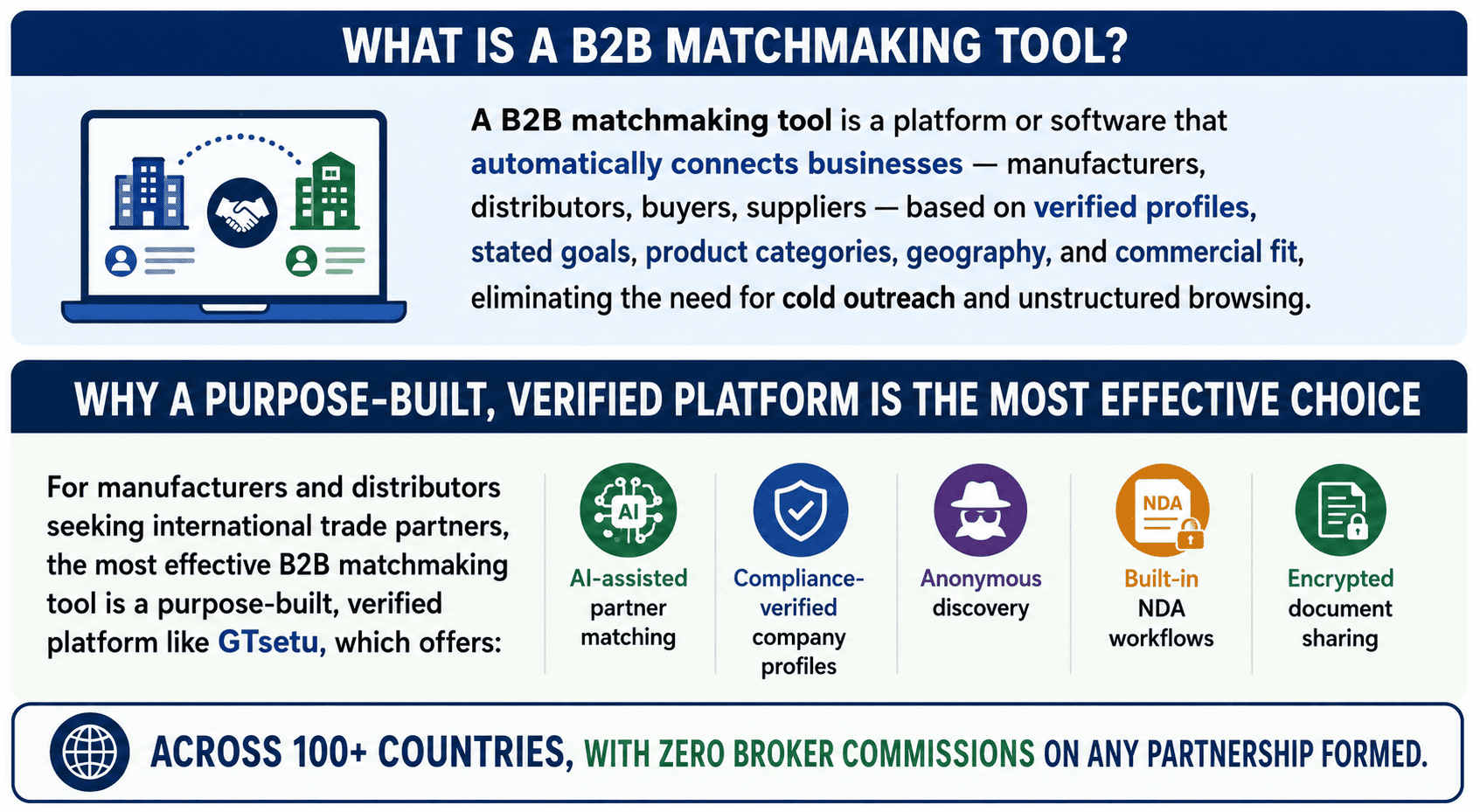
Direct Answer: A B2B matchmaking tool is a platform or software that automatically connects businesses, manufacturers, distributors, buyers, suppliers, based on verified profiles, stated goals, product categories, geography, and commercial fit, eliminating the need for cold outreach and unstructured browsing. For manufacturers and distributors seeking international trade partners, the most effective B2B matchmaking tool is a purpose-built, verified platform like GTsetu. GTsetu verifies companies on six key government-sourced points: Name, Address, Registration Number, Company Status, Company Type, and Date of Certificate of Incorporation. It then combines AI-assisted partner matching, anonymous discovery, built-in NDA workflows, and encrypted document sharing, across 100+ countries, with zero broker commissions on any partnership formed.
📅 March 5, 2026⏱ 18 min read✍️ GTsetu Editorial Team🔄 Updated regularly
500+
Verified Companies
100+
Countries
6-Point
Govt. Sourced Verification
0%
Broker Commission
Every manufacturer seeking a distributor in Southeast Asia, every distributor looking for a new principal brand in Europe, and every buyer searching for a reliable contract manufacturer faces the same fundamental problem: the right partner exists, but finding them through cold outreach, trade directories, or unstructured event networking is slow, expensive, and, when sensitive commercial information changes hands before any verification, dangerously risky.
A B2B matchmaking tool solves this. It is the infrastructure that makes the right introductions happen, automatically, based on verified criteria, at the right moment in the commercial relationship lifecycle. This guide covers everything: what B2B matchmaking means, how AI-powered matching algorithms work, the top platforms and their pricing, how B2B business networks and matchmaking tools relate to each other, and how GTsetu provides a verified, secure, zero-commission B2B matchmaking platform for manufacturers and distributors across 100+ countries.
💡 Who Is This Guide For?
This guide is written for manufacturers seeking international distributors, distributors seeking manufacturer principals, procurement teams managing supplier discovery, event organisers evaluating B2B matchmaking software, and business development leaders who want to understand how AI partner matching platforms work, and how to choose the right one for their use case. It is also a reference for anyone comparing B2B matchmaking apps, event matchmaking tools, or AI partner matching platform pricing.
SECTION 1
1 What Is a B2B Matchmaking Tool?
🎯 Definition
A B2B matchmaking tool is a platform or software that automatically connects two or more businesses, manufacturers, distributors, buyers, suppliers, or investors, based on verified profiles, stated commercial goals, industry alignment, geography, company size, and mutual fit criteria. It replaces the manual, time-consuming, and fraud-prone process of cold outreach and unverified browsing with algorithm-driven or AI-powered introductions between parties who have a genuine, confirmed reason to engage with each other commercially.
In practical terms, a B2B matchmaking tool does what a trusted broker or business development director does, identify who you should be talking to, but at scale, with speed, and without the commission fees that a human intermediary charges. The best B2B matchmaking tools also add a layer of security infrastructure that brokers never provide: verified business credentials, confidentiality frameworks, and encrypted communication channels.
B2B Matchmaking vs. General Networking vs. B2B Marketplace (FIXED GTsetu verification scope)
Dimension
General B2B Networking
B2B Marketplace
B2B Matchmaking Tool (GTsetu)
How connections are made
Self-directed browsing, cold outreach
Keyword search, product discovery
Algorithm/AI-driven introductions based on fit
Identity verification
None, self-reported
Partial, paid badges only
6-point government-sourced verification (Name, Address, Registration Number, Company Status, Company Type, Date of Incorporation)
Goal of connection
General relationship building
Transactional product sourcing
Strategic commercial partnership formation
Confidentiality framework
Absent
Absent
Built-in NDA workflows before data exchange
Quality of match
Variable, quantity over quality
Product-level fit only
Multi-criteria commercial fit scoring
Outcome
Contacts and leads
Supplier quotes and purchase orders
Verified, long-term trade partnership agreements
Commission / fee model
None or subscription
Often 5–15% of transaction
Zero commission (on verified platforms like GTsetu)
⚡ The Matchmaking Advantage
A B2B matchmaking tool is not just a faster directory, it is a fundamentally different approach to partner discovery. Instead of a manufacturer browsing 500 distributor profiles hoping to find fit, the platform analyses both profiles against 20+ compatibility criteria and surfaces the five that genuinely match. This inversion, machine finds fit, human decides, produces fewer but higher-quality connections, which is exactly what manufacturers and distributors need when selecting long-term trade partners. See how this compares to alternatives to Alibaba and alternatives to IndiaMart for verified partner discovery.
SECTION 2
2 How B2B Matchmaking Works: The Mechanics
B2B matchmaking is not magic, it is a structured data process. Understanding how matchmaking tools produce their recommendations helps you use them more effectively, complete your profile to attract better matches, and evaluate platform quality when comparing tools.
📝
Step 1, Profile Creation and Government-Sourced Verification
Each company creates a structured profile: industry, product category, geography, company size, partnership type sought (distributor, supplier, buyer, investor), certifications, and stated commercial goals. On GTsetu, companies are verified using government tie-ups on six key points: Name, Address, Registration Number, Company Status, Company Type, and Date of Certificate of Incorporation. Richer, more accurate profiles produce better matches; incomplete profiles produce generic, low-value suggestions.
Input
🔢
Step 2, Criteria Weighting and Algorithm Configuration
The platform (or its organiser, in an event context) configures which matching criteria carry the most weight: geography alignment, product category fit, company size complementarity, stated goals compatibility. Different use cases weight criteria differently, a trade fair may prioritise sector and geography; a permanent platform may prioritise product category and partnership intent.
Configuration
🤖
Step 3, AI Scoring and Match Generation
The algorithm processes all profiles against all other profiles, calculating compatibility scores for each potential pair based on weighted criteria. AI-powered tools also incorporate behavioural signals, which profiles a company has viewed, which meetings they have accepted, to refine recommendations dynamically over time. The output is a ranked list of matches, highest-scoring first.
Processing
🔍
Step 4, Anonymous Discovery and Interest Confirmation
On privacy-preserving platforms, companies can browse their match list without revealing their identity to the suggested matches. This protects market expansion strategy. Interest is signalled by one party; when the other party confirms reciprocal interest, identities are revealed simultaneously, neither party gains an information advantage.
Privacy
📄
Step 5, Confidentiality Framework and Secure Communication
Once mutual interest is confirmed, the best matchmaking platforms trigger an NDA workflow before any commercially sensitive information is exchanged. All subsequent communication and document sharing happens through encrypted, access-controlled channels with a complete audit trail, not open email.
Legal / Security
🗓️
Step 6, Meeting Scheduling and Engagement
Event-focused matchmaking tools integrate meeting scheduling directly, matched parties book time slots within the platform, with calendar sync and reminders. Permanent trade partnership platforms facilitate ongoing engagement through secure workspaces. Either way, the match produces a real conversation, not just a contact entry.
Engagement
📊
Step 7, Analytics and Match Refinement
Quality matchmaking platforms track engagement data, which matches led to meetings, which meetings led to agreements, and use this feedback to improve subsequent recommendations. Organiser dashboards surface participation rates, meeting acceptance rates, and match quality metrics for programme optimisation.
Optimisation
SECTION 3
3 AI-Powered Partner Matching: How Algorithms Find the Right Fit
The phrase “AI-powered” appears on nearly every B2B matchmaking platform’s marketing, but the reality of what this means, and how much it matters for match quality, varies significantly. Understanding the difference between genuine AI-driven matching and simple keyword filtering helps you evaluate platform claims accurately.
What “AI Matching” Actually Means
Matching Approach
How It Works
Match Quality
Common On
Keyword / Tag Matching
Matches profiles that share the same category tags or keywords
Low, produces many irrelevant results; easily gamed by selecting popular tags
Directories, basic event apps
Rule-Based Filtering
Organiser defines explicit rules: “match buyers with sellers in same industry”
Medium, good for structured events with clearly defined roles, limited in complexity
Trade show apps, hosted buyer programmes
Weighted Criteria Scoring
Multiple criteria are scored and weighted; highest combined score = best match
Good, produces relevant results when profiles are detailed and criteria are configured well
Algorithm learns from historical match acceptance and meeting success data to improve future recommendations
Very good, improves over time; handles complex, multi-variable fit assessment
Grip, advanced enterprise platforms
Verified + ML Hybrid
ML recommendations applied only to government-sourced verified profiles, with human review layer
Highest, combines algorithmic precision with government-sourced verification
GTsetu for trade partnerships
For B2B trade partnerships, where the stakes of a bad match are high and the benefits of a great match are multi-year revenue streams, the matching approach matters enormously. A manufacturer who is matched with a fraudulent “distributor” via a keyword-tag system, and who then shares pricing and product specifications, has suffered a security incident, not just a networking miss. This is why verified matching, where the data feeding the algorithm has been checked against official government registries (Name, Address, Registration Number, Company Status, Company Type, Date of Incorporation), produces categorically better commercial outcomes than AI applied to unverified self-reported data.
⚠️ AI on Unverified Data Is Not Safe
An AI algorithm is only as reliable as the data it processes. When matchmaking platforms apply sophisticated matching logic to self-reported, unverified profiles, the result is a highly confident recommendation pointing to an unverified company. Algorithmic confidence does not compensate for missing identity verification. For trade partnerships involving sensitive commercial data, pricing, product formulations, market strategy, match recommendations must come from verified profiles only. GTsetu verifies six core company attributes using government tie-ups. This is the foundational difference between B2B event matchmaking tools and verified trade partnership platforms like GTsetu. Also see our guide on why business verification is non-negotiable in B2B.
What AI-Powered Partner Matching Platforms Actually Score
🗺️
Geographic Alignment
Is the prospective partner operating in the markets you want to enter? Do their coverage areas complement yours without creating channel conflict with existing partners?
🏭
Product Category Fit
Does the distributor or buyer handle products in your category? Do they have the technical expertise, storage infrastructure, and regulatory approvals your product requires?
📏
Company Size Complementarity
Is the partner company large enough to handle your volume, but not so large that your product line becomes a negligible part of their portfolio and receives inadequate attention?
🎯
Partnership Intent Alignment
Is one party seeking exclusive distribution rights while the other only offers non-exclusive arrangements? Misaligned intent on exclusivity, territory, and volume kills otherwise viable matches.
⚖️
Regulatory & Compliance Fit
Does the partner hold the necessary import licences, certifications, and regulatory approvals to handle your product in their market? Note: This is self-reported on GTsetu; the platform verifies core company details, not specific licences.
💰
Commercial Stage Alignment
Is the company at the right stage, financially capable of meeting minimum order requirements, investing in market activation, and sustaining a multi-year commercial relationship?
SECTION 4
4 Types of B2B Matchmaking: Events, Platforms & Software
“B2B matchmaking” covers several structurally different contexts. Understanding which type applies to your situation is essential before choosing a tool or strategy.
Type
Context
Duration
Best For
Key Limitation
B2B Matchmaking Events
Trade shows, conferences, hosted buyer programmes where pre-scheduled 1:1 meetings are arranged between verified participants
Time-limited (event duration)
High-density meeting programmes, face-to-face first contacts, industry-specific networking
Relationships end when the event ends unless followed up actively; no persistent verified profile
B2B Matchmaking Platform (Permanent)
Always-on digital network where companies discover partners, match, and engage throughout the year, not just at events
Ongoing
Manufacturers seeking international distributors, distributors seeking new brands, cross-border trade partnerships
Requires active profile maintenance and engagement; match quality depends on network density in target markets
B2B Matchmaking Software (Event Tech)
Software licensed by event organisers to power attendee matchmaking at their events, often integrated into event apps
Event-specific
Event organisers wanting to improve attendee networking ROI and meeting quality
Not a stand-alone discovery tool, requires an event context; companies do not maintain persistent profiles post-event
B2B Matchmaking App
Mobile or web application used by event attendees to view matches, request meetings, and manage meeting schedules during events
Event-specific
Attendees at trade shows, conferences, and hosted buyer events wanting to optimise their meeting programmes
Event-specific; profile data is not typically portable to other platforms or events
AI Partner Matching Platform
Enterprise-grade platform using machine learning to match strategic commercial partners, buyers, suppliers, distributors, investors, on an ongoing basis
Ongoing
Organisations managing complex, multi-criteria partner discovery at scale across industries and geographies
Pricing typically requires enterprise commitment; learning curve for configuration
Vertical Trade Network with Matchmaking
Sector-specific platform combining a verified network of trade partners with built-in matchmaking, NDA workflows, and secure communication
Ongoing
Manufacturers and distributors in specific industries (FMCG, chemicals, pharma, industrial) seeking sector-relevant partners
Coverage limited to the platform’s active vertical and geographic network
💡 Which Type Do You Need?
If you are a manufacturer or distributor seeking ongoing access to a pool of verified trade partners across multiple markets, not just at a specific event, you need a permanent B2B matchmaking platform, not event matchmaking software. GTsetu is a permanent, verified trade partner discovery and matchmaking platform. Event matchmaking tools like Brella, Grip, and b2match are event tech products for organisers. These serve different needs and are not alternatives to each other. For cross-border trade partnerships, also explore our guide on cross-border business partnerships and how to find international distributors.
SECTION 5
5 Top B2B Matchmaking Software Platforms & Pricing
The B2B matchmaking software market spans permanent trade partnership platforms, event tech tools, and enterprise AI matching systems. Below is a comprehensive comparison of the leading options, covering use case, key features, and pricing, to help you identify the right fit for your organisation.
🌐GTsetuTrade Partnerships
Verified B2B matchmaking platform for manufacturers and distributors seeking international trade partnerships. All companies are verified on six government-sourced points (Name, Address, Registration Number, Company Status, Company Type, Date of Incorporation) before joining. AI-assisted matching by industry, geography, and commercial intent, with anonymous discovery, built-in NDA workflows, and encrypted workspaces.
Zero commission — subscription access, no success fees
🧩Innoloft LoftOSAll-in-One
Best overall B2B matchmaking software for organisations that need matchmaking, event management, and community features in one platform. Strong for innovation programmes, accelerators, and trade associations. Customisable matching rules, speed dating formats, and built-in analytics.
From $0 (Free) / $29 / $349 / $849 per month — Enterprise on request
🤝b2matchGlobal Events
Comprehensive B2B event matchmaking platform with AI-powered meeting recommendations, participant segmentation, and structured booking rules. Designed for international trade fairs, expos, and hybrid conferences. Supports 1:1, 1:many, and group meeting formats with integrated analytics.
From €699 per event — Professional and Enterprise on request
⚡GripLarge-Scale Events
AI-driven event platform built for large-scale conferences and trade shows. Uses machine learning across billions of data points to deliver precise meeting recommendations. Trusted by Ascential, Clarion, and Hyve for high-volume attendee matchmaking, lead retrieval, and sponsor monetisation.
Enterprise pricing — on request; demo required
🚀BrellaStartup & Investor
AI matchmaking platform tailored for startup ecosystems, accelerators, and investor-focused events. Combines intent-based matching with pre-event networking, live chat, and sponsor engagement tools. Strong for conferences where quality 1:1 meetings between attendees are the primary value proposition.
Pricing on request — per event or annual licence
🏛️SmartMatchAppAssociations
CRM-style matchmaking tool for associations and membership organisations that need matchmaking beyond events. Flexible per-admin pricing model makes it accessible for smaller organisations. Suitable for ongoing member connection programmes rather than one-off event matchmaking.
Per-admin pricing — transparent; contact for quote
B2B Matchmaking Platform Pricing: Full Comparison
Platform
Pricing Model
Starting Price
Commission on Partnerships
Best Fit
GTsetu
Subscription access
Varies by plan
0%, zero commission
Manufacturers & distributors seeking verified international trade partners
Innoloft LoftOS
Monthly SaaS tiers
Free / $29 / $349 / $849 /mo
None
All-in-one: events + community + matchmaking for organisations
b2match
Per event
From €699 per event
None
International trade fairs, expos, and hybrid conferences
Grip
Enterprise contract
On request
None
Large-scale events for associations and trade show organisers
💡 Zero Commission Matters More Than Subscription Cost
When evaluating B2B matchmaking platform pricing, the subscription cost is rarely the most important number. What matters more is whether the platform takes a commission on deals or partnerships formed. A matchmaking tool that takes 5–10% of a €500,000 distribution agreement costs you €25,000–€50,000 in one transaction. GTsetu charges zero commission on any partnership formed, the economics of your trade relationships remain entirely between you and your partner. See also: pricing structures in contract manufacturing and exclusivity clauses in distribution agreements.
SECTION 6
6 B2B Matchmaking Events: How They Work & What to Expect
B2B matchmaking events are structured gatherings, trade fairs, conferences, hosted buyer programmes, or dedicated business exchange events, where pre-scheduled one-to-one meetings between pre-vetted participants are the primary value proposition. The format transforms the random collision of traditional networking into structured, pre-qualified commercial conversations.
How B2B Matchmaking Events Are Structured
01
Pre-Event Profile Setup (2–6 Weeks Before)
Participants register on the event’s matchmaking platform (powered by tools like Grip, Brella, or b2match), complete their profile with industry, company details, goals, and partnership interests, and often specify who they want to meet (buyers, sellers, investors, specific sectors). The earlier and more completely a profile is filled, the more and better pre-event matches are generated. Event organisers using top B2B event companies with attendee matchmaking capability will often send curated match lists to participants before the event opens.
02
AI Match Generation and Meeting Requests
The platform runs its matching algorithm against all participant profiles and generates a ranked list of suggested meetings for each attendee. Participants review their match list, send and accept meeting requests, and build their meeting schedule, all before arriving at the event. Quality matchmaking tools allow participants to filter, sort, and message suggested matches before committing to a meeting slot, enabling pre-qualification that saves time at the event itself.
03
Scheduled Meetings at the Event (15–30 Minute Slots)
At the event, pre-scheduled meetings take place in dedicated meeting areas, typically at allocated tables or booths assigned by the platform. Meeting durations are usually 15–30 minutes, with a brief buffer between slots. A well-run B2B matchmaking event will have between 6 and 12 pre-scheduled meetings per participant per day, far more than the 2–3 meaningful conversations typically generated by unstructured networking at the same event.
04
Real-Time Meeting Management and Walk-In Requests
During the event, participants can add impromptu meetings, manage cancellations, and view updated schedules via the matchmaking app. Good event matchmaking apps sync calendars, send reminders, and provide venue maps to meeting locations. Some platforms also enable lead capture and note-taking within each meeting record for post-event follow-up.
05
Post-Event Follow-Up and Analytics
After the event, participants receive their meeting notes, contact details of everyone they met, and any documents shared. Event organisers receive analytics: total meetings scheduled, acceptance rates, participant satisfaction scores, and match quality metrics. The limitation: unless the matchmaking platform provides persistent profiles and ongoing communication channels, the commercial relationship must be continued via external channels, email, phone, or a separate CRM, after the event ends.
Top B2B Event Companies with Attendee Matchmaking
Event Type
Matchmaking Format
Typical Meeting Volume
Sectors
Key Platforms Used
Hosted Buyer Programmes
Curated 1:1 meetings between pre-qualified buyers and suppliers, often fully pre-scheduled
8–15 per buyer per day
Travel, hospitality, MICE, trade
Grip, b2match
Trade Show Matchmaking
AI-suggested meetings between exhibitors and visitors; mix of pre-scheduled and walk-in
4–10 per exhibitor per day
All sectors, manufacturing, food, pharma, tech
Grip, Brella, b2match
Innovation & Startup Events
Investor–startup matching, mentor–founder pairings, corporate–startup pilot matching
5–8 per startup per day
Technology, deeptech, sustainability
Brella, Innoloft LoftOS
Industry Conferences
Peer-to-peer matching among senior decision-makers, thought leaders, and solution providers
3–6 per attendee
Finance, healthcare, manufacturing, logistics
Brella, Grip, b2match
Government Trade Missions
Pre-scheduled B2B meetings between visiting trade delegations and local businesses
5–12 per participant per day
All export/import sectors
b2match, custom tools
SECTION 7
7 What to Look For in a B2B Matchmaking Platform
Not all B2B matchmaking platforms deliver equal value. The criteria that matter depend on your use case, event organiser vs. manufacturer seeking trade partners, but there are universal non-negotiables that every platform must meet.
Pre-verified business identities, not self-reported profiles anyone can fabricate without consequence (GTsetu uses government tie-ups for Name, Address, Registration Number, Company Status, Company Type, Date of Incorporation)
Multi-criteria AI or algorithm matching, not just keyword tags; must score on geography, category, intent, and size
Anonymous discovery, browse matches without revealing your company identity until you choose to engage
Built-in NDA workflow triggered before any commercially sensitive information can be shared
End-to-end encrypted document and communication channels, not open email or unprotected links
Role-based access controls, limit who on each team can view which documents at which stage
Full timestamped audit trail, every access event, communication, and document exchange logged for compliance
Meeting scheduling integration, pre-scheduled meetings bookable directly within the platform
Geographic breadth, verified participants in the markets where you actually want partners
Sector relevance, a network of companies in your industry, not a generic business directory
Zero commission or transparent fee model, platform incentives should not be misaligned with your deal success
Critical Red Flags When Evaluating a B2B Matchmaking Tool
🚩
Self-Reported Profiles Only
If any company can join without verification against government sources, you are matching against unverified data. Every match recommendation is based on what companies claimed about themselves, not what has been confirmed.
🚩
No Confidentiality Framework
If the platform has no built-in NDA workflow, any information you share after a match introduction is legally unprotected. Many manufacturers share pricing and specs in the first meeting without any executed NDA in place.
🚩
No Audit Trail
Without a record of who accessed which documents and when, there is no evidence base if a partner later misuses shared commercial information or a dispute arises over commitments made during negotiation.
🚩
Commission on Partnerships Formed
A platform that takes a percentage of your partnership deal value has a financial incentive to push matches that generate larger transactions, not necessarily the matches that are best for your long-term commercial interests.
🚩
Your Identity Exposed from First Discovery
If every company you browse can see that you viewed their profile, your market expansion strategy, which markets you are entering, which categories you are seeking, is visible to competitors from your first search.
🚩
No Ongoing Verification Monitoring
A company that was verified at onboarding may have changed its status since. Platforms should have processes to monitor for changes in company status. See: business verification explained.
SECTION 8
8 B2B Marketplace vs. B2B Matchmaking Tool: Key Differences
Manufacturers and distributors often start their partner discovery on B2B marketplaces, Alibaba, IndiaMART, TradeIndia, before discovering that these platforms were not built for the type of strategic, verified, confidential partnership formation they actually need. Understanding the structural differences prevents misallocated effort and, more importantly, prevents sensitive commercial information from reaching unverified parties. See our detailed comparisons: alternatives to Alibaba, alternatives to IndiaMart, and alternatives to TradeIndia.
✓ 6-point government-sourced verification (Name, Address, Registration Number, Company Status, Company Type, Date of Incorporation)
How connections are made
✗ Manual browsing by buyer
✓ AI-assisted matching by fit criteria
Anonymous discovery
✗ Identity visible from search
✓ Browse without revealing identity
Confidentiality framework
✗ None, no NDA workflow
✓ Built-in NDA before data exchange
Document sharing security
✗ Open messages and email
✓ AES-256 encrypted workspace
Outcome sought
✗ Product transaction / quote
✓ Verified long-term partnership agreement
Commission model
✗ Often 5–15% of transaction
✓ Zero broker commission
Audit trail
✗ Message history only
✓ Full timestamped log, downloadable
Fraud risk
✗ High, frequent scam reports
✓ Structurally reduced by government-sourced verification
SECTION 9
9 The B2B Matchmaking Journey for Manufacturers & Distributors
Here is how a complete B2B matchmaking journey unfolds on GTsetu, from profile creation to active trade partnership, with each stage’s security gate and matchmaking mechanism clearly defined.
✅
Verified Profile
6-point govt. verification completed.
🏛️ Verified
🤖
AI Matching
Algorithm surfaces best-fit partners from verified pool.
🤖 AI-scored
🔍
Anon Discovery
Browse matches without revealing your identity.
🔐 Anon mode
🤝
Mutual Interest
Both confirm; identities revealed simultaneously.
🔐 Gated
📄
NDA Signed
Legal gate before any commercial data moves.
🔐 Legal
⚖️
Partnership
Agreement signed. Trade begins. Zero commission.
✓ Complete
01
Complete Your Verified Company Profile
Before GTsetu’s matching algorithm can suggest relevant partners, your profile must be complete, and your company must be verified. GTsetu verifies companies using government tie-ups on six key points: Name, Address, Registration Number, Company Status, Company Type, and Date of Certificate of Incorporation. A complete, verified profile produces better matches and, critically, signals to prospective partners that you are a legitimate, compliance-checked company worth engaging. The verification step, which most platforms skip entirely, is what makes every match in GTsetu’s network trustworthy by default. See our guide to supplier collaboration platforms for context.
02
AI-Assisted Matching Against the Verified Partner Pool
GTsetu’s matching engine analyses your profile against the entire verified partner pool, scoring each potential match across industry alignment, geographic fit, company size complementarity, product category overlap, partnership type compatibility (exclusive vs. non-exclusive, distributor vs. agent), and stated commercial intent. The output is a curated, ranked match list, not a 500-entry directory to browse. This is fundamentally different from a marketplace search: you are not hunting for fit; the platform is surfacing fit for you, verified in advance.
03
Browse Matches Anonymously, Without Revealing Your Market Strategy
You review your curated match list without your identity being visible to the companies suggested. This protects your market expansion plans, competitors and prospective partners alike cannot see that you are evaluating them or considering a specific market until you choose to signal interest. Anonymous discovery is particularly important for manufacturers entering new geographies: revealing your target market before agreements are in place gives distributors unnecessary negotiating leverage and alerts competitors to your strategic direction. For context, see our article on the advantages and disadvantages of global expansion.
When you identify a high-fit match and signal interest, the platform notifies the prospective partner. When they confirm reciprocal interest, both companies’ identities are revealed to each other simultaneously, ensuring neither party gains an informational advantage during the discovery phase. This bilateral reveal mechanism is absent from most networking tools and marketplaces, where expressing interest in a company’s profile immediately exposes you to them whether or not they reciprocate.
05
NDA Execution Before Any Commercial Information Moves
Mutual interest confirmation triggers GTsetu’s NDA workflow. Both parties review and digitally sign a confidentiality agreement, with customisable scope, governing law selection, and duration, before the encrypted document workspace unlocks. This means no pricing sheet, product specification, or market strategy document ever changes hands before legal confidentiality is formalised. The NDA is timestamped and audited automatically. This is the legal security layer that transforms a B2B introduction into a commercially safe engagement. See our detailed guide on mutual vs one-way NDAs and B2B secure collaboration.
06
Encrypted Workspace, Due Diligence, and Partnership Agreement
Post-NDA, both parties collaborate in an encrypted shared workspace. Documents are access-controlled at the user level; every view, download, and communication is logged automatically. Commercial negotiation on territory, pricing, exclusivity, and performance terms happens inside the secure environment, with a full audit trail maintained throughout. When commercial terms are agreed, the partnership agreement is executed. GTsetu takes zero commission on any partnership formed, regardless of deal size. The full commercial economics of your distribution relationship stay between you and your partner. For frameworks to consider during this stage, see: licensing vs distribution agreements, territory rights, exclusivity clauses, and Incoterms explained.
SECTION 10
10 Common B2B Matchmaking Mistakes, and How to Avoid Them
The most costly B2B matchmaking mistakes are not technical, they are strategic. They occur when manufacturers and distributors use the wrong tool for the wrong use case, skip security steps in the enthusiasm of a promising introduction, or fail to follow up effectively after a promising match.
67%
of B2B trade partnerships fail within 18 months due to misaligned expectations set during partner discovery
$2.1M
average value of a mid-tier manufacturer–distributor distribution agreement, making partner selection a high-stakes decision
43%
of manufacturers report having shared sensitive commercial information with a partner later found to be unverified or misrepresented
Mistake
Why It Happens
Commercial Consequence
How to Avoid It
Using a marketplace as a matchmaking tool
Marketplaces are accessible and familiar; manufacturers default to what they know
Engagement with unverified companies; pricing and specs shared before identity confirmed; fraud exposure
Use a verified matchmaking platform for strategic partnerships; use marketplaces only for commodity sourcing. See: distributors vs manufacturers
Sharing sensitive information before NDA
Enthusiasm after a good first meeting overrides caution
Pricing intelligence and product specs reach competitors; no legal recourse without signed NDA
Never share pricing, specs, or market strategy before NDA is digitally signed with audit trail confirmed. See: mutual vs one-way NDAs
Incomplete matching profile
Rushing to start browsing without fully completing profile fields
Algorithm suggests generic matches that miss critical criteria; time wasted on poor-fit conversations
Invest 30–60 minutes completing every profile field before engaging with match suggestions
Failing to follow up post-event or post-introduction
Event fatigue, unclear ownership of follow-up, no structured process
High-value introductions go cold; competitor captures the relationship by moving faster
Define follow-up process before the event or introduction begins; send follow-up within 48 hours of any meeting
Selecting partners on interest, not verification
A company expresses strong interest and impressive claims; urgency overrides due diligence
Partnership formed with an unverified or misrepresented company; commercial, legal, and reputational damage
Always verify core company credentials via government sources before commercial commitment, or use a platform that does this for you. See: business verification guide
Ignoring territory and exclusivity complexity
First match discussion focuses on product and pricing, skipping structural terms
Exclusivity granted to a partner who cannot cover the territory; channel conflict emerges later
Discuss territory, exclusivity, and minimum volume commitments in the first substantive meeting. See: territory rights and volume commitments
SECTION 11
11 How GTsetu Delivers Verified B2B Matchmaking
🤝 Platform Spotlight, GTsetu
The Verified B2B Matchmaking Platform for Global Trade Partnerships
GTsetu was built specifically for manufacturers and distributors who need to find, vet, and form international trade partnerships, with a security and trust infrastructure that no marketplace, cold outreach method, or event-only networking tool provides. GTsetu verifies companies using government tie-ups on six core points: Name, Address, Registration Number, Company Status, Company Type, and Date of Certificate of Incorporation. Every feature is designed around one principle: in high-value B2B trade, the right match is worthless if the partner is not verified, and the best verification is worthless if the commercial engagement is not secure.
🏛️
6-Point Government-Sourced Verification
GTsetu verifies Name, Address, Registration Number, Company Status, Company Type, and Date of Certificate of Incorporation through government tie-ups before any company enters the matching pool.
🤖
AI-Assisted Matching
Matches scored by industry, geography, product category, company size, partnership intent, and commercial stage, surfacing the highest-fit partners from the verified global pool.
🕵️
Anonymous Discovery
Browse your match list across 100+ countries without your identity being revealed. Signal intent only when you have identified a genuine fit.
📄
Built-In NDA Workflow
Digital NDA execution with timestamped signatures and permanent audit trail, triggered automatically before the encrypted workspace unlocks.
🔐
Encrypted Document Workspace
AES-256 at rest, TLS in transit. All commercial documents shared in a role-access-controlled, fully audited environment, no email attachments.
📋
Full Audit Trail
Every access event, document view, NDA signature, and communication logged with timestamp, downloadable for compliance or legal purposes at any stage.
🚫
Zero Commission
GTsetu never takes a success fee or broker commission on any partnership formed, regardless of deal size, geography, or industry. Your deal economics stay entirely between you and your partner.
🌍
100+ Countries
Verified manufacturers and distributors across Asia, Middle East, Europe, Africa, Australia, and the Americas, available for matching from a single platform.
A B2B matchmaking tool is a platform or software that automatically connects businesses, manufacturers, distributors, buyers, suppliers, based on verified profiles, stated commercial goals, product categories, geographic alignment, and multi-criteria fit scoring. It replaces the manual, time-consuming process of cold outreach and unstructured directory browsing with algorithm-driven or AI-powered introductions between parties who have a confirmed reason to engage commercially. The best B2B matchmaking tools also include identity verification, confidentiality frameworks, and encrypted communication, ensuring that every introduction is both relevant and safe.
QWhat is B2B matchmaking and how does it differ from general networking?
B2B matchmaking is the structured process of connecting businesses that have complementary commercial needs, a manufacturer seeking a distributor, a buyer seeking a supplier, based on verified, multi-criteria compatibility assessment. General networking is self-directed, unstructured, and produces broad contact lists rather than qualified partner introductions. B2B matchmaking produces fewer but higher-quality connections; it prioritises commercial relevance over connection volume. For manufacturers and distributors, matchmaking is to general networking what precision engineering is to manual fabrication, same goal, fundamentally different quality of output. See also: B2B business networks explained.
QHow do AI-powered partner matching platforms work?
AI-powered partner matching platforms analyse participant profiles across multiple criteria, industry, geography, company size, product category, partnership intent, and stated goals, and calculate compatibility scores between all pairs in the database. Machine learning algorithms additionally incorporate behavioural signals (which profiles a company has viewed, which meetings they have accepted) to refine recommendations dynamically over time. The platform then surfaces a ranked match list: the highest-scoring, most commercially relevant partners first. Quality AI matching runs on verified data; platforms that apply AI to self-reported, unverified profiles produce algorithmically confident but fundamentally unreliable recommendations.
QWhat are the top AI-powered partner matching platforms for businesses?
The leading AI-powered B2B matchmaking platforms in 2026 are: GTsetu (verified trade partnerships for manufacturers and distributors, 100+ countries, zero commission), Innoloft LoftOS (all-in-one for events, communities, and innovation programmes; from $29/month), b2match (AI-powered for trade fairs and global conferences; from €699 per event), Grip (AI-driven for large-scale events; enterprise pricing), Brella (AI matchmaking for startup and investor events; per event pricing), and SmartMatchApp (for associations and membership organisations; per-admin pricing). Each platform serves a different context, permanent trade partnership discovery vs. event-specific attendee matchmaking, so the “top” choice depends entirely on your use case.
QWhat is AI partner matching platforms pricing?
B2B matchmaking platform pricing varies significantly by type and scale: Innoloft LoftOS starts at free (5 users) with paid plans from $29/month to $849/month, with enterprise pricing on request. b2match charges from €699 per event for small events, with larger events priced on request. Grip and Brella are enterprise-priced tools available on request following a demo. SmartMatchApp uses a per-admin pricing model available on request. GTsetu uses a subscription model with zero commission on any partnership formed, meaning the platform cost does not scale with the value of your commercial agreements. When evaluating pricing, always include the commission model in the calculation: a matchmaking platform charging 5% on a $1M distribution agreement costs $50,000 in a single transaction.
QWhat should I look for in a B2B matchmaking platform?
Non-negotiable criteria for a B2B matchmaking platform: (1) pre-verified company identities, not self-reported profiles; (2) multi-criteria AI matching on verified data; (3) anonymous discovery before identity disclosure; (4) built-in NDA workflow before any commercial data exchange; (5) end-to-end encrypted document sharing; (6) role-based access controls; (7) full timestamped audit trail; (8) geographic breadth in your target markets; (9) sector relevance, participants in your industry; (10) zero or transparent commission model with no success fees on partnership value. See our full checklist in B2B secure collaboration guide.
QWhat is the difference between a B2B matchmaking platform and a B2B marketplace?
A B2B marketplace lists products or services for transactional discovery, companies pay to appear, credentials are self-reported, and the goal is product-level sourcing. A B2B matchmaking platform connects verified business entities based on strategic commercial fit, verified credentials, stated partnership goals, and multi-criteria compatibility, producing long-term trade partnership agreements rather than individual transactions. Marketplaces are built for buyers searching for products; matchmaking platforms are built for companies seeking strategic partners. For manufacturers and distributors, the distinction determines whether you are buying a one-time shipment or forming a multi-year distribution relationship. See: alternatives to Alibaba and global partner services explained.
QHow do B2B matchmaking events work?
B2B matchmaking events are structured gatherings, trade shows, conferences, or dedicated business exchange events, where pre-scheduled one-to-one meetings between pre-vetted participants are the primary value proposition. Participants create profiles on the event’s matchmaking app 2–6 weeks before the event; the platform’s algorithm generates match lists; participants send and accept meeting requests before arriving; and structured 15–30 minute meetings take place in a dedicated meeting area at the event. Well-run B2B matchmaking events produce 6–12 pre-scheduled meetings per participant per day, far more commercial conversations than unstructured networking. The limitation: the platform and relationship are event-specific unless followed up actively via external channels post-event.
QHow does GTsetu work as a B2B matchmaking tool?
GTsetu is a permanent, verified B2B matchmaking platform connecting manufacturers and distributors across 100+ countries. All companies are verified on six key government-sourced points: Name, Address, Registration Number, Company Status, Company Type, and Date of Certificate of Incorporation. AI-assisted matching then scores verified profiles by industry, geography, product category, company size, and partnership intent, generating curated match lists for each member. Members browse matches anonymously, confirm mutual interest (triggering bilateral identity reveal), execute digital NDAs before any commercial data is shared, and collaborate in an AES-256 encrypted workspace with full audit trail. GTsetu takes zero commission on any partnership formed. See also: market entry partnerships and global collaboration examples.
QWhat is a B2B matchmaking app?
A B2B matchmaking app is a mobile or web application used primarily in the context of trade shows, conferences, and B2B events to help attendees view their match recommendations, send and accept meeting requests, manage their meeting schedule, and engage with other participants during the event. Examples include the mobile apps provided by Brella, Grip, and b2match. These are event-specific tools, their value is tied to the event context, and participant profiles are generally not portable to other platforms or events after the event ends. They are distinct from permanent B2B matchmaking platforms like GTsetu, which provide ongoing partner discovery and engagement capability across the full year.
Find Verified Trade Partners with GTsetu’s B2B Matchmaking Platform
Join 500+ verified manufacturers and distributors across 100+ countries. AI-assisted partner matching, anonymous discovery, built-in NDA workflows, encrypted collaboration, and zero broker commissions on every partnership you form.
They represents the product, and research team behind GTsetu, a global B2B collaboration platform built to help companies explore cross-border partnerships with clarity and trust. The team focuses on simplifying early-stage international business discovery by combining structured company profiles, verification-led access, and controlled collaboration workflows.
With a strong emphasis on trust, and disciplined engagement, Team GTsetu shares insights on global trade, partnerships, and cross-border collaboration, helping businesses make informed decisions before entering deeper commercial discussions.