How to Become a Contract Manufacturer for Pharmaceuticals in India
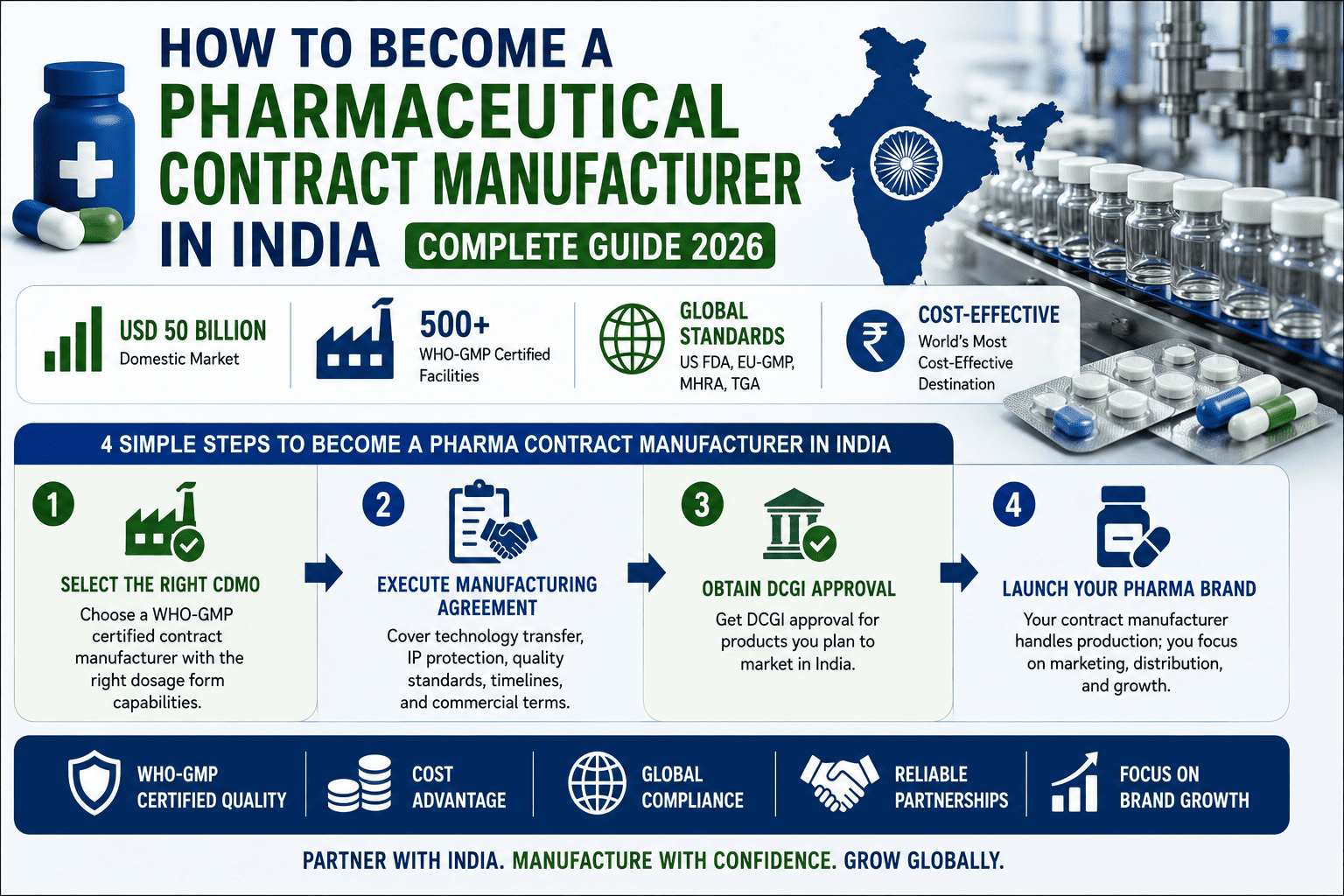
Direct Answer: India is the world’s largest provider of generic medicines and the most cost-effective destination for pharmaceutical contract manufacturing. With a USD 50 billion domestic market, 500+ WHO-GMP certified facilities, and a regulatory framework aligned with global standards (US FDA, EU-GMP, MHRA, TGA), India offers international pharma companies and brand owners unmatched capabilities for third-party manufacturing. The process is structured: (1) select a WHO-GMP certified contract manufacturing organization (CDMO) with the right dosage form capabilities; (2) execute a manufacturing agreement covering technology transfer, IP protection, quality standards, and timelines; (3) obtain DCGI approval for products marketed in India; (4) launch your pharma brand with the contract manufacturer handling production while you focus on marketing and distribution. GTsetu connects verified Indian pharmaceutical manufacturers and CDMOs with global partners, with zero broker commissions.
📅 June 22, 2026⏱ 18 min read✍️ GT Setu Editorial Team🔄 Updated regularly
$50B+
Indian Pharmaceutical Market
500+
WHO-GMP Certified Facilities
#1
Global Generic Drug Supplier
0%
GTsetu Broker Commission
India’s pharmaceutical industry is the world’s third-largest by volume and the largest provider of generic medicines globally, producing over 60% of the world’s vaccines and 20% of generic medicines by volume. The country’s USD 50 billion domestic market is complemented by USD 30+ billion in exports, making it the pharmacy of the world. For international pharma companies, brand owners, and entrepreneurs looking to enter the pharmaceutical market, India offers the most cost-effective, scalable, and regulatory-compliant contract manufacturing ecosystem anywhere in the world.
Pharmaceutical contract manufacturing, also known as third-party manufacturing or toll manufacturing, allows companies to outsource production to specialized manufacturers with established WHO-GMP compliant facilities, regulatory approvals, and technical expertise. This model eliminates the need for capital-intensive infrastructure investment, reduces time-to-market, and enables focus on branding, marketing, and distribution. India’s contract manufacturing ecosystem spans 500+ WHO-GMP certified facilities, offers comprehensive dosage form capabilities (tablets, capsules, syrups, injectables, ointments, nutraceuticals), and serves clients in 200+ countries. This guide covers everything you need to know, from regulatory requirements through partner selection, agreement structures, and how to launch your pharma brand. See also our guides on expanding to India’s manufacturing sector and China’s manufacturing ecosystem.
🇮🇳 Who Is This Guide For?
This guide is written for international pharmaceutical companies seeking to outsource manufacturing to India, entrepreneurs launching a pharma brand using third-party manufacturing, existing pharma brands looking to expand their product portfolio, and global healthcare companies exploring India as a manufacturing base for export markets. It is also for companies considering WHO-GMP certified manufacturing for regulated markets (US, EU, UK, Australia, Canada). If you are evaluating multiple markets for pharma manufacturing expansion, see our companion guides: China, Vietnam, and Germany.
SECTION 1
1 Why India for Pharmaceutical Contract Manufacturing?
🎯 The Strategic Case
India offers a combination of pharmaceutical manufacturing advantages that is unparalleled globally: cost-effective production (30–50% lower than developed markets), 500+ WHO-GMP certified facilities meeting global regulatory standards, a skilled workforce of 3+ million pharmaceutical professionals, comprehensive regulatory infrastructure under the Central Drugs Standard Control Organization (CDSCO) aligned with global norms, and proven export capability to 200+ countries including stringent regulatory markets like the US, EU, UK, Australia, and Japan. For pharmaceutical companies, India provides the lowest cost of manufacturing while maintaining the highest quality standards, the combination that has made India the pharmacy of the world.
30–50%
cost savings vs. manufacturing in US/EU, India’s cost advantage in pharma production
500+
WHO-GMP certified manufacturing facilities across India serving global markets
200+
countries served by Indian pharmaceutical exports, including all major regulated markets
💊
World’s Largest Generic Drug Provider
India produces over 60% of the world’s vaccines and 20% of generic medicines by volume. This scale ensures reliable supply, competitive pricing, and extensive formulation capabilities across all therapeutic categories.
🏭
WHO-GMP & Global Regulatory Compliance
India’s leading contract manufacturers hold WHO-GMP, US FDA, EU-GMP, MHRA (UK), TGA (Australia), and other stringent regulatory approvals, ensuring products meet the highest international quality standards.
💰
Cost-Effective Production
Lower labour costs, competitive raw material sourcing, and established manufacturing infrastructure mean Indian contract manufacturing is 30–50% more cost-effective than developed markets, without compromising quality.
🧪
Comprehensive R&D & Formulation Expertise
India’s pharmaceutical companies have extensive R&D capabilities, developing complex generics, novel drug delivery systems, and specialized formulations across all therapeutic areas including biologics, biosimilars, and nutraceuticals.
📦
End-to-End Manufacturing Services
From API synthesis to finished dosage forms, packaging, and serialization, Indian contract manufacturers offer comprehensive CDMO services including formulation development, process optimization, scale-up, commercial production, and regulatory support.
🌏
Global Export & Supply Chain Hub
India’s established pharma export infrastructure, cold chain capabilities, and regulatory expertise make it the preferred global sourcing hub for pharmaceutical products, serving both branded generics and CDMO relationships.
SECTION 2
2 Indian Pharma Contract Manufacturing Market: Size & Growth 2026
India’s pharmaceutical contract manufacturing market is the most dynamic and fastest-growing segment of the country’s pharmaceutical industry, driven by global pharmaceutical outsourcing trends, the expansion of domestic pharma brands using third-party manufacturing, and India’s proven regulatory and quality credentials. The market spans both domestic-focused contract manufacturers (serving Indian pharma brands) and export-oriented CDMOs (serving global pharmaceutical companies).
Market Segment
Current Value
Growth Drivers
Key Characteristics
Domestic Contract Manufacturing
USD 5–7 billion
Rising demand for third-party manufacturing from domestic pharma brands; new pharma startups entering the market
Focus on tablets, capsules, syrups, ointments; WHO-GMP compliance for domestic market; competitive pricing and flexibility
Export-Oriented CDMO
USD 12–15 billion
Global pharmaceutical outsourcing to India; patent expiries driving generic drug manufacturing; regulatory approvals for regulated markets
Advanced R&D, complex generics, injectables, biologics; US FDA, EU-GMP approvals; high regulatory compliance standards
Nutraceutical Contract Manufacturing
USD 2–3 billion
Growing health & wellness market; global demand for supplements; Indian Ayurveda and natural products heritage
GMP, ISO, organic certifications; combination of traditional and modern formulations; export to health-conscious markets
Injectable & Sterile Manufacturing
USD 4–6 billion
Global shift to injectable and biologics-based therapies; biosimilar opportunity; vaccine manufacturing (India’s vaccine leadership)
High-barrier facilities; SVP/LVP capabilities; fill-finish; major focus on export to US and EU markets
The global pharmaceutical contract manufacturing market is projected to exceed USD 150 billion by 2030, with India capturing a significant share. India’s share of the global generic drug market (by volume) is approximately 20%, and this is expected to grow as more multinational pharmaceutical companies increase their outsourcing to India. For international pharma companies, India’s contract manufacturing ecosystem offers the combination of cost-efficiency, regulatory compliance, technical expertise, and manufacturing scale that is unmatched globally. For domestic entrepreneurs, third-party manufacturing provides the lowest-risk entry point into India’s growing pharmaceutical market.
SECTION 3
3 Dosage Forms & Manufacturing Capabilities
Indian contract manufacturers offer one of the most comprehensive ranges of dosage forms in the world, from simple tablets to complex biologics. Understanding the manufacturing capabilities of your potential partner is essential for matching your product requirements with their expertise.
💊Most Common
Tablets & Capsules
Tablets (immediate release, sustained release, extended release, enteric coated, orally disintegrating) and capsules (hard gelatin, soft gelatin) represent the largest volume of contract manufacturing in India. Manufacturers offer formulation development, scale-up, commercial production, and packaging services with WHO-GMP compliance.
Oral liquids (syrups, suspensions, emulsions) are a significant segment of Indian contract manufacturing, driven by paediatric formulations, geriatric medicines, and OTC products. Manufacturers offer formulation development, flavour masking, viscosity optimization, and sterile liquid production for certain applications.
Key capabilities: mixing, filling, sterilization, flavouring, viscosity control
💉Premium Segment
Injectables & Sterile Products
Small Volume Parenterals (SVP) and Large Volume Parenterals (LVP), including vials, ampoules, pre-filled syringes, and IV bags. This is the highest-value contract manufacturing segment, requiring high-barrier facilities, aseptic processing, and regulatory approvals (US FDA, EU-GMP) for export markets. India is a global leader in vaccine and biosimilar manufacturing.
Topical formulations including creams, ointments, gels, and lotions for dermatological, wound care, and cosmetic applications. Manufacturers offer emollient formulation, stable emulsion development, and GMP-compliant production with stability testing for both domestic and export markets.
India’s traditional medicine heritage combines with modern manufacturing to produce WHO-GMP certified Ayurvedic, herbal, and natural products. This segment includes classical formulations, standardized extracts, and novel phytopharmaceuticals, growing rapidly for both domestic and export markets (especially Europe and North America).
India is emerging as a hub for biologics and biosimilar manufacturing, with established capabilities in recombinant proteins, monoclonal antibodies, and biosimilar development. This segment requires highly specialized facilities, experienced bioprocessing teams, and stringent regulatory oversight (US FDA, EMA).
Vitamins, minerals, probiotics, protein supplements, and functional foods. Nutraceutical contract manufacturing is India’s fastest-growing segment, driven by global health consciousness, India’s Ayurvedic heritage, and established GMP manufacturing infrastructure. Manufacturers offer both vegetarian and non-vegetarian capsules, tablets, and powder formulations.
Contract manufacturers increasingly offer comprehensive packaging services: blister packaging, strip packaging, bottle filling, labelling, and cartoning. Serialization and track & trace capabilities are now essential for export to regulated markets (US DSCSA, EU FMD), many Indian contract manufacturers are fully equipped with serialization lines and global compliance expertise.
4 Regulatory Framework: WHO-GMP, DCGI & Global Compliance
🏛️ Regulatory Overview
India’s pharmaceutical regulatory framework is comprehensive and aligned with global standards. The Central Drugs Standard Control Organization (CDSCO) is India’s national regulatory authority for pharmaceuticals and medical devices, operating under the Drugs and Cosmetics Act, 1940 and Rules, 1945. For contract manufacturing, the key requirements are: (1) Drug Manufacturing License, obtained from CDSCO or State Drug Authority for the specific dosage forms. (2) WHO-GMP Certification, mandatory for export-oriented manufacturing and increasingly for domestic manufacturing. (3) DCGI Approval, for products marketed in India. (4) Factory Registration, under the Factories Act. India’s regulatory system is recognized globally, US FDA, EMA, MHRA, TGA, and other agencies regularly inspect and approve Indian manufacturing facilities.
Regulatory Requirement
Description
Responsible Authority
Key Considerations
Drug Manufacturing License
License for manufacturing pharmaceutical products for sale in India or export. Required for each dosage form and manufacturing facility. Issued after facility inspection and compliance verification.
CDSCO (central) / State Drug Controllers (state)
Applicable for all manufacturing activities; requires both central and state approvals; specific to dosage form and therapeutic category
WHO-GMP Certification
World Health Organization Good Manufacturing Practice certification, required for export to most global markets. Audited by WHO and recognized by WHO member states. Mandatory for products exported to regulated markets.
WHO (audit) / Indian regulatory authorities (certification)
Facility-level certification; requires robust quality management systems; applicable to all manufacturing operations
DCGI Approval
Approval from the Drug Controller General of India (DCGI) for new drugs, imported drugs, and clinical trials. Required for marketing of pharmaceutical products in India.
DCGI (CDSCO)
Required for all products marketed in India; involves dossier submission, clinical trial review (where applicable), and product approval
US FDA Approval
US Food and Drug Administration approval for export of pharmaceutical products to the United States. Requires separate facility inspection and product-specific filings (ANDA, NDA).
US FDA
Stringent regulatory review; drug master file (DMF) and ANDA filing; regular inspections by US FDA inspectors
EU-GMP / EMA Compliance
European Medicines Agency and EU GMP compliance for export to the European Union. Requires compliance with EU GMP guidelines and product-specific marketing authorizations.
EMA / National EU Competent Authorities
Regulatory approval process involves dossier assessment and facility inspection; pharmacovigilance obligations for marketed products
Factory Registration
Registration under the Factories Act, 1948. Covers workplace safety, environmental compliance, labour welfare, and statutory obligations for manufacturing establishments.
State Factories Inspectorate
Applicable to all manufacturing facilities; ensures safe working conditions; compliance with environmental and labour laws
GST Registration
Goods and Services Tax registration for all business activities in India. Required for tax compliance, invoicing, and availing input tax credit.
GST Council / State GST Authorities
Mandatory for pharmaceutical manufacturing and trading; regular GST filing required; cross-border GST implications for export
🇮🇳 Regulatory Compliance: Key Considerations for International Clients
International pharmaceutical companies engaging Indian contract manufacturers must ensure: (1) The manufacturing facility holds the appropriate regulatory approvals for your target market (US FDA, EU-GMP, MHRA, TGA, etc.). (2) A Technology Transfer Agreement is executed, covering formulation details, analytical methods, and quality specifications. (3) A Manufacturing and Supply Agreement is in place, addressing quality standards, batch release criteria, packaging, labelling, and serialization requirements for your market. (4) Pre-shipment testing and documentation requirements are clearly defined. (5) The manufacturing site is auditable, including allowing your Quality Assurance team or appointed third-party auditors to conduct GMP audits. Indian contract manufacturers are generally very experienced with international client audits and the regulatory dossier submission process. GTsetu verifies the regulatory certifications and compliance status of all Indian pharma partners before they are listed in the platform.
SECTION 5
5 How to Choose the Right Third-Party Pharma Partner
Choosing the right pharmaceutical contract manufacturing partner is the most critical decision in your Indian market entry. The Indian pharma manufacturing ecosystem includes 500+ WHO-GMP certified facilities, with significant variation in quality, regulatory approvals, technical expertise, reliability, and commercial terms. A systematic selection process is essential.
✅
Regulatory Certifications & Approvals
Verify WHO-GMP certification, US FDA inspections and approvals (if exporting to US), EU-GMP status, MHRA approval (UK), TGA registration (Australia), and DCGI approval for Indian market. Regulatory certifications are the minimum qualification, review the actual inspection history, audit observations, and compliance status.
🏭
Manufacturing Infrastructure & Capacity
Assess the partner’s manufacturing facility: capacity (tablets/year, capsules/year, etc.), technology (compression machinery, encapsulation, filling lines), quality control (QC labs, stability chambers), and environmental controls (HVAC, cleanrooms). Ensure the facility is designed and operated for your dosage form and therapeutic category requirements.
🧪
R&D & Formulation Development Expertise
For companies requiring formulation development support (new products, complex generics, specialized delivery systems), evaluate the partner’s R&D capabilities: formulation labs, analytical development, stability testing, process optimization, and scale-up experience. Leading CDMOs have in-house R&D and regulatory affairs teams to support dossier development.
📊
Quality Management Systems
Verify the quality management system: Quality Assurance (QA) and Quality Control (QC) structure, batch release process, documentation practices, validation protocols, change control systems, deviation investigation, CAPA (Corrective and Preventive Action) processes. Robust quality management is essential for GMP compliance and product reliability.
📦
Packaging & Serialization Capabilities
For export to regulated markets, serialization (track & trace) and compliance with DSCSA (US), EU FMD, and other regulations are mandatory. Verify the partner’s packaging line capabilities, serialization technology, data management systems, and compliance with international regulatory requirements.
🤝
Commercial Terms & Contractual Clarity
Evaluate commercial terms: pricing structure (cost per batch, cost per unit, or fixed price), payment terms, volume commitments, minimum order quantities (MOQ), and exclusivity provisions. Ensure the contract manufacturing agreement covers IP ownership, confidentiality, regulatory responsibilities, batch release criteria, and dispute resolution. See our guide on manufacturer-distributor contracts for reference.
💡 GTsetu’s Partner Verification for Pharma Manufacturing
GTsetu conducts a comprehensive verification process for all Indian pharma partners listed in the platform: (1) Companies Registry registration and GST status. (2) Drug Manufacturing License verification. (3) WHO-GMP, US FDA, EU-GMP certifications and audit history. (4) Facility inspection report and dossier capabilities. (5) Client references and track record. This verification eliminates the due diligence burden from your discovery process, you can focus on evaluating commercial and technical fit without the time-consuming verification process.
SECTION 6
6 The Contract Manufacturing Process: Step-by-Step
The pharmaceutical contract manufacturing process in India follows a structured sequence, from initial inquiry through to commercial production and supply. Here is the complete process flow for engaging an Indian contract manufacturer.
01
Partner Discovery & Pre-Qualification
Identify Indian contract manufacturers with the appropriate dosage form capabilities, regulatory approvals (WHO-GMP, US FDA, EU-GMP for your target market), and technical expertise. GTsetu’s verified platform enables direct discovery of pre-qualified Indian pharma partners, with comprehensive profiles covering certifications, capabilities, capacity, and compliance history. For international clients, pre-qualification also includes auditable facilities and regulatory dossier support. See our guide on finding international partners.
02
NDA & Confidentiality Agreement
Execute a mutual NDA or unilateral confidentiality agreement before sharing proprietary formulation details, process information, or commercial strategy. Indian pharma companies routinely handle confidential client information and are generally very experienced with NDA execution. GTsetu’s platform provides built-in NDA workflows under appropriate legal frameworks. See mutual vs. one-way NDA for guidance.
03
Feasibility & Capability Assessment
Based on the product formulation and requirements, the contract manufacturer conducts a feasibility assessment: process capability, raw material availability, regulatory compliance, and packaging capability. This phase may involve small-scale trial batches to evaluate processability, yield, and quality attributes. Feasibility results inform the commercial proposal.
04
Technology Transfer
Upon agreement, technology transfer commences: the client shares the formulation, master formula, manufacturing process, analytical methods, and quality specifications. The contract manufacturer prepares the facility, equipment, and materials for production. Technology transfer is a critical phase requiring robust documentation and communication to ensure product consistency and quality.
05
Regulatory Dossier & Approval (if applicable)
For products requiring regulatory approval (DCGI for India, ANDA for US, marketing authorization for EU), the contract manufacturer provides technical support for dossier preparation. The client or joint team prepares the regulatory submission, and the contract manufacturer hosts regulatory inspections as required. Indian contract manufacturers are very experienced in supporting global regulatory submissions.
06
Commercial Agreement Execution
Finalize and execute the manufacturing and supply agreement covering: product specifications, quality standards, batch release criteria, pricing, payment terms, volume commitments, lead times, IP ownership, regulatory responsibilities, and dispute resolution. Include provisions for audit rights, CAPA management, and supply continuity.
07
Commercial Production & Batch Release
Production begins with initial commercial batches. Each batch undergoes in-process quality control checks, final quality control testing (QC), and batch release by the Qualified Person (QP) or authorised signatory. Batch release criteria must match regulatory approvals and product specifications. For export, batch release includes regulatory documentation and packaging for the target market.
08
Supply Chain Management & Logistics
Finished products are dispatched to the client’s designated distribution centre or directly to customers (under a drop-ship arrangement). The contract manufacturer manages packing, labelling, logistics documentation, and export clearance (where applicable). Cold chain logistics are managed for temperature-sensitive products. The client focuses on sales, marketing, and brand management.
SECTION 7
7 Key Elements of a Contract Manufacturing Agreement
Specifications must align with regulatory approvals; any change requires documented change control process and regulatory assessment.
Manufacturing Process & Technology Transfer
Description of the manufacturing process, equipment, environment, controls, in-process testing, and validation requirements. Technology transfer process, timelines, and responsibilities are clearly defined.
Ensure process and facilities are validated; process scale-up activities and validation batch requirements are specified.
Regulatory Responsibilities & Documentation
Who is responsible for product registration (DCGI, US FDA, EMA, etc.), dossier submission, manufacturing site inspections, and pharmacovigilance obligations. Technical documentation support is often provided by the contract manufacturer.
For export markets, ensure the contract manufacturer meets target market regulatory requirements (US FDA, EU-GMP, etc.) and is willing to host regulatory inspections.
IP Ownership & Confidentiality
Who owns the IP (formulation, manufacturing process, analytical methods)? For contract manufacturing, IP is typically retained by the client, but any jointly developed improvement IP must be addressed. Confidentiality provisions protect trade secrets.
Contract manufacturing agreements must include robust IP ownership clauses; any new IP developed during the process (process improvements, etc.) should be clearly assigned.
Pricing, Payment & Volume Commitments
Pricing structure (cost per batch, cost per unit), payment terms (advance, milestone, on delivery), volume commitments (MOQ, annual volume), and price adjustment mechanisms (raw material cost changes, currency fluctuations).
Indian pharma contract manufacturing is cost-competitive; pricing should be transparent with clear cost components; volume commitments should be realistic and mutually agreed.
Quality Assurance & Batch Release
QA/QC processes, batch release criteria, stability testing, complaint handling, deviation investigation, CAPA (Corrective and Preventive Action) processes, and audit rights for the client or appointed third-party auditors.
Audit rights are essential for maintaining quality oversight; define audit frequency, scope, and confidentiality provisions.
Packaging, Labelling & Serialization
Packaging specifications, labelling requirements, artwork approval, serialization and track & trace requirements (DSCSA for US, EU FMD for Europe), and packaging process validation.
Serialization compliance is a significant capability; ensure the manufacturer has appropriate technology and systems.
Supply, Logistics & Delivery Terms
Delivery terms (Incoterms), lead times, logistics arrangements, shipping documentation (commercial invoice, packing list, health certificates, etc.), cold chain management (where relevant), and supply continuity provisions.
Clearly define delivery terms, risk transfer, and insurance responsibilities; for export, ensure documentation is accurate and complete.
Termination & Dispute Resolution
Termination provisions (cause and no-cause), notice periods, post-termination obligations (IP, inventory, regulatory submissions), and dispute resolution mechanism (arbitration or litigation).
Termination provisions should protect both parties’ interests; dispute resolution should be practical (arbitration in a neutral jurisdiction is common). See dispute resolution in international contracts.
SECTION 8
8 How to Launch a Pharma Brand with Third-Party Manufacturing
🚀 Brand Launch Roadmap
Launching your pharmaceutical brand through third-party manufacturing in India follows a proven sequence: (1) Select a Reliable Third-Party Pharma Company, study the top contract manufacturers, verify WHO-GMP certification, US FDA/EU-GMP approvals for export markets, and market reputation. (2) Choose Your Product Range, select from DCGI Approved Products or develop a new formulation. (3) Design Branding and Packaging, customize labels, packaging, and artwork with the manufacturer’s support. (4) Complete Legal Formalities, obtain regulatory approvals with the manufacturer’s assistance. (5) Order and Establish Your Brand, place orders, then focus on marketing, distribution, and sales. This model minimizes risk, reduces capital expenditure, and accelerates market entry, the most common route for new pharma entrepreneurs and international brands entering India.
🏛️
Select a Reliable Third-Party Pharma Company
Study the top contract manufacturers in India before finalization. Ensure the partner is WHO-GMP certified, experienced in your target dosage forms and therapeutic categories, US FDA/EU-GMP approved for export (if relevant), and has a strong market reputation. GTsetu pre-verifies all Indian pharma partners against regulatory certifications and compliance history.
Step 1
📋
Choose Your Product Range
Select products from the manufacturer’s existing portfolio of DCGI Approved Products or develop new formulations through the manufacturer’s R&D capabilities. Leading Indian contract manufacturers offer comprehensive product ranges across tablets, capsules, syrups, injectables, ointments, and nutraceuticals. For new formulations, evaluate the partner’s formulation development and technology transfer capabilities.
Step 2
🎨
Design Branding and Packaging
Customize labels, packaging, and artwork to establish your brand identity. Contract manufacturers provide packaging support, including artwork design, packaging material sourcing, and packaging line configuration. Ensure branding complies with regulatory requirements (DCGI labelling requirements for India, target market labelling for exports). Professional packaging is essential for brand differentiation and compliance.
Step 3
📄
Complete Legal Formalities & Regulatory Approvals
Obtain necessary approvals with the manufacturer’s assistance: Drug Manufacturing License (if manufacturing), DCGI approval (if marketing in India), import licences (if importing from abroad), and export documentation (for international distribution). For regulated markets, the contract manufacturer supports dossier preparation and hosts regulatory inspections. Legal and regulatory compliance is a core service of reputable Indian CDMOs.
Step 4
📦
Order Production & Establish Your Brand
Place your commercial order with the contract manufacturer. Once production is underway and batch release is complete, focus on marketing, distribution, and sales strategies. A good contract manufacturer ensures timely delivery, quality compliance, and supply chain reliability, enabling you to concentrate on brand building and market penetration. This is the most capital-efficient and fastest route to market for new pharma entrepreneurs and international brands.
Step 5
SECTION 9
9 Benefits of Third-Party Pharmaceutical Manufacturing in India
💰
Low Cost & Cost Saving
By opting for third-party manufacturing, you avoid the capital investment required for plants, machinery, and workforce. You pay only for the manufacturing service, India’s cost advantage means 30–50% savings compared to developed markets. This is the most cost-effective model for new entrants and established brands seeking to expand their product portfolio without capital expenditure.
🎯
Focus on Branding and Marketing
The contract manufacturer handles compliance, packaging, and production, freeing you to focus on creative campaigns, network building, and brand establishment. This accelerates market penetration and builds competitive advantage through marketing excellence rather than manufacturing infrastructure.
✅
Access to DCGI Approved Products
Partnering with established Indian contract manufacturers provides access to a wide range of DCGI Approved Products, tablets, capsules, syrups, injectables, and more, that are already approved for the Indian market. This eliminates the long approval timeline for new products and enables rapid market entry.
🏅
High Quality Standards (WHO-GMP, ISO)
All WHO-GMP compliant Indian contract manufacturers maintain ISO, WHO & GMP standards to ensure quality. These certifications guarantee safety and efficacy, building customer trust and enabling long-term brand success. International clients benefit from the same quality standards that meet global regulatory requirements (US FDA, EU-GMP).
📈
Flexibility in Production
Contract manufacturing partners provide flexibility whether you need small trial runs or bulk production. This makes third-party manufacturing suitable for businesses of all sizes, from startups to large pharmaceutical companies. Scalability is built into the partner’s infrastructure, enabling you to respond to market demand without capacity constraints.
🧪
Expertise & Technology Access
Contract manufacturers use state-of-the-art technology and qualified staff to ensure accuracy. Their experience in formulation development, process optimization, and regulatory compliance ensures consistent quality and reliable supply. You gain access to advanced pharmaceutical manufacturing capabilities without investing in technology development.
SECTION 10
10 Common Challenges & How to Navigate Them
📋
Regulatory Documentation Complexity
Regulatory submissions (DCGI, US FDA, EU-GMP) require comprehensive documentation, including formulation details, process validation, analytical methods, and stability data. Incomplete or inaccurate documentation can delay approvals significantly. Work with contract manufacturers who have in-house regulatory affairs expertise and a proven track record of successful regulatory submissions.
🔬
Technology Transfer & Process Scale-Up
Transferring formulation and process from lab-scale to commercial production can introduce variability and quality issues. A robust technology transfer protocol, qualification batches, and process validation are essential. Ensure the contract manufacturer has a systematic technology transfer process with clear documentation and communication protocols.
📦
Supply Chain & Raw Material Availability
Pharmaceutical manufacturing relies on consistent raw material availability, any supply disruption affects production timelines. Assess the contract manufacturer’s raw material sourcing strategy, supplier qualification, and safety stock policies. International clients should also consider raw material import lead times and regulatory requirements.
🔒
IP Protection & Confidentiality
Protecting proprietary formulations and manufacturing processes is critical. Execute a comprehensive NDA before sharing any confidential information. The contract manufacturing agreement must address IP ownership, confidentiality obligations, and use restrictions. India’s intellectual property framework is robust and aligned with international standards (TRIPS). See our guide on IP ownership in contract manufacturing.
🌏
Regulatory Divergence for Export Markets
Products manufactured for multiple markets may require different regulatory specifications, packaging, labelling, and serialization. India’s contract manufacturers are generally well-versed in global regulatory requirements, but it is essential to verify their specific compliance for your target market (US DSCSA, EU FMD, etc.).
🔑
Communication & Time Zone Differences
For international clients, time zone differences and cultural communication styles can affect project timelines. Establish clear communication protocols, regular review meetings, and dedicated point of contact within the contract manufacturer’s organization. Indian pharma companies are generally very experienced with international client communication.
SECTION 11
11 How GTsetu Connects You with Verified Indian Pharma Partners
🇮🇳 GTsetu, Verified B2B Platform for Pharma Contract Manufacturing
Discover Verified Indian Pharmaceutical Manufacturers & CDMOs, No Broker Commission
GTsetu provides international pharmaceutical companies, brand owners, and healthcare entrepreneurs with direct access to compliance-verified Indian contract manufacturers and CDMOs, across all dosage forms and therapeutic categories. Every company in GTsetu’s Indian pharma network has been verified through Companies Registry registration, drug manufacturing license, WHO-GMP certification, and relevant regulatory approvals (US FDA, EU-GMP, etc.) before appearing in the platform. You discover, qualify, and engage, without broker intermediaries taking a percentage of your commercial economics.
🏛️
Multi-Layer Compliance Verification
Every Indian pharma partner verified: Companies Registry, Drug Manufacturing License, WHO-GMP, US FDA/EU-GMP approvals, by GTsetu’s compliance team. Eliminates fraud risk and due diligence workload.
🕵️
Anonymous Discovery
Browse verified Indian pharma partner profiles without revealing your own identity. Protect your market entry strategy and formulation details until you choose to engage.
📄
Built-In NDA Workflow
Digital mutual NDA under appropriate legal framework with timestamped signatures, activated before sensitive formulation or commercial data can be exchanged. Industry-standard confidentiality clauses included.
🔐
Encrypted Document Workspace
AES-256 encryption at rest, TLS in transit. Role-based access controls. Full audit trail. No unprotected email attachments for sensitive formulation data, analytical methods, or commercial terms.
🚫
Zero Broker Commission
GTsetu charges zero commission on any partnership formed. All commercial economics stay between you and your Indian pharma partner, always.
🌏
Global Network Including India
GTsetu’s network covers India, the GBA, and global markets, supporting your pharma sourcing in India today and China, Vietnam, and Germany expansion tomorrow.
QWhat is pharmaceutical contract manufacturing and how does it work in India?
Pharmaceutical contract manufacturing is the outsourcing of drug production to specialized third-party manufacturers. In India, it works through a structured process: (1) Agreement, defining scope, quality, and timelines. (2) Technology Transfer, sharing formulation, raw material specs, and process details. (3) Production, manufacturing under WHO-GMP compliance. (4) Quality Control, rigorous batch testing to meet standards. (5) Delivery, finished products supplied to the marketing company. India’s contract manufacturers offer cost-effective, regulatory-compliant, and scalable solutions across tablets, capsules, syrups, injectables, and nutraceuticals.
QWhat are the benefits of third-party pharmaceutical manufacturing in India?
The key benefits include: (1) Low Cost & Cost Saving, no capital investment in plants and machinery; pay only for manufacturing. (2) Focus on Branding and Marketing, manufacturing partner handles compliance, packaging, and distribution. (3) Access to DCGI Approved Products, wide range of quality-assured products. (4) High Quality Standards, ISO, WHO & GMP compliant facilities ensure safety and efficacy. (5) Flexibility in Production, handles both small trial runs and bulk orders. (6) Expertise and Technology, state-of-the-art facilities and skilled professionals. (7) Faster Market Access, reduced development time and streamlined processes.
QHow do I choose the right third-party pharma manufacturing partner in India?
Choosing the right partner is critical. Evaluate: (1) Certifications and Approvals, ensure ISO, WHO-GMP certification and offer DCGI Approved Products. (2) Experience and Reputation, years in pharmaceutical contract manufacturing and positive client reviews. (3) Infrastructure and Capacity, state-of-the-art facilities, laboratories, and production capacity. (4) Packaging and Labeling Support, professional branding solutions. (5) Regulatory Compliance, adherence to global standards like US FDA, EU-GMP, SAHPRA. (6) Transparency, clear communication and contractual clarity. (7) Scalability, ability to handle both large and small production volumes.
QWhat are the key regulatory requirements for pharmaceutical contract manufacturing in India?
Key regulatory requirements include: (1) Company Registration, under the Companies Act, 2013. (2) Drug Manufacturing License, from the Central Drugs Standard Control Organization (CDSCO) or State Drug Authority. (3) WHO-GMP Certification, mandatory for export-oriented manufacturing. (4) DCGI Approval, for products marketed in India. (5) Factory Registration, under the Factories Act. (6) GST Registration, for tax compliance. (7) Environmental Clearance, for manufacturing operations. (8) Export Licenses, for international shipments. India’s regulatory framework is well-established and aligned with global standards, making it relatively straightforward for qualified partners.
QWhat dosage forms and products can be manufactured through contract manufacturing in India?
Indian contract manufacturers offer a comprehensive range of dosage forms including: Tablets and Capsules, standard, sustained-release, and specialized formulations. Syrups and Liquids, including suspensions and emulsions. Injectables, SVP (Small Volume Parenteral) and LVP (Large Volume Parenteral). Ointments and Creams, topical preparations. Nutraceuticals, dietary supplements, vitamins, and wellness products. Additionally, many offer specialized manufacturing for biologics, complex generics, and high-barrier technology platforms across therapeutic categories like cardiology, anti-diabetic, gastrointestinal, respiratory, and pain management.
QWhat is the process for starting a pharma brand with third-party manufacturing in India?
Launching your pharma brand through third-party manufacturing involves: (1) Select a Reliable Third-Party Pharma Company, verify certifications, experience, and reputation. (2) Choose Your Product Range, select from DCGI Approved Products offered by the manufacturer. (3) Design Branding and Packaging, customize labels and packaging with the manufacturer’s support. (4) Complete Legal Formalities, obtain necessary approvals with the manufacturer’s assistance. (5) Order and Establish Your Brand, place orders, then focus on marketing, distribution, and sales. This model minimizes risk, reduces capital expenditure, and accelerates market entry.
Connect with verified Indian pharmaceutical contract manufacturers and CDMOs on GTsetu, compliance-backed verification, anonymous discovery, built-in NDA workflows, and zero broker commissions on every pharma manufacturing partnership you form.
They represents the product, and research team behind GTsetu, a global B2B collaboration platform built to help companies explore cross-border partnerships with clarity and trust. The team focuses on simplifying early-stage international business discovery by combining structured company profiles, verification-led access, and controlled collaboration workflows.
With a strong emphasis on trust, and disciplined engagement, Team GTsetu shares insights on global trade, partnerships, and cross-border collaboration, helping businesses make informed decisions before entering deeper commercial discussions.