International Market Entry for Manufacturers & Distributors: Strategy, Experts & Infrastructure
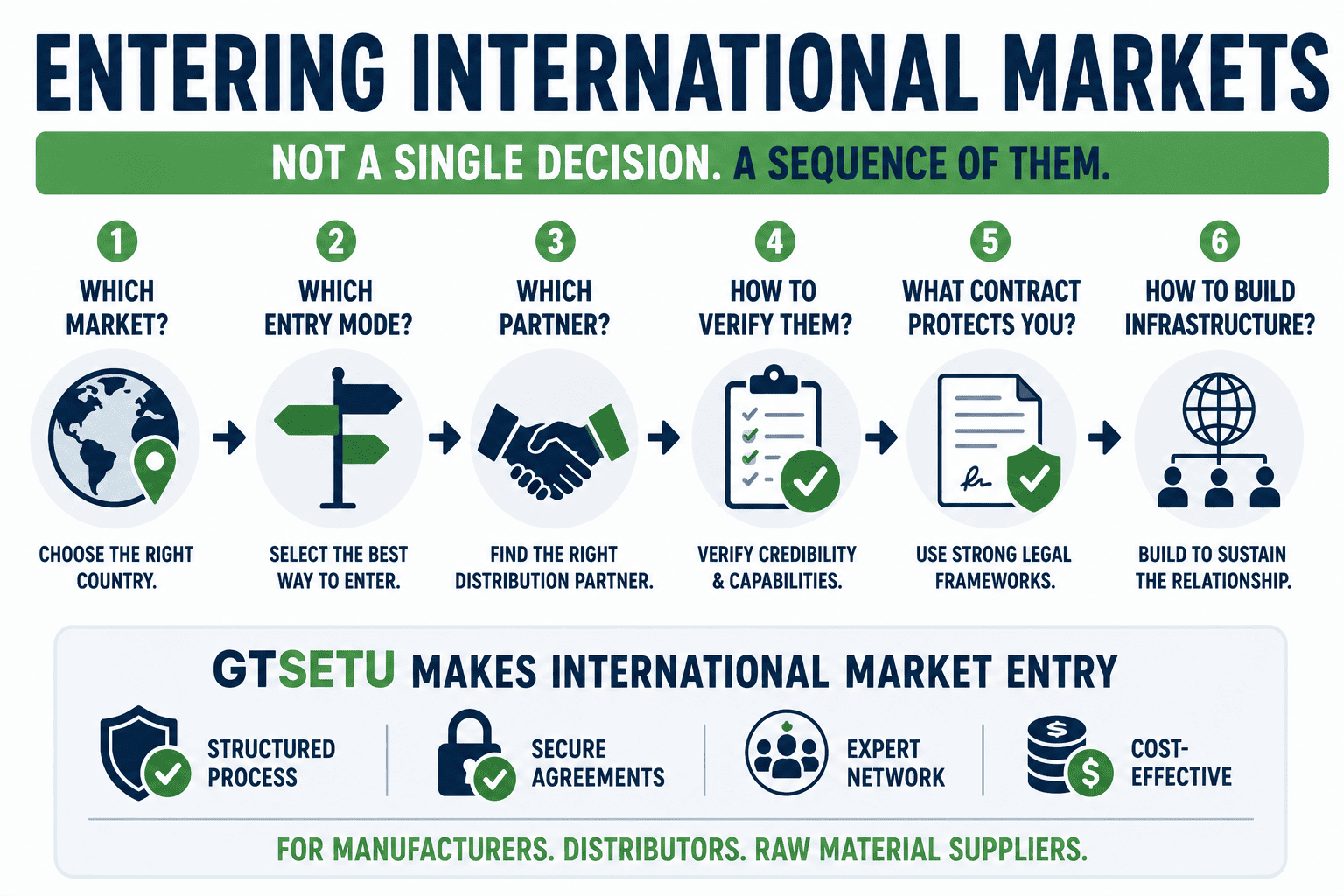
Entering an international market is not a single decision, it is a sequence of them. Which market, which entry mode, which partner, how to verify them, what contract protects you, and how to build the infrastructure to sustain the relationship. This guide covers every layer of that process: from choosing your market entry strategy and finding verified distribution partners, to the legal frameworks that protect cross-border agreements and the platform and expert network GTsetu provides to make international market entry structured, secure, and cost-effective for industrial manufacturers, distributors, and raw material suppliers.
📅 May 10, 2026⏱ 18 min read✍️ GTsetu Editorial🔄 Updated regularly
100+
Countries on GTsetu
500+
Verified Companies
6-pt
Govt-Sourced Verification
0%
Commission on Partnerships
The decision to enter an international market is, for most manufacturers and distributors, one of the highest-stakes commercial decisions they make. The upside is access to markets many times larger than the domestic one. The downside, without the right preparation, can be sunk costs, reputational damage in a market you barely understood, and commercial relationships that dissolve under legal ambiguity.
What separates successful international market entries from failed ones is rarely the quality of the product. It is almost always the quality of the process: how partners were found and verified, how agreements were structured, how risk was allocated, and what infrastructure, technological, legal, and relational, was in place to support the relationship once it started.
GTsetu exists to provide that infrastructure for industrial businesses, manufacturers, distributors, and raw material suppliers, across 100+ countries. This guide explains both the strategic framework for international market entry and how GTsetu’s platform, expert network, and services make each stage of that journey more structured and less risky.
💡 Who this guide is for
This guide is written for Indian manufacturers seeking international markets, international distributors seeking Indian manufacturer principals, and industrial businesses at any stage of cross-border expansion, from first international enquiry to building a multi-country distributor network. It covers strategy, legal frameworks, and practical platform infrastructure.
Section 1
1 Why International Market Entry Is Different from Domestic Expansion
Domestic expansion, opening a new sales territory, onboarding a regional distributor, entering a new product category, operates within familiar legal, cultural, and logistical territory. International market entry does not. Every layer of the business relationship changes when you cross a border.
⚖️
Unfamiliar Legal Jurisdictions
Contract law, dispute resolution, intellectual property protection, and regulatory compliance are all jurisdiction-specific. What is standard in India may be unenforceable in a target market. Distributor agreements that seem straightforward domestically can have very different implications under foreign commercial law.
🔍
Partner Verification Is Harder
You cannot visit a prospective partner’s factory or office easily. Local business registry systems vary widely in accessibility and reliability. Self-reported profiles and email references are not sufficient due diligence when entering a market where a bad partner can cost you years of lost commercial opportunity.
🌐
Cultural and Commercial Norms Differ
Negotiation styles, relationship-building timelines, payment expectations, and what constitutes a binding commercial commitment all vary significantly by region. A process that works in one market may produce the wrong signals in another.
📦
Logistics and Compliance Complexity
Customs documentation, export compliance, Incoterms selection, product certifications for the destination market, and payment instrument selection (LC, advance, open account) all add layers of complexity that domestic trade does not involve.
🔒
Confidentiality Risk Is Higher
Sharing pricing, formulations, proprietary designs, or commercial strategies with a prospective international partner, before a formal agreement is in place, carries real risk. In the absence of a legally executed NDA and secure document infrastructure, sensitive information can be misused with limited legal recourse across borders.
💱
Currency and Payment Risk
Foreign exchange exposure, payment term negotiation, and credit risk management are all substantively more complex in international trade. A distributor with strong local market knowledge but poor financial standing can create significant cash flow problems for a manufacturer relying on them as the primary market entry vehicle.
These are not reasons to avoid international market entry. They are reasons to approach it with the right infrastructure, which is precisely what GTsetu is built to provide.
Section 2
2 Market Entry Modes: Choosing the Right Structure
Before finding a partner or signing a contract, the first strategic question is: what mode of market entry is right for your product, your capital position, and your risk appetite? The options exist on a spectrum from minimal commitment (indirect export) to maximum control and risk (wholly owned subsidiary).
🤝
Indirect Export via Local Distributor
You appoint a verified local distributor who buys your product and resells it in their market. They carry the market risk; you provide product, pricing, and support. The lowest-risk, most capital-efficient entry mode for most industrial manufacturers.
Best starting point for most manufacturers
🏢
Direct Export / Sales Agent
You sell directly to buyers in the target market through a local sales agent who earns commission. More control than a distributor model, but you carry inventory and credit risk. Works best when buyers are large and identifiable.
Medium capital, higher control
🏭
Joint Venture / Strategic Alliance
A formal partnership with a local company to share investment, market access, and operational risk. Deeper commitment than a distribution arrangement, requires more robust partnership contract frameworks and governance structures.
Higher complexity, shared risk
🌐
Licensing or Franchising
You license your brand, technology, or product formulation to a local manufacturer or business. Appropriate for IP-rich businesses but requires strong IP protection agreements and careful selection of licensee capability.
IP-dependent, low capital
🔧
Contract Manufacturing Abroad
You engage a local manufacturer to produce your products in the target country. Relevant for markets with high import duties or where local production is a requirement. Involves deep product transfer and quality assurance complexity. See our guide on OEM, ODM, and EMS models.
High complexity, production risk
🏗️
Wholly Owned Subsidiary / Greenfield
Full ownership of a local entity, maximum control, maximum capital commitment, and maximum regulatory complexity. Appropriate only after market validation through lower-commitment entry modes.
Maximum commitment and risk
📌 For most industrial manufacturers
The distribution partnership model, appointing a verified local distributor with a formally structured agreement, is the most appropriate first entry mode. It minimises capital at risk, leverages local market knowledge, and allows market validation before deeper investment. GTsetu is purpose-built to help manufacturers find, verify, and formalise those distributor relationships across 100+ countries.
Section 3
3 Finding and Verifying International Trade Partners
The most critical single decision in international market entry is partner selection. A strong distributor in a target market can make an average product succeed. A weak or dishonest one will guarantee failure, regardless of product quality. Yet most manufacturers approach partner discovery through the least rigorous channels available, trade directories, trade shows, and word-of-mouth referrals, without a systematic process for verification or evaluation.
The Partner Discovery and Verification Process
1
Define the Partner Profile Before You Search
Before engaging any prospective partner, define precisely what you need: target geography, required product category experience, minimum revenue or company scale, existing customer relationships, required certifications, and storage or logistics infrastructure. Without a clear profile, partner evaluation becomes subjective and slow. Use our partnership evaluation criteria framework to build your scorecard.
2
Use Verified Discovery Channels
RFQ directories surface volume but not verification. Trade shows provide face-to-face meetings but limited background checks. GTsetu provides a third option: a verified B2B discovery platform where every company is verified on 6 government-sourced points (Name, Address, Registration Number, Company Status, Company Type, Date of Incorporation) before engagement. You can browse partner profiles anonymously across 100+ countries without revealing your own commercial strategy until mutual interest is confirmed. See our B2B matchmaking tool guide for more on how verified platform discovery works.
3
Conduct Structured Due Diligence
Government-sourced verification confirms identity and legal standing. Beyond that, due diligence should cover: existing product portfolio and category fit, current customer base and geographic reach, financial stability (payment history, credit references), warehouse and logistics capability, sales force structure, and existing competing or complementary lines. GTsetu’s verification covers the foundational identity layer; operational due diligence is the next layer that manufacturers must conduct independently or through an international business development consultant.
4
Execute NDA Before Sharing Commercial Information
Before sharing product specifications, pricing structures, margin expectations, or proprietary formulations, a Non-Disclosure Agreement must be in place. GTsetu’s platform provides a built-in digital NDA workflow with timestamped signatures, so sensitive commercial information is shared within a legally executed confidentiality framework from the first interaction, not as an afterthought.
5
Pilot Before Committing to Exclusivity
Where possible, begin with a non-exclusive arrangement or a defined pilot period before granting territorial exclusivity. Performance milestones, minimum purchase volumes, and review timelines should be built into the structure from the start. See our detailed guide on manufacturer-distributor contract structures for how to build these provisions in.
6
Build the Distributor Network Systematically
Single-country entry is rarely the goal. Once you have validated your market entry model in one geography, the same partner discovery, verification, and agreement framework scales to adjacent markets. GTsetu’s coverage across 100+ countries means the same platform and process can support a multi-region distributor network build-out. Read our guide on building a distributor network for the full strategic framework.
Section 4
4 Manufacturing Arrangement and Product Strategy
International market entry often requires rethinking how your products are manufactured, branded, and positioned, not just who sells them. The manufacturing and product arrangement you choose has direct implications for IP protection, quality control, cost structure, and the type of partner relationships you can form.
OEM, ODM, and EMS: Which Model Fits Your International Strategy?
If you are entering markets where local production is advantageous, due to import duties, logistics costs, or buyer preferences for locally manufactured goods, you may need to engage a contract manufacturer in the target market. Understanding the difference between OEM, ODM, and EMS models is essential before structuring that relationship. Our detailed guide on OEM vs ODM vs EMS manufacturing models covers the distinctions, risk profiles, and contractual implications of each.
White Label vs. Private Label: Branding Strategy for International Markets
For manufacturers entering markets where brand establishment is resource-intensive, white label or private label arrangements with local distributors can accelerate market entry. The distributor sells your product under their own brand, reducing the investment required to build brand recognition in a new geography. The trade-offs, margin, IP exposure, dependency, are significant and need careful structuring. Read our guide on white label vs. private label manufacturing to understand which model suits your international strategy and how to protect your interests in either arrangement.
✅
White Label: Rapid Market Penetration
Your product is sold under the distributor’s or retailer’s brand. Faster market entry, no brand investment required, but your brand builds no equity in the market.
✅
Private Label: Controlled Branding
Products are manufactured to your spec but sold under a proprietary brand owned by your buyer. Better for building long-term channel loyalty, requires clearer IP structuring.
✅
OEM: Your Design, Their Brand
You manufacture to the buyer’s specifications under their brand. Maximum production utilisation, minimal market risk, but lowest strategic leverage and margin.
✅
Own Brand Export: Maximum Long-Term Value
You enter the market under your own brand through a local distribution partner. Highest brand equity and margin over time, requires the most investment in partner quality and agreement structure.
Section 5
5 Legal Framework: Contracts, NDAs, and Risk Allocation
The quality of your legal framework is not a formality, it is the primary mechanism by which you protect commercial value across borders. Most international market entry failures that are attributable to partner relationships are, at their root, failures of legal and contractual structure. The right agreements, executed before commercial engagement begins, are what separate recoverable problems from permanent losses.
🔐 Non-Disclosure Agreement (NDA)
The first legal instrument in any international partnership, executed before pricing, product specs, or commercial strategies are shared. Should cover scope of confidentiality, duration, remedies for breach, and governing law. GTsetu’s platform provides built-in NDA workflow as a starting point; jurisdiction-specific legal review is recommended for high-value relationships.
The core commercial agreement governing your relationship with a distribution partner. Key provisions include: territory definition (exclusive or non-exclusive), performance milestones and minimum purchase commitments, pricing and discount structure, IP usage rights, termination provisions, and dispute resolution mechanism.
Cross-border agreements must explicitly allocate risk across the key dimensions of international trade: currency fluctuation, regulatory change, quality disputes, logistics failures, and geopolitical disruption. Ambiguity in risk allocation is the primary source of commercial disputes in international trade relationships.
Force majeure clauses protect both parties when extraordinary events, pandemics, natural disasters, regulatory bans, geopolitical crises, make performance impossible. The scope, definition, notification requirements, and consequences of force majeure vary significantly and must be explicitly defined rather than assumed from standard templates.
Where market entry involves sharing proprietary technology, software, or process IP with a partner, a technology partnership agreement governs the scope, duration, and protection of that transfer. Critical for manufacturers entering markets through licensing or joint venture structures.
If your international market entry involves establishing local supply chain relationships, sourcing raw materials, engaging logistics partners, or building local warehousing, each relationship needs a structured commercial agreement defining responsibilities, service levels, and risk allocation.
⚠️ The most common legal mistake in international market entry
Sharing product specifications, pricing, or commercial strategies with a prospective partner before any legal agreement is in place. In domestic markets, informal trust is often sufficient. In cross-border relationships, where legal recourse is expensive and jurisdiction-dependent, every material commercial disclosure should be preceded by an executed NDA. GTsetu’s platform enforces this sequence by building NDA execution into the engagement workflow before any sensitive document exchange occurs.
Cross-Border Partnership Structures
Beyond bilateral distributor agreements, some international market entries involve more complex partnership structures, joint ventures, technology alliances, co-manufacturing arrangements, or multi-party supply agreements. Each structure requires a distinct legal framework. Our comprehensive guide on cross-border business partnerships covers the full spectrum of partnership types, their structural requirements, and the governance frameworks that make them durable.
Section 6
6 Building Your International Supply Chain Infrastructure
A market entry partnership is only as strong as the supply chain infrastructure behind it. Your distributor can open doors, but if your product arrives late, in the wrong documentation, with quality inconsistencies, or at a landed cost that destroys their margin, the relationship will not survive the first year regardless of how well the commercial agreement is structured.
Key Supply Chain Decisions for International Market Entry
Incoterms selection. Whether you ship Ex-Works, FOB, CIF, or DDP determines where risk transfers, who handles logistics, and how your landed cost is perceived by the distributor. The right Incoterm depends on the distributor’s logistics capability and your willingness to control the export process.
Payment terms and instruments. Letter of Credit provides the strongest payment security but adds cost and processing time. Open account is faster but transfers credit risk to you. Advance payment is most secure but may deter distributors. The right structure depends on market norms, relationship stage, and the distributor’s financial standing.
Product certification for destination markets. CE marking for Europe, FDA registration for the US, BIS for certain product categories in India, destination market regulatory compliance is not optional and should be researched before committing to market entry timelines.
Lead time and MOQ alignment. International distributors carry inventory risk. If your minimum order quantities are misaligned with their capital position or storage capacity, order frequency will be low and market coverage will be inconsistent. Early negotiation of MOQ and lead time expectations is essential to a functional supply chain relationship.
Local warehousing and fulfilment. In markets where delivery speed is a competitive factor, having product locally stocked, either at the distributor’s premises or in a shared logistics facility, may be a prerequisite for market viability.
Finding the right supply chain partner in a target market, a logistics provider, customs broker, or third-party warehousing operator, is itself a partner selection and verification challenge, distinct from but parallel to finding a commercial distribution partner.
International Wholesale Distributors and Network Architecture
For manufacturers building coverage across multiple markets or a large geographic territory, the architecture of your international wholesale distributor network matters as much as the quality of individual partners. A well-structured network defines geographic territories clearly, avoids inter-distributor conflict, maintains price integrity across markets, and provides the manufacturer with consolidated market intelligence from multiple regions simultaneously. Our guide on building and managing a distributor network covers the architecture decisions, governance frameworks, and operational tools required to make a multi-country distribution network function.
Section 7
7 Region-by-Region Considerations
International market entry strategy is not uniform across regions. The factors that determine entry complexity, partner profile requirements, regulatory environment, and commercial relationship norms vary significantly by geography. The following is a high-level orientation to the key considerations for the markets most commonly targeted by Indian manufacturers and distributors.
🇦🇪
Middle East & GCC
High import activity, strong agent and distributor culture, regulatory requirements vary by emirate and country. Relationship-first commercial culture, trust establishment before formal agreement is the norm.
High opportunity for Indian manufacturers
🌍
Africa (Sub-Saharan & North)
Fast-growing markets with strong demand for industrial and consumer goods. Partner verification is critical, business registry systems vary in reliability. Payment risk management (LC preferred for new relationships) is essential.
High growth, higher due diligence need
🇪🇺
Europe (EU)
Stringent regulatory compliance (CE marking, REACH for chemicals, product liability). Buyers expect documented quality systems. Longer relationship-building timelines but durable once established. High value per unit.
High compliance requirement
🌏
South-East Asia
Diverse regulatory environments across ASEAN. Singapore as a regional hub for distribution. Strong manufacturing base creates both competition and co-manufacturing opportunity. Generally open to Indian supplier relationships.
Strong regional hub potential
🇺🇸
North America
Contract-first commercial culture, due diligence expectations are high. FDA, UL, and other certifications often mandatory. Distributor and rep agreements must be carefully structured to protect manufacturer’s rights under US commercial law.
High certification requirement
🌏
Australia & New Zealand
English-language markets with high product safety standards, transparent business environment, and strong purchasing power. Regulatory compliance (Australian Standards, TGA for some products) is a prerequisite for market entry.
Transparent, high-value market
💡 GTsetu covers all of these regions
Verified manufacturers and distributors across all the regions above are discoverable on GTsetu’s platform. Anonymous browse lets you assess partner profiles in any target geography before revealing your own commercial interest. The same verification, NDA, and document-sharing infrastructure applies regardless of which country you are entering.
Section 8
8 GTsetu’s International Market Entry Platform and Expert Network
GTsetu provides three interconnected layers of international market entry support for industrial businesses: a verified B2B partnership platform, a network of international market entry experts, and structural commercial infrastructure. Together, these address the primary failure modes of international market entry: wrong partner, inadequate verification, insufficient legal framework, and no infrastructure for confidential collaboration.
🌍 Platform & Expert Network
GTsetu: International Market Entry Infrastructure for Manufacturers, Distributors, and Industrial Businesses
GTsetu is not a directory and not a consultant referral service. It is a verified B2B partnership platform with an integrated expert network, built specifically for industrial businesses (manufacturers, distributors, raw material suppliers) navigating international market entry. Every company on the platform is verified on 6 government-sourced points before engagement. Every partnership begins with anonymous discovery. Every information exchange is protected by a built-in NDA workflow. And every document is shared through an encrypted workspace with a complete audit trail. Zero commission on any partnership formed.
🏛️
6-Point Government-Sourced Verification
Name, Address, Registration Number, Company Status, Company Type, and Date of Incorporation, verified via government tie-ups. The identity foundation every international partnership needs before commercial engagement begins.
🕵️
Anonymous Partner Discovery
Browse verified manufacturer and distributor profiles across 100+ countries without revealing your own identity or commercial strategy. You control when and to whom you disclose your interest.
📄
Built-In NDA Workflow
Digital NDA with timestamped signatures is executed before any sensitive commercial information, pricing, specifications, market strategy, changes hands. Not an afterthought. Built into the engagement sequence.
🔐
Encrypted Document Workspace
Product specs, pricing structures, and commercial proposals shared through AES-256 encrypted channels with a full access audit trail. No email attachments. No open links. Full control over who has seen what and when.
🧑💼
Market Entry Expert Network
Access to international business development consultants and market entry specialists across key geographies, for manufacturers who need more than a platform and require on-the-ground expertise, regulatory navigation, or localised commercial strategy support.
🌍
100+ Country Coverage
Verified companies across Asia, Middle East, Europe, Africa, Australia, and the Americas. Not a domestic directory. A global industrial partnership network with the verification and confidentiality infrastructure that cross-border relationships require.
🤝
Partnership Lifecycle Support
From discovery and due diligence to NDA execution, commercial negotiation, and ongoing partnership management, GTsetu supports the full lifecycle of international trade relationship formation, not just the initial introduction.
🚫
Zero Commission
No success fee, no broker commission, no deduction from deal value, ever. Every rupee or dollar of commercial value from a partnership formed through GTsetu stays entirely between you and your partner.
The Expert Network: When You Need More Than a Platform
Not every international market entry challenge can be solved with a platform. Some require on-the-ground expertise: regulatory navigation in a specific country, commercial strategy advice for a category or market you have not operated in before, or structured international business development consulting to identify and prioritise target markets before committing to entry. GTsetu’s expert network connects industrial businesses with specialists who have direct market-entry experience in the geographies and categories most relevant to industrial manufacturers and distributors, complementing the platform’s verification and partnership infrastructure with human expertise where it is needed most.
Section 9
9 Common Mistakes in International Market Entry
The failures of international market entry are remarkably consistent across industries, geographies, and company sizes. The following are the most commonly observed, and most avoidable, mistakes.
❌
Selecting a Partner Based on Enthusiasm, Not Evidence
A distributor who responds quickly, speaks excellent English, and expresses strong enthusiasm for your product is not necessarily the right partner. Enthusiasm without verified commercial track record, financial stability, and relevant market relationships is a leading indicator of disappointment, not success.
❌
Granting Exclusivity Before Validating Performance
Locking a territory to a single partner before that partner has demonstrated their ability to develop the market is one of the most expensive and hardest-to-reverse mistakes in international market entry. Structure initial agreements with performance milestones and time-limited exclusivity review clauses.
❌
Sharing Commercial Information Before NDA Execution
Sending a price list, product formulation, or commercial proposal before a legally executed NDA is in place is standard practice in many domestic commercial cultures, and a serious risk in international ones. Legal recourse for IP misuse across borders is expensive, slow, and uncertain. The NDA comes first.
❌
Using a Domestic Contract Template for an International Agreement
A distributor agreement drafted under Indian commercial law may be unenforceable in a target market, or may have provisions that inadvertently create obligations that differ from what was intended. International agreements require jurisdiction-specific review.
Product certifications, labelling requirements, import restrictions, and sector-specific regulatory standards in the destination market are not optional. Discovering regulatory non-compliance after a first shipment has arrived, or after a distributor has pre-sold product to their customers, is an expensive mistake that damages the partner relationship and your market entry timeline simultaneously.
❌
Treating Market Entry as a One-Time Event
International market entry is a process, not a milestone. Markets evolve, partners’ capabilities change, regulatory environments shift, and competitive dynamics require adaptation. Manufacturers who treat the appointment of a distributor as the completion of market entry rather than the beginning of a managed commercial relationship consistently underperform those who invest in ongoing partner development.
FAQ
? Frequently Asked Questions
QWhat is the best market entry strategy for Indian manufacturers going global?
For most industrial manufacturers, the distributor partnership model, appointing verified local distributors in target markets, is the lowest-risk, most capital-efficient entry mode. It leverages local market knowledge, minimises upfront capital commitment, and allows commercial validation before deeper investment. GTsetu is built specifically to help manufacturers find, verify, and formalise those distributor relationships across 100+ countries, with government-sourced partner verification, NDA workflows, and encrypted document infrastructure. See our guide on partnership evaluation criteria for how to select the right distributor once you have identified candidates.
QWhat does GTsetu’s international market entry service include?
GTsetu provides three layers of support: (1) a verified B2B partnership platform where manufacturers and distributors across 100+ countries are verified on 6 government-sourced points, enabling anonymous partner discovery, NDA execution, and encrypted document sharing; (2) an international market entry expert network providing on-the-ground advisory, international business development consulting, and market-specific strategic guidance; and (3) commercial infrastructure, zero commission on partnerships formed, full audit trail on document sharing, and a partnership lifecycle support framework from first contact through agreement formation.
QHow do I find verified international distributors for my products?
GTsetu’s platform provides a verified discovery channel for international distributors across 100+ countries. Every company is verified on 6 government-sourced points before appearing on the platform. You can browse anonymously, without revealing your identity, until you are ready to express interest. Once mutual interest is confirmed, an NDA is executed digitally before any commercial information is shared. This is structurally different from trade directories and RFQ platforms, which surface volume buyer enquiries rather than verified long-term distribution partners. See our guide on building a distributor network for the broader strategic framework.
QWhat legal agreements do I need for international market entry?
At minimum: an NDA before sharing any proprietary commercial information, a distributor or agency agreement governing the commercial relationship (territory, exclusivity, performance commitments, IP use, termination), and risk allocation clauses covering force majeure, currency, regulatory change, and quality disputes. If your entry involves technology transfer or manufacturing arrangements, additional agreements covering those elements are required. Our guides on manufacturer-distributor contracts, risk allocation in cross-border deals, and force majeure in global trade cover each element in detail.
QWhat is the difference between OEM, ODM, and private label for international market entry?
OEM (Original Equipment Manufacturer) means you produce to the buyer’s design specification under their brand. ODM (Original Design Manufacturer) means you design and manufacture products that the buyer brands as their own. Private label means your products are sold under a distributor’s or retailer’s brand with your manufacturing behind it. Each model has different implications for IP exposure, margin structure, and brand equity. Our guides on OEM vs ODM vs EMS and white label vs private label manufacturing cover the full strategic and contractual implications of each.
QHow does GTsetu’s partner verification work?
GTsetu verifies every company on the platform on 6 government-sourced data points using government tie-ups: company Name, registered Address, Registration Number, Company Status (active or inactive), Company Type (private, public, etc.), and Date of Incorporation. This forms the verified identity foundation for every engagement. Operational due diligence, production capability, financial standing, sales force capacity, certifications, is self-declared by companies and must be independently verified by users as part of their own partner evaluation process. GTsetu’s verification significantly reduces identity and registration fraud risk; it does not replace commercial due diligence.
QWhat regions does GTsetu cover for international market entry?
GTsetu has verified manufacturers and distributors across 100+ countries, covering Asia-Pacific, the Middle East and GCC, Africa (Sub-Saharan and North), Europe, North America, South America, and Australasia. The platform and its verification, NDA, and document-sharing infrastructure operate uniformly across all geographies. Market entry experts in GTsetu’s network provide region-specific advisory where local knowledge of regulatory environment, commercial norms, or distributor landscape is needed alongside the platform’s discovery and verification capabilities.
Ready to Enter International Markets with the Right Partner and Infrastructure?
GTsetu gives industrial manufacturers, distributors, and raw material suppliers the verified partnership platform, expert network, and commercial infrastructure to make international market entry structured, secure, and sustainable, across 100+ countries, with zero commission on partnerships formed.
They represents the product, and research team behind GTsetu, a global B2B collaboration platform built to help companies explore cross-border partnerships with clarity and trust. The team focuses on simplifying early-stage international business discovery by combining structured company profiles, verification-led access, and controlled collaboration workflows.
With a strong emphasis on trust, and disciplined engagement, Team GTsetu shares insights on global trade, partnerships, and cross-border collaboration, helping businesses make informed decisions before entering deeper commercial discussions.