Limitations of Partner Discovery Methods: Why Traditional Approaches Fail B2B Trade | GTsetu
Home ›
Blogs ›
Limitations of Partner Discovery Methods
🔍 Partner Discovery & B2B Trade Strategy
Limitations of Partner Discovery Methods: Why Traditional Approaches Fall Short in B2B Trade
Direct Answer: The core limitations of traditional partner discovery methods, cold outreach, trade directories, trade shows, broker networks, and B2B marketplaces, are: absence of identity verification (most targets are self-reported with no government-source validation); poor commercial fit matching (keyword searches and manual browsing replace multi-criteria algorithmic scoring); no confidentiality framework (sensitive commercial data is shared before any NDA exists); geography and time constraints (trade shows are event-specific, brokers are regionally concentrated, cold outreach lists are unvalidated); and high cost of failure (misrepresented or fraudulent partners cause severe commercial and reputational damage). Each of these limitations is structural, not operational, they cannot be fixed by trying harder within the same method. They require a fundamentally different approach: a verified, AI-assisted matchmaking platform like GTsetu, which verifies companies on six government-sourced points, matches on commercial criteria, and protects sensitive data through built-in NDA workflows and encrypted workspaces, with zero broker commissions across 100+ countries.
📅 June 10, 2026⏱ 22 min read✍️ GTsetu Editorial Team🔄 Updated regularly
<5%
Cold Outreach Response Rate
43%
Manufacturers Shared Data with Unverified Partners
5
Traditional Methods Analysed
0%
GTsetu Broker Commission
Every manufacturer looking for an international distributor and every distributor seeking a new manufacturer principal faces the same challenge: finding the right commercial partner from a global pool of candidates, without exposing market strategy, without sharing sensitive commercial data prematurely, and without investing months of effort into conversations that produce no agreement.
The traditional methods used to solve this problem, cold email campaigns, trade directory searches, trade show attendance, broker relationships, and B2B marketplace listings, have been the default toolkit for decades. They work, to a degree. But each one carries structural limitations that are rarely examined critically: limitations in verification, in matching quality, in confidentiality protection, in geographic coverage, and in the cost of the failures they produce. This guide examines every major limitation of traditional partner discovery methods in detail, from the specific failure modes of each approach to the cross-cutting weaknesses they share, and explains what a structurally different approach, verified AI-assisted matchmaking, does to address each one. For broader context on cross-border business partnerships, distributor networks, and supply chain partnerships, the linked guides provide complementary analysis.
💡 Who This Guide Is For
This guide is written for manufacturers seeking international distributors, distributors seeking manufacturer principals, procurement leaders managing strategic supplier discovery, business development executives evaluating partner outreach strategy, and anyone who has used traditional partner discovery methods and experienced the limitations first-hand. It is also relevant for organisations evaluating whether to move from traditional discovery to a verified matchmaking platform. For related topics, see our guides on partnership evaluation criteria and international business development consulting.
SECTION 1
1 What Is Partner Discovery and Why It Matters
🎯 Definition
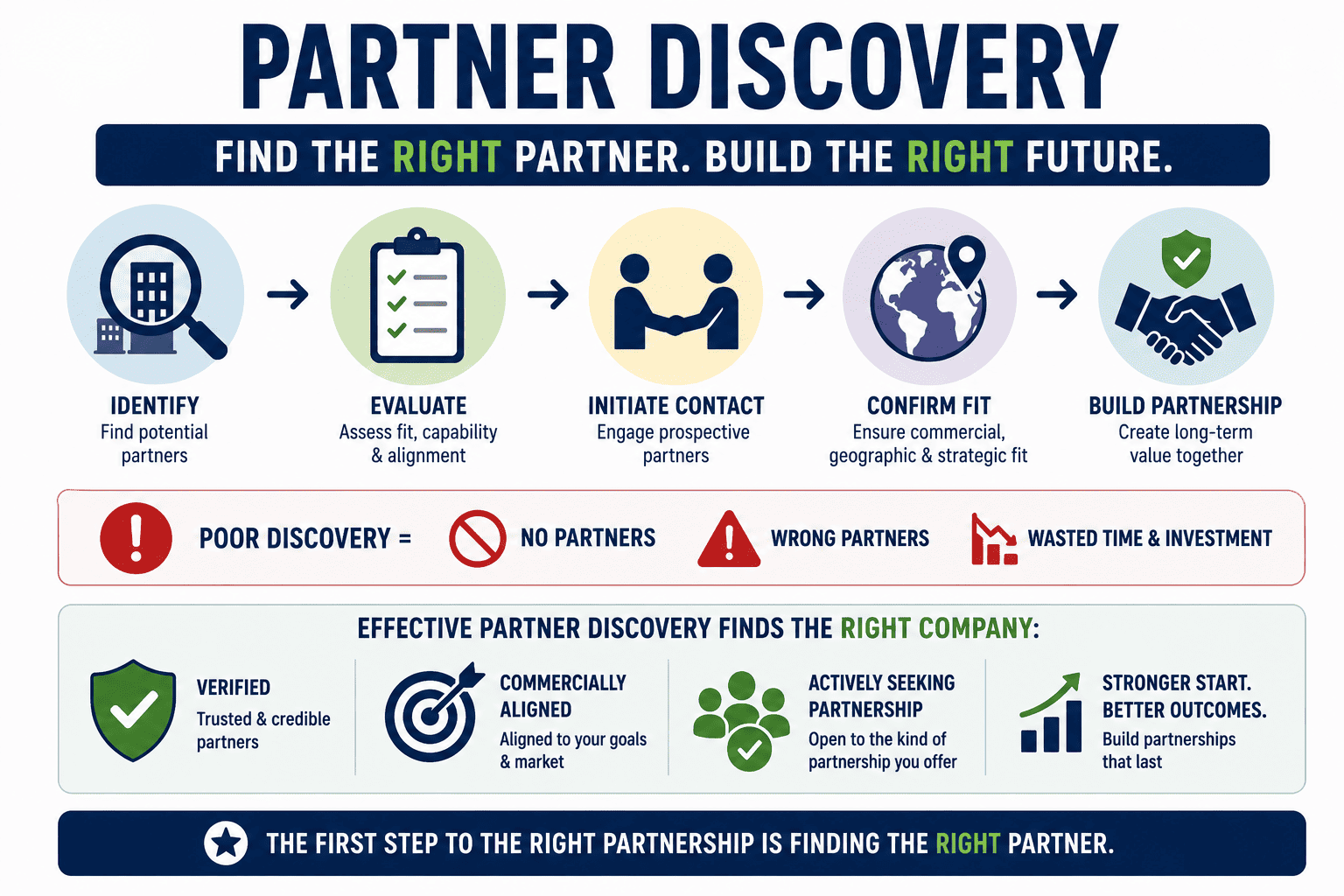
Partner discovery is the process by which a business identifies, evaluates, and initiates contact with prospective commercial partners, distributors, manufacturers, suppliers, licensees, technology partners, or joint venture counterparties, who have the commercial profile, geographic coverage, product expertise, and strategic intent to form a viable long-term trade relationship. It is the first and most consequential phase of the partnership formation lifecycle: a poor partner discovery process produces either no partners, or worse, the wrong partners, whose misalignment becomes apparent only after significant commercial investment. Effective partner discovery is not just about finding companies that exist in a target category, it is about finding the right company, verified, commercially aligned, and actively seeking the type of partnership you are proposing.
Partner discovery sits at the top of the partnership funnel. Every subsequent stage, evaluation, negotiation, agreement, and commercial operation, depends on the quality of the companies that discovery surfaces. When discovery produces unverified, misaligned, or fraudulent candidates, the downstream costs are severe: wasted negotiation time, premature disclosure of sensitive commercial information, failed launches, and legal disputes. When discovery is done well, producing verified, commercially fit, mutually interested candidates, the remaining stages of partnership formation proceed with substantially lower friction and higher success rates.
The Partnership Formation Lifecycle and Where Discovery Sits
🔍
Discovery
Identify and surface candidate partners from the available universe.
⚠️ Discovery Failures Are Expensive and Hard to Reverse
Unlike negotiation failures, which produce wasted time but no binding commitment, discovery failures that reach the agreement stage produce binding legal arrangements with the wrong partner, market positions that are difficult to unwind, and reputational damage in the target market that persists after the failed partnership is terminated. Getting discovery right is the highest-leverage investment in the entire partnership formation process. The limitations of traditional methods make this investment harder than it should be. See: risk allocation in cross-border deals and business partnership contract guide.
SECTION 2
2 Overview: The Five Traditional Partner Discovery Methods
Before examining their limitations individually, it is useful to understand what the five traditional partner discovery methods are, what they were designed to do, and what their fundamental operating assumption is, because each limitation flows directly from a mismatch between what the method was designed for and what effective partner discovery actually requires.
📧
Cold Outreach
High Volume, Low Signal
📚
Trade Directories
Stale & Unverified
🏛️
Trade Shows
Time-Limited & Costly
🕴️
Broker Networks
Commission-Heavy
🛒
B2B Marketplaces
Transaction-Focused
Method
Designed For
Operating Assumption
Core Limitation for Partnership Discovery
Cold Outreach
Sales lead generation at volume
A percentage of unqualified contacts will respond and convert
Partner discovery requires quality and fit, not volume; cold outreach optimises for the opposite
Trade Directories
General business contact lookup
Companies that appear in directories exist and are legitimate
Directory listing is self-reported and requires no verification; data goes stale rapidly
Trade Shows
Industry networking in a concentrated format
Physical proximity in the same sector creates commercial opportunity
Proximity does not equal commercial fit; relationships are event-specific without persistent infrastructure
Broker Networks
Leveraging a human intermediary’s relationship capital
A trusted broker’s existing relationships produce better candidates than independent search
Broker incentives (commission on deal value) are misaligned with your goal of finding the best fit, not the most profitable deal for the broker
B2B Marketplaces
Product-level transactional sourcing
Companies that list products for sale are legitimate trading entities
Marketplaces are built for transactions, not strategic partnerships; listing requires no verification; no confidentiality framework exists
SECTION 3
3 Limitations of Cold Outreach for Partner Discovery
Cold outreach, unsolicited email, phone, or LinkedIn campaigns directed at prospective trade partners, is the most widely used partner discovery method and the one with the most extensively documented limitations. It was designed for sales lead generation, where volume compensates for low response rates. Partner discovery has fundamentally different requirements, and applying a volume-based tool to a quality-based problem produces predictable failures.
📧
Cold Outreach for Partner Discovery
Designed for lead generation; applied to strategic partnership formation
Cold outreach for partner discovery rests on a flawed assumption: that the right partner can be identified from a list, contacted before any verification or fit assessment, and converted through communication quality alone. In practice, the fundamental limitations of this approach are structural and cannot be resolved by better copywriting or more aggressive sequencing.
Sub-5% Response Rate
The average unsolicited B2B cold email response rate is below 5%. For partnership proposals, which require higher trust and longer evaluation than a product sale, effective response rates are often lower still. The implication: to generate 10 qualified conversations, a manufacturer must contact 200+ unverified companies, investing significant personalisation time per contact with most of it wasted.
No Pre-Verification of Targets
Cold outreach lists are built from directories, LinkedIn, web scraping, or purchased databases, none of which require government-source verification. A manufacturer cold-emailing 200 prospective distributors has no confirmed knowledge of which are legitimate, currently active, financially solvent, or actually distributing in the target territory.
Market Strategy Exposure
Every cold outreach email reveals that the sender is considering the recipient’s market, category, or geography. If the recipient is a competitor’s distributor, a direct competitor, or simply an indiscreet company, the manufacturer’s expansion plans are now visible in the market before any commercial foothold is established.
No Fit Confirmation Before Contact
Cold outreach requires the sender to invest time and risk exposure before knowing whether the target has any interest in a new supplier relationship, capacity to distribute the product, or commercial alignment with what is being offered. Fit is discovered through the process, not before it, making every touchpoint an expensive blind probe.
No Confidentiality Framework
Cold conversations that progress to information exchange do so through email, with no NDA in place, no audit trail, and no access controls. Manufacturers routinely share pricing, product specifications, and margin structures with cold contacts who have not executed any confidentiality agreement, creating unprotected disclosure of commercially critical data.
High Scaling Cost
Effective cold outreach personalisation requires 20–60 minutes of research per prospect to achieve response rates meaningfully above baseline. At scale, targeting 20 markets with 10 prospects per market, this represents 200+ hours of research investment before a single qualified conversation begins, much of which is wasted on unresponsive or unfit targets.
Core Verdict
Cold outreach is a volume-optimised tool applied to a quality-optimised problem. Its structural limitations, no pre-verification, no fit confirmation, market strategy exposure, no confidentiality, and below-5% response rates, make it a high-cost, high-risk method for identifying strategic trade partners. It can generate awareness of your existence among prospective partners, but it cannot reliably identify which of those partners is verified, commercially aligned, or genuinely seeking the type of relationship you are proposing.
SECTION 4
4 Limitations of Trade Directories and B2B Listings
Trade directories, from industry-specific databases to national chamber of commerce member lists to general business registries, are often the starting point for partner discovery. They offer the appearance of a comprehensive, curated list of potential partners. In practice, their limitations are fundamental to how they are built and maintained.
📚
Trade Directories and B2B Listings
A phonebook, not a matching engine; tells you who exists, not who is the right fit
The fundamental architecture of a trade directory is a self-reported, manually maintained, passively browsed list of entities that have paid to appear or been included by a data aggregator. Each element of this architecture produces a specific limitation for partner discovery purposes.
Self-Reported, Unverified Data
Any company can submit a listing to most trade directories. The company name, address, product categories, certifications, and operational claims are provided by the company itself and are typically not validated against any government registry, financial record, or third-party source. A directory listing proves that someone filled in a form, nothing more.
Rapid Data Staleness
Directory data deteriorates quickly. Companies change address, cease trading, change ownership, add or drop product lines, and alter their market focus constantly. Most directories do not have real-time validation against current company registry data, meaning a significant proportion of any given directory’s listings refer to companies whose details are materially outdated, sometimes by years.
No Commercial Fit Matching
A directory search returns companies matching a category or keyword. It does not score results by commercial fit: whether the company’s size is appropriate to your volume requirements, whether their geographic coverage matches your target territory, whether they are actively seeking new partnerships, or whether their product portfolio has capacity for your category without cannibalisation. The browsing and filtering work is done entirely by the searcher.
No Indication of Partnership Availability
A directory listing tells you a company exists. It does not tell you whether that company already has an exclusive arrangement with your competitor in your target market, whether they have sufficient commercial bandwidth to take on a new principal, whether they are actively seeking new supplier relationships, or whether their owners are even engaged in the business anymore.
No Confidentiality Infrastructure
Directory contact leads to direct outreach, typically unprotected email or phone conversations in which commercially sensitive information is shared before any NDA is in place. The directory provides the contact; it provides no framework for what happens next from a confidentiality or security perspective.
High Manual Screening Cost
A keyword search for “FMCG distributors in Southeast Asia” might return 500 entries. Screening 500 unverified, potentially stale listings to identify 20 genuinely viable partnership candidates requires hours of manual research per company, website visits, LinkedIn checks, news searches, and often direct calls, the majority of which produces nothing actionable.
Core Verdict
Trade directories were designed for contact lookup, not partnership formation. They tell you who exists in a category; they cannot tell you who is verified, commercially fit, available for a new partnership, actively seeking your type of relationship, or safe to share sensitive commercial information with. Using a directory as the primary source for international distributor or manufacturer discovery means the most consequential decisions in the process are made based on the least reliable data.
SECTION 5
5 Limitations of Trade Shows and Industry Events
Trade shows remain one of the most popular partner discovery tools for manufacturers and distributors, particularly in sectors like FMCG, pharmaceuticals, industrial equipment, and technology. The appeal is intuitive: a concentrated gathering of industry participants in one place, at one time, with the explicit purpose of commercial engagement. The limitations, however, are significant and structural.
🏛️
Trade Shows and Industry Events
High-cost, time-limited, geography-restricted, and structurally unsuited to verified partnership formation
Trade shows concentrate commercial networking into a narrow window. This creates efficiency in some dimensions, many potential contacts in one place, but introduces structural constraints that make them a poor primary vehicle for verified, quality-first partner discovery at global scale.
Severe Time Constraint
A trade show runs for two to four days. Partner discovery, qualification, and initiation must happen in this window or be deferred entirely. Meaningful first conversations at a stand rarely exceed 15 minutes. Building the trust and information exchange necessary to advance toward a serious partnership proposal in this format is structurally difficult, most trade show relationships are at the contact stage, not the qualified prospect stage, when the event ends.
Geographic Bias
Trade show attendees are concentrated in the event’s host market and in markets with strong industry representation. A European FMCG trade show produces strong European contacts; it does not produce a balanced view of distributor capability in Southeast Asia, Sub-Saharan Africa, or South America. Manufacturers seeking truly global distributor coverage cannot replicate that through any single event or regional event calendar.
High Participation Cost
Booth rental, stand build, travel, accommodation, and staff time make a major international trade show one of the most expensive partner discovery channels per qualified contact produced. For manufacturers in early internationalisation stages, the cost-per-conversation at a major trade fair is often four to ten times the cost of a verified digital platform contact, for conversations of equivalent or lower commercial quality.
No Identity Verification of Contacts
Anyone with a trade show badge can approach your stand. There is no verification that the person claiming to be the regional director of a major distributor holds the role they claim, that their company is active and solvent, or that they have any authority to make partnership commitments. Trade show contacts are entirely self-reported, the same fundamental limitation as trade directories, with the added pressure of real-time conversation.
No Persistent Partnership Infrastructure
When the trade show ends, the relationship exists only in email inboxes and business card stacks. There is no persistent platform maintaining the connection, no secure document exchange environment, no NDA workflow, and no audit trail. Most trade show follow-up fails, not because the initial conversation lacked commercial promise, but because neither party has a structured, secure infrastructure to advance the relationship through the post-event stages efficiently.
Unstructured Networking Quality
Even with pre-scheduled meetings, trade show networking is materially more random than algorithm-driven matching. You meet the companies that happen to attend the same event, in the same booth proximity, who are available at the same time, not necessarily the companies that are the best commercial fit for your partnership criteria. The serendipity that sometimes produces valuable contacts is not a reliable discovery mechanism at scale.
Core Verdict
Trade shows produce awareness and first contacts. They do not produce verified, commercially assessed partnership candidates at global scale. Their value is highest when used as a relationship-building tool after the right partners have already been identified through a verified discovery process, not as the primary discovery mechanism. Using them as the latter makes every major commercial partnership dependent on who happened to attend the same event. See: B2B matchmaking tool guide for how structured pre-event matching changes this dynamic.
SECTION 6
6 Limitations of Broker and Agent Networks
Broker and agent networks, human intermediaries who leverage existing relationships to connect manufacturers with distributors, buyers with suppliers, or licensors with licensees, are among the oldest partner discovery mechanisms in international trade. They offer real advantages: existing trust with both parties, local market knowledge, and the ability to make warm introductions that produce genuine engagement. Their limitations are equally real and often more consequential.
🕴️
Broker and Agent Networks
Warm relationships at the cost of misaligned incentives, geographic concentration, and opaque selection criteria
Brokers provide genuine value when their relationship network overlaps precisely with your target market and your partnership requirements. The structural limitations emerge from their business model, geographic concentration, and the inherent opacity of human-intermediated candidate selection.
Misaligned Commercial Incentives
Brokers are typically compensated on a commission basis, a percentage of the deal value of any partnership they facilitate. This creates a structural incentive to present the introduction that produces the largest or fastest commission, not necessarily the introduction that produces the best long-term commercial partner. A broker who has a warm relationship with a large distributor will present that distributor as a candidate even when a smaller, more focused specialist distributor would be a better operational fit for your product category.
Geographic and Relationship Concentration
Any individual broker’s network is geographically and sectorally concentrated, typically around the markets and relationships they have built over their career. A broker with strong relationships in Germany and the Benelux cannot introduce you to the best distributor in Malaysia or Brazil. Manufacturers seeking global distributor coverage need multiple brokers across multiple markets, multiplying both cost and management complexity.
Opaque Candidate Selection
When a broker presents you with three distributor candidates, the criteria by which those three were selected from the broader universe of possibilities are not transparent. The broker’s selection reflects their existing relationships, their assessment of which introduction is most likely to close (and generate commission), and potentially preferences shaped by other client relationships, not a systematic, multi-criteria assessment of commercial fit.
Long-Term Dependency and Cost
Commission structures on distribution partnerships can mean paying a percentage of every order placed through that partnership for its entire duration, not just for the initial introduction. In a high-value, multi-year distribution relationship, broker commissions can represent a significant portion of total partnership economics, permanently reducing the margin available to both the manufacturer and distributor for market investment. See: manufacturer-distributor contract structures.
No Scalable Candidate Pool
A broker’s usable network is finite, bounded by the relationships they personally maintain. Unlike a verified platform with 500+ companies across 100+ countries, a broker can realistically draw on a few dozen active relationships per market. When those relationships do not include the right candidate for your specific criteria, the broker’s usefulness is exhausted, but you may not discover this until significant time and initial fee investment has already been made.
No Confidentiality Infrastructure
Brokers frequently brief multiple parties in parallel about the same opportunity to identify which one generates the fastest response. Your market entry plans, pricing, and product strategy may be shared with multiple distributor candidates simultaneously, with no NDA in place between any of them and you, and no audit trail of who received what information and when. This is a structural confidentiality risk inherent to the brokerage model.
Core Verdict
Broker networks offer warm introductions and local market knowledge, both genuinely valuable. Their structural limitations, commission-based incentive misalignment, geographic concentration, opaque candidate selection, and absence of confidentiality infrastructure, make them unreliable as a primary partner discovery mechanism when precision, global coverage, and cost efficiency are required. GTsetu’s zero-commission model structurally eliminates the incentive misalignment problem. See: international wholesale distributors guide.
SECTION 7
7 Limitations of B2B Marketplaces
B2B marketplaces, Alibaba, IndiaMART, TradeIndia, Made-in-China, and dozens of sector-specific equivalents, are the default starting point for many manufacturers and buyers seeking commercial partners. They offer apparent advantages: massive participant pools, searchable product listings, and established digital infrastructure. For strategic trade partnership discovery, however, their architecture produces structural limitations that are not immediately obvious to first-time users.
🛒
B2B Marketplaces (Alibaba, IndiaMART, and Equivalents)
Built for product transactions; applied to strategic partnership formation, a fundamental mismatch
B2B marketplaces were architecturally designed for a different problem than strategic partnership formation. Their listing model, verification approach, and engagement infrastructure are optimised for transactional sourcing, finding a product at a price, not for identifying a long-term, strategically aligned trade partner whose credentials have been independently validated.
Paid Visibility, Not Verified Legitimacy
Marketplace “verified supplier” badges are commercial products, companies pay for them. They do not represent government-source validation of company name, registration number, legal status, or operational authenticity. A company can display a “Gold Supplier” or “Verified” badge while being a recently registered entity with no operational history, trading under a misrepresented identity, or acting as a middleman falsely claiming to be the manufacturer.
High Fraud Incidence
B2B marketplace fraud is extensively documented: advance-payment fraud, where payment is received and goods are never shipped; identity fraud, where a legitimate company’s identity is cloned by a fraudulent listing; quality fraud, where samples are genuine but bulk orders are substituted with inferior goods; and ghost manufacturer fraud, where a trader presents as a manufacturer with no production capability. These are not edge cases, they are endemic to platforms where listing requires payment, not government-source verification.
Transaction Architecture, Not Partnership Architecture
Marketplaces are built for RFQ (Request for Quotation) workflows, a buyer specifies a product, suppliers bid for the business, a transaction occurs. This architecture has no mechanism for expressing or discovering partnership intent: whether a distributor is seeking a new principal, whether a manufacturer is seeking an exclusive distribution partner, or whether either party is interested in a multi-year strategic relationship rather than a single order.
No Confidentiality Framework
All marketplace communication occurs through the platform’s messaging system or direct email, both entirely unprotected. Manufacturers sharing product specifications, pricing, and market strategy with marketplace contacts before any NDA is executed have no legal protection against that information being used, copied, or shared by the recipient. Many manufacturers do not realise there is no confidentiality infrastructure until a problem occurs.
No Commercial Fit Matching
Marketplace searches return products and suppliers by category and price, not by commercial fit for a partnership. A search for “FMCG distributors” returns companies that have listed in that category, sorted by advertising spend or platform algorithm, not by whether they have the right geographic coverage, the right size, the right existing portfolio, or genuine availability for a new exclusive principal relationship.
Commission on Transactions
Many B2B marketplaces charge platform fees or transaction commissions on orders placed through the platform. For a strategic distribution partnership generating regular orders over multiple years, these transaction costs compound into a significant permanent cost on every commercial interaction, a structural tax on the partnership economics that persists for the relationship’s duration.
Core Verdict
B2B marketplaces are built for commodity sourcing, not strategic partnership formation. Their fundamental mismatch with partnership discovery requirements, no government-source verification, no confidentiality framework, no commercial fit matching, high fraud incidence, and transaction-centric architecture, makes them a structurally inappropriate tool for manufacturers seeking long-term distribution partners or distributors seeking verified manufacturer principals. Using them for strategic partnership discovery inverts the correct risk hierarchy: proceeding on the assumption of legitimacy until fraud is discovered, rather than requiring verification as a precondition for engagement. See our comparisons: alternatives to marketplace-sourced wholesale distributors.
SECTION 8
8 Cross-Cutting Limitations Shared by All Traditional Methods
Each traditional partner discovery method has specific limitations unique to its architecture. But there are also cross-cutting limitations that all five methods share, structural deficiencies that apply regardless of which method you are using or how skillfully you apply it.
🔓
Limitation 1, Absence of Government-Source Identity Verification
None of the five traditional methods require that a prospective partner’s identity be validated against an official government company registry before engagement begins. Cold outreach targets are unverified. Directory listings are self-reported. Trade show badges require only a registration form. Broker introductions are based on personal trust, not official records. Marketplace badges are paid products. The result is that the entire traditional partner discovery process operates on the assumption of legitimacy, proceeding as if the other party is who they claim to be until evidence emerges that they are not. GTsetu verifies six core company attributes through government tie-ups before any company enters the matching pool.
Universal
🤖
Limitation 2, No Multi-Criteria Commercial Fit Scoring
Traditional methods identify candidates. They do not score them against the multi-criteria commercial fit requirements that determine whether a partnership is viable: geographic coverage match, company size complementarity, product category expertise, partnership intent alignment, existing portfolio conflict assessment, and financial capacity. The burden of fit assessment falls entirely on the discovering party, who typically lacks the information needed to make these assessments accurately before significant time is invested in early conversations. For context on what good fit assessment looks like, see: partnership evaluation criteria.
Universal
🕵️
Limitation 3, No Anonymous Discovery Capability
In every traditional method, expressing interest in a prospective partner reveals your identity and your market intentions to that party, and potentially to others. A cold email reveals you are considering their market. A trade show conversation reveals your product category and expansion ambitions. A broker briefing may reach multiple parties simultaneously. There is no mechanism in any traditional method for a manufacturer to research prospective partners in a target market without those parties, or the broader market, becoming aware of the manufacturer’s intentions. Anonymous discovery, available on platforms like GTsetu, structurally eliminates this exposure.
Universal
📄
Limitation 4, No Built-In Confidentiality Framework
Every traditional method leads to information exchange through unprotected channels, email, phone, or in-person conversation, before any NDA is executed. The typical sequence is: discovery, first conversation, enthusiasm, information sharing, NDA discussion (eventually, if at all). The commercially correct sequence is: discovery, NDA execution, information sharing. In practice, the absence of a built-in confidentiality workflow in traditional methods means the NDA step is regularly skipped, deferred, or forgotten, leaving sensitive pricing, product specifications, and market strategies unprotected in the hands of unverified counterparties. See: business partnership contract guide.
Universal
🌍
Limitation 5, Geography and Scale Constraints
Each traditional method has inherent geographic limitations: cold outreach lists are only as global as the databases they are built from; directories are concentrated in markets with strong digital infrastructure; trade shows attract attendees from specific regions; broker networks are bounded by personal relationship geography; marketplaces are concentrated in high-volume manufacturing markets. None of them provides equal-quality discovery access across all 100+ countries where viable trade partners may exist. Manufacturers seeking truly global partner discovery cannot achieve it through any combination of traditional methods at acceptable cost and quality.
Structural
⏱️
Limitation 6, High Time-to-First-Qualified-Conversation
Across all five traditional methods, the time from initiating discovery to having a first qualified, commercially substantive conversation with a verified, fit partner is measured in weeks or months, not days. Cold outreach requires list building, personalisation, sending, waiting for responses, and qualifying respondents. Directories require browsing, screening, and manual due diligence. Trade shows require event attendance and post-event follow-up. Brokers require briefing, waiting for candidate identification, and being introduced. The aggregated timeline means that a manufacturer initiating distributor discovery through traditional methods should expect three to six months to reach a first serious conversation with a qualified candidate in a single market. GTsetu’s pre-verified, pre-matched pool compresses this to days.
Structural
SECTION 9
9 The Real Cost of Poor Partner Discovery
The limitations of traditional partner discovery methods are not merely inconveniences, they produce quantifiable commercial, legal, and reputational costs when they lead to bad outcomes. Understanding these costs establishes the business case for moving to a verified, structured discovery approach.
67%
of B2B trade partnerships fail within 18 months, most due to misaligned expectations set during discovery
43%
of manufacturers report having shared sensitive commercial information with a partner later found to be unverified or misrepresented
$2.1M+
average value of a mid-tier manufacturer–distributor agreement, making bad discovery a high-stakes failure
Failure Type
Root Cause in Discovery
Direct Cost
Indirect Cost
Partnering with a fraudulent company
No identity verification before engagement or data sharing
Advance payments lost, goods not received, or counterfeit goods in market
Regulatory exposure in target market; brand reputation damage; legal costs
Premature disclosure of commercial strategy
No NDA before information exchange; no confidential platform
Competitor acquires pricing, specifications, or market entry plans
Loss of first-mover advantage; competitor pre-empts market entry; reduced negotiating leverage
Wrong partner selected (misaligned fit)
No multi-criteria fit scoring before selection; fit assessed only in negotiation
Launch investment with underperforming partner; opportunity cost of delayed market entry
Market position established with wrong channel partner; difficult to correct without damaging existing relationship; territory locked under exclusivity
Partner disputes without audit trail
All pre-contract communication through unstructured email with no timestamped record
Legal costs to reconstruct what was agreed and when
Relationship breakdown; market exit; reputational damage in target sector
Market strategy revealed pre-commitment
Cold outreach and broker briefings disclose target market before any NDA or exclusivity protection
Competitor distributors and manufacturers alerted to your market intentions
Reduced exclusivity negotiating position; increased competitive response in target market before launch
High broker commission on long-term partnership
Broker-facilitated introduction with ongoing commission on all subsequent orders
5–15% of total distribution revenue for partnership duration
Reduced investment available for market activation, co-marketing, and product support
⚠️ The Most Expensive Mistakes Happen After a Discovery Success
The most damaging discovery failures are not the obvious ones, an email that receives no response, a trade show that produces no useful contacts. They are the ones where discovery appears to succeed, a prospective partner expresses strong interest, conversations progress, enthusiasm builds, but the partner turns out to be misrepresented, misaligned, or fraudulent. These failures are more costly because they occur after significant time investment and, frequently, after sensitive commercial information has already been shared. The absence of verification and confidentiality infrastructure in traditional discovery methods means that a superficially successful introduction can cause more damage than no introduction at all. See: risk allocation in cross-border deals and force majeure in global trade.
SECTION 10
10 What Effective Partner Discovery Actually Requires
Understanding the limitations of traditional methods defines the requirements for an approach that does not share them. Effective partner discovery for strategic B2B trade relationships requires seven capabilities that traditional methods cannot provide individually or in combination.
🏛️
Government-Source Identity Verification
Every company in the candidate pool must be verified against official government registries, Name, Address, Registration Number, Company Status, Company Type, and Date of Incorporation, before any engagement begins. Paid badges and self-reported profiles are not a substitute.
🤖
Multi-Criteria AI Fit Scoring
Commercial fit must be assessed algorithmically across multiple weighted criteria, geography, industry, product category, company size, partnership intent, before human time is invested. The algorithm surfaces the highest-fit candidates; humans make the final decision. Not keyword search. Not manual browsing.
🕵️
Anonymous Discovery Capability
The discovering party must be able to browse candidate partners without revealing their identity, their target markets, or their partnership intentions until they choose to signal interest to a specific, fit candidate. Market strategy protection during discovery is non-negotiable.
📄
Built-In NDA Workflow
Confidentiality must be formalised as a structural requirement before any commercially sensitive information changes hands, not as an optional step left to the parties to arrange informally after enthusiasm has already overridden caution.
🔐
Encrypted, Audited Document Exchange
All commercial document exchange must occur in an encrypted, access-controlled environment with a full timestamped audit trail, not through open email or unprotected file-sharing links with no record of who accessed what and when.
🌍
Global Coverage Without Geographic Bias
Discovery quality must not degrade as a function of target geography. A verified candidate in Malaysia must be as discoverable, and as reliably verified, as a candidate in Germany. No single traditional method provides this. A verified global platform can.
🚫
Zero Commission on Partnership Formed
The discovery platform’s incentives must be fully aligned with finding the best partner, not the most financially valuable transaction. A platform that takes commission on deal value has a structural incentive misalignment with the manufacturer’s long-term interests. Zero commission eliminates this entirely.
💡 No Traditional Method Provides All Seven Requirements
Cold outreach provides none of these seven capabilities. Trade directories provide none. Trade shows provide none. Broker networks provide a partial approximation of warm introduction (which is not the same as verification) and geographic knowledge (which is not the same as fit scoring), but at misaligned commission cost. B2B marketplaces provide scale but fail on verification, confidentiality, fit matching, anonymity, and commission alignment. The only approach that can provide all seven is a purpose-built verified matchmaking platform, which is precisely what GTsetu was designed to deliver for manufacturers and distributors seeking international trade partnerships. See: B2B matchmaking tool guide, technology partnerships, and OEM vs ODM vs EMS for sector-specific partnership context.
SECTION 11
11 How GTsetu Overcomes Every Structural Limitation
🤝 Platform Spotlight, GTsetu
The Verified B2B Matchmaking Platform Built to Eliminate Every Limitation of Traditional Partner Discovery
GTsetu was built specifically because the five traditional partner discovery methods share structural limitations that cannot be fixed within those methods. Each feature of GTsetu’s platform directly addresses one or more of those limitations: government-sourced verification eliminates the unverified identity problem; AI-assisted multi-criteria matching eliminates the poor fit problem; anonymous discovery eliminates the market strategy exposure problem; built-in NDA workflows eliminate the no-confidentiality problem; AES-256 encrypted workspaces with full audit trails eliminate the unprotected data exchange problem; 100+ country coverage eliminates the geography constraint; and zero commission eliminates the incentive misalignment problem. GTsetu verifies companies on six key government-sourced points: Name, Address, Registration Number, Company Status, Company Type, and Date of Certificate of Incorporation.
🏛️
Solves: No Verification
6-point government-sourced verification (Name, Address, Registration Number, Company Status, Company Type, Date of Incorporation) through government tie-ups, mandatory before joining the platform.
🤖
Solves: Poor Fit Matching
AI-assisted multi-criteria scoring on verified profiles, industry, geography, product category, company size, and partnership intent, surfaces highest-fit candidates automatically.
🕵️
Solves: Strategy Exposure
Anonymous discovery across 100+ countries. Browse verified matches without revealing your identity or market intentions until you choose to signal interest to a specific candidate.
📄
Solves: No Confidentiality
Built-in NDA workflow with digital signatures, timestamped audit trail, and automatic triggering before the encrypted document workspace unlocks, structural, not optional.
🔐
Solves: Unprotected Data Exchange
AES-256 at rest, TLS in transit. All commercial documents in role-access-controlled, fully audited encrypted workspace, no open email, no unprotected file shares.
🌍
Solves: Geography Constraint
Verified manufacturers and distributors across 100+ countries, Asia, Middle East, Europe, Africa, Australia, Americas. Equal-quality discovery regardless of target geography.
🚫
Solves: Incentive Misalignment
Zero broker commission on any partnership formed, regardless of deal size. Platform incentives are fully aligned with finding you the best partner, not the most commercially valuable transaction for GTsetu.
📋
Solves: No Audit Trail
Every access event, NDA signature, document view, and communication timestamped and logged automatically, downloadable for compliance or legal purposes at any stage.
Traditional Methods vs. GTsetu: Limitation-by-Limitation Comparison
Limitation
Cold Outreach
Directories
Trade Shows
Brokers
Marketplaces
GTsetu
Identity verification
None
None
None
Personal trust only
Paid badge only
6-point govt. verification
Commercial fit matching
Manual, post-contact
Keyword only
Proximity only
Broker’s subjective view
Category / price only
AI multi-criteria scoring
Anonymous discovery
Not possible
Not possible
Not possible
Not possible
Not possible
Built-in, default
Built-in NDA workflow
Absent
Absent
Absent
Absent
Absent
Structural, timestamped
Encrypted document exchange
Open email
Open email
Open email
Open email
Platform messaging
AES-256 + full audit trail
Global coverage (100+ countries)
List-dependent
Partial
Event-geography limited
Network-geography limited
Concentrated markets
100+ countries, equal quality
Commission / fee on partnership
None
None
None
5–15% ongoing
Transaction fees apply
Zero, always
Time to first qualified conversation
Weeks–months
Weeks–months
Event-dependent
Weeks
Days–weeks
Days
Fraud risk
High
High
Moderate
Low–moderate
High
Structurally reduced
FAQ
? Frequently Asked Questions
QWhat are the limitations of traditional partner discovery methods?
The core limitations of traditional partner discovery methods, cold outreach, trade directories, trade shows, broker networks, and B2B marketplaces, are: (1) absence of government-source identity verification, meaning every prospective partner’s credentials are self-reported and unvalidated; (2) no multi-criteria commercial fit matching, meaning the burden of assessing whether a candidate is actually the right size, geography, and category fit falls entirely on the discovering party through manual research; (3) no anonymous discovery capability, meaning every enquiry reveals the discovering party’s market intentions; (4) no built-in confidentiality framework, meaning sensitive commercial information is regularly shared before any NDA is executed; (5) geography and scale constraints, meaning no single traditional method provides equal-quality discovery access across all viable global markets; and (6) high cost of failure, meaning that a bad discovery outcome that reaches the partnership agreement stage produces severe commercial, legal, and reputational consequences that are difficult to reverse. These limitations are structural, they cannot be fixed by applying traditional methods more skillfully, and they require a fundamentally different approach to resolve. GTsetu’s verified AI-assisted matchmaking platform was built to address each one.
QWhat are the limitations of cold outreach as a partner discovery method?
Cold outreach for partner discovery has six structural limitations: response rates below 5% for unsolicited B2B collaboration proposals; no ability to verify the identity or legitimacy of targets before investing outreach effort; no mechanism to confirm commercial fit before disclosing your interest in a target market; high cost of list building and personalisation at scale; no anonymous discovery, every outreach email reveals your expansion intentions to the recipient; and no confidentiality protection over information shared before an NDA is executed. Cold outreach was designed for sales lead generation, where volume compensates for low response rates. Partner discovery requires quality and fit, not volume. Applying a volume-based tool to a quality-based problem produces predictable, expensive failures, particularly when the target turns out to be misrepresented or fraudulent. See our full analysis in Section 3 of this guide.
QWhat are the limitations of trade shows for partner discovery?
Trade shows as a partner discovery method are limited by: severe time constraint (all relationship initiation must happen in two to four days); geographic bias (attendees are concentrated in specific markets, not globally distributed); high participation cost (booth fees, travel, accommodation, and staff time make the cost-per-qualified-contact significantly higher than digital alternatives); unstructured networking that produces mostly superficial contacts rather than verified, qualified partnership candidates; no identity verification of attendees; no confidentiality framework for conversations at stands; and no persistent partnership infrastructure after the event ends. The most significant limitation is structural: trade shows identify who happened to attend the same event, not who is the best commercial fit for your specific partnership criteria. For context on how structured pre-event matchmaking partially addresses this, see: B2B matchmaking tool guide.
QWhat are the limitations of B2B marketplaces for partner discovery?
B2B marketplaces have six core limitations for strategic partner discovery: (1) verification badges are commercial products, not government-source validations, a “verified supplier” badge proves someone paid the platform, not that the company is legitimate; (2) high fraud incidence is endemic to platforms where listing requires payment rather than verification; (3) transaction architecture means marketplaces are built for RFQ and product sourcing, with no mechanism for expressing or discovering partnership intent; (4) no confidentiality framework, all communication occurs through unprotected channels before any NDA; (5) no commercial fit matching, search results are sorted by advertising spend and platform algorithm, not by commercial fit for a strategic partnership; and (6) transaction fees that compound into significant permanent costs on long-term distribution relationships. The fundamental problem is that marketplaces were designed for commodity sourcing, not strategic partnership formation. Using them for the latter inverts the correct risk hierarchy, proceeding on the assumption of legitimacy until fraud is discovered. See also our comparisons with international wholesale distributors.
QWhat are the limitations of trade directories for partner discovery?
Trade directories as a partner discovery method are limited by: self-reported, unverified company information that any entity can submit without government validation; rapid data staleness as companies change address, ownership, and operational status without directories updating their records; no commercial fit matching, browsing a directory is manual, keyword-based work with no algorithmic scoring of fit; no indication of partnership availability (a directory does not tell you if the company already has an exclusive arrangement with your competitor); no confidentiality framework for subsequent communication; and high manual screening cost, a single directory search for a target category in a target geography may return hundreds of entries, each of which requires individual manual due diligence to assess viability. The fundamental problem is that a directory is a phonebook, not a matching engine. It tells you who exists in a category. It cannot tell you who is verified, commercially aligned, available for a new partnership, or safe to share sensitive commercial data with.
QHow does GTsetu overcome the limitations of traditional partner discovery?
GTsetu addresses each structural limitation of traditional partner discovery through specific platform architecture: (1) mandatory 6-point government-sourced verification (Name, Address, Registration Number, Company Status, Company Type, Date of Incorporation) through government tie-ups eliminates the unverified identity problem; (2) AI-assisted multi-criteria matching by industry, geography, product category, company size, and partnership intent eliminates the poor fit problem; (3) anonymous discovery across 100+ countries eliminates the market strategy exposure problem; (4) built-in NDA workflows triggered before the encrypted document workspace unlocks eliminates the no-confidentiality problem; (5) AES-256 encrypted workspaces with full timestamped audit trail eliminate the unprotected data exchange problem; (6) 100+ country coverage with equal verification quality eliminates the geography constraint; and (7) zero commission on any partnership formed eliminates the broker incentive misalignment problem. GTsetu compresses the time from initiating discovery to first qualified conversation with a verified, fit partner from weeks or months to days. See our related guides on distributor networks, supply chain partners, and cross-border business partnerships.
QCan traditional partner discovery methods be combined to overcome their limitations?
Combining traditional methods partially compensates for the limitations of each individual method: using a broker to warm-qualify directory leads reduces (but does not eliminate) the cold outreach response rate problem; attending trade shows creates face-to-face validation that partially compensates for directory data staleness. However, no combination of traditional methods addresses the cross-cutting structural limitations that all five share: the absence of government-source identity verification, the absence of anonymous discovery, the absence of a built-in confidentiality framework, and the absence of multi-criteria algorithmic fit scoring. These are not operational gaps that can be patched by using multiple traditional methods simultaneously, they are architectural gaps that require an architecturally different approach. The time, cost, and risk of operating a multi-method traditional discovery programme at global scale typically exceed the cost of a purpose-built verified platform, while still producing inferior verification quality and no confidentiality infrastructure. For specific partnership contexts, see: white label vs private label manufacturing, OEM vs ODM vs EMS, and technology partnerships.
Move Beyond Traditional Discovery: Find Verified Trade Partners with GTsetu
Join 500+ verified manufacturers and distributors across 100+ countries. AI-assisted partner matching on verified profiles, anonymous discovery, built-in NDA workflows, encrypted collaboration, and zero broker commissions, structured to eliminate every limitation of traditional partner discovery methods.
They represents the product, and research team behind GTsetu, a global B2B collaboration platform built to help companies explore cross-border partnerships with clarity and trust. The team focuses on simplifying early-stage international business discovery by combining structured company profiles, verification-led access, and controlled collaboration workflows.
With a strong emphasis on trust, and disciplined engagement, Team GTsetu shares insights on global trade, partnerships, and cross-border collaboration, helping businesses make informed decisions before entering deeper commercial discussions.