Collaboration Agreement vs Joint Venture: Key Differences, When to Use Each & Templates | GTsetu
Home ›
Blogs ›
Collaboration Agreement vs Joint Venture
⚖️ Partnership Structures & Trade Law
Collaboration Agreement vs Joint Venture: Key Differences, When to Use Each & Decision Framework
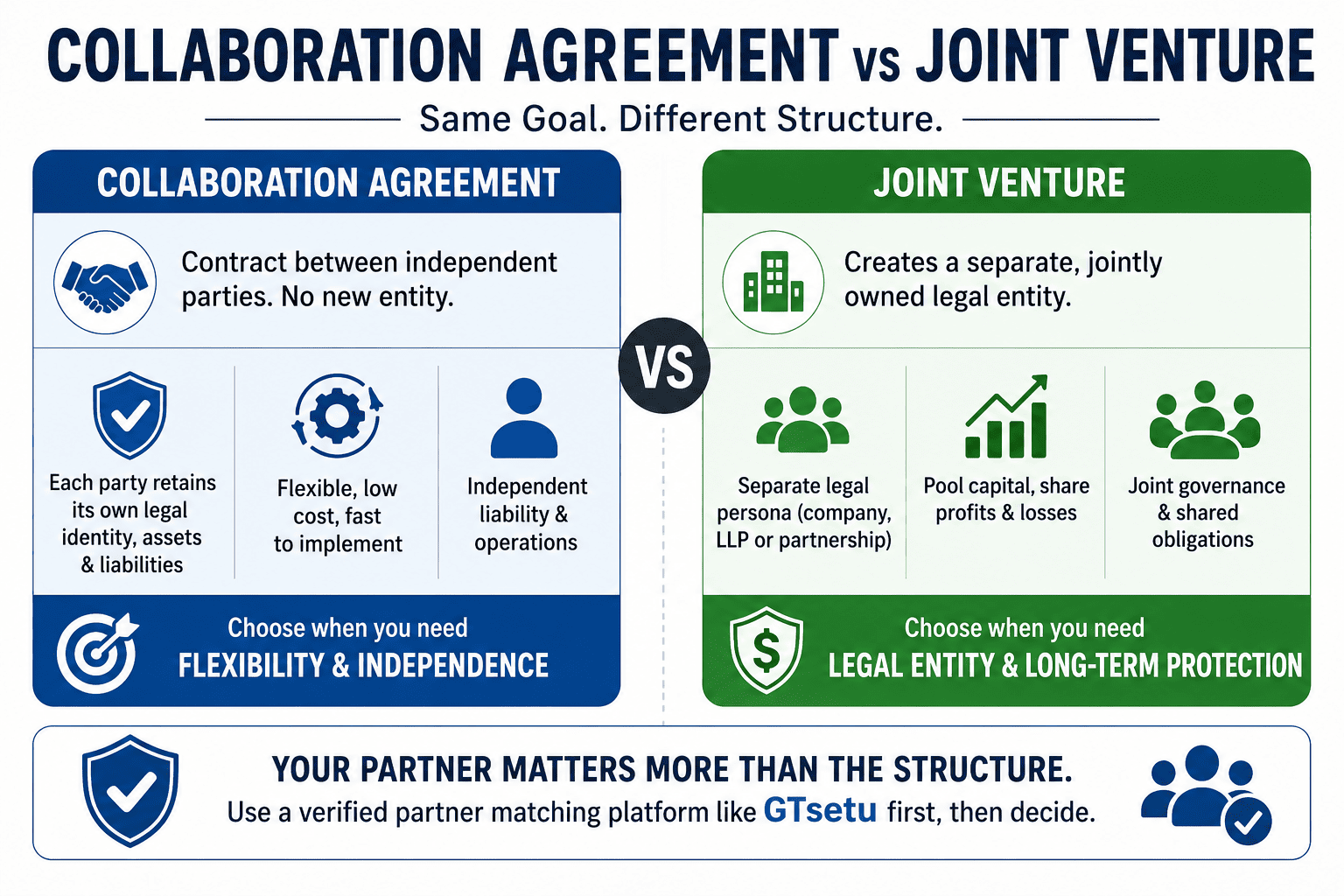
Direct Answer: A collaboration agreement is a contract between two or more independent parties who cooperate on a defined activity while each retaining their own legal identity, assets, and liabilities, no new entity is formed. A joint venture (JV) creates a separate, jointly owned legal entity, a company, LLP, or partnership, in which both parties pool capital, share profits and losses, and bear joint governance obligations. The core distinction is legal separateness: a collaboration agreement binds independent organisations through contract; a joint venture creates a new organisation that is distinct from both parents. Choose a collaboration agreement when you need flexibility, low formation cost, and independent liability. Choose a joint venture when you need a separate legal persona, equity-backed investment protection, and long-term shared governance. In both cases, the quality of the partner you choose is more consequential than the structure you use, which is why verified partner matching through a platform like GTsetu should precede the structural decision, not follow it.
📅 June 15, 2026⏱ 21 min read✍️ GTsetu Editorial Team🔄 Updated regularly
2
Structures Fully Compared
10+
Decision Dimensions Covered
100+
Countries on GTsetu
0%
GTsetu Partner Commission
Two companies want to work together. The commercial logic is clear, complementary capabilities, shared market ambitions, aligned incentives. But the moment lawyers enter the room, the conversation shifts to structure: should we use a collaboration agreement, or form a joint venture? The answer has major consequences for liability, tax, IP, governance, exit rights, and the amount of time and money invested before commercial activity can begin.
This guide provides a complete, dimension-by-dimension comparison of collaboration agreements and joint ventures, not as abstract legal concepts, but as practical tools for manufacturers, distributors, technology partners, and cross-border trade partners who need to choose the right framework for a specific commercial relationship. For context on related structures, see our guides on business partnership contracts, technology partnerships, and cross-border business partnerships.
💡 Legal Notice
This guide provides general commercial and strategic analysis of collaboration agreements and joint ventures for educational purposes. It does not constitute legal advice. The legal and tax implications of either structure vary significantly by jurisdiction, sector, and transaction-specific circumstances. Always engage qualified legal counsel in all relevant jurisdictions before structuring or executing either type of arrangement. For guidance on finding the right trade partners to structure such agreements with, GTsetu’s verified matchmaking platform is available at platform.gtsetu.com.
SECTION 1
1 Definitions: Collaboration Agreement vs Joint Venture
🎯 Core Distinction
The fundamental difference between a collaboration agreement and a joint venture is whether a new legal entity is created. A collaboration agreement is a contract, it binds two or more existing, independent legal entities to cooperate in a defined way, but neither entity changes its legal form and no new entity comes into existence. A joint venture is an entity, a new legal person (company, LLP, or contractual JV) jointly owned and governed by the founding parties, with its own assets, liabilities, contracts, and in most cases its own employees.
Structure A
Collaboration Agreement
A legally binding contract between two or more independent parties defining how they will cooperate on a specific project, activity, or commercial relationship, while each party retains its own legal identity, management structure, and balance sheet.
No new entity is formed. Each party remains independently responsible for its own obligations, assets, and liabilities. The agreement defines the scope of cooperation, the contribution of each party, IP ownership, revenue or cost sharing, confidentiality, and termination.
Common in: co-marketing, distribution relationships, technology licensing, contract manufacturing, co-development projects, and supply chain partnerships.
No new entityIndependent liabilityContractual onlyFaster to executeLower formation cost
Structure B
Joint Venture
A separate legal entity, typically a private limited company, LLP, or formal partnership, jointly owned by two or more parties who contribute capital, assets, technology, or know-how in exchange for an equity stake proportional to their contribution.
The JV entity has its own legal personality: it can hold assets, enter contracts, employ staff, open bank accounts, and incur liabilities in its own name. Profits and losses are distributed to the founding parties according to their equity stakes and the JV agreement.
Common in: manufacturing facilities, market entry into regulated jurisdictions, infrastructure co-investment, long-term product development, and asset-heavy commercial ventures.
New legal entityEquity-basedJoint governanceShared P&LHigher formation cost
Where Collaboration Agreements and Joint Ventures Overlap
The boundary between the two structures is not always sharp. A contractual joint venture (also called an “unincorporated joint venture”) uses contract rather than equity to define the relationship between parties who share profits, costs, and risk without forming a separate incorporated entity, making it structurally closer to a collaboration agreement while sharing some JV characteristics. Similarly, a collaboration agreement that involves substantial shared investment, joint hiring, and co-branded market presence may function commercially like a JV even if no entity is incorporated. The structural label matters less than the legal consequences in each specific jurisdiction. See also: global collaboration examples for real-world case types.
Characteristic
Collaboration Agreement
Contractual JV (Unincorporated)
Incorporated Joint Venture
New legal entity formed
No
No
Yes
Equity stakes defined
No
Sometimes (profit share % defined)
Yes, formal share ownership
Joint and several liability
Generally no, independent liability
Often yes, parties jointly liable
Limited to equity contribution (typically)
Own assets, bank accounts
No
Sometimes (jointly held)
Yes
Regulatory filing required
No (NDA may be required)
No (but tax registration may apply)
Yes, incorporation, annual filings
Formation cost
Low
Low–moderate
High
Exit complexity
Low (contractual termination)
Moderate
High (share transfer, dissolution)
SECTION 2
2 Legal Structure and Entity Formation
The legal structure dimension is the most fundamental difference between the two arrangements, and the one with the greatest downstream consequences for everything else covered in this guide. Understanding what “legal personality” means in each context is the foundation for every other comparison.
🏛️
Legal Structure and Entity Formation
Does a new legal person come into existence?
Collaboration Agreement
No new entity is created. Party A and Party B remain legally separate and independent. The collaboration agreement is a contract between them, it creates obligations between existing persons but does not create a new person. Each party continues to file its own tax returns, maintain its own accounts, hold its own assets, and employ its own staff. The agreement can be executed quickly, with minimal regulatory involvement, because no incorporation process is required. Formation can be completed in days once the commercial terms are agreed and lawyers have drafted and reviewed the contract.
Joint Venture
A new legal entity, most commonly a private limited company, is incorporated and jointly owned by the founding parties. This entity has its own legal personality: it can sue and be sued, hold property, employ staff, and enter contracts in its own name. Formation requires incorporation in the chosen jurisdiction, registration with the relevant company registry, appointment of directors, issuance of shares, opening of bank accounts, and in regulated sectors, obtaining licences in the JV entity’s name. This process typically takes weeks to months depending on jurisdiction, and involves legal, notarial, and registration fees before any commercial activity begins.
Implication
If you need to begin commercial activity quickly, the collaboration agreement’s lack of formation requirements is a major practical advantage. If you need the new venture to hold assets, employ staff, or be licensed in its own name, a JV’s incorporated entity is the appropriate structure, despite the higher formation cost and timeline. See: international business development consulting for jurisdiction-specific guidance on incorporation timelines.
SECTION 3
3 Liability: Who Is Responsible for What
Liability allocation is one of the most commercially significant differences between the two structures. It determines which party bears the financial and legal consequences of failures, claims, and obligations arising from the commercial relationship, and how exposed each party’s wider business assets are to those consequences.
⚖️
Liability and Risk Exposure
What happens when things go wrong, and who pays?
Collaboration Agreement
Each party is typically liable only for its own actions, obligations, and defaults under the agreement. Party A is not generally liable for Party B’s actions outside the collaboration scope. Liability between the parties is defined by the contract itself, including indemnification clauses, liability caps, and exclusion clauses. Third parties who deal with one party in the collaboration deal with that party directly and cannot ordinarily claim against the other party. This independent liability structure is one of the collaboration agreement’s most commercially attractive features: neither party’s wider balance sheet is exposed to the other’s business risks.
Joint Venture
In an incorporated JV, liability for the JV’s obligations is borne by the JV entity itself, the founding parties’ liability is generally limited to their equity contribution (similar to shareholder liability in any company). However, this protection can be pierced if the JV is undercapitalised, if founders have given personal guarantees to JV creditors, or if courts apply “lifting the corporate veil” doctrines. In an unincorporated (contractual) JV, the position is more complex: partners may be jointly and severally liable to third parties for the venture’s obligations, meaning one party can be pursued for the full liability of the venture regardless of their percentage share. This is a critical distinction that requires careful legal structuring.
Implication
For manufacturers engaging distributors, where each party operates independently in different markets, a collaboration agreement’s independent liability structure is typically more appropriate than a JV’s shared exposure. For a joint manufacturing facility where both parties’ actions create third-party liability risk (product liability, employment claims, environmental obligations), an incorporated JV with clear capitalisation provides better structural protection. See: risk allocation in cross-border deals.
SECTION 4
4 Governance, Decision-Making, and Control
How decisions are made, who has the right to make them, and what happens when the parties disagree are among the most practically important differences between the two structures. Governance failures, particularly in 50:50 joint ventures, are one of the leading causes of partnership breakdown. Understanding the governance architecture of each structure before committing is essential.
🏢
Governance and Decision-Making
Who controls what, and what happens when parties disagree
Collaboration Agreement
Each party governs itself. The collaboration agreement defines the scope of their cooperation and the decision-making processes for matters that affect both parties, but each party’s internal management, board, and operations remain entirely independent. Dispute resolution is contractual: the agreement will typically specify an escalation procedure (operational leads, then senior management, then mediation, then arbitration or litigation) for matters where the parties disagree on a collaboration-specific decision. Neither party has governance rights over the other party’s wider business. This independence is both a strength (clean separation) and a limitation (no mechanism to force cooperation beyond contractual obligations).
Joint Venture
The JV has its own governance structure: a board of directors (appointed by each founding party in proportion to their equity stake), a management team (which may be seconded from the founding parties or independently recruited), and defined reserved matters, decisions that require unanimous or supermajority approval rather than simple majority. The JV agreement must define: voting rights, quorum requirements, reserved matters requiring unanimity, deadlock resolution procedures (casting vote, buy-sell provisions, third-party mediation), dividend policy, and the conditions under which either party can appoint or remove directors. A poorly governed 50:50 JV with no deadlock provision is one of the most commercially dangerous structures in B2B trade.
Implication
For cross-border distribution relationships where each party manages its own market, a collaboration agreement’s independent governance is appropriate and efficient. For a manufacturing JV where both parties must approve capital expenditure, hiring, and product decisions, the JV’s formal governance structure provides the necessary framework, but only if deadlock provisions are drafted carefully. A 50:50 JV without a deadlock mechanism is a ticking clock. See: business partnership contract guide for governance clause frameworks.
SECTION 5
5 Intellectual Property Ownership
IP ownership is one of the most contested and consequential dimensions of any commercial partnership, and one where the structural choice between a collaboration agreement and a joint venture has major practical implications. Manufacturers sharing formulations, distributors developing local market adaptations, and technology partners co-developing products all need to understand how each structure treats IP created before, during, and after the collaboration.
💡
Intellectual Property Ownership
Who owns what, before, during, and after the collaboration
Collaboration Agreement
IP ownership is defined entirely by the contract. Pre-existing IP (IP each party brings into the collaboration) remains with the originating party, the collaboration agreement should grant the necessary licences for the collaboration’s purposes without transferring ownership. New IP created during the collaboration (background IP, foreground IP, and jointly developed IP) must be explicitly addressed: who owns it, who can use it, and what happens to it if the collaboration terminates. A well-drafted collaboration agreement creates a clear IP matrix covering all three categories. The risk of a poorly drafted agreement is that jointly created IP has ambiguous ownership, which becomes a dispute when the relationship ends. See: who owns tooling and moulds for a manufacturer-specific IP ownership framework.
Joint Venture
IP contributed to the JV entity by founding parties is typically licensed to (not transferred into) the JV, preserving each founder’s ownership of their contributed IP while giving the JV the right to use it. New IP developed by or for the JV is owned by the JV entity itself, not by either founding party individually. This has a critical implication: on exit, a departing party does not automatically take the JV’s IP with them. The JV agreement must specify what happens to IP on dissolution, exit, or change of control, whether it reverts to the contributor, is shared between the parties, or remains with the continuing JV. In technology partnerships and product development JVs, this IP disposition on exit is often the most contentious element of dissolution. See: technology partnership IP structures.
Implication
For partnerships where IP ownership clarity is paramount, particularly manufacturing, technology, and product development partnerships, the collaboration agreement’s contractual IP matrix (ownership defined explicitly in the contract between independent parties) is often cleaner than the JV structure’s entity-based IP ownership (new IP belongs to the entity, not the founders). However, a JV structure can be more appropriate when the parties want to pool IP into a jointly owned vehicle and share its commercial exploitation proportionally. Neither structure is inherently superior; the right choice depends on the nature of the IP and the parties’ long-term intentions for it.
SECTION 6
6 Tax Treatment and Financial Reporting
The tax treatment of collaboration agreements and joint ventures differs significantly, and the difference can materially affect the economics of the partnership. This is a jurisdiction-specific area where general analysis has limits; tax counsel in all relevant jurisdictions should be engaged before any structural decision is finalised.
💰
Tax Treatment and Financial Reporting
How profits are taxed and how the arrangement appears on each party’s accounts
Collaboration Agreement
Each party accounts for its own revenues, costs, and profits from the collaboration within its own financial statements. Revenue sharing, cost sharing, and contribution payments between the parties are treated as normal business income and expenditure in each party’s accounts. There is no separate financial reporting entity for the collaboration. Tax treatment depends on how the commercial flows are structured, service fees, royalties, cost-sharing, and revenue-sharing arrangements each have different tax treatment and may be subject to transfer pricing rules when the parties are in different tax jurisdictions. A collaboration agreement between parties in different countries must be reviewed for permanent establishment risk: if one party’s activities under the collaboration create a taxable presence in the other party’s jurisdiction, unintended tax liabilities can arise.
Joint Venture
An incorporated JV files its own tax returns, pays its own corporate tax on profits, and distributes after-tax profits to founding parties as dividends (subject to dividend withholding tax in many jurisdictions). The founding parties account for their JV investment as an equity investment on their balance sheets, recognising their share of JV profits or losses through equity accounting or as dividends received. Depending on jurisdiction and the founding parties’ percentage ownership, the JV may need to be consolidated into the accounts of the majority owner. JV losses can sometimes be shared with founding parties for tax purposes (in structures that permit flow-through taxation), but this depends entirely on the jurisdiction and entity type chosen. Transfer pricing rules apply to transactions between the JV and its founding parties.
Implication
Tax efficiency is not a one-size-fits-all argument for either structure. A collaboration agreement may be more tax-efficient when profits can be recognised directly in each party’s existing tax entity. A JV may be more efficient when it qualifies for tax incentives available only to locally incorporated entities, or when a specific jurisdiction’s tax treaty network benefits an incorporated structure. Always engage tax counsel in all relevant jurisdictions before deciding. See: cross-border business partnerships for jurisdiction-specific tax considerations.
SECTION 7
7 Exit Rights and Termination
How a partnership ends is as important as how it begins. The exit provisions of a collaboration agreement and a joint venture differ structurally, and the difficulty of exit is one of the most significant practical considerations when choosing between the two structures, particularly for partnerships expected to operate over multiple years.
🚪
Exit Rights and Termination
How the partnership ends, and at what cost
Collaboration Agreement
Termination of a collaboration agreement is a contractual process. The agreement will define the circumstances in which either party may terminate: expiry of the initial term, breach by the other party, insolvency, change of control, material adverse change, or termination for convenience with a defined notice period. On termination, the parties revert to their independent positions, no assets are jointly held (unless specifically co-invested), no employees are shared, and no entity requires dissolution. Post-termination obligations (confidentiality, IP licence termination, non-compete periods) are defined in the contract. Exit from a well-drafted collaboration agreement is generally faster, cheaper, and less disruptive to both parties’ wider operations than exit from a JV.
Joint Venture
Exit from an incorporated JV requires either sale of one party’s equity stake (subject to pre-emption rights, tag-along and drag-along provisions, and valuation mechanisms defined in the shareholder agreement), or dissolution of the JV entity (which requires settling all liabilities, distributing assets, and completing a formal winding-up process). Common exit mechanisms specified in JV agreements include: pre-emption rights (the continuing party has first right to buy the exiting party’s shares), put and call options (at pre-agreed valuations or using agreed valuation methodologies), Russian roulette clauses (either party can trigger a forced buy-sell at a stated price), and tag-along and drag-along rights. Exit is almost always more complex, more costly, and more time-consuming from a JV than from a collaboration agreement.
Implication
If there is any material uncertainty about whether the partnership will succeed or whether the parties will remain commercially aligned over the anticipated duration, the collaboration agreement’s lower exit cost and complexity is a significant advantage. A JV’s higher exit friction makes it more appropriate for long-term, high-investment partnerships where both parties are making a genuine commitment and have carefully assessed fit before committing. This is precisely why verified partner matching, confirming commercial alignment before structural commitment, is so important for JV candidates. See: partnership evaluation criteria.
SECTION 8
8 Foreign Collaboration vs Joint Venture
In the context of international trade and cross-border partnerships, the distinction between a foreign collaboration agreement and a joint venture with a foreign partner carries additional dimensions: foreign investment regulations, local incorporation requirements, technology transfer rules, and repatriation of profits all differ between the two structures and vary significantly by country.
🌍 Cross-Border Context
A foreign collaboration agreement is a contractual arrangement between a company in one country and a company in another for technology transfer, licensing, distribution, co-production, or supply, without forming a new jointly owned entity in either country. A joint venture with a foreign partner involves incorporating a new entity, typically in one of the partner countries, jointly owned by the domestic and foreign partners, subject to that country’s foreign investment regulations. Many emerging market jurisdictions have foreign ownership caps, local incorporation requirements, or mandatory technology transfer conditions that make the choice between these structures a regulatory necessity rather than a commercial preference. See: cross-border business partnerships guide for jurisdiction-specific context.
Dimension
Foreign Collaboration Agreement
Joint Venture with Foreign Partner
New entity in target country
No, parties remain in their home jurisdictions
Yes, JV entity incorporated in target jurisdiction
Foreign investment regulations
Generally not triggered (technology payments / royalties may require central bank approval in some jurisdictions)
Subject to foreign direct investment (FDI) regulations, ownership caps, and sector-specific restrictions
Technology transfer
Governed by the collaboration / licence agreement, technology stays with the foreign party, licences granted to local party
Technology may need to be licensed into or contributed to the JV entity, regulatory approval sometimes required
Profit repatriation
Royalties, fees, and payments remitted under the agreement, subject to withholding tax
Dividends from the JV entity to foreign founder, subject to dividend withholding tax and exchange controls
Local market presence
No local entity, market presence through the local partner’s existing entity
JV entity has local legal presence, can hold licences, employ local staff, enter local contracts in its own name
Applicable when local incorporation required
Not applicable, no local incorporation
Necessary when regulation requires local incorporation for the specific business activity (e.g., retail, defence, media in many jurisdictions)
Formation speed
Days to weeks (drafting and execution of agreement)
Weeks to months (incorporation, regulatory approvals, bank account opening)
Termination
Contractual, agreement expires or is terminated
Share sale, dissolution, or partner buyout, subject to local company law
⚠️ Regulatory Requirements Can Override Commercial Preference
In many jurisdictions, including India, China, Saudi Arabia, Indonesia, and several African markets, certain business activities require local incorporation, limiting foreign ownership percentages, or imposing mandatory local partner requirements. In these contexts, the choice between a foreign collaboration agreement and a joint venture is not purely commercial, it is dictated by regulatory requirements that must be researched before any structural commitment is made. Failing to comply with local FDI regulations can result in the arrangement being void, the parties being fined, or activities being prohibited. Always engage local legal counsel in the target jurisdiction before structuring any cross-border partnership arrangement. See: force majeure in global trade for how regulatory changes can affect established structures.
SECTION 9
9 Decision Framework: Which Structure to Choose
The decision between a collaboration agreement and a joint venture should be driven by the commercial, legal, and operational requirements of the specific partnership, not by familiarity with one structure or discomfort with the complexity of the other. The following decision tool maps the most common decision factors to the appropriate structural recommendation.
Decision Factor
→ Collaboration Agreement
→ Joint Venture
Will the commercial activity require a separately incorporated entity to hold assets, employ staff, or hold licences?
No, cooperation within existing legal structures
Yes, JV entity needs its own legal identity
Is the scope of cooperation defined and time-limited vs open-ended and long-term?
Defined scope, fixed term, specific deliverables
Open-ended, ongoing commercial operations
Are both parties committing substantial capital that requires equity-protected investment?
No major capital commitment or manageable within existing balance sheets
Yes, significant capital investment requires equity protection
Does the target jurisdiction require local incorporation for this type of commercial activity?
No regulatory requirement for local entity
Yes, local entity required by law or regulation
Is independent liability for each party’s obligations a priority?
Yes, parties want clean separation of liability
Shared liability acceptable or necessary for the venture type
How certain are you of long-term commercial alignment with this partner?
Uncertain, lower exit cost preferable at this stage
Does the venture involve jointly developing proprietary products or technology?
Limited IP development; clear IP ownership can be defined in a contract
Substantial co-development; pooled IP ownership in a shared entity appropriate
What is the required time and cost to begin commercial operations?
Fast and low-cost, begin commercial activity within days of signing
Longer timeline acceptable, weeks to months for formation and regulatory compliance
Will the venture need to hire its own employees and build its own team?
No, staff employed by each party individually and seconded to the collaboration
Yes, the venture needs its own employment contracts and HR infrastructure
Is proportional profit distribution based on equity stake a priority for both parties?
No, revenue or cost sharing defined contractually per the agreement
Yes, equity-based profit distribution provides the right governance framework
💡 The Most Common Pattern: Start with a Collaboration Agreement, Evolve to a JV
Many successful long-term joint ventures begin as collaboration agreements. The initial collaboration establishes whether the parties can work together effectively, whether commercial fit is as strong in practice as it appeared in assessment, and whether the market opportunity justifies the investment in a more permanent structure. If the collaboration proves successful, the parties then incorporate a JV, with far more confidence in the commercial basis and far less risk of the exit complexity materialising. Rushing to a JV structure before commercial compatibility is demonstrated is one of the most common and costly structural mistakes in international trade partnerships. See: global collaboration examples for case studies of this evolution in practice.
Collaboration Agreement vs Joint Venture: Comprehensive Comparison
Dimension
Collaboration Agreement
Joint Venture
New legal entity
No
Yes (incorporated or contractual)
Legal personality
Each party retains own legal identity
JV entity has separate legal personality
Liability
Independent, each party liable for own obligations
JV entity bears liability (limited to equity in incorporated JV); joint and several in unincorporated JV
Governance
Contractual cooperation, each party self-governed
Joint board, shared decision-making, defined reserved matters
IP created during partnership
Defined by contract, typically retained by creating party or shared as agreed
Typically owned by JV entity
Profit distribution
Revenue or cost sharing as defined in contract
Dividends proportional to equity stakes
Tax treatment
Each party accounts for its own P&L; collaboration payments treated as income/expenditure
JV pays its own tax; parties receive dividends (subject to withholding tax)
Financial reporting
No separate accounts; each party includes results in their own financials
JV files own accounts; founders equity-account their investment
Formation cost
Legal fees for drafting only, low
Legal fees + incorporation costs + regulatory filings, high
10 Common Structural Mistakes and How to Avoid Them
50%
of 50:50 joint ventures experience significant deadlock within the first five years
67%
of international partnership failures are attributed to misaligned expectations set before the structure was agreed
3–6×
higher exit cost from a JV vs a collaboration agreement when the partnership does not proceed as planned
🚩
Choosing a JV Before Confirming Commercial Fit
Committing to the cost and complexity of JV incorporation before the commercial partnership has been demonstrated in practice. A collaboration agreement first, evolving to a JV once the relationship is proven, is almost always the lower-risk path. See: partnership evaluation criteria.
🚩
A 50:50 JV Without a Deadlock Mechanism
Equal ownership with no casting vote, buy-sell provision, or third-party arbitration mechanism for deadlocked decisions is one of the most dangerous structures in commercial partnerships. Every 50:50 JV must have a clear, legally binding deadlock resolution procedure before it is formed.
🚩
Collaboration Agreement Without an IP Matrix
A collaboration agreement that does not explicitly address the ownership of jointly created IP, the scope of IP licences granted to each party, and the disposition of IP on termination is a dispute waiting to happen. Every collaboration agreement involving any co-development must include a detailed IP ownership matrix. See: who owns tooling and moulds.
🚩
No Confidentiality Before Information Exchange
Sharing pricing, product specifications, market strategies, or financial projections with a prospective partner before any NDA or confidentiality clause is executed. This applies in both collaboration agreements and JV negotiations. The information shared during due diligence is often the most sensitive in the entire relationship lifecycle. See: business partnership contract guide.
🚩
No Defined Termination or Exit Process
Collaboration agreements without clear termination provisions and JV agreements without clearly defined exit mechanisms (pre-emption rights, valuation methodology, dissolution procedures) make partnership termination, when it becomes necessary, a costly, disputed process rather than a managed, contractual one.
🚩
Partnering with an Unverified Company
Entering either structure with a partner whose company identity, registration status, and legal standing have not been independently verified against government sources. A collaboration agreement with a fraudulent counterparty is legally worthless; a JV with a misrepresented party is commercially and legally catastrophic. Verify before you structure. Use GTsetu’s verified matchmaking platform to confirm partner credentials before committing to any structural arrangement.
SECTION 11
11 Finding the Right Partner Before Choosing the Structure
The most consequential decision in any collaboration agreement or joint venture is not the structural choice, it is the partner choice. A collaboration agreement with the wrong partner is at best a wasted opportunity and at worst a commercially damaging dispute. A joint venture with the wrong partner is a locked-in, expensive mistake with high exit costs. Structure selection follows partner selection, and partner selection requires verification.
🤝 Platform Spotlight, GTsetu
Find Verified Partners Before You Commit to Any Structure
GTsetu is a verified B2B matchmaking platform that helps manufacturers and distributors identify, verify, and engage the right trade partners before any commercial structure is agreed. Every company on GTsetu is verified using government tie-ups on six key points: Name, Address, Registration Number, Company Status, Company Type, and Date of Certificate of Incorporation. AI-assisted matching then surfaces the highest-fit partners by industry, geography, product category, company size, and partnership intent. Whether you are seeking a distribution partner for a collaboration agreement or assessing a potential JV counterparty, GTsetu gives you verified, commercially relevant candidates, with a built-in NDA workflow and encrypted workspace to protect the due diligence process.
🏛️
6-Point Govt. Verification
Every partner verified on Name, Address, Registration Number, Company Status, Company Type, and Date of Incorporation through government sources before joining.
🤖
AI-Assisted Matching
Multi-criteria fit scoring by industry, geography, product category, company size, and partnership intent, surfacing the highest-fit verified candidates automatically.
🕵️
Anonymous Discovery
Browse verified matches across 100+ countries without revealing your identity or expansion intentions until you are ready to signal interest to a specific candidate.
📄
Built-In NDA Workflow
Digital NDA execution with timestamped signatures triggered before any commercially sensitive due diligence data is exchanged, structural, not optional.
🔐
Encrypted Due Diligence Workspace
AES-256 encrypted document workspace with full audit trail for all information exchanged during partner due diligence, the data that feeds JV and collaboration agreement negotiations.
🚫
Zero Commission
No broker fee or success commission on any partnership formed, collaboration agreement or joint venture. GTsetu’s incentives are fully aligned with finding you the best partner.
🌍
100+ Countries
Verified manufacturers and distributors across Asia, Middle East, Europe, Africa, Australia, and the Americas, available for matching from one platform.
📋
Full Audit Trail
Every access event, NDA signature, and document exchange logged with timestamp, providing a defensible record of the due diligence process for either structural arrangement.
How GTsetu Supports Both Collaboration Agreements and Joint Venture Formation
✅
Step 1, Verify the Candidate Partner Before Structural Discussion
Every company on GTsetu is verified on six government-sourced points before joining. When you identify a potential collaboration or JV partner through GTsetu, you already know their company registration is legitimate, their status is current, and their incorporation details are confirmed, before any structural negotiation begins. This eliminates the most basic risk in both collaboration agreements and JV formation: partnering with a company that turns out not to be what it claimed to be.
Pre-Structural
🤖
Step 2, Confirm Commercial Fit Before Committing to Structure
GTsetu’s AI-assisted matching scores prospective partners against your criteria across multiple dimensions. Before you decide whether to structure a collaboration agreement or a JV, you have already confirmed that the candidate is the right industry, geography, size, and partnership type, reducing the risk that a JV commitment is made before commercial fit is demonstrated. For distribution relationships suited to collaboration agreements, see: distributor network guide and international wholesale distributors.
Matching
🕵️
Step 3, Conduct Anonymous Discovery During Partner Assessment
Browse and assess potential partners anonymously before revealing your identity or partnership intentions. This protects your market strategy during the assessment phase, particularly important when assessing JV candidates in target markets where revealing your expansion plans prematurely could affect your negotiating position or alert competitors. See: B2B matchmaking tool guide.
Protection
📄
Step 4, Execute NDA Before Sharing Due Diligence Data
GTsetu’s built-in NDA workflow ensures that the encrypted document workspace, where due diligence data, financial information, product specifications, and commercial proposals are shared, only unlocks after both parties have digitally signed a confidentiality agreement. Whether the due diligence is feeding a collaboration agreement or a JV term sheet, the data is protected from the start. See: business partnership contract guide for the clauses that follow NDA execution.
Legal Gate
🔐
Step 5, Exchange Commercial Data in an Encrypted, Audited Workspace
All commercial documents shared during partner assessment, financial statements, market plans, IP summaries, proposed heads of terms, are exchanged in GTsetu’s AES-256 encrypted workspace with a full timestamped audit trail. This creates a defensible record of what was shared, when, and with whom, valuable for both collaboration agreement negotiation and JV due diligence, and essential if any dispute arises about pre-contractual representations made during the negotiation process.
Security
🚫
Step 6, Form the Partnership with Zero Commission
GTsetu takes zero commission on any partnership formed, whether it is structured as a collaboration agreement, a distribution arrangement, a technology partnership, or a joint venture. The full commercial economics of the partnership remain between the parties. This eliminates the broker incentive misalignment that affects traditional introduction services, where the intermediary’s commission interest can influence which candidates are presented and how negotiations are framed. See related: contract between manufacturer and distributor.
Zero Cost
FAQ
? Frequently Asked Questions
QWhat is the difference between a collaboration agreement and a joint venture?
A collaboration agreement is a contract between two or more independent parties who agree to cooperate on a defined commercial activity while each retaining their own legal identity, management structure, assets, and liabilities. No new entity is created. A joint venture is a separate legal entity, most commonly an incorporated company or LLP, jointly owned by two or more founding parties who pool capital, share governance, and distribute profits and losses according to their equity stakes. The core distinction is legal separateness: a collaboration agreement binds existing independent entities through contract; a joint venture creates a new entity that is legally distinct from both parent organisations. This distinction has major downstream consequences for liability, tax, governance, IP ownership, and exit complexity, all of which are covered in detail in this guide. See: business partnership contract guide and global collaboration examples.
QWhen should you use a collaboration agreement instead of a joint venture?
Use a collaboration agreement when: (1) the scope of cooperation is defined and time-limited rather than open-ended and long-term; (2) each party will retain independent control over their operations outside the collaboration; (3) you want to avoid the cost, time, and regulatory complexity of forming a new legal entity; (4) the commercial risk is manageable within each party’s existing balance sheet without requiring shared equity protection; (5) IP ownership can be clearly delineated in a contract between independent parties; (6) independent liability, each party responsible only for their own obligations, is a priority; and (7) either party may need to exit the arrangement without the complex share transfer or dissolution process of a JV. Collaboration agreements are appropriate for distribution relationships, technology licensing, contract manufacturing, co-marketing arrangements, and co-development projects with defined deliverables and timelines. See: cross-border business partnerships.
QWhen should you use a joint venture instead of a collaboration agreement?
Use a joint venture when: (1) the commercial activity requires a separately incorporated entity to hold assets, licences, or employ staff in its own name; (2) both parties are committing substantial capital and need equity-backed investment protection; (3) the venture will operate on an open-ended, long-term basis with its own governance structure rather than defined project deliverables; (4) the target market’s regulatory environment requires local entity incorporation for the type of business activity being conducted; (5) both parties want proportional profit distribution based on equity stakes rather than contractual revenue sharing; and (6) the parties have already demonstrated commercial compatibility through a prior collaboration or through verified partner assessment and are committed to a long-term structural partnership. Common JV use cases include manufacturing facilities, market entry structures in regulated jurisdictions, infrastructure co-investment, and long-term product development platforms. See: technology partnerships.
QWhat are the risks of a joint venture compared to a collaboration agreement?
The main risks of a joint venture compared to a collaboration agreement are: (1) deadlock risk in 50:50 ownership structures where governance procedures for breaking tied votes are absent or unclear; (2) joint liability exposure in unincorporated joint ventures where partners can be held jointly and severally liable for the venture’s obligations; (3) significantly higher exit cost and complexity, dissolving or exiting a JV involves share transfers, valuations, or dissolution proceedings, rather than contractual termination; (4) higher formation cost and regulatory burden before any commercial activity can begin; (5) loss of operational independence when strategic decisions require joint board approval rather than unilateral management; and (6) IP ownership complexity, IP created by the JV belongs to the JV entity, not the founding parties, creating uncertainty about what each party takes with them on exit. Collaboration agreements avoid most of these risks by keeping each party legally independent, but introduce their own risks around IP boundary clarity and the enforceability of cooperation obligations. See: risk allocation in cross-border deals.
QWhat is a foreign collaboration agreement vs a joint venture?
A foreign collaboration agreement is a contractual arrangement between a domestic company and a foreign company for technology transfer, licensing, distribution, or co-production, without creating a new jointly owned entity in either country. It is governed by the laws of the chosen governing jurisdiction and the parties remain in their home countries. A joint venture with a foreign partner involves creating a new entity, typically incorporated in one of the partner countries, jointly owned by the foreign and domestic partners, subject to that country’s foreign direct investment (FDI) regulations, local ownership caps, and sector-specific restrictions. In many emerging markets, specific business activities require local incorporation, making the JV structure a regulatory necessity rather than a commercial preference. Foreign collaboration agreements are simpler, faster, and cheaper to establish, but provide less structural investment protection. JVs provide stronger market presence, regulatory compliance for restricted activities, and equity-backed investment protection, at higher formation cost and governance complexity. See: cross-border business partnerships and international business development consulting.
QCan a collaboration agreement evolve into a joint venture?
Yes, and this is one of the most commercially prudent paths for international trade partnerships. Many successful long-term joint ventures began as collaboration agreements that allowed the parties to demonstrate commercial compatibility, develop mutual trust, and validate the market opportunity before committing to the higher cost and complexity of JV formation. The collaboration agreement stage provides a lower-risk proof-of-concept for the commercial relationship; once the partnership has proven its commercial viability, the parties incorporate a JV with far greater confidence and far less risk of the exit complexity materialising prematurely. The legal transition from a collaboration agreement to a JV typically involves terminating the collaboration agreement, incorporating the JV entity, and contributing the collaboration’s assets, IP licences, and commercial relationships to the new entity. This transition should be planned and documented carefully with legal counsel in all relevant jurisdictions. See: global collaboration examples.
QWho owns the IP created during a collaboration agreement?
IP ownership during a collaboration agreement is defined entirely by the contract, not by any default legal rule. A well-drafted collaboration agreement should contain an IP matrix covering three categories: (1) background IP, existing IP each party brings into the collaboration, which typically remains owned by the originating party; (2) foreground IP, new IP created by one party alone during the collaboration, ownership of which should be explicitly defined (often retained by the creating party, with a licence to the other for collaboration purposes); and (3) jointly developed IP, new IP created by both parties together, which requires the most careful drafting, as the default rules for jointly owned IP vary by jurisdiction and are often commercially inconvenient for both parties. A collaboration agreement without an explicit IP matrix creates ownership uncertainty that becomes a dispute when the relationship ends. See: who owns tooling and moulds for a manufacturer-specific IP ownership framework.
Find the Right Partner Before You Choose the Structure
Whether you are forming a collaboration agreement or a joint venture, the partner decision is more consequential than the structural decision. Join 500+ verified manufacturers and distributors across 100+ countries on GTsetu, AI-assisted matching, anonymous discovery, built-in NDA workflows, encrypted due diligence workspace, and zero broker commissions on every partnership formed.
They represents the product, and research team behind GTsetu, a global B2B collaboration platform built to help companies explore cross-border partnerships with clarity and trust. The team focuses on simplifying early-stage international business discovery by combining structured company profiles, verification-led access, and controlled collaboration workflows.
With a strong emphasis on trust, and disciplined engagement, Team GTsetu shares insights on global trade, partnerships, and cross-border collaboration, helping businesses make informed decisions before entering deeper commercial discussions.