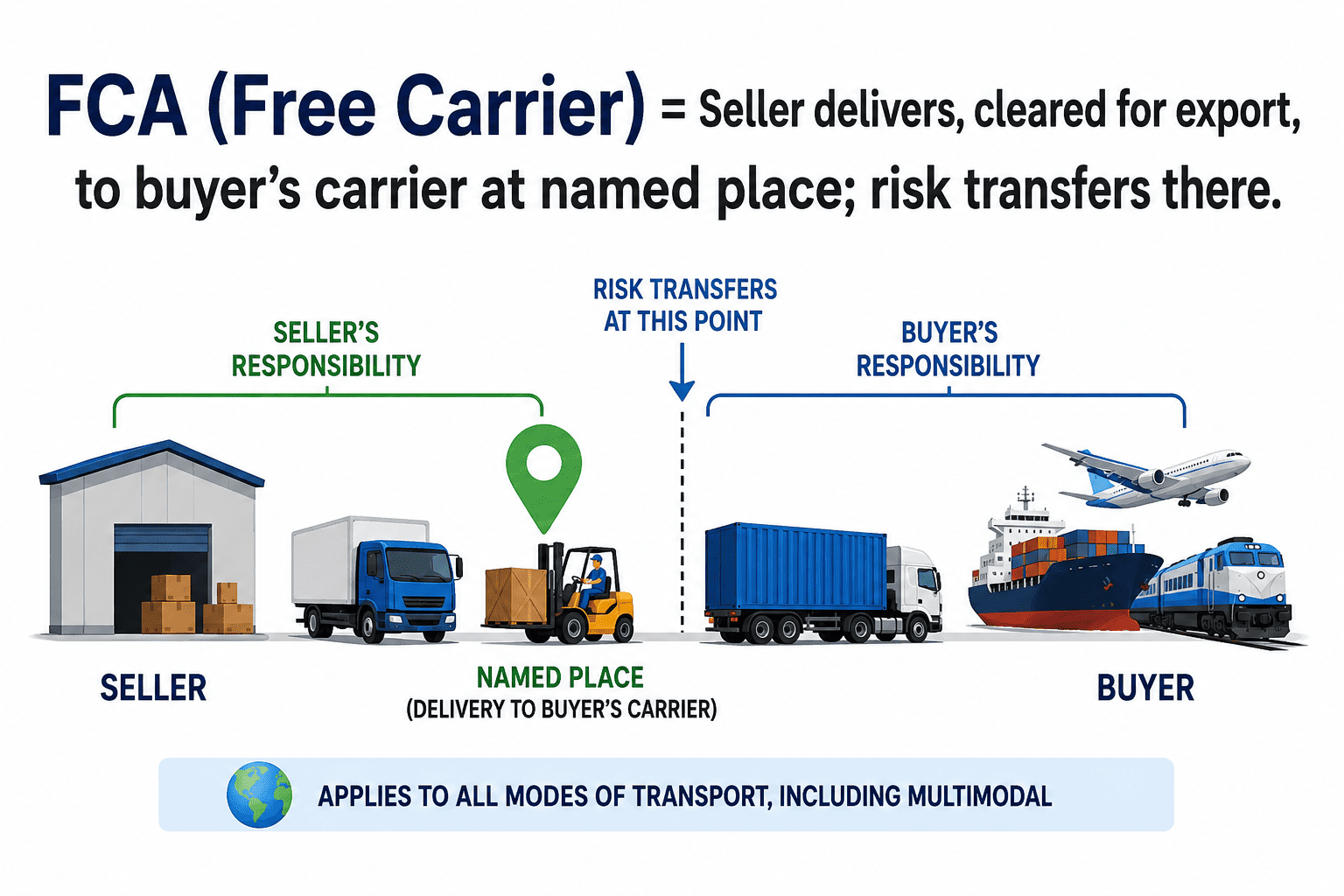
Why FCA Matters in International Trade
FCA is one of the most versatile and practical Incoterms, designed to facilitate modern trade across all modes of transport. It strikes a balance between seller and buyer responsibilities: the seller handles export clearance (a complex task that requires local knowledge), while the buyer controls the main carriage (allowing them to leverage their own logistics networks and rates). This division of labour makes FCA particularly useful for containerized shipments, where the seller delivers the goods to a terminal or forwarder’s warehouse, and the buyer arranges the ocean or air freight. FCA is often recommended as a replacement for FOB in containerized trade, as it avoids the risk gap that can occur when goods are delivered to a terminal before being loaded on board.
📊 Key Statistic
According to ICC guidelines, FCA is increasingly used in global trade, particularly for intra-European road and rail transport and for containerized sea shipments. Its flexibility and clear allocation of export clearance responsibilities make it a preferred choice for both SMEs and large multinationals.
FCA vs. Other Common Incoterms
Understanding how FCA compares to EXW, FOB, and other Incoterms is essential for choosing the right term for your transaction.
| Incoterm | Seller Responsibility | Buyer Responsibility | Risk Transfer Point |
|---|
| EXW (Ex Works) | Goods made available at seller’s premises | All costs and risks from pickup, including loading, transport, export/import clearance, insurance | When goods are made available at seller’s premises |
| FCA (Free Carrier) | Deliver goods cleared for export to carrier nominated by buyer; load if at seller’s premises | Main carriage, insurance, import clearance, and costs from carrier receipt | When goods are handed to carrier at named place |
| FOB (Free on Board) | Deliver goods on board the vessel at named port of shipment, including export clearance | Main carriage, insurance, import clearance, and costs from loading on vessel | When goods are on board the vessel |
| CIF (Cost, Insurance & Freight) | Cost, insurance, and freight to destination port, plus export clearance | Import clearance, duties, and costs from destination port onward | When goods are on board the vessel |
| DDP (Delivered Duty Paid) | All costs and risks to deliver goods to buyer’s premises, including import duties and taxes | Unloading at final destination | When goods are delivered to buyer’s premises |
📌 Choosing the Right Incoterm
FCA is often the best choice when the seller can handle export clearance but does not want to arrange or pay for international freight, and the buyer has the capability to manage the main carriage. For containerized shipments, FCA is generally preferred over FOB because it avoids the risk gap between delivery to the terminal and loading on board.
Core Responsibilities Under FCA
Seller’s Obligations Under FCA
The seller’s primary responsibilities under FCA are to prepare the goods, clear them for export, and deliver them to the buyer’s nominated carrier at the agreed place and time.
| Obligation | Description |
|---|
| Goods & Documentation | Provide the goods and commercial invoice as per the contract, along with any other evidence of conformity (e.g., analysis certificate). |
| Packaging & Marking | Package and mark the goods appropriately for transport, unless otherwise agreed. The packaging must be suitable for the intended mode of transport. |
| Export Clearance | Carry out and pay for all export customs formalities required by the country of export, including licenses, permits, and security clearances. |
| Delivery to Carrier | Deliver the goods to the carrier nominated by the buyer at the agreed place and time. If the named place is the seller’s premises, the seller loads the goods onto the collecting vehicle. If the named place is another location, the seller delivers the goods ready for unloading (the seller does not unload). |
| Proof of Delivery | Provide the buyer with proof that the goods have been delivered in accordance with the contract (e.g., a signed receipt, forwarder’s cargo receipt). |
| Notice to Buyer | Give the buyer sufficient notice that the goods have been delivered or that the carrier has failed to take delivery within the agreed time. |
| Assistance with Information | Provide the buyer, at the buyer’s request, risk, and cost, with any information or documents needed for the buyer to arrange carriage, insurance, or import clearance. |
Buyer’s Obligations Under FCA
The buyer is responsible for nominating the carrier, arranging the main carriage, and handling all import-related formalities and costs.
| Obligation | Description |
|---|
| Payment | Pay the price for the goods as stated in the contract of sale. |
| Carrier Nomination | Nominate a carrier and inform the seller of the carrier’s name, contact details, mode of transport, and any transport-related security requirements. |
| Main Carriage | Arrange and pay for the main carriage of the goods from the named place of delivery to the final destination. |
| Import Clearance | Carry out and pay for all import customs formalities, duties, taxes, and any transit formalities required by the country of import or transit. |
| Risk & Costs | Bear all risks of loss or damage to the goods from the point of delivery. Pay all costs from that point forward, including main carriage, insurance, import duties, and any additional costs if the carrier fails to take delivery. |
| Insurance | Arrange insurance coverage if desired (the buyer is not obligated to insure, but bears the risk from delivery onward). |
| Proof of Delivery | Accept the proof of delivery provided by the seller. |
| Instructions for Transport Document | If agreed, instruct the carrier to issue a transport document (e.g., an on-board bill of lading) to the seller, at the buyer’s cost and risk. |
Practical Guidance
Key Considerations When Using FCA
FCA offers flexibility but requires careful attention to the details of delivery and documentation. The following considerations are essential for a smooth transaction.
1
Specify the Named Place and Delivery Point
The contract must clearly state the named place of delivery. If it is the seller’s premises, the seller loads. If it is another location (e.g., a forwarder’s warehouse or terminal), the seller delivers ready for unloading. Ambiguity can lead to disputes over who is responsible for loading and unloading.
2
Ensure the Buyer Nominates the Carrier Promptly
The buyer must provide the seller with the carrier’s details and delivery instructions in sufficient time for the seller to deliver the goods and complete export formalities. Delays or failure to nominate can result in the buyer bearing additional risks and costs.
3
Coordinate Export Clearance
The seller is responsible for export clearance under FCA. This includes obtaining licenses, permits, and completing customs formalities. The seller should be confident in its ability to handle these tasks. If not, consider using EXW (where the buyer handles export) or another term.
4
Address the Bill of Lading Requirement
Under FCA, the seller’s delivery obligation ends when the goods are handed to the carrier, not when they are loaded on board. This can create issues with letters of credit that require an on-board bill of lading. The 2020 version of Incoterms introduced an optional provision allowing the buyer to instruct the carrier to issue an on-board bill of lading to the seller, but this must be agreed in the contract.
5
Clarify Loading and Unloading Responsibilities
If delivery is at the seller’s premises, the seller loads the goods onto the collecting vehicle. If delivery is at another location, the seller does not unload. These responsibilities should be explicitly stated in the contract to avoid confusion.
Real-World Example
FCA Example: Sourcing Components from a Domestic Manufacturer
This example illustrates how FCA works in practice, particularly for a buyer who wants to control the main carriage.
📄 Scenario: Component Procurement
Buyer (a manufacturer in Country B) needs to purchase specialized components from Seller (a manufacturer in Country A). The buyer has a preferred freight forwarder and wants to manage the international transport from Country A to Country B.
Terms: The parties agree to FCA Seller’s Premises, Country A.
Process: The seller packages the components, prepares the commercial invoice, and handles export clearance in Country A. On the agreed date, the buyer’s nominated carrier arrives at the seller’s premises. The seller loads the components onto the carrier’s truck. Once loaded, delivery is complete, and risk transfers to the buyer. The buyer’s carrier transports the goods to the port, arranges the ocean freight, handles import clearance in Country B, and delivers the components to the buyer’s factory. The buyer bears all costs and risks from the moment the goods are loaded onto the carrier’s truck at the seller’s premises.
Risks & Mitigation
Common Risks Under FCA & How to Mitigate Them
⚠️
Ambiguity in Delivery Point
Mitigation: Clearly specify in the contract the exact named place of delivery and whether the seller loads (if at seller’s premises) or not (if elsewhere). Include detailed delivery instructions to avoid disputes.
⚠️
Failure to Nominate Carrier
Mitigation: The buyer should nominate the carrier well in advance of the delivery date and provide complete details. If the carrier fails to collect, the buyer bears the additional risks and costs as per FCA rules.
⚠️
Export Clearance Issues
Mitigation: The seller should be confident in its ability to handle export clearance. If not, consider using FOB or another term where the buyer or a third party handles this. In some countries, a locally registered exporter is required, which the seller may not be.
⚠️
Letter of Credit and Bill of Lading Mismatch
Mitigation: If the buyer’s letter of credit requires an on-board bill of lading, the FCA term may not be compatible because the seller delivers to the carrier before the goods are on board. Consider FOB for ocean shipments where an on-board bill of lading is required, or use the ICC’s optional provision for an on-board bill of lading under FCA.
FAQ
Frequently Asked Questions About FCA
QWhat does FCA (Free Carrier) mean in shipping?
FCA stands for Free Carrier, an Incoterm where the seller delivers the goods, cleared for export, to the carrier nominated by the buyer at a named place (either the seller’s premises or another location). The risk transfers to the buyer at the point of delivery. The buyer is responsible for the main carriage, import clearance, and all subsequent costs.
QWhat are the seller’s obligations under FCA?
Under FCA, the seller must prepare the goods, package them, handle export customs clearance, and deliver them to the buyer’s nominated carrier at the agreed place and time. If delivery is at the seller’s premises, the seller loads the goods onto the collecting vehicle. If delivery is elsewhere, the seller delivers the goods ready for unloading. The seller must also provide proof of delivery.
QWhat are the buyer’s obligations under FCA?
The buyer must nominate a carrier, inform the seller of the carrier’s details and delivery instructions, pay for the main carriage, handle import clearance and duties, and bear all risks and costs from the point of delivery. The buyer must also take delivery when the goods are made available.
QWhat is the difference between FCA and EXW?
The key difference is that under FCA, the seller is responsible for loading the goods onto the buyer’s transport (when delivery is at the seller’s premises) and for clearing the goods for export. Under EXW, the buyer is responsible for both loading and export clearance. FCA therefore provides more protection and convenience for the buyer.
QWhen should I use FCA Incoterms?
FCA is suitable for all modes of transport, including multimodal. It is ideal when the buyer wants to control the main carriage and when the seller can handle export clearance but does not want to arrange or pay for international freight. It is often recommended over FOB for containerized shipments.