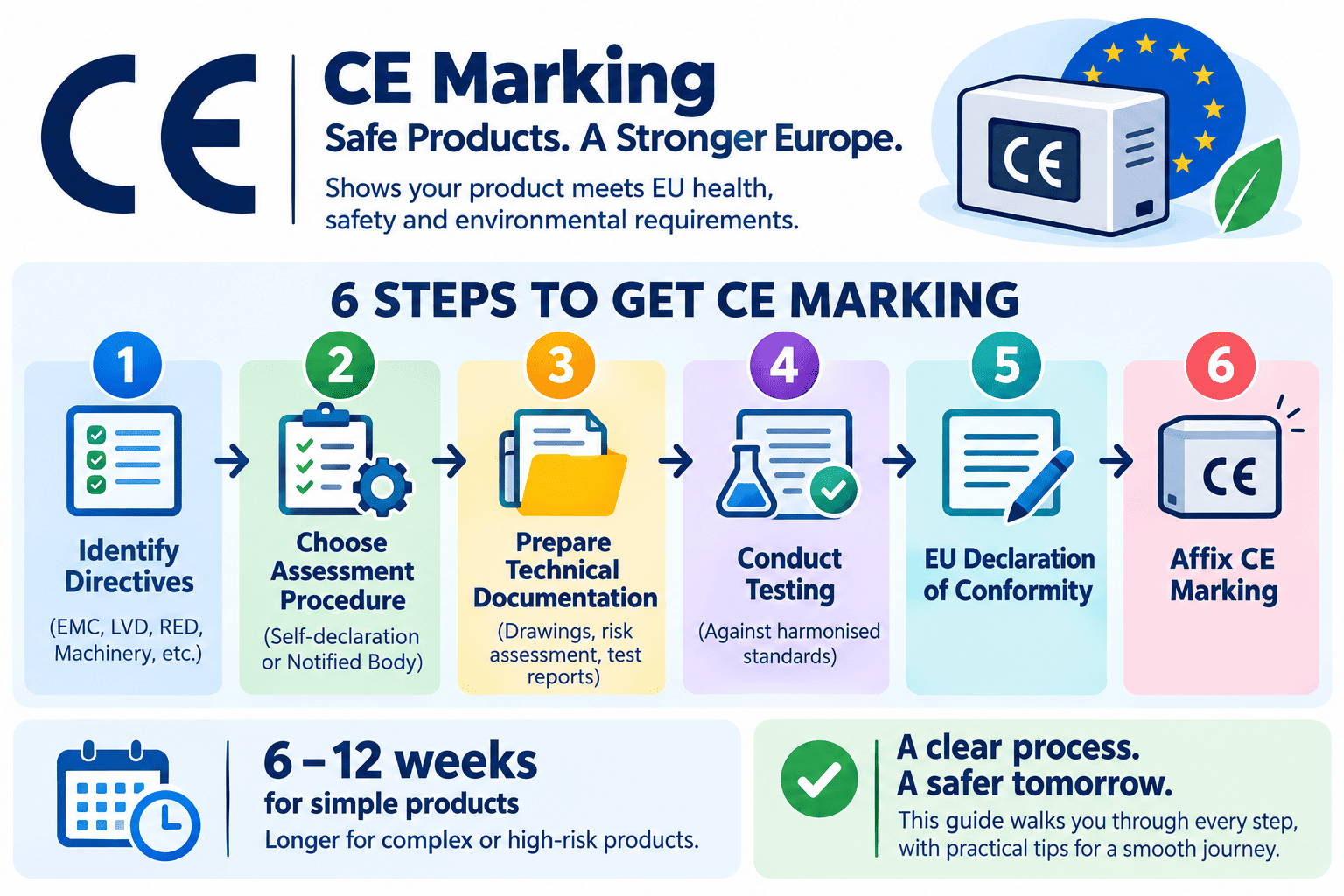
Direct Answer: CE marking is the mandatory conformity mark for products sold in the European Economic Area (EEA). It indicates that a product meets applicable EU health, safety, and environmental requirements. Getting CE marking involves: Identifying applicable directives (EMC, LVD, RED, Machinery, etc.), determining the conformity assessment procedure (self-declaration or Notified Body involvement), preparing technical documentation (technical file with drawings, risk assessment, test reports), conducting testing against harmonised standards, drawing up the EU Declaration of Conformity, and affixing the CE marking to the product. The process typically takes 6–12 weeks for simple products, longer for complex or high-risk products. This guide walks you through every step, with practical tips for a smooth certification journey.
📅 September 21, 2026⏱ 16 min read✍️ GT Setu Editorial Team🔄 Updated regularly
30+
EU Directives Requiring CE
5
Key Steps to CE Marking
6–12
Weeks (Typical Timeline)
0%
GTsetu Broker Commission
CE marking is the mandatory conformity mark for products sold in the European Economic Area (EEA), which includes the 27 EU member states plus Iceland, Liechtenstein, and Norway. The letters “CE” stand for “Conformité Européenne” (European Conformity), and the mark indicates that a product meets the applicable EU health, safety, and environmental protection requirements. With over 30 EU directives and regulations requiring CE marking, it is the cornerstone of product compliance for accessing the world’s largest single market.
For manufacturers, exporters, and distributors, CE marking is not optional, it is a legal requirement for products covered by specific EU harmonisation legislation. It signals that your product has undergone the appropriate conformity assessment procedure and meets EU standards. This guide covers the complete CE marking process, from identifying applicable directives through to affixing the CE mark and maintaining documentation, and provides practical, actionable advice for a smooth journey. See our related guides on indemnification clauses, warranty clauses, and commercial due diligence to understand how product compliance integrates with broader business contracts.
🇪🇺 Who Is This Guide For?
This guide is written for manufacturers, exporters, product managers, quality managers, compliance officers, and anyone responsible for placing products on the EU market. It covers both the self-declaration route and the Notified Body route, and is relevant for products ranging from simple electronics to complex machinery, medical devices, and construction products. For related partnership structures, see our guides on exclusivity clauses and master services agreements.
SECTION 1
1 What Is CE Marking & Why Get Certified?
🇪🇺 The Mark Explained
CE marking is the visual indication by the manufacturer or their authorised representative that a product conforms to the applicable EU harmonisation legislation. Contrary to common belief, CE marking is not a certification issued by a central authority, it is a self-declaration by the manufacturer that the product meets all relevant EU health, safety, and environmental requirements. The manufacturer is responsible for carrying out the conformity assessment procedure and affixing the CE marking. For higher-risk products, a Notified Body must be involved to conduct third-party conformity assessment. The CE mark is the only mark indicating conformity with EU requirements; voluntary marks (such as TÜV, VDE, or UL) can be added alongside it but must not confuse its meaning.
🌐
Mandatory for EU Market Access
CE marking is required for products covered by EU harmonisation legislation. Without it, products cannot be legally placed on the EEA market, and non-compliance can result in fines, product recalls, or market withdrawal.
🏛️
Single Market Access
The CE mark provides access to the entire EEA single market, over 500 million consumers, without needing separate national approvals from each member state, reducing cost and administrative burden.
🔄
Manufacturer Responsibility
The manufacturer is responsible for the conformity of the entire product, including components supplied by others, and for maintaining technical documentation for 10 years after placing the product on the market.
📈
Consumer Confidence & Market Trust
The CE mark signals to consumers, retailers, and regulators that the product has been assessed against EU safety and environmental standards, building trust and facilitating market acceptance.
SECTION 2
2 Key Benefits of CE Certification
CE marking delivers tangible benefits across commercial, regulatory, and operational dimensions. While the compliance process requires investment, the return on that investment is clear, access to the world’s largest single market.
500M+
Consumers in the EEA single market accessible with CE marking
27
EU member states where CE-marked products can freely circulate
30+
EU directives and regulations that require CE marking
🏷️
Legal Market Access
CE marking is the legal prerequisite for placing covered products on the EEA market. Without it, products cannot be sold, and non-compliance can result in enforcement action, fines, and reputational damage.
Compliance
💰
Cost Reduction Through Harmonisation
CE marking eliminates the need for multiple national approvals, reducing the cost and administrative burden of accessing 27+ EU markets. One conformity assessment covers the entire EEA.
Operational
🔗
Supply Chain Credibility
CE marking provides a common framework for product compliance across supply chains, enabling smoother collaboration with EU distributors, retailers, and partners who require compliant products.
Partnership
📊
Risk Management & Liability Protection
The conformity assessment process requires systematic identification and mitigation of product risks. This reduces exposure to product liability claims, recalls, and legal action.
Analytical
👥
Consumer & Market Trust
CE marking is recognised by consumers across Europe as a symbol of safety and quality. It builds trust with buyers and end-users, supporting market acceptance and brand reputation.
People
📋
Global Trade Facilitation
CE marking is recognised in many non-EU markets and can facilitate trade with countries that accept EU conformity assessment. It demonstrates a commitment to international standards.
Trade
SECTION 3
3 Applicable EU Directives & Regulations
CE marking is not governed by a single regulation. Instead, over 30 EU directives and regulations specify the requirements for different product categories. Identifying which directives apply to your product is the first and most critical step in the CE marking process.
Directive / Regulation
Product Category
Key Requirements
EMC Directive 2014/30/EU
Electrical and electronic equipment
Electromagnetic compatibility, emissions and immunity. Applies to almost all products with a circuit. Self-declaration is usually sufficient.
Low Voltage Directive (LVD) 2014/35/EU
Electrical equipment with input voltage 50–1000V AC or 75–1500V DC
Safety requirements for electrical equipment. Covers insulation, dielectric strength, leakage current, temperature rise, and mechanical safety. Self-declaration is usually sufficient.
Radio frequency performance, EMC, and safety for wireless equipment. Includes receiver performance requirements. May require Notified Body involvement for certain products.
Machinery Directive 2006/42/EC
Machinery and moving equipment
Safety requirements for machinery, including guards, emergency stops, and risk assessment. Many machinery categories require Notified Body involvement.
Medical Devices Regulation (MDR) 2017/745
Medical devices
Comprehensive requirements for medical devices, including clinical evaluation, quality management (ISO 13485), and risk management. Notified Body involvement is mandatory for most devices.
Personal Protective Equipment (PPE) Regulation 2016/425
Safety requirements for PPE. Category III (high-risk) PPE requires Notified Body involvement.
Construction Products Regulation (CPR) 305/2011
Construction products (cement, steel, insulation, etc.)
Performance requirements and CE marking for construction products. Requires Notified Body involvement for most products.
Toy Safety Directive 2009/48/EC
Toys and children’s products
Safety requirements for toys, including chemical, mechanical, and electrical safety. Notified Body involvement required for certain categories.
💡 Identifying Applicable Directives
To determine which directives apply to your product: (1) Review the product’s function, use, and characteristics. (2) Consult the European Commission’s list of harmonised legislation. (3) Check whether the product has wireless functionality (RED), operates on mains voltage (LVD), or is machinery (MD). (4) If unsure, consult a compliance expert or the relevant national authority. Many products are subject to multiple directives simultaneously, ensure full compliance with all applicable requirements before affixing the CE mark. This is similar to identifying applicable standards in due diligence processes.
SECTION 4
4 Step 1: Preparation, Identify Requirements
🏗️ Building the Foundation
The preparation phase sets the foundation for your entire CE marking project. The goal is to identify all applicable EU requirements, determine the conformity assessment procedure, and plan the project. This phase typically takes 1–2 weeks for a small organisation, longer for larger or more complex products.
1.1
Identify Applicable Directives
Determine which EU directives and regulations apply to your product. Consider the product’s function, intended use, operating environment, and characteristics. Products may be subject to multiple directives (e.g., a wireless speaker falls under RED, EMC, RoHS, and potentially LVD).
1.2
Determine Conformity Assessment Procedure
Determine whether the product can be self-declared (Module A, internal production control) or requires Notified Body involvement. Higher-risk products (machinery, medical devices, pressure equipment, certain wireless products) require third-party assessment. Check the applicable directive for the specific procedures.
1.3
Identify Harmonised Standards
Identify the harmonised European standards (EN standards) applicable to your product. Compliance with harmonised standards provides presumption of conformity with the essential requirements of the applicable directive. Examples: EN 55032 (EMC), EN 62368-1 (safety), EN 300328 (RED).
1.4
Plan the Project
Create a project plan covering documentation, testing, potential remediation, and declaration drafting. Identify responsible team members, key milestones, and target dates. For small organisations, keep the plan simple and focused on critical path activities. This is similar to project planning in master services agreements.
1.5
Appoint EU Authorised Representative (If Required)
If the manufacturer is based outside the EU, an EU Authorised Representative must be appointed to act on the manufacturer’s behalf for market surveillance purposes. The authorised representative’s name and address must appear on the product or packaging. This is a legal requirement for non-EU manufacturers.
1.6
Generate Employee Awareness
Inform your staff about the CE marking project early to build engagement. Explain how compliance benefits the company and ensures market access. This creates buy-in and ensures that quality and compliance considerations are embedded in development and production processes. This is similar to the approach recommended in our commercial due diligence guide.
💡 Pro Tip: Pre-Testing Saves Time
Before submitting samples for formal testing, consider conducting a pre-test (pre-scan) to identify potential EMC or safety issues. Pre-testing can screen for common failures like radiated emission exceedances, allowing you to address issues before formal testing begins. This can save at least one week in remediation time and avoid re-queuing at the lab. This proactive approach is similar to the gap analysis recommended in breach of contract risk assessment.
SECTION 5
5 Step 2: Documentation, Building Your Technical File
The technical file (also called technical documentation) is the foundation of CE marking compliance. It demonstrates that your product meets the applicable requirements and must be kept available for 10 years after the product is placed on the market. The technical file must be made available to national authorities upon request.
Document Type
Description
Key Consideration
General Product Description
Overview of the product, including its function, intended use, model number, and key specifications. Describes what the product is and what it does.
Must be clear and comprehensive. Should identify the product model for which the declaration is drawn up.
Design & Manufacturing Drawings
Conceptual design, manufacturing drawings, and schemes of components, sub-assemblies, and circuits. Includes PCB layout, mechanical drawings, and block diagrams.
Must be sufficiently detailed to assess conformity. Should show safety-critical dimensions and clearances.
Descriptions & Explanations
Explanations necessary for understanding the drawings and schemes, and for understanding the operation of the product.
Should bridge the gap between drawings and understanding. Includes theory of operation and safety-critical functions.
List of Harmonised Standards
List of harmonised standards applied in full or in part, with references published in the Official Journal. Where harmonised standards are not applied, descriptions of solutions adopted to meet essential requirements.
Must specify which parts of harmonised standards have been applied. If alternative solutions are used, must demonstrate they meet essential requirements.
Risk Assessment
Analysis and assessment of risks associated with the product, including identification of hazards and mitigation measures. Required for most product categories.
Must be systematic and thorough. For machinery, risk assessment is a key requirement of the Machinery Directive.
Test Reports
Results of design calculations, examinations carried out, and test reports from accredited laboratories. Evidence of compliance with harmonised standards.
Test reports must cover the applicable requirements. For EMC, LVD, and RED, reports from accredited labs are standard.
User Manual
Instructions for use, safety warnings, and maintenance information. Must be in the language(s) of the country where the product is sold.
Must include all safety information and instructions necessary for safe use. Language requirements vary by member state.
EU Declaration of Conformity
The formal declaration signed by the manufacturer or authorised representative stating that the product complies with all applicable EU requirements.
Must identify the product, list applicable directives, cite harmonised standards, and include manufacturer and authorised representative details. Must be kept for 10 years.
Label & Marking Documentation
Design drawings of product labels, including the CE mark, model number, manufacturer name, and any required warnings or symbols.
CE mark must be at least 5mm tall, with letters of equal vertical dimension. Must be visible, legible, and indelible.
💡 Documentation Best Practices
DO: Start documentation early and maintain it throughout the project. Use templates and checklists to ensure completeness. Keep documents organised and easily accessible for audits. Update the technical file when product changes occur.
DON’T: Wait until the end of the project to prepare documentation. Include incomplete or unclear evidence. Forget to document deviations from standards or exemptions. Miss the 10-year retention requirement.
Consider using documentation templates, pre-written documents designed to be tailored to your product. They save time, reduce errors, and provide a reliable starting point. This approach is also effective when implementing asset purchase agreements and termination for convenience provisions.
SECTION 6
6 Step 3: Testing & Conformity Assessment
Testing and conformity assessment is where your product is evaluated against the requirements of the applicable directives and harmonised standards. The scope of testing depends on the product type and the directives that apply.
⚡
EMC Testing
Electromagnetic compatibility testing covers emissions (conducted and radiated) and immunity. Standard products typically take 2–5 working days for testing, with total lead time of 1–2 weeks including documentation. Complex products with switching power supplies may require remediation.
EMC
🔌
Safety Testing (LVD)
Low Voltage Directive testing covers dielectric strength, leakage current, grounding continuity, temperature rise, mechanical strength, and fire resistance. Standard products take 4–7 working days. Products with lithium batteries add IEC 62133 testing (5–8 additional days).
Safety
📡
RF Testing (RED)
Radio Equipment Directive testing covers RF performance, EMC, and safety for wireless products. Bluetooth devices take 3–5 working days; dual-band WiFi takes 5–8 working days. Cellular and 5G products require additional testing. RED testing is the most time-consuming part of CE marking for wireless products.
Wireless
🔬
Chemical Testing (RoHS/REACH)
RoHS testing verifies compliance with restrictions on hazardous substances (lead, cadmium, mercury, etc.) in electrical and electronic equipment. REACH registration covers chemical substances in plastics, coatings, and solder. These tests are mandatory for electronics entering the EU.
Chemical
🔧
Remediation & Retesting
Few projects pass first time. Radiated emission exceedances, ESD failures, and temperature-rise issues are common. Software fixes take days; hardware redesigns take weeks or months. Budget at least one remediation round as buffer. Remediation is the biggest variable in the CE timeline.
Critical
📋
Notified Body Assessment (If Required)
For higher-risk products, a Notified Body conducts type examination or quality system assessment. This adds 4–8 weeks depending on body schedule and document completeness. The Notified Body’s 4-digit identification number must appear next to the CE marking.
Third-Party
💡 Testing Best Practices
Prepare samples carefully: Submit samples that are representative of production units, with locked firmware versions. Incomplete or incorrect samples will delay testing.
Confirm standards versions: Ensure you are testing against the current harmonised standard versions. Using outdated standards can invalidate test reports.
Use certified modules: For wireless products, using pre-certified RED modules can simplify testing, but full product testing is still required for EMC and safety.
Plan for remediation: Budget time and resources for at least one round of remediation and retesting. This is similar to planning for contingencies in consequential damages assessments.
SECTION 7
7 Step 4: Declaration of Conformity & CE Marking
📜 The Final Steps
Once testing and conformity assessment are complete, the manufacturer draws up the EU Declaration of Conformity and affixes the CE marking to the product. The Declaration of Conformity is a formal document signed by the manufacturer or authorised representative stating that the product complies with all applicable EU requirements. The CE marking must be affixed visibly, legibly, and indelibly to the product or its packaging.
📜
Draw Up the Declaration of Conformity
The Declaration must identify the product, list all applicable directives, cite the harmonised standards applied, and include the manufacturer’s name and address, and the authorised representative’s details (if applicable). It must be signed by a responsible person and kept for 10 years.
✅
Affix the CE Marking
The CE mark must be affixed to the product, or if not possible, to the packaging or accompanying documents. It must be at least 5mm tall, with both letters having the same vertical dimension. If a Notified Body is involved, their 4-digit ID number must appear next to the CE mark.
📋
Complete the Technical File
Ensure the technical file is complete, organised, and accessible. It must include all documentation generated during the conformity assessment process. The technical file must be kept available for national authorities for 10 years after placing the product on the market.
🏷️
Product Labelling
Ensure product labels include the CE mark, model number, manufacturer name and address, and any required warnings or symbols. Labels must be in the language(s) of the country where the product is sold. Check specific labelling requirements for your product category.
📋 CE Marking Design Requirements
The CE marking must: (1) Consist of the initials “CE” in the specified form. (2) Have both letters the same vertical dimension, with a minimum height of 5mm (unless otherwise specified). (3) Maintain proportions if scaled. (4) Be visible, legible, and indelible. (5) Be affixed to the product, or if not possible, to the packaging or accompanying documents. (6) Include the Notified Body’s 4-digit ID number if a Notified Body is involved. This is similar to the precision required in indemnification clauses where exact wording matters.
SECTION 8
8 Step 5: Maintain Compliance & Documentation
CE marking is not a one-time event, it is an ongoing obligation. The manufacturer must ensure that products continue to comply with applicable requirements throughout their lifecycle. This includes maintaining the technical file, monitoring regulatory changes, and updating documentation when product changes occur.
Ongoing Obligation
What It Involves
Key Consideration
Technical File Retention
Keep the technical file and Declaration of Conformity available for 10 years after placing the product on the market. Make available to national authorities upon request.
Retention period is 10 years from the date the product is placed on the market, not the date of certification.
Regulatory Monitoring
Monitor changes to EU directives, harmonised standards, and requirements that affect your product. Update compliance documentation when standards are revised.
Harmonised standards are updated periodically. Transition periods allow both old and new versions during the changeover.
Product Change Management
When product changes occur, assess whether they affect compliance. Significant changes may require re-testing or updating the Declaration of Conformity.
Document all changes and their impact on compliance. Update the technical file accordingly.
Market Surveillance Cooperation
Cooperate with national market surveillance authorities. Provide information and technical documentation upon request.
Non-compliance can result in fines, product recalls, or market withdrawal. Cooperation is essential.
Importer & Distributor Obligations
Importers and distributors have specific obligations to verify that products bear CE marking and that documentation is available.
Importers must ensure the manufacturer has complied and that the technical file can be provided to authorities.
💡 Maintaining Compliance
DO: Establish a document management system for the technical file and Declaration of Conformity. Monitor regulatory changes through official channels (EUR-Lex, European Commission websites). Update documentation when product changes occur. Cooperate with market surveillance authorities.
DON’T: Assume compliance is permanent. Ignore changes to harmonised standards. Fail to update documentation after product modifications. Forget the 10-year retention requirement. This is similar to the ongoing obligations in material breach monitoring and termination for convenience provisions.
SECTION 9
9 Costs & Timeline: What to Expect
The cost and timeline for CE marking vary significantly based on product type, applicable directives, testing requirements, and whether a Notified Body is involved. Understanding these variables upfront helps in planning and budget setting.
More directives = more testing and documentation. EMC + LVD + RED + RoHS increases cost.
Each directive adds testing and documentation time.
Notified Body Involvement
Notified Body fees add $5,000–$20,000+ depending on product type and body.
Adds 4–8 weeks for type examination and certificate issuance.
Remediation Rounds
Each remediation round adds cost for retesting (30–50% of initial test fee).
Software fixes: days. Hardware redesigns: weeks to months.
EU Authorised Representative
Fees range from $500–$3,000+ per year, depending on scope of representation.
Appointment must be completed before placing product on the market.
Documentation Preparation
Internal time or consultant fees. Templates can reduce cost.
Document preparation typically takes 1–2 weeks.
🇪🇺 Cost Breakdown by Component
Testing fees: EMC testing ($2,000–$5,000), safety testing ($1,000–$3,000), RF testing ($3,000–$8,000), chemical testing ($500–$2,000). Notified Body fees: $5,000–$20,000+ for type examination and certificate. Documentation: $2,000–$5,000 if outsourced. EU Authorised Representative: $500–$3,000 per year. Total typical range: $1,000–$3,000 for simple self-declared products; $10,000–$50,000+ for complex products requiring Notified Body. These costs are separate from the cost of any voluntary certification marks (TÜV, VDE, etc.) you may choose to pursue. This is similar to the cost structures in asset purchase agreements where multiple cost components must be accounted for.
SECTION 10
10 Notified Bodies & When You Need One
A Notified Body is an independent organisation authorised by an EU member state to assess product conformity when required by law. Notified Bodies are used for third-party conformity assessment, typically for higher-risk products.
🏛️
What Is a Notified Body?
A Notified Body is an organisation designated by an EU member state to perform conformity assessment tasks under specific EU directives. They are listed in the NANDO database and must be independent and impartial. Their 4-digit identification number appears next to the CE marking.
📋
When Is a Notified Body Required?
A Notified Body is required when the applicable directive specifies third-party assessment. This typically applies to higher-risk products such as machinery (certain categories), medical devices, pressure equipment, personal protective equipment (Category III), and construction products.
🔍
Finding a Notified Body
Search the NANDO database by product category or legislation to find Notified Bodies authorised for your product type. Ensure the body is authorised for the specific conformity assessment procedure required by the applicable directive.
💰
Cost & Timeline
Notified Body involvement adds $5,000–$20,000+ to costs and 4–8 weeks to the timeline, depending on product complexity and body schedule. Medical devices and high-risk machinery typically involve higher fees and longer timelines.
📊
Conformity Assessment Modules
Directives specify different modules (A through H) for conformity assessment. Module A (internal production control) allows self-declaration. Modules B+C, D, E, F, G, and H require Notified Body involvement. Check your directive for the applicable module.
⚠️
Beware of Voluntary Certificates
Voluntary certificates from private bodies (TÜV, VDE, etc.) are not the same as Notified Body certificates. They must not bear the CE marking or be confused with conformity assessment. Only CE marking provides legal market access.
💡 Notified Body Selection Checklist
When selecting a Notified Body, ask: Are you authorised for my product category and the required conformity assessment module? What is your experience with products similar to mine? What is your typical timeline for type examination and certificate issuance? What are your fees and what is included? How do you handle non-conformities and remediation? Can you provide references from clients in my industry? This is similar to the due diligence you would apply in due diligence for any business partner.
SECTION 11
11 Common Mistakes & How to Avoid Them
📋
Incomplete Technical File
Failing to include all required documentation, such as risk assessments, test reports, or drawings. An incomplete technical file can result in non-compliance findings and market access issues.
Avoid: Use a checklist to ensure all required documents are included. Review the applicable directive for specific documentation requirements. Keep the technical file organised and accessible.
🏛️
Misidentifying Applicable Directives
Failing to identify all applicable directives, resulting in incomplete compliance. A product may be subject to multiple directives simultaneously.
Avoid: Systematically review all potential directives. Consult the European Commission’s list of harmonised legislation. If unsure, seek expert advice.
📖
Incorrect CE Marking
Affixing the CE mark incorrectly, wrong size, proportions, or placement. The CE mark must meet specific design requirements to be valid.
Avoid: Follow the design requirements precisely: minimum 5mm height, equal letter dimensions, visible, legible, and indelible. Include Notified Body number if applicable.
🔄
Missing Declaration of Conformity
Failing to draw up or sign the EU Declaration of Conformity, or including incorrect information. The Declaration is a mandatory document.
Avoid: Ensure the Declaration includes all required information: product identification, applicable directives, harmonised standards, manufacturer details, and signature. Keep it for 10 years.
🎓
Ignoring Notified Body Requirements
Proceeding with self-declaration when a Notified Body is required. This is a legal non-compliance that can result in enforcement action.
Avoid: Check the applicable directive to determine if Notified Body involvement is required. If unsure, consult the directive or a compliance expert.
📊
Failure to Maintain Documentation
Failing to retain the technical file and Declaration of Conformity for the required 10-year period, or failing to update documentation after product changes.
Avoid: Establish a document management system. Monitor regulatory changes. Update documentation when product changes occur. This is similar to the ongoing obligations in material breach monitoring.
SECTION 12
12 How GTsetu Supports Your Certification Journey
🔗 GTsetu, Verified B2B Platform
Connect with Verified Partners & Build Compliant Supply Chains
CE marking is a powerful tool for demonstrating product compliance to EU customers and partners. GTsetu complements your certification by connecting you with verified manufacturers, distributors, and suppliers who meet rigorous quality and compliance standards. Our platform provides:
✅
Verified Company Profiles
Every company on GTsetu is verified on 6 key data points (Name, Address, Registration Number, Company Status, Company Type, Date of Incorporation) using government tie-ups, complementing your CE marking due diligence.
🕵️
Anonymous Discovery
Browse verified partner profiles without revealing your identity until you’re ready to engage, protecting your sourcing strategy and commercial confidentiality.
📄
Built-In NDA Workflow
Digital mutual NDA with timestamped signatures, activated before any sensitive commercial or technical data is exchanged, supporting your IP protection and confidentiality commitments under CE compliance.
🔐
Encrypted Document Workspace
AES-256 encryption at rest, TLS in transit, role-based access controls, and full audit trail, ensuring the secure exchange of compliance documentation, test reports, and contracts with partners.
🚫
Zero Broker Commission
GTsetu charges zero commission on any partnership formed. All commercial value stays between you and your verified partner, supporting the cost management objectives of your compliance programme.
🌏
Global Network of Verified Partners
Access verified manufacturers, distributors, and suppliers across 100+ countries, supporting your supply chain compliance objectives and enabling you to build a network of CE-aligned partners.
QWhat is CE certification and why is it important?
CE marking is the mandatory conformity mark for products sold in the European Economic Area (EEA). It indicates that a product meets applicable EU health, safety, and environmental requirements. While often called “CE certification,” CE marking is actually a self-declaration by the manufacturer that the product complies with all relevant EU directives and regulations. It is required for products covered by specific EU harmonisation legislation, including electrical equipment, toys, machinery, medical devices, and construction products. Without the CE mark, products cannot be legally placed on the EU market. For manufacturers and exporters, it provides market access and is a key factor in commercial due diligence by EU buyers.
QWhat are the main steps to get CE certification?
The main steps are: (1) Identify applicable EU directives and regulations for your product. (2) Determine the conformity assessment procedure, whether self-declaration is sufficient or a Notified Body must be involved. (3) Prepare the technical documentation including design drawings, risk assessment, test reports, and user manual. (4) Conduct testing and assessment per the applicable harmonised standards. (5) Draw up the EU Declaration of Conformity and affix the CE marking to the product. (6) Maintain the technical file and declaration for 10 years after placing the product on the market. This structured approach is similar to building any master services agreement, start with a solid foundation and build methodically.
QHow long does it take to get CE certification?
The timeline varies significantly based on product complexity and the applicable directives. Simple self-declaration products (e.g., EMC only) typically take 6-10 weeks. Wireless products requiring RED compliance take 8-12 weeks. Products requiring Notified Body involvement add 4-8 weeks on top. The timeline includes document preparation, sample testing, potential remediation, report issuance, and Declaration of Conformity drafting. Remediation rounds are the biggest variable, a single round of fixes and retesting can add 1-4 weeks, while hardware redesign can add months.
QHow much does CE certification cost?
The cost varies based on product type, applicable directives, number of tests required, and whether a Notified Body is involved. Factors include: testing fees (EMC, safety, RF, chemical), technical documentation preparation, Notified Body fees (if applicable), and EU Authorised Representative fees. A typical range for a simple electronic product is $1,000-$3,000 for testing, while complex products with wireless and safety requirements can cost $5,000-$15,000 or more. Machinery and medical devices requiring Notified Body involvement typically cost $10,000-$50,000. These costs are similar to the components involved in asset purchase agreements where multiple cost factors must be accounted for.
QWhat documents are required for CE certification?
Key required documents include: technical documentation (technical file) containing a general product description, design and manufacturing drawings, circuit diagrams, a list of harmonised standards applied, risk assessment, test reports, and user manual. The EU Declaration of Conformity is a mandatory document signed by the manufacturer. For products requiring Notified Body involvement, the certificate of conformity is also required. Records must be kept for 10 years after the product is placed on the market. This is similar to the documentation requirements in indemnification clauses where precise records are essential.
QDo I need a Notified Body for CE marking?
It depends on the product and the applicable EU legislation. Many products can be self-declared using the internal production control procedure (Module A). However, higher-risk products, such as machinery, medical devices, pressure equipment, and certain wireless products, require Notified Body involvement for type examination or quality system assessment. The applicable directive specifies the conformity assessment procedure. You can search for Notified Bodies in the NANDO database by product category or legislation. This is similar to the due diligence you would apply in due diligence for any business partner.
QWhat is the difference between CE marking and a voluntary certificate?
CE marking is the only mark that indicates a product conforms to applicable EU harmonisation legislation. It is affixed by the manufacturer or their authorised representative. Voluntary certificates (such as those issued by private testing bodies like TÜV, VDE, or UL) are private marks that can be added alongside CE marking but must not be confused with it. Voluntary certificates cannot bear the CE marking and cannot replace the CE marking requirement. Only CE marking provides legal market access to the EEA. This distinction is important for understanding compliance obligations, similar to distinguishing between different types of breach of contract claims.
QHow long must I keep CE documentation?
The technical file and EU Declaration of Conformity must be kept for 10 years after the product is placed on the market. This applies to the manufacturer or the authorised representative in the EU. National authorities can request access to this documentation at any time during this period. Failure to retain documentation can result in non-compliance findings and enforcement action. This retention requirement is similar to the record-keeping obligations in material breach and termination for convenience provisions.
Connect with verified manufacturers, distributors, and suppliers on GTsetu, compliance-backed verification, anonymous discovery, built-in NDA workflows, and zero broker commissions. Find partners who share your commitment to product compliance and market access.
They represents the product, and research team behind GTsetu, a global B2B collaboration platform built to help companies explore cross-border partnerships with clarity and trust. The team focuses on simplifying early-stage international business discovery by combining structured company profiles, verification-led access, and controlled collaboration workflows.
With a strong emphasis on trust, and disciplined engagement, Team GTsetu shares insights on global trade, partnerships, and cross-border collaboration, helping businesses make informed decisions before entering deeper commercial discussions.