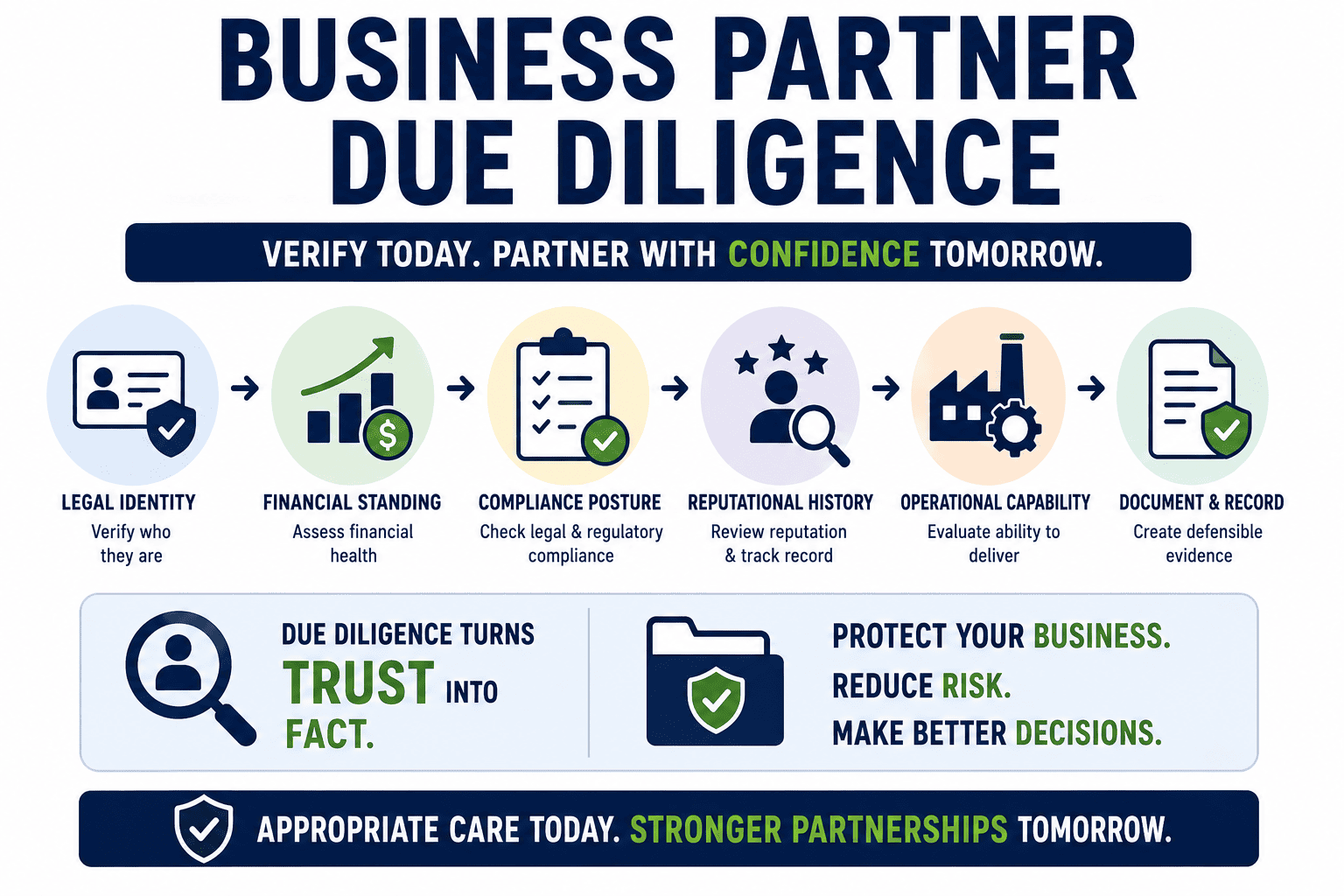
Business Partner Due Diligence: Checklist, Policy & Process
Direct Answer: Business partner due diligence is the structured process of verifying and assessing a prospective commercial partner, manufacturer, distributor, channel partner, raw material supplier, or agent, before entering a formal agreement. It covers legal identity, financial health, regulatory compliance, reputational standing, operational capability, and ESG practices. This guide provides the complete checklist, policy framework, and step-by-step process, along with specific guidance for channel partner due diligence, red flags to watch for, and how to build an ongoing monitoring programme.
📅 May 1, 2026⏱ 20 min read✍️ GTsetu Editorial Team🔄 Updated regularly
6
Due Diligence Domains
50+
Checklist Items
3
Risk Tiers
18+
Red Flags Covered
Every trade partnership begins with some level of trust. The question is whether that trust is assumption-based or evidence-based. In commercial relationships between manufacturers, distributors, raw material suppliers, agents, and channel partners, the gap between those two is where fraud, compliance violations, reputational damage, and commercial failure live.
Business partner due diligence is not about distrust. It is about replacing assumption with verified fact before commercial commitments are made, before a business partnership contract is signed, before sensitive pricing and product data is shared, and before your company’s reputation becomes entangled with a partner you have not properly assessed.
This guide covers the complete framework: what due diligence domains matter, the full checklist, how to calibrate depth to risk, the step-by-step process, how to build a policy, and what specifically changes when you are conducting channel partner due diligence rather than supplier or manufacturer due diligence.
💡 Who This Guide Is For
This guide is written for trade compliance officers, procurement professionals, international business development teams, and founders managing cross-border business partnerships. It is equally applicable to manufacturers assessing distributors, distributors assessing manufacturer principals, and organisations onboarding supply chain partners, agents, or technology partners.
SECTION 1
1 What Is Business Partner Due Diligence?
📖 Definition
Business partner due diligence is the structured process of verifying a prospective commercial partner’s legal identity, financial standing, compliance posture, reputational history, and operational capability before entering a formal business relationship. It is the evidence-gathering process that turns trust from an assumption into a documented fact, and creates a defensible record that your organisation exercised appropriate care before making commercial commitments.
The term covers a family of related practices depending on context. Supplier due diligence assesses the capability and compliance of companies from which you procure goods or materials. Channel partner due diligence, covered in detail in Section 8, applies to distributors, resellers, and agents acting on your behalf in a market. Third-party due diligence is the broadest term and encompasses any external party with whom your organisation has a material commercial relationship.
In the context of international trade, whether you are appointing an international wholesale distributor, entering a technology partnership, or building a distributor network in a new market, partner due diligence is the process that determines whether the entity you are about to engage is genuinely who they claim to be, financially stable enough to honour their commitments, and legally and ethically compliant enough to be associated with your brand.
SECTION 2
2 Why It Matters: The Cost of Skipping It
95%
of what matters about a business partner is not visible without investigation, the “iceberg” problem of surface credibility
40%
of FCPA enforcement actions in recent years have involved third-party intermediaries acting on behalf of the principal
3–5×
the cost to remediate a failed partnership versus the cost of conducting proper due diligence before engagement
The consequences of inadequate business partner due diligence fall into four categories, each of which can be existentially damaging to a business:
⚖️
Legal Liability
Under laws like the US Foreign Corrupt Practices Act (FCPA) and UK Bribery Act 2010, a company can be held criminally liable for the corrupt conduct of third parties acting on its behalf, including distributors and agents, even without direct knowledge. Demonstrating adequate due diligence is the primary defence available.
💰
Financial Loss
Partnering with a financially distressed entity creates exposure to non-payment, inventory abandonment, and the cost of restarting market entry. An undisclosed insolvency or hidden debt structure that due diligence would have surfaced becomes your problem once the agreement is signed.
📰
Reputational Damage
A partner’s ethics violations, human rights abuses in their supply chain, or adverse media history attach to your brand through association. In the era of ESG reporting and supply chain transparency requirements, reputational contagion from partners is a board-level risk.
🚫
Sanctions Exposure
Transacting with a sanctioned entity, or an entity controlled by sanctioned individuals, creates severe legal exposure regardless of intent. Beneficial ownership opacity, where the real controlling party is hidden behind nominee directors or holding structures, is the primary vector for inadvertent sanctions violations.
📦
Operational Failure
A partner who misrepresents their production capacity, certifications, or technical capability creates cascading failures: missed delivery commitments, quality defects, and the cost of emergency alternative sourcing. For manufacturers and distributors, this can mean lost customer relationships, not just supplier relationships.
📋
Regulatory Non-Compliance
Many regulated industries (pharmaceuticals, food, chemicals, electronics with RoHS/REACH requirements) impose liability on companies for their supply chain partners’ non-compliance. If your partner does not hold the licences, certifications, or regulatory approvals they claimed, your product may be non-compliant too.
⚠️ The Iceberg Problem
A company’s website can be polished. Its pitch deck can be impressive. Its founders can be charismatic. Its numbers can look promising. None of this tells you about its undisclosed litigation, its hidden debt, its beneficial ownership structure, its track record with previous partners, or its compliance posture. The majority of material risk in any business partnership is not visible on the surface. Due diligence is the process that looks below the waterline before you decide to board.
SECTION 3
3 The Six Domains of Partner Due Diligence
Comprehensive business partner due diligence covers six distinct domains. Each has its own information sources, assessment criteria, and risk implications. Understanding the domains separately, even when running assessments in parallel, ensures that no material risk category is skipped because it was assumed to be covered by another.
Domain
What It Covers
Primary Risk if Skipped
Key Sources
Legal Identity
Registered name, registration number, incorporation date, registered address, active company status, director and UBO details
Engaging with a non-existent, dissolved, or fraudulently represented entity
Company registry, government databases, certificate of incorporation
Financial Health
Audited financials, revenue and profit trends, outstanding liabilities, credit ratings, debt structure, solvency status
Partner insolvency, non-payment, inability to fulfil commitments
Filed accounts, credit bureaus, bank references, auditor reports
Compliance & Regulatory
Sanctions and watchlist screening, anti-bribery and corruption (ABC) policy, AML status, industry licences, regulatory approvals
Reputational contagion, undisclosed disputes, known misconduct
News databases, court record searches, reference checks, industry contacts
Operational Capability
Production capacity, quality certifications (ISO, GMP, CE, etc.), insurance coverage, infrastructure, logistics capability, references from existing partners
Capability misrepresentation leading to delivery failure, quality defects, product non-compliance
Factory audits, certification bodies, existing customer references, site visits
ESG
Environmental practices and certifications, labour standards and human rights compliance, supply chain ethics, anti-corruption culture, governance quality
4 The Complete Business Partner Due Diligence Checklist
The checklist below is organised by the six domains. Items are tagged by criticality: Critical items must be completed for any partner regardless of risk tier. High items should be completed for medium and high-risk partners. Standard items apply to high-risk or high-value partnerships.
🏛️
Domain 1: Legal Identity Verification
8 items
✓
Legal registered name Critical
Confirm the legal entity name exactly as registered with the relevant company authority, not trading name or brand name alone.
✓
Company registration number Critical
Obtain and independently verify the registration number against the official company registry of the country of incorporation.
✓
Registered address Critical
Confirm the registered address matches official records. Flag discrepancies between registered address, operating address, and address given during negotiations.
✓
Active company status Critical
Verify the company is in good standing, not dissolved, struck off, or in administration or insolvency proceedings.
✓
Date of incorporation Critical
Newly incorporated entities with no track record warrant additional scrutiny, particularly if claiming extensive operational experience.
✓
Company type and structure Critical
Confirm entity type (private limited, public, partnership, sole trader). Shell companies or holding structures without operational substance require explanation.
✓
Director and officer details High
Obtain names and screen all current directors and officers against sanctions lists, PEP databases, and adverse media.
✓
Ultimate Beneficial Owner (UBO) High
Identify all individuals holding 25%+ ownership or effective control. Screen UBOs against sanctions lists. Be alert to complex holding structures designed to obscure true ownership.
💰
Domain 2: Financial Health Assessment
7 items
✓
Audited financial statements (2–3 years) Critical
Request independently audited financials. Unaudited management accounts are acceptable as a supplement but not a substitute.
✓
Revenue and profit trend analysis Critical
Assess whether revenue is real and growing, declining, or flat. Artificially inflated revenue claims are a common due diligence failure point.
✓
Debt and liabilities disclosure High
Request a schedule of material liabilities. Hidden or understated debt is a primary cause of partner insolvency post-agreement.
✓
Credit rating or credit report High
Obtain a credit report from a recognised bureau (Dun & Bradstreet, Experian Business, etc.) for an independent assessment of creditworthiness and payment history.
✓
Bank reference High
Request a bank reference confirming the company’s account standing. Particularly important for partners who will receive advance payments or act as financial intermediaries.
✓
Cash flow and working capital adequacy Standard
Assess whether the partner has sufficient working capital to fund their obligations under the proposed partnership, particularly relevant for distributors taking on stock.
✓
Insolvency and winding-up check Critical
Search insolvency registers in the country of incorporation. Companies in administration, receivership, or voluntary liquidation proceedings are obvious non-starters.
⚖️
Domain 3: Compliance & Regulatory Standing
9 items
✓
Sanctions screening, entity Critical
Screen the legal entity name against OFAC (US), EU Consolidated List, UN Security Council, HM Treasury (UK), and any jurisdiction-specific sanctions lists relevant to your business.
✓
Sanctions screening, directors and UBOs Critical
Screen all identified directors, officers, and UBOs individually. A clean entity screen is insufficient if a controlling individual is sanctioned.
Screen directors and UBOs against PEP databases. PEP status does not disqualify a partner but requires enhanced due diligence and senior approval.
✓
Anti-bribery and corruption (ABC) policy High
Request and review the partner’s ABC policy. For channel partners specifically, this is a near-mandatory requirement under FCPA and UK Bribery Act compliance frameworks.
✓
Anti-money laundering (AML) procedures High
Assess whether the partner has AML procedures appropriate to their business type and transaction volumes, particularly for financial intermediaries and agents.
✓
Industry-specific licences and regulatory approvals Critical
Verify all licences required to operate in their sector and geography are current and in good standing (import/export licences, distribution licences, professional qualifications, sector-specific permits).
✓
Debarment and exclusion list screening High
Check relevant debarment lists, World Bank, Asian Development Bank, US System for Award Management (SAM), EU excluded party lists, particularly for partners involved in public procurement.
✓
Tax compliance status High
Request evidence of current tax registration and, where obtainable, confirmation of no material outstanding tax liabilities. Tax evasion or non-compliance can void contracts and create cross-border liability.
✓
Data protection and cybersecurity posture Standard
For partners who will handle your data or connect to your systems: assess GDPR or applicable data protection compliance, and basic cybersecurity hygiene. Particularly relevant for technology partnerships.
📰
Domain 4: Reputational Screening
7 items
✓
Adverse media search, entity Critical
Systematic news and media search for the entity name in relevant languages. Use Boolean search operators to surface negative coverage not visible in standard searches.
✓
Adverse media search, key individuals Critical
Separately search directors, owners, and key management. Reputational issues often attach to individuals who move between entities, not to the entity itself.
✓
Litigation and court record search High
Search commercial court records in the country of incorporation and key operating markets. Material pending or recent litigation, particularly partner disputes, is a red flag.
✓
Regulatory enforcement history High
Check for regulatory fines, enforcement notices, licence revocations, or public warnings issued by relevant authorities in their sector.
✓
Previous business partner references High
Request and contact a minimum of two references from current or former business partners. Assess consistency between the reference account and the company’s own claims about its track record.
✓
Industry reputation check Standard
Conduct informal market intelligence through industry contacts, trade associations, or your existing network in the relevant market to surface known issues not visible in formal records.
✓
Social media and digital footprint review Standard
Review the company’s public digital presence for inconsistencies, complaints, or reputational issues that may not surface in formal media searches.
🏭
Domain 5: Operational Capability Verification
8 items
✓
Production capacity evidence Critical
For manufacturer partners: request documented evidence of actual production capacity, not claimed capacity. Previous order confirmations, production schedules, or third-party audit reports are more reliable than self-stated figures.
Verify all stated certifications are current and held by the specific entity (not a parent or affiliate). Certificates should be verified directly with the issuing certification body. Relevant for OEM, ODM, and EMS manufacturers.
✓
Insurance coverage High
Request and review certificates of insurance for product liability, professional indemnity, and public liability. Verify cover limits are adequate for the contemplated partnership scope.
✓
Facility and infrastructure verification High
For manufacturing or logistics partners: confirm the facility exists at the stated location, is the correct type of facility, and is owned or leased by the entity (not by a completely separate company). Site visits or third-party facility audits provide the highest confidence.
✓
Market and territory coverage capability Critical
For distributor partners: verify actual coverage of the claimed territory through reference checks, evidence of existing distribution infrastructure, and customer references in the target market. Critical for distributor network appointments.
✓
Key personnel and technical capability High
Assess whether the partner has the technical staff and subject matter expertise claimed. Particularly important for white label, private label, or contract manufacturing partnerships.
✓
Import and export licence verification Critical
Confirm the partner holds valid import/export licences for the product categories and markets covered by the proposed partnership. Licences expire and are revocable; verify current status.
✓
Existing principal and conflict of interest check High
Identify all existing principal brands or manufacturers the partner works with. Conflicts of interest, particularly competing product lines, must be disclosed and addressed in the manufacturer-distributor contract.
🌱
Domain 6: ESG Assessment
6 items
✓
Labour standards and working conditions High
Review labour practices, working hour policies, fair wage compliance, and freedom of association. Increasingly mandatory under UK Modern Slavery Act, German Supply Chain Act, and EU CSDDD requirements.
✓
Environmental practices and certifications High
Assess environmental management systems (ISO 14001), wastewater treatment, emissions, and hazardous substance handling. Relevant certifications should be independently verified.
✓
Supply chain ethics Standard
For manufacturing partners: assess the ethical posture of their own supply chain. Your ESG obligations extend to your partners’ suppliers in many regulatory frameworks.
✓
Anti-corruption and governance culture High
Request the partner’s code of conduct and assess whether anti-corruption principles are embedded in practice, not just stated in policy. Evidence: training programmes, reporting channels, governance documentation.
✓
Sustainability disclosures or ESG report Standard
For larger partners: review any published sustainability or ESG report. Assess whether disclosures are substantive or superficial greenwashing.
✓
Third-party ESG audit or assessment Standard
For high-risk or strategically significant partners, commission an independent ESG audit. Programmes like EcoVadis, Sedex/SMETA, or Bureau Veritas Social Responsibility audits provide standardised, comparable assessments.
SECTION 5
5 Risk Tiering: Calibrating Depth to Risk
Not every partner requires the same depth of assessment. A well-designed business partner due diligence programme uses a risk-tiering framework to allocate resource proportionately, focusing the most intensive scrutiny on the highest-risk relationships, and applying a lighter but still rigorous process to lower-risk partnerships.
Tier 1, Low Risk
Standard Screening
Well-established entity in a low-risk jurisdiction
Action: Full checklist all 6 domains + third-party due diligence firm + senior approval required
📌 Risk Tier Assignment Is a Judgement, Not a Formula
Risk tier assignment should be reviewed by a qualified compliance professional, not automated by a single criterion. A partner that appears Tier 1 on deal value but Tier 3 on jurisdiction risk should be assessed at the higher tier. The purpose of tiering is to allocate resources intelligently, not to create a mechanism for rationalising lighter scrutiny. See also: risk allocation in cross-border deals.
SECTION 6
6 The Due Diligence Process: Step by Step
A structured due diligence process ensures nothing is missed, creates a defensible audit trail, and allows consistent comparison across multiple potential partners. The steps below apply to medium and high-risk (Tier 2–3) partnerships; Tier 1 processes can be condensed.
1
Partner Identification & Initial Screening
Identify the potential partner and assign a risk tier based on jurisdiction, entity type, deal structure, and relationship nature. Run immediate sanctions and PEP screening on the entity and known key individuals. This step determines the depth of due diligence required before engaging further and prevents wasted effort on disqualifying partners. For finding initial partner candidates, B2B matchmaking tools and international business development consulting resources can surface initial shortlists.
⏱ Typical duration: 1–2 days
2
Due Diligence Information Request
Issue a formal due diligence questionnaire and document request to the prospective partner. The questionnaire should cover all six domains proportionate to the assigned risk tier. Use a secure, encrypted channel for document exchange, emailing sensitive registration documents, financial statements, and identity data via unprotected channels is itself a security risk. Specify a clear deadline for information receipt and flag that the partnership cannot proceed without satisfactory completion.
⏱ Typical duration: 3–10 business days (partner response time varies)
3
Independent Verification
Never rely solely on documents provided by the partner. Independently verify: legal identity against official company registries; certifications with issuing bodies; sanctions and watchlist status via authoritative databases; financial statements with credit bureaus; and licence status with relevant regulators. For high-risk (Tier 3) partners, engage a specialist third-party due diligence firm to conduct enhanced verification, particularly for UBO identification and reputational intelligence in the local market.
⏱ Typical duration: 5–15 business days
4
Assessment & Risk Scoring
Compile all findings into a structured due diligence report scored against each domain. Use a consistent assessment framework, not a subjective narrative, so that findings are comparable across partners and defensible to auditors. Flag red flags explicitly. Rate overall risk as Acceptable, Acceptable with Conditions, or Not Acceptable. All “Acceptable with Conditions” ratings should specify exactly what contractual, monitoring, or approval conditions must be met before the partnership proceeds. Refer to your partnership evaluation criteria framework for a structured scoring approach.
⏱ Typical duration: 2–5 business days
5
Approval and Sign-Off
Route the due diligence report through the appropriate approval process for the assigned risk tier. Low-risk partnerships may be approved by a procurement or compliance manager. Medium-risk partnerships should have sign-off from a senior business leader and compliance officer. High-risk partnerships (particularly those involving PEPs, government-connected entities, or high-risk jurisdictions) should require Board or C-suite approval with legal counsel review. The approval decision and rationale should be documented and retained.
⏱ Typical duration: 2–10 business days (approval cycle varies)
6
Contract and Compliance Obligations
Translate due diligence findings into contractual protections in the partnership agreement. This includes representations and warranties about the partner’s legal standing and compliance, audit rights, anti-bribery and corruption clauses, termination rights for material misrepresentation, confidentiality provisions, and force majeure handling. See: business partnership contract and contract between manufacturer and distributor for relevant contractual frameworks. Address force majeure provisions explicitly for cross-border trade relationships.
⏱ Typical duration: 5–20 business days (legal negotiation varies)
7
Onboarding and Ongoing Monitoring
Due diligence does not end at contract signature. Schedule periodic reassessment based on risk tier (annually for Tier 2–3; every 2–3 years for Tier 1 with ongoing automated monitoring). Set up trigger-based reassessment protocols for material events: change of ownership, adverse media alert, sanctions addition, significant contract expansion, or financial deterioration signal. Maintain a complete, timestamped record of all due diligence activities and findings for regulatory audit purposes.
⏱ Ongoing, not a one-time event
SECTION 7
7 Building a Business Partner Due Diligence Policy
A due diligence checklist and process are operational tools. A business partner due diligence policy is the governing framework that mandates the use of those tools, defines accountabilities, sets standards, and creates the audit trail that demonstrates organisational compliance. Without a policy, due diligence depends on individual judgement and is inconsistently applied. With a policy, it becomes a systematic, auditable programme.
Core Elements of a Business Partner Due Diligence Policy
Scope and applicability. Define which types of business partners require due diligence (distributors, suppliers, agents, JV partners, technology partners, etc.) and whether the policy applies to all geographies or only specific jurisdictions. The scope should be broad, exclusions create gaps that become liability vectors.
Risk tiering methodology. Define the risk tiering framework (see Section 5) and specify which criteria trigger each tier. The methodology should be documented so it can be applied consistently by different people and audited externally.
Mandatory minimum requirements by tier. Specify which checklist domains and items are mandatory for each risk tier. These are non-negotiable floors, business urgency or commercial pressure cannot waive them.
Roles and accountabilities. Define who owns due diligence initiation (the business unit proposing the partnership), who owns assessment (compliance or legal), who owns approval (tiered by risk level), and who owns ongoing monitoring. Clear ownership prevents due diligence from falling between organisational stools.
Approval thresholds and escalation. Define the approval authority for each risk tier. Specify escalation paths when a partner falls outside normal parameters, PEP involvement, high-risk jurisdiction, previously rejected partner, or findings that are borderline.
Record retention. Specify how long due diligence records must be retained (minimum 5 years post-partnership end in most jurisdictions; longer where regulatory requirements specify). Records should be stored securely and be retrievable on request.
Periodic review and policy update. The policy should be reviewed at least annually and updated to reflect changes in sanctions regimes, applicable legislation, and lessons from internal due diligence findings. The review should be documented and approved at the appropriate governance level.
Breach and exception handling. Define what happens when the policy is not followed: the process for raising an exception request (not a blanket waiver), the consequences for policy bypass, and the escalation path when a due diligence finding recommends against a partnership that the business still wishes to pursue.
💡 Policy vs. Process vs. Checklist
These three things work together, not interchangeably. The policy says what must be done, who must do it, and what authority is required. The process describes how to do it step by step. The checklist specifies what information must be gathered and verified. A company that has only a checklist but no policy has a tool without a mandate. A company that has a policy but no checklist has intent without execution. All three are necessary.
SECTION 8
8 Channel Partner Due Diligence: What Changes
Channel partner due diligence is a specific application of business partner due diligence that applies to distributors, resellers, agents, brokers, and other intermediaries who act on your behalf in a market, selling your products, representing your brand, or facilitating access to end customers. It shares the same six-domain framework as general partner due diligence, but several elements take on heightened importance because of the specific liability exposure that channel partner relationships create.
When a channel partner acts in your name or on your behalf, their conduct creates direct legal exposure for your organisation. Under the US Foreign Corrupt Practices Act (FCPA) and the UK Bribery Act 2010, a company can be held criminally liable for corrupt acts committed by agents, distributors, or other third parties acting on its behalf, even without the company’s direct knowledge. The primary defence in both frameworks is demonstrating that you conducted adequate due diligence on the channel partner before engagement and maintained appropriate compliance controls throughout the relationship.
What Specifically Differs in Channel Partner Due Diligence
Element
General Partner DD
Channel Partner DD, Key Differences
ABC Policy
Requested and reviewed
Must be actively confirmed, contractual commitment to anti-bribery compliance and right to audit are standard requirements
PEP and Government Connections
Standard screen
Heightened scrutiny if the channel partner has government connections or sells to public sector, a high-risk indicator for FCPA/Bribery Act purposes
Compensation Structure Review
Not typically included
Unusually high commission rates or off-market payment arrangements are red flags for bribery pass-through, the commission structure should be reasonable and documented
Conflict of Interest, Competing Brands
Reviewed
For exclusive distribution networks, competing principal relationships must be disclosed and contractually resolved before appointment
Territory Coverage Capability
Assessed
Actual evidence of coverage, not stated claims, is critical. A distributor who cannot genuinely cover the territory will either sub-distribute (creating unvetted third-party exposure) or fail to perform
Sub-Distributor and Agent Arrangements
Rarely relevant
Must be disclosed upfront. If the channel partner sub-distributes or uses agents, your compliance obligations extend to those parties, or the contract must prohibit sub-distribution without prior approval
Ongoing Monitoring Frequency
Tier-based
Channel partners who regularly interact with government officials, operate in high-risk markets, or handle significant commercial values warrant continuous or quarterly monitoring, not just annual review
Training Requirement
Not typically required
Many FCPA/Bribery Act compliance programmes require that channel partners receive anti-bribery training as a condition of appointment and on a periodic renewal basis
For manufacturers building international distribution, the contract between manufacturer and distributor should reflect these specific due diligence requirements, including contractual anti-bribery representations, audit rights, and termination clauses for compliance failures.
SECTION 9
9 Red Flags to Watch For
Red flags are information patterns that materially increase the risk that a partner is not who they claim to be, is financially vulnerable, or presents compliance or reputational liability. The presence of a red flag does not automatically disqualify a partner, but each one requires an explanation, additional investigation, and senior review before the relationship proceeds.
🚩
Reluctance to Share Basic Documents
A legitimate business should be able to provide certificate of incorporation, registration documents, and recent financials without material resistance. Reluctance or excessive delay is itself a red flag, it is the most basic check, and nothing that follows can be trusted if the foundation is missing.
🚩
Newly Incorporated Entity with Implausible History
A company incorporated recently that claims years of experience, an established customer base, and significant capacity warrants deep scrutiny. The mismatch between age of entity and claimed track record is a classic fraud indicator.
🚩
Address Inconsistencies
Registered address, operating address, website address, and address given in negotiations that do not match, or a registered address that is a known nominee/registered agent address with no operational substance, are significant red flags for shell company use.
🚩
Opaque Beneficial Ownership
Unwillingness to disclose beneficial owners, or a complex multi-layer holding structure through jurisdictions with no beneficial ownership transparency, should be treated with high suspicion. UBO opacity is a primary mechanism for sanctions evasion and bribery facilitation.
🚩
Unusually High Commission or Fee Requests
For channel partners and agents: commission rates that are materially above market norms for the sector and geography are a classic red flag for bribery facilitation. The excess commission provides the funds for payments to government officials or procurement decision-makers.
🚩
Request to Pay Third Parties
Any request to make payments to a third party other than the contracting partner, particularly to entities in different jurisdictions, is a serious compliance red flag and potential money laundering or bribery indicator.
🚩
Undisclosed Government Connections
For channel partners selling to or involving government customers: undisclosed connections to government officials, political parties, or public sector decision-makers, particularly where the partner did not proactively disclose these, is a major red flag under anti-corruption frameworks.
🚩
Certificates That Cannot Be Independently Verified
Quality certifications (ISO, GMP, CE, etc.), import/export licences, or regulatory approvals that cannot be verified with the issuing body, or where the issuing body does not recognise the certificate, indicate potential forgery or misrepresentation of compliance status.
🚩
Financial Statements That Don’t Add Up
Revenue claims inconsistent with stated headcount, facilities, or operational scale; profit margins implausibly high for the sector; expenses that cannot be reconciled with described business activities, all warrant forensic accountant review before proceeding.
🚩
Excessive Urgency or Pressure to Skip Steps
Legitimate partners understand compliance requirements. Pressure to close the deal before due diligence is complete, or claims that competitors are also in discussions so you must decide immediately, are manipulation tactics designed to short-circuit the verification process.
🚩
References That Cannot Be Independently Contacted
References who cannot be reached except through the partner introducing them, or who are unwilling to speak about the partner’s performance and conduct, provide no meaningful assurance. All reference contacts should be independently identified and approached directly.
🚩
Prior Relationship Failures or Disputes
Evidence of multiple terminated distributor or supplier relationships, unresolved commercial disputes, or consistent complaints from former partners is a material pattern, not an isolated incident. Ask explicitly about prior partnership exits and the reasons for them.
SECTION 10
10 Ongoing Monitoring: Beyond Onboarding
Business partner due diligence is commonly treated as a one-time onboarding exercise. This is a structural compliance failure. The circumstances that made a partner acceptable at the time of onboarding can change materially over the life of the relationship, through ownership changes, financial deterioration, sanctions additions, regulatory enforcement actions, or simply through the passage of time revealing conduct that was not visible at onboarding.
Types of Ongoing Monitoring
🔄
Periodic Reassessment
Scheduled re-screening at fixed intervals: annually for Tier 2–3 partners; every 2–3 years for Tier 1 partners who also receive continuous automated monitoring. Periodic reassessment should update all six domains, not just repeat the sanctions screen.
⚡
Trigger-Based Reassessment
Material events that automatically trigger reassessment regardless of the periodic schedule: change of ownership or key management; addition to sanctions or watchlists; adverse media alert; regulatory enforcement action; partner-reported compliance incident; significant contract expansion; financial distress signal.
📡
Continuous Automated Monitoring
For higher-risk partners, subscribe to automated alert services that flag sanctions additions, adverse media, and regulatory events in near-real-time. This is not a substitute for periodic reassessment but provides an early warning layer between scheduled reviews.
📊
Performance and Compliance KPIs
Build compliance indicators into ongoing partner performance reviews: delivery of required compliance certifications, response to audit requests, completion of mandatory training, and timely submission of required reporting. Non-compliance with these obligations should trigger a formal review.
🗂️
Audit Rights
For channel partners and strategic suppliers, contractual audit rights allow you to inspect records, systems, and practices at the partner’s facilities. For anti-bribery and ESG compliance in particular, the right to audit is meaningless without the intention to exercise it. Audits should be conducted on a risk-based schedule, not purely as a contractual formality.
📝
Record Maintenance
Maintain a complete, timestamped record of all due diligence activities, initial assessment, periodic reassessments, trigger events, audit findings, and approval decisions, in a retrievable format. In the event of regulatory investigation, this is the documentation that demonstrates adequate due diligence was performed throughout the relationship.
SECTION 11
11 Starting with a Verified Identity: How GTsetu Helps
Business partner due diligence is a programme that your organisation must own and execute. No platform does due diligence for you, and any that claims to is overstating what identity verification, screening, or matchmaking can achieve. Legal due diligence, financial assessment, operational capability verification, and ESG auditing require access to documents, records, and information that only the partner and independent verification sources can provide.
That said, due diligence begins with a very basic question: Is the entity I am talking to actually who they say they are? Answering that question reliably, before any other assessment begins, requires that the company’s core legal credentials are verified against official government records, not self-stated.
🔐 A Verified Starting Point, Not a Due Diligence Service
GTsetu: Government-Verified Identity Before Any Engagement Begins
GTsetu is a verified B2B trade partnership platform for manufacturers, distributors, and raw material suppliers. Every company on the platform has passed a 6-point government tie‑up verification, legal name, registered address, registration number, company status, company type, and date of certificate of incorporation, before any engagement is permitted. That verification does not replace your due diligence programme. It answers the foundational question, does this entity exist and is it legally registered as described?, before the conversation begins, removing the most basic form of identity fraud from your due diligence workload.
🏛️
6-Point Govt Tie‑Up VerificationLegal name, registered address, registration number, company status, type, and incorporation date, confirmed via official government sources for every company on the platform.
🕵️
Anonymous DiscoveryEvaluate potential partners without revealing your company identity or market strategy, protecting your expansion plans while you conduct due diligence.
📄
NDA Before Data SharingBuilt-in NDA workflow ensures that sensitive commercial information, pricing, product specs, market strategy, is legally protected before it is shared with any party.
🔐
Encrypted Document WorkspaceAES-256 encryption for all files shared on the platform. Your due diligence information requests and partner responses are not transmitted via unprotected email.
📋
Full Audit TrailEvery interaction, NDA signature, and document exchange is timestamped and recorded, providing the interaction history that your due diligence records programme requires.
🌍
100+ CountriesVerified manufacturers, distributors, and raw material suppliers across Asia, Middle East, Europe, Africa, Australia, and the Americas, not a China-only or single-region network.
GTsetu does not conduct financial due diligence, legal due diligence, compliance screening, reputational research, ESG assessment, or operational capability audits on your behalf. Those remain your organisation’s responsibility. What it provides is a starting point where the most fundamental check, legal identity confirmation against government records, has already been done, and where the infrastructure for secure, legally protected engagement exists before the first conversation begins.
Business partner due diligence is the structured process of verifying and assessing a prospective commercial partner before entering a formal agreement. It covers six domains: legal identity verification, financial health assessment, compliance and regulatory standing, reputational screening, operational capability review, and ESG evaluation. The process creates documented, evidence-based assurance that the partner is who they claim to be, financially capable of honouring their commitments, legally and ethically compliant, and operationally capable of delivering on the proposed partnership. It also creates the audit trail that demonstrates your organisation exercised appropriate care before making commercial commitments.
QWhat should a business partner due diligence checklist include?
A complete business partner due diligence checklist covers all six domains: Legal identity (registered name, registration number, incorporation date, registered address, active status, directors, UBOs); Financial (audited financials, credit report, debt disclosure, bank reference, insolvency check); Compliance (sanctions and PEP screening for entity and individuals, ABC policy, AML procedures, regulatory licences, debarment list screening); Reputational (adverse media for entity and individuals, litigation and court records, regulatory enforcement history, partner references); Operational capability (production capacity, quality certifications, insurance, facility verification, territory coverage evidence, import/export licences, conflict of interest check); and ESG (labour standards, environmental practices, supply chain ethics, anti-corruption culture). Items should be tagged by criticality and applied proportionate to the risk tier of the specific partnership.
QWhat is channel partner due diligence?
Channel partner due diligence is the specific application of partner due diligence to distributors, resellers, agents, and other intermediaries who act on your behalf in a market. It uses the same six-domain framework as general business partner due diligence but places heightened emphasis on anti-bribery compliance (required by FCPA and UK Bribery Act), beneficial ownership transparency, PEP and government connection screening, commission structure review (unusually high commissions are a red flag for bribery facilitation), sub-distributor and agent disclosure, and ongoing monitoring, not just one-time onboarding. Because channel partners act in your name, their misconduct creates direct legal exposure for your organisation, making channel partner due diligence one of the most compliance-critical categories.
QHow often should business partner due diligence be repeated?
Business partner due diligence should not be a one-time event. Leading practice distinguishes between initial onboarding due diligence (full assessment before the relationship begins), periodic reassessment (annually for Tier 2–3 partners; every 2–3 years for Tier 1 with continuous monitoring), and trigger-based reassessment (when a material event occurs, change of ownership, new sanctions, adverse media, change in financial status, or significant contract expansion). High-risk partners in high-risk jurisdictions, and channel partners who interact regularly with government officials, warrant more frequent and more intensive ongoing monitoring than low-risk, well-established counterparties.
QWhat is the difference between due diligence and KYC?
Know Your Customer (KYC) is a specific compliance process, originating in financial services anti-money laundering frameworks, focused on verifying the identity of a counterparty and assessing their AML/sanctions risk. It is narrower in scope than full business partner due diligence, which additionally covers financial health, operational capability, reputational history, and ESG assessment. KYC is effectively a subset of business partner due diligence: every thorough due diligence programme should include KYC-level identity and AML/sanctions checks as a minimum, but full partner due diligence goes significantly further.
QDo I need to conduct due diligence on manufacturers as well as distributors?
Yes. Due diligence requirements apply to manufacturers, distributors, raw material suppliers, agents, and any other material third-party commercial relationship. For manufacturers, including those you engage for OEM, ODM, or EMS production, or for white label or private label manufacturing, the due diligence emphasis is on legal identity, operational capability and certifications, ESG (particularly labour standards and environmental compliance), and financial stability. For distributors and channel partners, the compliance and anti-bribery dimensions are additionally critical, as they are the primary vector for FCPA and UK Bribery Act liability.
QWhat are the most common due diligence failures in cross-border trade?
The most common due diligence failures in cross-border trade are: treating it as a one-time onboarding exercise rather than an ongoing programme; relying on documents provided by the partner without independent verification (particularly certifications and financial statements); failing to identify ultimate beneficial owners behind complex holding structures; not screening individuals (directors and UBOs) alongside the entity; conducting the check once but not updating it when material events occur; allowing commercial pressure or urgency to short-circuit the process; and failing to translate due diligence findings into contractual protections in the partnership agreement. The cross-border business partnership framework should include due diligence as a mandatory precondition, not an optional step.
Your due diligence programme is your responsibility, but it starts with knowing who you are dealing with. GTsetu’s 6-point government tie‑up verification confirms legal identity before any engagement begins, giving your due diligence team a verified starting point rather than an unverified claim to investigate from scratch. 500+ verified industrial companies across 100+ countries. Built-in NDA workflows. Encrypted document sharing. Zero broker commission.
They represents the product, and research team behind GTsetu, a global B2B collaboration platform built to help companies explore cross-border partnerships with clarity and trust. The team focuses on simplifying early-stage international business discovery by combining structured company profiles, verification-led access, and controlled collaboration workflows.
With a strong emphasis on trust, and disciplined engagement, Team GTsetu shares insights on global trade, partnerships, and cross-border collaboration, helping businesses make informed decisions before entering deeper commercial discussions.