Challenges of Global Expansion: Possibilities, Obstacles, Failures & Tax Implications
Direct Answer: The challenges of global expansion fall into five recurring categories: cultural misalignment, regulatory and legal complexity, financial and currency risk, operational and supply chain friction, and underestimated local competition. Academic research examining the possibilities and obstacles of global business expansion consistently finds that the same markets offering the biggest growth opportunity, large populations, fast-growing middle classes, also carry the steepest obstacles, including complex tax regimes and entrenched incumbents. Well-documented global expansion failures (eBay in China, Best Buy in China, Tesco in the US) share a common root cause: replicating a home-market playbook rather than adapting to local realities. The global tax implications of international expansion, permanent establishment risk, double taxation, transfer pricing, and the OECD’s 15% global minimum tax, compound this risk further. Global expansion service benefits, from Employer of Record providers to verified B2B partner discovery, exist specifically to convert this high-risk undertaking into a staged, testable process.
📅 June 10, 2026⏱ 20 min read✍️ GT Setu Editorial Team🔄 Updated regularly
5
Core Categories of Global Expansion Challenges
80%
Faster Time-to-Hire Reported With EOR Services
15%
OECD Pillar Two Global Minimum Tax Rate
0%
GTsetu Broker Commission on Verified Partner Discovery
Global expansion sits at an unusual intersection in business strategy: it is simultaneously one of the most reliable paths to long-term growth and one of the most common causes of costly, public failure. The same forces that make a new market attractive, a large population, a fast-growing middle class, rising demand for products not yet well served locally, are frequently the same forces that make that market hard to enter correctly. A 2026 PwC Global CEO Survey found only around 30% of CEOs confident in their company’s revenue growth prospects over the next year, the lowest level in five years, with geopolitical uncertainty cited as a core driver. Understanding the challenges of global expansion isn’t a reason to avoid it, it’s the prerequisite for doing it well.
This guide examines the possibilities and obstacles of global business expansion side by side, walks through real, well-documented global expansion failures and what caused them, breaks down the global tax implications of international expansion that catch most companies off guard, and explains which global expansion service benefits are actually proven to reduce risk versus which are simply marketing claims. If your expansion plan specifically involves a manufacturing, distribution, or technology partnership rather than direct entity establishment, see our companion guides on cross-border business partnerships and risk allocation in cross-border deals for partnership-specific risk frameworks.
🌍 Who Is This Guide For?
This guide is written for founders, business development leaders, and operations teams evaluating or actively planning international market entry, whether through a wholly owned subsidiary, a distribution partnership, contract manufacturing, or a joint venture. It is educational and strategic in nature, drawing on documented case studies, academic research, and industry data; it is not a substitute for jurisdiction-specific legal or tax advice. If your expansion plan centres on finding and qualifying a foreign partner rather than direct establishment, see our guides on building a distributor network and partnership evaluation criteria.
SECTION 1
1 What Is Global Expansion, and Why Examine Its Challenges?
🎯 The Core Definition
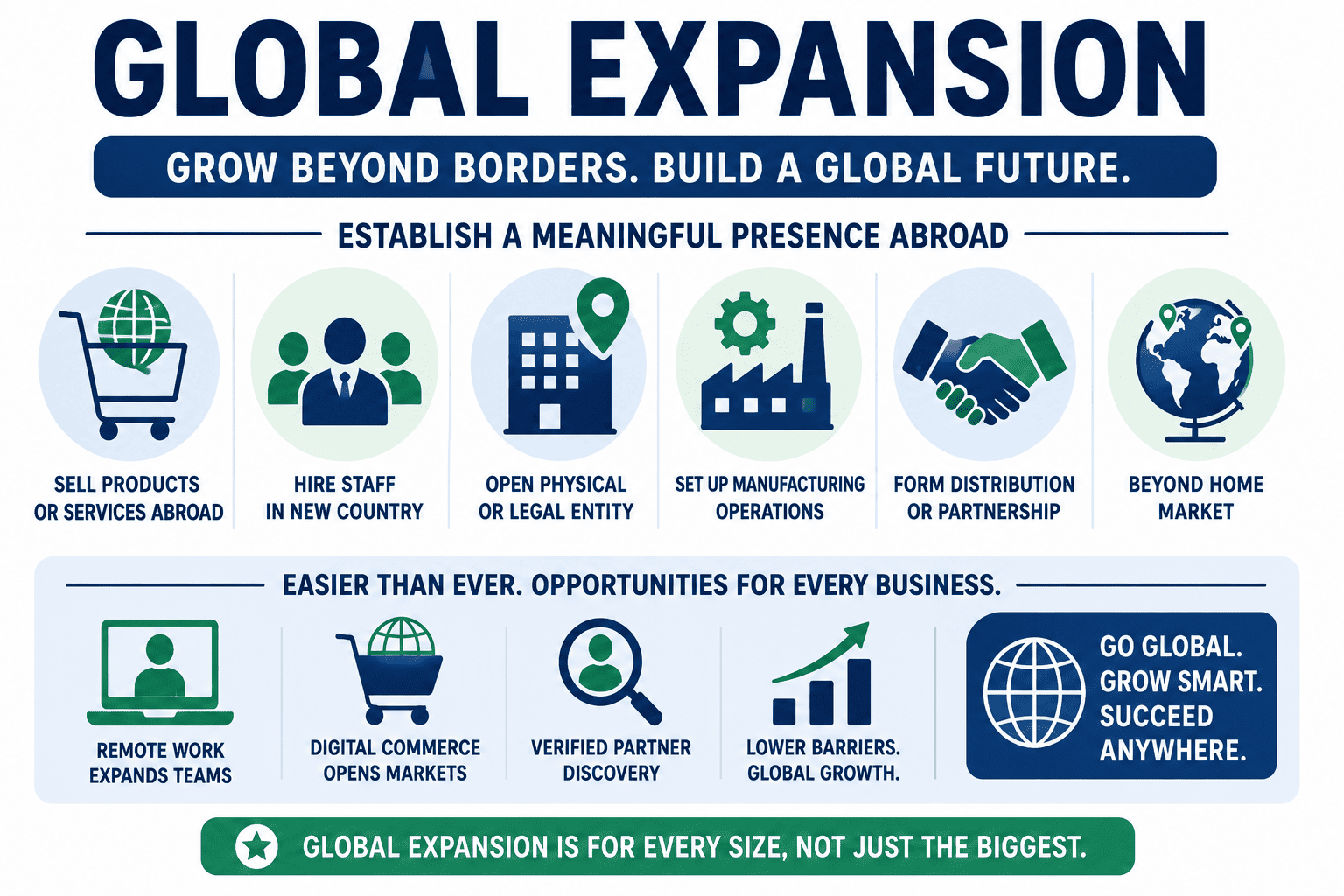
Global expansion is the strategic process by which a company establishes a meaningful presence in international markets, whether by selling products or services abroad, hiring staff in a new country, opening a physical or legal entity, or forming a manufacturing or distribution partnership beyond its home market. It is increasingly a core growth strategy for companies of every size, not just established multinationals, as remote work, digital commerce, and verified partner-discovery platforms have lowered the practical barriers to entry that once made international growth the exclusive domain of large enterprises.
📈
Access to New Customer Bases
The most direct driver of global expansion: reaching customers who don’t yet have access to your product or service, often in markets where demand is structurally growing faster than your home market.
💼
Talent Access
Expansion provides access to specialized skills and talent pools that may be scarce, expensive, or simply unavailable domestically, a driver that has intensified as remote and hybrid work normalizes cross-border hiring.
🛡️
Risk Diversification
Operating across multiple countries spreads exposure to geopolitical, economic, or regulatory shocks that might otherwise be concentrated entirely in a single home market.
🏆
Competitive Advantage
Establishing a presence in a market before competitors do can create durable first-mover advantages, brand recognition, distribution relationships, and regulatory familiarity that are expensive for later entrants to replicate.
🔗
Access to Resources & Supply Chains
Global operations provide access to new raw materials, supplier networks, and distribution channels, strengthening supply chain resilience in ways a single-market footprint cannot.
🧠
Adaptation & Innovation
Operating across diverse cultural, regulatory, and economic environments tends to push organizations toward greater flexibility and innovation than they would develop serving a single, homogeneous market alone.
None of this potential is automatic, however. The same research base that documents global expansion’s upside also documents, in granular detail, exactly how and why it goes wrong, which is the focus of the rest of this guide.
SECTION 2
2 Examining the Possibilities and Obstacles of Global Business Expansion
Academic research framing global expansion as a possibilities-and-obstacles trade-off, rather than treating opportunity and risk as separate questions, offers the most useful lens for real decision-making. A 2024 study published in the Journal of Informatics Education and Research, drawing on empirical data and theoretical frameworks, found that the primary impediments to global business expansion are cultural disparities, intricate regulations, political volatility, currency oscillations, and competitive forces, and crucially, that these obstacles are not independent of the possibilities; they are often two sides of the same market characteristic.
Market Characteristic
The Possibility It Creates
The Obstacle It Also Creates
Large, fast-growing population
Enormous addressable market and long-term revenue runway
Intense local competition already serving that demand at scale
Emerging middle class with rising spending power
Demand for products/services not yet well served
Consumer behaviour and brand loyalty patterns that differ sharply from mature markets
Underdeveloped regulatory infrastructure
Lower compliance overhead and faster initial market entry
Regulatory unpredictability and the risk of sudden policy shifts post-entry
Lower labour costs
Improved unit economics and margin structure
Currency volatility that can erode that margin advantage overnight
Strategic trade location (e.g. EU access, free trade agreements)
Tariff-free access to large adjacent markets
Complex multi-jurisdiction tax and compliance obligations to maintain that access
Distinct cultural and linguistic identity
A genuinely differentiated market opportunity for localized products
Communication, marketing, and management practices that don’t transfer from the home market
💡 The Practical Implication
Don’t evaluate “how attractive is this market” and “how risky is this market” as two separate scoring exercises run by different teams. The research consistently shows they are correlated, the most attractive markets are very often also the most obstacle-laden. A market-entry decision framework should weigh possibility and obstacle for the same underlying characteristic together, market by market, rather than producing an opportunity score and a risk score that get averaged or compared in isolation.
SECTION 3
3 The Five Core Challenges of Global Expansion
Across dozens of industry guides, academic papers, and case study collections, the same five challenge categories recur with remarkable consistency. Understanding each in depth, not just naming it, is what separates a useful expansion plan from a generic checklist.
🌐Most Underestimated
Cultural & Behavioural Misalignment
Misunderstanding local consumer behaviour, communication norms, and management expectations can derail even well-funded expansions. This extends beyond language translation to deeper assumptions about trust, loyalty, decision-making hierarchy, and what counts as acceptable business conduct. Companies with collectively-oriented home cultures often misjudge individually-oriented markets, and vice versa.
Root cause in nearly every documented case-study failure
⚖️Compounding
Regulatory & Legal Complexity
Trade restrictions, tariffs, intellectual property frameworks, employment law, and compliance requirements vary widely by country, and change without warning. Navigating multiple, sometimes contradictory, regulatory frameworks simultaneously requires either deep in-house expertise or trusted local partners, and getting it wrong carries legal, financial, and reputational consequences.
64% of companies expanding globally report compliance management as their top struggle (EY)
💱Financial
Currency, Cost & Tax Risk
Currency exchange rate fluctuations directly erode profitability and complicate financial planning across jurisdictions. High upfront entity-setup costs, legal, administrative, infrastructure, must be budgeted for before any revenue materializes. Layered on top is the tax exposure addressed in depth in the next section: permanent establishment risk, transfer pricing, and double taxation.
Entity setup can cost tens of thousands of dollars per market before any revenue
🚚Operational
Supply Chain & Logistics Complexity
Managing supply chains, shipping, and distribution across borders is costly and complicated, different infrastructure quality, customs procedures, and last-mile delivery norms all affect cost and reliability differently than in the home market. A supply chain that performs reliably domestically can become the single biggest source of customer dissatisfaction abroad if not redesigned for local conditions.
A leading cause of margin erosion in international e-commerce expansion
👥Talent
Talent Acquisition & Retention
Finding and retaining skilled local talent who genuinely understand the market, not just speak the language, is consistently identified as a top obstacle. This is compounded by visa restrictions, differing job-market expectations, and the administrative burden of payroll and benefits compliance across multiple labour law regimes.
A USD 8.5 trillion global talent shortage is projected by 2030 (G-P analysis)
🥊Strategic
Underestimated Local Competition
Every market already has local players who understand their customers, regulatory environment, and distribution channels better than a new entrant does. Companies that dominate their home market often enter new markets with overconfidence, assuming brand reputation alone will translate, a pattern visible across nearly every well-documented expansion failure discussed below.
Cited as a contributing cause in the majority of documented global expansion failures
SECTION 4
4 Global Tax Implications of International Expansion
🏛️ Why This Deserves Its Own Section
The global tax implications of international expansion are frequently the single most expensive category of challenge that companies fail to plan for adequately, not because the rules are secret, but because they are genuinely complex, vary enormously by jurisdiction, and often only become visible after a structure is already in place. Misclassifying a tax obligation can mean retroactive liability, penalties, and double taxation on income that should only have been taxed once.
Tax Concept
What It Means in Practice
Why It Catches Companies Off Guard
Permanent Establishment (PE)
A fixed place of business, or even a dependent agent who negotiates and finalizes contracts on your behalf, can create a taxable presence in a foreign country, triggering local corporate tax on profits attributable to that presence
PE can be triggered without ever opening a formal subsidiary; in 2016, Spanish tax authorities found Dell Ireland had a PE through Dell Spain acting as a dependent agent, a structure many companies use without realizing the exposure
Double Taxation
The same income gets taxed in both the home and host country, absent relief mechanisms
Companies assume domestic tax payment covers their obligation everywhere, it usually doesn’t without an applicable treaty and correct structuring
Double Tax Treaties (DTTs)
Bilateral agreements between countries that reduce or eliminate double taxation, often via foreign tax credits, exemptions, or reduced withholding rates
Treaty benefits are not automatic, they require correct entity structuring and documentation to claim, and the treaty network varies significantly by country pair
Withholding Tax (WHT)
Tax deducted at source on cross-border payments, dividends, interest, royalties, and certain service fees, before funds are remitted abroad
Rates vary enormously: from single-digit treaty rates to 35%+ statutory rates on payments to non-residents, depending on the jurisdiction and whether a treaty applies
Transfer Pricing
Pricing rules requiring transactions between related entities in different countries to be conducted at “arm’s length”, as if the parties were unrelated
Non-compliance triggers significant penalties and retroactive adjustments; thorough documentation and justification of pricing policy is required, not just a defensible number
VAT / GST Registration
Indirect tax registration obligations that can apply to digital sales even without any physical presence in the country
Registration thresholds are often low or non-existent for digital goods and services, many companies assume no physical presence means no VAT obligation, which is frequently wrong
OECD Pillar Two, 15% Global Minimum Tax
A global minimum effective tax rate of 15% for large multinational groups, designed to prevent profit-shifting to low-tax jurisdictions
UK and other jurisdictions are actively implementing Pillar Two; companies that based expansion plans on legacy low-tax-jurisdiction strategies need to reassess those structures
⚠️ Tax Planning Cannot Be an Afterthought
Effective tax planning during expansion means structuring operations, transactions, and investment flows in a tax-efficient manner from the outset, not retrofitting a structure after a problem surfaces. A correctly structured IP holding arrangement, R&D incentive claim (such as the UK’s Patent Box regime, which applies a lower corporate tax rate to patented-invention profits), or treaty-aligned entity structure can materially change the economics of an expansion. Engaging a qualified cross-border tax advisor before, not after, entity formation is consistently the highest-leverage early investment in any expansion plan.
SECTION 5
5 Global Expansion Failures: What Real Cases Teach Us
Studying well-documented global expansion failures is more instructive than studying successes, because failures reveal exactly which assumption broke down, and that assumption is almost always identifiable, preventable, and repeated across multiple unrelated companies and industries.
eBay, China (2002–2006)
Cultural Misread + Platform Loyalty
eBay entered China assuming the world’s most populous market would respond the same way US users had. It underestimated the depth of local trust in homegrown platforms and failed to adapt its model to local consumer behaviour before asking users to change their own. Local competitor Taobao eventually dominated, and eBay exited.
Best Buy, China (Withdrawn 2011)
Cost Structure Mismatch
Best Buy’s big-box, premium-service retail model, built around US suburban shopping habits, did not translate to Chinese consumer price sensitivity and shopping patterns. Significant cost reduction would have been required to compete, and the company ultimately withdrew rather than restructure its entire value proposition.
Tesco, United States (Fresh & Easy, 2007–2013)
Operational Assumption Failure
Tesco assumed US grocery shopping habits would mirror UK patterns. A key misstep: stocking shelves overnight when stores were closed, standard UK practice but a major mismatch with how US grocery operations and staffing typically work, among several operational missteps that compounded losses.
Airbnb, China (2016–2022)
Localization That Didn’t Land
After seven years, including a platform name change and adaptation attempts, Airbnb exited China in July 2022. Chinese consumers generally trusted locally operated platforms more than foreign entrants, even after genuine localization effort, illustrating that surface-level localization isn’t always sufficient to overcome deep platform-trust dynamics.
Mobike, Global Bike-Share Expansion
Model-Market Mismatch
Mobike’s shared-bicycle model depended heavily on market-specific commuting behaviour and local regulation. Despite high resource investment, the model proved unsuitable for many of the international markets it expanded into, illustrating that even well-capitalized expansions fail when the underlying business model doesn’t transfer.
Tim Hortons, United States
Brand Strength Didn’t Transfer
Despite a powerful brand identity in Canada, Tim Hortons has held only a small fraction of US market share, given the choice, the typical American consumer has tended to default to Starbucks or Dunkin’ rather than switching to a foreign brand without the same domestic cultural equity.
🌍 Not Every Expansion Fails, The Counter-Examples Matter Too
Companies including Aldo, Carrefour, and Nordstrom have succeeded internationally precisely where others failed, by deeply understanding customer preferences and carefully managing location and supply chain decisions rather than assuming their home-market formula would transfer unchanged. The difference between failure and success in these case studies is rarely access to capital, it is the depth and seriousness of pre-entry research and willingness to genuinely adapt rather than merely translate.
SECTION 6
6 Why Global Expansion Efforts Fail, The Common Threads
Pulling back from individual case studies, the same underlying causes appear again and again across industries, company sizes, and decades. Recognizing the pattern is the first step toward not repeating it.
🔍
Insufficient Pre-Entry Market Research
A lack of understanding of local purchasing characteristics, consumer behaviour, and competitive dynamics is the single most frequently cited root cause across documented failure case studies, more common than capital shortfall, regulatory surprise, or any other single factor.
Most Common Cause
😎
Overconfidence From Home-Market Success
Companies that dominate their domestic market frequently enter foreign markets assuming their playbook, brand strength, or operational model will transfer directly, an assumption that case after case shows to be unreliable, particularly regarding legal systems, supply chains, and local competitive responses.
Pattern Across Large Incumbents
⏱️
Underestimating Time-to-Traction
Many organisations treat international expansion as a short-term growth lever, when building brand trust, relevance, and visibility in a genuinely new market is consistently a long-term exercise requiring sustained investment well before meaningful sales follow.
Timeline Misjudgment
🎯
Internal Prioritization Failure
Leadership may champion global expansion, but the rest of the organisation often treats new-market investment as lower priority than new products or domestic segments, even though, as one industry expert notes, going international frequently has the largest single impact on long-term company valuation.
Organizational Risk
🪞
Losing Brand Identity in the Adaptation Process
In trying to fit a new market, some companies over-adapt, changing their tone, values, or product quality so much that they lose what made them distinctive in the first place. Customers in any market tend to want authenticity, not an unrecognizable version of a once-clear brand.
Over-Correction Risk
💸
Expanding Too Fast Relative to Revenue Stability
Heavy upfront investment in logistics, legal setup, local staffing, and marketing, before securing stable local revenue, creates financial pressure that compounds quickly when returns don’t meet projections, particularly once currency and unexpected regulatory costs are added.
Financial Overreach
SECTION 7
7 Entry Models & How They Change the Risk Profile
Much of the risk discussed above is not fixed, it can be deliberately reduced by choosing a lower-commitment entry model first and graduating to deeper local investment only once a market is validated. The entry model you choose is, in effect, a direct lever on how much of each challenge category you’re exposed to.
Markets requiring deep local knowledge or regulatory advantage from local ownership
Wholly owned subsidiary
High
High, clear PE and full local tax exposure
Slow (12–18 months)
Long-term strategic commitment once a market is validated through a lower-risk model first
For most companies, the financially and operationally disciplined approach is to sequence these models, start with a distributor relationship or EOR-based test team, validate demand and operational fit, then escalate to contract manufacturing, a joint venture, or a wholly owned subsidiary only once the market has proven itself. This mirrors the sequencing recommended across virtually every documented expansion success story and stands in direct contrast to the “expand too fast” failure pattern discussed above. See our guide on business partnership contracts for how to formalize the lower-commitment stages of this sequence.
SECTION 8
8 Global Expansion Service Benefits: What Actually Reduces Risk
A growing category of specialized service providers exists specifically to absorb the categories of risk discussed above. Some of these benefits are well-documented with industry data; others are primarily vendor marketing claims. Here’s what the evidence actually supports.
80%
Faster time-to-hire reported by companies using Employer of Record services in new markets (Papaya Global, 2024)
50%
Decrease in compliance-related issues reported by companies leveraging EOR services vs. self-managed compliance (EY analysis)
82%
Reported cost savings vs. full entity setup when using an EOR partnership model for initial market entry
👤
Employer of Record (EOR)
Acts as the legal employer of staff in a foreign country, handling payroll, tax withholding, statutory benefits, and labour law compliance, eliminating the need to establish a local entity just to hire a small initial team.
🧾
Global Payroll & Tax Compliance Platforms
Centralize multi-currency payroll, withholding tax calculation, and statutory filing across jurisdictions, reducing the administrative burden that a 2024 ADP analysis found 68% of US payroll teams cite as their top global complexity challenge.
⚖️
Cross-Border Legal & Tax Advisory
Provides jurisdiction-specific guidance on permanent establishment risk, transfer pricing documentation, and treaty network optimization, the single highest-leverage early investment for tax-related risk reduction discussed in Section 4.
🔍
Market Research & Localization Services
Conduct in-depth research into target-market legal, cultural, and economic environments before entry, directly addressing the “insufficient research” root cause identified as the most common reason expansions fail.
🤝
Verified B2B Partner Discovery Platforms
Reduce the due diligence burden and fraud risk of finding a distributor, manufacturer, or technology partner abroad, addressing the partner-related risk explored in depth in Section 10. See our guide on international wholesale distributors for the discovery framework.
📦
Supply Chain & Logistics Management Platforms
Optimize cross-border distribution, customs documentation, and delivery networks, directly addressing the operational complexity category, particularly relevant for companies expanding e-commerce or physical product distribution.
💡 Service Benefits Are a Bridge, Not a Permanent Strategy
The strongest evidence base for global expansion service benefits, particularly EOR and verified partner discovery, applies specifically to the early, market-testing phase of expansion. These services are most valuable as a way to validate a market before committing the capital required for a wholly owned subsidiary or large-scale manufacturing investment, consistent with the staged entry-model approach discussed in Section 7, and the staged risk allocation discussed in our guide on risk allocation in cross-border deals.
SECTION 9
9 A Practical Framework for Mitigating Expansion Risk
01
Conduct Research Before Committing Capital, Not After
Commission genuine local market research, consumer behaviour, competitive landscape, regulatory environment, before any entity is formed or significant capital deployed. This single step addresses the most commonly cited failure cause across every case study in Section 5.
02
Map the Possibility-Obstacle Pair for Each Target Market
Using the framework in Section 2, evaluate each candidate market’s growth potential and its structural obstacles together, not as separate scores, and rank markets by the trade-off, not by opportunity size alone.
03
Engage Tax & Legal Advisory Before Entity Formation
Resolve permanent establishment exposure, treaty-network optimization, and transfer pricing structure before forming any local entity or signing a partnership agreement, retrofitting tax structure after the fact is consistently more expensive and riskier than planning it upfront.
04
Choose the Lowest-Commitment Viable Entry Model
Use the entry-model framework in Section 7 to select the option that validates demand with the least capital exposure, then graduate to deeper commitment only once the market has demonstrated traction.
05
Verify Every Local Partner Before Signing
Whether a distributor, manufacturer, or joint venture partner, verify business registration, financial standing, and reputation independently rather than relying solely on documents the prospective partner provides, see Section 10 for the specific risks this addresses.
06
Budget for a Longer Time-to-Traction Than Your Home Market Required
Treat brand-building and trust establishment in a new market as a multi-year investment, not a single-quarter campaign, and ensure internal stakeholders and investors share that timeline expectation before launch, addressing the prioritization and timeline-misjudgment failure patterns from Section 6.
07
Preserve Brand Identity While Genuinely Localizing
Adapt language, payment methods, and channel strategy to local norms, but protect the core product quality and values that built your domestic success. The right balance is “locally relevant,” not “unrecognizable.”
08
Build Force Majeure and Risk Allocation Into Every Cross-Border Contract
Whatever entry model you choose, ensure every contract, distribution, manufacturing, technology licensing, explicitly addresses risk allocation and unforeseeable disruption. See our guides on force majeure in global trade and contracts between manufacturer and distributor for the specific clauses this requires.
SECTION 10
10 Partner-Related Risk: The Most Underestimated Obstacle
Of all the challenges discussed in this guide, partner-related risk is the one most consistently underestimated in expansion planning, and one of the most preventable. Whether you’re appointing a distributor, qualifying a contract manufacturer, or forming a joint venture, the wrong local partner can simultaneously expose you to nearly every other category of risk discussed above: cultural misjudgment (a partner who doesn’t actually understand the local customer), regulatory exposure (a partner whose compliance practices create liability for you), and financial loss (a partner who can’t or won’t fulfil capital or service commitments).
Confirm business registration status independently, never rely solely on documents the prospective partner provides
Verify financial standing and credit capacity relative to the scale of commitment being discussed
Check for existing competing relationships or conflicting commitments in your category
Assess genuine sector and application expertise, not just general business credibility
Use a mutual NDA before sharing sensitive product, pricing, or market-entry strategy details
Confirm how a cross-border dispute would actually be enforced in each party’s home jurisdiction
🌍 Why This Compounds Every Other Challenge
A partner who misrepresents their distribution coverage, financial capacity, or regulatory standing doesn’t just create a single point of failure, they amplify every other challenge discussed in this guide. A poor manufacturing partner doesn’t just cost you a contract; it can damage your brand’s local reputation just as severely as the cultural missteps documented in Section 5’s case studies. See our guides on finding a supply chain partner and white-label vs. private label manufacturing for sector-specific partner qualification criteria.
SECTION 11
11 How GTsetu Reduces Partner-Related Expansion Risk
🌍 GTsetu, Verified B2B Partner Discovery for Global Expansion
Reduce the One Risk Category Most Likely to Undermine Every Other Mitigation Effort
Every mitigation strategy discussed in this guide, research, tax planning, staged entry models, brand discipline, can still be undermined by a single bad local partner. GTsetu addresses this specific risk directly: a compliance-verified B2B platform where every company has been checked through business registration, tax ID, licensing, and industry certification before it ever appears in the network. Whether you’re discovering a distributor to test a new market with minimal capital exposure, qualifying a contract manufacturer before committing to local production, or evaluating a technology licensing partner, GTsetu lets you verify and engage anonymously, execute an NDA before sharing sensitive expansion plans, and move forward with zero broker commissions on whatever partnership you ultimately form.
🏛️
Pre-Verified Business Identity
Every company on GTsetu has been checked against business registration, tax ID, and licensing records before appearing in the network, directly addressing the verification gap discussed in Section 10.
🕵️
Anonymous Discovery
Evaluate a prospective partner’s credentials and capacity without revealing your own expansion plans or identity until you choose to engage directly.
📄
Built-In NDA Workflow
A digital mutual NDA with timestamped signatures is in place before any sensitive market-entry strategy, pricing, or product detail is exchanged.
🔐
Encrypted Document Workspace
Share financial references, contract drafts, and technical specifications through an AES-256 encrypted workspace rather than unprotected email.
🚫
Zero Broker Commission
GTsetu charges no commission on any partnership formed through the platform, the commercial terms of your expansion stay strictly between you and your partner.
🌏
100+ Countries Covered
GTsetu’s verified network and B2B matchmaking tool support discovery across the same markets where global expansion is most active, helping de-risk the partner-discovery stage of any expansion plan.
QWhat are the biggest challenges of global expansion?
The biggest challenges of global expansion typically fall into five categories: cultural differences (misreading local consumer behaviour and communication norms), regulatory complexity (varying labour laws, tax regimes, and compliance requirements across jurisdictions), financial risk (currency fluctuation, high upfront entity-setup costs, and unpredictable tax exposure), operational complexity (supply chain, logistics, and talent acquisition in unfamiliar markets), and competitive disadvantage (underestimating entrenched local incumbents who understand the market better). Academic research on global business expansion consistently identifies cultural disparities, intricate regulations, political volatility, currency oscillations, and competitive forces as the primary impediments companies face when expanding internationally, and these obstacles are frequently most acute in precisely the markets that offer the greatest growth opportunity.
QHow do you examine the possibilities and obstacles of global business expansion together?
Examining the possibilities and obstacles of global business expansion together means treating market opportunity and market risk as a single, correlated trade-off rather than two independent scoring exercises. Research consistently shows that the same market characteristics driving the greatest growth possibility, a large population, an emerging middle class, lower labour costs, strategic trade access, also tend to create the steepest obstacles, such as intense local competition, unfamiliar consumer behaviour, currency volatility, and complex multi-jurisdiction compliance. A useful market-entry framework evaluates each underlying market characteristic for both its possibility and its corresponding obstacle simultaneously, rather than producing an opportunity score and a risk score that are compared only at the end of the analysis.
QWhy do so many global expansion efforts fail?
Global expansion failures are most often caused by insufficient market research before entry, underestimating entrenched local competitors, failing to adapt products or business models to local consumer behaviour, and overconfidence carried over from home-market success. Well-documented examples include eBay’s 2002 exit from China after underestimating local platform loyalty and trust, Best Buy’s withdrawal from China after failing to adjust its big-box cost structure to local price sensitivity, Tesco’s costly US exit (Fresh & Easy) after misjudging local grocery shopping and staffing habits, and Airbnb’s 2022 departure from China after seven years of localization attempts that still couldn’t overcome local platform-trust dynamics. A common thread across nearly all documented failures is that companies tried to replicate their home-market playbook rather than genuinely adapting it, and frequently underestimated how long it actually takes to build brand trust and demand in a market that doesn’t yet know them.
QWhat are the global tax implications of international expansion?
The global tax implications of international expansion include: permanent establishment (PE) risk, where a fixed place of business or a dependent agent abroad can trigger local corporate tax liability even without a formal subsidiary, as seen in the 2016 Dell Ireland/Dell Spain case; double taxation, where the same income is taxed in both the home and host country absent relief mechanisms; withholding tax on cross-border dividends, interest, and royalty payments, which varies significantly by country and treaty network (from low single-digit treaty rates to 35%+ statutory rates); transfer pricing rules requiring related-party transactions to be priced at arm’s length, with significant penalties and documentation requirements for non-compliance; VAT/GST registration obligations that can apply even without physical presence in digital sales scenarios, often at low or non-existent thresholds; and the OECD’s Pillar Two framework, which introduced a 15% global minimum tax rate for large multinational groups, with implementation already underway in the UK and other jurisdictions. Double tax treaties between the home and host country can reduce or eliminate many of these costs, making treaty-network analysis and correct entity structuring a critical early step in any expansion plan.
QWhat benefits do global expansion services provide?
Global expansion services, including Employer of Record (EOR) providers, cross-border tax and legal advisory, market research firms, and verified B2B partner discovery platforms, reduce the cost, time, and compliance risk of entering a new market. An EOR allows a company to hire employees in a foreign country without establishing a local legal entity, with industry data from Papaya Global reporting time-to-hire reductions of up to 80% and reported cost savings of up to 82% versus full entity setup. EY analysis found that companies leveraging EOR services reported a 50% decrease in compliance-related issues compared to managing compliance internally. Verified partner discovery platforms like GTsetu reduce the due diligence burden and fraud risk associated with finding a distributor, manufacturer, or technology partner abroad, directly addressing the partner-related risk that compounds nearly every other expansion challenge. Collectively, these services convert global expansion from a high-capital, high-risk undertaking into a staged, testable process that can be validated before committing to full local establishment.
QWhat is the difference between obstacles and possibilities in global business expansion?
Examining the possibilities and obstacles of global business expansion means weighing the structural upside, access to new customer bases, diversified revenue streams, talent pools, and resilience against domestic market downturns, against the structural risks of cultural misalignment, regulatory complexity, currency exposure, and competitive disadvantage. Neither exists in isolation: a market with the greatest growth possibility (large population, fast-growing middle class) is often also the market with the steepest obstacles (complex regulation, intense local competition, currency volatility). Effective global expansion planning treats this as a single trade-off analysis per market, evaluating the possibility and the obstacle tied to the same underlying market characteristic together, rather than scoring opportunity and risk as separate, unrelated questions and comparing the results only at the end.
Reduce the Risk That Compounds Every Other Expansion Challenge
Find and verify a distributor, manufacturer, or technology partner abroad through GTsetu’s compliance-verified network before you commit capital to a new market. Anonymous discovery, built-in NDA workflow, zero broker commissions.
They represents the product, and research team behind GTsetu, a global B2B collaboration platform built to help companies explore cross-border partnerships with clarity and trust. The team focuses on simplifying early-stage international business discovery by combining structured company profiles, verification-led access, and controlled collaboration workflows.
With a strong emphasis on trust, and disciplined engagement, Team GTsetu shares insights on global trade, partnerships, and cross-border collaboration, helping businesses make informed decisions before entering deeper commercial discussions.