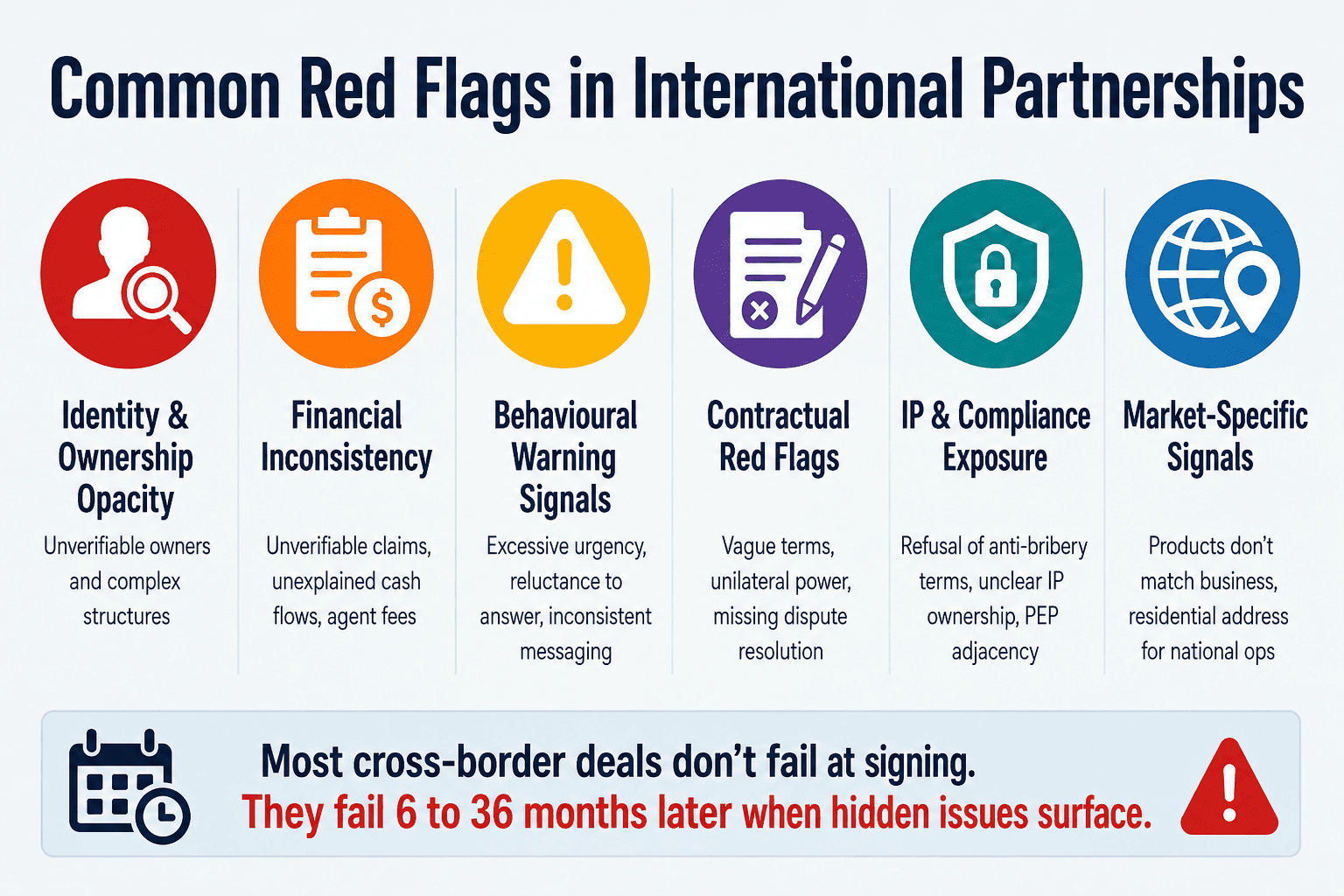
Direct Answer: The most common red flags in international partnerships fall into six categories: identity and ownership opacity (unverifiable ultimate beneficial owners, layered shell structures); financial inconsistency (unverifiable claims, unexplained cash flows, agent fee structures); behavioural warning signals (excessive urgency to close, reluctance to answer specific questions, inconsistent messaging); contractual red flags (vague terms, unilateral decision-making power, missing dispute resolution); IP and compliance exposure (refusal of standard anti-bribery representations, unclear IP ownership, PEP adjacency); and market-specific signals (products not matching the buyer’s stated business, residential addresses for supposed national operations). Most cross-border deals that fail do not fail at signing, they fail six to thirty-six months later when issues that were visible during due diligence, had anyone looked carefully, finally surface.
📅 June 14, 2026⏱ 19 min read✍️ GT Setu Editorial Team🔄 Updated regularly
6
Core Red Flag Categories in International Partnerships
7
Layers of Foreign Partner Due Diligence (Best Practice)
36mo
Avg. Delay Before Hidden Problems Surface Post-Signing
0%
GTsetu Broker Commission on Verified Partner Discovery
Most international partnerships don’t fail because of bad market conditions or strategic miscalculations. They fail because one party entered the relationship without genuinely understanding who the other party was, their actual ownership structure, their real financial position, or the gap between what they claimed and what was verifiable. The problem is compounded internationally because the verification infrastructure that domestic due diligence takes for granted, accessible public registries, English-language litigation records, searchable adverse media, is absent, unreliable, or in a language the reviewing team cannot read in most of the world’s highest-priority expansion markets.
This guide covers the complete landscape of red flags in international partnerships, not as a generic list of bad things to avoid, but as a structured, category-by-category framework for knowing what to look for, why each signal matters, and what specific action it should trigger. If you’re evaluating a foreign distributor, a contract manufacturer, a technology licensee, or a joint venture partner, the red flag categories below apply regardless of your industry or the partner’s country. For the contractual frameworks that govern what happens once you’ve cleared due diligence and decided to proceed, see our guides on business partnership contracts and the contract between manufacturer and distributor.
⚑ Who Is This Guide For?
This guide is written for business development leaders, procurement teams, legal counsel, and founders evaluating potential international partners, whether distributors, manufacturers, technology licensees, or joint venture candidates. It is educational in nature and draws on documented due diligence practice, regulatory guidance, and real-world cross-border deal patterns; it is not a substitute for jurisdiction-specific legal or compliance advice. If you are evaluating a specific partnership structure, see our companion guides on partnership evaluation criteria and cross-border business partnerships.
SECTION 1
1 Why International Partnership Due Diligence Is Harder Than Domestic
🎯 The Core Problem
Standard domestic due diligence assumes three things that are rarely true internationally: accurate and accessible public records, searchable litigation history in a common language, and English-language media coverage of the counterparty. Remove those assumptions, as you must in most cross-border deals, and you’re evaluating a partner with substantially less independent evidence than you would have domestically, which is precisely when red flags become both more likely and harder to spot.
🌐
Language Barrier in Adverse Media
The most consequential reporting about a foreign counterparty often appears in local-language press, regional trade publications, and online forums that never surface in English-language database searches, only researchers who read the language natively can reliably find and evaluate that content.
🏗️
Shell Company Infrastructure
Jurisdictions with low barriers to set up shell companies, Panama, BVI, Seychelles, make it easy to insert multiple ownership layers between you and the Ultimate Beneficial Owner. Each layer is a layer where a sanctioned individual, a PEP, or a competitor can hide.
📋
Registry Quality Varies Enormously
Public company registries in some countries are accurate and current; in others they are poorly maintained, accept self-reported data with minimal verification, or are simply inaccessible to foreign researchers in a usable format.
⚖️
Regulatory Consequence Inheritance
Under frameworks like the US Foreign Corrupt Practices Act (FCPA), a company can inherit its foreign partner’s bribery payments, sanctions violations, and corrupt relationships the moment the deal closes, making partner vetting not just a business risk question but a legal liability question.
🤖
AI-Generated Corporate Facades
AI-generated company websites, fabricated biographies, and synthetic identities have become a fast-growing due diligence challenge, capable of producing convincing corporate presences that pass superficial review but collapse under detailed investigation.
⏳
Problems Surface Long After Signing
Most cross-border deals that fail do not fail at signing, they fail six, twelve, or thirty-six months later when a bribery payment surfaces, a sanctioned beneficial owner is exposed, or “consulting fees” turn out to fund a government official’s family.
SECTION 2
2 Category 1: Identity & Ownership Opacity
Identity and ownership red flags are the foundational category, if you cannot establish with confidence who you are actually dealing with, every other piece of due diligence is built on sand. A firm that refuses to reveal its beneficial owners or disentangle its financial ownership structure typically has something to hide, whether that is tax exposure, sanctions risk, or simply the laundering of financial history.
🏠High Severity
Residential or Shared Address for a National Business
A company claiming to be a major national distributor or manufacturer but listing a residential address, a shared registered-agent address, or an address common to multiple unrelated entities is a significant structural inconsistency. Legitimate large-scale operations have real commercial premises that can be verified and, where appropriate, visited.
Action: Request and verify a physical trading address separately from the registered office
🐚High Severity
Opaque Ownership, No Verifiable UBO
Shell companies are not automatically red flags, but every layer between you and the Ultimate Beneficial Owner is a layer where a sanctioned individual, a Politically Exposed Person (PEP), or a competitor can hide. An ownership structure that cannot be traced to a named, verifiable human being deserves either a complete explanation or withdrawal from the deal.
Action: Trace ownership to a specific named individual with corroborating evidence (passport, residency, second-source reference)
📅Moderate Severity
Recently Incorporated Company Claiming Extensive History
A company registered six months ago that claims ten years of industry experience and a large existing customer base is describing a history that either belongs to a predecessor entity (which should be disclosed and explained) or is fabricated. Registration dates are publicly verifiable in most jurisdictions and should always be checked.
Action: Pull original registration documents from the home-country registry and verify the founding date independently
🌐Moderate Severity
Little or No Verifiable Web Presence
A company with no domain-based email address, no verifiable website, or a website filled with generic descriptions, stock imagery, and no real contact points or staff is a concern, particularly if it is also using a free webmail address for all communications.
Action: Verify domain registration date; check whether email domains match company registration; run reverse image search on key photos
👤High Severity
Fabricated Leadership Experience
Inconsistent job titles, career histories that differ across LinkedIn, press releases, and public records, and “serial entrepreneur” profiles with no verifiable evidence of prior businesses are among the most common identity red flags found in international business due diligence. Generative AI has made these fabrications easier to produce convincingly.
Action: Cross-reference biographical claims across at least three independent sources; check prior employer registrations independently
🔄Moderate Severity
Frequent Ownership Changes or Unresolved Disputes
Frequent changes in ownership, unclear or disputed shareholder records, or ongoing litigation involving ownership rights signal potential future legal fights or power struggles that will affect the partnership’s stability, regardless of who ultimately prevails.
Action: Review the complete ownership history; search local courts for shareholder dispute filings
Financial red flags are often the most technically demanding category to identify, but they are also the category most likely to conceal the most significant legal exposure. Even seasoned investors and business development professionals can be misled by a polished financial presentation, financial claims that are not tested independently tend to reflect weaker, or much riskier, businesses than they appear.
💸
Vague “Business Development” or “Government Relations” Fees
Agent or consultant fee structures described as “business development,” “government relations,” or “market access” without a clear, market-rate, documented deliverable are the single most common FCPA failure mode in cross-border deals. They are also among the most common ways to structure a bribe. Demand precise written scope of services, market-rate fee justification, and counterparty identification for any agent or intermediary arrangement.
Critical Signal
📊
Financial Performance Far Outside Industry Norms
Reported profits that look significantly better, or significantly worse, than industry norms for the same geography and sector deserve independent verification. Margins far above peers may conceal hidden liabilities, unsustainable accounting practices, or inflated figures. Margins far below may indicate hidden expenses, poor management, or a deliberately suppressed paper trail.
Investigate
🔄
Unexplained Inter-Company Cash Flows
Inter-company transfers, success fees, or rebates that don’t match commercial activity, for example, large payments to a related entity with no clear commercial rationale, are consistently identified as a red flag by FCPA enforcement teams, anti-money-laundering investigators, and cross-border due diligence specialists.
Critical Signal
📑
Financial Documents That Don’t Match
Irregularities or discrepancies within financial documents, revenue figures that don’t reconcile across different versions of accounts, tax filings that imply different income than reported P&L, point to poor record keeping at best, and potential fraud at worst. Independent verification against third-party sources (bank references, tax authority filings where accessible) is essential.
Investigate
💰
Inability to Demonstrate Financial Capacity for Claimed Volume Commitments
A distributor or manufacturer claiming the capacity to handle large minimum-purchase or production volume commitments should be able to demonstrate the working capital, credit lines, and inventory infrastructure to support those claims. Inability or reluctance to provide financial references appropriate to the scale of commitment is a significant commercial risk signal.
Commercial Risk
SECTION 4
4 Category 3: Behavioural Warning Signals During Negotiations
Behavioural and process-related red flags are consistently underweighted in due diligence compared to financial and legal ones. Reviewers naturally focus on documents and numbers, but some of the most important signals come from how the other party behaves throughout the process, not just what the documents say. As one due diligence specialist notes: “Investors should pay close attention to the texture of manager responses, not just their content. Defensive answers, excessive caveating, and the careful management of what information reaches whom are often more revealing than the information itself.”
Behavioural Signal
What It Looks Like
Why It Matters
Excessive urgency to close
“We have another interested party and need your decision by end of week.” Timeline pressure that doesn’t reflect any obvious commercial rationale.
Urgency that bypasses proper review time is typically designed to prevent scrutiny from surfacing problems. Every deal has a timeline, urgency that compresses due diligence specifically is a warning.
Vague or deflecting responses to specific questions
Standard due diligence includes a Q&A process. If responses are consistently evasive, surprisingly defensive, or redirect to unrelated topics when specific questions are asked, that pattern itself is a finding.
Reluctance to answer follow-up questions in standard due diligence is one of the most common behavioural red flags identified by investigators. The pattern across multiple questions matters more than any single evasive answer.
Inconsistent messaging
Key facts, founding date, customer counts, ownership structure, that change between conversations, or that differ between what the CEO says and what the company website claims.
Inconsistency signals that claims are not grounded in actual records, which means either careless record-keeping or deliberate misrepresentation, neither of which supports a durable partnership.
Documents perpetually “being updated” or “with legal”
Documents that should exist but are consistently unavailable, described as being updated, or held by a third party for weeks beyond any reasonable period.
Unexplained document gaps deserve active follow-up, not passive acceptance. Delays in document sharing are one of the most common reasons due diligence surfaces a problem, or fails to.
Senior management perpetually unavailable
All communication consistently routed through a representative who holds general power of attorney, with decision-makers never directly available for substantive discussions.
Regulatory guidance consistently identifies this pattern as a red flag, it prevents independent assessment of the decision-making structure and whether the named leadership is genuinely directing the business.
Requests for unusual advance payments
Requests for cash advances, deposits, or “registration fees” before any contractual framework is agreed or any service has been delivered.
Advance payment requests outside any normal commercial or contractual context are a common precursor to fraud, particularly in unfamiliar international markets where the requesting entity lacks a verifiable track record.
Refusal of standard NDA before technical data exchange
Reluctance to execute a mutual NDA before any product specifications, pricing strategy, or market-entry plans are shared, reframed as “standard practice” or “excessive formality.”
Resistance to standard confidentiality processes, as opposed to resistance to an unusually broad NDA, signals either a disregard for IP protection norms or a deliberate attempt to access sensitive information without accountability.
⚠️ The Pattern Matters More Than Any Single Signal
No single behavioural signal is definitively disqualifying on its own. One slow document delivery might be an administrative delay. One vague answer might reflect a genuine communication style difference. But a pattern of multiple behavioural signals together, slow documents plus evasive answers plus urgency to close, is itself a finding that demands explicit investigation, not rationalization. The most significant operational risks appear in the combination of factors, not in any isolated data point.
SECTION 5
5 Category 4: Contractual Red Flags in the Agreement Itself
The contract itself can be a source of red flags, both in what it says and in what it deliberately omits. Vague language in a commercial agreement is almost never accidental; it is usually in the interest of whichever party has more power or more information at the time of signing. Identifying contractual red flags before you sign is significantly cheaper than litigating their consequences after.
🌫️Most Common
Vague or Undefined Key Terms
Ambiguous language around territory, volume, exclusivity, payment terms, or product specifications creates disputes by design, because the vague term will be interpreted differently by each party when a disagreement arises. Watch particularly for “any competing brand,” “related products,” or “reasonable efforts” without specific definition.
Seek: specific, measurable definitions for every commercially significant term
⚖️Governance Risk
Unilateral Decision-Making Power
Clauses giving one partner excessive control over pricing, product selection, termination, or dispute resolution, without corresponding checks and balances, create an asymmetric structure that the disadvantaged party will eventually try to exit. In international partnerships, this asymmetry is frequently introduced by the party who drafted the template agreement.
Seek: balanced governance with clear escalation paths and mutual veto rights on material decisions
🚪Exit Risk
Missing or Unclear Exit Provisions
No clear process for a partner’s withdrawal, termination for cause, or dissolution of the partnership, including how assets are valued, who retains customer relationships, and what happens to inventory, creates the conditions for expensive, protracted disputes when the relationship ends.
Restrictions that prevent you from working with competitors for an extended period or across a broad category, without being specifically defined, can limit future business opportunities well beyond what was commercially intended. Courts in most jurisdictions will not automatically enforce overly broad restraint provisions; they should be negotiated, not accepted.
Seek: clear scope, defined duration, and carve-outs for pre-existing relationships
🗺️Territory Risk
Ambiguous Territory Definitions
Territory terms that are not geographically precise, claiming “national coverage” without defining specific regions, or using broad terms like “Europe” without specifying which countries, create costly disputes when the partner’s actual coverage doesn’t match what was implied. A partner claiming national coverage in Germany who operates only in Munich effectively parks a 100 million-consumer market with a two-person team.
Seek: named countries, region-level specificity, and coverage verification before signing
⚔️Dispute Risk
Missing or Inadequate Dispute Resolution
No specified dispute resolution mechanism, or a clause that defaults to litigation in the counterparty’s home jurisdiction, is a structural disadvantage. International arbitration under recognised rules (ICC, SIAC, LCIA) is typically preferable to home-court litigation for cross-border commercial disputes, and should be specified rather than left as a gap.
Seek: staged resolution (negotiation → mediation → arbitration), specified arbitration body, and governing law clause
💡 The Key Question for Every Vague Contract Term
For any clause you’re uncertain about: “If this partnership ended badly tomorrow, and both parties interpreted this clause differently, who would this ambiguity favour?” If the answer is consistently “the other party,” the agreement needs to be renegotiated before signing. For the complete framework of what a sound international commercial agreement should contain, see our guides on contracts between manufacturer and distributor, business partnership contracts, and who owns tooling and moulds in manufacturing arrangements.
Compliance red flags carry a different character from the previous categories, they are not simply business risks but potential legal liabilities that can follow you home from the partnership regardless of the commercial outcome. Under frameworks including the US FCPA, UK Bribery Act, and EU Sanctions Regime, a company that enters a relationship with a partner bearing unaddressed compliance exposure can find itself inheriting those problems at the moment the deal closes.
Refusal of standard anti-bribery representations and warranties, any counterparty that refuses to make standard anti-bribery, anti-corruption, and books-and-records representations, particularly in jurisdictions with known corruption risk, should be treated as presenting elevated FCPA or UK Bribery Act exposure
PEP adjacency with undocumented compensation, any arrangement where a government-connected individual is paid, through a consulting agreement or similar structure, without a clear, market-rate, documented deliverable is a known failure mode
The counterparty appears on sanctions lists or has undisclosed proximity to sanctioned persons, screen the counterparty, its affiliates, its directors, its UBOs, and its key commercial contacts against US (OFAC SDN, Entity List, Denied Persons), UK (OFSI), EU, UN, and relevant regional sanctions lists, and screen again after any change in ownership
Products or services don’t fit the buyer’s stated line of business, an order of sophisticated industrial equipment for an entity with no evident industrial operation, or controlled items routed through a trading company with no apparent business rationale, are among the most-cited cross-border compliance red flags in export control guidance
Reluctance to provide end-use information or sign “no re-export” clauses, customers reluctant to share information about the end use of a product, or who resist standard contractual clauses about the destination or re-export of goods, raise significant export control compliance concerns
Complex transactional structures with no clear economic rationale, layered letters of credit, multiple intermediaries with no obvious function, or indirect transactions that add complexity without adding commercial value are consistently flagged as potential indicators of sanctions evasion or money laundering
Last-minute changes to shipping instructions or commercial terms, changes in shipment destination or party names at the last minute, particularly toward or from jurisdictions with sanctions or export control implications, are a well-documented signal in customs enforcement guidance
Prior enforcement actions, even dismissed ones, regulatory enforcement history, even where charges were dropped or settled, indicates a counterparty that has come to the attention of regulators before and whose documented diligence should address this explicitly
SECTION 7
7 Category 6: Intellectual Property & Operational Red Flags
IP and operational red flags are often the final category to surface in due diligence, typically discovered only after identity, financial, and compliance screening has been completed, but they are frequently the category with the longest-lasting commercial consequences, since IP loss is rarely recoverable.
🔐
Unclear IP Ownership
Unregistered trademarks, expired patents, or vague ownership of key software, manufacturing processes, or brand assets creates post-partnership disputes and competitor exposure. If a partner cannot produce documentation proving ownership of the IP that underpins the commercial value they’re offering, that is both a legal and commercial red flag. See our guide on who owns tooling and moulds.
🏭
Claimed Capacity Inconsistent with Visible Infrastructure
A manufacturer claiming 50,000 units per month capacity whose facility, as visible from satellite imagery, social media, or a site visit, clearly cannot support that throughput is misrepresenting a commercially critical fact. Physical site verification catches counterparty misrepresentation that no database search can detect.
🤝
Competing Products in Portfolio
A distributor or manufacturer carrying directly competing product lines without disclosing them, or who cannot clearly distinguish how they will prioritise your products versus competitors’, creates a structural conflict of interest that will manifest in reduced sales commitment once the honeymoon period ends.
📜
Informal IP Arrangements With Employees or Third Parties
Technical expertise that lives in a single key individual’s head rather than in documented, owned processes; informal arrangements with former employees who “know how it works”; or IP developed jointly with a third party without a clear ownership agreement all create exposure that transfers to the partnership if undisclosed.
📍
Geographic Coverage Claims Not Supported by Actual Infrastructure
A partner claiming national distribution coverage who has service engineers in only one or two cities, warehouse locations that don’t cover the committed territory, or customer references concentrated in a fraction of the claimed geography is overstating a commercial capability that will determine whether your market entry plan actually works.
📊
No Verifiable Reference Customers
Customer references who cannot be independently verified, who don’t recall working with the partner, or who describe a significantly different relationship than was represented should be treated as a serious finding, not an administrative error. Reference verification is one of the most straightforward due diligence steps and one of the most often skipped.
SECTION 8
8 A Practical Due Diligence Framework for International Partners
Best practice in international partner due diligence runs through seven overlapping layers, the same number cited by cross-border due diligence specialists, scaled to the risk tier of the specific deal and market. Not every layer is required for every partnership; a low-value distribution agreement in a low-risk market warrants less depth than a joint venture in a high-corruption-risk jurisdiction. The goal is not to generate a comprehensive binder, it is to answer one question with evidence: can I stand behind this relationship if a regulator, prosecutor, or journalist asks me to?
01
Legal Entity Verification
Pull the home-country registration, verify it against the relevant national or regional registry, and confirm founding date, registered address, corporate status, and authorised signatories. For GTsetu’s specific verification methodology, see our guide on partnership evaluation criteria.
02
Beneficial Ownership Tracing
Chase ownership up the chain until you reach a named, verifiable human being. Shell companies require each layer to be documented and explained. Request a UBO declaration supported by corroborating evidence, not just a name on a form.
03
Sanctions & PEP Screening
Screen the counterparty, its affiliates, its directors, its UBOs, and its key commercial contacts against US (OFAC SDN, Entity List), UK (OFSI), EU, UN, and relevant regional lists. Screen again after any change in ownership or key personnel.
04
Adverse Media & Reputation Research
Search local-language press, regional trade publications, court record databases, and online forums, not just English-language database searches. The most consequential reporting about a foreign counterparty is typically in the local language. Engage a native-language researcher for high-value or high-risk markets.
05
Financial Verification
Request independently verifiable financial references appropriate to the scale of commitment being discussed. Cross-reference revenue and margin claims against publicly available industry benchmarks. Where accessible, verify against tax authority filings or audited accounts. Treat any financial claim that cannot be independently verified as unconfirmed.
06
Reference Customer Verification
Contact reference customers independently, not through email or contact details provided by the counterparty, and ask specific, open-ended questions about the nature of the relationship, volume transacted, and their experience of the partner’s service quality. Discrepancies between claimed and described relationships are a significant finding.
07
Physical Site Verification (Where Risk Warrants)
For manufacturing partnerships, joint ventures, or large-scale commitments in medium-to-high-risk markets, a physical site visit by an independent representative, not arranged by the counterparty alone, provides verification of claimed capacity, operations, and infrastructure that no database search can deliver. Physical site verification catches counterparty misrepresentation that is otherwise invisible.
SECTION 9
9 The Red Flag Checklist: Before You Sign Any International Agreement
The following checklist is designed to be run before signing any significant international partnership agreement. It synthesises the red flag categories discussed in this guide into a practical, sequential review that can be used by business development, legal, and compliance teams.
Identity & Ownership
Can you independently verify the company’s legal registration, founding date, and authorised signatories from a primary source (national registry), not just from documents the counterparty provides?
Have you traced the ownership structure to a named, verifiable individual, the Ultimate Beneficial Owner, with corroborating evidence beyond a self-declared form?
Does the company have a verifiable physical trading address, not a residential address, registered-agent address, or shared multi-company address, that can be independently confirmed?
Is the company’s web presence consistent with its claimed scale, history, and sector? Do domain registration dates, team profiles, and contact information align with the business as described?
Financial & Commercial Credibility
Have any financial claims been independently verified, or are you relying on figures provided by the counterparty without cross-referencing to third-party sources?
Is the financial performance consistent with industry norms for their sector and geography, or does it look significantly better or worse in a way that has not been explained?
Are there any agent, consultant, or intermediary fee structures described as “business development,” “market access,” or “government relations” without a clear, documented commercial deliverable?
Can they demonstrate the financial capacity to fulfil the volume, inventory, or investment commitments they’re representing?
Behavioural Due Diligence
Is there any urgency pressure to close before proper review is complete that has no clear commercial justification?
Have responses to due diligence questions been specific and verifiable, or vague, deflecting, and inconsistent across different conversations?
Are there any documents that should exist but have been consistently unavailable, described as being updated, or held by a third party beyond a reasonable period?
Is senior management directly accessible, or is all communication routed through a single intermediary?
Contractual Review
Are all commercially significant terms, territory, volume, pricing, exclusivity, payment, specifically defined with no vague or ambiguous language?
Is decision-making authority shared fairly, with checks on unilateral action by either party?
Are exit provisions explicit, covering termination triggers, inventory buyback, and post-termination obligations?
Is there a clear, staged dispute resolution mechanism specifying the arbitration body, governing law, and jurisdiction?
Are restrictive covenants (non-compete, non-solicitation) proportionate in scope, geography, and duration?
Compliance & IP
Has the counterparty and its key principals been screened against US, UK, EU, and UN sanctions and PEP lists?
Has the counterparty agreed to standard anti-bribery and anti-corruption representations without resistance?
Is IP ownership, trademarks, patents, key software, tooling, moulds, clearly documented and verifiable?
Are customer reference claims verifiable through independent contact, and do the referenced customers describe the relationship consistently with how it was represented?
SECTION 10
10 What to Do When You Spot a Red Flag
A red flag is not automatically a disqualifier, it is a signal requiring investigation. No single finding should automatically kill a transaction, but the following response framework gives a clear, defensible approach that protects your organisation whether the relationship ultimately proceeds or is exited.
Red Flag SeverityImmediate ActionIf Unresolved After Investigation
Opaque UBO / no verifiable beneficial owner
Request full ownership documentation and independent corroboration
Withdraw, no UBO, no deal
Hit on sanctions or PEP screening
Escalate immediately to legal counsel and compliance; do not proceed until cleared
Withdraw, regulatory liability risk is not manageable commercially
Refusal of anti-bribery reps and warranties
Require representations as a condition of proceeding; document the request and response
Withdraw, refusal of standard reps in this category has no legitimate explanation
Financial claims unverifiable or inconsistent
Request independent financial references and cross-verify against available third-party sources
Proceed only with reduced commercial commitment; do not extend credit or inventory minimums based on unverified claims
Vague contract terms
Request specific definitions as a condition of signing; document all negotiation exchanges
If the other party refuses to define commercially significant terms, treat as a behavioural signal and escalate overall caution
Inconsistent messaging or evasive responses
Document the inconsistency in writing; ask specific follow-up questions that require a direct answer
If pattern persists across multiple questions, treat as a significant overall finding, not a communication style difference
💡 Build the File for the Regulator You Hope Never Calls
The practical test for every due diligence finding is this: if this item appeared in a federal indictment or a regulator’s enforcement notice two years from now, would your documented due diligence file give your general counsel something to work with, or would it reveal a gap? Build the file for the worst-case scenario rather than the best-case one. For the partner discovery platform that reduces the due diligence burden before you even begin the above process, see the next section.
SECTION 11
11 How GTsetu Reduces Partner-Related Risk Before Due Diligence Begins
⚑ GTsetu, Verified B2B Partner Discovery That Addresses Red Flags Before They Arise
Start Your International Partner Search With Companies That Have Already Been Verified
Every red flag in this guide, from identity opacity to unverifiable financial claims to fabricated web presence, is addressed by starting your partner search with companies that have already been independently checked rather than discovering problems after you’ve invested weeks in relationship-building. GTsetu pre-verifies every company in its network through business registration, tax ID, import/export licences, industry certifications, and authority letter confirmation before they ever appear. You discover and qualify partners anonymously, execute an NDA before sharing sensitive plans, and engage through an encrypted workspace, with zero broker commissions on any partnership formed. GTsetu’s B2B matchmaking tool and international business development consulting resources complement the verification layer for the analytical side of partner evaluation.
🏛️
Pre-Verified Business Identity
Registration, tax ID, licences, and certifications checked before network access, eliminating the identity and ownership opacity red flags from Section 2 from your starting pool.
🕵️
Anonymous Discovery
Evaluate a prospective partner’s profile and credentials without revealing your own identity or strategic plans, protecting you from the social engineering tactics that exploit early engagement.
📄
NDA Before Any Data Exchange
A digital mutual NDA with timestamped signatures is in place before product specifications, pricing, or market-entry plans are shared, addressing the IP exposure risk from Section 7.
🔐
Encrypted Document Workspace
Share references, contract drafts, and technical specifications through AES-256 encrypted channels with full access controls and audit trail, not unprotected email.
🚫
Zero Broker Commission
GTsetu charges no commission on any partnership formed, the commercial terms of your international deal stay strictly between you and your partner.
🌏
100+ Countries Covered
GTsetu’s verified network spans the cross-border markets where identity and financial opacity are most prevalent, providing a verified starting point where direct market discovery would carry the highest unverified risk.
QWhat are the most common red flags in international partnerships?
The most common red flags in international partnerships fall into six categories: (1) Identity and ownership opacity, inability to verify the ultimate beneficial owner, layered shell company structures with no clear economic rationale, or residential addresses for supposed national businesses. (2) Financial inconsistency, unverifiable financial claims, financial performance far outside industry norms, unexplained inter-company cash flows, or vague agent fee structures. (3) Behavioural warning signals, excessive urgency to close without proper review time, evasive or inconsistent responses to due diligence questions, and documents that are perpetually unavailable. (4) Contractual red flags, vague key terms, unilateral decision-making power, missing exit provisions, and inadequate dispute resolution. (5) Compliance and sanctions risk, sanctions screening hits, proximity to PEPs, refusal of anti-bribery representations, and products not fitting the buyer’s stated line of business. (6) IP and operational red flags, unclear IP ownership, claimed capacity inconsistent with visible infrastructure, and reference customers who describe a different relationship than was represented.
QWhat is a red flag in business partner due diligence?
A red flag in business partner due diligence is any indicator that is inconsistent with what you’ve been told, potentially misleading, or deserving of a closer look before committing to a partnership. Red flags don’t automatically mean fraud or bad faith, they mean the claim or behaviour doesn’t yet have sufficient independent evidence to support the level of trust the partnership requires. Some red flags are obvious, a business registered one week ago claiming ten years of industry experience. Others are subtle, documents that should exist are consistently described as being “with legal” for weeks, or financial performance that looks implausibly better than every comparable business in the same sector. The key discipline is to treat red flags as signals requiring documented investigation, not as minor concerns to rationalize away or as automatic deal-killers.
QWhat makes international partnership due diligence different from domestic?
International partnership due diligence is significantly more complex than domestic for several structural reasons: public business records are harder to access and verify independently across most international markets; the most consequential adverse information about a foreign counterparty typically exists only in local-language press, regional trade publications, and online forums that English-language database searches cannot find; the risk of encountering shell company structures, politically exposed persons, or sanctioned entities is higher in cross-border contexts; the regulatory consequences of getting it wrong, FCPA violations, UK Bribery Act exposure, sanctions breach, can be severe and can follow you home from the partnership; and physical counterparties claiming to be major manufacturers may turn out to be residential addresses or mail-forwarding services. Standard domestic due diligence assumes accurate public records, searchable litigation history in a common language, and accessible local media, none of which hold true in most international markets.
QWhat behavioural signals should I watch for during partnership negotiations?
Behavioural signals during partnership negotiations are often more revealing than the documents themselves, and are consistently underweighted compared to financial and legal findings. Watch for: excessive urgency to close quickly without allowing proper review time, which typically signals that scrutiny would surface problems; vague, deflecting, or defensive responses to specific due diligence questions rather than specific answers; key facts that change between conversations or differ between what the CEO says and what the company website states; documents that should exist but are consistently unavailable or said to be “being updated”; senior management never directly accessible while all communication routes through a single representative with general power of attorney; requests for unusual advance payments before any contractual framework is agreed; and resistance to standard NDA execution before sensitive technical or commercial data is shared. No single behavioural signal is definitively disqualifying, but a pattern of multiple signals together is itself a significant finding that demands explicit investigation.
QWhat should I do when I find a red flag in a potential international partner?
When you identify a red flag in international partner due diligence, the structured response is: investigate and document, not rationalize or ignore. The most effective framework is to categorize the severity of the finding, determine what additional evidence would resolve it, request that evidence as a specific condition of proceeding, and document the entire exchange. For the most severe categories, opaque UBO with no verifiable owner, sanctions screening hits, or refusal of anti-bribery representations, withdrawal is typically the only defensible outcome if the finding cannot be resolved. For lower-severity findings, unverifiable financial claims, geographic coverage overstated, proceeding with reduced commercial commitment (smaller initial orders, no extended credit, lower minimum commitments) may be appropriate while the uncertainty is resolved. The practical test: if this finding appeared in an enforcement action two years from now, would your documented response file give your counsel something to work with, or would it reveal a gap? Build the file for that scenario before you sign.
Start Your International Partner Search With Companies Already Verified
Every red flag in this guide is harder to catch after you’ve invested in a relationship. GTsetu pre-verifies every company before they appear in the network, anonymous discovery, built-in NDA, encrypted workspace, zero broker commissions.
They represents the product, and research team behind GTsetu, a global B2B collaboration platform built to help companies explore cross-border partnerships with clarity and trust. The team focuses on simplifying early-stage international business discovery by combining structured company profiles, verification-led access, and controlled collaboration workflows.
With a strong emphasis on trust, and disciplined engagement, Team GTsetu shares insights on global trade, partnerships, and cross-border collaboration, helping businesses make informed decisions before entering deeper commercial discussions.