Company TIN Number Verification: Complete Global Guide (2026)
At a glance: A company TIN (Tax Identification Number) is a government-issued identifier used to track business tax obligations globally. TIN formats differ by country, EIN in the US, GSTIN in India, VAT Number in the EU, TRN in the UAE, ABN in Australia, and so on. Business TIN verification confirms a number’s format is valid and matches official government records. This guide covers what TINs are, how they work by country, the tools available for verification, and, critically, why TIN verification is only one part of the 6-point government tie-up verification that manufacturers and distributors need when evaluating cross-border trade partners.
📅 May 2026⏱ 20 min read✍️ GTsetu Editorial Team🔄 Updated regularly
100+
Countries Covered
30+
TIN Name Variants
6-Point
Govt Verification (GTsetu)
0%
Broker Commission
Every business that engages in taxable commercial activity, anywhere in the world, is assigned a government-issued tax identification number. In the United States it is called an EIN or FEIN. In India it is a GSTIN. In the European Union, VAT Number. In the UAE, TRN. In Australia, ABN. In the United Kingdom, UTR or VAT Registration Number. The name changes. The function is the same: to uniquely identify a registered business for tax reporting, compliance, and regulatory purposes.
For manufacturers, distributors, raw material suppliers, and procurement teams operating in cross-border trade, the ability to verify a company’s TIN number is increasingly a baseline due diligence requirement. A TIN that cannot be verified against government records is a warning sign, the entity may be unregistered, using a fictitious number, operating under a different legal name, or presenting credentials that belong to an entirely different business. For businesses where millions of dollars in trade agreements, advance payments, or exclusive distribution rights are at stake, this risk is not theoretical.
This guide covers everything relevant to company TIN number verification: what TINs are, how formats vary by country, which tools perform verification, and, importantly, why TIN verification, while necessary, is not on its own sufficient for the standard of business identity assurance that serious cross-border trade partnerships require.
💡 Who This Guide Is For
This article is written for procurement teams, compliance officers, business development managers, manufacturers entering new export markets, and distributors evaluating potential manufacturing principals, anyone who needs to confirm a business entity is legally real, currently registered, and operating under the identity it presents before entering into a commercial relationship.
SECTION 1
1 What Is a Company TIN Number?
📖 Definition
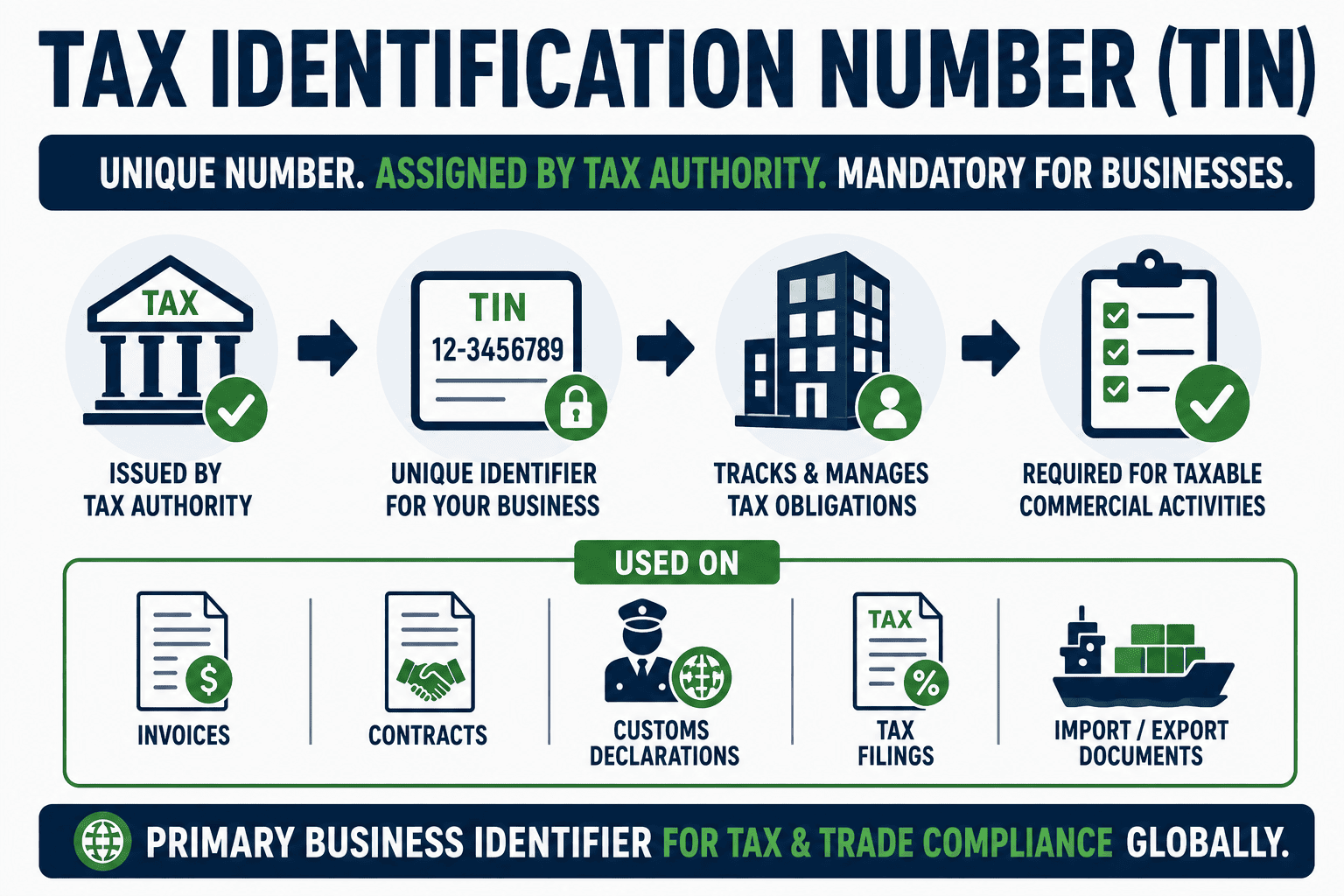
A Tax Identification Number (TIN) is a unique identifier assigned by a national tax authority to a business entity for the purpose of tracking and managing tax obligations. It is mandatory for any entity engaged in taxable commercial activity in that jurisdiction. TINs appear on invoices, contracts, customs declarations, tax filings, and import/export documentation, making them the primary reference identifier for business identity in most tax and trade compliance contexts globally.
TINs serve several distinct functions simultaneously. At the tax administration level, they allow government authorities to match income reported by payers (customers, banks, employers) with income declared by payees (businesses, individuals). At the trade compliance level, they appear on customs and import/export documents to identify the exporter, importer, and freight agents. At the commercial due diligence level, they are the first verifiable identifier that procurement teams, compliance functions, and anti-fraud teams use to confirm a business entity is real and legally registered.
🏛️
Tax Administration
Used by national tax authorities to match income reported by payers with declarations filed by businesses. Required on every tax return, invoice above reporting thresholds, and withholding payment.
📦
Trade & Customs
Appears on commercial invoices, bills of lading, customs declarations, and import/export documentation to identify the exporting and importing entities. Required by customs authorities in virtually every jurisdiction for clearance.
🔍
Business Due Diligence
Used by procurement teams, compliance functions, banks, and KYB (Know Your Business) platforms to confirm a company’s legal registration and verify that the entity claiming a TIN is the actual registrant, not a fraudulent or misrepresenting party.
🌐
Cross-Border VAT & GST
In international trade, VAT/GST numbers are used to determine whether goods or services qualify for zero-rating, exemptions, or reverse charge mechanisms. EU VAT numbers are verified through the VIES system; incorrect numbers trigger VAT liability issues.
⚖️
Anti-Fraud & AML Compliance
TIN verification is a component of Anti-Money Laundering (AML) and anti-fraud programmes, confirming that a business counterparty’s stated identity matches official government registration records before entering commercial or financial relationships.
📋
Contract & Regulatory Documentation
Commercial contracts, distribution agreements, and regulatory submissions in most jurisdictions require the TIN of all parties. A contract signed with an unverified or incorrect TIN may be unenforceable or create regulatory exposure.
100+
countries where businesses are assigned a TIN or equivalent identifier by national tax authorities
30+
different names for TIN equivalents globally, EIN, GSTIN, VAT, ABN, TRN, USt-IdNr, NIF, RFC, and more
$5.8T
in annual global trade value affected by customs and tax documentation, where TIN accuracy is a compliance requirement
SECTION 2
2 Business TIN Formats by Country
🌍 Global TIN Reference, Names, Formats & Verification Sources
Understanding what a business TIN is called in a specific country, and what its correct format looks like, is the first step in verification. A number presented in the wrong format for its country immediately signals a potential error or misrepresentation. The table below covers the major trading nations relevant to Indian manufacturers and global distributors.
Country
TIN Name
Format / Example
Verification Authority
🇮🇳 India
GSTIN (GST Identification Number) / PAN
22AAAAA0000A1Z5 (15 chars)
GST Portal (gstin.gov.in), Income Tax dept
🇺🇸 United States
EIN / FEIN (Employer Identification Number)
XX-XXXXXXX (9 digits, e.g. 12-3456789)
IRS TIN Matching Program, IRS Business Tax Transcript
🇦🇪 UAE
TRN (Tax Registration Number)
100XXXXXXXXXXX3 (15 digits)
Federal Tax Authority (tax.gov.ae)
🇬🇧 United Kingdom
UTR (Unique Taxpayer Reference) / VAT Reg No.
XXXXXXXXXX (10 digits UTR) / GB999 9999 99 (VAT)
HMRC / Government Gateway
🇩🇪 Germany
USt-IdNr / Steuernummer
DE123456789 (VAT) / 12/345/67890 (tax no.)
Bundeszentralamt für Steuern / EU VIES
🇦🇺 Australia
ABN (Australian Business Number) / ACN
XX XXX XXX XXX (11 digits)
Australian Business Register (ABR)
🇸🇬 Singapore
UEN (Unique Entity Number)
XXXXXXXXX (9–10 chars)
Accounting and Corporate Regulatory Authority (ACRA)
🇨🇳 China
USCC (Unified Social Credit Code)
91XXXXXXXXXXXXXXXXXX (18 chars)
National Enterprise Credit Information (GSXT)
🇳🇿 New Zealand
NZBN (New Zealand Business Number) / IRD
9429XXXXXXXXXX (13 digits NZBN)
NZBN Register / Inland Revenue
🇵🇱 Poland
NIP (Numer Identyfikacji Podatkowej)
PL1234567890 (10 digits)
Ministry of Finance / EU VIES
🇹🇷 Turkey
Vergi Kimlik Numarası (VKN)
XXXXXXXXXX (10 digits)
Gelir İdaresi Başkanlığı (GIB)
🇻🇳 Vietnam
MST (Mã Số Thuế / Tax Code)
XXXXXXXXXX (10 digits)
General Department of Taxation
🇹🇼 Taiwan
Business Registration Number / GUI Number
XXXXXXXX (8 digits)
Ministry of Finance, National Taxation Bureau
🇪🇬 Egypt
Tax Registration Number (TRN)
XXX-XXX-XXX (9 digits)
Egyptian Tax Authority (ETA)
🇨🇿 Czech Republic
DIČ (Daňové identifikační číslo)
CZ12345678 (8–10 digits)
Czech Financial Administration / EU VIES
🇷🇴 Romania
CIF (Codul de Identificare Fiscală)
ROXXXXXXXXXX (2–10 digits)
ANAF (National Agency for Fiscal Administration)
🇭🇰 Hong Kong
BRN (Business Registration Number)
XXXXXXXX (8 digits)
Inland Revenue Department / Companies Registry
🇩🇪 EU (all member states)
VAT Number (varying prefix by country)
XX + 8–12 digits/chars
VIES (ec.europa.eu/taxation_customs/vies)
Each country’s TIN has a specific format, a defined length, character set, prefix pattern, and often a checksum algorithm. A format-valid TIN that fails a government registry match means the number may belong to a different entity, may have been fabricated, or the business may have had its registration cancelled. Both the format check and the registry match are required for meaningful verification.
TIN Format Reference by Region, Key Manufacturing Markets
🇮🇳
India
GSTIN
15-char alphanumeric. State code + PAN + entity type + check digit. Verified at gstin.gov.in
3 Federal Tax ID Verification for Business (US EIN / FEIN)
🇺🇸 United States, EIN / FEIN Verification
In the United States, the Employer Identification Number (EIN), also called the Federal Employer Identification Number (FEIN) or Federal Tax ID, is the primary business tax identifier issued by the Internal Revenue Service (IRS). Every US business entity that files taxes, opens a business bank account, applies for business licences, or hires employees is required to obtain an EIN. It is the US equivalent of a company TIN.
🇺🇸 EIN / FEIN Format
A US EIN is a 9-digit number in the format XX-XXXXXXX (for example: 12-3456789). The first two digits identify the issuing IRS campus or online EIN assignment. EINs are issued by the IRS and cannot be transferred between entities, each legal business entity has its own unique EIN. EINs are used on Form W-9 (for payors collecting tax information from US payees), Form 1099 series (for reporting payments), and all US federal tax filings.
How Federal Tax ID (EIN) Verification Works
Unlike EU VAT numbers, which can be verified in real time through the publicly accessible VIES system, US EIN verification is more restricted. The IRS does not provide a public API or lookup tool for EIN validation. The available methods are:
📋
IRS TIN Matching Program
The IRS TIN Matching Program allows authorised payers (those who file 1099-series returns) to verify that a payee’s name and TIN combination matches IRS records before filing. It is available through the IRS e-services portal. This is a bulk and interactive lookup available only to registered payers, not a public verification tool.
📄
Form W-9 Collection
The most common method for US businesses verifying a partner’s federal tax ID is to collect a completed IRS Form W-9 (Request for Taxpayer Identification Number), which requires the payee to certify under penalty of perjury that the TIN provided is accurate and belongs to them.
🔗
IRS Business Tax Transcript
Businesses can request a Business Tax Transcript from the IRS which confirms that the EIN is assigned and associated with a filed return, providing evidence that the entity is real and tax-compliant at the time of the transcript.
🤖
Third-Party TIN Verification Tools
Commercial services like TINCheck.com and Parcha AI provide EIN format validation and where possible match against IRS records for payors with access to the TIN Matching Programme. These tools are used primarily by financial institutions, payroll processors, and compliance-heavy procurement functions.
ℹ️ IRS TIN Policy for Cross-Border Trade
For manufacturers and distributors in cross-border trade with US counterparties, EIN verification confirms a US business entity’s tax registration. However, it does not confirm the entity’s legal status under state law (corporations are registered at state level, not federal), its address, its type of business, or its current operational status. For cross-border trade due diligence purposes, EIN verification should be combined with state-level business registration lookup (Secretary of State databases) and an address confirmation.
SECTION 4
4 Why Company TIN Verification Matters
For anyone involved in commercial transactions, issuing invoices, processing payments, signing contracts, or onboarding new suppliers and distributors, TIN verification matters for a specific set of reasons that go beyond compliance formality.
💸
Invoice Fraud and Payment Diversion
A fraudulent entity presenting a false or misappropriated TIN on an invoice can redirect payments intended for a legitimate supplier. TIN verification against government records catches cases where the TIN does not match the entity name presented, a key signal in invoice fraud detection.
⚖️
VAT and GST Compliance
In the EU, claiming input VAT based on an invalid or incorrect VAT number exposes the buyer to liability for the full VAT amount that was wrongly deducted. Businesses purchasing from EU suppliers must verify the VAT number through VIES before accounting for zero-rating or reverse charge. Similar rules apply in India (GSTIN) and Australia (ABN).
📋
Contract Enforceability
A commercial contract referencing an incorrect TIN, or a TIN that does not match the signatory entity, creates legal uncertainty about which entity is actually bound by the agreement. For international distribution agreements, supply contracts, or licensing deals, this ambiguity can make enforcement impractical across jurisdictions.
🏛️
AML and Sanctions Compliance
Anti-Money Laundering frameworks and sanctions screening programmes require that business counterparties can be uniquely identified and matched against watchlists. An entity presenting a TIN that cannot be verified against official records fails the basic identity confirmation step that AML programmes require. Businesses found to have transacted with unverifiable entities can face regulatory penalties.
🔗
Customs and Import/Export Documentation
Customs authorities require accurate TINs on all import and export declarations. Incorrect TINs cause shipment delays, customs holds, and potential seizure in jurisdictions with strict import control. For manufacturers shipping to new export markets, verifying the importer’s TIN before the first shipment prevents customs clearance failures.
🤝
Cross-Border Trade Partner Identity
For manufacturers and distributors entering new markets, TIN verification is the minimum identity check on a prospective trade partner. It confirms the entity is registered and paying taxes under the name it presents, reducing the risk of engaging with misrepresented suppliers, shell companies, or entities with lapsed registrations.
SECTION 5
5 TIN Verification Tools Compared
A number of commercial tools and government resources exist for performing business TIN verification, ranging from single-country format checkers to multi-country API platforms that match against live government registries. Below is a review of the major options.
1
Commenda
commenda.io · Global Tax ID Verification, 40+ Countries
🌐 Multi-Country
Commenda provides free, instant tax ID verification across 40+ countries, covering VAT numbers, GST IDs, and TINs. It performs both format checks (validating structure, length, and checksum) and live registry matches against official government sources: VIES for EU VAT numbers, HMRC for UK VAT, and national tax authority APIs for other countries. The tool is designed for finance teams, tax teams, and accountants who need to verify supplier or customer tax IDs before issuing invoices or filing returns. It also supports Commenda’s broader entity management and indirect tax compliance platform.
Free to use40+ CountriesFormat + Registry CheckEU VIES IntegrationHMRC IntegrationAPI Available
Best for: Finance, tax, and accounting teams needing fast, free VAT/GST/TIN verification across EU and other major markets. Covers format validation plus live registry match in a single step.
2
LookupTax
lookuptax.com · Global Tax ID Validation API, 100+ Countries
🔌 Developer API
LookupTax is a developer-focused global Tax ID validation API covering 100+ countries, connecting directly to national government databases (not cached data) for real-time, authoritative validation. It supports VAT (EU via VIES), ABN (Australia via ABR), GSTIN (India), EIN (US via IRS TIN Matching), CRA (Canada), HMRC (UK), USCC (China via GSXT), NZBN (New Zealand), and dozens more. Trusted by enterprise clients including Cummins, Aiko Solar, and Commenda. Suitable for businesses that need to embed TIN validation into their supplier onboarding, invoicing, or KYB workflows via API.
100+ CountriesDirect Govt DatabaseReal-Time (No Cache)REST APIEnterprise-GradeFree Tier Available
Best for: Engineering and compliance teams that need to embed authoritative, real-time TIN validation across 100+ countries into supplier onboarding, invoicing, or KYB platforms via API.
3
TIN-Check.com
tin-check.com · EU and OECD TIN Format Validation
🇪🇺 EU / OECD Focus
TIN-Check.com is a specialised format validation tool for Tax Identification Numbers across EU member states and OECD countries, aligned with the OECD’s TIN portal for tax transparency and AEOI (Automatic Exchange of Information) compliance. It validates TIN formats against country-specific rules published by the OECD Global Forum on Transparency and Exchange of Information, making it particularly useful for financial institutions and tax compliance teams dealing with FATCA, CRS, and AEOI reporting requirements. It does not perform live government registry matching, it validates format only.
OECD-Aligned Format RulesEU Member StatesFATCA / CRS ComplianceAEOI FrameworkFree to Use
Best for: Financial institutions and tax compliance teams dealing with FATCA, CRS, and AEOI reporting, where OECD-aligned TIN format validation is the primary requirement. Not for: Live registry matching or trade due diligence beyond format checks.
4
TINCheck.com
tincheck.com · US EIN and SSN Verification for 1099 Compliance
🇺🇸 US IRS Focus
TINCheck.com is a US-focused TIN verification service that matches EINs and Social Security Numbers against IRS records through the IRS TIN Matching Programme, specifically designed for 1099 compliance, backup withholding avoidance, and vendor onboarding for US payers. It provides batch and real-time verification of name/TIN combinations against IRS records, with results that indicate match, no match, or TIN not found. It also includes OFAC sanctions screening. Used primarily by accounts payable departments, payroll processors, and compliance teams at US businesses that pay large numbers of US vendors and need to avoid 1099 penalties from incorrect TIN information.
IRS TIN Matching1099 ComplianceEIN + SSN VerificationOFAC ScreeningBatch Processing
Best for: US accounts payable and compliance teams managing 1099 vendor databases who need to verify EIN/SSN against IRS records and avoid backup withholding penalties. Not for: International TIN verification or cross-border trade due diligence.
5
Parcha AI
parcha.ai · AI-Powered TIN Validation + KYB Platform
🤖 AI KYB Platform
Parcha AI is an AI-powered KYB (Know Your Business) platform that includes TIN validation as one component of a broader automated business verification suite, covering legal entity status, sanctions and watchlist screening, address verification, incorporation document verification, EIN verification (US), adverse media, beneficial ownership, and more. Its TIN validation covers format checks across 60+ countries and government database matching where available (US IRS for EIN; others via national tax authority APIs). Designed for financial institutions, fintech platforms, and marketplace businesses that need automated, scalable KYB workflows rather than manual TIN lookup tools.
AI-Powered KYB60+ Country TIN ValidationSanctions ScreeningEntity Status CheckAPI + Workflow Platform
Best for: Fintech platforms, banks, and marketplaces needing automated, scalable KYB workflows where TIN validation is one component of a broader business identity verification process.
6
EU VIES (VAT Information Exchange System)
ec.europa.eu/taxation_customs/vies · Official EU VAT Verification
🆓 Free Official
VIES is the European Commission’s official system for verifying EU VAT numbers in real time, checking whether a VAT number is valid and currently assigned to an active EU business. It queries member state VAT databases directly and returns a match confirming the company name, address, and VAT registration status. VIES is the authoritative source for EU VAT verification, all commercial tools that verify EU VAT numbers ultimately query VIES or member state equivalents. For businesses in cross-border EU trade, VIES verification is both free and the legally recognised standard for confirming VAT number validity.
Free Official SourceAll 27 EU Member StatesReal-Time Registry MatchCompany Name ConfirmedLegally Recognised
Best for: Any business trading across EU borders that needs to verify a supplier or customer’s EU VAT number. The definitive authoritative source, free and legally recognised for VAT compliance purposes across all EU jurisdictions.
TIN Verification Tool Comparison
ToolCountriesRegistry MatchBeyond TIN
EU VIES
27 EU states
✓ Real-time
✗ VAT only
Commenda
40+ countries
✓ Format + Registry
✗ TIN only
LookupTax
100+ countries
✓ Direct govt source
✗ TIN / tax only
TIN-Check.com
OECD / EU
⚠ Format only
✗ Format only
TINCheck.com
US only (IRS)
✓ IRS TIN Match
⚠ OFAC included
Parcha AI
60+ countries
✓ AI + Registry
⚠ KYB suite
GTsetu(Trade Partnership)
100+ countries
✓ Reg. no. verified
✓ Full 6-point verification
SECTION 6
6 Why TIN Verification Is Not Enough for Trade Partners
TIN verification is a necessary first step, but for manufacturers, distributors, and raw material suppliers evaluating cross-border trade partners, it is not sufficient on its own. Understanding why reveals the gap that a 6-point government verification standard is designed to close.
⚠️ What TIN Verification Does NOT Confirm
A validated TIN confirms that a tax number is format-correct and matches a registered entity in government records. It does not confirm: (1) whether the entity is currently active or has been struck off, dissolved, or had its registration suspended; (2) whether the registered address matches the address the entity claims for its operations; (3) whether the entity is the type of business it claims (a trading company presenting as a manufacturer, for example); (4) how long the business has been in operation; (5) whether the person presenting the TIN is actually authorised to act for that entity; or (6) whether the entity is sanction-free and has no adverse legal or regulatory history. All of these matter when appointing a distributor, contracting a manufacturer, or entering a multi-year supply agreement.
Consider a concrete scenario: a manufacturer in India receives an enquiry from a company in the UAE claiming to be a major distributor. They provide a TRN (UAE Tax Registration Number) that passes format validation and matches a registered entity in FTA records. A standard TIN check returns “valid.” But the entity may have been registered two months ago with no trading history. It may be a trading intermediary, not a distribution company with market reach. Its registered address may be a mail forwarding service. The beneficial owner may appear on a sanctions watchlist under a different name. None of these risks are caught by TIN verification alone.
A valid TIN does not mean the entity is currently active, registrations can lapse, be suspended, or be in the process of dissolution while still appearing in tax records
A valid TIN does not confirm the entity type, a trading company can have a perfectly valid tax registration while misrepresenting itself as a manufacturer or exclusive regional distributor
A valid TIN does not confirm the registered address, entities frequently use registered agent addresses that do not reflect actual operational locations
A valid TIN does not confirm the incorporation date, a newly registered entity can pass TIN verification with no trading history behind it
A valid TIN does not confirm beneficial ownership or sanctions status, watchlist screening is a separate process not covered by any standard TIN verification tool
A valid TIN does not protect your commercial information, sharing pricing or product specifications with an entity that passed a TIN check but has no NDA in place leaves that information legally unprotected
SECTION 7
7 The 6-Point Government Verification Standard
For manufacturers, distributors, and raw material suppliers building cross-border trade partnerships, the appropriate standard of business verification goes beyond a single TIN check. GTsetu’s 6-point government tie-up verification covers all the dimensions that a TIN check alone cannot address.
🏛️ Why 6 Points, Not Just 1
A TIN number is one government data point about a business entity. But the six credentials below, together, create a complete, government-verified picture of who a business actually is, its legal identity, where it is registered, whether it is currently in good standing, what kind of entity it is, and when it was formed. Any one of these credentials can be misrepresented. Verifying all six against government sources simultaneously closes the gaps that single-point TIN verification leaves open.
1
Legal Name
The exact legal name as registered with the relevant government authority, not a trading name, not a brand name, but the formal legal entity name that appears on the company registration certificate.
Comparable TIN layer: name match on TIN registry check
2
Registered Address
The address on the official government registration record, confirmed against the address the entity provides. Mismatches between claimed and registered addresses are a common indicator of shell entity risk.
Not covered by standard TIN verification
3
Registration Number
The company registration or incorporation number issued by the companies registry, distinct from the TIN, which is the tax authority number. Together these two numbers provide cross-registry identity confirmation.
TIN is the tax registry number. This is the companies registry number, a different, additional check.
4
Company Status
Whether the company is currently active, struck off, dissolved, in administration, or under regulatory action. A TIN check may show a valid number for an entity whose companies registry status has lapsed.
Not covered by standard TIN verification
5
Company Type
Whether the entity is a private limited company, public company, LLP, partnership, sole trader, or other legal form, confirming it is the structure it claims and has the legal capacity to enter binding commercial agreements.
Not covered by standard TIN verification
6
Date of Incorporation
The date the entity was legally formed, confirming trading history, the longevity of the business, and ruling out newly registered entities presenting themselves as established market players.
Not covered by standard TIN verification
Of these six verification points, a standard TIN check addresses only one, and even then only partially (name match but not company type, address, status, or incorporation date). For manufacturers evaluating distributors in the UAE, Vietnam, Germany, or Australia, or for distributors evaluating Indian manufacturers, all six points are needed before any commercial information is shared.
SECTION 8
8 GTsetu: 6-Point Verified Trade Partnerships for Industrial Sectors
GTsetu does not replace TIN verification tools, for VAT compliance, 1099 filing, or AEOI reporting, the specialist tools reviewed above are the right instruments. What GTsetu provides is the complete 6-point government verification layer for cross-border industrial trade partnerships, covering all six dimensions of business identity confirmation, not just the TIN, before any manufacturer, distributor, or raw material supplier is permitted to engage commercially on the platform.
Every company on GTsetu has passed verification across all six credentials via government tie-ups. When you discover a distributor in Germany, a manufacturer in Vietnam, or a raw material supplier in Turkey through GTsetu, you know their legal name, registered address, registration number, status, type, and incorporation date have been independently confirmed, not self-reported in a directory profile, not inferred from a TIN format check. The difference between a valid TIN and a 6-point verified business is the difference between a number that matches a record and a business you can actually trust with your commercial information.
🏛️ 6-Point Government Verification, Beyond TIN
GTsetu: Verified Trade Partnership Infrastructure for Manufacturers & Distributors
GTsetu verifies every company across 6 government-sourced credentials before any engagement. Then adds anonymous discovery, built-in NDA workflows, encrypted document sharing, and zero broker commissions, providing the complete infrastructure for cross-border industrial trade partnerships in 100+ countries.
🏛️
6-Point Govt VerificationLegal name, registered address, registration number, status, type, and incorporation date, all 6 confirmed via government tie-ups, not just a TIN format check.
🕵️
Anonymous DiscoveryBrowse verified partner profiles across 100+ countries without revealing your company identity or expansion plans during the search phase.
📄
Built-in NDA WorkflowsLegal confidentiality protection triggered before any pricing, product, or strategy data is shared, with full digital audit trail and timestamps.
🔐
Encrypted Document SharingAES-256 at rest; TLS in transit. All commercial files, pricing, specs, contract drafts, exchanged securely within the platform.
🚫
Zero CommissionNo percentage of partnership value extracted. The full commercial economics of every deal stay between the two trading parties.
🌍
100+ CountriesManufacturers, distributors, and raw material suppliers across the Middle East, Europe, Southeast Asia, Africa, Australia, and the Americas, all 6-point verified.
📋
Full Audit TrailTimestamped, downloadable record of all verification confirmations, NDA signatures, document exchanges, and engagement milestones, for compliance and regulatory purposes.
🏭
Industrial Sector FocusManufacturers, distributors, and raw material suppliers in industrial sectors, not general directories, not consumer RFQ platforms.
GTsetu Covers All 16 Manufacturing Markets Linked in This Guide
GTsetu’s verified partner network spans all the manufacturing and distribution markets referenced in this guide, and more. Whether you are a manufacturer in India looking to appoint distributors in Germany, UAE, or Vietnam, or an overseas distributor seeking verified Indian manufacturing principals, GTsetu’s 6-point government verification applies equally to every partner, in every market.
Raw material suppliers seeking long-term manufacturing customers across verified partner networks in New Zealand and the Asia-Pacific region
FAQ
? Frequently Asked Questions
QWhat is a company TIN number?
A company TIN (Tax Identification Number) is a unique government-issued number used to identify a business entity for tax filing, reporting, and compliance purposes. It is mandatory for any entity engaged in taxable commercial activity in that jurisdiction. Different countries use different names for the equivalent identifier: EIN or FEIN in the United States, GSTIN in India, VAT Number in the EU, TRN in the UAE, ABN in Australia, UEN in Singapore, USCC in China, UTR or VAT Registration Number in the UK. The name and format differ by jurisdiction; the function is the same, to uniquely identify a registered business entity in the government’s tax records.
QHow do I verify a company TIN number?
Company TIN verification has two components: (1) Format validation, confirming the number matches the correct length, character pattern, and checksum rules for its country. This can be done with tools like TIN-Check.com (OECD countries) or LookupTax (100+ countries). (2) Registry match, checking the number against the official government database to confirm it is live, matches the company name, and belongs to an active registered entity. For EU VAT numbers, the VIES system (ec.europa.eu/taxation_customs/vies) is the free official source. For US EINs, the IRS TIN Matching Programme is available to registered payers; TINCheck.com provides commercial access. For global multi-country verification via API, LookupTax and Commenda are the most comprehensive tools. For cross-border industrial trade partnerships where verification needs to go beyond TIN alone, GTsetu provides 6-point government tie-up verification covering registration number, legal name, address, status, type, and incorporation date.
QWhat is federal tax ID verification for a business?
Federal tax ID verification for a business (EIN or FEIN verification in the United States) is the process of confirming that a business’s Employer Identification Number is valid, active, and correctly associated with the legal entity that claims it. In the US, the IRS assigns EINs; unlike EU VAT numbers which can be verified through the public VIES system, US EIN verification is restricted to the IRS TIN Matching Programme (available to registered payers for 1099 compliance) or through Form W-9 collection (where the payee self-certifies their TIN under penalty of perjury). Commercial tools like TINCheck.com provide access to the IRS TIN Matching Programme for businesses that need to verify large numbers of vendor EINs for 1099 compliance. For cross-border trade partners, EIN verification should be combined with state-level business registration lookup and address confirmation for a more complete picture of the entity’s identity.
QIs TIN verification enough to verify a business trade partner?
No. TIN verification confirms that a tax identification number is format-valid and matches a registered entity’s name in government tax records. It does not confirm that the entity is currently active (company status can lapse while the TIN remains in records), that the registered address matches the location the entity claims, that the entity is the type of business it presents itself as (a trading company may have a valid TIN while misrepresenting itself as a manufacturer), how long the business has been incorporated, or that the entity is sanctions-free. For manufacturers and distributors evaluating cross-border trade partners, TIN verification is one input into a 6-point government verification process. GTsetu’s platform performs all 6 checks, registration number, legal name, registered address, company status, company type, and date of incorporation, via government tie-ups before any partner appears in its verified network.
QWhat is the best tool for global business TIN verification?
The best tool depends on your use case. For EU VAT verification: VIES (free, official, authoritative). For US EIN verification: TINCheck.com (IRS TIN Matching access) or IRS Form W-9 collection. For multi-country TIN validation via API across 100+ countries: LookupTax (direct government database connections, no cached data). For EU + 40 country TIN verification with registry match: Commenda (free to use). For OECD-aligned format validation for FATCA/CRS compliance: TIN-Check.com. For AI-powered KYB with TIN validation embedded: Parcha AI. For cross-border industrial trade partnership verification that goes beyond TIN to cover all 6 government-verified credentials: GTsetu, where TIN/registration number is one of six points verified before any company is permitted to engage commercially on the platform.
QHow do TIN formats differ for the key manufacturing markets?
TIN formats vary significantly across the major manufacturing markets. India uses a 15-character alphanumeric GSTIN (verifiable at the GST Portal). The UAE uses a 15-digit TRN issued by the Federal Tax Authority (tax.gov.ae). Germany uses the USt-IdNr (DE + 9 digits) verifiable through VIES. Australia uses an 11-digit ABN verifiable at abn.business.gov.au. China uses an 18-character USCC verifiable through the GSXT national enterprise registry. Vietnam uses a 10-digit MST (tax code). Turkey uses a 10-digit VKN. Taiwan uses an 8-digit Business Registration Number. Full format details for Germany, UAE, Australia, Vietnam, Turkey, and other markets are covered in the country table in Section 2 of this guide.
QWhat is the OECD TIN portal and who uses it?
The OECD’s Global Forum on Tax Transparency maintains a TIN portal that documents the TIN structures, formats, and descriptions for member and partner countries, used primarily in the context of Automatic Exchange of Information (AEOI), FATCA, and CRS (Common Reporting Standard) compliance. Financial institutions, banks, investment firms, insurance companies, use the OECD TIN documentation to validate the format of TINs provided by account holders in cross-border financial relationships. The TIN-Check.com tool is built on OECD TIN format rules. For trade compliance and business partner verification purposes (as opposed to financial account due diligence), the OECD TIN portal provides a useful reference for TIN formats, but the verification itself needs to be performed against the national tax authority databases of each country, which commercial tools like LookupTax, Commenda, and VIES facilitate.
Go Beyond TIN Verification, Find 6-Point Government Verified Trade Partners
TIN verification confirms a tax number. GTsetu verifies all 6 government credentials, legal name, registered address, registration number, company status, type, and incorporation date, before any manufacturer, distributor, or raw material supplier can engage on the platform. Across 100+ countries. Zero broker commissions. Built for industrial sectors.
They represents the product, and research team behind GTsetu, a global B2B collaboration platform built to help companies explore cross-border partnerships with clarity and trust. The team focuses on simplifying early-stage international business discovery by combining structured company profiles, verification-led access, and controlled collaboration workflows.
With a strong emphasis on trust, and disciplined engagement, Team GTsetu shares insights on global trade, partnerships, and cross-border collaboration, helping businesses make informed decisions before entering deeper commercial discussions.