Free for a limited time·Profile verification free·First collaboration free·500+ Companies Onboarded·6 Continents Covered·No Commission & No Profit Share·Free for a limited time·Profile verification free·First collaboration free·500+ Companies Onboarded·6 Continents Covered·No Commission & No Profit Share·Free for a limited time·Profile verification free·First collaboration free·500+ Companies Onboarded·6 Continents Covered·No Commission & No Profit Share·
Ending a Business Partnership Contract: The Complete Guide (2026) | GTsetu
Home ›
Blog ›
Ending a Business Partnership Contract
⚖️ Partnership Dissolution & Trade Law
Ending a Business Partnership Contract: The Complete Guide (2026)
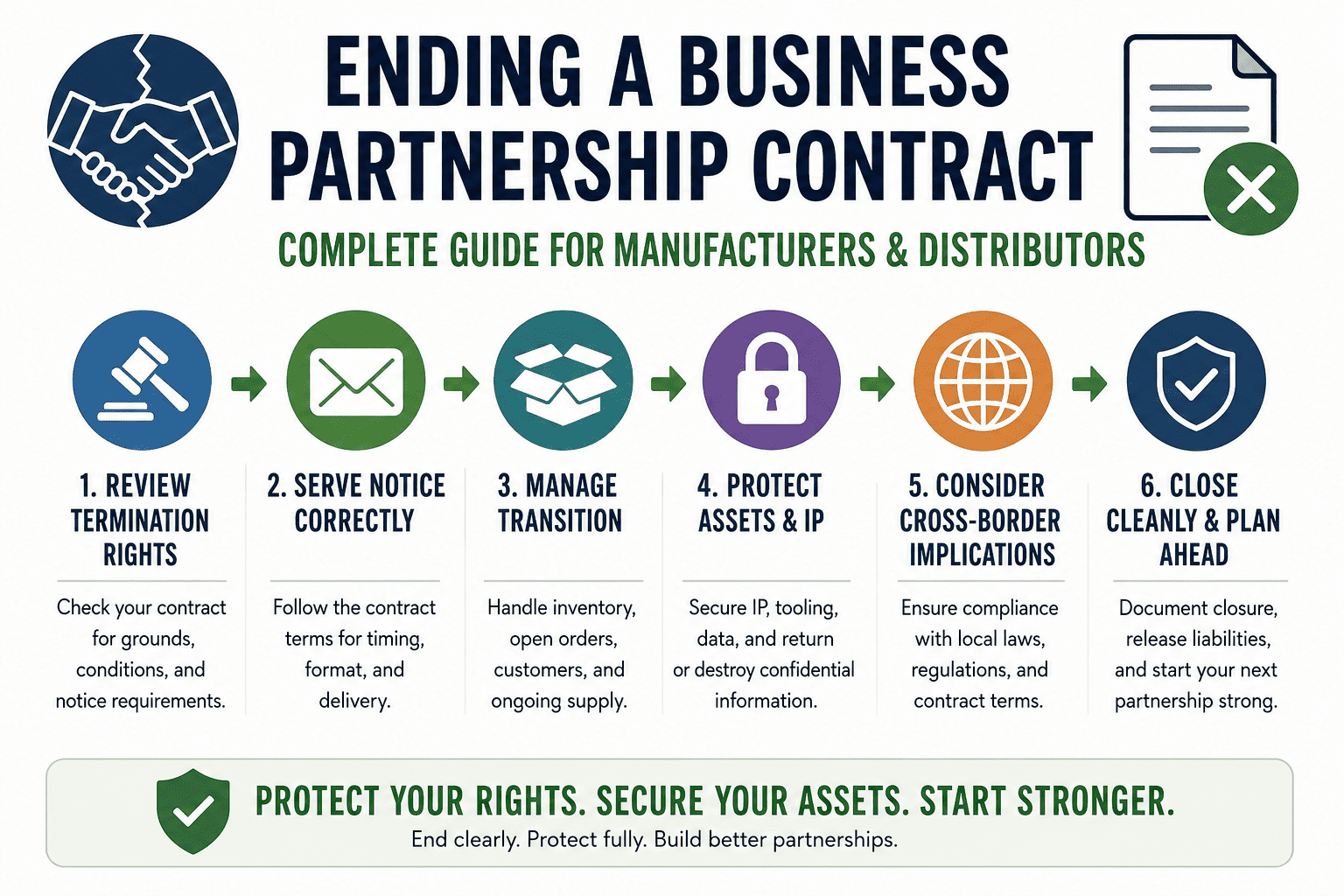
At a glance: Ending a business partnership contract, whether a manufacturer-distributor agreement, a supply arrangement, a technology partnership, or a co-manufacturing relationship, requires more than giving notice. It requires reviewing your termination rights, serving notice correctly, managing the transition of stock, IP, tooling, and customer relationships, and protecting yourself legally before the other party takes defensive action. This guide covers the full process: legal grounds, dissolution steps, asset protection, cross-border considerations, and how to ensure the next partnership starts on verified, legally protected foundations.
📅 May 2026⏱ 18 min read✍️ GTsetu Editorial Team🔄 Updated regularly
9
Dissolution Steps
6
Grounds for Termination
Cross
Border Considerations
GTsetu
For Your Next Partnership
No business partnership lasts forever. Distributor relationships reach their natural term. Manufacturing agreements become uneconomic. Technology partnerships deliver what they were designed to deliver and conclude. Supply agreements end when production priorities shift. And sometimes, more often than anyone plans for, a partner simply fails to perform, breaches the agreement, or pursues a direction that is incompatible with yours.
Whatever the cause, ending a business partnership contract is one of the most commercially significant and legally sensitive actions a manufacturer, distributor, or supplier can take. Done properly, it protects your assets, preserves your market position, settles outstanding obligations cleanly, and positions you to appoint a better partner quickly. Done badly, it creates disputes that drag on for months or years, exposes your IP and customer relationships to risk, and leaves commercial liabilities unresolved that become far more expensive over time.
This guide covers the full process in detail, from understanding your legal termination rights to executing a clean dissolution and finding a better-verified replacement partner through GTsetu’s 6-point verified partnership platform.
💡 Who This Guide Is For
This guide is written for manufacturers ending distributor or supply agreements, distributors terminating manufacturing principal relationships, raw material suppliers exiting long-term supply contracts, and any business involved in ending a formal B2B trade partnership, particularly across borders. For the foundational framework these agreements should have contained before they started, see: business partnership contracts and cross-border business partnerships.
SECTION 1
1 What Ending a Business Partnership Contract Really Means
📖 The Core Distinction
Ending a business partnership contract is not the same as ending a business. Most people conflate the two, but for manufacturers, distributors, and trade partners, the contract that needs to end is the specific commercial agreement between two parties, not the dissolution of a legal entity. A manufacturer ending a distribution agreement with a regional partner continues trading; they are simply restructuring who carries their goods to market. The process, legal documentation, and commercial protections required are entirely different from winding up a company.
Industrial trade partnerships, the kind that GTsetu is built to form, are governed by specific commercial agreements: distribution agreements, supply agreements, manufacturing principal agreements, technology licences, co-manufacturing contracts, and OEM/ODM arrangements. Each of these has its own termination framework, and ending one is a process that must follow the contract’s own rules, the governing law jurisdiction’s requirements, and a set of commercial transition steps that are specific to the type of relationship.
⚠️ What People Assume
A Simple Letter and It’s Over
Many businesses treat partnership termination as a straightforward notification, give notice, stop trading, move on.
Send a termination notice by email
Stop accepting orders
Assume outstanding issues resolve themselves
Move on to the next partner
✓ What’s Actually Required
A Structured Legal and Commercial Process
Proper termination requires a structured sequence that protects both parties and resolves all outstanding obligations.
Review contract for notice form, period, and grounds
Serve notice correctly, format, delivery, timing
Manage stock, tooling, IP, and customer transition
Settle payments and execute dissolution agreement
60%
of partnership termination disputes stem from notice period violations or incorrect notice service method
3–18
months: typical commercial dispute timeline when termination is handled without proper legal documentation
1 in 3
cross-border manufacturer-distributor terminations result in IP or brand misuse claims by the exiting partner
SECTION 2
2 When Should You End a Business Partnership?
The decision to end a business partnership is rarely straightforward, but the warning signs that a relationship has run its course are usually clearer than they appear in retrospect. For industrial trade partnerships, the key signals fall into three categories: performance failures, strategic misalignment, and relationship breakdown.
📉
Consistent Volume Underperformance
A distributor who repeatedly fails to meet the minimum volume commitments in the agreement, especially when they hold exclusivity over a territory, is blocking your market access without delivering the commercial return that justified granting exclusivity. If performance targets have been missed for two or more consecutive periods and meaningful corrective action has not materialised, the relationship has likely served its useful commercial life.
🎭
Brand Misuse or Quality Compromise
A partner who uses your brand or product outside the agreed territory, in unapproved channels, or in a way that damages the brand’s positioning in the market, whether through discounting below agreed floors, distributing through grey market channels, or representing the product inaccurately to buyers, creates IP and reputational exposure that justifies immediate action. See: cross-border business partnerships.
🤝
Strategic Misalignment
When a partner’s ownership changes (acquisition by a competitor, management buyout, change of controlling interest), when their market focus shifts away from your product category, or when their strategic direction diverges materially from the relationship’s original commercial rationale, the partnership may need to be restructured or terminated, even if performance metrics are technically met.
💸
Payment or Financial Issues
Persistent late payment, requests for extended credit beyond agreed terms, or signs of financial distress (creditor pressure, rumours of insolvency, missed bank deadlines) are early warning signals that a partner may not be able to meet their obligations. Acting before a formal insolvency filing, while the relationship can still be wound down with some control over the outcome, is almost always better than waiting.
⚖️
Contract Breach
Material breach of specific contract terms, failure to obtain required import licences, operating outside the defined territory, sublicensing without authorisation, violating confidentiality obligations, or appointing sub-distributors without approval, typically provides contractual grounds for termination for cause, often with shorter notice periods than standard termination. Documenting the breach is critical before serving notice.
🔚
Natural Contract Expiry
Many distribution and supply agreements are time-limited, typically 1–3 years with renewal provisions. Allowing a contract to expire through non-renewal is the cleanest form of termination and avoids disputes about notice, cause, and compensation. If you plan not to renew, communicating this clearly and early, before the renewal notice deadline, is both the professional and legally safer approach. See: contract between manufacturer and distributor.
ℹ️ The Emotional Dimension
Industrial trade partnerships, especially long-standing ones, carry personal relationships, shared commercial history, and genuine mutual investment alongside the contractual obligations. Ending them has an emotional dimension that affects judgment. The most common error is delaying a necessary termination because of the personal relationship, until the commercial damage or legal exposure becomes significantly worse than it would have been with earlier action. Acknowledge the relationship honestly, act on the commercial reality promptly, and execute the termination professionally. The cost of delay almost always exceeds the discomfort of early action.
SECTION 3
3 Legal Grounds for Terminating a Partnership Contract
⚖️ Legal Framework, Know Your Termination Rights
Before serving any notice, you need to understand precisely what grounds your contract permits for termination, and what those grounds require in terms of evidence, notice period, and process. Terminating for the wrong grounds, or on the right grounds but with incorrect notice, can convert a justified termination into a wrongful termination claim that reverses your position entirely.
Termination Ground
What It Requires
Notice Period
Key Risk
Natural Expiry (Non-Renewal)
Giving notice of non-renewal before the contractual deadline; no grounds needed
As specified in contract (typically 30–90 days before expiry)
Missing the non-renewal notice window, contract may auto-renew
Termination for Convenience
No breach needed; available if the contract includes a convenience termination clause
Usually 60–180 days; sometimes triggers compensation obligation
Compensation clauses may require payment of lost profit or goodwill
Material Breach
Documented evidence of breach; often requires a cure period (30 days to remedy) before termination is effective
Typically immediate after cure period; varies by contract
Breach must be genuinely material; risk of counter-claim if disputed
Performance Failure (Below Minimums)
Demonstrated failure to meet defined volume commitments; often requires notice and opportunity to remedy
As specified for performance-related termination
Volume targets must be clearly defined in contract to be enforceable
Insolvency or Winding-Up
Partner enters formal insolvency, administration, or liquidation proceedings
Often immediate; check contract for specific insolvency clause
Insolvency practitioner may dispute your right to terminate; stock and IP recovery becomes complex
Change of Control
Ownership of partner changes to a competitor, sanctioned entity, or party not approved by you
As specified in change of control clause
Change of control clause must be included in original contract to be available
Force Majeure, Permanent
A force majeure event that prevents performance indefinitely
Usually after a defined period of sustained impossibility
A termination that does not comply with the contract’s grounds, notice form, notice period, or delivery method is a wrongful termination, and creates liability for the party serving it. In distributor relationships under EU law, for example, commercial agents and exclusive distributors may have statutory rights to compensation on termination regardless of what the contract says. In some jurisdictions, long-standing exclusive distributor relationships carry implied goodwill compensation rights. Before serving any termination notice, particularly in a cross-border context, legal advice on the specific jurisdiction’s mandatory rules is not optional.
SECTION 4
4 Step-by-Step: The Dissolution Process
The following process applies to ending a business partnership contract for industrial trade relationships, manufacturer-distributor agreements, supply contracts, technology partnerships, and co-manufacturing arrangements. Each step builds on the previous one.
1
Review the Contract Carefully Before Any Action
The partnership or distribution agreement is the primary legal document governing termination. Before any communication with the other party, review it for: notice period and form (written letter, registered mail, email with read receipt?); grounds available for termination and what each requires; cure period provisions (does a breach require a notice to remedy before termination can follow?); auto-renewal provisions and renewal notice deadlines; and any special rights on termination, stock buyback, IP recovery, non-compete, goodwill compensation. See: business partnership contracts.
2
Take Legal Advice on Jurisdiction-Specific Requirements
Particularly for cross-border partnerships, the governing law and jurisdiction specified in the contract determines what mandatory rules apply, and these can override what the contract says. EU commercial agents have statutory compensation rights under the Commercial Agents Directive. Some Middle Eastern jurisdictions require local notarisation of termination notices. Some markets require regulatory notification of distribution agreement terminations. Consulting a lawyer with expertise in the relevant jurisdiction before serving notice is not a luxury for significant relationships, it is the minimum standard. See: international business development consulting.
3
Document Your Grounds (If Terminating for Cause)
If terminating for material breach or performance failure, compile the evidence before serving notice. This includes: written records of performance reviews where shortfalls were raised; sales reports and volume commitment calculations; records of breach notifications previously sent; correspondence documenting the other party’s acknowledgement of issues or failed remediation attempts. The quality of this evidence will determine your position if the other party challenges the termination. See: partnership evaluation criteria.
4
Issue a Cure Notice (If Required)
Many commercial contracts require that before terminating for breach, you must first issue a written cure notice, specifying the breach and giving the other party a defined period (typically 14–30 days) to remedy it. Only if the breach is not remedied within that period can the termination notice follow. Skipping this step when the contract requires it makes the subsequent termination ineffective. Cure notices must be in writing, clearly describe the breach, state the remedy required, and specify the deadline.
5
Serve the Termination Notice Correctly
The notice must be in the form the contract requires, typically written, signed, and sent by the specified method to the specified address. Common failures: serving by email when the contract requires registered mail; sending to the wrong address (operational address vs registered address); not retaining proof of delivery; serving outside business hours in the recipient’s jurisdiction; or serving on a public holiday. Keep copies of everything, with delivery confirmations. The date the notice is received (not sent) typically starts the notice period clock.
6
Negotiate and Execute the Dissolution Agreement
A dissolution agreement formally records both parties’ acceptance of the termination and its terms, covering the effective date, stock transition, outstanding orders in progress, IP revocation, final payment settlement, release of claims, and any surviving obligations (confidentiality, non-compete, non-solicitation). For contentious terminations this may require negotiation; for amicable ones it is often straightforward. Do not skip this document, verbal agreements about how the wind-down will work are not enforceable. See: contract between manufacturer and distributor.
7
Resolve Stock, Tooling, and IP Simultaneously
These three categories, existing inventory held by the distributor or manufacturer, tooling and moulds used in production, and IP materials including brand assets, product registrations, and marketing collateral, must be resolved as part of the dissolution, not after it. Leaving them open creates leverage for the exiting party and prolongs the transition. Each is covered in detail in Section 5. See: who owns tooling and moulds.
8
Notify Third Parties
Depending on the nature of the partnership, you may need to notify: key buyers or customers of the relationship change; regulatory authorities who have registered the distributor as the local responsible party for product approvals; banks or trade finance providers with exposures to the relationship; logistics and freight providers with standing instructions referencing the partner; and in some jurisdictions, the local commercial registry if the partnership was formally registered. Notification timing matters, too early and you destabilise the relationship before the dissolution is agreed; too late and third parties may be caught with unrecoverable commitments.
9
Settle All Outstanding Financial Obligations and Close Accounts
Issue and settle all outstanding invoices in both directions. Reconcile any open purchase orders, returns, credit notes, or scheme payments. Close any joint bank accounts, shared payment arrangements, or trade credit facilities. Obtain written confirmation from both parties that all financial obligations have been settled, this release of financial claims should be part of the dissolution agreement. Retain records of all settlements for at least 7 years for audit and tax compliance purposes.
SECTION 5
5 Stock, Tooling & IP: The Hardest Parts
The three most contentious elements of any industrial trade partnership dissolution are what happens to the existing inventory, who owns the tooling and production moulds, and how IP rights, brand authorisation, product registrations, and market materials, are unwound. All three need to be addressed explicitly, simultaneously, and in writing.
Inventory and Stock Transition
📦
Stock Buyback
The manufacturer repurchases unsold inventory from the distributor at the original transfer price (or an agreed discount). This is the cleanest resolution, the distributor has no residual stock exposure, the manufacturer retains control of where the inventory goes next. Buyback clauses should ideally be included in the original distribution agreement. Without them, buyback terms must be negotiated as part of the dissolution.
🕐
Sell-Through Period
The distributor is given a defined window, typically 30–90 days, to sell existing stock through their normal channels before obligations fully cease. The manufacturer retains the right to sell through other channels simultaneously. Sell-through periods require careful management to prevent the exiting distributor from dumping product below agreed price floors or selling outside territory to clear stock quickly.
📋
Open Orders in Progress
Orders that were placed before notice was served but have not yet shipped, or have shipped but not yet been paid for, need a specific treatment in the dissolution agreement. Options include: complete fulfilment under original terms; cancellation with agreed compensation; or partial completion based on what the distributor can commit to paying for immediately. Do not leave open orders unaddressed, they become the most common source of post-dissolution disputes.
Tooling and Moulds
🔧 The Tooling Ownership Question
Tooling and moulds, particularly in contract manufacturing, OEM, and ODM relationships, are among the most frequently disputed assets at partnership termination. The question of who owns them turns entirely on what was written in the original agreement and how payments were characterised. If tooling was paid for by the manufacturer and the cost was recorded as a loan to be recovered through production orders, ownership remains with the manufacturer. If it was paid for by the buyer/brand and characterised as a one-time purchase, ownership rests with them. Without a clear written provision, this becomes a factual dispute. For the framework that should govern tooling from the outset, see: who owns tooling and moulds.
On dissolution, tooling resolution typically follows one of three paths: the tooling is returned to the party who owns it (and who bears shipping and insurance costs must be agreed); the tooling is purchased by the other party at an agreed valuation; or the tooling is destroyed or decommissioned if it has no value outside the specific production relationship and neither party wants to bear its cost. In cross-border manufacturing relationships, customs duties on the return of tooling can be significant and should be factored into the dissolution negotiation.
Intellectual Property and Brand Rights
At partnership termination, all IP rights granted to the other party under the agreement must be formally revoked. This covers: brand and trademark licences; product marketing authorisations; use of your business name, logo, or registered marks in the partner’s own marketing materials; access to product registration certificates held in the partner’s name in the target market; and any sub-licences the partner may have granted to their own sub-distributors or agents.
Revoke all trademark licence authorities in writing, and confirm receipt of revocation
Issue a take-down demand for any ongoing use of your brand in the partner’s online or offline channels, including social media, marketplace listings (Amazon, eBay, regional equivalents), and B2B directories
Recover all physical branded materials, point of sale displays, branded packaging stocks, promotional materials
Address product registration certificates, in many markets (pharma, food, chemicals, electrical goods) the distributor holds product registrations in their own name. Decide whether to transfer these to a new distributor or request their cancellation
Update your own IP register to remove the expired authorisation
Ensure surviving confidentiality obligations are explicitly restated in the dissolution agreement, just because the main agreement ends does not mean the NDA provision ceases. See: technology partnership agreements
SECTION 6
6 Cross-Border Partnership Dissolution
🌍 International, Extra Complexity, Extra Stakes
Ending a cross-border business partnership contract introduces a layer of complexity that domestic terminations do not have: the governing law may mandate rights for the exiting party that the contract does not contemplate; the jurisdiction may require local court or regulatory approval; notice obligations may need to be met simultaneously in two countries; and recovering assets across borders, whether stock, tooling, or branded materials, requires customs clearance and potentially import duty payment.
🇪🇺
EU: Commercial Agent Compensation Rights
The EU Commercial Agents Directive gives qualifying commercial agents a statutory right to compensation or an indemnity on termination, regardless of what the distribution agreement says. UK law retains similar provisions post-Brexit. EU exclusive distributors (as opposed to agents) may also have implied goodwill claims under national laws in some member states. Get local legal advice before terminating any EU relationship.
🇦🇪
UAE & GCC: Commercial Agency Law
The UAE and several GCC countries have commercial agency laws that provide registered commercial agents with substantial termination protections, including the right to compensation and the ability to block import of goods by a new distributor until compensation is settled. Registered commercial agency relationships require specific legal steps to terminate, and in some cases UAE court involvement. See: cross-border business partnerships.
⚖️
Governing Law vs Mandatory Local Law
The contract’s governing law clause (often English law, Singapore law, or Indian law for Indo-centric relationships) determines which rules apply, but mandatory local law provisions in the distributor’s country can override the contract in their jurisdiction. A termination that is valid under English law may be unenforceable in France, Turkey, or Egypt without additional steps.
📦
Stock and Tooling Recovery Across Borders
Recovering inventory or tooling from a cross-border partner who is uncooperative requires customs clearance for re-export, potential re-import duties, and in the worst case, court orders in the partner’s jurisdiction to compel return. Agreed stock buyback and tooling return provisions in the dissolution agreement, executed before the relationship deteriorates, are the only reliable way to avoid this scenario. See: who owns tooling and moulds.
🔐
Surviving Confidentiality and Non-Compete
In cross-border relationships, enforcing surviving confidentiality and non-compete obligations against a partner in another jurisdiction is significantly harder than domestically. Courts in one country typically cannot enforce restraints against entities operating in another. Build in specific remedies and penalty clauses rather than relying on general injunctive relief that may be unavailable internationally.
🌐
Product Registrations and Regulatory Approvals
In markets where the product requires local registration (pharma, food, chemicals, medical devices, electrical goods), the registrations held in the distributor’s name are often the most valuable, and most contested, asset in a cross-border termination. Plan their transition as early as possible, some registrations take 12–18 months to transfer, meaning you may need to begin the process before formally serving termination notice.
SECTION 7
7 Protecting Yourself During & After Termination
The period between serving notice and the effective termination date, and the 6–12 months after, are when most of the commercial and legal risk in partnership dissolution materialises. The following protections apply specifically to industrial trade partnerships.
📋
Do Not Share New Commercial Information After Notice
Once notice has been served, treat the relationship as concluded commercially, even if the notice period is still running. Do not share new pricing, upcoming product launches, market strategy, or new buyer relationships. An exiting distributor with knowledge of your next product range or preferred customer list has leverage they can use against you or pass to a competitor. See: business partnership contracts.
🔐
Revoke System Access Immediately
On or before the date notice is served, revoke the exiting partner’s access to any shared systems, ERP portals, ordering platforms, brand asset libraries, price lists, product databases, and any shared cloud storage. Access left open during a notice period creates information security risk and can complicate IP recovery if the partner downloads protected materials.
💼
Secure Key Customer Relationships
If the distributor holds direct relationships with key end buyers in the territory, begin a managed transition of those relationships before the dissolution is complete, with the distributor’s cooperation wherever possible, or with a direct approach from your own team where the contract permits. Losing access to key buyers alongside the distributor relationship compounds the market entry cost of the transition.
📝
Document Everything in Writing
Every agreement reached during the dissolution process, about stock quantities, buyback prices, tooling return dates, IP revocation confirmations, payment settlements, must be in writing. Verbal agreements made in good faith during a dissolution negotiation are routinely disputed afterwards. The dissolution agreement is the definitive record; ensure every agreed point is included in it before signing. See: building a distributor network.
🛡️
Enforce Surviving Obligations Proactively
Confidentiality, non-compete, and non-solicitation clauses survive the end of the main agreement, but only if you enforce them. Monitor for brand misuse, competing product launches, and customer solicitation during and after the notice period. Act on any breach promptly, delay in responding to a breach of surviving obligations can be interpreted as waiver of your rights to enforce them.
🔍
Obtain a Business Valuation if Compensation Is in Play
Where termination triggers a compensation obligation, goodwill, lost profits, commercial agent indemnity, an independent business valuation of the terminated relationship creates an objective baseline for negotiation. Without it, the other party’s claim of losses is unchallenged. A qualified appraiser or industry expert can quantify the relationship’s value in terms that are defensible in mediation or arbitration.
SECTION 8
8 Common Mistakes When Ending a Partnership
The most costly mistakes in partnership dissolution are predictable and avoidable. They share a common cause: acting before understanding your legal position, or failing to document what was agreed.
Serving notice by the wrong method. If the contract requires registered post, email notice is ineffective, even if the other party acknowledges receiving it. The notice period does not begin until valid notice is served in the required form.
Terminating without a cure period where one is required. Jumping straight to termination when the contract requires a prior written notice to remedy converts a valid breach termination into a wrongful one.
Missing auto-renewal deadlines. Many distribution agreements auto-renew unless notice is given by a specified date, sometimes 60–90 days before the contract end date. Missing this window locks you into another year (or more) of a relationship you wanted to exit.
Leaving stock and tooling unresolved. Dissolving the trading relationship without agreeing what happens to existing inventory and tooling creates the most common and most expensive post-dissolution disputes. Address these simultaneously with the main termination. See: who owns tooling and moulds.
Not revoking IP access and brand authorisation immediately. An exiting distributor who retains live access to your trademarks, product registrations, or brand materials can continue to use them after termination, sometimes deliberately as leverage. Revoke formally and immediately.
Sharing new commercial information during the notice period. The notice period is not an extension of the normal commercial relationship, it is a wind-down period. New product details, new pricing, and new market plans shared during this window go directly to a competitor relationship.
Delaying action once the decision is made. Every month of delay after deciding to terminate is a month in which stock continues to be ordered under terms you plan to end, IP rights continue in the hands of a partner you are removing, and the other party may be taking steps to protect their position at your expense. See: international wholesale distributors.
Neglecting third-party notifications. Buyers, regulators, banks, and logistics providers who have ongoing commitments structured around the partnership need to be notified. Failing to do so creates stranded obligations and credibility damage with important commercial relationships.
SECTION 9
9 What Comes Next: Finding a Better Verified Partner
Ending a partnership, even a difficult one, is an opportunity to replace it with one that starts on better foundations. Most of the problems that lead to partnership dissolution are traceable to the formation stage: insufficient due diligence on the partner’s identity and credentials, a distribution agreement that lacked clear performance conditions and exit mechanisms, or a commercial information sharing process that created leverage for the wrong party at the wrong time.
🔴 What the Failed Partnership Was Usually Missing at the Start
Most industrial trade partnership failures are predictable at formation, not inevitable. The partner’s credentials were not independently verified against government records. The agreement did not include enforceable volume commitments tied to exclusivity. Pricing was shared before an NDA was in place. Tooling ownership was left ambiguous. Termination clauses were copied from a template without being adapted to the specific commercial relationship. The next partnership does not have to repeat these errors.
🤝 Start the Next Partnership on Verified Foundations
GTsetu: Verified Partner Formation, Before the Agreement, Not After the Problem
GTsetu is built specifically for manufacturers, distributors, and raw material suppliers who need to find and form new trade partnerships with verified counterparties, with the legal protection, identity confirmation, and commercial infrastructure that prevents the problems that end partnerships before they start. Every company on the platform is 6-point government verified. Anonymous discovery protects your strategy. Built-in NDA workflows protect your commercial information. And zero broker commissions mean all deal economics stay between you and your partner.
🏛️
6-Point Govt VerificationEvery partner’s legal name, registered address, registration number, status, type, and incorporation date confirmed via government tie-ups before first contact.
🕵️
Anonymous DiscoveryEvaluate partner profiles without revealing your identity, protecting your market expansion plans while your current termination is still in progress.
📄
Built-in NDA Before Data SharingLegal confidentiality protection triggered before any pricing, product, or strategy information is shared, eliminating the exposure that characterises most unprotected distributor evaluations.
🔐
Encrypted Document SharingAES-256 encrypted workspace for all commercial documents, no unprotected email attachments for pricing sheets or draft contracts.
🌍
100+ CountriesVerified manufacturers, distributors, and raw material suppliers across the Middle East, Europe, Southeast Asia, Africa, Australia, and the Americas, ready to engage on verified, legally protected terms.
🚫
Zero Broker CommissionNo percentage of the new partnership’s value extracted. Your next partnership’s full commercial economics stay between you and your new verified partner.
Partner identity verified before any commercial discussion begins, 6-point government verification, not a directory listing or a paid membership badge. See: partnership evaluation criteria
NDA executed before any pricing, product specifications, or market strategy is shared, so your commercial information has legal protection from the first conversation. See: business partnership contracts
Distribution or supply agreement drafted with explicit volume commitments, exclusivity conditions, performance thresholds, IP provisions, tooling ownership, stock buyback terms, and clear termination clauses. See: contract between manufacturer and distributor
Tooling and mould ownership defined in writing before any production begins, who paid, how characterised, what happens on termination. See: who owns tooling and moulds
Termination rights clearly written, grounds, notice form, notice period, cure requirements, surviving obligations, and what happens to stock, IP, and outstanding orders on exit. See: global collaboration examples
Audit trail maintained throughout the relationship, so that if termination ever becomes necessary, the evidence needed to support a termination for cause already exists. See: B2B matchmaking tools
FAQ
? Frequently Asked Questions
QWhat are the legal grounds for ending a business partnership contract?
Legal grounds for ending a business partnership contract typically include: natural expiry through non-renewal (available without any grounds when the contract term ends); termination for convenience (available if the contract includes a convenience clause, though this may trigger compensation obligations); material breach by the other party (requires documented evidence and usually a cure period); persistent failure to meet defined volume or performance commitments; insolvency or formal winding-up of either party; change of control of the partner entity; and force majeure events that permanently prevent performance. The grounds available to you depend entirely on what your specific contract says, which is why the termination clause is one of the most important provisions in any distribution or supply agreement. See: business partnership contracts.
QHow do I end a distributor agreement properly?
To end a distributor agreement properly: (1) review the agreement for notice period, form, and available grounds; (2) take legal advice on jurisdiction-specific mandatory requirements, particularly in the EU, GCC, and other markets with strong distributor protection laws; (3) if terminating for cause, compile evidence of the breach or underperformance before serving notice; (4) issue a cure notice if the contract requires one; (5) serve the termination notice in the correct form, to the correct address, by the required delivery method, retaining proof of delivery; (6) negotiate and execute a dissolution agreement covering stock, tooling, IP, outstanding orders, and final payment settlement; (7) revoke all IP and brand access; and (8) notify relevant third parties, buyers, regulators, banks, logistics providers. See: building a distributor network.
QWhat happens to inventory and tooling when ending a manufacturing or distribution partnership?
What happens to inventory and tooling depends on the original agreement and what is negotiated in the dissolution. For inventory, common outcomes are a stock buyback (manufacturer repurchases unsold stock at agreed price), a sell-through period (distributor has a defined window to deplete existing stock), or a write-off agreement where neither party bears the other’s unsold stock cost. For tooling, ownership must be established, who paid, how the payment was characterised in the agreement (loan, purchase, contribution), and what the contract says happens on termination. Tooling ownership is one of the most frequently disputed issues in contract manufacturing terminations precisely because it is so often left ambiguous in the original agreement. See: who owns tooling and moulds.
QWhat is a partnership dissolution agreement?
A partnership dissolution agreement is a formal written document that records both parties’ agreement to end their commercial relationship and sets out the terms of the separation. It covers: the effective termination date; how unsold inventory is handled; what happens to outstanding orders in progress; IP and brand rights revocation; final payment settlement and release of financial claims; tooling and asset return; surviving obligations (confidentiality, non-compete, non-solicitation); and any agreed compensation payments. It is the definitive legal record of how the termination was concluded, and is essential for closing disputes, filing tax returns, notifying regulators, and protecting both parties from future claims about what was or was not agreed during the wind-down. See: cross-border business partnerships.
QHow long does it take to end a business partnership contract?
The timeline for ending a business partnership contract depends on the notice period in the agreement, the complexity of transition issues, and whether the termination is contested. Simple non-renewal at contract expiry can be completed in 30–90 days from the non-renewal notice. Amicable termination for convenience with an agreed transition plan typically takes 60–180 days. Contested terminations, where the other party disputes the grounds, claims compensation, or refuses to return assets, can take 12–24 months through negotiation and, if unresolved, years through arbitration or litigation. The single most effective way to shorten the timeline is to have a dissolution agreement negotiated and signed promptly, covering all transition elements simultaneously. See: international business development consulting.
QWhat are the special considerations for ending a cross-border partnership?
Cross-border partnership dissolution has additional complexity across several dimensions: mandatory local law may give the distributor or agent rights to compensation that the contract does not provide for (EU Commercial Agents Directive, GCC commercial agency laws, and equivalent frameworks in other markets); product registrations held by the distributor in the target market may take months or years to transfer or cancel; recovering physical assets, stock and tooling, across borders requires customs clearance and may trigger import duties in both directions; enforcing surviving confidentiality and non-compete obligations against a party in another jurisdiction requires local legal proceedings; and notice obligations must be met in compliance with the local jurisdiction as well as the contract’s governing law. Always take jurisdiction-specific legal advice before terminating any cross-border trade partnership. See: cross-border business partnerships.
QHow can I find a better distributor or manufacturing partner after ending a partnership?
Finding a better verified distributor or manufacturing partner starts with addressing the formation failures that contributed to the partnership you are ending. GTsetu provides the verified partner-formation infrastructure specifically for industrial sector manufacturers, distributors, and raw material suppliers: every company on the platform is verified via 6-point government tie-up checks before engagement; anonymous discovery lets you evaluate candidates without revealing your transition plans; built-in NDA workflows protect your commercial information from the first conversation; and encrypted document workspaces ensure pricing and product data is never shared unprotected. After the current partnership ends, GTsetu is the platform for finding the right next partner, starting on the foundations that the previous relationship was missing. See: partnership evaluation criteria, B2B matchmaking tools, and international wholesale distributors.
Ending One Partnership? Find Your Next Verified Partner on GTsetu.
GTsetu connects manufacturers, distributors, and raw material suppliers with 6-point government-verified trade partners across 100+ countries, with anonymous discovery, built-in NDA workflows, encrypted document sharing, and zero broker commissions. Start the next partnership on the foundations this one was missing.
They represents the product, and research team behind GTsetu, a global B2B collaboration platform built to help companies explore cross-border partnerships with clarity and trust. The team focuses on simplifying early-stage international business discovery by combining structured company profiles, verification-led access, and controlled collaboration workflows.
With a strong emphasis on trust, and disciplined engagement, Team GTsetu shares insights on global trade, partnerships, and cross-border collaboration, helping businesses make informed decisions before entering deeper commercial discussions.