Supplier Switching Risks, What They Are & How to Manage Them (2026)
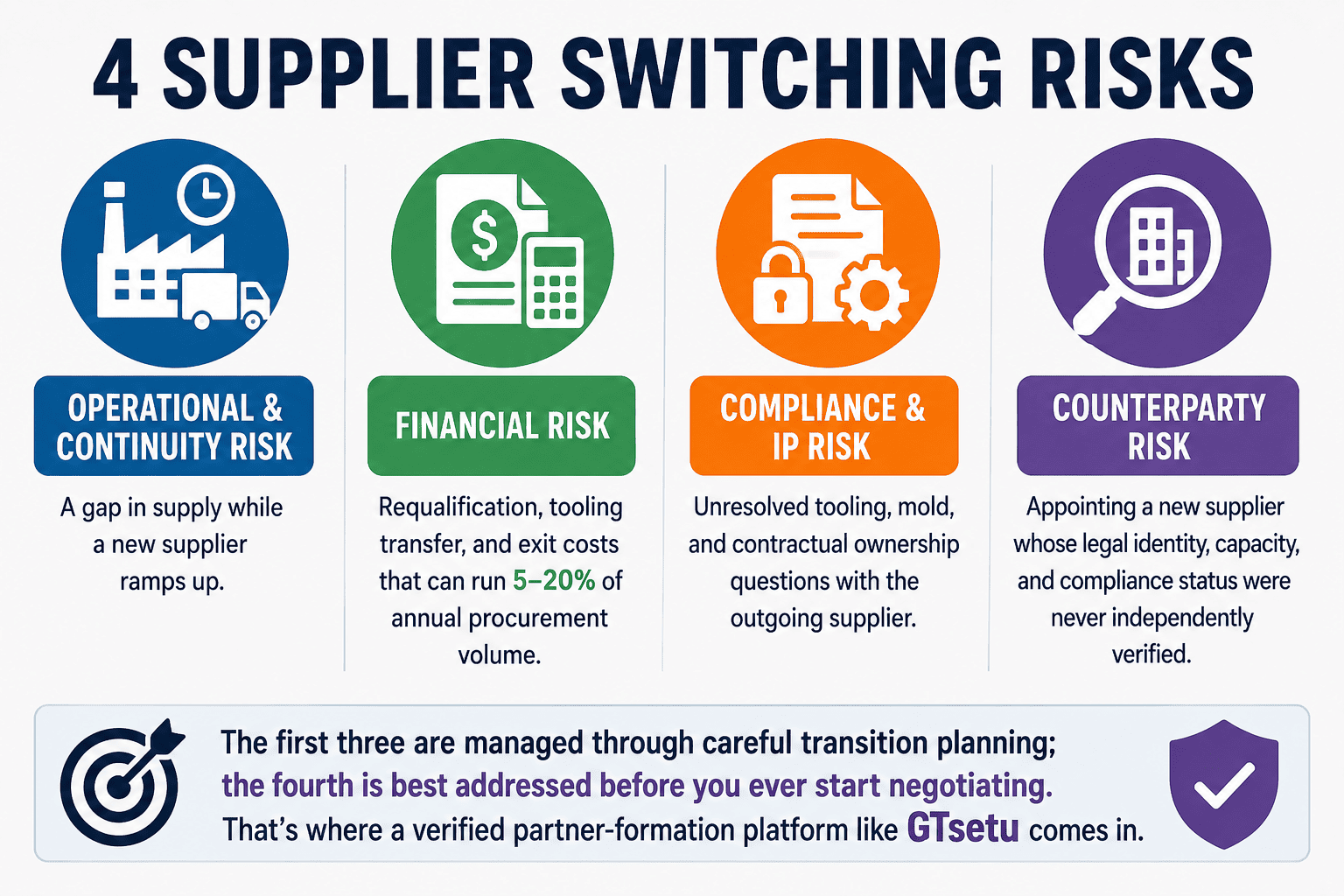
At a glance: Supplier switching risks fall into four groups, operational and continuity risk (a gap in supply while a new supplier ramps up); financial risk (requalification, tooling transfer, and exit costs that can run 5–20% of annual procurement volume); compliance and IP risk (unresolved tooling, mold, and contractual ownership questions with the outgoing supplier); and counterparty risk, appointing a new supplier whose legal identity, capacity, and compliance status were never independently verified. The first three are managed through careful transition planning; the fourth is best addressed before you ever start negotiating, which is where a verified partner-formation platform like GTsetu comes in.
📅 July 2026⏱ 18 min read✍️ GTsetu Editorial Team🔄 Updated regularly
4
Risk Categories
8
Sources Reviewed
5–20%
Typical Switching Cost
100+
Countries on GTsetu
Every manufacturer, distributor, and procurement team eventually faces the same question: is it worth switching suppliers? A current supplier may have raised prices without justification, developed a pattern of late shipments, failed an audit, or simply stopped being a strategic fit as a business scales into new markets. But changing suppliers is rarely a simple swap, it carries its own distinct set of risks, and those risks are frequently underestimated relative to the risks of staying with an underperforming supplier.
This guide maps the four categories of supplier switching risk, operational, financial, compliance, and counterparty, reviews what the leading industry sources say about managing a supplier transition, and explains why the biggest single driver of switching risk is usually the one addressed earliest or latest: how thoroughly the new supplier was verified before the relationship began.
💡 How to Use This Guide
If you are trying to decide whether the risk of switching is worth it, start with Section 5. If you have already decided to switch and want to plan the transition, go to Section 6. If your primary concern is finding and verifying a new supplier or distributor before you commit volume, especially across a border, go directly to Section 8.
SECTION 1
1 What Are Supplier Switching Risks?
📖 The Core Idea
Supplier switching risk is the combined operational, financial, compliance, and relationship exposure a buyer takes on when moving commercial volume from an existing supplier to a new one. It is distinct from ordinary supply chain risk, which is the risk that any supplier fails to deliver, because switching risk is specifically concentrated in the transition window: the period between the decision to change suppliers and the point where the new supplier is fully qualified, ramped, and performing reliably.
Supplier risk more broadly is usually grouped into risk types such as geopolitical, financial, concentration, strategic, reputational, and compliance risk. Supplier switching risk cuts across several of these categories at once, concentrated into a short but high-stakes window, which is exactly why it deserves its own framework rather than being treated as a subset of general vendor risk.
🏭
Category 1, Operational
Continuity & Ramp-Up Risk
The risk of a supply gap or quality dip while a new supplier is qualified, tooled, and brought up to full production volume. Ramping a new manufacturing partner into mass production typically takes months, not weeks.
Shows up as: production validation delays, inconsistent early-batch quality, missed delivery windows during ramp-up
💰
Category 2, Financial
Switching-Cost & Exit Risk
Direct costs of the change, requalification, IT and systems integration, contractual exit penalties with the outgoing supplier, and possible price premiums from the new supplier during onboarding.
Shows up as: requalification spend, contract termination penalties, dual-running costs during transition
📄
Category 3, Compliance / IP
Tooling, IP & Contractual Risk
Disputes over molds, tooling, technical drawings, and product IP that an outgoing supplier may be reluctant to release, plus exposure from exclusivity or minimum-volume clauses that make an exit contractually messy.
Shows up as: withheld tooling, IP disputes, unclear ownership clauses, exclusivity lock-in. See: who owns tooling and moulds
🕵️
Category 4, Counterparty
Unverified New-Supplier Risk
The risk of appointing a replacement supplier whose legal identity, production capacity, and compliance status were never independently confirmed, often the single largest source of switching risk, and the most preventable.
Shows up as: misrepresented capacity, undisclosed subcontracting, legal identity mismatches discovered after volume commitments are made
5–20%
of annual procurement volume, the typical total cost range of a supplier change once requalification, penalties, and integration are counted
2–6
months, typical time to move a new manufacturing partner from pilot run through production validation to stable mass production
7
commonly cited categories of broader supply chain risk that switching risk overlaps with, operational, financial, geopolitical, cyber, compliance, concentration, and reputational
SECTION 2
2 Operational & Continuity Risks
🏭 Category 1, The Transition Window
The most immediate risk of switching suppliers is a gap, or a quality dip, in the transition window itself. Ramping up a new supplier is not a matter of placing a large order on day one and expecting full production quality immediately; industry guidance on manufacturing transitions consistently points to a phased approach, typically running two to six months from initial documentation transfer through a pilot production validation run before mass production volumes are safe to commit.
ℹ️ Why Ramp-Up Takes Time
A new supplier needs the full set of specifications, tooling, learnings, and quality standards the outgoing supplier accumulated, and then needs to run a pre-production pilot that mirrors the eventual mass-production process end-to-end before that process can be trusted at scale. Skipping this step to save time is the single most common cause of quality failures immediately after a supplier switch.
Document the full quality standard and specification set before initiating the transition, verbal or informal standards rarely transfer cleanly
Run a phased production shift rather than moving all volume to the new supplier at once
Build in a production validation test (PVT) stage before committing to mass production
Keep the outgoing supplier engaged (where contractually possible) until the new supplier’s output is proven, to avoid a hard cutover
SECTION 3
3 Financial & Switching-Cost Risks
💰 Category 2, What a Supplier Change Actually Costs
Switching costs are frequently underestimated at the point a decision is made to change suppliers. Beyond the obvious price of a new contract, a full supplier change carries qualification costs, contractual exit penalties with the outgoing party, training and IT integration expense, and the risk of production downtime during cutover, together estimated at roughly 5–20% of the annual procurement volume for the item in question, a figure that needs to be weighed directly against the long-term savings or risk reduction the switch is meant to deliver.
🔬
Requalification Costs
Testing, certification, and sample approval cycles required to qualify a new supplier’s output against the same specification the outgoing supplier met.
📜
Contractual Exit Penalties
Minimum-volume shortfalls, early-termination fees, or notice-period obligations owed to the outgoing supplier under the existing agreement. See: ending a business partnership contract.
💻
IT & Systems Integration
Onboarding a new supplier into EDI, ERP, or DMS systems, plus the manual reconciliation effort during the overlap period.
⏸️
Dual-Running & Downtime Costs
The cost of running both suppliers in parallel during transition, or the cost of a production gap if that overlap is not built into the plan.
📈
Onboarding Price Premiums
New suppliers sometimes price conservatively during the early relationship period before volume commitments and trust are established.
🌍
Cross-Border Cost Layers
Tariffs, currency exposure, and logistics restructuring add an additional cost layer when the switch also involves a change of country. See: the true cost of global expansion.
SECTION 4
4 Compliance, IP & Contractual Risks
📄 Category 3, What Can Go Wrong on the Way Out
A supplier that senses it is about to lose business does not always behave cooperatively. Tooling, molds, technical drawings, and product IP developed jointly, or paid for by the buyer but held by the supplier, can become leverage in a dispute, and without a manufacturing agreement that clearly assigns ownership of these deliverables in advance, recovering them can be slow, expensive, or in some jurisdictions practically impossible.
🏛️ The Contractual Fix Comes Before the Dispute, Not After
The businesses that switch suppliers with the least friction are the ones whose original agreement already specified who owns tooling, molds, and IP, what happens on termination, and what notice periods and exit obligations apply. If that clarity was not built into the original contract, it needs to be negotiated, carefully, as part of the exit, ideally before the new supplier relationship is publicly known to the outgoing party. See: who owns tooling and moulds, business partnership contract frameworks, and ending a business partnership contract.
Where the switch also involves handing proprietary processes, designs, or technology to a new manufacturing partner, the risk extends beyond tooling into technology transfer terms and licensing structure, a topic covered in more depth in technology partnership.
SECTION 5
5 Warning Signs It’s Time to Switch Suppliers
🚩 Signals, When the Risk of Staying Outweighs the Risk of Switching
Industry practitioners who guide manufacturers through supplier transitions consistently point to a cluster of warning signs rather than any single red flag: recurring quality control issues, inconsistent or evasive communication, repeated delivery delays, and disruptive supply chain gaps. A factory with over a thousand staff can display exactly the same red flags as a small workshop, size is not a proxy for reliability.
Recurring quality defects that reappear after corrective action plans, rather than isolated one-off issues
Lack of transparency about subcontracting, ownership structure, or where production actually happens
Uncontrolled or opportunistic price increases disconnected from underlying cost changes
Reluctance to be audited by a third party, or inconsistent information across directories and public filings
Communication that becomes slower, vaguer, or harder to get a straight answer from over time
These same signals, inconsistent information, resistance to verification, unexplained ownership structures, are also exactly what independent buyers should screen for before appointing a new supplier in the first place, not just when deciding whether to leave an old one. See: common red flags in international partnerships.
SECTION 6
6 How to Reduce Supplier Switching Risk
🛡️ Mitigation, Practical Steps for a Smooth Transition
📋 During the Transition
Operational Discipline
Steps that reduce continuity and quality risk once the switch is underway:
Phase production volume gradually rather than a single hard cutover
Document specifications, defects, and quality standards in one master file
Run a full pilot production validation before mass production
Keep the outgoing supplier’s records and learnings as a transfer package
🔍 Before the Transition
Verification Discipline
Steps that reduce counterparty and compliance risk before volume is committed:
Independently verify the new supplier’s legal identity and registration
Confirm capacity claims rather than relying on self-reported figures
Execute an NDA before sharing pricing, specifications, or drawings
Clarify tooling, IP, and exit terms in the new contract from day one
The first set of steps is well understood and widely documented in manufacturing and quality-management circles. The second, verification before commitment, is where most switching failures actually originate, and it is the step that is hardest to do well without dedicated infrastructure, particularly when the new supplier is in another country. See: partnership evaluation criteria and global collaboration examples.
SECTION 7
7 Research & Industry Perspectives on Supplier Switching
📚 Sources, What Practitioners & Researchers Say
The following sources each address a distinct facet of supplier switching risk, from academic supply-chain modelling to hands-on manufacturing transition guidance. They are summarised here at a high level; each publisher’s own page should be consulted directly for the full analysis.
A peer-reviewed research article examining the economics and risk dynamics of switching between suppliers within a supply chain, contributing to the academic literature on switching cost theory as it applies to industrial procurement decisions. Useful for readers who want a formal, data-driven treatment of switching cost and risk trade-offs rather than practitioner guidance.
Switching Cost TheorySupply Chain Economics
Best for: Researchers and analysts wanting the formal academic grounding behind switching-cost concepts referenced throughout this guide.
2
Mitratech, Supplier Risks Blog
mitratech.com · Vendor & Contract Risk Management
⚖️ Legal & Compliance
A practitioner-oriented overview of supplier risk from a legal and contract-management standpoint, reflecting Mitratech’s focus on vendor risk, contract lifecycle, and compliance tooling for legal and procurement teams managing third-party relationships.
Vendor RiskContract Lifecycle
Best for: Legal and compliance teams wanting a contract-management lens on supplier risk. See: business partnership contract.
3
Component Advertiser, Changing Suppliers: What’s the Risk
componentadvertiser.com · Electronics Components Industry
🔩 Electronics Sourcing
An industry-focused piece aimed at electronic component buyers and distributors, addressing the specific risks of changing component suppliers, including qualification cycles, obsolescence exposure, and supply continuity concerns unique to the electronics sourcing world.
Component SourcingElectronics Supply Chain
Best for: Electronics component buyers evaluating a supplier change with obsolescence and qualification concerns in mind.
qualityinspection.org · Manufacturing & Sourcing in Asia
🏭 Manufacturing Practitioner
A practitioner discussion, featuring a contract-manufacturing CEO, on recognising when it’s time to switch manufacturers, covering quality inconsistencies, communication lapses, and disruptive delays as key triggers, and on managing the transition through phased production shifts, clear upfront expectations, and thorough documentation. It also notes that transferring production typically takes two to six months given the documentation, tooling, and production validation testing (PVT) required before mass production can safely begin.
Best for: Manufacturers physically relocating production to a new factory, particularly in Asia. See: who owns tooling and moulds.
5
Tacto, Supplier Change (Procurement Glossary)
tacto.ai · Procurement Definitions & Best Practice
📖 Glossary / Reference
A procurement-glossary style definition of a supplier change as the strategic transition from an existing supplier to a new one, triggered by cost optimisation, quality issues, or shifting market conditions. It frames switching costs, qualification effort, contractual penalties, training, IT integration, and possible downtime, as running roughly 5–20% of annual procurement volume, to be weighed against expected long-term savings.
Switching Cost DefinitionProcurement Glossary
Best for: A quick, structured definition of supplier-change terminology and its main cost drivers.
6
Precoro, 7 Basic Types of Supply Chain Risks
precoro.com · Procurement Software Blog
🗂️ Risk Taxonomy
A broader taxonomy of supply chain risk categories, including the specific point that global sourcing changes carry higher risk and cost, and that switching suppliers internationally can even shift business toward competitors in markets where a vendor decides to focus. It situates supplier switching within the wider set of financial, operational, geopolitical, and compliance risks procurement teams track.
Risk TaxonomyGlobal Sourcing Risk
Best for: Procurement teams wanting to place switching risk in the context of the full supply chain risk landscape.
7
Taylor & Francis Online, Supply Chain Risk Journal Article
tandfonline.com · Peer-Reviewed Research
🎓 Academic
A peer-reviewed journal article contributing to the academic literature on supply chain and supplier-related risk management, offering a research-grounded perspective that complements the practitioner sources in this list. As with all academic sources referenced here, the publisher’s page should be consulted for the full methodology and findings.
Peer-ReviewedRisk Management Research
Best for: Readers wanting the underlying academic research behind supply chain risk management frameworks.
8
Endries, Mitigating Risk During a Supplier Change
endries.com · Fastener & Industrial Component Distribution
🔧 Industrial Distribution
A distribution-industry perspective on managing the risk of a supplier change, reflecting Endries’ background in fastener and industrial component supply, relevant to manufacturers and distributors weighing a change of component or raw material supplier where continuity of specification and part compatibility is critical.
Industrial ComponentsFastener Distribution
Best for: Industrial buyers switching component or raw material suppliers where specification continuity is critical. See: international wholesale distributors.
ℹ️ The Common Thread Across These Sources
Whichever industry lens is used, academic, legal, manufacturing, or distribution, the same pattern recurs: switching risk is manageable when the transition is planned and documented, but it compounds sharply when the new supplier’s identity, capacity, or compliance status was assumed rather than verified. None of the sources above include a built-in mechanism for independently verifying a new counterparty before commercial engagement begins, that is the layer described in Section 8.
SECTION 8
8 Reducing Switching Risk Before It Starts: The GTsetu Approach
Most switching-risk advice, documentation, phased ramp-up, contractual clarity, addresses risk that appears during the transition. The counterparty risk described in Section 1 is different: it originates before the transition even begins, at the point a new supplier or distributor is first selected. GTsetu operates specifically at that upstream point, helping manufacturers, distributors, and raw material suppliers verify a prospective new trade partner before pricing, specifications, or volume commitments are exchanged.
🤝 Verified Partner Formation, Before the Switch, Not After
GTsetu: Verifying the New Supplier or Distributor Before You Commit Volume
GTsetu is not a DMS or a supplier data monitoring tool. It is the verified partnership infrastructure that lets manufacturers, distributors, and raw material suppliers identify a prospective replacement partner, confirm their legal identity through government tie-ups, protect commercial data before it is shared, and structure the legal foundation of the new relationship, across 100+ countries, with zero broker commissions.
🏛️
6-Point Govt Tie-Up VerificationLegal name, registered address, registration number, company status, type, and incorporation date, verified before engagement begins.
🕵️
Anonymous DiscoveryEvaluate prospective replacement suppliers or distributors without revealing that a switch is even being considered, protecting your position with the outgoing supplier.
📄
Built-in NDA WorkflowsDigital NDA triggered before pricing, specifications, or strategy data changes hands, with a timestamped audit trail.
🔐
Encrypted Document SharingAES-256 at rest, TLS in transit, no unprotected email attachments for specifications or draft agreements.
🚫
Zero Broker CommissionNo percentage of deal value extracted from the new partnership you form.
🌍
100+ CountriesVerified manufacturers, distributors, and raw material suppliers across the Middle East, Europe, Southeast Asia, Africa, Australia, and the Americas.
🏭
Industrial Sector FocusBuilt for manufacturers, distributors, and raw material suppliers, not enterprise procurement bolt-ons.
📋
Full Audit TrailDownloadable, timestamped record of verifications, NDA executions, and engagement milestones for compliance purposes.
Manufacturers replacing an underperforming distributor in an export market without tipping off the outgoing partner or relying on broker intermediaries. See: building a distributor network
Distributors switching manufacturing principals for a product category, needing to verify a new supplier’s legal standing before committing purchase volume. See: contract between manufacturer and distributor
Raw material buyers replacing a supplier for quality or continuity reasons and needing confidence in the new supplier’s capacity claims before signing a long-term agreement
Businesses considering a joint venture or deeper collaboration instead of a simple supplier swap, where the structuring question itself needs clarity. See: collaboration agreement vs joint venture
Teams evaluating multiple candidate replacement suppliers who want a structured way to compare verified counterparties before revealing switching intent. See: partnership evaluation criteria and B2B matchmaking tools
Businesses needing outside expertise to plan a cross-border supplier switch well beyond what an internal team can evaluate alone. See: international business development consulting
SECTION 9
9 Risk Category Comparison Table
The table below summarises how each risk category behaves, what mitigates it, and where GTsetu’s verification layer fits relative to standard transition-planning advice.
Risk CategoryWhen It OccursTypical Cost/ImpactStandard MitigationVerified Before Commitment?
Operational / Continuity Risk
⚠ During ramp-up
⚠ 2–6 month ramp window
✓ Phased transition, PVT
✗ Not applicable
Financial / Switching-Cost Risk
⚠ Throughout transition
⚠ 5–20% of procurement volume
✓ Cost-benefit planning
✗ Not applicable
Compliance / IP / Tooling Risk
⚠ At exit / termination
⚠ Variable, potentially high
✓ Clear contract terms upfront
⚠ Contract-dependent
Counterparty / Unverified Supplier Risk
✗ Before engagement
✗ Potentially severe
⚠ Rarely systematised
✓ GTsetu: 6-point govt verification
FAQ
? Frequently Asked Questions
QWhat are supplier switching risks?
Supplier switching risks are the operational, financial, compliance, and counterparty exposures a business takes on when moving from an existing supplier to a new one. They include a possible gap or quality dip in supply while the new supplier ramps up, switching costs such as requalification and contractual exit penalties, disputes over tooling, molds, or IP with the outgoing supplier, and, often the largest and most preventable risk, appointing a new supplier whose legal identity and capacity were never independently verified. See: common red flags in international partnerships.
QWhat are the biggest risks of changing suppliers?
The biggest risks are a continuity gap while the new supplier ramps up production; switching costs, requalification, tooling transfer, and exit penalties, that can reach 5-20% of annual procurement volume; loss of institutional knowledge accumulated with the outgoing supplier; disputes over IP, molds, or tooling; and the risk of committing volume to a new supplier whose identity and capacity claims were never verified. See: who owns tooling and moulds.
QHow much does it cost to switch suppliers?
Estimates from procurement industry sources place the total cost of a supplier change, covering requalification, contractual penalties, training, IT integration, and possible production downtime, at roughly 5-20% of the annual procurement volume for the item being switched. Cross-border switches typically add tariff, currency, and logistics restructuring costs on top. See: the true cost of global expansion.
QWhat are the warning signs it’s time to switch suppliers?
Common warning signs include recurring quality control problems that reappear after corrective action, inconsistent or evasive communication, repeated delivery delays, uncontrolled pricing changes, lack of transparency about subcontracting, and reluctance to be independently audited. Any single sign can often be managed; several appearing together usually signals the relationship has moved past the point where a corrective action plan will resolve it. See: common red flags in international partnerships.
QHow can a business reduce supplier switching risk?
Switching risk is reduced by phasing the transition rather than moving all volume at once, documenting specifications and quality standards clearly, resolving tooling and IP ownership questions contractually before a dispute arises, running a production validation trial before mass production, and, critically, independently verifying the new supplier’s legal identity, capacity, and compliance status before committing volume, rather than relying on self-reported claims or a directory listing. See: partnership evaluation criteria.
QShould I switch suppliers or renegotiate with my current one?
That depends on whether the underlying issue is fixable within the existing relationship. Price disputes and one-off quality lapses are often resolvable through renegotiation or a corrective action plan. Recurring quality failures, transparency concerns, or a supplier that has structurally outgrown your needs are harder to fix without a switch. Either way, the decision should weigh the documented switching costs in Section 3 against the ongoing cost of staying, and should not be made without first identifying and verifying at least one credible replacement option, see international wholesale distributors.
QHow is switching a distributor different from switching a raw material or component supplier?
Switching a distributor carries more market-facing risk, territory coverage, customer relationships, and brand presentation are all at stake, and an underperforming distributor holding an exclusivity clause can lock a market for years. Switching a raw material or component supplier carries more production-facing risk, specification match, part compatibility, and continuity of supply. Both share the same underlying counterparty risk: whether the replacement partner was properly verified before commitments were made. See: global collaboration examples and cross-border business partnerships.
Planning a Supplier or Distributor Switch? Verify Before You Commit.
GTsetu is the verified partner-formation platform for manufacturers, distributors, and raw material suppliers in industrial sectors, 6-point government verification, anonymous discovery, built-in NDA workflows, encrypted document sharing, and zero broker commissions across 100+ countries. Reduce the biggest switching risk before the transition ever begins.
They represents the product, and research team behind GTsetu, a global B2B collaboration platform built to help companies explore cross-border partnerships with clarity and trust. The team focuses on simplifying early-stage international business discovery by combining structured company profiles, verification-led access, and controlled collaboration workflows.
With a strong emphasis on trust, and disciplined engagement, Team GTsetu shares insights on global trade, partnerships, and cross-border collaboration, helping businesses make informed decisions before entering deeper commercial discussions.