Free for a limited time·Profile verification free·First collaboration free·500+ Companies Onboarded·6 Continents Covered·No Commission & No Profit Share·Free for a limited time·Profile verification free·First collaboration free·500+ Companies Onboarded·6 Continents Covered·No Commission & No Profit Share·Free for a limited time·Profile verification free·First collaboration free·500+ Companies Onboarded·6 Continents Covered·No Commission & No Profit Share·
Trialing and Scaling Production for Startups (2026) | GTsetu
Home ›
Blog ›
Trialing & Scaling Production for Startups
🏭 Trial-Batch & Production Scale-Up
Trialing and Scaling Production for Startups, Complete Guide (2026)
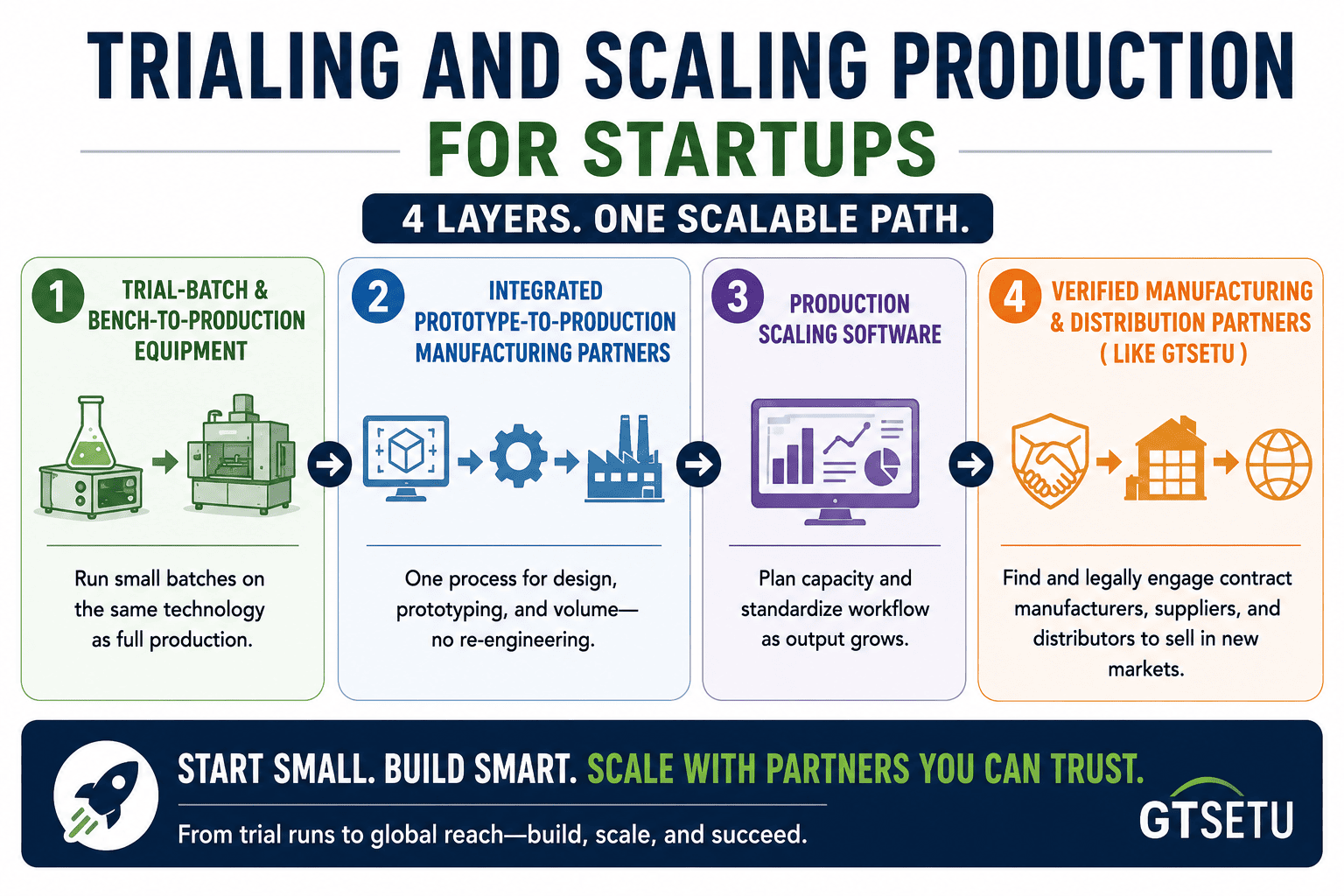
At a glance: Trialing and scaling production for startups happens across four layers, trial-batch and bench-to-production equipment that lets a small batch run on the same technology as a full production run; integrated prototype-to-production manufacturing partners who use one process for design, prototyping, and volume so nothing gets re-engineered; production scaling software that plans capacity and standardizes workflow as output grows; and, once volume is proven, a verified manufacturing and distribution partner layer like GTsetu, for startups that need to find and legally engage the contract manufacturers, raw material suppliers, or distributors required to actually sell that scaled production into new markets.
📅 July 2026⏱ 19 min read✍️ GTsetu Editorial Team🔄 Updated regularly
4
Scale-Up Layers
8+
Approaches Reviewed
100+
Countries on GTsetu
0%
Broker Commission
Almost every startup that makes a physical product hits the same wall: the process that worked perfectly for ten units in a lab, workshop, or kitchen does not automatically work for ten thousand. Somewhere between “we built a working prototype” and “we can fulfil orders reliably,” a huge number of promising products stall, not because the idea was wrong, but because trialing and scaling production was never treated as its own discipline.
That discipline breaks down into layers that are often confused with one another. The first is equipment, the physical machines used to run small trial batches in a way that transfers predictably to full volume. The second is manufacturing partners, the people who actually cut, mould, mill, assemble, or compound the product, and whether they treat prototyping and production as one continuous process or two disconnected ones. The third is software, the planning and visibility layer that keeps quality and cost under control as output climbs. And the fourth, which most scaling guides skip entirely, is the commercial layer: once a startup can actually produce at volume, who do they sell it to, and who do they trust to manufacture it under licence in a new country?
This guide walks through each layer with the tools and approaches startups actually use, trial-batch machinery, integrated CNC and prototyping shops, production planning software, and CDMO-grade scale-up for regulated products, and explains where a verified partner-formation platform like GTsetu fits once production itself is no longer the bottleneck.
💡 How to Use This Guide
If your bottleneck is physically proving a process at small scale before committing to full volume, go to Section 2. If you are choosing between a prototype shop and a production manufacturer, go to Section 3. If your problem is planning, tracking, or standardizing output as volume rises, go to Section 4. If your product is pharmaceutical, nutraceutical, or otherwise regulated, go to Section 5. And if you have already solved production and now need to find verified manufacturing or distribution partners to sell into new markets, go directly to Section 6.
SECTION 1
1 The 4 Layers of Trialing & Scaling Production
📖 The Landscape Mapped
Trialing and scaling production for startups spans four layers, each solving a different part of the journey from working prototype to reliable volume output. Confusing them is the single most expensive mistake a scaling startup can make, buying a production ERP when the real problem is unproven equipment, or investing in a new factory when the real problem is that no verified partner exists to sell into the target market.
⚗️
Layer 1, Equipment
Trial-Batch & Bench-to-Production Equipment
Physical machines, mills, compactors, metering pump skids, engineered so a trial batch run at bench scale uses the exact same mechanism, ratios, and controls as the production-scale machine. Proves the process, not just the product.
Key examples: North Ridge Pumps batching skids, Quadro Scalable Lab System, Fitzpatrick Lab Compaction System
🔧
Layer 2, Manufacturing Partner
Integrated Prototype-to-Production Manufacturing
Machine shops and product developers who use one team, one set of tooling, and one quality system across prototyping, qualification, and volume production, eliminating the re-engineering that happens when a startup switches suppliers mid-journey.
Key examples: R E Thompson (CNC machining), AME-3D (3D printing, vacuum casting, low-volume production)
📊
Layer 3, Software
Production Scaling Software & Operations Platforms
ERP, MES, and MOM platforms that plan capacity, standardize procedures, and give real-time visibility into quality, cost per unit, and bottlenecks as production volume rises from tens to thousands of units.
Key examples: Cin7 (inventory/production ERP for SMBs), Siemens Opcenter via Snic Solutions (MOM/MES for regulated manufacturers)
🤝
Layer 4, Commercial Formation
Verified Manufacturing & Distribution Partner Formation
Once a process and production volume are proven, startups still need to find and legally engage the contract manufacturers, raw material suppliers, or distributors required to scale into new geographies, with verified identity and NDA protection before commercial data is shared.
typical scale-up factor from lab batch to full production run in regulated manufacturing
3
most common causes of scale-up failure: process re-engineering, unstandardized workflows, and unverified partners
20+ weeks
typical timeline from initial prototype through qualification to a stable production ramp
SECTION 2
2 Trial-Batch & Bench-to-Production Equipment
⚗️ Layer 1, Proving the Process Before Committing to Volume
Before a startup can scale production, it has to prove the process itself is repeatable, that a batch made today behaves the same way as a batch made next month, at ten times the size. The equipment used for this stage matters enormously: if the trial machine works on a fundamentally different mechanism than the production machine, every result has to be re-validated from scratch once volume increases. The equipment reviewed below is purpose-built to avoid exactly that problem.
ℹ️ Why Mechanism Continuity Matters
According to FDA Scale-Up and Post-Approval Changes (SUPAC) guidance, a manufacturing process must typically be re-validated every time output is scaled by a factor of 10 or more. Equipment that uses the same mechanism, speed ratios, and control logic at bench and production scale reduces how many of those re-validation cycles are needed, and how many surprises show up only once volume increases.
Trial-to-Production Equipment Reviewed
1
North Ridge Pumps, Heat-Traced Batching Skids
northridgepumps.com · High-Viscosity Trial & Batch Dispensing Systems
🇬🇧 UK Fluid Handling
North Ridge Pumps supplies pump technology and complete batching systems for startups that need to transfer, dispense, and repeatably batch viscous, temperature-sensitive, or shear-sensitive liquids, a common bottleneck for supplement, cosmetic, and specialty chemical startups. In one documented case, a supplement industry innovator needed to dispense a product with the consistency of molten fat, which solidified when cold and was otherwise near-impossible to remove from its container. North Ridge supplied, commissioned, and installed a complete automatic batching system with a heat-traced hose and heat-traced barrel, keeping the liquid pumpable throughout dispensing. This let the client trial new processes, test small batches, and trial packaging methods with accurate, repeatable, fully traceable results, the same considerations any startup needs before committing a formulation to production volume: shear sensitivity, solid handling, volatility and corrosion, accuracy and repeatability, and hygienic or material accreditation.
Best for: Startups in supplements, food, cosmetics, or specialty chemicals trialing viscous or temperature-sensitive formulations before committing to batch production volumes. Not for: Solid-dose, powder, or granulation processes, a different equipment category entirely.
Quadro Engineering’s Scalable Lab System is a laboratory milling and processing platform that switches between four heads for five milling solutions in seconds, letting formulators narrow down the ideal particle size reduction technology while simultaneously proving a smooth scale-up path to full production. Its SMARTdetect feature keeps each milling head operating within scalable speed ranges, so parameters proven during small lab-scale trials transfer to production-scale Comil equipment with simple, direct parameter transfer rather than a full re-development cycle. This matters because SUPAC guidance requires the entire process to be re-validated at each 10x scale-up factor, and the path from a laboratory batch to a production batch commonly spans a factor of 100 or more.
4-in-1 Milling HeadsSMARTdetect Speed ControlParticle Size Distribution ControlDirect Parameter TransferPharma / Food / Chemical
Best for: Pharmaceutical, nutraceutical, food, and chemical startups needing to prove milling and particle-size processes at lab scale before a 10–1,000x production scale-up. Not for: Liquid, semi-solid, or non-powder processes.
3
The Fitzpatrick Company, Lab Compaction System (LCS)
fitzpatrick-mpt.com · Benchtop Roller Compaction for R&D & Trial Batches
🧪 Dry Granulation
Fitzpatrick’s Lab Compaction System is a benchtop roller compactor purpose-built for the smallest-volume R&D and trial batch dry granulation, tested down to just 10g of test material at moderate bulk density. It handles capacities up to 6 kg/hr and, critically, uses Fitzpatrick’s high-precision twin feed screw system, processing powders using the same mechanism as the company’s larger production-scale systems. Its 20 kN/cm available roll force is equivalent to production-scale systems and matches most pharmaceutical blend requirements, meaning the compact produced on the benchtop unit can be easily replicated on a production-scale model, the exact continuity a startup needs to move from proof-of-concept to clinical or commercial trial batches with confidence.
10g Minimum BatchTwin Feed Screw SystemProduction-Equivalent Roll ForceContainment-ReadyTouchpad Process Control
Best for: Startups producing highly potent, small-batch, or clinical trial dry granulation products that must scale confidently to production-scale roller compaction. Not for: Wet granulation, liquid, or milling-only processes.
🔧 Layer 2, One Partner, One Process, No Re-Engineering
A second, equally common failure mode is organizational rather than technical: startups work with one supplier for prototyping and a completely different one for production. It sounds logical, different volumes need different capabilities, but it introduces risk at exactly the moment a product is most vulnerable. Manufacturing partners who run prototyping and production through the same team, equipment, and quality system remove that risk entirely.
R E Thompson runs prototype and production work through the same manufacturing engineers, the same CNC machining centres, and the same quality systems, rather than treating rapid prototyping as a separate business from volume manufacturing. Prototypes are programmed on the same 5-axis machines and toolpaths that will be used at production volume, so when a design moves from six prototype units to a 500-unit production order, the programs are already proven, no re-engineering, no re-qualification, no surprises. The company reports that re-engineering parts for high-volume manufacturing after a disconnected prototype phase is a common cause of delayed launches, lost design-for-manufacture knowledge, and quality issues that never appeared in prototypes but emerge in production. Materials, certifications, and traceability requirements are also sourced identically from the prototype stage onward, avoiding the scenario where a production part’s specification differs from what was actually qualified during testing.
Same Team, Prototype to Volume5-Axis CNC Machining24/7 Lights-Out ManufacturingDesign for Manufacture (DFM)Process Capability Studies
Best for: Aerospace, defence, automotive, and medical device startups needing precision-machined parts where prototype and production tolerances, materials, and certifications must match exactly. Not for: Injection-moulded plastics, additive manufacturing, or non-machined components.
AME-3D is a UK product design and manufacturing business spanning 3D CAD design, Design for Manufacturing (DFM), rapid prototyping (SLA, SLS, MJF, LCD, FDM), and low-volume production including vacuum casting and reaction injection moulding. Its published guidance to startups scaling from prototype to production stresses validating the prototype for mass manufacturability before committing to tooling, since prototype-grade materials such as SLA resin are often unsuitable at full production; choosing the right process, injection moulding, CNC machining, 3D printing, or vacuum casting, based on volume, budget, and material needs; vetting manufacturing partners on industry experience, scalability, and quality certifications; and starting with small pre-production batch runs before committing to high-volume tooling investment.
Design for ManufactureVacuum CastingMultiple 3D Printing TechnologiesLow-Volume ProductionISO 9001:2015 Certified
Best for: Startups in consumer goods, medical, automotive, or defence needing to validate a design and produce low-to-medium volumes before deciding whether full injection-moulding tooling is justified. See: who owns tooling and moulds, a critical question once a startup moves from vacuum casting or 3D printing into committed injection-mould tooling with a manufacturing partner. Not for: High-volume metal machining or regulated pharmaceutical production.
ℹ️ The Tooling Ownership Question Startups Often Miss
Once a startup commits to injection-mould tooling with a manufacturing partner, whether domestically or, more commonly, with an overseas contract manufacturer as volumes climb, who legally owns that tooling becomes a critical and frequently overlooked question. If the relationship with the manufacturer ends, unclear tooling ownership can leave a startup unable to retrieve its own moulds or move production elsewhere. See: who owns tooling and moulds and ending a business partnership contract for how to structure this before signing, not after a dispute begins.
SECTION 4
4 Production Scaling Software & Operations Platforms
📊 Layer 3, Planning, Standardizing, and Tracking Growth
Even with proven equipment and an integrated manufacturing partner, scaling production without the right operational software commonly produces the same symptoms: rising cost per unit, declining quality, overworked staff, and limited visibility into what is actually happening on the shop floor as volume increases. Two distinct categories of platform address this, SMB-focused inventory and production ERP, and enterprise-grade Manufacturing Operations Management (MOM) suites for regulated or highly complex manufacturers.
1
Cin7
cin7.com · Inventory, Production & Order Management for Growing Brands
📦 SMB Production ERP
Cin7 centralizes production planning, inventory, and sales data for small and mid-sized manufacturers scaling output. Its guidance identifies the clearest signals a business is ready to scale, frequent stockouts and turned-away sales, rising lead times, increasing cost per unit despite higher volume, declining product quality, and chronically overworked staff, and pairs that with concrete strategies: standardizing processes into written SOPs, applying lean manufacturing principles, ensuring supply chain and supplier readiness before ramping up, running pilot batches before full-scale implementation, and using real-time dashboards with manufacturing execution system (MES) style visibility to catch bottlenecks and quality issues as they happen rather than after the fact.
Centralized Production PlanningReal-Time DashboardsDemand ForecastingQuality & Compliance TrackingSMB-Priced
Best for: Growing product brands in food and beverage, fashion, health and beauty, and consumer goods that need a single system for inventory, production, and multichannel sales as volume scales. Not for: Regulated pharmaceutical manufacturing requiring full electronic batch records and validated MOM infrastructure.
2
Snic Solutions, Siemens Opcenter (MOM/MES)
snicsolutions.com · Manufacturing Operations Management for Scaling Manufacturers
🏭 Enterprise MOM/MES
Snic Solutions implements Siemens Opcenter Manufacturing Operations Management (MOM) and Execution System (MES) software for manufacturers scaling from small-batch or prototype production toward larger-scale operations. Its scaling framework covers assessing current workflow efficiency, equipment utilization, and quality control effectiveness; setting SMART goals and KPIs such as throughput, cycle time, and defect frequency; adopting a phased scaling approach rather than an abrupt jump in volume; and progressing through defined automation stages, manual workstations, “manumation” (partial automation), islands of automation, and fully integrated automated lines. Opcenter integrates real-time shop floor monitoring, quality management (QMS, CAPA, FMEA), and laboratory information management (LIMS) with ERP, APS, and MES systems, giving scaling manufacturers a single source of truth across production, quality, and logistics.
Best for: Small and mid-sized manufacturers in regulated or complex sectors, pharma, chemicals, industrial goods, needing enterprise-grade production, quality, and laboratory data integration as they scale past manual or semi-automated operations. Not for: Very early-stage startups without a validated production process yet, or businesses needing only basic inventory tracking.
ℹ️ The Gap in Both Software Categories
Cin7 and Opcenter-class MOM platforms excel at planning, standardizing, and monitoring production you already control. Neither addresses how a startup identifies, verifies, and legally engages a new contract manufacturer, raw material supplier, or distributor when scaling means expanding into a market where the startup has no existing operational footprint. That is a partner-formation problem, not a production-planning problem. See: B2B matchmaking tools and the true cost of global expansion.
Startups developing pharmaceutical, biotech, or other regulated products face a stricter and more codified version of the same scale-up problem, typically working through a Contract Development and Manufacturing Organization (CDMO) rather than building in-house capacity.
1
UPM Pharmaceuticals
upm-inc.com · CDMO Technology Transfer & Clinical Scale-Up Support
💊 Clinical CDMO
UPM Pharmaceuticals supports the transition from lab-scale drug product development through clinical trial manufacturing via its technology transfer and scale-up support services. Its published scale-up process moves through a pre-scale/pilot stage establishing proof of concept and critical process parameters (CPPs); technology transfer and scale-up, qualifying process equipment and analytical assays for clinical-scale (IND/Phase I–III) manufacturing; and clinical trial manufacturing under full cGMP compliance. Documented challenges include scale-dependent process variables (mixing, heat transfer, granulation, and compression forces all behave differently at bench versus clinical scale), analytical method translation risk, and raw material and supplier consistency at higher volumes. Best practices include starting with robust process development and Design of Experiments (DOE), conducting a thorough gap and risk analysis between lab and pilot scale, securing raw material supply early, and running pilot lots and bridging studies before full clinical-scale production.
Technology TransfercGMP Clinical ManufacturingAnalytical Method ValidationRisk Gap AnalysisDEA-Licensed Facility
Best for: Pharmaceutical and biotech startups moving from formulation development into IND-enabling or Phase I–III clinical trial manufacturing needing a single CDMO partner through commercial launch. See: technology partnership for how technology transfer agreements with a CDMO or licensing partner should be structured contractually. Not for: Non-regulated consumer products or startups not yet at the formulation-locked stage.
SECTION 6
6 The Layer After Scale-Up: Finding Who Actually Makes and Sells It
🤝 Layer 4, The Missing Piece in Most Scaling Playbooks
Every resource reviewed above, trial equipment, integrated manufacturing partners, production software, and CDMO scale-up support, answers the question “how do we make more of this reliably?” None of them answer a question that arrives immediately afterward: once a startup can produce at real volume, who actually manufactures a licensed version in a new country, who distributes it there, and who is the verified raw material supplier that keeps the whole thing running at the new scale?
This is where most scaling startups improvise, trade shows, cold outreach, unverified online directories, or a broker who takes a cut of every deal in exchange for an introduction that may or may not be trustworthy. It’s the same category mistake as buying a production ERP to solve an equipment problem: using the wrong layer for the job.
🔧 Production Scale-Up Tools
What They Assume Is Already Solved
Trial equipment, manufacturing partners, and production software all assume:
You already know which supplier or factory will make it at scale
That supplier’s identity and legal standing are already confirmed
A commercial and manufacturing agreement is already signed
Tooling ownership and IP protection are already defined
A route to market, distributors, retail partners, already exists
🤝 Partner-Formation Platforms
What Happens Before Scale-Up Reaches a Market
Partner-formation platforms solve the upstream commercial challenge:
Discovering verified contract manufacturers or suppliers abroad
Confirming legal identity via government registration data
Protecting formulation, tooling, and pricing data with NDAs
Structuring the legal foundation of the manufacturing or supply deal
Finding verified distributors once production capacity exists
Left unaddressed, this gap produces the same predictable damage seen in common red flags in international partnerships: a contract manufacturer overseas who misrepresents its capacity or certifications; pricing and formulation data shared with a prospective partner before any NDA is in place; or a distributor granted exclusivity in a new market who cannot deliver, locking the startup out of that geography with no easy exit. See also the true cost of global expansion for how these hidden costs compound once a startup is committed.
⚠️ Why “Scaled Production” and “Scaled Revenue” Are Not the Same Thing
A startup can solve every technical problem in this guide, proven trial equipment, an integrated manufacturing partner, production planning software, even CDMO-grade clinical scale-up, and still fail to grow, because production capacity without a verified route to market is just inventory. The three most expensive outcomes of skipping partner verification at this stage are: (1) engaging an overseas contract manufacturer who cannot actually deliver the certified capacity claimed, discovered only after tooling and deposits are committed; (2) sharing a proprietary formulation or design with a prospective manufacturing or licensing partner with no NDA in place; and (3) signing an exclusive distribution agreement in a new market with a partner who underperforms, with no clean way to exit. See: ending a business partnership contract and business partnership contract frameworks.
SECTION 7
7 GTsetu: Verified Manufacturing & Distribution Partners for Scaled Startups
GTsetu operates exclusively at this fourth layer, the step after a startup’s production process, equipment, and internal systems are already proven. It is built for manufacturers, distributors, and raw material suppliers who need to identify, verify, and legally structure new cross-border trade partnerships once scale-up is no longer a technical problem but a market-access one: contract manufacturing capacity abroad, licensed production partners, export distributors, or long-term raw material supply agreements.
🤝 Verified Partner Formation, After Production Is Solved
GTsetu: The Infrastructure Layer for Finding and Forming Verified Manufacturing & Distribution Partnerships
GTsetu is not trial equipment, not a manufacturing partner, and not production software. It is the verified partnership infrastructure that lets a startup that has already scaled its production process find the right contract manufacturers, distributors, and raw material suppliers abroad, confirm their identity via government tie-ups, protect formulation and pricing data before it is shared, and structure the legal foundation for a long-term cross-border relationship, across 100+ countries, with zero broker commissions.
🏛️
6-Point Govt Tie-Up VerificationLegal name, registered address, registration number, company status, type, and incorporation date, verified via government sources before any engagement begins.
🕵️
Anonymous DiscoveryBrowse and evaluate verified manufacturer, distributor, and supplier profiles across 100+ countries without revealing your company identity or expansion plans.
📄
Built-in NDA WorkflowsDigital NDA triggered automatically before any formulation, tooling design, or pricing data changes hands, with a full timestamped audit trail.
🔐
Encrypted Document SharingAES-256 at rest, TLS in transit. No unprotected email attachments for formulations, drawings, or draft agreements.
🚫
Zero Broker CommissionNo percentage of deal value extracted. The full commercial value of every partnership stays between the two parties who built it.
🌍
100+ CountriesVerified manufacturers, distributors, and raw material suppliers across the Middle East, Europe, Southeast Asia, Africa, Australia, and the Americas.
🏭
Industrial & Manufacturing FocusContract manufacturers, raw material suppliers, and distributors, not generic B2B listings. See: global collaboration examples.
📋
Full Audit TrailDownloadable, timestamped record of all verifications, NDA executions, document exchanges, and engagement milestones, for regulatory and investor due diligence.
Startups scaling production who need a verified contract manufacturer abroad once domestic capacity is maxed out, without broker intermediaries or unverified directories. See: international business development consulting
Startups licensing a formulation or process abroad via a technology transfer or licensing partner. See: technology partnership
Founders evaluating whether a prospective manufacturing partner is genuinely a fit before committing tooling or deposits. See: partnership evaluation criteria
SECTION 8
8 How to Choose the Right Layer for Your Stage
The right tool depends entirely on where a startup actually sits on the journey from prototype to scaled, commercially distributed production. Use this decision matrix to identify which layer, and which specific resource, matches the current bottleneck.
Your Goal
Right Layer
Recommended Resource
Why
Prove a viscous liquid or supplement formulation can be batched repeatably before committing to volume
Equipment (Layer 1)
North Ridge Pumps batching skids
Heat-traced, repeatable dosing designed specifically for trial-to-production continuity
Scale a milling or particle-size process from lab to production by a factor of 10–1,000x
Equipment (Layer 1)
Quadro Scalable Lab System
Direct parameter transfer between lab and Comil production-scale equipment
Run 10g–6kg dry granulation trial batches that scale confidently to production roller compaction
Equipment (Layer 1)
Fitzpatrick Lab Compaction System
Production-equivalent roll force and mechanism at benchtop scale
Move precision-machined parts from prototype to a 500+ unit production order without re-engineering
Manufacturing Partner (Layer 2)
R E Thompson
Same CNC equipment, toolpaths, and quality system across prototype and volume
Validate a design and produce low-to-medium volumes before committing to injection-mould tooling
Manufacturing Partner (Layer 2)
AME-3D
Design for Manufacture guidance plus 3D printing and vacuum casting production runs
Plan, standardize, and track inventory and production as an SMB brand scales output
Software (Layer 3)
Cin7
Centralized production ERP built for growing consumer product brands
Integrate shop floor MES, quality, and lab data as a regulated or complex manufacturer scales
Software (Layer 3)
Snic Solutions / Opcenter
Enterprise MOM/MES with QMS, CAPA, and LIMS integration
Scale a pharmaceutical formulation from lab batch to clinical trial manufacturing under cGMP
Regulated CDMO (Layer 3B)
UPM Pharmaceuticals
Full technology transfer, risk gap analysis, and clinical-scale manufacturing under one CDMO
Find and legally engage a verified contract manufacturer, raw material supplier, or distributor abroad once production is scaled
Commercial Formation (Layer 4)
GTsetu
6-point govt verification, anonymous discovery, built-in NDA, zero commission, 100+ countries, purpose-built for this exact gap
SECTION 9
9 Full Comparison Table
The table below compares every resource reviewed in this guide across the criteria most relevant to a startup deciding what it actually needs at its current scaling stage.
QWhat does trialing and scaling production actually involve for a startup?
Trialing and scaling production for startups involves four broad layers: (1) trial-batch and bench-to-production equipment, machines like scalable lab mills, roller compactors, and metering pump systems that let a startup run small, repeatable trial batches on the same technology used at full volume; (2) integrated prototype-to-production manufacturing partners, machine shops and product developers who use the same tooling and processes for prototypes and volume runs so nothing has to be re-engineered; (3) production scaling software, ERP, ATS, and MES/MOM platforms that plan, standardize, and track output as volumes grow; and (4) a verified manufacturing and distribution partner layer, such as GTsetu, for startups that need to find and legally engage the actual contract manufacturers, tooling partners, or distributors required to scale into new markets.
QWhat is the difference between scaling equipment and a production scaling platform?
Scaling equipment, such as a scalable lab mill, a benchtop roller compactor, or a heat-traced batching pump skid, is physical hardware designed so a process proven at trial scale transfers predictably to production scale without re-validation. A production scaling platform is software: ERP, MES, or MOM systems like Cin7 or Siemens Opcenter that plan capacity, standardize workflows, and give real-time visibility as output volumes rise. Startups typically need both, the right equipment to keep the process itself consistent, and the right software to plan and manage the growing operation around it.
QWhy do startups fail when moving from prototype to full-scale production?
The most common failure points are: using different suppliers, equipment, or materials at prototype stage versus production stage, which forces re-engineering and re-qualification later; scaling output without standardizing processes first, which causes quality to slip as volume rises; and treating supply chain and distribution partner selection as an afterthought, so a startup reaches production capacity with no verified, legally protected route to sell into new markets. Integrated manufacturing partners, scale-appropriate trial equipment, and production planning software address the first two. A verified partner-formation platform like GTsetu addresses the third. See: common red flags in international partnerships.
QWhat equipment lets a startup run small trial batches without redesigning for production later?
Equipment built specifically for scalable trial batches, such as Quadro Engineering’s Scalable Lab System for milling, Fitzpatrick’s Lab Compaction System for dry granulation, and heat-traced batching pump skids like those supplied by North Ridge Pumps for viscous liquid dispensing, uses the same mechanism, speed ratios, and control logic at bench scale as the full production-scale machine. This means results proven in a 10g or few-kilogram trial batch can be repeated confidently at hundreds or thousands of kilograms without re-validating the entire process from scratch.
QHow does GTsetu help startups scaling production into new markets?
GTsetu operates at the partner-formation layer, the step that determines whether a startup’s newly scaled production actually reaches new markets. Once a startup has proven its process and increased capacity, GTsetu helps it discover verified contract manufacturers, raw material suppliers, and distributors across 100+ countries, each checked via 6-point government verification before any engagement is permitted. Built-in NDA workflows protect formulations, tooling designs, and pricing before they are shared, and zero broker commissions mean the full value of every partnership formed stays between the two companies that built it. See: cross-border business partnerships.
QShould a startup choose a joint venture or a simpler collaboration agreement with an overseas manufacturing partner?
It depends on how deeply integrated the relationship needs to be and how much control, IP exposure, and long-term commitment each side is willing to take on. A collaboration or supply agreement is typically faster to set up and lower-risk for a first engagement, useful while a startup is still validating whether a manufacturing partner can actually deliver at the required quality and volume. A joint venture involves shared ownership, shared risk, and typically shared upside, and makes more sense once a long-term, high-volume relationship is already proven. See: collaboration agreement vs joint venture for a full breakdown of when each structure fits.
QWhat happens to tooling and moulds if a manufacturing partnership ends?
This depends entirely on what was agreed in writing before production began, and it is one of the most commonly overlooked terms in a first manufacturing agreement. Tooling and mould ownership should be explicitly assigned in the contract, along with the process for retrieving physical tooling if the relationship ends, since a manufacturer who fabricated the tooling may otherwise treat it as their own asset even though the startup paid for it. See: who owns tooling and moulds and ending a business partnership contract for how to structure this before signing.
Ready to Find Verified Manufacturing or Distribution Partners for Your Scaled Production?
GTsetu is the verified partner-formation platform for startups, manufacturers, distributors, and raw material suppliers scaling into new markets, 6-point government verification, anonymous discovery, built-in NDA workflows, encrypted document sharing, and zero broker commissions across 100+ countries. Solve production first. Find your partners here.
They represents the product, and research team behind GTsetu, a global B2B collaboration platform built to help companies explore cross-border partnerships with clarity and trust. The team focuses on simplifying early-stage international business discovery by combining structured company profiles, verification-led access, and controlled collaboration workflows.
With a strong emphasis on trust, and disciplined engagement, Team GTsetu shares insights on global trade, partnerships, and cross-border collaboration, helping businesses make informed decisions before entering deeper commercial discussions.