What Is a Global Partner Portal? Types, Features & How to Build a Global Partner Program
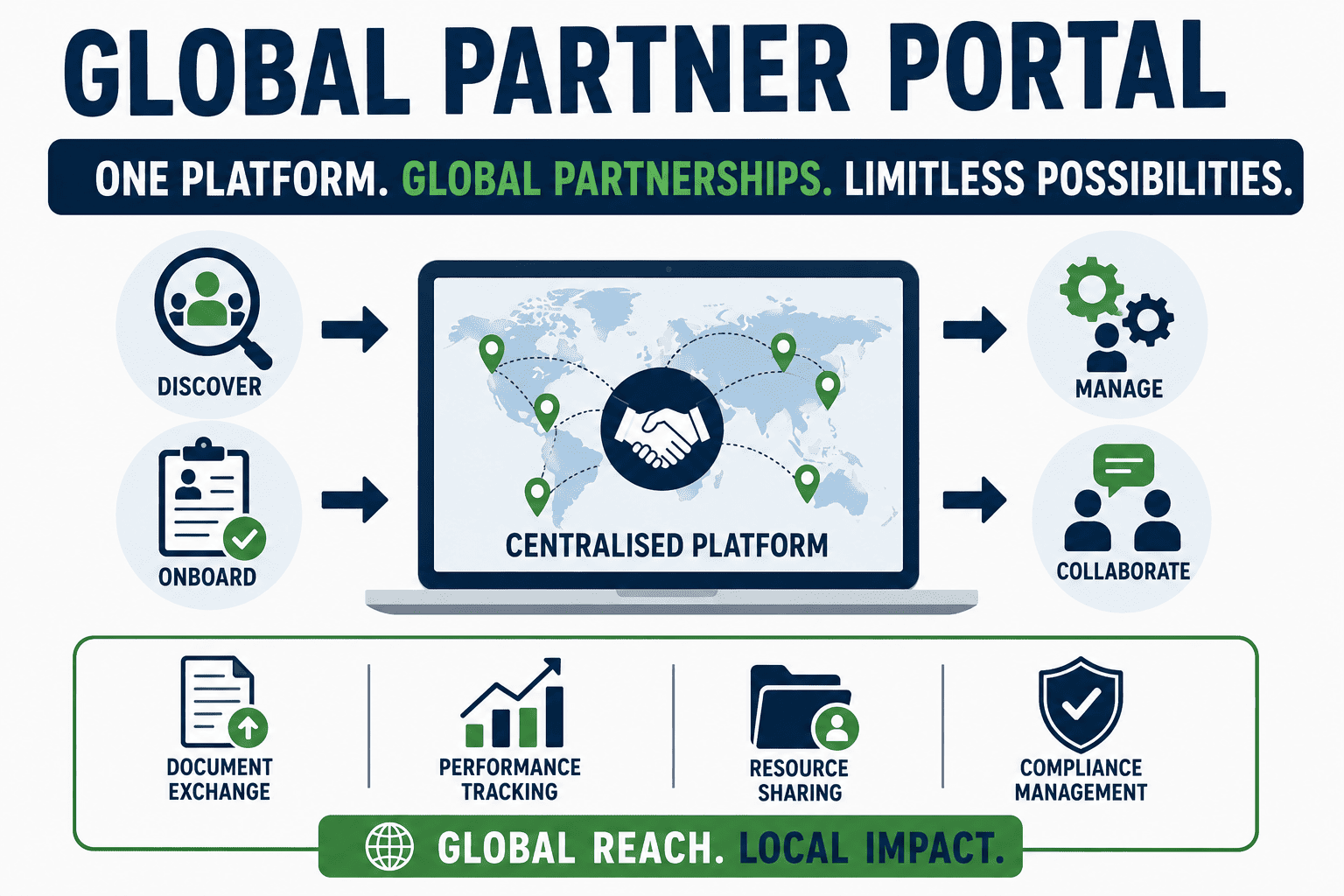
Direct Answer: A global partner portal is a centralised digital platform that organisations use to find, onboard, manage, and collaborate with commercial partners across multiple countries. What that looks like in practice varies significantly by industry, from SAP’s technology reseller network to the UN Partner Portal for civil society organisations to industrial platforms for manufacturers and distributors. This guide explains the different types of global partner portals, what a global partner program needs to succeed, and specifically how manufacturers and distributors in industrial sectors can use a verified partner portal to expand into new markets across 16+ countries.
📅 May 1, 2026⏱ 16 min read✍️ GTsetu Editorial Team🔄 Updated regularly
4
Portal Types Covered
16+
Expansion Markets Linked
100+
Countries on GTsetu
0%
Broker Commission
The phrase “global partner portal” is used across industries as different as enterprise software, humanitarian aid, financial services, and industrial manufacturing, and in each context, it means something meaningfully different. What stays constant is the underlying concept: a centralised, structured platform through which an organisation manages its relationships with partners operating across multiple countries.
This guide cuts through the ambiguity. It maps the main types of global partner portals, explains what a global partner program needs to be effective, and addresses specifically how industrial companies, manufacturers, distributors, and raw material suppliers, can use a partner portal to find verified partners and expand into new markets efficiently and securely.
💡 Who This Guide Is For
This article is written for international business development managers, manufacturers seeking distribution partners, distributors seeking manufacturer principals, and industrial companies planning market entry into new geographies. It covers both the conceptual framework of global partner portals and practical guidance on how to use them for cross-border expansion.
SECTION 1
1 What Is a Global Partner Portal?
📖 Definition
A global partner portal is a centralised digital platform through which an organisation discovers, onboards, manages, and collaborates with commercial partners across multiple countries. It serves as the operational hub for the partnership relationship, providing the infrastructure for partner communication, document exchange, performance tracking, resource sharing, and compliance management at international scale.
The distinction between a partner portal and a supplier directory is important. A directory is passive: it lists companies, and you contact them directly. A partner portal is active: it manages the relationship lifecycle from first contact through to ongoing collaboration. The best global partner portals do not just help you find a partner; they provide the tools to engage with that partner securely, manage the commercial relationship, and monitor performance over time.
For industrial companies, manufacturers, distributors, and raw material suppliers, a global partner portal addresses a very specific operational challenge: how do you identify verified partners in multiple markets simultaneously, engage with them confidentially before formal agreements are in place, and manage those relationships at scale without a dedicated team in every geography you operate in?
68%
of B2B companies say managing partner relationships across multiple countries is one of their top three operational challenges
3–5×
faster partner onboarding for companies using a structured partner portal versus ad-hoc email and spreadsheet management
40%
of international expansion failures are attributed to poor partner selection and inadequate ongoing partner management infrastructure
SECTION 2
2 Types of Global Partner Portals
Global partner portals divide into four broad types based on their primary function. Understanding which type applies to your situation determines what features you need and what platforms are relevant to you.
💻
Technology & Software Partner Portals
For resellers, system integrators, implementation partners
The most widely known category. Technology companies use partner portals to manage their reseller ecosystems, providing sales tools, training, certification tracking, deal registration, co-marketing resources, and revenue tracking across partner tiers. Partners log in to access product information, submit deal registrations, claim incentives, and collaborate with the vendor on joint opportunities.
Examples: SAP Partner Portal (find.sap.com), UiPath Global Partner Portal, Salesforce AppExchange partner hub, Microsoft Partner Center
🌍
Humanitarian & Development Partner Portals
For NGOs, civil society, and implementing organisations
Multilateral organisations like the UN and development banks use partner portals to connect with implementing organisations, NGOs, civil society bodies, and local partners, for programme delivery. These portals typically handle partner registration, eligibility verification, project application, grant documentation, and reporting. Compliance and verification are central to their function.
Examples: UN Partner Portal (unpartnerportal.org), The Global Fund Partner Portal, World Bank civil society portal
💳
Financial Services & Payments Partner Portals
For acquirers, payment processors, and financial intermediaries
Banks, payment processors, and financial services companies use partner portals to manage their networks of acquiring partners, distribution agents, and referral partners. These portals focus heavily on compliance documentation, regulatory reporting, commission calculation, and ongoing monitoring, given the highly regulated nature of financial services partner relationships.
For manufacturers, distributors, and raw material suppliers
Industrial companies use partner portals to find, vet, and manage international distributors, manufacturers, and supply chain partners across multiple markets. Unlike technology portals focused on sales enablement, industrial partner portals focus on identity verification, confidential commercial collaboration, multi-market partner discovery, and secure long-term relationship management, without broker commissions on partnerships formed.
Example: GTsetu, verified B2B trade partnership platform for manufacturers, distributors, and raw material suppliers across 100+ countries
SECTION 3
3 Global Partner Portal Examples Across Industries
Looking at real global partner portals across different sectors reveals both the diversity of approaches and the common infrastructure needs that any serious partner management platform must address.
Portal
Industry
Primary Function
Key Features
Partners Served
SAP Partner Portal sap.com/partners
Enterprise Software
Manage global reseller, SI, and ISV ecosystem
Deal registration, certification tracking, co-selling tools, tiered incentives, training library
22,000+ partners across 180+ countries
UiPath Global Partner Portal partnerportal.uipath.com
Automation Software
Reseller and implementation partner management
Deal registration, partner finder, training and certification, revenue tracking, co-marketing
Global RPA implementation and reseller partners
UN Partner Portal unpartnerportal.org
Humanitarian / Development
Connect UN agencies with implementing organisations
Partner registration and verification, CFP applications, compliance documentation, grant management
NGOs, CSOs, and implementing organisations globally
The Global Fund Partner Portal resources.theglobalfund.org
Global Health / Development
Grant entity data and partner compliance management
Partner data management, grant documentation, compliance requirements, reporting
Manufacturers, distributors, raw material suppliers in 100+ countries
What stands out across these examples is that the most effective global partner portals do more than serve as a directory. They provide infrastructure for the entire partner relationship, from first identification through compliance verification, active collaboration, performance monitoring, and ongoing management.
SECTION 4
4 Core Features Every Partner Portal Needs
Regardless of industry, a global partner portal that genuinely improves partner relationship management, rather than just digitising existing processes, needs a core set of features. These features vary in implementation but are consistent in purpose across portal types.
🔍
Partner Discovery & Search
The ability to find partners matching specific criteria, geography, sector, capability, product category, or certification, without requiring extensive outbound manual research. For industrial portals, filtering by verified status and geographic coverage is essential.
✅
Identity Verification
Confirmation that partners are who they claim to be, with credentials verified against official sources rather than self-stated. For industrial trade portals, this means company registration, legal status, and key credentials confirmed via government records.
🚀
Partner Onboarding Workflows
Structured, repeatable processes for bringing new partners onto the platform, including information requests, document submission, compliance checks, NDA execution, and approval workflows that can be tracked and audited.
📄
Document Management & Sharing
Secure storage and controlled sharing of partnership documents, commercial agreements, product specifications, pricing schedules, compliance certificates, with access controls and an audit trail of who accessed what and when.
💬
Secure Communication Tools
Encrypted, in-platform communication that keeps commercial conversations inside a controlled environment rather than fragmented across personal email threads, WhatsApp groups, and unprotected file attachments.
🔐
Confidentiality Infrastructure
Built-in NDA workflows and confidentiality agreements that protect commercially sensitive information before it is shared. Without this layer, partners exchange pricing, product data, and market strategy with no legal protection in place.
📊
Performance Tracking & Reporting
Tools for monitoring partner activity, sales performance, training completion, certification status, and compliance obligations against agreed KPIs, enabling proactive management rather than reactive firefighting when partners underperform.
📋
Compliance & Audit Trail
A complete, timestamped record of all portal interactions, NDA signatures, document exchanges, approvals, and communications, that provides evidence of proper process for regulatory, legal, and anti-bribery audit purposes.
🎓
Training & Resource Library
For technology and consumer product portals: product training, certification programmes, sales collateral, and market intelligence accessible to partners in a controlled environment. For industrial portals: product specifications, technical documentation, and market guides.
💰
Commission & Incentive Management
Where partner programmes include commission or incentive structures, a portal should automate calculation, provide partners with transparent visibility into their earnings, and maintain a clear audit trail of commercial benefit flows.
📌 What Industrial Partner Portals Prioritise Differently
Technology partner portals prioritise sales enablement and deal registration. Humanitarian portals prioritise programme compliance and reporting. Industrial partner portals, for manufacturers and distributors, prioritise identity verification, confidential commercial collaboration, and long-term relationship security. The training library and co-marketing features matter far less than knowing your partner is genuinely who they claim to be before any sensitive commercial information is shared.
SECTION 5
5 What Is a Global Partner Program?
📖 Definition
A global partner program is the structured commercial and operational framework through which an organisation defines, recruits, onboards, supports, and manages its partners internationally. The partner portal is the platform through which the program runs; the partner program is the policy, strategy, and structure that the portal executes. A partner program without a portal is hard to scale. A portal without a program is just a database.
The key components of a global partner program that must be defined before the portal can be effectively deployed are as follows:
🎯
Partner Eligibility Criteria
Who qualifies to become a partner? What minimum requirements must a company meet, in terms of size, geography, sector expertise, financial standing, and compliance posture, before they can be admitted to the program? Clear criteria prevent the program from filling with unqualified or low-quality partners.
🏆
Partner Tiers
Most global partner programs operate multiple tiers, often three, based on partner capability, commitment, and performance. Higher tiers receive better commercial terms, more resources, and priority support. Tier criteria should be objective and transparently communicated through the partner portal.
💼
Commercial Terms by Tier
What does each partner tier receive commercially? Pricing structures, margin levels, exclusivity arrangements, minimum purchase commitments, and incentive structures should be clearly defined in the program structure and accessible through the portal once a partner is admitted.
📚
Partner Enablement Resources
What does the program provide to help partners succeed? Training, technical documentation, product information, market intelligence, sales tools, and co-marketing support should be defined as part of the program and delivered through the portal’s resource library.
📈
Performance Expectations & KPIs
What is expected of partners in each tier? Annual revenue targets, market coverage, customer acquisition, reporting requirements, and compliance obligations should be specified at program level and tracked through the portal’s performance monitoring tools.
⚖️
Compliance Requirements
What compliance standards must partners meet as a condition of program membership? Anti-bribery policy, export control compliance, data protection requirements, and ESG standards should be specified in the program and enforced through the portal’s compliance infrastructure.
SECTION 6
6 How to Build a Global Partner Program
Building a global partner program that scales across multiple markets requires a structured approach. Organisations that try to manage international partner relationships through email, spreadsheets, and periodic in-person visits consistently underperform those with a structured program backed by a purpose-built portal.
1
Define Your Partnership Strategy
Before building the program or selecting a portal, define your partnership objectives: which markets do you want to enter, what type of partners do you need in each market (distributors, agents, resellers, co-manufacturers), what commercial model will govern each relationship, and what you can offer partners that makes your program worth joining. Your partnership strategy determines everything downstream, the eligibility criteria, the tier structure, the portal features you need, and the markets where you focus partner recruitment first.
2
Design the Program Structure
Translate the partnership strategy into a program structure: define the partner tiers, eligibility criteria for each tier, commercial terms at each level, performance KPIs, compliance requirements, and the resources and support your organisation will provide. This structure should be documented formally before partner recruitment begins, trying to define it after partners start joining creates inconsistency and disputes. For manufacturers building an international distribution network, this step includes defining territory boundaries, exclusivity terms, and minimum purchase commitments that will govern each distributor relationship.
3
Select and Configure Your Partner Portal
Choose the partner portal that matches your industry type and program needs (see the types in Section 2). For technology and software companies, purpose-built PRM (Partner Relationship Management) platforms like Salesforce PRM or Impartner are standard. For industrial manufacturers and distributors, a verified trade partnership platform that provides identity verification, NDA workflows, and secure document sharing addresses the distinct needs of industrial partner programs. Configure the portal to reflect your program structure, tier definitions, eligibility criteria, onboarding workflows, resource libraries, and performance dashboards should all be built into the portal before launch.
4
Build Your Partner Identification & Recruitment Process
Define how you will identify and recruit partners in each target market. This includes specifying the ideal partner profile for each market, the channels through which you will find candidates (industry events, trade associations, referrals, partner portal discovery), and the outreach and qualification process. For industrial companies expanding into new markets, your recruitment process must include country-specific market knowledge, understanding what type of distributor or manufacturer operates in each geography, what commercial terms are standard, and what compliance requirements are market-specific. See the market guides in Section 8 for country-specific expansion intelligence.
5
Implement Partner Onboarding
Partner onboarding through your global partner portal should be a structured, repeatable process, not a one-off negotiation each time. Standardise the information and documentation you collect from every new partner (legal identity, compliance documents, financial references, operational capability evidence), the verification checks you run, the NDA or confidentiality agreement you execute before sharing sensitive information, the commercial agreement you formalise, and the portal training and resource orientation you provide to ensure partners can use the platform effectively from day one.
6
Manage, Monitor, and Evolve
A global partner program is a living system, not a one-time setup. Use the portal’s performance tracking tools to monitor partner performance against KPIs, identify underperforming partners early, and recognise top performers with tier promotions and enhanced support. Review the program structure annually to ensure commercial terms remain competitive, compliance requirements remain current, and the partner profile criteria continue to reflect what your business actually needs in each market. As your geographic footprint expands, the program structure and portal configuration will need to evolve to accommodate new markets, new regulatory environments, and new partner types.
SECTION 7
7 Partner Portals for Industrial Sectors: What’s Different
Industrial companies, manufacturers, distributors, raw material suppliers, and industrial automation businesses, have fundamentally different partner portal needs than technology companies or humanitarian organisations. Understanding these differences is essential for choosing the right portal infrastructure rather than trying to adapt a technology-focused PRM platform to an industrial use case it was not built for.
Requirement
Technology Partner Portals
Industrial Trade Partner Portals
Primary relationship type
Reseller, VAR, system integrator, ISV
Distributor, manufacturer, raw material supplier, OEM/ODM partner
Identity verification priority
Standard KYC and onboarding checks
Government-verified legal identity before any engagement, the foundational requirement
Confidentiality infrastructure
Standard NDAs, often paper-based
Built-in digital NDA workflows before any pricing, product, or market data is exchanged
Document security
Standard file sharing
AES-256 encrypted document workspaces, no unprotected email for sensitive commercial files
Discovery model
Active outbound recruitment by vendor
Anonymous discovery, industrial companies evaluate potential partners without exposing their market entry strategy
Commission model
Standard reseller margins on product sales
Zero broker commission, the platform fee must not scale with deal value for long-term distribution relationships
8 Expanding Through a Partner Portal: 16 Key Markets
A global partner portal is only as valuable as the partner network it connects you to. For industrial manufacturers and distributors, geographic expansion through a partner portal means identifying verified partners in the specific markets where you want to grow, not just accessing a generic global database.
The market guides below cover the key considerations for manufacturers and distributors expanding into each geography, including market structure, regulatory environment, distribution characteristics, and what to look for in a local partner.
💡 Using Market Guides Alongside Your Partner Portal
Each country expansion guide covers the local market structure, regulatory environment, what makes a strong local distribution or manufacturing partner, and the key compliance considerations for entering that market. Use these guides to build your ideal partner profile for each geography before starting your partner search through the portal, the more specific your requirements, the more efficiently the portal can surface relevant matches.
SECTION 9
9 GTsetu as Your Global Partner Portal for Industrial Trade
For industrial companies, manufacturers, distributors, and raw material suppliers, GTsetu functions as a purpose-built global partner portal designed around the specific requirements of industrial trade: verified identities, confidential commercial collaboration, multi-market discovery, and zero broker commission on partnerships formed.
Unlike technology PRM platforms adapted to industrial use, or generic B2B directories without relationship infrastructure, GTsetu was built for the complete lifecycle of an industrial trade partnership, from anonymous initial discovery through verified identity confirmation, NDA-protected commercial dialogue, encrypted document exchange, and long-term partner relationship management.
🌐 Built for Industrial Global Partner Programs
GTsetu: The Verified Global Partner Portal for Manufacturers & Distributors
Every company on GTsetu has passed a 6-point government tie‑up verification before they can engage with or be discovered by other companies on the platform. That means when you use GTsetu as your global partner portal, you start every partnership search from a verified foundation, not an open directory where anyone can list without meaningful identity confirmation.
🏛️
Verified Partner NetworkEvery company verified via government tie‑ups across 6 points: legal name, registered address, registration number, company status, type, and incorporation date. The foundation every global partner portal should have.
🕵️
Anonymous DiscoverySearch and evaluate partner profiles across 100+ countries without revealing your company identity or market expansion plans, protecting your strategy during the partner identification phase.
📄
Built-in NDA WorkflowsLegal confidentiality protection before any pricing, product specifications, or commercial strategy is exchanged. Not a separate legal process, built into the portal’s engagement flow.
🔐
Encrypted Document SharingAES-256 encryption at rest; TLS in transit. All commercial documents shared within the portal, no sensitive files sent via unprotected email attachments.
🚫
Zero Broker CommissionThe platform fee never scales with the value of partnerships you form. Industrial distribution agreements worth millions should not pay percentage commissions to the platform that connected you.
🌍
100+ Country CoverageVerified manufacturers, distributors, and raw material suppliers across Asia, Middle East, Europe, Africa, Australia, and the Americas, matching the geographic scope of a genuine global partner program.
GTsetu is a verified trade partnership platform, not a generic supplier directory and not a technology PRM system. It is specifically designed for the use case where the relationship, not the transaction, is what matters: manufacturers appointing international distributors, distributors sourcing verified manufacturer principals, raw material suppliers building long-term industrial buyer relationships across borders.
Use GTsetu as your global partner portal when you need to find verified industrial partners across multiple countries simultaneously, not one-off RFQ quotes
Use GTsetu when your expansion strategy needs to remain confidential during the partner evaluation phase, anonymous discovery protects your market entry plans
Use GTsetu when the identities of your potential partners must be confirmed against government records before any commercial information is shared, not just accepted on face value
Use GTsetu when the commercial value of your partnerships is large enough that paying a percentage commission to an intermediary platform would be commercially damaging over the life of the relationship
Use GTsetu when you are expanding into multiple markets from the country guides in Section 8 and need a single platform that covers all of those geographies with verified partners rather than separate regional platforms for each
FAQ
? Frequently Asked Questions
QWhat is a global partner portal?
A global partner portal is a centralised digital platform that organisations use to find, onboard, manage, and collaborate with commercial partners across multiple countries. It serves as the operational hub for partner relationships, providing the infrastructure for discovery, identity verification, document management, communication, performance tracking, and compliance management at international scale. The specific features and focus of a global partner portal vary significantly by industry: technology companies use portals for reseller and implementation partner management; humanitarian organisations use portals for NGO programme partner management; industrial companies use portals for finding and managing verified manufacturer, distributor, and supply chain partner relationships across multiple markets.
QWhat is a global partner program?
A global partner program is the structured commercial and operational framework through which an organisation defines, recruits, onboards, supports, and manages its partners internationally. It includes partner eligibility and tiering criteria, commercial terms and incentive structures, performance expectations and KPIs, compliance requirements, and the enablement resources provided to partners. The global partner portal is the platform through which the program runs, the program defines what needs to happen; the portal provides the tools to execute it. A program without a portal is hard to scale; a portal without a program structure is just a database of contacts.
QWhat industries use global partner portals?
Global partner portals are used across a wide range of industries. In technology and software, portals like SAP Partner Portal, UiPath Global Partner Portal, and Microsoft Partner Center manage reseller, system integrator, and implementation partner ecosystems. In humanitarian and development sectors, the UN Partner Portal and The Global Fund Partner Portal connect multilateral agencies with implementing organisations globally. In financial services, portals like the TSYS Acquiring Solutions Partner Portal manage payment acquirer and financial intermediary networks. In consumer electronics, LG’s partner portal manages its global distributor and reseller network. In industrial trade, platforms like GTsetu provide verified partner discovery and relationship management for manufacturers, distributors, and raw material suppliers across 100+ countries.
QHow is a global partner portal different from a supplier directory?
A supplier directory is a passive listing of companies, you browse it and contact suppliers directly. A global partner portal is an active relationship management platform that supports the entire partner lifecycle: discovery, identity verification, NDA execution, document exchange, onboarding, performance tracking, and ongoing compliance management. The key distinction is that a directory helps you find someone; a partner portal manages the complete relationship from identification through long-term collaboration. For industrial companies, this distinction is critical, a directory gives you a list of potential partners; a verified partner portal tells you which of those partners has been identity-confirmed, provides secure infrastructure for the initial commercial conversation, and maintains an audit trail of the entire relationship.
QWhat should a global partner program include?
A global partner program should include: (1) Partner eligibility criteria defining minimum requirements for entry; (2) Partner tiers (typically three levels) with objective criteria for each; (3) Commercial terms by tier, pricing, margins, exclusivity, minimum purchase commitments; (4) Partner enablement resources, training, technical documentation, market intelligence; (5) Performance expectations and KPIs for each tier; (6) Compliance requirements, anti-bribery policy, data protection, export control, ESG standards; (7) Approval and governance processes for partner admittance and tier changes; and (8) Ongoing monitoring, reassessment, and escalation processes. The global partner portal is the platform that executes these program elements at scale across multiple markets and partner relationships simultaneously.
QCan manufacturers use a global partner portal to find distributors in multiple countries?
Yes, and for industrial manufacturers, a verified global partner portal is the most efficient infrastructure for multi-market distributor identification and engagement. Rather than running separate discovery processes for each target market through local consultants, industry contacts, or trade shows, a global partner portal with genuine multi-country coverage allows simultaneous partner evaluation across geographies. The key requirement is that the portal provides verified partner identities (not just self-listed profiles), supports confidential commercial dialogue before formal agreements are in place, and covers the specific markets relevant to your expansion strategy. GTsetu’s coverage across Asia, the Middle East, Europe, Africa, Australia, and the Americas, with verified company profiles in each region, provides this capability for industrial manufacturers building international distributor networks.
Expand Your Manufacturing & Distribution Business: Country Guides
Your Global Partner Portal for Verified Industrial Trade
GTsetu is the verified partner portal built specifically for manufacturers, distributors, and raw material suppliers expanding internationally. 500+ verified companies across 100+ countries. Government-verified identities. Anonymous discovery. Built-in NDA workflows. Zero broker commissions. Start building your global partner network on a verified foundation.
They represents the product, and research team behind GTsetu, a global B2B collaboration platform built to help companies explore cross-border partnerships with clarity and trust. The team focuses on simplifying early-stage international business discovery by combining structured company profiles, verification-led access, and controlled collaboration workflows.
With a strong emphasis on trust, and disciplined engagement, Team GTsetu shares insights on global trade, partnerships, and cross-border collaboration, helping businesses make informed decisions before entering deeper commercial discussions.