Business Collaboration Letter: Complete Guide to Templates, Emails & Proposals
Direct Answer: A business collaboration letter is a formal written communication proposing a commercial partnership, distribution agreement, supply arrangement, or joint venture to another business. The most effective collaboration letters share four characteristics: they are research-based and specific to the recipient, they lead with the value the collaboration creates for the recipient (not the sender), they propose a clearly defined partnership structure rather than a vague concept, and they request a concrete, low-friction next step. This guide provides ready-to-use business collaboration email templates, letter formats, proposal frameworks, and letter of intent structures, along with the strategic context that makes the difference between a letter that generates a response and one that is ignored. Manufacturers and distributors will also learn why GTsetu’s verified B2B matchmaking platform is the step that should come before writing any collaboration letter, because reaching out to a verified, pre-matched partner produces a fundamentally higher response rate than cold outreach to an unverified contact.
📅 June 1, 2026⏱ 20 min read✍️ GTsetu Editorial Team🔄 Updated regularly
<5%
Cold Email Response Rate
47%
Warm Intro Response Rate
7+
Templates in This Guide
0%
GTsetu Partner Commission
Most business collaboration letters fail before they are read. Not because they are poorly written, but because they are sent to the wrong company, at the wrong time, without the sender having done enough research to make the proposition genuinely relevant. A distributor receiving a collaboration email from a manufacturer whose product does not fit their portfolio, geography, or commercial stage will discard it in seconds, regardless of how well-crafted the email subject line is.
This guide addresses both problems: the quality of the letter itself (structure, language, templates, and proposal frameworks) and the strategic foundation that makes any collaboration letter work, reaching out only to partners who are the right fit, verified, active in your target markets, and commercially aligned with what you are offering. For manufacturers and distributors managing cross-border business partnerships, distributor networks, or supply chain partnerships, this guide covers every stage of the process.
💡 Who Is This Guide For?
This guide is for manufacturers seeking distributors, distributors seeking manufacturer principals, procurement teams reaching out to prospective suppliers, business development professionals managing partner outreach, and anyone who needs to write a business collaboration letter, email, proposal, or letter of intent that produces a response. Templates, frameworks, and strategic guidance throughout are calibrated for B2B trade contexts, not influencer collaborations or social media partnerships.
SECTION 1
1 What Is a Business Collaboration Letter?
🎯 Definition
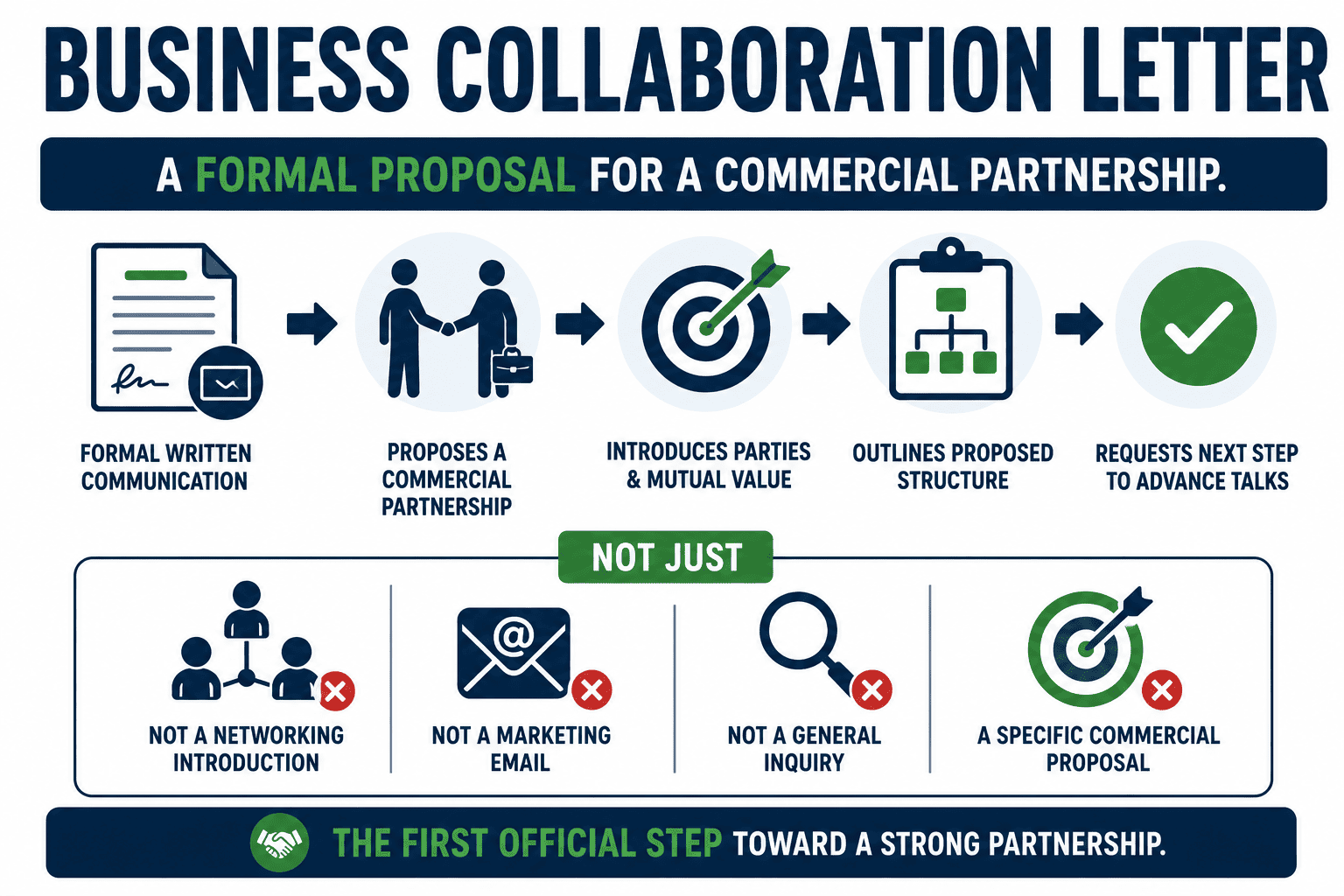
A business collaboration letter is a formal written communication, delivered by email, post, or through a business platform, in which one company formally proposes a commercial partnership, distribution relationship, supply arrangement, technology partnership, or joint venture to another. It serves as the first official record of a proposed collaboration: introducing the parties, articulating the mutual value, outlining the proposed structure, and requesting a specific next step to advance discussions. It is distinct from a casual networking introduction, a marketing email, or a general inquiry, a collaboration letter is a specific commercial proposal directed at a named organisation for a defined type of partnership.
In trade contexts, a business collaboration letter may be sent by a manufacturer to a prospective distributor, by a distributor to a manufacturer whose brand they want to represent, by a company seeking an OEM or ODM manufacturing partner (see: OEM vs ODM vs EMS explained), or by a buyer seeking a strategic supply chain partner. The letter initiates a relationship that, if successful, will eventually be formalised through a business partnership contract or a contract between manufacturer and distributor.
Business Collaboration Letter vs. Related Documents
Document
Purpose
Timing
Level of Commitment
Length
Collaboration Email / Initial Letter
Propose collaboration and request a meeting or response
First contact or follow-up after an event or introduction
None, exploratory only
200–400 words
Business Collaboration Proposal
Detailed outline of proposed collaboration structure, terms, and value case
After initial interest is confirmed by both parties
Non-binding, basis for negotiation
1–4 pages
Letter of Intent (LOI)
Record mutual intent to proceed toward a formal partnership agreement
After proposal is reviewed and both parties agree to advance
Partially binding (confidentiality, exclusivity clauses may be binding)
1–3 pages
Partnership Agreement / Contract
Legally binding commercial arrangement with all terms defined
After LOI, due diligence, and commercial negotiation
Fully legally binding
5–30+ pages
⚡ The Sequence Matters
Most failed partnerships can be traced to a broken sequence: the initial letter asked for too much too soon, or a full partnership agreement was signed before both parties had enough verified information to assess fit. The correct sequence is: initial collaboration letter → positive response → detailed proposal → LOI → due diligence → formal contract. Each stage gates the next. Rushing any stage produces misaligned expectations that cause partnerships to fail after significant time and investment. For the later stages, see our guides on partnership evaluation criteria and risk allocation in cross-border deals.
SECTION 2
2 Types of Business Collaboration: Which Letter Format to Use
The type of collaboration you are proposing determines the structure, tone, and content of your letter. A letter proposing a distribution agreement reads very differently from one proposing a technology partnership or a white-label manufacturing arrangement. Using the wrong format signals to the recipient that you do not fully understand the nature of the collaboration you are proposing.
🏭Manufacturer–Distributor PartnershipMost Common
A manufacturer seeks a company to distribute, sell, or represent their products in a defined territory. The letter must address territory, exclusivity, minimum volumes, and the manufacturer’s support model. See: distributor network and international wholesale distributors.
A brand seeks a manufacturer to produce goods to their specification (OEM), design and produce (ODM), or produce under a private label. The letter must address IP ownership, quality standards, and confidentiality. See: OEM vs ODM vs EMS explained and white label vs private label manufacturing.
💻Technology PartnershipTech / IP
Two organisations propose to develop, integrate, or co-market technology. IP ownership, licensing terms, and revenue sharing must be introduced clearly in the initial letter. See: technology partnership guide.
🔗Supply Chain PartnershipProcurement
A buyer seeks a strategic supplier, or a supplier seeks to formalise a preferred relationship with a key buyer. The letter must address volume commitments, lead times, quality standards, and continuity clauses. See: supply chain partner guide.
🤝Joint VentureStrategic
Two companies propose to create a jointly owned entity or co-invest in a defined project, market, or asset. This requires the most detailed initial proposal among all collaboration types, as equity and governance questions must be signalled from the outset.
🌍Market Entry PartnershipExpansion
A company entering a new geography seeks a local partner for market access, regulatory navigation, or channel development. The letter must demonstrate specific knowledge of the target market and clearly define what the local partner will receive in return. See: international business development consulting.
SECTION 3
3 How to Write a Business Collaboration Letter: 7-Step Framework
A business collaboration letter has a specific job: to move the recipient from “I do not know this company” to “I want to learn more about this proposal.” It is not a sales pitch, a credentials presentation, or an explanation of your company history. Every sentence must serve the single goal of earning a response.
01
Research the Recipient Before Writing a Single Word
The single biggest predictor of collaboration letter response rates is the depth of recipient-specific research evident in the first paragraph. Study their product range, geographic coverage, current distribution footprint, recent news, stated strategic priorities, and any public statements about growth ambitions. A collaboration letter that opens with a specific, accurate observation about the recipient’s business signals that this is a targeted proposal, not a mass email. This research phase takes 30–60 minutes per prospective partner and is the highest-ROI investment in the entire outreach process. For manufacturers seeking distributors specifically, see our guide on building a distributor network and international wholesale distributors.
02
Define the Collaboration Structure You Are Proposing
Before writing, decide precisely what type of collaboration you are proposing. Are you seeking an exclusive distribution agreement in a defined territory? A non-exclusive supply partnership? A co-manufacturing arrangement? A technology integration? “Exploring potential collaboration opportunities” is not a proposal, it is a placeholder for a proposal you have not yet designed. Precision signals seriousness and respects the recipient’s time. The more specific your proposal, the easier it is for the recipient to evaluate whether it is relevant to their business and respond. Vague proposals produce either silence or exploratory calls that consume time without producing decisions.
03
Open With a Research-Based Observation, Not Your Company Introduction
Most collaboration letters open with a lengthy self-introduction: “We are [Company Name], founded in [year], specialising in [product category] with operations in [countries]…” The recipient has not yet decided whether to read the rest of the letter. Open instead with a specific observation about their business that demonstrates research and creates immediate relevance: “Your recent expansion into the Gulf Cooperation Council markets, combined with your established cold chain infrastructure in the UAE, suggests a strong fit for the proposal I want to share.” This inverts the usual structure: the recipient is drawn in by evidence that you understand them before you ask them to learn about you.
04
State the Value Proposition from the Recipient’s Perspective
In two to three sentences, explain what the proposed collaboration offers the recipient. Not what it offers you. Lead with their gain: a new revenue category requiring no product development investment, a supply source with shorter lead times than their current partners, a technology integration that reduces their operational cost, access to a geographic market where you have existing regulatory approvals. The recipient’s gain should be the centrepiece of your letter. Your credentials and requirements come later, after the recipient has decided the proposal is worth reading further.
05
Outline the Proposed Structure at a High Level
For an initial letter, indicate the structure in brief: the proposed partnership type, target territory or market, proposed duration and exclusivity status, and any key commercial parameters you can share at this stage. This gives the recipient enough to assess structural fit without disclosing commercially sensitive information. Full pricing, detailed terms, and volume commitments belong in the proposal document that follows a positive initial response, not in the first letter. For context on what structural terms matter at each stage, see our guides on risk allocation in cross-border deals and force majeure in global trade.
06
Request a Specific, Low-Commitment Next Step
Close with a concrete request. Not “please let me know if you are interested” or “I would love to connect at some point”, both of these require the recipient to make a decision and do work to move the conversation forward. Instead: “I would welcome a 20-minute call on [proposed date] or [alternative date] to discuss whether there is a fit worth exploring further.” This gives the recipient a specific, easy-to-accept or easy-to-counter offer. A low-commitment first step, a call, not a meeting; a meeting, not a contract, dramatically increases response rates.
07
Include Verifiable Company Credentials in Your Sign-Off
Every recipient of a collaboration letter will immediately search the sender’s company. Make this search easy and reassuring: include your company registration number, website URL, LinkedIn company page, and where applicable, your GTsetu verification status. If you are a GTsetu-verified company, mention it explicitly, “Our company is verified on GTsetu’s trade partnership platform, government-sourced verification details available on request”, because it signals that your core company credentials have been independently validated against government sources. For context on why this matters, see our guide on the importance of B2B matchmaking and verification.
SECTION 4
4 Business Collaboration Email Templates (Ready to Use)
The templates below are structured according to the 7-step framework above. Each covers a specific collaboration type. Text in [square brackets] should be replaced with your specific information. Do not use these as mass-email templates, each should be personalised for the recipient before sending.
Template 1: Manufacturer to Distributor, Initial Collaboration Email
Subject: Distribution Partnership Proposal,  [Product Category] in [Territory]

Dear [Recipient Name],

Your distribution network across [specific region or country] and your established presence in [specific retail channel or sector] make [Recipient Company] an exceptionally well-placed partner for a proposal I want to share.

[Your Company Name] manufactures [specific product category]. We currently distribute in [existing markets] and are seeking a distribution partner for [target territory] with the infrastructure and market relationships to launch and grow the [product category] category there.

The arrangement I am proposing is a [exclusive / non-exclusive] distribution agreement covering [territory], with a proposed initial term of [duration]. We offer [key commercial benefit 1,  e.g., a fully managed regulatory registration process], [key commercial benefit 2,  e.g., co-funded marketing support in the first year], and [key commercial benefit 3,  e.g., 90-day payment terms for the initial order].

I would welcome a 20-minute call to explore whether there is a fit worth taking further. I am available on [proposed date] or [alternative date],  please suggest a time that works for you, or reply to this email and I will work around your schedule.

[Your Full Name]
[Title] | [Company Name]
[Website URL] | [Company Registration Number]
[LinkedIn] | [GTsetu Verified Profile URL if applicable]
Replace all [bracketed] text before sending. Personalise the opening observation based on specific research into the recipient’s business.
Template 2: Distributor to Manufacturer, Seeking to Represent a Brand
📧 Email Template 2, Distributor Seeking Manufacturer Principal
Subject: Distribution Representation Proposal,  [Country/Region]

Dear [Recipient Name],

Having reviewed [Your Company Name]'s product range and your current distribution footprint, I notice that [specific market or territory] is an area where you do not currently have an established distribution partner. This is a market we know well.

[Your Company Name] is a [type of distributor,  e.g., specialist FMCG distributor] operating in [territory] with [number] active retail and wholesale accounts and a cold chain / logistics infrastructure capable of handling [product type]. We represent [number] manufacturer principals and have consistently grown category sales year-on-year in [relevant category].

We believe your [specific product line] would perform strongly in [territory], particularly through [specific channel or account type where you have relationships]. I am proposing a [non-exclusive / exclusive for defined sub-territory] distribution arrangement under which we would take responsibility for [list of responsibilities,  import clearance, local marketing, retailer relationship management].

I would welcome a short introductory call with your export sales team. I am available [date range] and can work around your time zone. Would [specific date and time] work?

[Your Full Name]
[Title] | [Company Name]
[Website] | [Company Registration Number]
[Territory Coverage and Key Accounts,  optional brief list]
Distributors should attach or link to a brief one-page company profile with territory map, key accounts, and relevant product category experience.
Subject: OEM Manufacturing Partnership Enquiry,  [Product Category]

Dear [Recipient Name],

Your manufacturing capabilities in [specific product category], combined with your [relevant certification,  e.g., ISO 9001 / GMP / CE] certification and demonstrated export experience to [markets], suggest that [Your Company Name] may be an excellent manufacturing partner for a product line we are developing.

We are a [type of company,  brand owner / product developer] based in [country] with an established customer base in [markets]. We are seeking an OEM / ODM manufacturing partner for [product description] to a specification I can share under NDA. Our target volumes are approximately [volume range] units per year, with an initial development order of [volume] units.

What we are seeking in a manufacturing partner: [Requirement 1], [Requirement 2], and [Requirement 3]. The proposed structure is a [multi-year supply agreement / product development and supply agreement] with IP ownership clearly defined and a mutual NDA in place before any specification is shared.

If this is within your manufacturing scope, I would welcome a short call to assess fit before sharing any proprietary specifications. I can be available [dates],  or please suggest a time.

[Your Full Name]
[Title] | [Company Name]
[Website] | [Registration Number]
Subject: [Specific Proposal],  [Your Company] + [Their Company]

Dear [Name],

[One sentence specific to their business demonstrating research,  e.g., "Your expansion into Southeast Asian pharmacy channels aligns directly with a distribution partnership I am looking to fill in Malaysia and Thailand."]

[Your Company] [one sentence description,  what you make/do, where you operate]. I am seeking a [partnership type] covering [territory], and your [specific capability or market position] makes this a natural fit to explore.

Would a 20-minute call on [date] work to assess whether there is a fit? Alternatively, I am happy to send a one-page overview first if that would help.

[Your Name] | [Company] | [Website] | [Registration Number]
Use this format for a first-contact email when you have a strong, specific reason to approach the company but limited verified context. Follow up with the full proposal format if they respond positively.
SECTION 5
5 Business Collaboration Letter Templates (Formal Format)
Formal business collaboration letters, sent on company letterhead via post or as PDF attachments, are appropriate when the recipient organisation is senior enough that formality signals respect, when the jurisdiction or cultural context expects formal written communication (common in certain Asian, Middle Eastern, and European markets), or when the collaboration proposal involves significant commercial or legal implications that warrant a formal record.
Formal Business Collaboration Letter Template
📄 Formal Letter Template, Business Collaboration Proposal
[Your Company Name]
[Registered Address]
[Company Registration Number]
[Date]

[Recipient Name]
[Title]
[Recipient Company]
[Address]

RE: Proposal for Business Collaboration,  [Partnership Type] in [Territory/Market]

Dear [Recipient Name],

I am writing on behalf of [Your Company Name] to formally propose a [type of collaboration] between our two organisations.

Background and Context

[Your Company Name] is a [brief description,  industry, years in operation, key markets, certifications relevant to the proposed collaboration]. Over the past [period], we have [specific relevant achievement that establishes credibility for this proposal,  e.g., "established distribution relationships in 12 markets across Southeast Asia" or "manufactured over 50 million units of [product type] annually for brand partners in Europe and the United States"].

We have been following [Recipient Company]'s development with interest, particularly your [specific observation,  product launch, geographic expansion, certification achieved, award received]. This, combined with your [capability], suggests that there is a compelling commercial case for the collaboration I am proposing.

The Proposed Collaboration

We propose a [specific collaboration type] structured as follows:

• Partnership Type: [Exclusive / Non-exclusive distribution / OEM supply / Technology partnership / Joint venture]
• Territory / Scope: [Defined geography, product categories, or business units covered]
• Proposed Duration: [Initial term, with renewal provisions]
• Commercial Structure: [High-level,  fixed supply price / revenue share / milestone-based fee,  without disclosing sensitive figures at this stage]
• Responsibilities of [Your Company]: [Key obligations]
• Responsibilities of [Recipient Company]: [Key obligations]

Value Proposition

For [Recipient Company], this collaboration offers [specific benefit 1], [specific benefit 2], and [specific benefit 3]. We are prepared to support the partnership with [specific support,  regulatory assistance, co-marketing contribution, exclusive territory protection, preferred pricing].

Confidentiality and Next Steps

We recognise that advancing this discussion will require the exchange of commercially sensitive information. We propose executing a mutual Non-Disclosure Agreement (NDA) at the earliest stage of substantive discussions, prior to the sharing of any pricing, specifications, or market strategy data.

As a first step, I would welcome the opportunity to present this proposal in greater detail at a meeting or call at your convenience. I will follow up within [timeframe,  e.g., five business days] to propose a specific date. Alternatively, please contact me directly at [contact details].

We look forward to exploring a partnership that creates long-term value for both organisations.

Yours sincerely,

[Your Full Name]
[Title]
[Your Company Name]
[Direct Telephone] | [Email] | [Website]
[Company Registration Number] | [Registered Address]

Enclosures: [Company Profile / Product Brochure / Relevant Certifications,  as appropriate]
This formal letter is appropriate for the first substantive written communication after an initial email has generated interest. It should be printed on letterhead and sent as a PDF for maximum professional impact.
SECTION 6
6 Business Collaboration Proposal Template
A business collaboration proposal is more detailed than an initial letter. It is sent after the prospective partner has expressed interest in the initial email or letter and requested more information. It typically runs to two to four pages and provides enough commercial detail for the recipient to make a substantive go / no-go decision on whether to advance to formal negotiation. For strategic guidance before drafting the proposal, see our guide on partnership evaluation criteria.
How to Write a Business Collaboration Proposal: Structure
📋
Section 1, Executive Summary (Half Page)
One paragraph: who is proposing what, to whom, and what the core value exchange is. The executive summary should stand alone, a senior executive who reads only this section should understand the proposal, the value case, and the ask.
Required
🏢
Section 2, About [Your Company] (Half Page)
Credentials relevant to this specific collaboration: years in operation, key markets, relevant certifications, production capacity or distribution reach, and one or two specific achievements that prove capability. Avoid generic company history. Every sentence should be relevant to why you are a credible partner for this specific proposal.
Required
🎯
Section 3, The Opportunity (One Page)
Context for why this collaboration makes commercial sense: market size, growth trends in the category or territory, the specific gap or opportunity this partnership addresses, and why now is the right time. Use publicly available data or your own market intelligence. Reference the recipient’s specific position and how this collaboration strengthens it.
Define the collaboration clearly: partnership type, geographic scope, duration, exclusivity, roles and responsibilities, commercial model (supply price range, revenue share, fee structure, at a high level without exposing sensitive figures), support and resources each party contributes, and performance expectations. See: business partnership contract guide.
Required
📊
Section 5, Value for [Recipient Company] (Half Page)
Separate from the structure, this section focuses entirely on the recipient’s benefit. Quantify where possible: estimated revenue opportunity, cost savings, time-to-market reduction, risk reduction. Avoid generic claims. Be specific about what the recipient gains that they cannot readily achieve without this collaboration.
Required
🚀
Section 6, Next Steps and Timeline (Quarter Page)
A clear, time-bound next step: when you propose to meet or call, what will be discussed, and what the decision point is. Include a proposed NDA execution at the start of substantive discussions, before any pricing or specification data is shared. Define what a “yes” looks like at this stage, a meeting, an LOI, or a pilot order.
Required
💡 Keep the Proposal to Four Pages Maximum
A business collaboration proposal that runs to ten pages before any agreement to advance is almost always read only in part. A recipient who is genuinely interested will read a well-structured four-page document in full and respond. A recipient who is only marginally interested will read the executive summary and the next steps page, and decide from those two sections. Design your proposal to work at both reading depths. For further structural guidance, see our resource on international business development consulting.
SECTION 7
7 Sample Letter of Intent for Business Collaboration
🎯 What Is a Letter of Intent?
A letter of intent (LOI) for business collaboration is a formal, typically signed document that records the mutual understanding of two parties who intend to enter into a commercial partnership. It is more detailed and legally significant than an initial collaboration letter: certain provisions, particularly the confidentiality clause and any exclusivity commitment, may be legally binding even before the full partnership agreement is executed. An LOI follows the proposal stage and precedes the full business partnership contract or contract between manufacturer and distributor.
Sample Letter of Intent, Business Collaboration (Manufacturer and Distributor)
📄 Letter of Intent Template, Business Collaboration
LETTER OF INTENT FOR BUSINESS COLLABORATION

Date: [Date]

Between:
[Party A: Your Company Name], a company registered under [jurisdiction] with Company Registration Number [number], having its registered address at [address] ("Manufacturer" / "Party A")

and

[Party B: Partner Company Name], a company registered under [jurisdiction] with Company Registration Number [number], having its registered address at [address] ("Distributor" / "Party B")

1. PURPOSE

This Letter of Intent records the mutual intention of Party A and Party B to enter into a formal [Distribution Agreement / Supply Agreement / Partnership Agreement] (the "Agreement") for the [distribution / supply / joint development] of [product or service description] in [territory / market scope].

This LOI is not itself legally binding in respect of the proposed commercial relationship, except for Clauses 4 (Confidentiality) and 5 (Exclusivity / Standstill Period), which shall be binding upon signature by both parties.

2. PROPOSED PARTNERSHIP STRUCTURE

2.1 Nature of Collaboration: [Exclusive / Non-exclusive distribution / OEM supply / Technology partnership]
2.2 Territory: [Defined geography]
2.3 Product Scope: [Product categories covered by the proposed agreement]
2.4 Proposed Duration: [Initial term] from the date of the formal Agreement, with [renewal terms]
2.5 Commercial Framework: [High-level description of pricing model,  fixed price supply / revenue share / milestone fees]
2.6 Performance Obligations: [Minimum purchase volumes / revenue commitments,  to be defined in the formal Agreement]

3. DUE DILIGENCE AND CONDITIONS PRECEDENT

Execution of the formal Agreement is subject to:
(a) Satisfactory completion of due diligence by each party on the other, including verification of company registration, financial status, and relevant certifications;
(b) Agreement on all commercial terms, including pricing, volumes, payment terms, and territory definition;
(c) Execution of formal Agreement documents by authorised representatives of both parties.

4. CONFIDENTIALITY (BINDING)

With effect from the date of signature of this LOI, both parties agree to maintain strict confidentiality in respect of all information exchanged in connection with the proposed collaboration, including but not limited to pricing data, product specifications, customer lists, and market strategy. Neither party shall disclose such information to any third party without the prior written consent of the other. This obligation survives the termination of this LOI for a period of [two / three] years.

5. EXCLUSIVITY / STANDSTILL PERIOD (BINDING)

From the date of signature of this LOI until [specific date or duration,  e.g., 90 days], Party A agrees not to enter into discussions with any other party regarding [exclusive distribution / OEM supply arrangement] in [defined territory], and Party B agrees not to appoint any alternative [manufacturer / supplier] for [product category] in [defined territory].

6. TIMELINE

Both parties intend to:
— Complete due diligence by: [Target Date]
— Exchange draft Agreement by: [Target Date]
— Execute formal Agreement by: [Target Date]

7. NO BINDING COMMERCIAL COMMITMENT

This LOI records the mutual intention of the parties and does not constitute a binding commitment to enter into the formal Agreement. Either party may withdraw from the proposed collaboration at any time before execution of the formal Agreement, subject to the obligations in Clauses 4 and 5.

8. GOVERNING LAW

This LOI shall be governed by and construed in accordance with the laws of [jurisdiction]. Any dispute arising under the binding provisions of this LOI shall be subject to the exclusive jurisdiction of the courts of [jurisdiction].

Signed by the parties:

For and on behalf of [Party A]:
Name: ___________________________
Title: ____________________________
Date: ____________________________
Signature: ________________________

For and on behalf of [Party B]:
Name: ___________________________
Title: ____________________________
Date: ____________________________
Signature: ________________________
This is a template framework, not legal advice. Have this document reviewed by a qualified legal professional before use, particularly regarding governing law, exclusivity terms, and binding obligations. See also: risk allocation in cross-border deals and force majeure in global trade.
SECTION 8
8 How to Ask for a Business Collaboration: Strategy & Timing
Writing the letter is the final step, not the first. The strategy that precedes the letter determines whether the letter lands in fertile ground or falls on unresponsive soil. These are the strategic decisions that separate collaboration letters that generate responses from those that generate silence.
🎯
Target the Right Company, Not Just Any Company
The most common reason collaboration letters fail is not the quality of the writing, it is that they are sent to companies that are not a genuine fit. A manufacturer’s collaboration email to a distributor who already has an exclusive arrangement with a direct competitor, who does not cover the target territory, or whose commercial scale is mismatched to the manufacturer’s volume requirements, will fail regardless of how well it is written. Before writing, verify that the recipient is actually a plausible partner. GTsetu’s verified matching surfaces companies that meet your criteria before you invest in outreach.
⏰
Time Outreach to the Recipient’s Commercial Calendar
Collaboration proposals sent at the wrong time in the recipient’s commercial cycle are ignored not because they are bad proposals but because the timing makes them irrelevant. Distributors evaluating new brands typically do so in Q4 for the following year’s range plan, or immediately after major trade shows in their sector. Manufacturers assessing new supply chain partners often do so after a disruption event or before a new product launch. Research the recipient’s commercial rhythm before sending.
🤝
Use a Warm Introduction Where Possible
A collaboration email preceded by a warm introduction, from a mutual contact, an industry body, a trade association, or through a verified platform like GTsetu where both parties have confirmed mutual interest, generates response rates five to ten times higher than a cold email to an unknown contact. The warm introduction pre-establishes legitimacy. If you are outreaching cold, acknowledge this directly in your letter rather than pretending a relationship exists.
✅
Verify Your Own Company Before Outreaching
The recipient will search your company immediately after reading your letter. If your company’s registration details, website, and verifiable credentials are not easily findable and consistent, you will lose the opportunity regardless of how compelling the letter is. Ensure your company is verification-ready before sending collaboration letters at scale. GTsetu-verified companies have an advantage here: government-sourced verification is an immediately verifiable trust signal. See: B2B matchmaking tool guide.
📊
Establish a Credible Online Presence First
A collaboration letter from a company whose website was last updated two years ago, whose LinkedIn company page has no activity, and whose industry presence is absent from any verifiable public record will generate suspicion, not engagement. Before launching a collaboration outreach campaign, ensure your digital footprint reflects the company the letter claims you are.
📬
Follow Up Once, Specifically, After 7 Days
A single, specific follow-up email seven days after the initial letter is appropriate and expected. It should not repeat the original letter verbatim, instead, acknowledge that you sent an earlier email and add one new piece of value: a specific data point relevant to their business, a reference to a recent piece of news about their market, or an offer to send a one-page summary if the full letter was not the right format. Do not follow up more than twice on an unsolicited collaboration proposal.
SECTION 9
9 Common Mistakes in Collaboration Letters and How to Avoid Them
<5%
Average cold B2B collaboration email response rate across industries
3×
Response rate improvement from personalising the opening paragraph with research
72%
Of B2B decision-makers research a sender’s company before responding to an unsolicited collaboration proposal
🚩
Opening With Your Company Introduction
The first sentence of most collaboration letters is a self-introduction the recipient did not ask for and is not yet motivated to read. Open with a specific observation about the recipient’s business instead. Earn the right to introduce yourself.
🚩
Proposing a Vague Collaboration
“Exploring potential synergies” and “discussing opportunities to work together” are not collaboration proposals. They tell the recipient nothing about what you want, what you offer, or whether responding is worth their time. Be specific about the collaboration type, territory, and structure.
🚩
Sharing Commercially Sensitive Data Without an NDA
Many manufacturers share pricing sheets, product formulations, or market strategies in a first collaboration email. Before any such information is shared, a signed NDA must be in place. See our guide on business partnership contracts for NDA frameworks.
🚩
Using a Generic, Mass-Email Template
Recipients of collaboration emails can identify a mass-sent template in seconds. When they do, the letter is treated as marketing material, not a commercial proposal. Every collaboration letter should contain at least one piece of research specific to the recipient’s business.
🚩
Asking for Too Much in the First Letter
Requesting a signed LOI, a meeting with the CEO, or a pilot order commitment in an initial collaboration email sets an expectation that cannot be met at that stage of trust and information exchange. Ask for one low-commitment next step: a call, a response, a meeting.
🚩
No Follow-Up After the Initial Letter
Decision-makers receive high volumes of correspondence. A single collaboration letter with no follow-up will often go unread or be deferred indefinitely. A single, specific follow-up after seven days is appropriate and materially increases response rates without becoming intrusive.
Mistake
Why It Happens
Commercial Consequence
Correct Approach
Outreaching without verifying fit first
Building a broad contact list and mass-emailing is faster than researching each prospective partner
Low response rates, wasted outreach budget, brand reputation damaged with the right companies who receive poor-quality, generic proposals
Use a verified platform like GTsetu to identify partners who already meet your criteria before writing a single letter. See: partnership evaluation criteria
Leading with what you need, not what you offer
The sender naturally thinks about their own requirements first
Recipient has no reason to respond, the letter reads as a request for help, not an offer of value
Rewrite every collaboration letter with the recipient’s gain as the lead. What do they get? State it in the first substantive paragraph
No verifiable company credentials
Sender assumes their company name and letter quality are sufficient signals of legitimacy
72% of recipients search the sender immediately; unverifiable credentials produce suspicion and no response
Include company registration number, website, and GTsetu verification status in every collaboration letter
Skipping the LOI stage and going straight to a full contract
Enthusiasm after a positive initial meeting drives urgency to formalise
Full contract negotiation begins without adequate due diligence; misaligned expectations emerge late and derail the deal
Always use an LOI to record mutual intent, establish confidentiality obligations, and agree a due diligence timeline before advancing to a full contract. See: manufacturer-distributor contract guide
SECTION 10
10 Before You Write: Why Verified Matching Beats Cold Outreach
The most professionally written business collaboration letter, sent to the wrong company, will generate no response. The most straightforward, simple email, sent to a company that is pre-verified as a fit and has already indicated interest in the type of partnership you are proposing, will almost always generate a response. This is the fundamental insight that changes how manufacturers and distributors should approach partner outreach.
DimensionCold Outreach (No Matching)Verified Matching (GTsetu) Then Outreach
💡 The Correct Sequence for Manufacturer and Distributor Outreach
Step 1: Join GTsetu and complete your verified company profile. Step 2: Browse AI-matched partners anonymously, identify those who meet your criteria before revealing your interest. Step 3: Confirm mutual interest via the platform, both parties know there is a potential fit. Step 4: Use the business collaboration email or proposal templates in this guide to advance the conversation, now sent to a verified, interested, pre-matched partner, not a cold prospect. Step 5: Execute the platform’s built-in NDA workflow before sharing any sensitive commercial information. The templates in this guide work best when steps 1–3 have already been completed. See also our guides on cross-border business partnerships and supply chain partners.
SECTION 11
11 How GTsetu Helps You Find the Right Partners Before Outreach
🤝 Platform Spotlight, GTsetu
The Verified B2B Matchmaking Platform That Makes Every Collaboration Letter More Effective
A collaboration letter sent to a GTsetu-matched, verified partner is categorically different from a cold email to an unknown contact. GTsetu verifies companies using government tie-ups on six core points, Name, Address, Registration Number, Company Status, Company Type, and Date of Certificate of Incorporation, before any company enters the matching pool. AI-assisted matching then surfaces the highest-fit partners for your specific criteria: industry, geography, company size, product category, and partnership intent. By the time you are ready to write a collaboration letter, you already know the recipient is verified, commercially aligned, and actively seeking the type of partnership you are proposing.
🏛️
6-Point Government Verification
Every company verified on Name, Address, Registration Number, Company Status, Company Type, and Date of Incorporation through government tie-ups before joining the platform.
🤖
AI-Assisted Partner Matching
Multi-criteria scoring on verified profiles, industry alignment, geographic fit, company size, product category, and partnership intent, surfaces your highest-fit matches automatically.
🕵️
Anonymous Discovery
Browse matches across 100+ countries without revealing your identity. Signal intent only when you have confirmed a genuine fit. Your market strategy stays protected.
📄
Built-In NDA Workflow
Digital NDA execution with timestamped signatures and permanent audit trail before any commercially sensitive information, pricing, specs, or market strategy, is exchanged.
🔐
Encrypted Document Workspace
AES-256 at rest, TLS in transit. All commercial documents exchanged in a role-access-controlled, fully audited environment, not open email or unprotected file shares.
🚫
Zero Commission
GTsetu never charges a broker fee or success commission on any partnership formed, regardless of deal size, geography, or industry category. The economics of your trade partnership stay entirely between you and your partner.
🌍
100+ Countries
Verified manufacturers and distributors across Asia, the Middle East, Europe, Africa, Australia, and the Americas. One platform for global partner discovery.
📋
Full Audit Trail
Every access event, communication, NDA signature, and document view logged with timestamp, downloadable for compliance or legal purposes at any stage of the partnership lifecycle.
The GTsetu Collaboration Journey: From Match to Partnership Agreement
✅
Verified Profile
6-point govt. verification complete.
🏛️ Verified
🤖
AI Matching
Best-fit verified partners surfaced.
🤖 AI-scored
🔍
Anon Discovery
Browse without revealing identity.
🔐 Anon mode
✉️
Collaboration Letter
Letter sent to verified, matched partner.
📧 Targeted
📄
NDA Signed
Legal gate before commercial data moves.
🔐 Legal
⚖️
Partnership
Agreement signed. Zero commission.
✓ Complete
FAQ
? Frequently Asked Questions
QWhat is a business collaboration letter?
A business collaboration letter is a formal written communication in which one business proposes a commercial partnership, distribution agreement, supply arrangement, technology partnership, or joint venture to another. It introduces the sending company, explains the value of the proposed collaboration, outlines the proposed structure, and requests a specific next step to advance discussions. It is the first formal record of a proposed commercial relationship and the document that initiates the sequence leading to a formal business partnership contract. A well-written collaboration letter is concise (under 400 words for an email, one to two pages for a formal letter), research-based, and specific about the partnership type being proposed.
QHow do you write a business collaboration proposal?
A business collaboration proposal follows six sections: (1) a personalised introduction demonstrating specific research into the recipient’s business; (2) a clear value proposition leading with what the collaboration offers the recipient; (3) a description of the proposed collaboration structure, including type, territory, duration, and key commercial parameters; (4) an outline of responsibilities and support from each party; (5) a request for a specific next step, a meeting, a call, or a response by a stated date; and (6) a professional close with full, verifiable company credentials. The initial proposal should be one to two pages. Detailed commercial terms are reserved for the formal proposal document that follows a positive response. The single most important element is specificity: a proposal for a defined partnership in a defined territory for a defined product category will always outperform a vague expression of interest in “exploring opportunities.” See our full guide on partnership evaluation criteria for the structural terms you should plan before writing.
QWhat is a sample letter of intent for business collaboration?
A letter of intent (LOI) for business collaboration is a formal, typically signed document recording the mutual understanding of two parties who intend to enter into a commercial partnership. Unlike the initial collaboration letter, an LOI is more detailed and legally significant: it specifies the parties, the nature of the proposed collaboration, the territory and duration, the exclusivity status, and the confidentiality obligations, certain of which (particularly confidentiality and exclusivity) may be legally binding from the moment of signature. An LOI is executed after the proposal stage and before the full business partnership contract. It protects both parties during the due diligence phase and creates a clear, shared record of what was agreed before formal negotiations begin. A sample LOI framework is provided in Section 7 of this guide.
QWhat should I include in a business collaboration email?
A business collaboration email should include: a specific subject line identifying the collaboration type and territory (not a generic “Partnership Opportunity”); a personalised opening that references something specific about the recipient’s business; a one-sentence introduction of your company that establishes relevance to the proposal; a two-to-three sentence description of the collaboration you are proposing, including type, territory, and key benefit for the recipient; a specific, low-commitment next step request (a 20-minute call, a meeting at an upcoming event); and professional contact details including company registration number and website. The email should be under 300 words. Detailed terms, proposal documents, and sensitive commercial information are shared only after the recipient responds positively and, critically, only after an NDA is in place. Never share pricing, formulations, or market strategy data in an initial collaboration email.
QHow do you ask for a business collaboration professionally?
To ask for a business collaboration professionally: research the prospective partner before reaching out; open with a specific observation about their business that demonstrates research; propose a specific type of collaboration (not a vague “working together”); lead with what the collaboration offers them; request a specific, low-commitment next step; keep the initial communication under 300 words if by email; and include verifiable company credentials. The most effective approach is to identify and verify prospective partners before outreaching, through GTsetu’s verified matching platform, so that your collaboration letter reaches a company that is already verified as a plausible fit and has already indicated they are seeking the type of partnership you are proposing. This single change transforms the outreach from cold to warm and materially increases both response rates and the quality of resulting discussions. For sector-specific partnership contexts, see our guides on technology partnerships, distributor networks, and supply chain partners.
QWhat is a business collaboration proposal template?
A business collaboration proposal template is a structured document framework providing the sections, headings, and content guidance needed to write a complete collaboration proposal. A good template covers: executive summary, about the proposing company, the commercial opportunity, proposed partnership structure (type / territory / duration / commercial model / responsibilities), value for the recipient, and next steps with a proposed timeline. Templates in this guide (Section 6) follow this structure and are calibrated for B2B trade contexts, distribution agreements, OEM/ODM manufacturing, supply chain partnerships, and technology partnerships. A template is a starting point: every proposal should be customised with recipient-specific research before sending. A generic, template-looking proposal signals to the recipient that the sender has not invested in understanding their business.
QHow do I write a business collaboration proposal for a manufacturer–distributor relationship?
A manufacturer–distributor collaboration proposal should cover: the manufacturer’s product range, production capacity, and key certifications; the proposed territory and whether the arrangement is exclusive or non-exclusive (see our guide on contracts between manufacturer and distributor); the minimum volume commitments expected from the distributor; the marketing support, training, and regulatory assistance the manufacturer will provide; a high-level commercial structure (supply price range, payment terms); and the key qualifications being sought in a distribution partner. The proposal should demonstrate that the manufacturer has researched the distributor’s market position, existing portfolio, and geographic coverage, and that the product being proposed genuinely fits their portfolio and commercial model. Generic manufacturer proposals that could be sent to any distributor produce near-zero response rates from experienced, well-positioned distributors.
QShould I share pricing in a collaboration letter?
No. Pricing, cost structures, product formulations, market strategies, and detailed commercial terms should never be shared in an initial collaboration letter or email. The initial letter’s purpose is to establish interest and secure a next step, not to provide full commercial information to an unverified, uncommitted prospective partner. Full commercial terms are shared in the proposal stage, after the recipient has expressed substantive interest, and only after a mutual NDA is in place. If you are using GTsetu, the platform’s built-in NDA workflow ensures that the encrypted document workspace, where pricing and specifications can safely be shared, only unlocks after both parties have digitally signed the confidentiality agreement. See: risk allocation in cross-border deals and our B2B matchmaking tool guide.
Find Verified Trade Partners Before Writing Your Next Collaboration Letter
Join 500+ verified manufacturers and distributors across 100+ countries. AI-assisted partner matching, anonymous discovery, built-in NDA workflows, encrypted collaboration, and zero broker commissions on every partnership you form. Every collaboration letter you write through GTsetu reaches a verified, pre-matched partner.
They represents the product, and research team behind GTsetu, a global B2B collaboration platform built to help companies explore cross-border partnerships with clarity and trust. The team focuses on simplifying early-stage international business discovery by combining structured company profiles, verification-led access, and controlled collaboration workflows.
With a strong emphasis on trust, and disciplined engagement, Team GTsetu shares insights on global trade, partnerships, and cross-border collaboration, helping businesses make informed decisions before entering deeper commercial discussions.