How to Become a Contract Manufacturer for Automotive & EV: Complete Guide 2026 | GTsetu
Home ›
Guide ›
Automotive & EV Contract Manufacturing
⚡ Automotive & EV Contract Manufacturing Guide 2026
How to Become a Contract Manufacturer for Automotive & EV Components
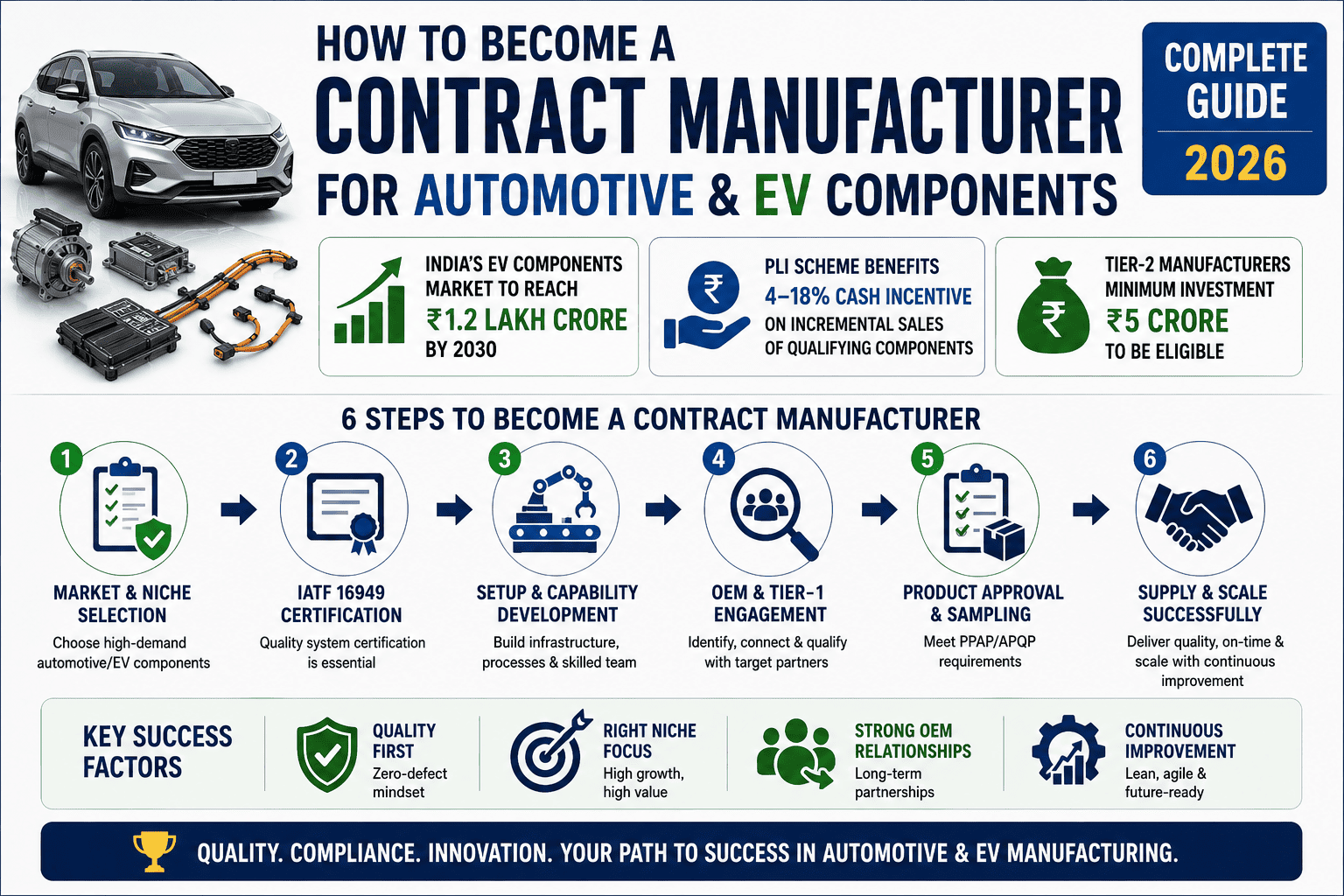
Direct Answer: The global automotive and electric vehicle (EV) component manufacturing market is experiencing unprecedented growth, with India’s EV components market projected to reach ₹1.2 lakh crore by 2030 and automotive contract manufacturing offering a structured entry pathway for manufacturers of all sizes. The Government of India’s PLI (Production Linked Incentive) Scheme provides 4–18% cash incentives on incremental sales of qualifying automotive and EV components, with Tier-2 manufacturers requiring a minimum investment of just ₹5 crore to be eligible. Success in automotive contract manufacturing requires IATF 16949 quality certification, strategic component niche selection (motor controllers, BMS, wiring harnesses, battery packs), and verified OEM supply chain relationships. GTsetu connects verified manufacturers with automotive OEMs and Tier-1 suppliers globally, with zero broker commissions.
📅 June 22, 2026⏱ 22 min read✍️ GT Setu Editorial Team🔄 Updated regularly
₹1.2L Cr
EV Component Market by 2030 (India)
94%
Import Dependence on Power Electronics
4–18%
PLI Incentive on Incremental Sales
0%
GTsetu Broker Commission
The global automotive industry is undergoing its most significant transformation since the invention of the assembly line, the transition from internal combustion engines to electric vehicles (EVs) is not a trend but a structural shift that will define the next three decades of manufacturing. For entrepreneurs and established manufacturers alike, the question is no longer whether to enter automotive and EV component manufacturing, but how, and how quickly, to capture the opportunity.
India alone is expected to have a retail EV component market of ₹1.2 lakh crore by 2030, according to NITI Aayog’s e-Amrit portal. Yet, 94% of sophisticated power electronics that power EVs, motor controllers, on-board chargers, and battery management systems, are currently imported, primarily from China and Taiwan. This import dependence represents not a barrier but an opportunity: a massive domestic manufacturing gap waiting to be filled by contract manufacturers who can deliver quality, reliability, and cost-competitiveness.
This guide covers everything you need to know to become an automotive and EV contract manufacturer, from selecting your component niche and understanding the PLI scheme, through to regulatory compliance, facility setup, and finding OEM partners. For broader market context, see our guides on expanding to India’s manufacturing market, China, and global expansion strategy.
⚡ Who Is This Guide For?
This guide is written for entrepreneurs, manufacturing business owners, electronics manufacturing services (EMS) providers, and existing manufacturers (auto ancillaries, electronics, precision engineering) seeking to enter the automotive and EV contract manufacturing sector. It covers both component-level manufacturing (motor controllers, BMS, wiring harnesses, battery packs) and full-scale contract manufacturing of complete automotive assemblies. If you are evaluating multiple manufacturing sectors, see our companion guides on Germany, Vietnam, and United Kingdom.
SECTION 1
1 Why Automotive & EV Contract Manufacturing?
🎯 The Strategic Case
Automotive contract manufacturing offers a uniquely structured and scalable business model. Unlike consumer electronics or general industrial manufacturing, where product lifecycles are short and buyer loyalty is weak, the automotive industry operates on long-term supply agreements (typically 5–7 years), rigorous quality standards (IATF 16949), and just-in-time delivery requirements that create sticky, recurring revenue relationships between manufacturers and OEMs. The EV transition is amplifying this opportunity: as OEMs rush to electrify their vehicle platforms, they are actively seeking qualified contract manufacturers to fill critical component supply gaps, particularly in power electronics, battery packs, and wiring harnesses. Government incentives like India’s PLI scheme (4–18% on incremental sales) further improve the economics of entry, effectively subsidising the growth of qualified contract manufacturers.
94%
Import dependence on sophisticated power electronics, the manufacturing gap waiting to be filled
₹1.2L Cr
India’s projected EV component market by 2030 (NITI Aayog e-Amrit portal)
India sold approximately 16 lakh EVs in the last complete fiscal year, with the market growing at about 40% per year. Every new EV sold requires hundreds of components, each representing a manufacturing opportunity. EV penetration is expected to reach 30%+ of all vehicle sales by 2030, creating sustained, multi-year demand visibility.
🇮🇳
PLI Scheme, Direct Government Incentives
The PLI Scheme for Auto and EV Components provides 4–18% cash incentives on incremental sales of qualifying products. Tier-2 component manufacturers with a minimum investment of ₹5 crore qualify. This is direct government subsidy to your growth, effectively improving your margins by up to 18% on qualifying sales volumes.
🔄
Long-Term, Recurring Revenue
Automotive supply agreements typically run for 5–7 years once you are qualified as an approved supplier. Unlike consumer goods where buyers switch frequently, automotive OEMs maintain stable supplier relationships, creating predictable, recurring revenue and strong business valuation multiples.
🏭
Proximity to OEM Clusters
India’s EV OEM clusters are well-defined: Tamil Nadu (Hosur, Chennai, Ather, Ola, Hyundai), Maharashtra (Pune, Chakan, Bajaj, Tata Motors), Gujarat (Sanand, Tata Motors EV), Karnataka (Bengaluru, Ather, Ola), and Uttar Pradesh (Noida, Hero Electric). Strategic location selection enables just-in-time delivery and strong buyer relationships.
💰
Attractive Financial Returns
EV component manufacturing offers gross margins of 22–28% at volume (500+ units/month for motor controllers), with net margins stabilising at 14–18% once monthly revenue exceeds ₹2 crore. PLI incentives add an additional 4–18% to net margins. Payback period for a small unit (₹90–95 lakh capex) is 36–42 months at 60% utilisation.
🔋
Growing Aftermarket & Replacement Demand
Beyond OEM supply, the EV aftermarket is emerging as a significant opportunity. Battery replacement, motor controller replacement, and charging infrastructure component manufacturing add secondary revenue streams that are less dependent on OEM qualification cycles.
SECTION 2
2 Market Opportunity: EV Components & EMS
The automotive and EV component manufacturing market is structurally distinct from other industrial manufacturing sectors: it is highly consolidated at the Tier-1 level (large, established suppliers), but fragmented and opportunity-rich at the Tier-2 and Tier-3 level, precisely where new entrants can establish a foothold. The EV transition is accelerating this fragmentation: OEMs and Tier-1 suppliers are actively seeking qualified Tier-2 and Tier-3 suppliers for components they previously imported or manufactured in-house.
Component Category
Current Import Dependence
Localisation Opportunity
PLI Category
Key OEM Demand Drivers
Motor Controllers & Inverters
85–95% (China/Taiwan)
Highest, immediate PLI eligible
Advanced automotive tech, Tier-2 eligible at ₹5Cr investment
BLDC/PMSM controllers for 2W/3W/4W; demand growing 40%+ annually
Battery Management Systems (BMS)
80–90% (China/Europe)
Very high, AIS 156 compliance creates barrier
Advanced automotive tech, Tier-2 eligible
EV battery packs, stationary storage, aftermarket retrofits
Wiring Harnesses (EV-specific)
40–50% (China/SE Asia)
Moderate, established players dominate
Advanced automotive tech, Tier-2 eligible
High-voltage and low-voltage harnesses for EV platforms
On-Board Chargers & DC-DC Converters
85–90% (China/Europe)
Very high, PLI eligible
Advanced automotive tech, Tier-2 eligible
AC charging, DC charging, HV-LV conversion for all EVs
Cooling plates, pumps, fluid management for EV batteries
Charging Connectors & Infrastructure
60–70% (China)
High, growing with charging infrastructure
Eligible under broader PLI
Public charging, home charging, fleet charging deployments
Precision Machined Components
30–40% (China/Germany)
Moderate, established CNC ecosystem
Eligible under broader PLI
Motor shafts, housings, connectors, high-precision parts
💡 The Entrepreneur Spotlight Lesson
Aravind Krishnamurthy, a power electronics engineer from Tiruchirapalli, left his ₹18 lakh/year job to start an EV motor controller manufacturing unit in Hosur, Tamil Nadu. He failed twice before building a ₹40 crore revenue business in five years. His key lesson: “In the first co-founder agreement, you need to have exit valuation clauses and IP ownership terms. I wasted 14 months and ₹22 lakh on legal expenses in my second venture when we failed to have that discussion.” The takeaway: structure your business agreements professionally from day one, the price of poor documentation is measured in years and crores.
SECTION 3
3 High-Demand Components for Contract Manufacturing
Selecting the right component niche is the single most consequential early decision. The most successful EV contract manufacturers focus on one component category and build deep expertise, quality reputation, and volume scale within that niche before diversifying. Here are the highest-opportunity component categories for new entrants.
⚡Highest Opportunity
BLDC/PMSM Motor Controllers
Motor controllers are the “brain” of an electric vehicle, converting battery DC power into AC power to drive the motor. BLDC (Brushless DC) controllers dominate 2W and 3W EVs; PMSM (Permanent Magnet Synchronous Motor) controllers are used in 4W EVs. Current import dependence is 85–95%, making this the highest localisation opportunity. Gross margins at volume: 22–28%. Typical unit price: ₹3,500–8,000 for 2W controllers.
Key demand: 2W/3W/4W controllers, sensorless control, CAN bus integration, field-oriented control (FOC)
🔋Fast-Growing
Battery Management Systems (BMS)
BMS monitors and controls battery pack performance, cell balancing, temperature monitoring, State of Charge (SoC), State of Health (SoH), and safety cut-offs. Demand is driven by both OEMs and aftermarket battery pack assemblers. AIS 156 compliance is increasingly mandatory for BMS in India. BMS hardware + software integration is a higher-value segment than pure hardware manufacturing.
Wiring harnesses are the “nervous system” of EVs, connecting battery, motor, controllers, and all vehicle electronics. EV-specific harnesses require high-voltage handling (up to 800V), shielding, and specialised connectors. While more established than other EV component categories, demand is growing rapidly with EV production volume increases.
On-board chargers convert AC mains to DC for battery charging. DC-DC converters step down high-voltage battery power (300–800V) to low-voltage (12–48V) for vehicle electronics. Both are power electronics-intensive components requiring SMT assembly, thermal management, and compliance with AIS 156/electrical safety standards.
EV batteries require active thermal management to maintain optimal operating temperature (20–40°C) and ensure safety, performance, and longevity. Thermal management includes cooling plates, fluid pumps, chillers, and thermal interface materials. As EV battery sizes increase, thermal management becomes more critical, and more specialised.
EV motors, gearboxes, and structural components require precision machining, forging, and casting. This category suits manufacturers with existing CNC machining, die-casting, or forging capabilities who want to enter the EV supply chain through precision components rather than electronics.
4 PLI Scheme: The Game-Changer for EV Manufacturing
🏛️ PLI Scheme Overview
The Production Linked Incentive (PLI) Scheme for Auto and EV Components is the most significant government support programme for automotive manufacturing in India’s history. Administered by the Ministry of Heavy Industries (MHI), the scheme provides 4–18% cash incentives on incremental sales of qualifying automotive technology products over a defined base year. The scheme is designed to enhance India’s domestic manufacturing capabilities in advanced automotive technologies, reduce import dependence, and create a globally competitive local supply chain. For Tier-2 component manufacturers, the eligibility threshold is a minimum investment of ₹5 crore, making the scheme accessible to MSME manufacturers with the ambition to scale.
Scheme Component
Details
Eligibility Requirement
Key Consideration for New Entrants
PLI, Auto & EV Components
4–18% incentive on incremental sales of qualifying advanced automotive technology products
Tier-2 threshold is accessible for serious MSME manufacturers with proper planning
Base Year Definition
Incentive is calculated on sales incremental to a defined base year production level
Base year is the year you begin production (must be declared on PLI portal before production)
Do NOT artificially inflate your base year, this disqualifies many applicants in later years
Incentive Range
4–18% depending on product category, technology level, and year of scheme participation
Product must be on the MHI’s eligible product list for advanced automotive technology
Motor controllers, BMS, and power electronics are among the highest-incentive categories
Annual Validation
Claims are validated annually by MHI, documented production, sales, and investment proof required
Maintain complete production records, invoices, and investment documentation
Start maintaining PLI-ready records from Month 1, retroactive documentation is difficult
Registration Requirement
Registration on the MHI PLI portal is MANDATORY before production begins
Registration must be completed pre-production, cannot be done retroactively
This is the single most common reason for PLI disqualification, register before you produce a single unit
💡 PLI Success Strategy
Based on successful PLI participants: (1) Register on the MHI PLI portal before production begins, this is non-negotiable. (2) Do not overstate your base year production, inflation will disqualify you in future years when you fail to demonstrate the claimed increment. (3) Maintain documentation discipline, PLI claims require audited financial statements, production records, and investment proof. (4) Align your product with the highest incentive categories, motor controllers and power electronics currently offer the strongest incentives.
Automotive manufacturing has among the most rigorous quality and compliance standards of any industrial sector. The complete certification framework for EV component manufacturing includes:
📋
IATF 16949, Automotive Quality Management
The global automotive quality management system standard, mandatory for suppliers to major OEMs. IATF 16949 combines ISO 9001:2015 requirements with additional automotive-specific requirements including APQP, PPAP, FMEA, MSA, and SPC. Certification typically takes 6–12 months and requires documented processes across the entire production chain.
🏭
Factory License & Udyam Registration
All manufacturing operations require a Factory License from the state labour department under the Factories Act, 1948. Udyam Registration (MSME) is essential for access to government schemes, collateral-free loans (CGTMSE), and priority sector lending. Both are relatively straightforward to obtain.
🌿
Pollution Control NOC & Consent
Consent to Establish (CTE) and Consent to Operate (CTO) from the State Pollution Control Board are mandatory for manufacturing operations with emissions, effluent, or noise generation. This process is often the longest regulatory step, typically 45–90 days. Apply early.
🔌
AIS 156, EV Battery & Electrical Safety
Automotive Industry Standard 156 covers safety requirements for EV batteries, electrical systems, and components. Compliance is increasingly mandatory for all EV components. BMS, motor controllers, and on-board chargers must demonstrate AIS 156 compliance through certified testing.
✅
BIS Certification
Bureau of Indian Standards (BIS) certification is mandatory for applicable electrical and electronic components. The mandatory certification list is continuously expanding as the government aims to improve domestic quality standards. Check BIS mandatory certification list for your specific component category.
🌍
ISO 14001, Environmental Management
Environmental Management System certification is increasingly required by OEMs and Tier-1 suppliers as part of their ESG compliance frameworks. ISO 14001 demonstrates your commitment to sustainable manufacturing, particularly important for EV supply chain participation.
⚡ Certification Strategy for New Entrants
The most efficient approach to certification: (1) Obtain Udyam registration immediately, this unlocks government scheme access. (2) Apply for Factory License and Pollution Control NOC concurrently, these are the longest steps. (3) Engage a consultant for IATF 16949 implementation, the documentation requirements are extensive and a good consultant will save 6+ months of trial and error. (4) Begin the BIS/AIS 156 testing process as early as possible, testing labs have significant backlogs. Many manufacturers underestimate the time to certification, budget at least 12 months from facility setup to full certification.
SECTION 6
6 Contract Manufacturing Business Models
Automotive and EV contract manufacturing encompasses several distinct business models. Your choice determines your capital requirements, margin profile, customer relationships, and scalability pathway.
Business Model
How It Works
Capital Required
Margin Profile
Best For
Key Reference
EMS, Electronics Manufacturing Services
Build-to-order electronic components (motor controllers, BMS, chargers) for OEMs, provides SMT, assembly, testing, and conformal coating services
Moderate (₹75 lakh – ₹2 crore)
15–25% gross; 8–15% net
Companies with electronics assembly capabilities entering EV through power electronics
For most first-time automotive contract manufacturers: (1) Start as a Tier-2 supplier, lower qualification barriers, ₹5 crore PLI eligibility threshold, and direct access to Tier-1 supply chains. (2) Choose a single component niche, become known as the go-to manufacturer for that component before diversifying. (3) Secure a Letter of Intent from a Tier-1 supplier before investing in full-scale capex, the LOI is your most important document for fundraising and PLI application. (4) Plan for IATF 16949 certification within the first 18 months, Tier-1 suppliers and OEMs increasingly require it even from Tier-2 suppliers.
SECTION 7
7 Step-by-Step Guide to Starting Your EV Component Unit
01
Define Your Component Niche & Validate Market Demand
Select a single component category based on your existing capabilities, capital availability, and market opportunity. Do NOT try to build the entire electronics package, focus on one of: BLDC/PMSM motor controllers, on-board chargers, wiring harnesses, or BMS units. Before investing any capital, perform market validation with 2–3 OEMs or Tier-1 suppliers. Aravind Krishnamurthy began with motor controllers for two-wheelers priced at ₹3,500–8,000 per unit with a gross margin of 22–28% at volume. This focused approach built his ₹40 crore business.
02
Location & Facility Selection
A basic unit requires at least 3,000–5,000 square feet of covered industrial shed area. Sheds are available for rent in Hosur (Tamil Nadu), Chakan (Maharashtra), Neemrana (Rajasthan), and Sanand (Gujarat) at rates of ₹18–32 per sq ft per month, significantly lower than Bengaluru or Chennai city rates, and located within 50–100 km of EV OEM clusters. Proximity to OEM plants reduces logistics costs, a critical factor for Tier-1 qualification is just-in-time supply capability.
03
Procure Key Machinery & Equipment
Essential equipment for a motor controller manufacturing facility: PCB SMT assembly line (semi-auto), pick and place machine, conformal coating machine, environmental stress screening chamber, and functional test rigs (custom-built to OEM specification). Total machinery cost: ₹35–45 lakh for a small unit; an additional ₹30–40 lakh for automation at mid-scale. Most non-specialised equipment can be supplied by Indian machinery manufacturers from Pune, Coimbatore, and Kolkata.
04
Establish Raw Material Supply Chain
Power semiconductors (MOSFETs, IGBTs, gate drivers, microcontrollers) are import-dependent, source through authorised distributors of Infineon, STMicroelectronics, and ON Semiconductor with bonded warehouses in Mumbai and Chennai. Passive components (capacitors, resistors, inductors) are available from manufacturers in Bengaluru and Hyderabad. PCB fabrication is available in India from fabs in Bengaluru and Noida at affordable quality. Supply chain reliability is as important as manufacturing capability.
05
Obtain Licenses & Regulatory Approvals
Required clearances: GST registration (immediate), Udyam Registration (MSME), Factory License from the state labour department, Pollution Control NOC (CTE + CTO, apply early; 45–90 days), BIS certification for applicable components, AIS 156 compliance for battery-related components. PLI Auto portal registration must be completed before production begins, this is the single most common reason for PLI disqualification.
06
Timeline & Team Building
Typical timeline: company registration to first production dispatch, 9–14 months. Month 1–2: Register company and obtain factory license. Month 3–5: Order machinery, prepare shed. Month 6–8: Install, commission, and test the line. Month 9–12: OEM qualification and sample approvals. Month 12–14: First bulk dispatch. Start-up team: 2 electronics engineers, 2 production technicians, 1 quality manager, 1 accounts/compliance person, total headcount: 6–8 people to start.
Always budget contingency, actual costs frequently exceed estimates
TOTAL CAPEX (approx.)
93,50,000
2,02,40,000
Based on NSIC Technology Centre Equipment Lists and NPCS techno-economic estimates
Financial Snapshot: What the Numbers Actually Look Like
With a product mix of BLDC motor controllers at an average selling price of ₹4,800 per unit, a small unit (₹90–95 lakh capex) at 60% capacity utilisation produces 650–800 units/month, generating ₹1.8–2.2 crore in monthly revenue. At 100% capacity, monthly revenue increases to ₹3.2–3.8 crore.
📊
Gross Margins (Volume)
22–28% at 500+ units/month, at the standard BLDC controller selling price of ₹4,800 per unit, gross profit per unit is ₹1,050–1,350.
📈
Net Margins (Stabilised)
14–18% once monthly revenue exceeds ₹2 crore, after depreciation, salaries, rent, and overheads. PLI incentives add 4–18% to net margin for eligible units.
💵
Payback Period
36–42 months at 60% utilisation for ₹90–95 lakh capex. Reduces to 24–28 months at 80%+ utilisation. PLI incentives can accelerate payback by 6–12 months.
🏦
Financing Available
CGTMSE provides collateral-free loans up to ₹2 crore for eligible MSMEs. PMEGP offers 25–35% capital subsidy for new units (project cost up to ₹50 lakh). PLI scheme provides cash incentives on sales, not just capital.
SECTION 9
9 Automotive Supply Chain Integration
Becoming an automotive contract manufacturer is not just about manufacturing capability, it’s about integrating into the automotive supply chain. Automotive OEMs and Tier-1 suppliers operate on rigorous procurement cycles, just-in-time delivery requirements, and long-term supply agreements. Understanding these dynamics is essential.
🏗️
Automotive Supply Chain Structure
OEMs (Maruti, Tata, Hyundai) → Tier-1 suppliers (Bosch, Magna, Mahindra) → Tier-2 suppliers (component sub-assemblies) → Tier-3 suppliers (raw materials, basic components). Most new entrants start at Tier-2 or Tier-3 level, building capability and quality reputation before moving up the chain.
Structural Understanding
📋
APQP & PPAP, The Qualification Gateway
Advanced Product Quality Planning (APQP) and Production Part Approval Process (PPAP) are the standard automotive qualification frameworks. You must submit PPAP documentation, including design records, process flow diagrams, FMEA, control plans, and capability studies, to your customer. APQP/PPAP approval is the formal gateway to becoming an approved supplier.
Qualification Required
🚚
Just-in-Time (JIT) Delivery
Automotive supply chains operate on Just-in-Time delivery, components arrive at the assembly line precisely when needed. Tier-1 suppliers require Tier-2 suppliers to meet strict delivery windows (often hourly), with penalties for late delivery. Proximity to OEM clusters (within 50–100 km) is a competitive advantage for JIT compliance.
Operational Requirement
📝
Long-Term Supply Agreements
Automotive supply agreements typically run for 5–7 years once you are qualified. These agreements specify volume commitments, pricing, quality requirements, and delivery terms. The long-term nature of automotive contracts provides revenue visibility that is rare in other manufacturing sectors.
Revenue Stability
📊
Continuous Quality Monitoring
OEMs and Tier-1 suppliers continuously monitor supplier quality through ppm (parts per million defect) metrics, supplier audits, and periodic quality reviews. Maintaining consistent quality is as important as achieving initial qualification, supply contracts can be cancelled for quality failures.
Ongoing Compliance
⚡ The Tier-1 Supplier Qualification Timeline
Realistic qualification timeline for a new Tier-2 supplier: (1) Supplier registration, 1–3 months (registration on OEM/Tier-1 supplier portal). (2) Quality audit, 2–4 months (IATF 16949 audit, on-site quality assessment). (3) APQP/PPAP submission, 3–6 months (documentation, sample production, testing). (4) Sample approval, 2–4 months (OEM/Tier-1 testing and sign-off). (5) Production ramp-up, 3–6 months (initial production, capacity validation). Total time to full qualification: 12–24 months. Start the process early, do not wait until your facility is fully built.
SECTION 10
10 How to Find Automotive OEMs & Tier-1 Suppliers
Finding your first OEM or Tier-1 customer is the most significant milestone in becoming an automotive contract manufacturer. The key is a structured, multi-channel approach rather than relying on a single method.
What to Look for in an Automotive Customer
✅
Verified Business Identity
Ensure the OEM or Tier-1 supplier is a registered entity with a track record of paying suppliers on time. GTsetu verifies automotive companies before they appear in the network. See business verification requirements.
📈
Clear Procurement Process
Established automotive companies have documented supplier registration processes, procurement guidelines, and qualification criteria. If a company cannot articulate their supplier qualification process, proceed with caution.
💰
Financial Stability
Automotive supply chains are capital-intensive. Ensure your customer has the financial capacity to honour long-term supply agreements. Check credit ratings, financial statements, and payment reputation in the industry.
🏛️
PLI Participation
OEMs and Tier-1 suppliers participating in the PLI scheme are actively seeking to localise supply chains. These are the most motivated buyers for new domestic suppliers.
🤝
Long-Term Partnership Orientation
Quality automotive buyers view suppliers as long-term partners, not transactional vendors. Look for evidence of long-standing supplier relationships, joint development programmes, and collaborative problem-solving approaches.
🔐
IP & Confidentiality Standards
Automotive supply agreements involve sharing proprietary designs and processes. Ensure your customer has robust IP protection standards and is willing to execute mutual NDAs before technical data exchange.
Channels for Finding Automotive Customers
💻
GTsetu Verified B2B Platform
GTsetu provides access to compliance-verified automotive OEMs, Tier-1 suppliers, and contract manufacturing partners across 100+ countries, with anonymous discovery, built-in NDA workflow, and encrypted collaboration. Zero broker commissions.
Best for Verified Discovery
🏛️
Industry Bodies & Trade Associations
Register with ACMA (Automotive Component Manufacturers Association), SIAM (Society of Indian Automobile Manufacturers), and CII (Confederation of Indian Industry). These bodies provide industry introductions, supplier directories, and PLI scheme guidance.
Industry Channel
🎪
Trade Shows & Expos
Auto Expo India (the largest automotive show in South Asia), AUTOMOTIVE WORLD (Japan), and IAA Mobility (Germany) are the primary events for meeting automotive buyers. HKTDC and Invest India also host business matching services for international manufacturers.
In-Person Channel
🏢
OEM Supplier Portals
Most major OEMs operate formal supplier registration portals: Tata Motors (tata.com/suppliers), Maruti Suzuki (marutisuzuki.com/suppliers), Hyundai (hyundai.com/suppliers), and Mahindra (mahindra.com/suppliers). Register on these portals, this is often the only way to be considered for RFQs.
Direct Channel
🏛️
Government Agencies
The Ministry of Heavy Industries (MHI) and Invest India actively facilitate introductions for PLI-qualifying manufacturers. Attend MHI’s PLI outreach events and supplier development programmes.
Government Channel
SECTION 11
11 Common Challenges & How to Overcome Them
🔌
Semiconductor Supply Chain Dependency
Power semiconductors (IGBTs, MOSFETs, microcontrollers) are import-dependent. Global supply chain disruptions have affected EV manufacturing timelines. Mitigation: build buffer stock (3+ months), diversify suppliers, and work with authorised distributors with bonded warehouse facilities in Mumbai and Chennai.
⏱️
Long OEM Qualification Timelines
OEM qualification can take 12–24 months from initial contact to full production approval. Many new entrants underestimate this timeline and run out of capital before qualification is complete. Mitigation: secure a Letter of Intent before capex investment; manage burn rate carefully during qualification; consider aftermarket as a parallel revenue stream.
📋
PLI Documentation Complexity
PLI claims require extensive documentation, audited financial statements, production records, and investment proof. Many manufacturers miss PLI eligibility due to poor documentation. Mitigation: engage a PLI consultant early; maintain production records from day one; appoint a dedicated compliance officer.
📊
Quality Consistency at Scale
Maintaining consistent quality as production volume scales is one of the most common failure points. A single quality failure can lose a supply contract. Mitigation: implement SPC (Statistical Process Control) from day one; invest in in-line testing rather than end-of-line testing; build a robust quality culture through training and accountability.
💰
Working Capital Management
Automotive supply agreements typically have 60–90 day payment cycles. Working capital requirements are significant, especially during production ramp-up. Mitigation: secure CGTMSE or bank working capital facility before starting production; negotiate progress payments for large orders; build 6 months of working capital into your initial budget.
🔑
Co-founder & Partnership Disputes
Aravind Krishnamurthy’s experience: “I wasted 14 months and ₹22 lakh on legal expenses in my second venture when we failed to have exit valuation clauses and IP ownership terms in the co-founder agreement.” Mitigation: formalise all partnership agreements with clear IP ownership, exit clauses, and dispute resolution mechanisms before starting operations. See IP ownership frameworks.
SECTION 12
12 How GTsetu Connects Manufacturers with Global OEMs
🚗 GTsetu, Verified B2B Platform for Automotive Contract Manufacturing
GTsetu provides automotive manufacturers and contract manufacturers with direct access to compliance-verified OEMs, Tier-1 suppliers, and contract manufacturing partners, across India, Southeast Asia, the Middle East, Europe, and North America. Every company in GTsetu’s network has been verified through business registration, trade licences, and relevant sector certifications before appearing in the platform. You discover, qualify, and engage, without broker intermediaries taking a percentage of your commercial economics.
🏛️
Multi-Layer Compliance Verification
Every automotive partner verified: company registration, trade licences, IATF/ISO certifications, by GTsetu’s compliance team. Eliminates fraud risk and due diligence workload.
🕵️
Anonymous Discovery
Browse verified OEM and supplier profiles without revealing your own identity. Protect your automotive manufacturing strategy until you choose to engage.
📄
Built-In NDA Workflow
Digital mutual NDA with timestamped signatures, activated before sensitive technical or commercial data can be exchanged. HKIAC arbitration clause option included.
🔐
Encrypted Document Workspace
AES-256 encryption at rest, TLS in transit. Role-based access controls. Full audit trail. No unprotected email attachments for sensitive technical or commercial data.
🚫
Zero Broker Commission
GTsetu charges zero commission on any partnership formed. All commercial economics stay between you and your automotive partner, always.
🌏
100+ Countries Including India & Global Markets
GTsetu’s network covers India, Southeast Asia, the Middle East, Europe, and North America, supporting your automotive manufacturing entry in any market.
An automotive contract manufacturer is a company that produces automotive components, subsystems, or complete assemblies on behalf of OEMs (Original Equipment Manufacturers) or Tier-1 suppliers. This includes everything from simple stamped metal parts and wiring harnesses to complex EV battery modules, motor controllers, and power electronics. Contract manufacturers in the automotive sector operate under strict quality standards (IATF 16949), just-in-time delivery requirements, and long-term supply agreements with OEMs. The most successful contract manufacturers focus on a specific component niche, build deep quality reputation, and scale within that niche before diversifying.
QWhat are the most in-demand EV components for contract manufacturing?
The most in-demand EV components for contract manufacturing include: (1) Motor controllers and inverters, BLDC and PMSM motor controllers for 2W/3W/4W EVs; current import dependence 85–95%. (2) Battery Management Systems (BMS), hardware and software for battery pack monitoring and control; AIS 156 compliance required. (3) Wiring harnesses, specialised high-voltage and low-voltage wiring for EV platforms. (4) On-board chargers and DC-DC converters. (5) Battery pack assemblies, cell/module assembly into complete battery packs. (6) Thermal management systems, cooling plates, pumps, and fluid management for EV batteries. (7) Charging connectors and infrastructure components. Motor controllers and BMS currently offer the highest opportunity due to the combination of import dependence and PLI incentives.
QWhat is the PLI scheme for automotive and EV components?
The Production Linked Incentive (PLI) Scheme for Auto and EV Components is a Government of India programme that provides 4–18% cash incentives on incremental sales of qualifying automotive technology products. The scheme aims to enhance India’s domestic manufacturing capabilities in advanced automotive technologies, including EVs, hydrogen fuel cell vehicles, and components thereof. Tier-1 suppliers require a minimum investment of ₹50 crore to be eligible; Tier-2 component manufacturers require a minimum investment of ₹5 crore. The scheme is administered by the Ministry of Heavy Industries (MHI). Critical success factors: (1) Register on the MHI PLI portal before production begins, this is non-negotiable. (2) Do NOT artificially inflate your base year production, this disqualifies many applicants in later years. (3) Maintain PLI-ready documentation from Month 1.
QWhat certifications are required for automotive contract manufacturing?
Essential certifications for automotive contract manufacturing include: (1) IATF 16949, the global automotive quality management system standard, mandatory for suppliers to major OEMs; includes APQP, PPAP, FMEA, MSA, and SPC requirements. (2) ISO 9001:2015, the baseline quality management standard. (3) ISO 14001, environmental management system certification, increasingly required by OEMs for ESG compliance. (4) AIS 156, Automotive Industry Standard for EV battery and electrical safety compliance; mandatory for BMS, motor controllers, and on-board chargers. (5) BIS certification, mandatory for applicable electrical and electronic components. (6) Factory License and Udyam (MSME) registration. (7) Pollution Control Board consent, Consent to Establish and Consent to Operate. Certification typically takes 12–24 months, start early and engage consultants for IATF 16949 implementation.
QHow do I find automotive OEMs looking for contract manufacturers?
Finding automotive OEM partners requires a structured, multi-channel approach: (1) GTsetu provides access to compliance-verified OEMs, Tier-1 suppliers, and contract manufacturing partners across 100+ countries, with anonymous discovery and zero broker commissions. (2) Attend industry trade shows, Auto Expo India, IAA Mobility, and AUTOMOTIVE WORLD are the primary events for meeting automotive buyers. (3) Register on OEM supplier portals, most major OEMs have formal supplier registration platforms (Tata, Maruti, Hyundai, Mahindra). (4) Engage with industry bodies, ACMA (Automotive Component Manufacturers Association), SIAM (Society of Indian Automobile Manufacturers), and CII facilitate introductions. (5) Work with government agencies, the Ministry of Heavy Industries and Invest India facilitate introductions for PLI-qualifying manufacturers. (6) Secure a Letter of Intent before significant capex investment, the LOI is your most important document for fundraising and PLI application.
QWhat is the investment required to start an EV component manufacturing facility?
The estimated total investment for a small-scale EV component manufacturing facility (BLDC motor controller or wiring harness) is ₹75–95 lakh for machinery, fit-out, initial raw material stock, and 6 months of working capital. A mid-scale unit with PLI scheme eligibility requires approximately ₹1.8–2.2 crore in capital expenditure. The CGTMSE scheme provides collateral-free loans up to ₹2 crore for eligible MSME applicants. The PMEGP scheme offers 25–35% capital subsidy for new units with a project cost up to ₹50 lakh. The payback period for a small unit at 60% capacity utilisation is typically 36–42 months, reducing to 24–28 months at 80%+ utilisation. PLI incentives can accelerate payback by 6–12 months for qualifying manufacturers. Ensure you budget for the full 12–24 month qualification timeline, many manufacturers run out of capital before their first OEM order arrives.
Ready to Start Your Automotive & EV Contract Manufacturing Journey?
Connect with verified automotive OEMs, Tier-1 suppliers, and contract manufacturing partners on GTsetu, compliance-backed verification, anonymous discovery, built-in NDA workflows, and zero broker commissions on every partnership you form.
They represents the product, and research team behind GTsetu, a global B2B collaboration platform built to help companies explore cross-border partnerships with clarity and trust. The team focuses on simplifying early-stage international business discovery by combining structured company profiles, verification-led access, and controlled collaboration workflows.
With a strong emphasis on trust, and disciplined engagement, Team GTsetu shares insights on global trade, partnerships, and cross-border collaboration, helping businesses make informed decisions before entering deeper commercial discussions.