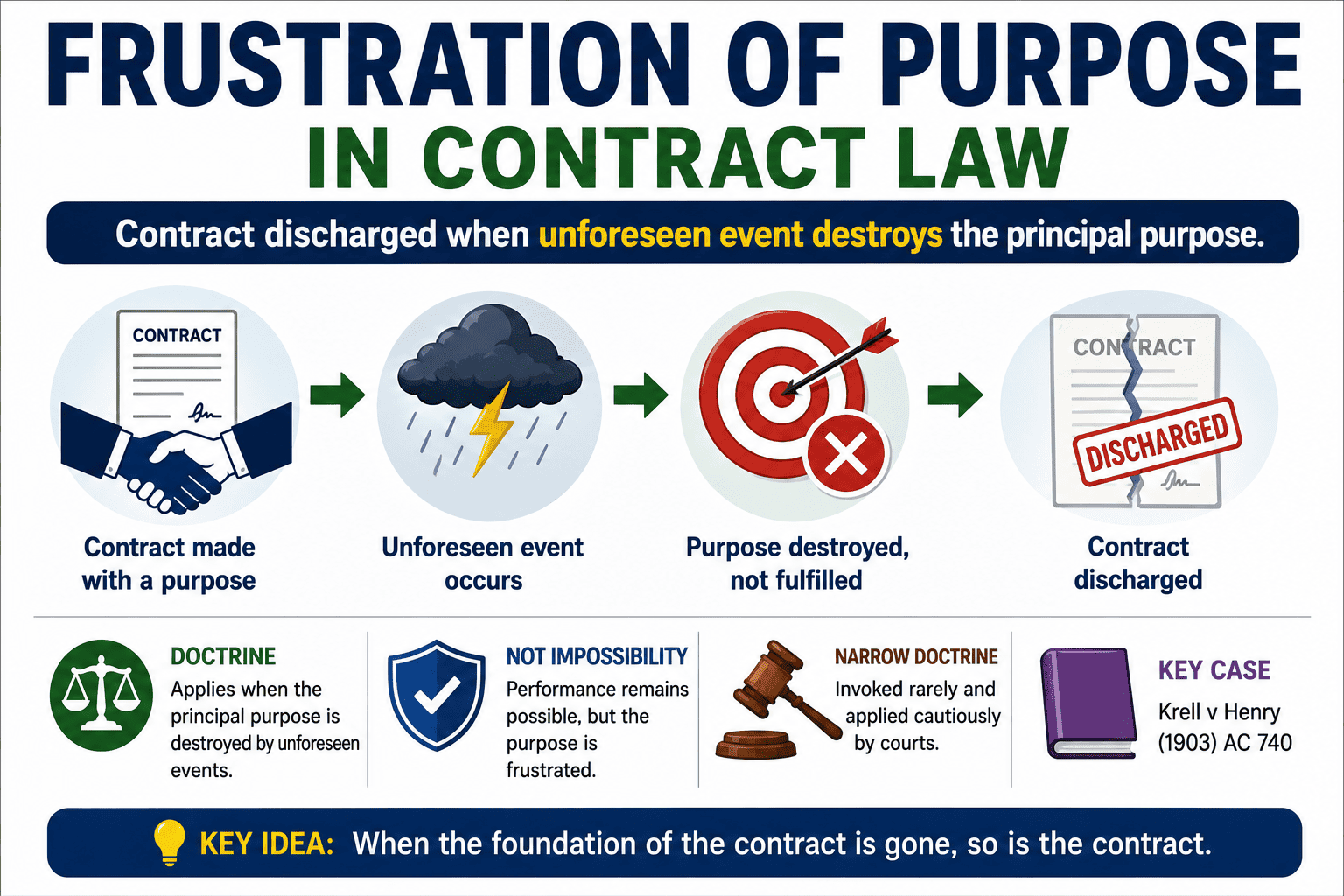
Why Frustration of Purpose Matters
The doctrine of frustration of purpose is a vital safety valve in contract law. It prevents injustice when an unforeseen event, through no fault of either party, destroys the very reason for the contract. Without this doctrine, a party could be forced to perform a contract that has become commercially meaningless or to pay for a benefit they no longer receive. It balances the principle of pacta sunt servanda (agreements must be kept) with the realities of a changing world.
📊 Key Insight
The doctrine is rarely invoked successfully. Courts have emphasized that it is not a means to escape a bad bargain or unforeseen hardship. The frustrating event must strike at the root of the contract, making it “radically different” from what was originally undertaken.
Frustration of Purpose vs. Impossibility: Key Distinctions
While often confused, these doctrines address different scenarios. The distinction is critical in determining whether a contract is discharged.
| Doctrine | Nature | Performance | Classic Example |
|---|
| Impossibility | Performance becomes physically or legally impossible | Cannot be performed at all | Destruction of the subject matter (e.g., a music hall burns down – Taylor v Caldwell) |
| Frustration of Purpose | Performance remains possible, but the fundamental purpose is destroyed | Can be performed, but it’s pointless | Coronation procession cancelled – the room can still be used, but the purpose (viewing the procession) is gone (Krell v Henry) |
| Impracticability | Performance is possible but extremely difficult or costly | Can be performed, but at excessive cost | Unexpected shortage of raw materials making performance commercially impracticable |
📌 Key Takeaway
In impossibility, the contract cannot be performed at all. In frustration of purpose, the contract can be performed, but the reason for performing it has been destroyed. The doctrine asks: “What was the fundamental purpose known to both parties?”
Essential Requirements
The Five Essential Requirements for Frustration of Purpose
For the doctrine to apply, the party seeking to rely on it must satisfy strict conditions, as established in English and Commonwealth jurisprudence.
1
The Purpose Must Be the Foundation of the Contract
The frustrated purpose must have been the principal basis of the contract, known to both parties at the time of contracting. As articulated in Canary Wharf v European Medicines Agency, the first step is to uncover the “common purpose” – something more elemental than just the terms of the contract.
2
The Event Must Be Unforeseen
The frustrating event must have been unforeseeable at the time the contract was made. If the event could have been reasonably anticipated, the parties are presumed to have allocated the risk in the contract, and frustration will not apply.
3
The Event Must Not Be the Fault of Either Party
As Lord Wright stated, “the essence of frustration is that it should not be due to the act or election of the party” seeking to rely on it. Self-induced frustration is no defense.
4
Performance Must Be Radically Different
The change in circumstances must be so fundamental that performance becomes “a thing radically different from that which was undertaken by the contract” (Davis Contractors v Fareham UDC). Mere expense, delay, or onerousness is not sufficient.
5
No Contractual Provision for the Event
The doctrine cannot be invoked if the contract contains a provision (e.g., a force majeure clause) that addresses the frustrating event. Express contractual terms prevail over implied doctrines.
Landmark Cases
Landmark Cases: The Evolution of Frustration of Purpose
The doctrine was established and refined through a series of key judicial decisions, primarily in English law, which have shaped its application globally.
| Case | Facts | Holding | Significance |
|---|
| Taylor v Caldwell (1863) | Music hall burned down before concerts. | Contract discharged – performance impossible. | Established the doctrine of frustration (impossibility) in English law. |
| Krell v Henry (1903) | Room rented to view coronation procession of Edward VII; coronation cancelled due to King’s illness. | Contract discharged – purpose frustrated, even though performance remained possible. | Established frustration of purpose as a distinct doctrine; the “coronation cases” remain the classic example. |
| Herne Bay Steam Boat Co v Hutton (1903) | Boat hired to view naval review and cruise; review cancelled, but fleet remained. | Contract not frustrated – the primary purpose (cruising) remained possible. | Demonstrates that partial frustration is insufficient; the purpose must be wholly defeated. |
| Davis Contractors v Fareham UDC (1956) | Increased costs due to labour shortages made contract less profitable. | No frustration – mere expense or onerousness is not enough. | Established the “radically different” test; frustration depends on the true construction of the contract. |
| Canary Wharf v European Medicines Agency (2019) | EMA sought to terminate lease due to Brexit; argued purpose frustrated. | No frustration – the purpose (having a London HQ) was not wholly defeated. | Modern confirmation that frustration is of “very limited scope” and requires a common purpose. |
Practical Application & Examples
Real-World Examples of Frustration of Purpose
Understanding the doctrine requires seeing it in practical scenarios. These examples illustrate where the doctrine may or may not apply.
✅ Successful Frustration
Example: A business leases a storefront to operate a restaurant serving a specific type of meat. A law is passed banning the sale of that meat. The storefront can still be used, but the fundamental purpose (operating that specific restaurant) is destroyed. The lease may be frustrated.
❌ Unsuccessful Frustration
Example: A developer signs a contract to build a high-end condominium. A market downturn makes the project less profitable. The contract can still be performed; it’s simply a bad bargain. Frustration does not apply.
📌 COVID-19 Context
During the pandemic, many argued that lockdowns frustrated contracts. Courts generally rejected these arguments where contracts contained force majeure clauses or where the purpose remained partially achievable. The restrictive approach to frustration was maintained.
Frustration in Different Jurisdictions
Application in Different Legal Systems
The doctrine is recognized in common law jurisdictions but with variations. Its application in India is governed by statute, while in the US it is codified in the Restatement.
| Jurisdiction | Legal Basis | Key Feature |
|---|
| England & Commonwealth | Common law (judge-made) | Highly restrictive; courts rarely find frustration. Based on the “radically different” test from Davis Contractors. |
| United States | Restatement (Second) of Contracts, Section 265 | Discharged if principal purpose is “substantially frustrated” without fault. Applied cautiously. |
| India | Section 56 of the Indian Contract Act, 1872 | Based on English law; covers both initial and supervening impossibility. The doctrine is called “supervening impossibility.” |
| Australia | Common law (Codelfa Construction v State Rail Authority) | Applies a tripartite test: obligation incapable, no fault, radically different. Recognized but narrow. |
Frustration vs. Force Majeure vs. Breach
Frustration of Purpose vs. Force Majeure vs. Breach of Contract
Understanding the differences between these concepts is essential for contract drafting and litigation.
| Concept | Nature | Source | Effect |
|---|
| Frustration of Purpose | Legal doctrine – operates by law | Judicial precedent / statute | Discharges the contract; parties are released from future obligations. |
| Force Majeure | Contractual clause – negotiated by parties | Express contract term | Excuses performance when specified events occur; may suspend or terminate obligations. |
| Breach of Contract | Failure to perform contractual obligations | A party’s action or omission | Non-breaching party may claim damages or seek specific performance. |
⚖️ Key Legal Reference
In Energy Watchdog v. CERC (2017), the Supreme Court of India ruled that mere increase in fuel prices does not constitute force majeure or frustration. The court emphasized that commercial hardships are not enough; there must be a “break in identity between the contract as provided for and contemplated and its performance in the new circumstances.” This reinforces the narrow scope of the doctrine.
Practical Tips
Drafting and Litigation Tips for Frustration of Purpose
Whether you are drafting a contract or litigating a dispute, understanding the practical implications of this doctrine is essential.
1
Draft Clear Force Majeure Clauses
To avoid reliance on the uncertain doctrine of frustration, include a comprehensive force majeure clause that lists specific events (pandemics, changes in law, etc.) and their consequences. This provides clarity and predictability.
2
Identify and Document the Common Purpose
In contracts where the purpose is critical, consider expressly stating the purpose in the recitals or preamble. This can make it easier to argue frustration later, as the purpose is clearly documented.
3
Consider Risk Allocation
When negotiating, consider who should bear the risk of unforeseen events. If the risk is foreseeable, allocate it explicitly in the contract. Courts will not use frustration to reallocate risks that the parties could have addressed.
4
In Litigation, Focus on the “Radically Different” Test
If seeking to rely on frustration, your argument must show that performance is fundamentally different, not just more expensive or difficult. Use evidence of the original purpose and the extent of the change.
5
Use the Law Reform (Frustrated Contracts) Act 1943 (UK)
In jurisdictions where it applies, this Act governs the financial consequences of frustration, allowing recovery of money paid and compensation for expenses. Understanding its provisions is crucial for advising clients.
FAQ
Frequently Asked Questions About Frustration of Purpose
QWhat is the difference between frustration of purpose and impossibility?
Impossibility concerns the duties specified in the contract – performance becomes physically or legally impossible (e.g., the subject matter is destroyed). Frustration of purpose concerns the reason a party entered into the contract – performance remains possible but the fundamental reason for the contract no longer exists (e.g., the coronation procession is cancelled). In impossibility, the contract cannot be performed; in frustration, it can, but it’s pointless.
QWhat are the essential requirements for frustration of purpose?
The requirements are: (1) the frustrated purpose must have been the foundation of the contract, known to both parties; (2) the frustrating event must have been unforeseen and not the fault of either party; (3) performance must remain physically possible; (4) the change in circumstances must be so fundamental that it strikes at the root of the contract; and (5) the doctrine cannot be invoked if the contract makes provision for the frustrating event.
QIs frustration of purpose the same as force majeure?
No. Force majeure is a contractual clause that excuses performance when specified events occur, and it is negotiated between the parties. Frustration of purpose is a legal doctrine that operates by law when an unforeseen event destroys the contract’s fundamental purpose, and it applies only when the contract is silent on the event. COVID-19 could be force majeure if included in the contract; frustration applies when the event fundamentally undermines the contract’s purpose and the contract has no relevant provision.
QCan a party rely on frustration of purpose if the event was foreseeable?
No. A fundamental requirement is that the event must have been unforeseeable at the time the contract was made. If the event could have been reasonably anticipated, the parties are presumed to have allocated the risk in the contract, and frustration will not apply. Courts have consistently rejected frustration claims based on foreseeable events.
QWhat happens to money paid if a contract is frustrated?
Under the Law Reform (Frustrated Contracts) Act 1943 (UK) and similar provisions in other jurisdictions, money paid before frustration is generally recoverable, and money payable before frustration ceases to be payable. The court may also allow the retention of sums to cover expenses incurred. The Act provides a statutory framework for restitution, moving away from the harsh common law position.