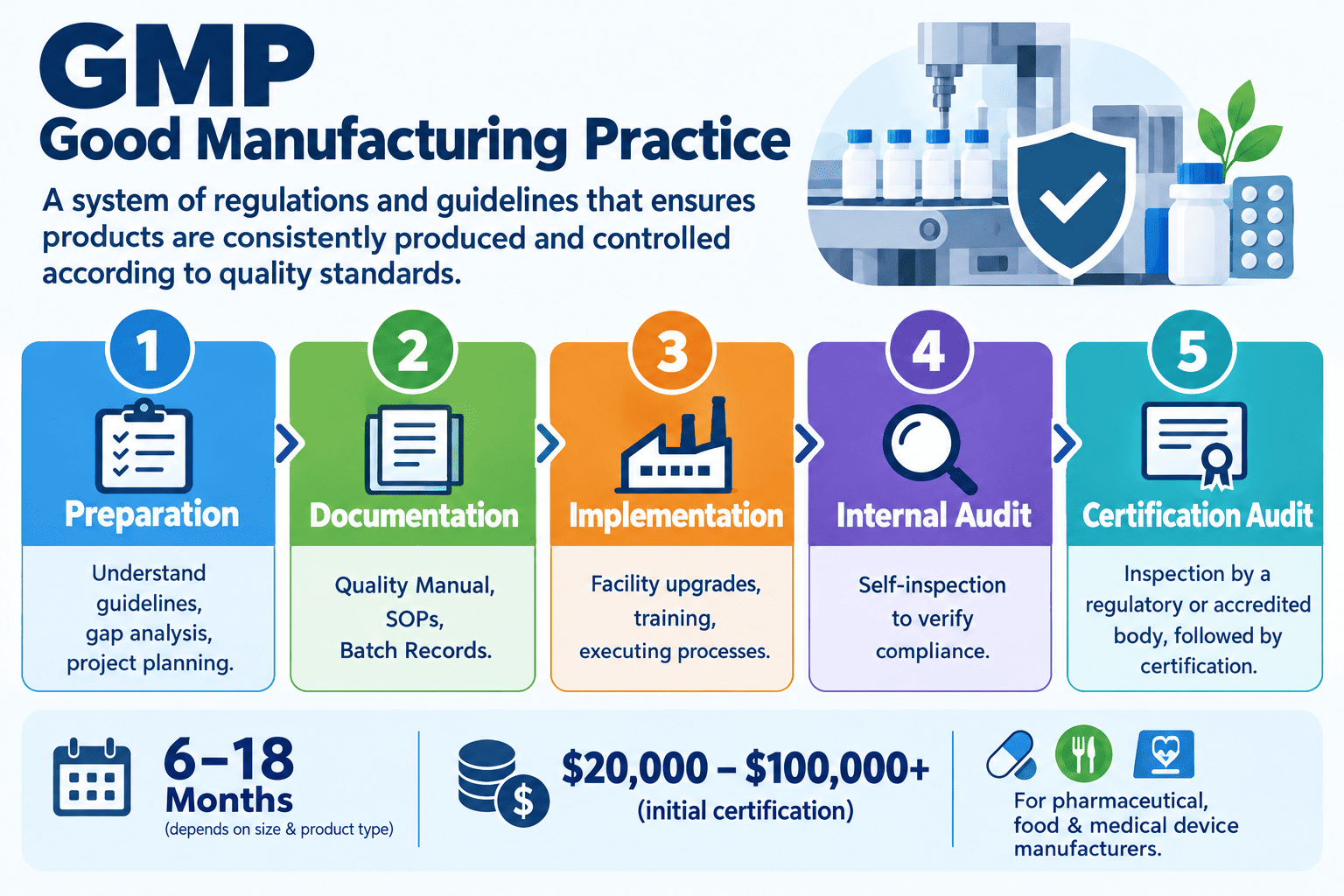
Direct Answer: GMP (Good Manufacturing Practice) is a system of regulations and guidelines that ensures products are consistently produced and controlled according to quality standards. Getting certified involves a 5-step process: Preparation (understanding guidelines, gap analysis, project planning), Documentation (Quality Manual, SOPs, Batch Manufacturing Records), Implementation (facility upgrades, training, executing processes), Internal Audit (self-inspection to verify compliance), and Certification Audit (inspection by a regulatory body or accredited certification body, followed by certification). The process typically takes 6–18 months depending on facility size and product type, with costs ranging from $20,000–$100,000+ for initial certification. This guide walks you through every step, with practical tips for a smooth certification journey for pharmaceutical, food, and medical device manufacturers.
📅 May 5, 2026⏱ 16 min read✍️ GT Setu Editorial Team🔄 Updated regularly
100+
Countries with GMP Requirements
5
Key Steps to Certification
6–18
Months (Typical Timeline)
0%
GTsetu Broker Commission
Good Manufacturing Practice (GMP) is a system of regulations and guidelines that ensures products are consistently produced and controlled according to quality standards. Developed by regulatory authorities worldwide, including the US FDA, European Medicines Agency (EMA), World Health Organization (WHO), and India’s Central Drugs Standard Control Organisation (CDSCO), GMP is legally required for pharmaceutical, food, cosmetic, and medical device manufacturing in most countries. With over 100 countries enforcing GMP requirements, it is the foundation of global product safety and quality.
For manufacturers, GMP certification is often a prerequisite for market access, regulatory approval, and doing business with large corporations and government agencies. It signals that your organization has implemented robust processes for quality control, contamination prevention, and product traceability. This guide covers the complete certification process, from initial preparation through to the final inspection, and provides practical, actionable advice for a smooth journey. See our related guides on ISO 9001 quality management and HACCP food safety to understand how GMP integrates with broader quality and safety frameworks.
🏭 Who Is This Guide For?
This guide is written for quality managers, production managers, regulatory affairs professionals, business owners, and anyone responsible for implementing or maintaining GMP compliance in their organization. It covers both the DIY approach (using templates and internal resources) and the consultant-led route. It is equally relevant for pharmaceutical manufacturers seeking regulatory approval, food processors who need to demonstrate safety, and cosmetic or medical device manufacturers who require GMP certification for market access. For related partnership structures, see our guides on ISO 13485 medical devices and ISO 14001 environmental management.
SECTION 1
1 What Is GMP & Why Get Certified?
🏭 The Standard Explained
GMP (Good Manufacturing Practice) is a system of regulations and guidelines that ensures products are consistently produced and controlled according to quality standards. It is designed to minimize the risks involved in any pharmaceutical, food, cosmetic, or medical device production that cannot be eliminated through final product testing alone. GMP covers all aspects of production, from the raw materials, premises, and equipment to the training and personal hygiene of staff. It requires that all manufacturing processes are clearly defined, systematically reviewed, and documented. GMP certification demonstrates that your facility, processes, and documentation meet these stringent requirements, ensuring product safety, efficacy, and quality. It is a legal requirement in most countries and a prerequisite for market access and regulatory approval in regulated industries.
🌐
Globally Recognized Standard
GMP is recognized in over 100 countries, with harmonized requirements through organizations like the WHO, PIC/S, and ICH. It provides a common framework for product safety across international supply chains.
⚖️
Legal Requirement & Market Access
GMP is legally mandated for pharmaceutical, food, and medical device manufacturing in most countries. Compliance is essential for regulatory approval, product registration, and market access.
🛡️
Product Safety & Quality
GMP focuses on preventing contamination, mix-ups, and errors. It ensures that products are safe, effective, and of consistent quality, protecting consumers and patients.
📈
Consumer Trust & Brand Reputation
GMP certification signals to customers, regulators, and partners that you have robust quality controls and a commitment to product safety, building trust and strengthening your brand.
SECTION 2
2 Key Benefits of GMP Certification
GMP certification delivers tangible benefits across operational, commercial, and regulatory dimensions. For manufacturers in regulated industries, GMP is not just a certification, it is a license to operate and a foundation for business success.
90%
Reduction in product recalls and quality failures reported by GMP-certified organizations
40%
Improvement in production efficiency after GMP implementation
100%
Compliance with legal and regulatory requirements in target markets
🏷️
Enhanced Market Credibility
GMP certification signals to customers, partners, and regulators that you have a validated system for managing product quality and safety. This credibility opens doors to new business opportunities with clients who require certified suppliers.
Commercial
💰
Cost Reduction & Efficiency Gains
By systematically identifying and eliminating the root causes of errors and inefficiencies, certified organizations reduce rework, waste, and non-conformance costs. The process-focused approach drives operational efficiency.
Operational
🔗
Supply Chain Integration
GMP provides a common framework for quality management across supply chains, enabling smoother collaboration with partners, easier audits, and more consistent quality throughout the value chain.
Partnership
📊
Data-Driven Decision Making
The standard requires organizations to collect and analyze quality data, enabling evidence-based decisions. This reduces reliance on intuition and improves the quality of operational and strategic decisions.
Analytical
👥
Employee Engagement & Clarity
Clear processes, defined responsibilities, and documented procedures improve employee understanding of their roles and how their work contributes to quality objectives, increasing engagement and reducing ambiguity.
People
📋
Regulatory & Risk Management
The risk-based approach embedded in GMP helps organizations proactively identify and mitigate quality-related risks, reducing exposure to regulatory non-compliance, product liability, and recalls.
Compliance
SECTION 3
3 GMP vs ISO 9001: What’s the Difference?
A common question when exploring GMP certification is how it relates to ISO 9001. While both are quality management frameworks, they serve different purposes and are often complementary rather than competitive. Understanding the distinction is crucial for a successful compliance strategy.
AspectGMPISO 9001
Purpose
✓ Regulatory compliance
✓ Quality management
Legal Status
✓ Mandatory in regulated industries
◐ Voluntary
Scope
✓ Product safety & quality
✓ Customer satisfaction
Industry
✓ Pharma, food, medical devices, cosmetics
✓ Any industry
Approach
✓ Prescriptive & detailed
✓ Generic & flexible
Focus
✓ Contamination prevention & traceability
✓ Continual improvement
Certification
✓ Regulatory inspection
✓ Third-party audit
💡 The Relationship Explained
GMP tells you WHAT you must do: It provides the specific regulatory requirements for product safety, hygiene, documentation, and quality control in regulated industries. It is prescriptive and legally enforceable.
ISO 9001 tells you HOW to manage quality: It provides a flexible framework for managing quality across any organization, focusing on customer satisfaction and continual improvement. It is voluntary and can be applied to any industry.
Practical approach: Many organizations implement ISO 9001 as a foundation for their quality management system, then add GMP-specific requirements for their regulated products. The two are complementary, ISO 9001 provides the management system structure, while GMP provides the industry-specific technical requirements.
SECTION 4
4 Step 1: Preparation, Foundation & Planning
🏗️ Building the Foundation
The preparation phase sets the foundation for your entire GMP certification project. The goal is to ensure you have the knowledge, resources, and support in place before beginning the detailed work of documentation and implementation. This phase typically takes 4–8 weeks for a small organization, longer for larger or more complex facilities.
1.1
Understand GMP Guidelines & Regulations
Familiarize yourself with the GMP guidelines that apply to your industry and target markets. For pharmaceuticals, this may include WHO GMP, US FDA 21 CFR Parts 210/211, EU GMP, or India’s Schedule M. For food, refer to CODEX Alimentarius, FDA FSMA, or FSSAI regulations. Understanding the specific requirements is the first step to compliance.
1.2
Secure Executive Support
Top management commitment is critical. They must “walk the talk” by allocating resources, supporting the project, and communicating its importance. Provide executives with a concise overview of GMP’s role in the business and the benefits certification will deliver, including market access, regulatory compliance, and risk reduction. For related legal considerations, see our guide on indemnification clauses.
1.3
Define Your Quality Goals & Scope
Define the specific operational and commercial benefits you want from certification (e.g., product registration, market access, reduced recalls). Clearly define the scope of your GMP system: which products, departments, locations, and activities will be included? You can exclude certain areas, but consider the pros and cons of limiting the scope. See our guide on due diligence for a framework that also applies to scope definition.
1.4
Conduct a Gap Analysis
Assess how compliant your organization already is with GMP requirements and identify gaps. This helps you prioritize efforts and create a more accurate project plan. You can do this internally or with a consultant. A thorough gap analysis should cover facility design, equipment qualification, documentation systems, personnel training, and quality control processes.
1.5
Create a Simple Project Plan
Plan your implementation steps, milestones, target dates, and responsibilities. For small and medium organizations, avoid complex Gantt charts; focus on a clear, simple plan that everyone understands. Define who will be the GMP point person (Quality Manager or Regulatory Affairs Manager) responsible for achieving and maintaining certification.
1.6
Generate Employee Awareness
Inform your staff about the GMP project early to prevent rumors and build engagement. Explain how certification benefits the company and individual employees, addressing concerns about job security and work processes. This creates buy-in and transforms staff into stakeholders in the project’s success. Training on GMP principles should begin early.
💡 Pro Tip: Start with a Facility Assessment
Before beginning documentation, conduct a thorough assessment of your facility design and equipment. GMP requires that facilities are designed to prevent contamination, allow for proper cleaning and maintenance, and ensure a logical flow of materials and personnel. Upgrades to facility design are often the most time-consuming and costly part of GMP compliance, so identifying these needs early is critical. This is also a good time to review your warranty clauses for equipment purchases and breach of contract provisions for supplier agreements.
SECTION 5
5 Step 2: Documentation, Building Your QMS
Documentation is often considered the most challenging phase of GMP certification. It requires aligning documents with regulatory requirements while tailoring them to your company’s unique context and needs. The goal is to create a documentation set that is useful, practical, and compliant, not a bureaucratic burden. GMP documentation is critical for demonstrating control over your processes and ensuring traceability.
Document Type
Description
Key Consideration
Quality Manual
A high-level document describing your quality management system, including quality policy, objectives, and organizational structure.
It should outline the scope of the QMS and how it meets GMP requirements.
Site Master File (SMF)
A document providing specific information about the manufacturer’s quality management policies, production activities, and facility details.
Required by many regulatory authorities as part of the product registration or certification process.
Standard Operating Procedures (SOPs)
Detailed, step-by-step instructions for performing all routine operations, from equipment cleaning to batch manufacturing and quality testing.
SOPs must be written by subject matter experts, approved, version-controlled, and followed exactly.
Batch Manufacturing Records (BMRs)
A record of all steps taken during the manufacturing of a batch, including equipment used, materials added, and in-process controls.
BMRs provide complete traceability and are critical for investigating deviations.
Batch Packaging Records (BPRs)
A record of all packaging and labeling operations for a batch, including line clearance, packaging materials used, and yields.
Critical for preventing mix-ups and ensuring correct labeling.
Validation Protocols & Reports
Documents covering Installation Qualification (IQ), Operational Qualification (OQ), and Performance Qualification (PQ) for equipment, systems, and processes.
Validation ensures that processes consistently produce products meeting predetermined specifications.
Calibration Records
Records for all instruments and equipment used in manufacturing and quality control, showing calibration against traceable standards.
Calibration must be performed at defined intervals, and records must be maintained.
Training Records
Documentation of all GMP training provided to personnel, including topics, dates, and assessment of competency.
All personnel must be trained on GMP principles and the specific SOPs relevant to their role.
Deviation & Investigation Reports
Records of any deviation from approved procedures, including investigation findings, root cause analysis, and corrective/preventive actions (CAPA).
Deviations must be documented and investigated promptly; CAPAs must be effective.
Change Control Records
A formal system for managing changes to processes, equipment, materials, or documents.
Changes must be evaluated for their impact, approved, and documented before implementation.
Product Quality Review (PQR)
A periodic review of batch records, quality data, and complaints to confirm process consistency and identify improvements.
PQRs are typically performed annually and are reviewed during inspections.
💡 Documentation Best Practices
DO: Look for the simplest way to meet a requirement and adapt it to your business. Use your company’s vernacular and avoid vague language. Use diagrams and flowcharts to simplify complex processes. Ensure all documents are version-controlled, approved, and retrievable.
DON’T: Include time-consuming references to other documents. Include bureaucratic requirements that are not suitable for your company’s circumstances or culture. Create documents that don’t add value to your operations.
Consider using documentation templates, pre-written documents designed to be tailored to your company’s needs. They save time, reduce errors, and provide a reliable starting point. Ensure they come with detailed customisation instructions. This approach is also effective when drafting Master Services Agreements (MSAs) and other commercial contracts.
SECTION 6
6 Step 3: Implementation, Rolling Out Your QMS
Implementation is where your carefully designed GMP system becomes a reality. This phase involves introducing your procedures to the workforce, training them, and guiding them through adjustments to improve their work processes. The goal is seamless integration into daily operations, supported by a compelling incentive for adopting the new processes.
📢
Introduce the Quality Policy
Top management should communicate the quality policy, explaining its significance and how the company will put it into practice. Staff must understand the policy and connect it to their individual responsibilities, this is a mandatory requirement of GMP.
Leadership
🎓
Provide Comprehensive Training
All personnel involved in manufacturing, quality control, and warehouse operations must be trained on GMP principles, hygiene, and the specific SOPs relevant to their roles. Training should be documented, and competency should be assessed.
Training
📋
Implement Process Controls
Ensure that all manufacturing processes, from raw material receipt to finished product release, are performed according to approved SOPs. Implement in-process controls and environmental monitoring where required.
Rollout
🔄
Execute Validation Activities
Perform equipment qualification (IQ, OQ, PQ), process validation, cleaning validation, and analytical method validation as required. Validation is a critical GMP requirement and must be completed before commercial production.
Validation
✍️
Maintain Accurate Records
As you implement GMP, records are created and must be maintained. Ensure that all records are complete, legible, and properly stored. Records are the primary evidence of compliance during inspections.
Documentation
📁
Implement Quality Control
Establish a quality control laboratory with qualified personnel, validated methods, and calibrated equipment. Implement a system for testing raw materials, in-process samples, and finished products.
Compliance
📣
Prepare for Inspection
Conduct mock inspections to prepare for the regulatory audit. Ensure that all documentation is complete, personnel are trained, and the facility is inspection-ready. Address any gaps identified during mock inspections.
Readiness
SECTION 7
7 Step 4: Internal Audit, Self-Inspection
🔍 Verifying Your QMS
Internal audits (also called self-inspections) are a mandatory requirement of GMP and play a critical role in ensuring the effectiveness of your quality management system. These self-inspections involve observing work processes, interviewing management and staff, and examining records. The objective is to verify compliance not only with GMP requirements but also with your own SOPs. Internal audits must be conducted before seeking certification and periodically thereafter. They can be performed by trained internal staff or outsourced to expert auditors. For related legal considerations, see our guide on material breach.
📋
Set Up the Audit Program
Develop an audit schedule and methods for planning and preparing your audits. Create documents, forms, and checklists that support the audit process. Consider using lead auditor training that includes a module on managing the audit program.
👤
Appoint Qualified Auditors
Small businesses often rely on their quality manager, regulatory affairs manager, or safety inspector. Larger companies may form an audit team. Auditors should be objective and impartial, they cannot audit their own work. Being an auditor is typically an additional responsibility, not a full-time role.
🎓
Provide Auditor Training
Auditors must be familiar with GMP regulations, possess strong auditing skills, be capable of reporting findings and following up on corrective actions, and ideally, promote best practices and add operational value. Consider formal auditor training for your team.
🔄
Start Audits Early
Use internal audits as training tools to support implementation. You can start auditing during Step 3, focusing on specific requirements or processes initially, and expanding the scope as the system matures. This early start helps identify and fix issues before the formal certification audit.
✅
Conduct a Complete Internal Audit
To be eligible for GMP certification, you must complete a comprehensive internal audit covering your entire QMS. The audit can be divided into multiple partial audits, focusing on specific departments or processes at a time. Address all identified nonconformities before proceeding to the certification audit.
📄
Outsource If Needed
If you lack internal audit expertise, you can outsource the pre-certification internal audit to experienced auditors. This ensures that all issues with your QMS are identified and addressed, increasing confidence in passing the certification audit.
💡 Internal Audit as a Management Tool
Many organizations view internal audits purely as a certification requirement, but they are a powerful management tool. Use them to identify process improvements, uncover hidden inefficiencies, and engage employees in quality thinking. A well-conducted internal audit provides valuable insights that go far beyond compliance. This same principle applies to commercial due diligence and other business assessments.
SECTION 8
8 Step 5: Certification Audit, Getting Certified
The certification audit is the final step in obtaining GMP certification. It is conducted by an independent, third-party auditor from an accredited certification body or by a regulatory authority (such as the FDA, EMA, or CDSCO). The audit is similar to your internal audits but with regulated scope and number of audit days. Successful completion results in the issuance of your GMP certificate, which is typically valid for a defined period (e.g., 2-3 years, depending on the regulatory body).
Audit Stage
What Happens
Key Focus
Stage 1 Audit (Documentation Review)
The auditor reviews your Quality Manual, SOPs, validation reports, and other documentation to ensure they meet GMP requirements and that your QMS is ready for the on-site audit.
Completeness and adequacy of documentation. Identification of any gaps or nonconformities that must be addressed before Stage 2.
Stage 2 Audit (On-Site Inspection)
The auditor visits your facility to verify that your QMS is effectively implemented and working in practice. They will interview employees, observe processes, and review records. They will also inspect the facility, equipment, and quality control laboratory.
Effective implementation of the QMS. Evidence that procedures are being followed and that the system is achieving its objectives. Verification that Stage 1 nonconformities have been addressed.
Audit Report & Decision
Following the inspection, the auditor prepares a report detailing findings. If no major nonconformities are found, or if corrective actions are successfully implemented, the certification body or regulatory authority issues your GMP certificate.
Overall conformity assessment. The certificate is valid for the defined period from the date of issue.
Surveillance Audits
During the certificate validity period, the certification body or regulatory authority conducts periodic surveillance audits to ensure your QMS remains compliant and effective.
Ongoing compliance. The auditor checks that the QMS is being maintained and that continuous improvement is taking place.
Recertification Audit
After the certificate expires, you must undergo a recertification audit to renew your certificate. This is typically a more comprehensive audit than surveillance audits.
Full system re-assessment. You must demonstrate that your QMS remains effective and has evolved to meet changing regulatory requirements.
💡 Preparing for the Certification Audit
Prepare your facility and staff: Ensure all areas are clean, organized, and inspection-ready. All documents should be current and retrievable. Staff should be prepared for the auditor’s questions and should answer truthfully without volunteering additional information. Conduct mock inspections to identify and address any gaps.
Select your certification body: Choose an accredited certification body that has experience in your industry and regulatory environment. Compare quotes, check their reputation, and ensure they are recognized by your customers or industry bodies. See our guide on due diligence for a framework that also applies to certification body selection.
SECTION 9
9 Costs & Timeline: What to Expect
The cost and timeline for GMP certification vary significantly based on organization size, product type, complexity, existing processes, and the regulatory body. Understanding these variables upfront helps in planning and budget setting.
Factor
Impact on Cost
Impact on Timeline
Organization Size (Employees)
Small (1–50): $20,000–$50,000 Medium (50–250): $50,000–$100,000 Large (250+): $100,000+
Sterile products, biologics, and complex dosage forms require more rigorous controls and higher costs
Complex products require longer validation and documentation timelines
Facility Upgrades
HVAC systems, cleanrooms, water systems, and facility redesign can add significant costs
Facility upgrades are often the longest lead-time item
Equipment Qualification & Validation
IQ, OQ, PQ for equipment and processes can add $10,000–$50,000+ depending on complexity
Validation activities must be completed before commercial production
Use of Templates / Digital Tools
Reduces consultant fees and internal time, significantly lowering cost
Can cut timeline by 30–50% by streamlining documentation and implementation
Consultant Involvement
Full consultant support: adds $20,000–$100,000+ to cost; DIY with templates: lower cost
Consultant can accelerate timeline by providing expertise and templates
Regulatory Body Fees
Inspection fees vary by regulatory authority (e.g., FDA, EMA, CDSCO)
Regulatory review timelines are outside your control
📋 Digital & Low-Cost Certification Options
Several providers offer digital GMP documentation platforms that significantly reduce cost and timeline. Subscription-based models can include document management, training tracking, and audit management tools. These digital solutions can bring GMP compliance within reach for small organizations that might otherwise find the traditional consultant-led route prohibitive. When evaluating such options, use the same commercial due diligence you would apply to any B2B engagement.
SECTION 10
10 How to Choose a Certification Body (Registrar)
The certification body (also called a registrar) is the independent organization that will conduct your audit and issue your GMP certificate. Choosing the right certification body is a critical decision that affects the cost, timeline, and market recognition of your certification. For pharmaceutical GMP, the certification may be issued by a regulatory authority (e.g., FDA, EMA, CDSCO) or by an accredited certification body.
🏛️
Accreditation Status
Ensure the certification body is accredited by a recognized national or international accreditation body (e.g., NABCB in India, UKAS in the UK, ANAB in the US). For pharmaceutical GMP, the certification body must be recognized by the relevant regulatory authority.
🏭
Industry Experience
Choose a certification body with auditors who have experience in your specific industry and product type. They will understand your processes, terminology, and risks, leading to a more relevant and valuable audit.
📋
Market Recognition
Consider whether your customers or industry bodies recognize the certification body’s certificate. In some industries, specific certification bodies are preferred or required. If you are exporting to a specific region, a certification body with local recognition may be advantageous.
💰
Cost & Value
Compare quotes from multiple certification bodies. The cheapest option is not always the best, consider the value of the audit, the auditor’s expertise, and the certification body’s reputation. Ensure you understand what is included in the quoted fee.
🌐
Global Capability
If you have or plan to have multiple sites in different countries, choose a certification body that can audit all sites consistently. This simplifies the management of your certification across locations.
🤝
Relationship & Support
Choose a certification body you feel comfortable working with. The relationship should be collaborative, not adversarial. A good auditor will help you improve your QMS, not just find faults. Assess their responsiveness and communication during the quoting process.
💡 Certification Body Selection Checklist
When evaluating certification bodies, ask: Are you accredited by a recognized national or international accreditation body? Do you have auditors with experience in my industry and product type? What is your audit process and how many days do you typically allocate for my organization type? What is included in your fee and are there additional costs? How do you handle nonconformities and what is the process for issuing the certificate? Can you provide references from clients in my industry? How do you conduct surveillance audits? Use this information alongside your due diligence framework to make an informed decision.
SECTION 11
11 Common Mistakes & How to Avoid Them
📋
Over-Documentation & Bureaucracy
Creating excessive documentation that adds no operational value and makes the system difficult to maintain. This creates employee resentment and audit fatigue.
Avoid: Focus on what is necessary to control your processes and demonstrate compliance. Use the simplest approach that meets the requirements. Ask: “Does this document add value?”
🏛️
Lack of Management Commitment
When leadership does not actively support the QMS, it becomes a compliance exercise for employees rather than a strategic initiative, leading to poor implementation and audit failures.
Avoid: Secure top management commitment from the start. Ensure they understand the business case for certification and communicate their support visibly to the organization.
📖
“GMP Language” Instead of Your Language
Using regulatory jargon instead of your company’s natural language makes procedures confusing and difficult for employees to follow and maintain.
Avoid: Write procedures in your company’s everyday language. Use diagrams and illustrations. Make them user-friendly and practical for the people who will use them.
🔄
Treating Certification as the End Goal
Focusing solely on passing the audit rather than building a QMS that improves operations. This leads to a system that is maintained only for the auditor, not for business performance.
Avoid: Design your QMS to solve real operational problems. Use the internal audits and management reviews for genuine improvement, not just audit readiness.
🎓
Inadequate Staff Training
Employees who do not understand the QMS or how their role contributes to it will not follow procedures consistently, leading to nonconformities and audit findings.
Avoid: Invest in training at all levels. Explain the “why” behind the procedures. Make training engaging and relevant to employees’ daily work. Consider using MSA principles for structured training programmes.
📊
Ignoring the Internal Audit Results
Failing to address internal audit findings before the certification audit, or treating internal audits as a tick-box exercise without taking corrective action.
Avoid: Use internal audits as a genuine check on your system. Address all findings promptly. Conduct root cause analysis and implement corrective actions that prevent recurrence. See our guide on material breach for related risk management.
SECTION 12
12 How GTsetu Supports Your GMP Certification Journey
🔗 GTsetu, Verified B2B Platform
Connect with Verified Partners & Build Quality Supply Chains
GMP certification is a powerful tool for demonstrating product quality and safety to customers and partners. GTsetu complements your certification by connecting you with verified manufacturers, distributors, and suppliers who meet rigorous quality standards. Our platform provides:
✅
Verified Company Profiles
Every company on GTsetu is verified on 6 key data points (Name, Address, Registration Number, Company Status, Company Type, Date of Incorporation) using government tie-ups, complementing your GMP due diligence.
🕵️
Anonymous Discovery
Browse verified partner profiles without revealing your identity until you’re ready to engage, protecting your sourcing strategy and commercial confidentiality.
📄
Built-In NDA Workflow
Digital mutual NDA with timestamped signatures, activated before any sensitive commercial or technical data is exchanged, supporting your IP protection and confidentiality commitments under GMP.
🔐
Encrypted Document Workspace
AES-256 encryption at rest, TLS in transit, role-based access controls, and full audit trail, ensuring the secure exchange of quality documentation, specs, and contracts with partners.
🚫
Zero Broker Commission
GTsetu charges zero commission on any partnership formed. All commercial value stays between you and your verified partner, supporting the cost management objectives of your QMS.
🌏
Global Network of Verified Partners
Access verified manufacturers, distributors, and suppliers across 100+ countries, supporting your supply chain quality objectives and enabling you to build a network of GMP-aligned partners.
QWhat is GMP certification and why is it important?
GMP (Good Manufacturing Practice) is a system of regulations and guidelines designed to ensure that products are consistently produced and controlled according to quality standards. It is legally required for pharmaceutical, food, cosmetic, and medical device manufacturing in most countries. GMP certification demonstrates that your facility, processes, and documentation meet these stringent requirements, ensuring product safety, efficacy, and quality. It is a prerequisite for market access and regulatory approval in regulated industries. For related legal considerations, see our guide on warranty clauses.
QWhat are the 5 main steps to get GMP certified?
The 5 main steps are: (1) Preparation, understand GMP guidelines, secure management support, conduct a gap analysis, and plan your project. (2) Documentation, create your Quality Manual, Standard Operating Procedures (SOPs), Batch Manufacturing Records (BMRs), and other required documents. (3) Implementation, roll out the system, train staff, and execute processes according to SOPs. (4) Internal Audit, conduct a self-assessment to verify the system works and complies with GMP. (5) Certification Audit, undergo an inspection by a regulatory body or accredited certification body and receive your GMP certificate. This structured approach is similar to building any Master Services Agreement, start with a solid foundation and build methodically.
QHow long does it take to get GMP certification?
The timeline varies by company size, product type, and readiness. For a small to medium organization (under 50 employees), the process typically takes 6-12 months. Larger organizations (50-250 employees) usually take 12-18 months. Large, complex manufacturing facilities may take 18-24 months. The timeline includes facility upgrades, documentation, training, implementation, internal audit, and the final regulatory inspection. Using templates or digital tools can significantly reduce the time to certification.
QHow much does GMP certification cost?
The cost varies significantly based on product type, facility size, complexity, and regulatory body. Factors include: facility upgrades, equipment validation, consultant fees, training, and the certification inspection fees. For a small to medium facility, initial costs may range from $20,000 to $100,000+, not including ongoing compliance. A digital documentation platform can reduce costs by streamlining document management. Investment in GMP is substantial but necessary for market access in regulated industries. For related cost considerations, see our guide on consequential damages.
QWhat documents are required for GMP certification?
Key required documents include: Quality Manual, Site Master File, Standard Operating Procedures (SOPs) for all critical processes, Batch Manufacturing Records (BMRs), Batch Packaging Records (BPRs), Validation Protocols (IQ, OQ, PQ), Calibration Records, Training Records, Deviation and Investigation Reports, Change Control Records, and Product Quality Review (PQR) reports. All documentation must be controlled, versioned, and retained according to regulatory requirements. Using templates can help ensure completeness and reduce the burden of starting from scratch, much like using an Asset Purchase Agreement template saves time in M&A transactions.
QWhat is the difference between GMP and ISO 9001?
GMP is a regulatory framework that is legally mandated for specific industries like pharmaceuticals, food, and medical devices. It focuses on product safety, quality, and traceability. ISO 9001 is a voluntary, internationally recognized quality management standard applicable to any industry. It focuses on customer satisfaction and continual improvement. GMP is more prescriptive and industry-specific, while ISO 9001 is generic and flexible. Many organizations implement both, using ISO 9001 as a foundation for a broader QMS and GMP for specific regulatory compliance. The selection process should mirror the rigor you would apply when using due diligence criteria to choose any business partner.
QHow do I choose a GMP certification body?
Choose a certification body that is accredited by a recognized national or international accreditation body (e.g., NABCB in India, UKAS in the UK, ANAB in the US). For pharmaceutical GMP, the certification body must be recognized by the relevant regulatory authority (e.g., US FDA, EMA, CDSCO). Evaluate their industry experience, auditor qualifications, and market recognition. For food GMP, organizations like NSF, SGS, and others offer certification. The selection process should mirror the rigor you would apply when using indemnification clauses to allocate risk in any business partnership.
Ready to Build a Quality-Driven Supply Chain?
Connect with verified manufacturers, distributors, and suppliers on GTsetu, compliance-backed verification, anonymous discovery, built-in NDA workflows, and zero broker commissions. Find partners who share your commitment to quality.
They represents the product, and research team behind GTsetu, a global B2B collaboration platform built to help companies explore cross-border partnerships with clarity and trust. The team focuses on simplifying early-stage international business discovery by combining structured company profiles, verification-led access, and controlled collaboration workflows.
With a strong emphasis on trust, and disciplined engagement, Team GTsetu shares insights on global trade, partnerships, and cross-border collaboration, helping businesses make informed decisions before entering deeper commercial discussions.