Long-Term Supplier Management: Strategy, Best Practices & Procurement Guide
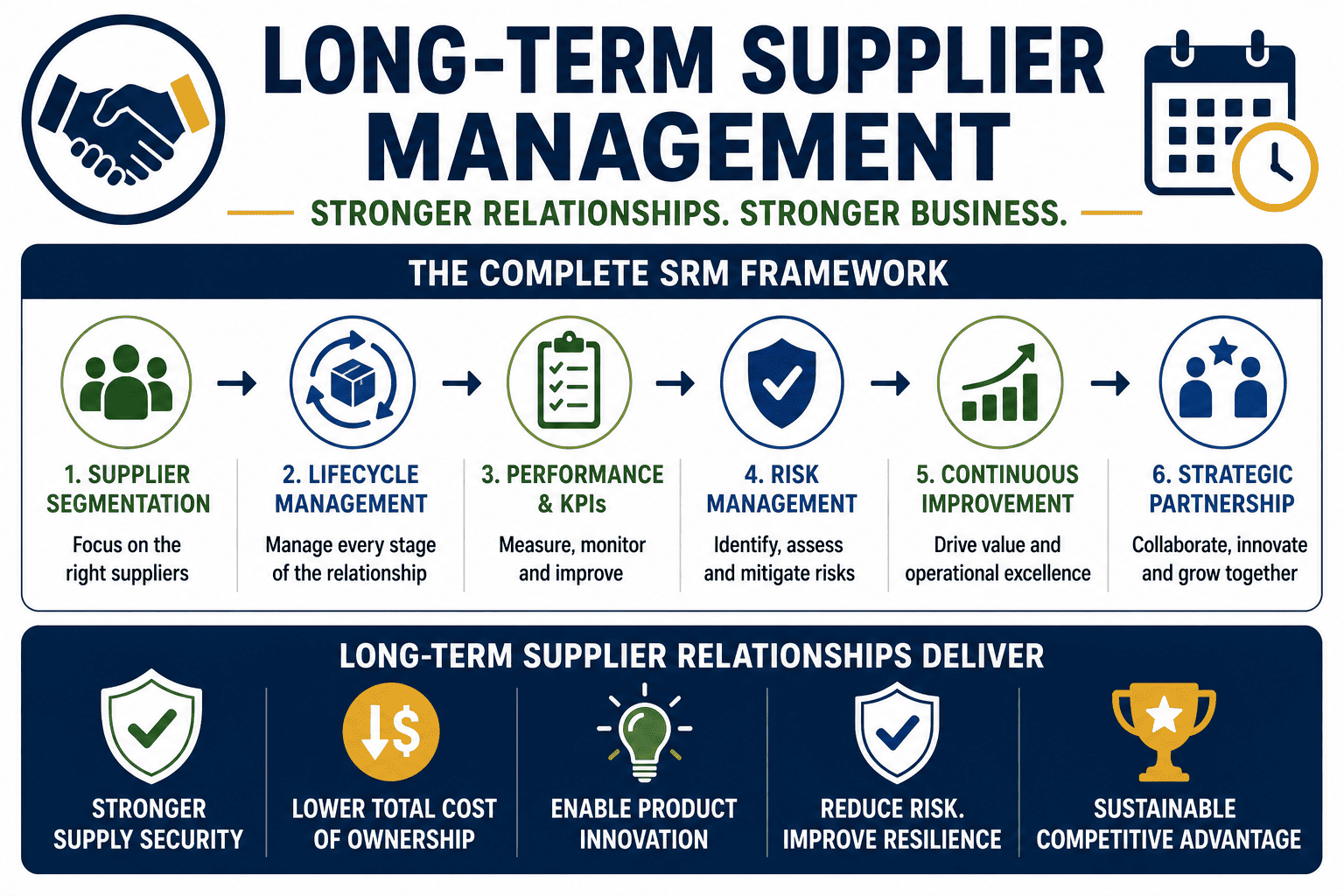
Direct Answer: Long-term supplier management is the structured, ongoing process of developing, monitoring, and deepening commercial relationships with suppliers over time, beyond individual transactions or contracts. It encompasses supplier segmentation, lifecycle management, SRM, performance KPIs, risk management, and continuous improvement. For manufacturers and distributors, long-term supplier relationships are a source of competitive advantage: they improve supply security, reduce total cost of ownership, enable product innovation, and build the resilience that transactional purchasing cannot create. This guide covers the complete framework.
📅 May 1, 2026⏱ 20 min read✍️ GTsetu Editorial Team🔄 Updated regularly
4
SM Elements
6
Lifecycle Stages
30+
KPIs Covered
15
Internal Resources
Most procurement failures are not sourcing failures. The supplier looked right at the RFQ stage: the pricing was competitive, the samples were acceptable, the certifications were in order. The failure happened later, in the absence of structured performance monitoring, deteriorating quality that went unaddressed for too long, a financial problem that was visible in retrospect but invisible at the time, or a relationship that was never invested in enough to withstand the first serious disagreement.
Long-term supplier management is the discipline that prevents these failures. It is not simply “keeping suppliers happy”, it is a systematic, evidence-based approach to developing and maintaining commercial relationships that deliver consistent value, manage risk, and build the kind of mutual trust that creates genuine competitive advantage for both parties over time.
This guide covers the complete framework: the four elements of supplier management, the Kraljic segmentation model, the supplier lifecycle, SRM strategy, performance KPIs, risk management, procurement strategy integration, and how to identify when a supplier relationship has deteriorated beyond recovery.
💡 Who This Guide Is For
This article is written for procurement professionals, supply chain managers, manufacturers managing international supplier bases, and distributors building long-term relationships with manufacturer principals. It covers both the strategic framework and the practical implementation of long-term supplier management, including where to find verified suppliers to begin the process. See also: cross-border business partnerships and partnership evaluation criteria.
SECTION 1
1 What Is Long-Term Supplier Management?
📖 Definition
Long-term supplier management is the structured, ongoing process of developing, monitoring, and deepening commercial relationships with suppliers over an extended time horizon, beyond individual purchase orders, contracts, or sourcing cycles. It connects strategic procurement decisions upstream (what to source, from whom, and on what terms) with operational purchasing downstream (requisitions, orders, payments, quality), with the supplier relationship itself as the central focus. The goal is to move key suppliers from commodity providers into strategic partners who contribute capacity, innovation, resilience, and commercial value that transactional purchasing cannot extract.
The distinction between transactional purchasing and long-term supplier management is not just semantic. Transactional purchasing optimises for unit price and short-term availability. Long-term supplier management optimises for total cost of ownership, supply security, relationship depth, and the ability to jointly navigate disruption, innovation, and commercial change over time.
For manufacturers, long-term supplier management governs relationships with raw material suppliers, component manufacturers, contract manufacturers, tooling suppliers, and logistics partners. For distributors, it governs relationships with manufacturer principals, the brands and businesses whose products they represent in their markets. In both cases, the quality of the relationship management determines whether the commercial partnership creates value or merely extracts it. Explore more on the structures that underpin these relationships in our guide to global collaboration examples.
lower total cost of ownership typically achieved through long-term supplier partnerships versus transactional sourcing over a five-year horizon
3–5×
faster recovery from supply disruptions for companies with strong strategic supplier relationships compared to those relying on transactional vendor pools
60%
of innovation inputs in manufacturing companies come from the supply base, accessible only through collaborative supplier relationships, not spot purchasing
🔒
Supply Security
Suppliers prioritise their most loyal, long-term customers during periods of capacity constraint, material shortage, or logistics disruption. A transactional buyer is the first to be de-prioritised. A strategic partner with a track record of mutual reliability is protected.
💡
Access to Innovation
Suppliers share new materials, processes, and product developments with partners they trust, not with buyers who switch on price. Long-term relationships create the information flow and mutual investment that makes collaborative innovation possible.
💰
Better Economics Over Time
Long-term supplier relationships create opportunities for volume commitments, early payment incentives, jointly-engineered cost reductions, and process integrations that reduce total cost of ownership well beyond what unit price negotiation can achieve.
📈
Quality Improvement
Quality problems are solved more quickly and more permanently in collaborative relationships where both parties have invested in mutual success. Adversarial purchasing creates a dynamic where suppliers cut corners and conceal problems rather than escalate them.
🌐
Capacity Access
Long-term commitments give suppliers the confidence to invest in capacity expansion. A manufacturer that has been a reliable customer for five years can negotiate capacity allocations and lead time commitments that a spot buyer cannot access at any price.
🛡️
Risk Resilience
Deep supplier relationships come with early warning: suppliers alert strategic customers to geopolitical risks, raw material shortages, and operational challenges before they become supply chain crises. Transactional buyers find out when the order fails to arrive.
📌 The Cost of Short-Termism
Switching suppliers to save 2% on unit price typically costs far more than 2% when the full cost is calculated: new supplier qualification costs, ramp-up quality issues, loss of relationship-based priority during disruptions, and the foregone value of the innovation and process integration that the existing relationship had been building. The true cost of global expansion includes the relationship equity that takes years to build and is lost in a single price-driven supplier switch.
SECTION 3
3 The Four Elements of Supplier Management
Supplier management as a discipline has four distinct but interconnected elements. Each operates at a different level of the supplier relationship and requires different tools, cadences, and organisational capabilities. Understanding them as distinct elements, rather than as a single undifferentiated activity, is the first step toward building a coherent supplier management programme.
Element
What It Covers
Primary Outputs
Organisational Owner
Supplier Lifecycle Management
End-to-end process of identifying, qualifying, onboarding, managing, and offboarding suppliers. Covers the entire commercial relationship from pre-engagement to exit.
Cultivation of mutually beneficial relationships with strategic suppliers, through structured communication, joint planning, shared objectives, and collaborative problem-solving.
SRM programme, joint business plans, preferred supplier designations, innovation pipelines
Procurement + Business Leadership
Supplier Risk Management
Identification, assessment, mitigation, and monitoring of risks arising from the supply base, including financial, geopolitical, operational, compliance, and ESG risks.
These four elements do not operate independently. A supplier who scores poorly on performance management requires action at the SRM and risk management levels. A supplier flagged at the risk management level may need to be managed out through the lifecycle management process. Effective long-term supplier management requires all four elements to be operating simultaneously and communicating with each other.
SECTION 4
4 Supplier Segmentation: The Kraljic Matrix
Not every supplier warrants the same depth of management. Applying strategic relationship management to a commodity stationery supplier wastes resource that should go to the manufacturer supplying a critical proprietary component. Supplier segmentation solves this problem by classifying the supply base and determining the appropriate management approach for each segment.
The most widely used and well-validated segmentation framework is the Kraljic Matrix, which classifies suppliers across two dimensions: profit impact (how significantly the supplier affects your cost base, product quality, or revenue) and supply risk (how difficult the supplier is to replace due to market concentration, switching costs, or unique capability).
PROFIT IMPACT →
High Profit / High Risk
Strategic Suppliers
Unique capability, high switching cost, critical to product or margin. Cannot be easily replaced. Require deep SRM, joint planning, and executive-level relationships.
→ Partner; invest in relationship depth
High Profit / Low Risk
Leverage Suppliers
High spend, replaceable. Use market competition and consolidation to drive value. Still merit performance management but less intensive relationship investment.
→ Compete; consolidate spend to maximise leverage
Low Profit / High Risk
Bottleneck Suppliers
Low spend but hard to replace, single source or specialist. Risk of supply disruption outweighs their spend. Require contingency planning and supply security measures.
→ Secure; develop alternatives; dual-source where possible
Low Profit / Low Risk
Non-Critical Suppliers
Commodity products, easily replaceable, low spend. Automate and standardise procurement. Minimal relationship investment; focus on transaction efficiency.
→ Automate; streamline; aggregate where possible
← SUPPLY RISK →
How to Use Segmentation in Practice
The Kraljic matrix determines where each supplier sits and, therefore, what management approach is appropriate. Strategic suppliers receive the deepest investment: executive sponsorship, quarterly business reviews, joint innovation programmes, and the full SRM toolkit. Leverage suppliers are managed through performance monitoring and competitive discipline. Bottleneck suppliers require risk mitigation focus, dual sourcing, safety stock, and contingency agreements. Non-critical suppliers are managed for efficiency, not relationship depth.
Segmentation should not be static. A bottleneck supplier who develops new capacity may move to strategic or leverage. A strategic supplier that loses its proprietary advantage may migrate to leverage. Review your segmentation annually and after any material supply market change. Use your partnership evaluation criteria to guide re-segmentation decisions systematically rather than reactively.
📌 The Temptation to Over-Stratify
One common failure in supplier segmentation is classifying too many suppliers as “strategic”, spreading SRM resources so thin that the programme delivers little value anywhere. A typical manufacturing organisation has 5–15 genuinely strategic suppliers, not 150. The discipline of Kraljic is in the rigour of the criteria, not the generosity of the classification.
SECTION 5
5 Supplier Lifecycle Management
Supplier lifecycle management covers the complete arc of the commercial relationship from before first engagement through to potential exit, ensuring that each stage is handled systematically with appropriate processes, documentation, and governance rather than ad hoc judgement.
1
Identification
Define the need. Build an ideal supplier profile. Use sourcing tools, industry contacts, trade associations, and verified platforms to identify candidates.
2
Qualification
Verify identity, capability, financial health, compliance posture, and ESG standing. Conduct site visits or audits for strategic suppliers. Confirm certifications independently.
3
Onboarding
Execute the commercial agreement. Integrate into procurement systems. Complete compliance onboarding. Conduct supplier orientation to your processes, standards, and expectations.
4
Active Management
Run the performance management and SRM programmes. Monitor KPIs. Hold QBRs. Address issues proactively. Invest in relationship development for strategic suppliers.
5
Development
For strategic suppliers: joint innovation, capacity investment, process integration, preferred status, and expanded commercial scope. Turn the relationship into a mutual competitive advantage.
6
Exit / Transition
When a supplier relationship ends, by mutual agreement, performance failure, or strategic change, manage the transition systematically to protect supply continuity and minimise disruption.
The Onboarding Stage: Where Long-Term Relationships Are Won or Lost
The onboarding stage is disproportionately important in long-term supplier management. A poorly managed onboarding, unclear expectations, incomplete commercial documentation, missing compliance requirements, unresolved questions about tooling or IP ownership, creates problems that compound over the life of the relationship. Getting onboarding right means having a complete business partnership contract in place before commercial activity begins, clarity on questions like who owns tooling and moulds, and a structured communication framework that both parties understand and commit to from day one.
For manufacturers appointing distribution partners, the onboarding framework should reference the contract between manufacturer and distributor to ensure all commercial terms, territory definitions, exclusivity arrangements, and performance expectations are documented before the relationship begins delivering commercial value.
The Exit Stage: Ending Relationships Professionally
Not every supplier relationship should last forever. Markets change, capabilities evolve, strategic priorities shift. When the decision is made to exit a supplier relationship, whether due to performance failure, strategic change, or cost restructuring, the exit must be managed as carefully as the onboarding. Poor exit management creates supply chain disruption, legal liability, reputational damage in the supply market, and in some cases, the loss of proprietary tooling, IP, or data. See: ending a business partnership contract for the structured approach to managing supplier relationship exits legally and commercially.
SECTION 6
6 Supplier Relationship Management (SRM) Strategy
📖 What SRM Is and Isn’t
Supplier relationship management is not supplier monitoring. Monitoring tells you when something has gone wrong. SRM is the proactive investment in the relationship itself, so that things go right, and when they don’t, the relationship has enough trust and communication infrastructure to resolve issues collaboratively rather than adversarially. SRM is a strategic programme, not a procurement administrative function.
1
Identify and Prioritise SRM-Eligible Suppliers
Apply your segmentation framework (Kraljic) to identify which suppliers in the supply base warrant active SRM investment. Typically strategic suppliers and selected bottleneck suppliers. SRM for every supplier is not sustainable; focus is what makes the programme effective. Assign an internal relationship owner, a named individual who is accountable for the health of each strategic supplier relationship.
2
Establish Structured Communication Cadences
Define and commit to regular, structured communication at multiple levels: operational check-ins (weekly or monthly) for issue resolution; tactical reviews (monthly or quarterly) for performance against KPIs; strategic sessions (quarterly or biannual) for joint business planning, market intelligence sharing, and relationship development. Ad hoc communication is not SRM. Structured, scheduled, documented communication is. Both sides should prepare agendas, and all sessions should generate documented action items with named owners and deadlines.
3
Share Data and Mutual Intelligence
The most powerful accelerant for supplier relationships is information sharing. Share your demand forecasts so suppliers can plan capacity. Share quality data so suppliers can improve at source. Share strategic plans (with appropriate confidentiality protection) so suppliers can align their investment decisions with your direction. The supplier who knows your demand three months out is the supplier who prioritises your orders when capacity is constrained. Use technology partnerships and collaborative platforms to enable real-time data exchange where appropriate.
4
Align Strategic Objectives
The highest-value SRM relationships are those where both parties have genuine shared objectives, not just aligned transactional interests. Develop joint business plans with strategic suppliers that identify shared goals, market growth, cost reduction, product innovation, geographic expansion, and define how each party will contribute. When your supplier’s success is your success, the relationship becomes genuinely strategic rather than merely preferred-vendor. Joint planning also surfaces alignment issues early, before they become commercial conflicts. For distributors, the distributor network framework covers how to structure these joint plans across multiple distribution relationships simultaneously.
5
Build Trust Through Reliability and Transparency
Trust in a supplier relationship is built through consistent behaviour over time: paying on time, providing accurate forecasts, communicating problems early rather than late, and following through on commitments. It is also built through transparency, sharing data and context rather than managing information asymmetrically to maintain purchasing leverage. Paradoxically, buyers who share more with suppliers receive more in return: better prices, better service, earlier warning of problems, and access to innovations that are not offered to buyers who treat information as a negotiating weapon.
6
Recognise and Reward Supplier Excellence
The most durable SRM programmes create positive reinforcement loops: suppliers who deliver excellent performance receive recognition, preferred status, and expanded commercial opportunity. Preferred supplier designations, supplier awards programmes, and volume commitments for consistently high performers are not just morale-boosting gestures, they create commercial incentives for the supplier to continue investing in the relationship. The supplier who knows that excellent performance leads to increased business makes a rational investment in sustaining it. This is the foundation of the mutual-benefit dynamic that separates strategic SRM from transactional vendor management.
💡 SRM and Collaboration Agreements
For the most strategically important supplier relationships, particularly those involving joint development, shared IP, or market collaboration, a collaboration agreement versus a joint venture structure may be appropriate. The choice between these structures determines how IP is owned, how costs and risks are shared, and what each party can do independently. SRM for these relationships is the day-to-day management programme; the legal structure is the framework that governs what that collaboration can produce.
SECTION 7
7 Supplier Performance KPIs
Supplier performance management without defined, measurable KPIs is opinion-based, not evidence-based. KPIs provide the shared language through which performance is discussed, problems are identified, and improvement is tracked. The most effective KPI frameworks cover six dimensions of supplier performance, with specific metrics within each.
New ideas submitted to joint improvement programme; accepted ideas implemented; process efficiency savings delivered; new product development contributions; sustainability initiatives
On-time delivery rate (OTD); lead time consistency (actual vs. quoted); order fill rate; partial shipment rate; advance shipment notification compliance
OTD: >95% (strategic >98%); lead time variance <10%
Monthly; real-time for critical suppliers
🟡 Cost
Price performance vs. market benchmark; total cost of ownership trend; invoice accuracy rate; over/under-invoicing frequency; cost reduction contributions delivered
Price within 3% of market benchmark; invoice accuracy >99%; committed cost savings delivered on schedule
Regulatory and certification compliance rate; code of conduct adherence; audit findings count and severity; insurance currency; reporting submission timeliness
Zero critical compliance failures; all certifications current; audit findings resolved within agreed timeframes
Annual review; continuous monitoring for critical items
🟤 Innovation & Improvement
Minimum 2 improvement initiatives per year for strategic suppliers; agreed innovation contribution targets in joint business plan
Biannual; QBR agenda item
Running Effective Quarterly Business Reviews (QBRs)
The Quarterly Business Review (QBR) is the primary structured vehicle for supplier performance management with strategic and key leverage suppliers. A QBR is not a complaint session or a one-sided performance lecture, it is a structured bilateral review that covers performance data, commercial developments, mutual opportunities, and joint action planning.
Prepare shared data in advance, both parties bring performance data to the QBR, not just the buyer. The supplier’s view of buyer performance (forecast accuracy, payment timeliness, specification changes) is as important as the buyer’s view of supplier performance.
Review all six KPI domains systematically, not just the issues that came up in the last quarter. Consistent review prevents problems from being overlooked until they become critical.
Address open action items from the previous QBR before adding new ones. An action log that is never completed destroys the credibility of the QBR as a management tool.
Include a forward-looking agenda item, demand forecast update, market intelligence sharing, product roadmap discussion, or joint opportunity identification. The QBR should not only look backwards.
Document outcomes with named owners and deadlines. A QBR without a documented action log is a conversation, not a management meeting.
Involve the right levels of seniority. For strategic suppliers, the QBR should include decision-makers on both sides, not just operational contacts who cannot commit to strategic actions.
SECTION 8
8 Supplier Risk Management in Long-Term Relationships
Long-term supplier relationships reduce some risks, supply interruption risk, quality uncertainty, capacity access, while creating others. Concentration risk (over-dependence on a single supplier), switching cost risk (the difficulty and cost of moving away from a deeply integrated supplier), and reputational contagion risk (when a supplier’s conduct creates liability for your organisation) all increase as supplier relationships deepen.
Effective supplier risk management in long-term relationships requires monitoring across five risk dimensions, not just the financial and operational risks that are most immediately visible.
💼
Financial Risk
Ongoing monitoring of supplier financial health, credit ratings, published accounts, payment behaviour to their own suppliers, and early warning indicators of financial distress. A strategic supplier becoming financially distressed while deeply integrated into your operations is one of the most damaging supply chain risks. Annual financial health checks; continuous credit monitoring for strategic suppliers.
🌍
Geopolitical Risk
For internationally-sourced suppliers: monitoring of political stability, trade policy changes, sanctions developments, and export control regime changes in the supplier’s jurisdiction. Geopolitical risks can materialise rapidly and without warning; early monitoring allows contingency activation before the crisis arrives. See: common red flags in international partnerships.
⚙️
Operational Risk
Single-site production, geographic concentration of the supplier’s own supply base, key-person dependency, ageing equipment, and insufficient quality systems are operational risks that deepen in significance as the supplier relationship becomes more strategic. Factory audit programmes should specifically assess these dimensions.
🔒
Concentration Risk
Over-dependence on any single supplier for a critical input creates a vulnerability that long-term relationships can inadvertently increase. Monitor the percentage of any critical category sourced from a single supplier and maintain a diversification strategy that keeps concentration within acceptable limits, even for deeply trusted strategic partners.
🌱
ESG and Compliance Risk
ESG failures in the supply chain, labour violations, environmental non-compliance, anti-bribery incidents, create direct legal and reputational liability for buyer organisations. Ongoing ESG monitoring, periodic audits, and contractual ESG obligations are requirements for any long-term supplier relationship in today’s regulatory environment. Understand the risk allocation in cross-border deals to ensure contractual protection is in place.
💻
Cybersecurity & Data Risk
Suppliers with system integration, access to your data, or shared IT infrastructure create cybersecurity exposure. As supplier relationships deepen and system integration increases, supplier cybersecurity posture becomes a direct component of your own security risk profile. Assess and contractually require appropriate security standards.
SECTION 9
9 Aligning Supplier Management with Procurement Strategy
Long-term supplier management does not exist in isolation from procurement strategy, it is one of its primary delivery mechanisms. The strategic direction of the organisation (new market entry, product innovation, cost leadership, ESG commitments) should directly shape the supplier management programme: which suppliers are prioritised, what the SRM programme is designed to achieve, and what the performance management framework is optimised for.
Procurement Strategy Objective
Implications for Supplier Management
Key Supplier Management Actions
Cost leadership
Total cost optimisation across the supply base; leverage consolidation; cost reduction through long-term partnerships
Spend analysis; Kraljic application; volume consolidation; cost-down programmes with strategic suppliers; payment term optimisation
Product innovation
Access to supplier R&D, materials innovation, and process technology
Collaborative innovation programmes; early supplier involvement in NPD; preferred supplier programmes; IP-sharing frameworks; joint development agreements
Geographic expansion
Local supply base development in new markets; understanding of true cost of global expansion including supply chain establishment costs
Market-specific supplier identification; local supplier qualification; international wholesale distributor relationships; in-market supply chain development
Supply resilience
Reducing single-supplier dependency; building geographic and supply network diversity
Supplier ESG scorecards; mandatory ESG requirements in contracts; supplier development programmes for ESG improvement; sustainability audit programmes
Speed to market
Supplier responsiveness and flexibility as strategic priority; reduction of lead times
Preferred supplier programmes with expedite capability; VMI (vendor managed inventory) with strategic suppliers; system integration for real-time inventory visibility
The alignment between procurement strategy and supplier management is also critical in the context of geographic expansion. When a manufacturer enters a new market, whether through appointing international distributors, establishing local supply chain partners, or engaging international business development consulting support, the supplier and partner management approach in the new market must be adapted to local market conditions, not simply replicated from the home market. Using a B2B matchmaking tool to identify initial partner candidates in new markets, followed by systematic qualification and lifecycle management, is more effective than cold outreach alone.
SECTION 10
10 Red Flags in Long-Term Supplier Relationships
Long-term relationships can mask deterioration. The trust and familiarity built over years of collaboration can make buyers reluctant to acknowledge warning signs that, with a new supplier, would trigger immediate action. Maintaining objective vigilance, monitoring the same signals regardless of relationship tenure, is essential for catching supplier problems before they become supply chain crises.
🚩
Consistent Late Delivery Normalised
When “they’re always a bit late” becomes an accepted description rather than a performance issue requiring action, the supplier management programme has failed. Chronic delivery underperformance should trigger a formal performance improvement plan, not informal tolerance.
🚩
Deteriorating Financial Health Signals
Extended payment terms requests, increasing invoicing errors, changes in payment behaviour to their own suppliers, auditor qualifications, or changes in key financial staff are early indicators of financial distress that, ignored, lead to supply chain disruption when the supplier reaches crisis point.
🚩
Ownership or Management Change Without Notification
A change of ownership, key management departure, or significant organisational restructuring that was not proactively disclosed by the supplier is a serious red flag, both as a governance signal and because the new ownership or management may have very different operational priorities, compliance cultures, or financial circumstances than the entity you originally contracted with.
🚩
Declining Responsiveness to Issues
A supplier who responds to quality or delivery issues with increasing defensiveness, delays, or dismissiveness rather than collaborative problem-solving is signalling that the relationship dynamic has shifted. This pattern often precedes a complete breakdown in the commercial relationship.
🚩
Sub-Contracting Without Disclosure
A supplier who begins sub-contracting work to third parties without disclosure or approval is violating the terms of most commercial agreements, and creating unvetted third-party exposure in your supply chain. Quality, IP, and compliance obligations are only as strong as the entity actually performing the work.
🚩
Certification Lapses or Quality System Deterioration
Certifications (ISO, GMP, CE, product-specific) that lapse, or audit findings that indicate deteriorating quality systems, are leading indicators of product quality failure. These signals often precede the defective shipment by six to twelve months, catching them early prevents the downstream crisis.
🚩
Relationship Complacency: No Innovation, No Improvement
A long-term supplier relationship that has generated no cost reduction, no process improvement, and no innovation in the past two to three years is a stagnant relationship, not a strategic one. The absence of continuous improvement is a signal that the partnership dynamic has settled into comfortable inertia rather than mutual value creation.
🚩
Adverse Media or Compliance Incidents
Adverse media coverage, regulatory enforcement actions, or compliance incidents, even if the supplier claims they do not affect your supply relationship, create reputational and legal exposure through association. Trigger an immediate reassessment and senior review before deciding whether and how to continue. See: common red flags in international partnerships for a complete framework.
SECTION 11
11 When to End a Supplier Relationship
The decision to exit a long-term supplier relationship is one of the most consequential in supply chain management. The costs of staying too long with a deteriorating supplier, quality failures, supply disruptions, compliance exposure, must be weighed against the costs of switching: new supplier qualification time, ramp-up costs, relationship rebuild, and potential disruption to supply during the transition period.
Indicators that exit is necessary, rather than a further performance improvement cycle, include: repeated failure to meet commitments despite formal improvement plans; fundamental misalignment of strategic direction; change of ownership that creates compliance or values conflict; financial distress that creates unacceptable supply continuity risk; or ESG failures that cannot be remediated within an acceptable timeframe.
When exit is the right decision, it must be managed with the same rigour as onboarding. The commercial agreement, particularly the business partnership contract provisions on notice periods, data return, IP ownership, tooling repatriation (see: who owns tooling and moulds), and transition assistance, governs the process. Handling exits well protects supply continuity, preserves legal standing, and maintains the organisation’s reputation in the supply market as a fair commercial partner. Full guidance on managing the process is available in our dedicated article on ending a business partnership contract.
SECTION 12
12 Starting Long-Term Relationships on a Verified Foundation
Long-term supplier management, everything covered in this guide, begins with a single precondition: that the supplier you are managing is genuinely who they claim to be, legally registered as described, and engaging with you in good faith as an identifiable, accountable commercial entity.
This precondition is more easily stated than guaranteed. In international industrial sourcing, the discovery of a supplier’s fundamental misrepresentation, a fabricated registration number, a claimed certification that cannot be verified, an undisclosed change of ownership, typically emerges only after months of commercial engagement. By that point, commercial commitments have been made, sensitive information has been shared, and the cost of unwinding the relationship is substantial.
GTsetu addresses this precondition before the relationship begins.
🏭 The Verified Starting Point for Industrial Supplier Relationships
GTsetu: Verified Identity Before the First Conversation
GTsetu is a verified B2B trade partnership platform for manufacturers, distributors, and raw material suppliers. Every company on the platform has passed a 6-point government tie‑up verification, legal name, registered address, registration number, company status, company type, and date of certificate of incorporation, before they can engage with or be discovered by any other company on the platform. When you identify a potential supplier through GTsetu, you start your long-term supplier management programme from a verified identity, not from an unverified claim that must be investigated from scratch.
🏛️
6-Point Govt VerificationEvery company verified via official government sources: legal name, registered address, registration number, company status, type, and incorporation date. The foundation your supplier lifecycle programme needs.
🕵️
Anonymous DiscoveryIdentify and evaluate potential suppliers across 100+ countries without revealing your sourcing strategy or market expansion plans during the initial search phase.
📄
NDA Before Data SharingBuilt-in NDA workflow ensures commercial information, pricing, specifications, forecast data, is legally protected before it is shared with any prospective supplier.
🔐
Encrypted Document WorkspaceAES-256 encrypted document sharing for all commercial files exchanged during the supplier qualification and onboarding process. No sensitive files transmitted via unprotected email.
📋
Audit TrailFull timestamped record of all interactions, NDA signatures, and document exchanges, the compliance record your supplier management programme requires from day one of the relationship.
🚫
Zero Broker CommissionNo percentage of deal value taken. The platform fee never scales with the commercial value of the supplier relationships you build and manage through it.
GTsetu does not run your supplier management programme. It provides the verified starting point, confirmed legal identity, secure initial engagement infrastructure, and audit trail, from which your lifecycle management, SRM, and performance management programme can operate with confidence.
Long-term supplier management is the structured, ongoing process of developing, monitoring, and deepening commercial relationships with suppliers over an extended time horizon, beyond individual transactions or contracts. It encompasses four elements: supplier lifecycle management (end-to-end relationship from identification to exit), supplier performance management (monitoring KPIs and driving improvement), supplier relationship management or SRM (cultivating strategic partnerships through structured communication and joint planning), and supplier risk management (identifying and mitigating financial, operational, geopolitical, and ESG risks). The goal is to move key suppliers from commodity vendors to strategic partners who contribute supply security, innovation, and commercial advantage over time.
QWhat is supplier relationship management (SRM)?
Supplier relationship management (SRM) is the strategic discipline of managing an organisation’s most important supplier relationships to maximise long-term value and mutual success. Unlike operational procurement, which handles day-to-day purchasing and contract compliance, SRM focuses on cultivating the relationship itself, through structured communication at multiple levels, shared data and forecasts, aligned strategic objectives, joint business planning, and recognition and reward for supplier excellence. SRM transforms suppliers from commodity providers into strategic allies. It is applied selectively to strategic and key bottleneck suppliers; applying full SRM to the entire supply base is neither sustainable nor necessary.
QHow do you segment suppliers for long-term management?
The Kraljic Matrix is the most widely used supplier segmentation framework. It classifies suppliers across two dimensions: profit impact (how significantly the supplier affects cost, quality, or revenue) and supply risk (how difficult the supplier is to replace). The four resulting segments, Strategic (high impact, high risk; require deep SRM), Leverage (high impact, low risk; compete and consolidate), Bottleneck (low impact, high risk; secure supply and develop alternatives), and Non-Critical (low impact, low risk; automate and streamline), determine the appropriate management approach for each supplier. Segmentation should be reviewed annually and after significant supply market changes; most organisations classify 5–15 suppliers as genuinely strategic.
QWhat KPIs should you use for supplier performance management?
A complete supplier performance KPI framework covers six dimensions: Quality (defect rate in PPM, non-conformance rate, first-pass yield, customer complaint attribution); Delivery (on-time delivery rate, lead time consistency, order fill rate); Cost (price vs. market benchmark, total cost of ownership trend, invoice accuracy); Service (query response time, issue resolution speed, account management quality); Compliance (regulatory compliance rate, certification currency, audit finding severity); and Innovation (process improvement contributions, joint development projects, sustainability initiatives). KPIs should be defined jointly with strategic suppliers, embedded in the commercial agreement, and reviewed at structured quarterly business reviews. For strategic suppliers, KPIs should be more demanding and more frequently monitored than for leverage or non-critical suppliers.
QWhat is the difference between supplier management and procurement strategy?
Procurement strategy defines what an organisation wants to achieve from its supply base, cost leadership, supply resilience, innovation access, geographic expansion, ESG compliance, and how the supply base should be structured to deliver those objectives. Supplier management is the operational discipline that executes the strategy through the supply base: segmenting suppliers, managing relationships, monitoring performance, and mitigating risk in ways that deliver the strategic outcomes the procurement strategy requires. The two must be aligned: if procurement strategy prioritises supply resilience, supplier management must focus on diversification and contingency; if it prioritises innovation, SRM must prioritise collaborative development programmes with strategic suppliers.
QHow do you manage supplier relationships across international markets?
International supplier management requires adapting the core framework, segmentation, SRM, performance management, risk management, to the specific characteristics of each market: local regulatory requirements, cultural communication norms, legal system differences, compliance requirements (including jurisdiction-specific anti-bribery laws), and logistical complexity. Common international challenges include: verifying supplier identity and legal standing across different company registry systems; managing performance KPIs across time zones and language barriers; adapting SRM communication cadences to cultural expectations; and monitoring geopolitical and economic risks that are specific to the supplier’s geography. Starting with verified supplier identities, through a platform that confirms government-registered credentials before engagement, reduces the fundamental identification risk that makes international supplier management more complex than domestic sourcing.
Start Every Supplier Relationship on Verified Ground
Long-term supplier management works when the supplier is genuinely who they claim to be. GTsetu’s 6-point government tie‑up verification gives your supplier lifecycle programme a verified starting point before the first commercial conversation begins. 500+ verified manufacturers, distributors, and raw material suppliers across 100+ countries. Anonymous discovery. Built-in NDA workflows. Zero broker commission.
They represents the product, and research team behind GTsetu, a global B2B collaboration platform built to help companies explore cross-border partnerships with clarity and trust. The team focuses on simplifying early-stage international business discovery by combining structured company profiles, verification-led access, and controlled collaboration workflows.
With a strong emphasis on trust, and disciplined engagement, Team GTsetu shares insights on global trade, partnerships, and cross-border collaboration, helping businesses make informed decisions before entering deeper commercial discussions.