Why Companies Should Understand China’s Manufacturing Ecosystem Before Building Alternative Supply Chains
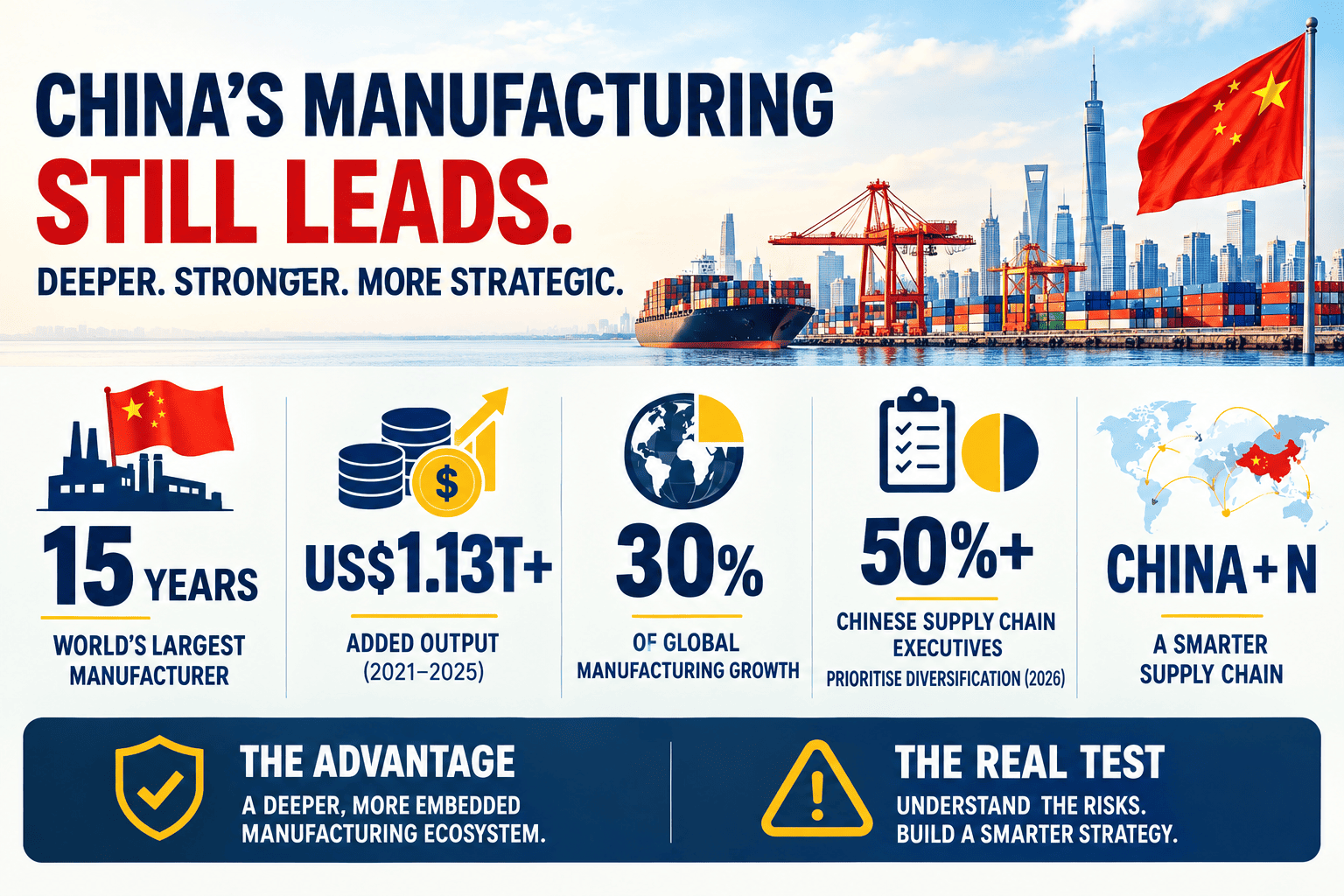
China has held the position of the world’s largest manufacturer for 15 consecutive years, and manufacturing value-added output there is estimated to have grown by more than US$1.13 trillion between 2021 and 2025 alone, contributing over 30 percent of global manufacturing growth in that period. At the same time, more than half of Chinese supply chain executives now say diversifying their own sourcing is a top priority for 2026, and companies worldwide are quietly building China-plus-N footprints rather than exiting outright. Those two facts are not in tension. They are the same story: China’s manufacturing base is deeper and more structurally embedded than most alternative destinations, and understanding exactly what that ecosystem does well, and where it is genuinely being tested, is what separates a sound diversification strategy from a reactive one. This article looks at what actually drives China’s manufacturing advantage, where the real risks sit, and how to formalise a manufacturing partnership responsibly, whether that partner is in China or part of a broader cross-border manufacturing network.
📅 Published September 7, 2026⏱ 13 min read✍️ GTsetu Editorial🔄 Updated September 7, 2026
Most conversations about supply chain diversification start with a list of alternative countries. Fewer of them start with a clear-eyed understanding of what is actually being diversified away from, and why it worked as well as it did for so long. That gap matters. A company that treats China’s manufacturing advantage as simply “cheap labour and subsidies” will consistently underestimate what it takes to replicate that advantage elsewhere, and will misjudge how much of its China footprint is worth keeping as part of a broader global expansion strategy rather than replacing entirely.
Section 1
China’s Manufacturing Base in Numbers
The scale of China’s manufacturing sector is not a matter of interpretation; it shows up consistently across trade, output, and investment data. What is more revealing is the direction that data has been moving even as global sourcing conversations have shifted toward diversification.
~30%
Share of global manufacturing value-added output that China accounts for, a position it has held for 15 consecutive years
US$4.67T
China’s manufacturing GDP in 2024, roughly 25% of the country’s total GDP
US$3.53T
Value of China’s manufactured goods exports in 2024
58%
Share of Chinese supply chain executives who name sourcing diversification their top strategic priority for 2026
That last figure is easy to misread. It does not describe companies fleeing China; it describes Chinese manufacturers themselves building more resilient, multi-market supplier networks in response to the same tariff volatility and geopolitical uncertainty that is pushing Western buyers to diversify. Meanwhile, buyers are moving in a similar direction from the other side: recent industry surveys show large importers now sourcing from close to fifty countries on average, up from the mid-forties just a year earlier, with a growing share of large companies sourcing from ten or more markets at once.
💡 Why this matters for strategy
Both sides of the trade relationship are converging on the same conclusion at the same time: single-country concentration, in either direction, is a risk worth actively managing. That is a very different starting point than “China is being replaced.” It is closer to “global manufacturing is becoming a portfolio, and China remains one of its largest and most productive holdings.”
Section 2
Why China’s Manufacturing Ecosystem Is Different
What Actually Drives the Advantage
Subsidies and low wages built China’s reputation as the world’s factory two decades ago, but that framing has aged badly. Local governments are increasingly constrained from competing on cash incentives as part of national market-unification policy, yet China’s manufacturing edge has not eroded. That is the clearest evidence that the real advantage sits somewhere else.
1
A Genuinely Integrated, End-to-End Supplier Ecosystem
Component suppliers clustered minutes, not weeks, apart
Ecosystem DepthCost Structure
The defining trait of Chinese manufacturing is scale combined with tight physical and organisational integration: nearly an entire value chain sitting inside one country, at industrial scale, with suppliers clustered close enough that problems get solved face to face rather than across a shipping delay. That density lowers inventory carrying costs, reduces coordination overhead, and shortens the distance between a design change and a working part.
🎯
Why it matters: None of these savings show up on a simple factor-cost comparison chart, which is exactly why companies that judge China purely on wage rates tend to underprice what they would be giving up by leaving, and overestimate how quickly a new location can catch up.
2
Fast Feedback Loops Between Engineering and Production
Fixes that scale across dozens of plants in a fraction of the time
Speed
Chinese factories tend to operate on unusually short cycles between production, engineering, and customer feedback, so products and processes evolve quickly. Once a fix works on one production line, the organisational discipline exists to roll it out across many plants and regions far faster than in most alternative manufacturing bases, catching defects and design flaws earlier and lowering rework and warranty costs over a product’s life.
🎯
Why it matters: This is a capability advantage, not a cost advantage, and capability advantages take years of compounding to build. That is precisely why they are so difficult for a new location to offer on short notice.
3
Provinces Now Compete on Operating Environment, Not Just Incentives
Energy pricing, test infrastructure, and pilot-friendly conditions
Policy Shift
As subsidy competition between Chinese provinces has been reined in, localities have shifted to competing on operating conditions instead. Some regions, including Yunnan, Inner Mongolia, Shanxi, and Guizhou, are competing on cheap, abundant renewable power for energy-intensive manufacturers, while others invest in infrastructure built for rapid product piloting and stress-testing.
🎯
Why it matters: A subsidised factory can be replicated anywhere a government is willing to write a bigger check. A dense, self-improving network of suppliers and engineers built over a decade cannot be conjured the same way, which is the real moat behind China’s manufacturing position.
4
Most Companies Are Building “China Plus N,” Not Replacing China
Strategic capacity retained in China, additional capacity added elsewhere
Portfolio Strategy
The China Plus One hedge of the past two decades has evolved into something closer to a manufacturing portfolio: strategic capacity retained in China where it still makes the most sense, additional manufacturing countries added for specific product categories, and risk spread across regions rather than concentrated in a single alternative. This is increasingly how leading companies are structuring their footprints rather than treating diversification as a wholesale exit.
🎯
Why it matters: Understanding what China’s ecosystem specifically delivers, integration speed, sector depth, engineering feedback, helps a company decide category by category what belongs in China, what belongs in an alternative hub, and what genuinely needs to be duplicated in both.
Section 3
Which Sectors Define China’s Manufacturing Depth
China’s manufacturing strength is not spread evenly, and neither is the pressure to diversify. Some sectors, particularly those tied to national industrial strategy, have scaled to a level few alternative locations can match in the near term, while others are more exposed to cost and tariff pressure. Understanding sector-level detail matters more than the country-level headline when a company is deciding what, specifically, to keep in China and what to test elsewhere, ideally backed by proper market research for manufacturers.
Sector
Global Position
Diversification Pressure
Trend
Electronics & Consumer Devices
Dominant global assembly and component base
High, tariff and geopolitical exposure
→ Selective relocation
Electric Vehicles & Batteries
Global leader in production and technology
Low to moderate, deep vertical integration
↑ China-anchored
Solar Panels & Renewable Equipment
Dominant global manufacturer
Moderate, trade defence measures in key markets
→ Mixed
Textiles & Apparel
Large but no longer sole global hub
High, cost and quota-driven relocation
↓ Losing share
Industrial Machinery & Robotics
Growing global competitiveness
Low, high capital and technical barriers to replicate
China’s next Five-Year Plan is explicitly doubling down on advanced manufacturing, prioritising artificial intelligence, advanced computing, and smart and green production, and pushing further localisation of strategic technologies such as semiconductors and aircraft engines. For companies evaluating how to source manufacturing materials internationally, that trajectory matters: the sectors China is investing hardest in are also the ones where an alternative location is least likely to offer comparable depth any time soon.
Section 4
The Real Risks of Single-Country Concentration
None of China’s structural strengths cancel out the practical risks of depending on a single country for critical manufacturing. These risks are well documented, and they are the actual reasons diversification has become a board-level priority rather than a theoretical exercise.
Tariff and trade-policy volatility. Tariff increases introduced in recent years have added significant landed cost to some categories of imported Chinese goods, in some cases eliminating the price advantage that made China sourcing attractive in the first place for certain products.
Retaliatory measures and export controls. Trade tensions have brought tighter export controls and monitoring of trans-shipment routes, adding a compliance layer that did not exist a decade ago, and making global trade compliance for manufacturers a much bigger part of sourcing decisions than it used to be.
Rising coastal labour costs. Wages in China’s established manufacturing hubs have climbed steadily, narrowing the pure cost gap with several alternative Asian and Latin American destinations, even as China’s productivity and sector depth remain ahead in many categories.
ESG and traceability expectations. Customers, investors, and regulators increasingly expect supply chain traceability and ethical sourcing documentation that a single, opaque, single-country footprint can struggle to provide credibly.
Rules-of-origin and transshipment scrutiny. As companies route more production through secondary countries, some of it genuinely relocated and some of it merely transiting, importing markets have tightened scrutiny of origin claims, which raises the compliance bar for both China-based and alternative suppliers alike.
📌 The honest read
China is not becoming uncompetitive, and it is not being wholesale replaced. What is changing is the risk tolerance companies bring to concentrating an entire supply chain in one country, regardless of how strong that country’s manufacturing base is. The practical response is not abandonment; it is building a deliberate, well-documented multi-country footprint, and applying the same due diligence discipline to every partner in it, including any long-standing partner already in China.
Section 5
China vs. Emerging Alternative Manufacturing Hubs
Vietnam, India, Mexico, and a growing list of emerging clusters are frequently discussed as China alternatives, but in practice they play complementary rather than directly competing roles. Each offers a different trade-off between scale, cost, and sector depth.
Factor
China
Vietnam
India
Manufacturing scale
~30% of global manufacturing value-added
Fast-growing, still a fraction of China’s scale
Large and growing, domestic-market anchored
Core strength
Deep, integrated supplier ecosystem; fast iteration
Retained for capability-intensive, high-integration production
Added for cost-sensitive, export-oriented categories
Added for scale-sensitive or domestic-market-linked categories
The practical implication is that most global manufacturers are not choosing China or an alternative; they are deciding, category by category, what stays anchored in China’s ecosystem and what moves to a location like an emerging industrial cluster or an established Southeast or South Asian hub. Running that comparison well depends on consistent partnership evaluation criteria applied across every country in the footprint, not a different standard for each one.
Section 6
Vetting and Formalising a Manufacturing Partnership, Anywhere
A strong understanding of a country’s manufacturing ecosystem, China’s or anyone else’s, does not de-risk a specific supplier relationship. A company still needs to answer very concrete questions about a specific factory: is it legally registered, does it actually hold the production capacity it claims, what happens if a shipment is delayed by disruption, and who owns the specifications once they have been shared. This discipline applies equally whether the partner in question is a long-standing manufacturer in China or a new one being evaluated as part of a diversification plan.
🏛️
Confirm legal registration and business status
Verify the company’s registration, incorporation date, and current standing before any commercial discussion goes further, in China or any alternative market.
Government-sourced verification
📄
Protect specifications and pricing before you share them
Put a formal NDA in place, and follow it with a proper business partnership contract, before sensitive product or pricing data changes hands.
NDA-first engagement
📜
Check certifications relevant to your export markets
Review how the agreement handles disruption, including force majeure in global trade, before signing, not after a shipment is delayed.
Contract terms review
🔬
Research the specific province or region, not just the country
Operating conditions, energy pricing, and labour availability vary significantly within China and any alternative market; a tailored market study for manufacturers can uncover this before capital is committed.
🤝 For Verified Long-Term Manufacturing Partnerships
GTsetu: Verified Discovery and Secure Engagement for Manufacturers, Distributors, and Raw Material Suppliers
Understanding China’s manufacturing ecosystem, or any alternative hub’s, explains why a country is worth serious consideration. It does not tell you whether a specific manufacturer is who they claim to be, or whether your product specifications will stay confidential during early-stage discussions. That gap is what GTsetu is built to close. It is a structured partnership platform, not a directory or a general marketplace, where every company is verified on 6 government-sourced points before engagement, where discovery is anonymous until mutual interest is confirmed, where NDAs are executed digitally before any commercial information changes hands, and where document exchange happens through an encrypted workspace rather than email attachments.
GTsetu is used by industrial manufacturers, distributors, and raw material suppliers across 100+ countries, including China and its emerging alternatives, to build out a distributor network, source international wholesale distribution partners, or find manufacturing and technology partnership relationships they intend to keep for years, not a single order cycle. It complements, rather than replaces, on-the-ground factory audits and country-level research, but it removes much of the identity and documentation risk before that deeper diligence even begins.
🏛️
6-Point Government-Sourced Verification
Name, Address, Registration Number, Company Status, Company Type, and Date of Incorporation, verified using government tie-ups before any engagement.
🕵️
Anonymous Discovery
Browse verified manufacturer and distributor profiles across 100+ countries without revealing your own identity or sourcing strategy until you choose to engage.
📄
Built-In NDA Workflow
Digital NDA with timestamped signatures before any pricing, formulations, or product specs are shared. No sensitive information exposed without protection.
🔐
Encrypted Document Workspace
All commercial documents shared through encrypted channels with a full access audit trail, not email attachments.
🌍
100+ Countries, Including China
Verified manufacturers and distributors across Asia, the Middle East, Europe, Africa, Australia, and the Americas. Built for cross-border partnership formation, not one-off quotes.
🚫
Zero Commission
No success fee, no broker commission, ever. Your partnership economics remain entirely between you and your partner.
It is also worth remembering that China’s ecosystem, however dominant, is not the only one worth understanding deeply before committing capital. Companies building genuinely global, resilient cross-border business partnerships increasingly run parallel evaluations across several regions at once, using a platform built for B2B matchmaking across countries rather than one built around a single geography, so the verification standard stays consistent no matter which market they land in.
FAQ
Frequently Asked Questions
QWhy does China’s manufacturing advantage go beyond low cost and subsidies?
China’s edge increasingly comes from an integrated ecosystem of clustered suppliers, tight feedback loops between engineering and production, and infrastructure built for fast iteration, not just cheap labour or tax incentives. Those structural advantages compound over time and are far harder for a single alternative location to replicate quickly than a subsidy package is, which is why the advantage has held even as local governments have pulled back on incentive competition.
QDoes understanding China’s manufacturing ecosystem still matter for a company diversifying away from it?
Yes. Most companies are not fully exiting China; they are adding capacity elsewhere while keeping strategic production in China, a pattern often described as China Plus N. Understanding what China’s ecosystem actually delivers helps a company decide what to replicate elsewhere, what to keep in China, and what realistic trade-offs an alternative supplier will involve, rather than diversifying reactively.
QWhat are the main risks of staying concentrated in China-only sourcing?
Common risks include tariff exposure and retaliatory trade measures, rising coastal labour costs, tightening rules of origin and transshipment scrutiny on goods routed through third countries, and customer-side ESG and compliance expectations that a single-country footprint can struggle to satisfy. These risks sit alongside, not instead of, China’s genuine manufacturing strengths, and they are why a documented multi-country strategy has become standard practice.
QHow should a company vet a manufacturing partner, whether in China or an alternative country?
Beyond a factory audit, companies should verify legal registration and business status, confirm real production capacity against claimed capacity, check compliance history and relevant export certifications, and put a formal agreement and confidentiality protections in place before sharing sensitive specifications or pricing. This discipline applies equally whether the partner is in China, Vietnam, India, or anywhere else in a diversified footprint, and platforms built for verified B2B partnership formation can substantially reduce the burden of doing it well.
QIs China still the default choice for global manufacturing?
For many product categories, particularly those requiring deep component integration, fast engineering iteration, or advanced-manufacturing technology, China remains difficult to match. For cost-sensitive or geopolitically exposed categories, alternative hubs such as Vietnam, India, and emerging regional clusters are increasingly viable additions. Most global manufacturers are treating this as a portfolio decision made category by category, not a single either-or choice.
Building a Diversified Manufacturing Strategy Around China?
GTsetu is purpose-built for manufacturers, distributors, and raw material suppliers in industrial sectors seeking verified long-term trade partnerships, across 100+ countries including China and its leading alternatives, with government-sourced partner verification, built-in NDA workflows, and zero commission.
They represents the product, and research team behind GTsetu, a global B2B collaboration platform built to help companies explore cross-border partnerships with clarity and trust. The team focuses on simplifying early-stage international business discovery by combining structured company profiles, verification-led access, and controlled collaboration workflows.
With a strong emphasis on trust, and disciplined engagement, Team GTsetu shares insights on global trade, partnerships, and cross-border collaboration, helping businesses make informed decisions before entering deeper commercial discussions.