Why Global Automotive Companies Should Explore Germany’s OEM Ecosystem
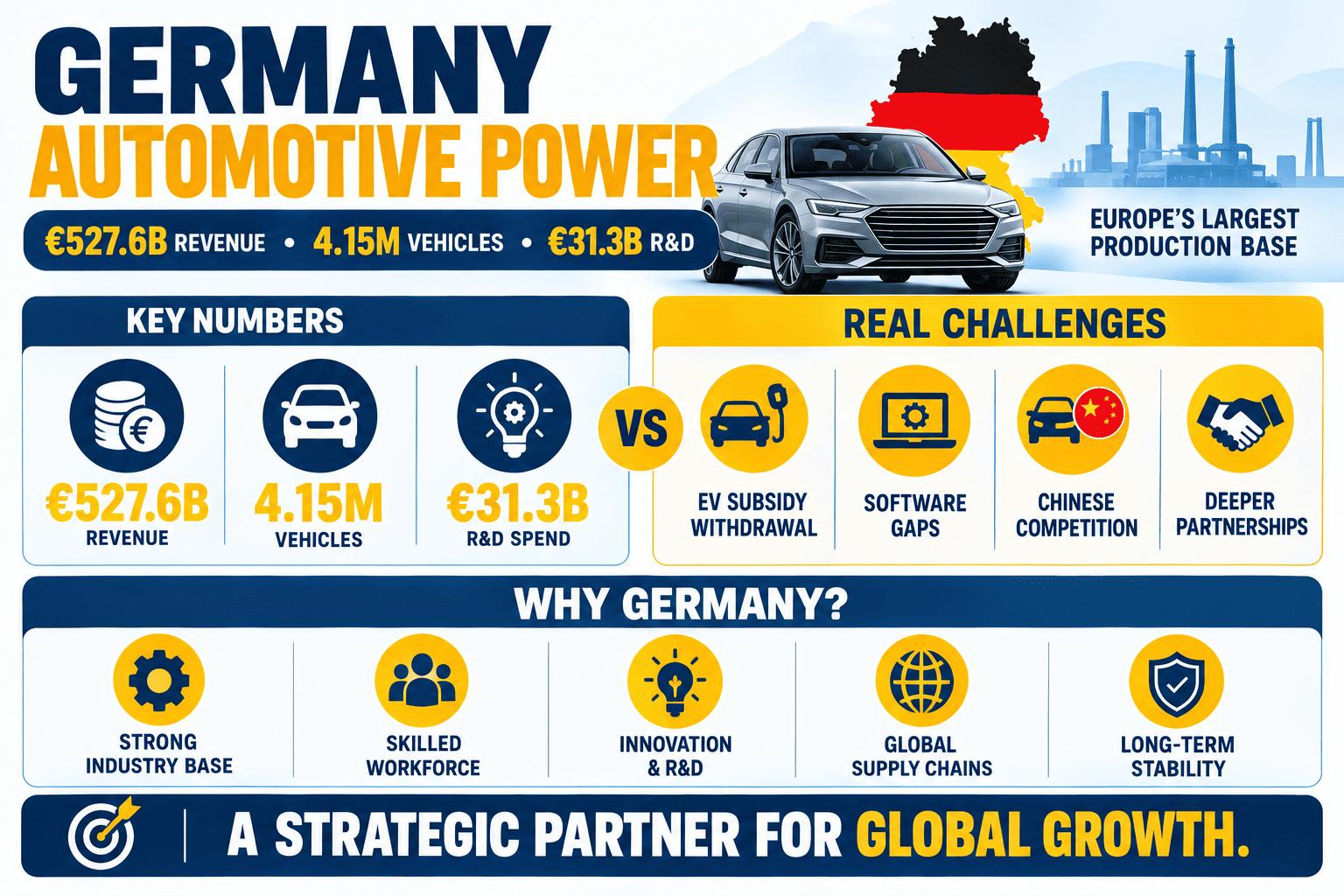
Germany’s automotive industry generated €527.6 billion in revenue in 2025 and produced 4.15 million passenger vehicles, cementing its position as Europe’s largest production base, while the sector’s roughly €31.3 billion in annual internal R&D spend remains unmatched by any other national automotive industry on the continent. That scale is not the whole story. Germany’s OEMs and their supplier base are navigating a genuine structural shift, from EV subsidy withdrawal to software gaps and Chinese competition, even as existing global players deepen technical partnerships and co-development work inside the ecosystem. This article looks at what is actually drawing global automotive companies to Germany, where the ecosystem is under real pressure, and what a company needs to check before treating a German OEM or Tier 1 supplier as a long-term partner rather than a one-off contract, as part of a broader global expansion and supply chain strategy.
📅 Published September 7, 2026⏱ 13 min read✍️ GTsetu Editorial🔄 Updated September 7, 2026
For most of the last century, Germany’s pitch to the global automotive industry has been simple: unmatched engineering depth, a dense and specialised supplier base, and brands, BMW, Mercedes-Benz, Volkswagen, Porsche, Audi, that define the premium segment worldwide. That pitch still holds real weight, but the ecosystem around it looks different than it did even five years ago. Global automakers, Tier 1 and Tier 2 suppliers, and battery and software companies engaging with Germany today are increasingly looking for co-development relationships and cross-border manufacturing partnerships within global supply chains, not just component orders.
Section 1
Germany’s Automotive Industry in Numbers
The scale of Germany’s automotive ecosystem is easiest to see in its recent industry data. In 2025, the automotive sector remained by far Germany’s largest industrial sector by revenue, and its export share, production volume, and R&D intensity all continued to outpace every other segment of German industry.
€527.6B
Total automotive industry revenue in Germany in 2025, the largest of any German industrial sector
4.15M
Passenger vehicles produced in Germany in 2025, making it Europe’s leading production site
€31.3B
Internal automotive R&D expenditure in 2024, with 158,000+ engineers working in automotive R&D
77%
Share of German passenger car and light commercial vehicle manufacturer revenue generated from exports in 2025
Behind these headline figures is a more specific pattern worth noting: Germany’s automotive R&D base is not just large in absolute terms, it is disproportionately concentrated relative to the rest of the German economy. Historically, automotive R&D spend has accounted for well over a third of total private-sector R&D investment nationwide, a concentration no other German industry comes close to matching. That is a meaningfully different signal than pure production capacity. It suggests that companies engaging the German ecosystem are tapping into a research and engineering base built specifically around next-generation vehicle technology, not just assembly capacity.
💡 Why this distinction matters
Production volume tells you a country can build cars at scale. R&D concentration tells you whether the ecosystem around that production is actively solving tomorrow’s engineering problems, battery chemistry, software-defined vehicles, autonomous systems, rather than just executing yesterday’s designs. Germany’s R&D numbers lean heavily toward the latter, which is a stronger signal for companies evaluating whether to commit to a German automotive partner for co-development rather than a single sourcing cycle.
Section 2
Why Global Companies Are Engaging Germany’s OEM Ecosystem
The Core Drivers
No single factor explains why global automotive companies keep returning to Germany. It is a combination of engineering depth, research infrastructure, supplier density, and regulatory credibility that together make Germany a higher-trust, technically demanding partner ecosystem, even as its cost position has shifted.
1
Unmatched Automotive R&D and Innovation Infrastructure
Fraunhofer institutes, battery research clusters, 158,000+ automotive engineers
R&D DepthTalent Pool
Germany hosts a dense network of applied research institutions, including the Fraunhofer Society, the Max Planck Institute, and dedicated battery research clusters such as FESTBATT, that connect academic research directly to industrial application. The Fraunhofer Research Institution for Battery Cell Production exists specifically to help scale battery technology from lab bench to large-scale manufacturing, and international battery and EV technology companies have established German entities specifically to plug into this research base.
🎯
Why it matters: Few countries offer this density of applied automotive research infrastructure alongside production capacity, which is why global battery, software, and component companies treat a German presence as a way to accelerate commercialisation, not just manufacture at scale.
2
One of the World’s Deepest Tier 1 and Tier 2 Supplier Networks
Decades of close OEM-supplier collaboration and quality systems
Supplier Depth
Germany’s automotive strength has never rested on OEMs alone. A dense, specialised network of component and systems suppliers, in metal products, powertrains, electronics, and rubber and plastics, has grown up alongside the major brands over decades, with employment attributable to this upstream network running into the hundreds of thousands. This collaborative OEM-supplier model, built on close technical integration and rigorous quality certification, remains a structural advantage that newer manufacturing hubs have not yet replicated at the same depth.
🎯
Why it matters: A global automaker or Tier 1 entering the German ecosystem is not just accessing a factory, it is accessing an entire layered network of specialised, certified suppliers built for exactly this kind of integration.
German passenger car and light commercial vehicle manufacturers generated 77 percent of their 2025 revenue from exports, and the country’s automotive industry operates under strict safety and environmental regulation backed by internationally recognised certifications such as ISO 9001 and ISO 14001. For global buyers and partners, a “Made in Germany” designation still functions as a credible quality signal that eases market entry and customer trust in markets far beyond Europe.
🎯
Why it matters: Regulatory and quality credibility reduces downstream risk for companies sourcing components or co-developing vehicles intended for markets with strict compliance requirements.
4
An Ecosystem Actively Repositioning for the Software-Defined Vehicle Era
Unified software platforms, regional battery supply chains, EU alliances
Transformation
German OEMs are consolidating platform and software development, Volkswagen’s unified SSP platform and VW.os operating system are a clear example, while simultaneously investing in regional battery production and EU-based supply chain resilience rather than continuing to depend on distant, just-in-time global logistics. For companies looking to co-develop software-defined vehicle capabilities or secure regionally resilient component supply, this repositioning creates a genuine entry point rather than a legacy structure to work around.
🎯
Why it matters: An ecosystem actively rebuilding itself around software and regional resilience is one where new partners can shape how things get built, not just plug into a fixed, legacy process.
Section 3
Which Segments Are Driving Germany’s Automotive Ecosystem
Germany’s automotive strength is not evenly distributed across segments. Some areas remain the industry’s traditional core, while others, batteries, software, and autonomous systems, are where the fastest-growing investment and partnership activity is happening. Understanding segment-level detail matters more than the country-level headline when evaluating a specific international sourcing decision.
Segment
Approx. Scale / Signal
Global Position
Trend
Passenger Vehicle Production
4.15 million vehicles (2025)
Europe’s leading production site
↑ Recovering post-2024
Automotive R&D
€31.3 billion internal spend, 158,000+ engineers
Highest automotive R&D intensity in Europe
↑ E-mobility & digitalization focus
Battery & E-Mobility R&D
~€44 billion earmarked for e-mobility and digitalization
Major solid-state and cell-production research hub
↑ Fastest-growing investment area
Employment
731,900 direct automotive employees (2025)
Second-largest industrial employer in Germany
→ Under restructuring pressure
Software-Defined Vehicles (SDV)
Unified OEM software platforms in development
Catching up after publicised software setbacks
↑ Heavy strategic investment
Autonomous Driving (ADAS)
Level 3 autonomy deployment underway
Early-mover among legacy premium OEMs
↑ Early but expanding
The direction of travel matters as much as the current scale. Germany’s automotive opportunity areas explicitly named by national investment promotion bodies now include solid-state battery technology, autonomous driving, fuel cell technology, lightweighting, and software-defined vehicles, alongside the traditional strengths in precision engineering and powertrain manufacturing. Companies partnering with German OEMs and suppliers today are increasingly likely to be working alongside an ecosystem investing heavily in its own next-generation capability, not simply defending legacy market share.
Section 4
The Challenges the German Auto Industry Still Has to Solve
None of this means Germany is a frictionless choice. Several structural issues are well documented and worth weighing honestly before committing to a long-term partnership with a German OEM or supplier.
High domestic energy and labour costs. Germany remains among the most expensive places in the world to manufacture vehicles, and nearly 40 percent of German industrial firms have reported considering relocating some operations abroad as a result, a real signal of cost pressure worth factoring into any long-term sourcing plan.
A software and digital-UX gap at several premium OEMs. Multiple German brands have faced public criticism over clunky infotainment systems, delayed software timelines, and in at least one case a major software recall affecting hundreds of thousands of EV owners, underscoring that hardware excellence alone no longer guarantees market leadership.
Intensifying competition from Chinese EV brands. Lower-cost, tech-forward Chinese automakers are increasingly viewed by consumers as innovative rather than merely cheap, which is compressing the price premium German brands have traditionally commanded, particularly in the mid-market segment.
Uneven EV charging infrastructure. Germany’s EV-to-public-charger ratio continues to lag rising EV adoption, with a large majority of charging still happening in private workplace or dealership settings rather than public infrastructure, a gap that affects both consumer demand and the broader e-mobility investment case.
Likely consolidation among suppliers. Electrification is capital-intensive, and not every traditional supplier or smaller OEM is expected to survive the transition independently, meaning partnership evaluation now needs to weigh a supplier’s financial resilience and EV-transition exposure, not just current capacity, and this connects directly to broader global trade compliance and continuity planning for buyers.
📌 The honest read
Germany’s automotive ecosystem is not eroding overnight, but it is at a genuine inflection point: the industry needs to shift from competing on engineering prestige alone to competing on software, cost discipline, and regional supply chain resilience simultaneously. Companies building a long-term manufacturing or co-development relationship in Germany should factor this transition into their planning rather than assuming today’s structure holds static for the life of the partnership.
Section 5
Germany vs. Other Automotive Manufacturing Hubs
Germany is not the only automotive manufacturing and innovation hub global companies are evaluating. Vietnam and India, in particular, are increasingly discussed alongside Germany as complementary rather than competing options for automotive components and assembly, since the markets tend to play to very different strengths.
Factor
Germany
Emerging Hubs (e.g. Vietnam, India)
Core strength
Engineering depth, R&D, premium quality
Cost-competitive assembly and components at scale
Automotive R&D intensity
€31.3B+ annual internal spend
Growing, but concentrated in fewer segments
Cost position
High labour and energy costs
Lower labour costs, improving productivity
Trade and regulatory credibility
Strict EU standards, established export trust
Expanding trade agreement networks and FTZs
Supplier ecosystem maturity
Decades-deep Tier 1/Tier 2 integration
Rapidly scaling, less deeply layered
Best fit for
Co-development, precision components, premium and technical manufacturing
Export-oriented assembly and cost-sensitive component sourcing
Many global automotive companies are not choosing between Germany and lower-cost hubs so much as building a multi-country footprint that uses each for what it does best, engineering and co-development depth from Germany, cost-competitive assembly and scale from Southeast or South Asia. That approach reduces both cost risk and technical risk further than committing entirely to one region, but it also means a company will likely need to evaluate and formalise more than one automotive partnership at once, using consistent partnership evaluation criteria across markets.
Section 6
Vetting and Formalising a German Automotive Partnership
Country-level engineering credibility does not de-risk an individual OEM or supplier relationship. A promising national ecosystem still leaves a company needing to answer very specific questions about a specific partner: is it legally registered and financially stable heading into an expensive electrification cycle, does it hold the quality certifications your programme requires, what happens if a shipment or development milestone is delayed, and who owns the intellectual property once specifications are shared. This is where most automotive sourcing and co-development decisions actually succeed or fail, and it is a different discipline from reading industry reports.
🏛️
Confirm legal registration and financial stability
Verify the company’s registration, incorporation date, and current standing, and weigh its financial resilience given the capital intensity of the EV transition.
Government-sourced verification
📄
Protect specifications and IP before you share them
Put a formal NDA in place, and follow it with a proper business partnership contract, before sensitive vehicle or component data changes hands.
NDA-first engagement
📜
Check certifications relevant to automotive quality
Review how the agreement handles disruption, including force majeure in global trade, before signing, not after a production milestone slips.
Contract terms review
🔬
Research the specific state and cluster, not just the country
Conditions, incentives, and supplier density vary significantly by federal state and industrial cluster; a tailored market study for manufacturers can uncover this before capital is committed.
GTsetu: Verified Discovery and Secure Engagement for Manufacturers, Distributors, and Component Suppliers
Germany’s engineering reputation and R&D depth explain why the ecosystem is worth serious consideration. They do not tell you whether a specific OEM or Tier 1 supplier is who they claim to be, whether they are financially positioned to survive the electrification transition, or whether your specifications will stay confidential during early-stage discussions. That gap is what GTsetu is built to close. It is a structured partnership platform, not a directory or a general marketplace, where every company is verified on 6 government-sourced points before engagement, where discovery is anonymous until mutual interest is confirmed, where NDAs are executed digitally before any commercial information changes hands, and where document exchange happens through an encrypted workspace rather than email attachments.
GTsetu is used by industrial manufacturers, distributors, and component and raw material suppliers across 100+ countries, including Germany, to build out a distributor network, source international wholesale distribution partners, or find manufacturing and technology partnership relationships they intend to keep for years, not a single order cycle. It complements, rather than replaces, on-the-ground facility audits and country-level research, but it removes much of the identity and documentation risk before that deeper diligence even begins.
🏛️
6-Point Government-Sourced Verification
Name, Address, Registration Number, Company Status, Company Type, and Date of Incorporation, verified using government tie-ups before any engagement.
🕵️
Anonymous Discovery
Browse verified manufacturer and supplier profiles across 100+ countries without revealing your own identity or sourcing strategy until you choose to engage.
📄
Built-In NDA Workflow
Digital NDA with timestamped signatures before any pricing, specifications, or engineering data is shared. No sensitive information exposed without protection.
🔐
Encrypted Document Workspace
All commercial documents shared through encrypted channels with a full access audit trail, not email attachments.
🌍
100+ Countries, Including Germany
Verified manufacturers and distributors across Europe, Asia, the Middle East, Africa, Australia, and the Americas. Built for cross-border partnership formation, not one-off quotes.
🚫
Zero Commission
No success fee, no broker commission, ever. Your partnership economics remain entirely between you and your partner.
It is also worth noting that Germany is far from the only region rewriting global automotive sourcing maps. Manufacturers evaluating diversification often run parallel conversations across multiple regions at once, including emerging clusters like the Nigerian industrial and agro cluster, alongside established options in Southeast Asia and elsewhere in Europe. A platform built for B2B matchmaking across countries, rather than one built around a single geography, makes it easier to run that comparison with consistent verification standards throughout, all underpinned by durable cross-border business partnerships.
FAQ
Frequently Asked Questions
QWhy should global automotive companies explore Germany’s OEM ecosystem?
Germany combines the largest automotive production and revenue base in Europe, the highest automotive R&D spend of any economy on the continent, and one of the deepest Tier 1 and Tier 2 supplier networks in the world. Companies looking for engineering-grade manufacturing partners, software-defined vehicle expertise, or battery and e-mobility R&D collaboration continue to find Germany one of the most credible automotive ecosystems to plug into, even as the industry itself goes through real structural change.
QIs Germany still cost-competitive for automotive manufacturing?
Germany has never competed primarily on labour cost, and that gap has widened as energy and wage costs have risen, with nearly 40 percent of German industrial firms reportedly considering relocating some operations abroad. Its advantage lies in engineering depth, quality certification, R&D intensity, and supply chain sophistication rather than price. Many global companies engage the German ecosystem for co-development, component sourcing, or premium and technical manufacturing rather than as a low-cost production base.
QWhat are the main risks of partnering with the German automotive industry right now?
Common risks include high domestic energy and labour costs pushing some firms to consider relocating operations, a software and digital-UX gap that has affected several premium OEMs, competitive pressure from lower-cost Chinese EV brands, uneven EV charging infrastructure, and likely consolidation among suppliers as electrification strains capital. Verifying a specific supplier or OEM’s registration, capacity, and financial stability before committing is essential given this backdrop, and building contingency terms for disruption into the contract from the outset matters just as much.
QHow should a company vet an automotive partner in Germany?
Beyond a standard facility audit, companies should verify legal registration and business status, confirm production capacity and quality certifications such as IATF 16949, check the supplier’s exposure to the EV transition and financial resilience, and put a formal agreement and confidentiality protections in place before sharing sensitive specifications or pricing. Platforms built for verified B2B partnership formation, rather than general directories or RFQ marketplaces, can substantially reduce this due diligence burden by handling identity verification and document security upfront.
QShould a company choose Germany or an emerging hub like Vietnam or India for automotive sourcing?
It depends on the product and priority. Germany tends to suit co-development, precision components, and premium or technically demanding manufacturing where engineering depth and quality credibility matter most. Emerging hubs tend to suit cost-sensitive component sourcing and export-oriented assembly at scale. Many global automotive companies are not choosing one over the other; they are building sourcing footprints that use both, alongside other regions, for what each does best.
Considering Germany for Your Next Automotive Partnership?
GTsetu is purpose-built for manufacturers, distributors, and component suppliers in industrial sectors seeking verified long-term trade partnerships, across 100+ countries including Germany, with government-sourced partner verification, built-in NDA workflows, and zero commission.
They represents the product, and research team behind GTsetu, a global B2B collaboration platform built to help companies explore cross-border partnerships with clarity and trust. The team focuses on simplifying early-stage international business discovery by combining structured company profiles, verification-led access, and controlled collaboration workflows.
With a strong emphasis on trust, and disciplined engagement, Team GTsetu shares insights on global trade, partnerships, and cross-border collaboration, helping businesses make informed decisions before entering deeper commercial discussions.