Why the Middle East Is Becoming a Strategic Hub for Global Trade and Logistics
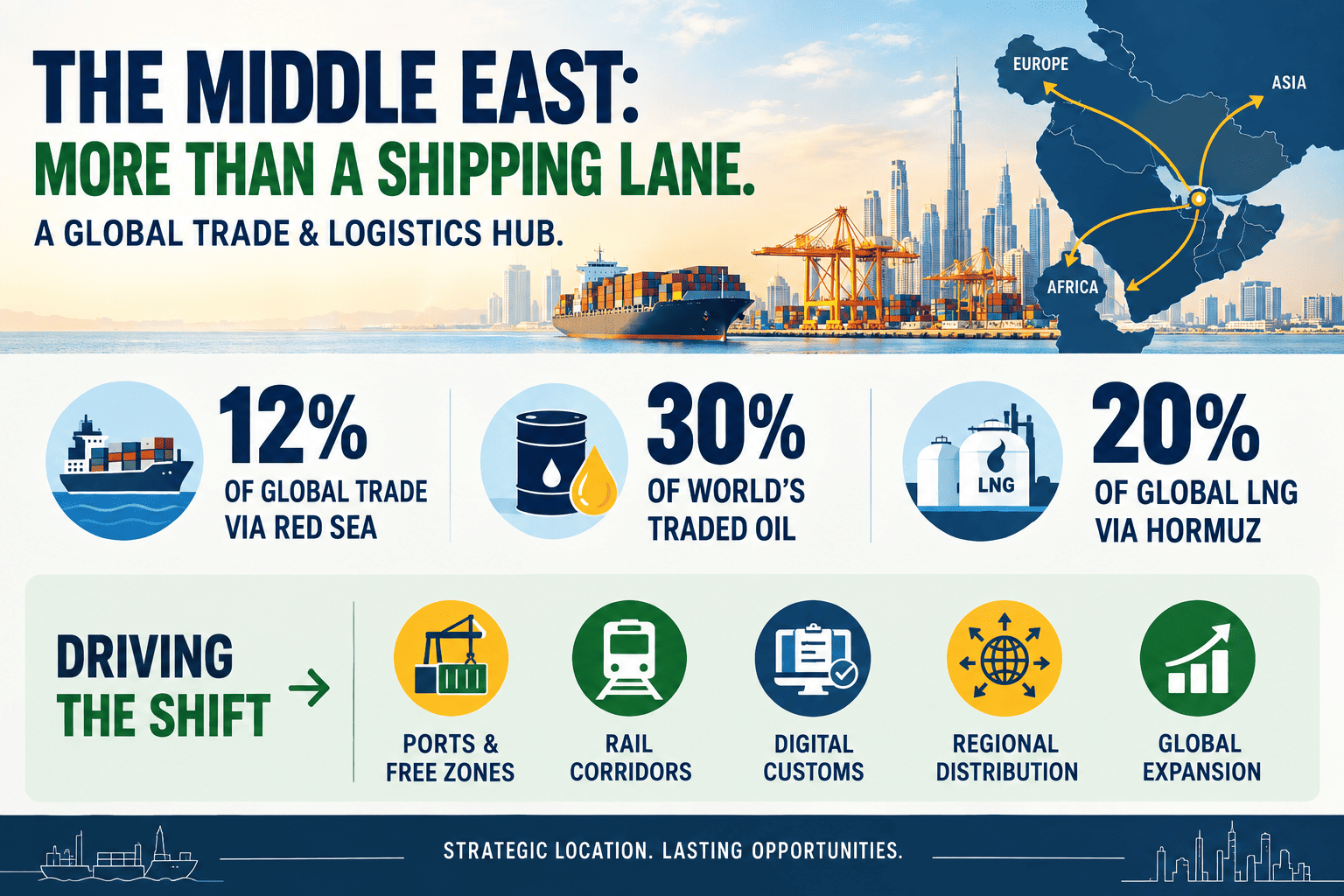
Around 12% of global trade volumes pass through the Red Sea, and roughly 30% of the world’s traded oil and about 20% of all liquefied natural gas move through the Strait of Hormuz each year. Those numbers alone would make the Middle East geographically important. What has changed is what governments and companies are doing with that geography: Gulf states have paired their historic position between Europe, Asia, and Africa with sustained investment in ports, free zones, rail corridors, and digital customs, and global companies are increasingly treating the region as a base for regional distribution and global expansion, not just a shipping lane to pass through. This article looks at what is actually driving that shift, where the region still has real gaps, and what a company needs to check before treating a Middle Eastern logistics or trade partner as a long-term relationship rather than a one-off shipment.
📅 Published September 7, 2026⏱ 13 min read✍️ GTsetu Editorial🔄 Updated September 7, 2026
For centuries, the Middle East’s value to global trade came almost entirely from where it sits on the map, between the manufacturing centres of Asia and the consumer markets of Europe and Africa. That geography still matters, but it is no longer the whole story. National transformation programmes, purpose-built free zones, and a wave of infrastructure spending have turned a historic transit corridor into a region companies are choosing to build long-term trade partnerships in, part of broader cross-border business partnerships rather than a single shipping route to route product through.
Section 1
The Middle East’s Trade Position in Numbers
The scale of the Middle East’s role in global trade is easiest to see through the volumes that move across, and around, the region every year. Even accounting for recent disruption, the numbers show a region that remains structurally central to how goods and energy reach the rest of the world.
~12%
Of global trade volumes passed through the Red Sea in 2023, according to the US Congressional Research Service
~30%
Of the world’s traded oil, and around 20% of global LNG, shipped via the Strait of Hormuz in 2023 (IEA)
$54.4B
Target annual revenue for the UAE’s logistics industry by 2032, up from around $35 billion today
8.3M
Containers handled by Saudi Arabia in 2025, including 2.2 million transshipment containers
Behind these headline figures is a more specific pattern worth noting: a meaningful share of recent investment is going into re-export and transshipment capacity rather than domestic consumption alone. Saudi Arabia’s logistics centres linked to re-export activity have grown to 24, up from just two in 2019. That is a different signal than raw trade volume; it suggests the region is being built out deliberately as a redistribution point for goods moving onward to other markets, not simply as a place goods pass through on their way somewhere else.
💡 Why this distinction matters
A country that merely sits on a busy shipping lane benefits passively from geography. A country building dedicated re-export infrastructure, free zones, bonded warehousing, digital customs, is actively converting transit volume into value-added logistics revenue. The Middle East’s recent investment pattern leans heavily toward the latter, which is a stronger signal for companies evaluating whether to base a regional distribution hub there rather than simply ship through.
Section 2
Why Global Companies Are Routing Trade Through the Middle East
The Core Drivers
No single factor explains the Middle East’s rise as a trade and logistics hub. It is a combination of geography, government-led transformation programmes, purpose-built free zones, and digital trade infrastructure that together make the region a more central node in global supply chains than it was a decade ago.
1
A Geography No Other Region Can Replicate
The Red Sea, the Strait of Hormuz, and the Suez corridor
Trade CorridorTransit Advantage
The Middle East sits directly on the maritime corridors that connect Asian manufacturing centres with European and African markets, with around 12% of global trade volumes moving through the Red Sea and close to a third of the world’s seaborne oil trade passing through the Strait of Hormuz. That position gives companies routing goods through the region shorter transit times to three continents than most alternative hub locations can offer.
🎯
Why it matters: A shipment consolidated or transshipped through a Gulf port frequently reaches European, African, and South Asian destinations faster than the same shipment routed through a single-continent hub. That is a durable geographic advantage, not a temporary routing choice.
2
Coordinated National Transformation Programmes
Saudi Vision 2030, We the UAE 2031, Qatar National Vision 2030
Policy Driven
Saudi Arabia’s National Shipping and Logistics Plan, part of Vision 2030, has already produced 59 logistics hubs alongside gains in digital services, port capacity, and multimodal connectivity. The UAE launched its Emirates Council for Logistics Integration in February 2025 with a target of raising the country’s logistics industry revenue from roughly $35 billion to $54.4 billion by 2032, backed by a broader Dh200 billion transport and logistics strategy. Qatar’s National Vision 2030 runs a parallel track focused on economic diversification away from hydrocarbons.
🎯
Why it matters: These are not one-off announcements; they are funded, multi-year national strategies with explicit revenue and capacity targets, which reduces the risk that incentives or infrastructure commitments stall partway through a company’s investment horizon.
3
Purpose-Built Free Zones and Multimodal Networks
JAFZA, Jebel Ali Port, and integrated sea-air-road-rail links
Infrastructure
Free zones such as the Jebel Ali Free Zone give companies direct access to one of the region’s busiest container ports alongside scalable warehousing, streamlined customs, and connections across sea, air, and road freight. The Gulf Railway Project, a planned 2,177-kilometre high-speed rail network linking six member states, is intended to extend that connectivity further inland, reducing dependence on road freight for cross-border cargo movement.
🎯
Why it matters: A company can consolidate inventory from multiple suppliers in one free zone and redistribute it across the GCC, Africa, and South Asia without maintaining separate warehousing in every market, cutting both cost and lead time.
Digital customs systems across the region are replacing manual paperwork with electronic documentation and automated data sharing, improving cargo visibility and reducing clearance delays. National transformation programmes are also directing continuing public and private investment into infrastructure that incorporates artificial intelligence for demand forecasting, predictive maintenance, and shipment tracking.
🎯
Why it matters: Faster, more predictable customs clearance lowers the effective cost of routing time-sensitive goods, electronics, medical devices, and automotive parts among them, through the region rather than around it.
Section 3
Which Hubs and Sectors Are Driving the Region’s Growth
The Middle East’s trade and logistics strength is concentrated in a handful of hubs and sectors, each playing a distinct role in the broader network. Understanding which one fits a specific sourcing or distribution need matters more than the region-level narrative when planning actual operations, and it connects directly to the kind of international sourcing decisions companies are already making elsewhere in Asia.
Hub / Sector
Core Role
Global Position
Trend
Jebel Ali Port & JAFZA (UAE)
Regional distribution & re-export
Among the world’s busiest container ports
↑ Steady expansion
Saudi Ports & Logistics Hubs
Transshipment & industrial logistics
8.3M containers handled in 2025
↑ Fastest-growing capacity
Strait of Hormuz Energy Corridor
Oil & LNG shipping
~30% of world’s seaborne oil trade
→ Stable, strategically sensitive
Red Sea Shipping Corridor
Asia–Europe container transit
~12% of global trade volumes
→ Recovering from disruption
Air Cargo (Dubai, Doha, Riyadh)
Electronics, medical, high-value goods
Fast-growing global air freight gateways
↑ Expanding capacity
Gulf Railway Project
Inland multimodal connectivity
2,177 km network across six states
↑ Under development
The direction of travel matters as much as current scale. National programmes are explicitly pushing investment toward higher value-added logistics activity, digital customs, bonded re-export facilities, cold-chain and specialised warehousing, rather than pure pass-through transit. Companies sourcing or distributing through the Middle East today are increasingly dealing with hubs investing in their own capability, not just their throughput.
Section 4
The Challenges the Region Still Has to Solve
None of this makes the Middle East a frictionless choice. Several structural issues are well documented and worth weighing honestly before building a logistics or trade partnership around the region.
Limited cross-border collaboration between logistics systems. Coordination between individual Gulf countries’ logistics strategies is improving through joint dialogues, but remains less integrated than a single regional system would be, meaning some infrastructure investment risks overlapping rather than compounding.
Uneven intermodal integration. Maritime, aviation, rail, and road logistics are not yet fully connected across the region; the Gulf Railway Project is intended to close part of that gap, but it remains under development rather than complete.
Shortage of skilled logistics personnel. National transformation programmes explicitly flag a need to expand training for both expatriate and local logistics workers so they can operate increasingly automated, AI-driven logistics technology.
Gaps in sustainability alignment. Middle Eastern logistics and shipping companies are working to bring their operations into full alignment with international sustainability regulations, a compliance dimension global buyers increasingly expect their trade compliance partners to meet.
Exposure to geopolitical shocks. The COVID-19 pandemic, the 2021 Suez Canal obstruction, the Red Sea crisis, and the war in Ukraine have all placed severe strain on trade flows through the region, with shipping costs and insurance rates rising sharply between 2020 and 2024, underscoring why force majeure terms in global trade agreements need to be planned for rather than assumed away.
📌 The honest read
The Middle East’s structural trade advantage is not going away; its geography does not change. But the region is at an inflection point similar to other rising hubs: it needs to convert a series of strong national programmes into a genuinely coordinated regional system, rather than a set of parallel efforts that occasionally compete for the same investment and cargo. Companies building a long-term logistics relationship in the region should factor that transition into their planning.
Section 5
The Middle East vs. Other Global Trade Hubs
The Middle East is not the only region rewriting global logistics maps. Southeast Asian manufacturing hubs and other emerging logistics clusters are frequently discussed alongside the Middle East as complementary rather than competing options, since each tends to play to different strengths in a company’s broader network.
Factor
Middle East (GCC + Egypt)
Southeast Asia (e.g. Vietnam)
Primary role in supply chains
Trade, transshipment & regional distribution
Manufacturing & assembly
Core geographic advantage
Crossroads of Europe, Asia & Africa
Proximity to China, export-oriented ports
Flagship transformation programme
Vision 2030, We the UAE 2031, Qatar National Vision 2030
Manufacturing FDI incentives, free trade zones
Strongest infrastructure asset
Free zones (e.g. JAFZA), Red Sea & Hormuz shipping lanes
Deep-water export ports, FTA network
Best fit for
Regional consolidation, re-export and distribution across GCC, Africa & South Asia
Export-oriented assembly and light manufacturing at speed
Many global companies are not choosing between the Middle East and Asian manufacturing hubs so much as linking the two: manufacturing in Asia, consolidating and redistributing through a Gulf free zone, and serving Europe, Africa, and South Asia from that single base. That approach reduces concentration risk further than committing to one region alone, but it also means a company will likely need to evaluate and formalise more than one trade partnership at once, using consistent partnership evaluation criteria across markets.
Section 6
Vetting and Formalising a Middle Eastern Trade Partnership
Regional momentum does not de-risk an individual logistics or trade relationship. A strong national trend still leaves a company needing to answer specific questions about a specific counterparty: is it legally licensed in the free zone or mainland it claims, does it have the warehousing or throughput capacity it advertises, what happens if a shipment is delayed by a force majeure event, and who bears responsibility for customs compliance. This is where most trade partnerships actually succeed or fail, and it is a different discipline from reading a country-level transformation plan.
🏛️
Confirm legal registration and licensing status
Verify the company’s free zone or mainland registration, incorporation date, and current standing before any commercial discussion goes further.
Government-sourced verification
📄
Protect specifications and pricing before you share them
Put a formal NDA in place, and follow it with a proper business partnership contract, before sensitive product or pricing data changes hands.
NDA-first engagement
📜
Check certifications relevant to your export markets
Review how the agreement handles disruption, including force majeure in global trade, before signing, not after a shipment is delayed by a regional shock.
Contract terms review
🔬
Research the specific free zone or port, not just the country
Conditions, incentives, and connectivity vary significantly by free zone; a tailored market study for manufacturers can uncover this before capital is committed.
🤝 For Verified Long-Term Trade & Logistics Partnerships
GTsetu: Verified Discovery and Secure Engagement for Manufacturers, Distributors, and Raw Material Suppliers
The Middle East’s trade numbers explain why the region is worth serious consideration. They do not tell you whether a specific logistics provider or distributor is who they claim to be, or whether your product specifications will stay confidential during early-stage discussions. That gap is what GTsetu is built to close. It is a structured partnership platform, not a directory or a general marketplace, where every company is verified on 6 government-sourced points before engagement, where discovery is anonymous until mutual interest is confirmed, where NDAs are executed digitally before any commercial information changes hands, and where document exchange happens through an encrypted workspace rather than email attachments.
GTsetu is used by industrial manufacturers, distributors, and raw material suppliers across 100+ countries, including across the Middle East, to build out a distributor network, source international wholesale distribution partners, or find logistics and technology partnership relationships they intend to keep for years, not a single shipment cycle. It complements, rather than replaces, on-the-ground facility audits and country-level research, but it removes much of the identity and documentation risk before that deeper diligence even begins.
🏛️
6-Point Government-Sourced Verification
Name, Address, Registration Number, Company Status, Company Type, and Date of Incorporation, verified using government tie-ups before any engagement.
🕵️
Anonymous Discovery
Browse verified manufacturer and distributor profiles across 100+ countries without revealing your own identity or sourcing strategy until you choose to engage.
📄
Built-In NDA Workflow
Digital NDA with timestamped signatures before any pricing, formulations, or product specs are shared. No sensitive information exposed without protection.
🔐
Encrypted Document Workspace
All commercial documents shared through encrypted channels with a full access audit trail, not email attachments.
🌍
100+ Countries, Including the Middle East
Verified manufacturers and distributors across Asia, the Middle East, Europe, Africa, Australia, and the Americas. Built for cross-border partnership formation, not one-off quotes.
🚫
Zero Commission
No success fee, no broker commission, ever. Your partnership economics remain entirely between you and your partner.
It is also worth noting that the Middle East is far from the only region rewriting global trade maps. Manufacturers and distributors evaluating diversification often run parallel conversations across multiple regions at once, including emerging clusters like the Nigerian industrial and agro cluster, alongside established manufacturing bases across Asia connected through cross-border manufacturing partnerships in global supply chains. A platform built for B2B matchmaking across countries, rather than one built around a single geography, makes it easier to run that comparison with consistent verification standards throughout.
FAQ
Frequently Asked Questions
QWhy is the Middle East becoming a strategic hub for global trade and logistics?
The Middle East sits at the intersection of Europe, Asia, and Africa, with roughly 12% of global trade volumes passing through the Red Sea and around 30% of the world’s traded oil moving through the Strait of Hormuz. National transformation programmes such as Saudi Arabia’s Vision 2030 and the UAE’s We the UAE 2031 have paired that geography with sustained investment in ports, free zones, rail, and digital customs, turning a historic trade corridor into a modern logistics and distribution hub.
QIs the Middle East just a transit region, or does it add value to global supply chains?
It is increasingly both. The region still moves an outsized share of the world’s maritime oil and container traffic, but free zones such as JAFZA now let companies consolidate, warehouse, and re-export goods across the GCC, Africa, and South Asia from a single base, while national programmes are pushing investment into higher value-added logistics, digital customs, and multimodal rail and port integration rather than pure transit.
QWhat are the main risks of routing trade through the Middle East?
Documented risks include limited cross-border collaboration between logistics systems in different Middle Eastern countries, uneven intermodal integration between sea, air, rail, and road, a shortage of skilled logistics personnel, gaps in alignment with international sustainability regulations, and periodic geopolitical shocks such as the Red Sea crisis and the 2021 Suez Canal obstruction that can sharply raise shipping costs and insurance rates. Verifying a specific partner’s registration, capacity, and compliance record before committing remains essential, and building contingency terms for disruption into the contract from the outset matters just as much.
QHow should a company vet a trade or logistics partner in the Middle East?
Beyond a standard facility audit, companies should verify legal registration and free zone or mainland licensing status, confirm actual warehousing and throughput capacity against claimed capacity, check compliance history and applicable certifications, and put a formal agreement and confidentiality protections in place before sharing sensitive specifications or pricing. Platforms built for verified B2B partnership formation, rather than general directories or RFQ marketplaces, can substantially reduce this due diligence burden by handling identity verification and document security upfront.
QShould a company use the Middle East or an Asian manufacturing hub for supply chain diversification?
It depends on the role a company needs filled. Asian manufacturing hubs tend to suit export-oriented assembly and light manufacturing, while the Middle East tends to suit regional consolidation, re-export, and distribution across the GCC, Africa, and South Asia. Many global companies are not choosing one over the other; they are linking manufacturing in Asia with distribution through a Gulf free zone as part of a single, more resilient supply chain.
Considering the Middle East for Your Next Trade or Logistics Partnership?
GTsetu is purpose-built for manufacturers, distributors, and raw material suppliers in industrial sectors seeking verified long-term trade partnerships, across 100+ countries including across the Middle East, with government-sourced partner verification, built-in NDA workflows, and zero commission.
They represents the product, and research team behind GTsetu, a global B2B collaboration platform built to help companies explore cross-border partnerships with clarity and trust. The team focuses on simplifying early-stage international business discovery by combining structured company profiles, verification-led access, and controlled collaboration workflows.
With a strong emphasis on trust, and disciplined engagement, Team GTsetu shares insights on global trade, partnerships, and cross-border collaboration, helping businesses make informed decisions before entering deeper commercial discussions.