How to Expand Your Manufacturing & Industrial Automation Business to Egypt
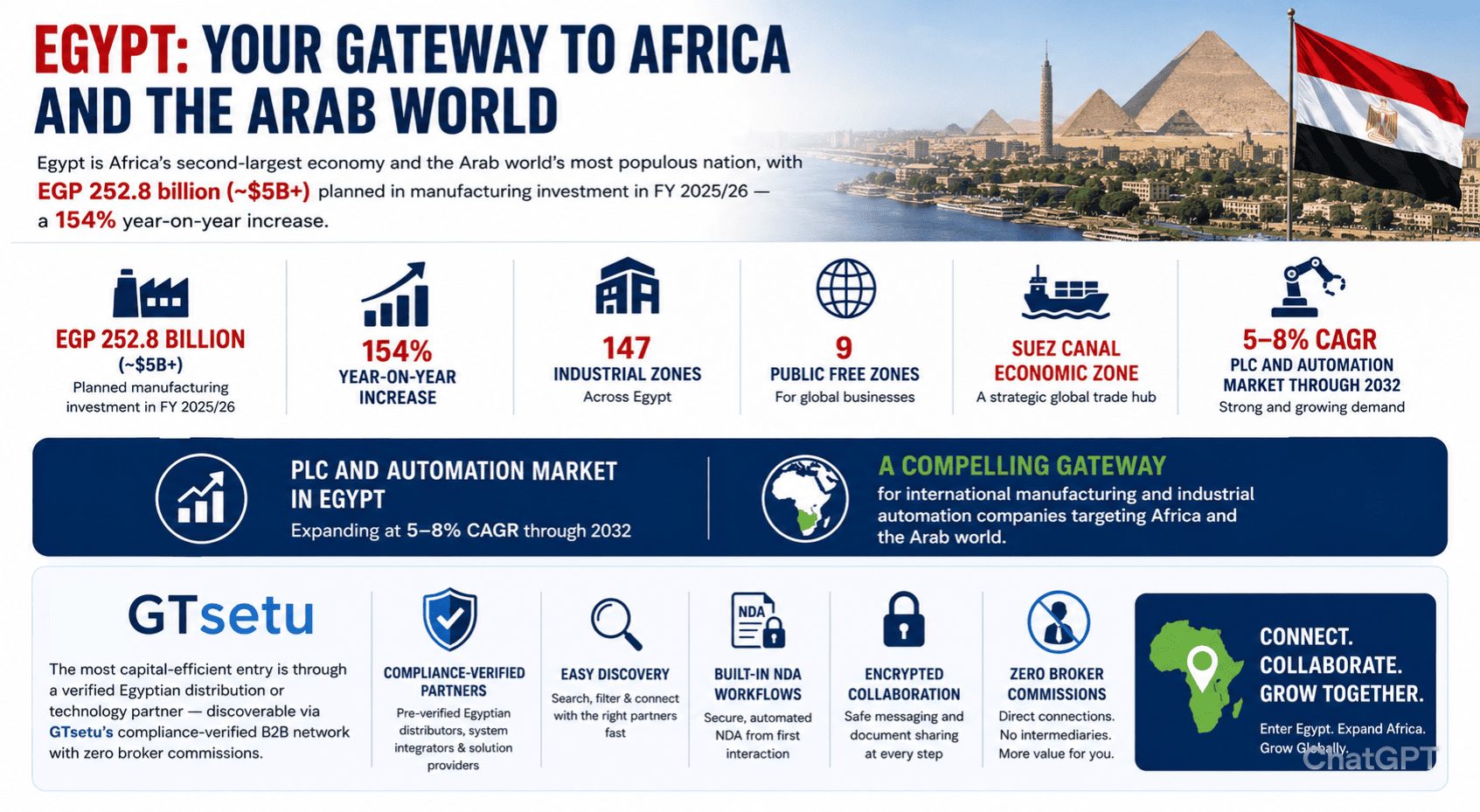
Direct Answer: Egypt is Africa’s second-largest economy and the Arab world’s most populous nation, with EGP 252.8 billion (~$5B+) planned in manufacturing investment in FY 2025/26, a 154% year-on-year increase. With 147 industrial zones, 9 public free zones, the Suez Canal Economic Zone, and a PLC and automation market expanding at 5–8% CAGR through 2032, Egypt represents a compelling gateway for international manufacturing and industrial automation companies targeting Africa and the Arab world. The most capital-efficient entry is through a verified Egyptian distribution or technology partner, discoverable via GTsetu‘s compliance-verified B2B network with zero broker commissions.
📅 April 20, 2026⏱ 20 min read✍️ GT Setu Editorial Team🔄 Updated regularly
EGP 252.8B
Manufacturing Investment FY 2025/26
147
Industrial Zones Nationwide
5–8%
Automation Market CAGR 2026–2032
0%
GTsetu Broker Commission
Egypt occupies a uniquely strategic position at the intersection of three continents, serving as a commercial gateway between Africa, the Arab world, and Southern Europe via the Suez Canal, one of the world’s most critical trade arteries. For international manufacturers and industrial automation companies, Egypt in 2026 represents one of the most compelling emerging market entry opportunities on the planet: a government aggressively incentivising manufacturing investment, 147 industrial zones providing ready infrastructure across the country, a growing skilled technical workforce, and an industrial base actively modernising toward Industry 4.0.
Egypt’s industrial exports more than doubled over the past decade, reaching $32.5 billion in FY 2023/24, and manufacturing investment for FY 2025/26 has been set at EGP 252.8 billion, a 154% increase year-on-year with over 83% coming from the private sector. The PLC and industrial automation market is projected to grow from approximately $478 million in 2024 to $731 million by 2032, driven by manufacturing modernisation, oil and gas sector expansion, and accelerating Industry 4.0 adoption. This guide covers every dimension of Egypt market entry, sector opportunity, industrial zone infrastructure, entry model selection, regulatory requirements, partner discovery, and how GTsetu connects verified manufacturers and distributors across Egypt with zero broker commissions. See also our related guides on advantages and disadvantages of global expansion and international business development consulting.
🇪🇬 Who Is This Guide For?
This guide is written for international manufacturers, industrial automation OEMs, robotics and control system providers, technology integrators, and industrial equipment companies seeking to enter or expand in the Egyptian market, whether through a distributor partnership, technology licensing, joint venture, free zone establishment, or contract manufacturing arrangement. It is also relevant for companies already exporting to Egypt informally who want to formalise and scale their market presence. If you are evaluating multiple MENA and African markets, see our companion guides: UAE, Germany, and India.
SECTION 1
1 Why Egypt for Manufacturing & Industrial Automation?
🎯 The Strategic Case
Egypt sits at the intersection of three continents, controls the Suez Canal through which 12–15% of global trade passes, holds Africa’s second-largest economy, and has a government that is, with urgency and substantial public capital, transforming the country’s manufacturing base from an import-dependent economy into a diversified export platform. For industrial automation companies, the combination of rapid manufacturing capacity expansion, rising labour costs in industrial centres, government-mandated smart manufacturing initiatives, and a young technical workforce actively demanding modernisation creates a demand environment that is structurally expanding rather than cyclically volatile.
154%
year-on-year increase in Egypt’s planned manufacturing investment for FY 2025/26 (EGP 252.8 billion target)
73.8%
growth in Egypt’s industrial exports, from $18.7B to $32.5B between FY 2013/14 and FY 2023/24
272
projects secured in the Suez Canal Economic Zone between 2022 and March 2025, totalling EGP 418.2 billion (~$8.3B)
🌍
Gateway to Africa, Arab World & Europe
Egypt’s geographic position, Suez Canal, Mediterranean coastline, Red Sea ports, and African land connectivity, makes it the most strategically located manufacturing hub in the region. A production or distribution base in Egypt serves 1.4 billion African consumers and 400 million Arab market consumers.
🏭
Massive Industrial Infrastructure Investment
147 industrial zones by end of 2024 (a 21.5% increase since 2014), 17 new industrial complexes across 15 governorates, and four new public free zones under establishment, Egypt is building the industrial infrastructure to attract manufacturing at scale.
🤖
Smart Manufacturing & Industry 4.0 Drive
Egypt’s government has launched smart factory initiatives and digital transformation programmes targeting the manufacturing sector. Growing companies are adopting PLCs, SCADA, MES, and IoT solutions to meet export market quality requirements and compete globally.
⚡
Energy Sector Expansion
Egypt’s oil and gas sector, plus an aggressive renewable energy programme targeting 42% renewable by 2030, is driving significant investment in process automation, SCADA, DCS, and energy management systems, some of the highest-value automation segments.
👩🎓
Growing Technical Workforce
Egypt has over 25 technical universities and institutes producing engineering graduates annually, creating a growing pool of automation technicians, system integrators, and application engineers capable of supporting, installing, and maintaining advanced automation technology.
🔗
Regional Export Platform via Trade Agreements
Egypt is party to the Greater Arab Free Trade Area (GAFTA), the COMESA agreement covering 22 African countries, the EU-Egypt Association Agreement, and the African Continental Free Trade Area (AfCFTA), making a manufacturing base in Egypt a potential export platform to 54 African countries at preferential tariffs.
Egypt’s industrial automation market is a subset of the broader Middle East and Africa automation market, but one with its own distinct growth dynamics driven by domestic manufacturing policy, oil and gas investment, and the rapid modernisation of legacy industrial infrastructure across the country’s expanding industrial zones.
Research Source
Market Scope
2024 Value
Forecast Year
Projected Value
CAGR
DataBridge Market Research
Egypt Industrial Automation
USD 477.5M
2032
USD 730.9M
5.98%
IMARC Group
Egypt PLC Market
Growing steadily
2034
Significant expansion driven by IIoT
~7–8%
MEA Process Automation (Research & Markets)
Middle East & Africa Process Automation
USD 17.12B (MEA)
2034
USD 28.15B (MEA)
5.10% (MEA)
6W Research
Egypt Industrial Automation
Growing market
2030
Steady expansion
~6–7%
Egypt’s automation market growth is structurally supported by: rapid expansion of manufacturing capacity in industrial zones; the oil and gas sector’s ongoing digital transformation; water and wastewater utility automation driven by government infrastructure spending; food and beverage sector modernisation for export compliance; and pharmaceutical manufacturing expansion. The PLC market specifically is benefiting from rising adoption across SME manufacturers who were previously dependent on manual processes, driven by falling PLC hardware prices, improved local technical support availability, and growing awareness of ROI from automation.
Key Market Drivers for International Automation Companies
Egypt’s FY 2025/26 manufacturing investment target, a 154% year-on-year increase with 83% from the private sector, is driving factory construction and capacity expansion across every industrial vertical, creating direct and indirect demand for automation solutions.
Policy Driver
⛽
Oil & Gas Sector Digital Transformation
Egypt is a major oil and gas producer with ongoing field development in the East Mediterranean (Zohr field) and Western Desert. The sector is investing heavily in DCS/SCADA upgrades, safety instrumented systems, and predictive maintenance platforms, among the highest-value automation segments in the Egyptian market.
Sector Driver
🌞
Renewable Energy Infrastructure Expansion
Egypt’s target of 42% renewable energy by 2030, combined with the Benban Solar Park (one of the world’s largest), wind farms in the Gulf of Suez, and grid modernisation investments, is driving demand for energy management systems, substation automation, and grid SCADA.
Energy Driver
📦
Export-Oriented Manufacturing Modernisation
Egyptian manufacturers targeting EU, Gulf, and African export markets face increasing quality and compliance requirements that demand automation, pharmaceutical serialisation, food safety compliance (FSSC, BRC), and automotive quality standards are all creating automation upgrade demand across Egypt’s industrial base.
Egypt’s national water infrastructure programme and smart city initiatives are driving investment in SCADA for water treatment, wastewater automation, smart grid management, and building management systems, expanding the automation market beyond the traditional manufacturing sector.
Egypt’s industrial policy is actively incentivising localisation of manufacturing inputs, including renewable energy components, automotive parts, pharmaceuticals, and electronics. This creates both direct demand for automation technology from new factories and partnership opportunities for international automation companies seeking local production arrangements.
Policy Driver
SECTION 3
3 High-Demand Sectors for Industrial Automation in Egypt
Industrial automation demand in Egypt is concentrated in verticals where government investment, export market requirements, and operational modernisation imperatives are converging. Understanding which sectors are generating the highest automation investment demand enables international companies to prioritise their sales, distribution, and partnership strategies.
⛽Largest Segment
Oil, Gas & Petrochemicals
Egypt’s oil and gas sector, with major offshore Mediterranean fields and Western Desert production, represents the largest and highest-value automation investment segment. DCS, SCADA, SIS, flow measurement, and pipeline management systems are all priority investment areas as Egypt upgrades legacy infrastructure and develops new fields.
Key demand: DCS/SCADA, SIS, flow computers, pipeline automation, gas processing control
🏗️Rapid Growth
Construction Materials & Building Products
Egypt’s massive new cities programme, New Administrative Capital, New Alamein, New October, and urban housing expansion is driving the world’s fastest-growing construction materials sector. Cement, ceramics, glass, and steel plants are investing in kiln automation, quality control systems, energy management, and process optimisation to reduce costs and improve output consistency.
Key demand: kiln control, quality inspection, energy management, conveyor automation
💊Export-Driven Growth
Pharmaceuticals & Healthcare
Egypt is Africa’s largest pharmaceutical manufacturer and is aggressively targeting GAFTA and African export markets. WHO-GMP and EU GMP compliance requirements are driving investment in process automation, cleanroom monitoring, packaging line automation, MES, and serialisation systems across Egypt’s 120+ pharmaceutical companies.
Key demand: process automation, serialisation, cleanroom HVAC control, packaging line automation, MES
🍅High Volume
Food & Beverage Processing
Egypt has the Arab world’s largest food processing sector, driven by a 105 million population, extensive agricultural production, and growing export orientation. International food safety standards (FSSC, BRC, Halal) are creating automation investment demand in filling and packaging, CIP systems, cold chain, and process control across the sector.
Egypt’s automotive assembly sector and the rapidly developing EV component manufacturing industry are creating demand for welding automation, precision machining, assembly robots, and vision inspection systems. Several global OEMs have established or expanded assembly operations in Egypt, pulling automation technology demand through their supply chains.
Key demand: welding robots, assembly line automation, vision inspection, conveyor systems
🌞Policy Priority
Renewable Energy & Power Generation
Egypt’s 42% renewable energy target and active solar, wind, and green hydrogen programmes are creating demand for solar manufacturing line automation, substation automation, grid SCADA, and energy management systems. The Benban Solar Park, Suez Gulf wind projects, and emerging green hydrogen facilities all require sophisticated automation infrastructure.
Key demand: grid SCADA, substation automation, solar manufacturing line automation, energy management
🧪Large Base
Chemicals & Fertilisers
Egypt has significant chemical, fertiliser, and specialty chemical manufacturing capacity, all of which is investing in process automation upgrades, DCS modernisation, safety system compliance, and energy efficiency improvements to maintain competitiveness in global markets.
Key demand: DCS upgrades, SIS, process analytics, safety compliance automation
💧Infrastructure Growth
Water Treatment & Utilities
Egypt’s national water security programme and expanding urban infrastructure are driving SCADA investment in water treatment, wastewater management, irrigation automation, and smart grid applications, a growing and government-funded segment of the automation market.
Egypt’s industrial and investment zone infrastructure is one of the most extensive in the MENA region, providing international manufacturers with a range of structured, incentive-supported locations to establish production, warehousing, or commercial operations. Understanding the differences between zone types is essential for optimising your Egypt entry structure.
🏭 Industrial Zones (147 Zones)
Serviced industrial land with utilities, roads, and sector-specific infrastructure across Egypt’s governorates. Designed for domestic-market-oriented manufacturing. Managed by the Industrial Development Authority (IDA). Benefits include below-market land pricing and streamlined licensing.
Key clusters: 10th of Ramadan, Borg El-Arab, Sadat City, 6th of October, Qantara West
🌐 Public Free Zones (9 Zones)
Export-oriented zones offering customs-free import of equipment and raw materials, 5-year tax holiday on profits, and unlimited profit repatriation. Designed for export-oriented manufacturers. Four new public free zones announced for 10th of Ramadan, New October, New Borg El-Arab, and New Alamein, operational by end-2026.
Zones: Alexandria, Port Said, Ismailia, Nasr City, Suez, Damietta, Shebin El-Kom, Media Production City, East Port Said
🚢 Suez Canal Economic Zone (SCZone)
Egypt’s flagship special economic zone along the Suez Canal corridor, 461 km² of integrated industrial and logistics area with the most comprehensive incentive package available. 272 projects totalling EGP 418.2 billion secured between 2022 and March 2025. Offers zero customs duties, zero income tax for 5 years (then 10%), and full foreign ownership.
Key areas: East Port Said, Ain Sokhna, West Ismailia, Qantara West, Ras El-Hekma (new 10M m² zone)
⚡ Private Free Zones
Company-specific free zone status available for large investments, customised incentive packages negotiated with GAFI (General Authority for Investment). Provides the flexibility of a public free zone with the operational control of a privately managed facility. Suitable for anchor investments above $50M.
Application through: GAFI (General Authority for Investment and Free Zones)
🏙️ New Administrative Capital & Smart Cities
Egypt’s new capital city and associated smart city developments are creating demand for smart building automation, integrated infrastructure management systems, and urban technology platforms, a distinct opportunity for automation companies serving the smart infrastructure segment.
Projects: New Administrative Capital, New Alamein, New October expansion, New Mansoura
🔬 Technology & Innovation Zones
Egypt is establishing high-tech industrial clusters for robotics, software, and advanced manufacturing technology companies, offering R&D incentives, university linkages, and co-development support for technology companies seeking Egyptian engineering talent partnerships.
Key hubs: Smart Village Cairo, Technology Valleys, Industry 4.0 Demo Centres
💡 Zone Selection Principle for Automation Companies
For industrial automation companies entering Egypt through a distributor or sales model (no local production), zone registration is not typically required, standard commercial company registration suffices. For companies considering local assembly, repair centre establishment, or technology transfer to an Egyptian partner, a public free zone registration or SCZone presence significantly improves tax economics and customs treatment. The decision point is whether your Egypt operations involve physical goods handling (free zone beneficial) or purely commercial/service activity (standard company registration sufficient). See our guide to market entry partnership models for the full structural comparison.
SECTION 5
5 Market Entry Models: Choosing the Right Approach
The right entry model for your manufacturing or industrial automation business in Egypt depends on your product category, capital availability, long-term Egypt strategy, and whether your commercial model is import-based or locally-produced. Here is the complete menu with Egypt-specific trade-offs.
Entry Model
How It Works
Capital Required
Time to Revenue
Best For
Key Reference
Egyptian Distributor / Channel Partner
Appoint a verified Egyptian company to import, stock, sell, and support your products in a defined territory
Very Low
3–9 months
Industrial automation hardware, instruments, control systems, standardised products with established applications in Egypt’s industrial sectors
Form a jointly owned Egyptian company with an established Egyptian manufacturer or distributor, shared equity and governance
Shared
12–24 months (setup)
Sectors benefiting from local political relationships; shared risk in capital-intensive production investment; complex technology requiring local integration
Register an export-oriented operation in a public free zone or SCZone, customs and tax benefits for import-process-export model
Moderate
6–12 months (registration + setup)
Manufacturers wanting to use Egypt as an African/MENA export hub; assembly or repair centre operations; companies with significant equipment import requirements
💡 Recommended Entry Sequence for Industrial Automation Companies
For most international industrial automation companies entering Egypt for the first time, the optimal approach is: (1) Year 1–2: Appoint 1–2 verified Egyptian national or sector-specialist distributors to validate market demand, build reference installations, and generate initial revenue with minimal capital. (2) Year 2–3: Based on validated revenue, evaluate establishing a representative office or Egyptian LLC for greater market control and direct customer relationships. (3) Year 3–5: If scale justifies, explore free zone or SCZone establishment for regional export economics, or joint venture with an Egyptian industrial company for co-production. This staged model manages currency and political risk while building the Egyptian market knowledge needed to make high-capital decisions correctly.
SECTION 6
6 Egypt Investment Incentives for Foreign Manufacturers
🏛️ Investment Framework Overview
Egypt’s Investment Law No. 72/2017 and its amendments represent a significant modernisation of the country’s foreign investment framework, designed specifically to attract international manufacturing and technology companies with a competitive incentive package, simplified procedures, and guaranteed rights under international investment treaties. The law provides a menu of general and special incentives, with manufacturing in industrial zones and free zones receiving the most comprehensive package. Foreign investors are guaranteed the right to transfer profits and repatriated capital in foreign currency, the right to full foreign ownership in most sectors, and protection under Egypt’s 120+ bilateral investment treaties.
Incentive Type
Details
Eligible Investments
Investment Cost Deduction
50% of investment cost deductible from taxable income (Upper Egypt and new cities); 30% deduction (other areas)
Manufacturing and industrial projects across all sectors
Customs Duty Reduction
5% flat customs duty on imported machinery and equipment for industrial projects (vs. standard rates of 5–30%)
All manufacturing projects registering with GAFI and the Industrial Development Authority
Free Zone Tax Holiday
5-year income tax exemption in public free zones; then fixed rate; no customs duties on goods in transit or for processing
Export-oriented manufacturing in public free zones; SCZone operations
SCZone Special Incentives
Zero income tax for 5 years (then 10%); zero customs on all inputs; full profit repatriation; one-stop-shop licensing
Companies establishing in the Suez Canal Economic Zone
Upper Egypt & Remote Area Incentives
Enhanced investment cost deduction (50%), streamlined licensing, government-provided industrial land at subsidised rates
Manufacturing investments in Upper Egypt governorates, Sohag, Qena, Assiut, Luxor, Aswan
Land Allocation at Industrial Rates
Industrial zone land allocated at regulated industrial tariffs, typically significantly below market value
Manufacturing companies registering with the Industrial Development Authority (IDA)
Employment-Linked Incentives
Employer social insurance contributions paid by the government for 24 months for new employees in some sectors
EU-Egypt Association Agreement provides access to some EU grant funding for technology transfer and capacity building in priority sectors
Egyptian companies and foreign-invested companies in priority sectors, technology, clean energy, agri-food
🇪🇬 GAFI, Your Primary Entry Point
The General Authority for Investment and Free Zones (GAFI) is Egypt’s primary investment facilitation body, providing company registration, investment licencing, and one-stop-shop services for foreign investors. GAFI also operates an investor service centre providing post-establishment support. For industrial automation companies entering Egypt, GAFI registration is the starting point for accessing Investment Law incentives and obtaining the commercial licences required for import and sale of industrial goods. GAFI’s Investment Map portal identifies available industrial zone land by governorate and sector, useful for companies considering local production as part of their Egypt strategy.
SECTION 7
7 Regulatory & Compliance Requirements for Entry
Egypt’s regulatory environment has improved meaningfully since the 2017 Investment Law reforms, but retains specific compliance requirements that must be navigated carefully to avoid the delays and costs that catch first-time Egypt entrants unprepared.
01
Business Entity Registration
Foreign companies in Egypt typically incorporate as an Egyptian Limited Liability Company (LLC/S.A.R.L.) or Joint Stock Company (S.A.E.), both available with 100% foreign ownership in most manufacturing and technology sectors under Investment Law 72/2017. Minimum capital requirements apply (EGP 5,000+ for LLC; EGP 250,000+ for SAE). Registration is through GAFI’s one-stop shop or the Companies Registration Department (CRD), electronic registration is available and significantly faster than traditional paper-based filing. Representative offices and branch offices are also available but with different commercial permissions and limitations. Expect 2–4 weeks for LLC registration with GAFI if documents are complete and properly notarised.
02
Tax Registration & VAT Compliance
All commercial entities in Egypt must register with the Egyptian Tax Authority (ETA) and obtain a Tax Registration Number (TRN). Value Added Tax (VAT) at 14% applies to most goods and services sold in Egypt, registration is required when annual turnover exceeds EGP 500,000. Industrial automation products are subject to VAT at the standard 14% rate unless specifically exempt. Companies importing goods for resale are also subject to customs duty (0–40% depending on product classification) and CAPMAS registration for statistical purposes. The Egyptian Tax Authority has modernised its systems significantly, electronic filing is now standard for most tax types.
03
Product Conformity & GOEIC Certification
The General Organisation for Export and Import Control (GOEIC) administers Egypt’s conformity assessment programme for imported industrial goods. Many electrical, electronic, and industrial safety products require GOEIC conformity certification before importation, a process involving product testing at an GOEIC-approved laboratory, factory audit (for some product categories), and certificate issuance. Lead times range from 4–12 weeks depending on product category and laboratory workload. International automation companies entering Egypt through a distributor should confirm GOEIC certification requirements for their specific product range before finalising the market entry timeline, a missing certification can block the first shipment. EgyptTrade conformity marks are required on product labelling for many categories.
04
Import Licensing & Customs Classification
Most industrial automation products can be imported into Egypt without a specific import licence, but are subject to customs duties, VAT at import, and in some cases Development Duty (2–3% on most goods). Companies importing for resale require Import Registration with the General Organisation for Export and Import Control (GOEIC). The effective landed cost for industrial automation products in Egypt, including customs duty (typically 5–20% for equipment), CAPMAS fees, port handling, and VAT, can add 25–40% to ex-works cost. Accurate HS code classification and the use of Egypt’s preferential import duty rates under GAFTA, COMESA, and the EU Association Agreement can significantly reduce effective duty rates for products with qualifying origin.
05
Industrial Registry (Segel Sanai)
Companies operating manufacturing facilities in Egypt must register with the Industrial Registry (Segel Sanai) at the Industrial Development Authority (IDA). Registration requirements include factory location, production capacity, number of employees, energy consumption, and environmental impact assessment. The Industrial Registry is also the gateway to accessing Industrial Zone land allocation and the customs duty reduction on imported equipment (5% flat rate for registered industrial companies, vs. standard rates). For companies entering through a distributor model without local production, Industrial Registry registration is not required.
06
IP Protection in Egypt
Egypt is a member of WIPO, the Paris Convention, and the Patent Cooperation Treaty, providing the legal framework for international patent, trademark, and design protection. Trademark registration through the Egyptian Trademarks and Industrial Designs Registry provides national protection and is advisable before significant market entry investment. Patent filing through the Egyptian Patent Office provides 20-year protection (15 years for utility models). Critically, for automation companies licensing technology or entering co-development partnerships in Egypt, address IP ownership and NDA structures explicitly before sharing any proprietary technical information, Egyptian courts provide enforcement, but prevention through contract is always preferable to litigation.
07
Foreign Exchange & Profit Repatriation
Egypt’s 2022 currency float and IMF-backed reforms have stabilised the foreign exchange environment significantly, the Egyptian Pound has stabilised after the 2023–2024 devaluation, and the Central Bank of Egypt (CBE) has committed to a managed float policy. Investment Law 72/2017 guarantees registered investors the right to transfer profits, dividends, and repatriated capital in foreign currency through licensed banks without restriction. For distribution partnerships, ensure payment terms are structured in USD or EUR with appropriate currency risk allocation between you and your Egyptian distributor, see our guide on payment term options.
SECTION 8
8 Finding a Verified Egyptian Distribution or Technology Partner
For most international manufacturing and industrial automation companies entering Egypt, finding the right Egyptian partner, a distributor, system integrator, technology licensor, or joint venture candidate, is the single most consequential market entry decision. A well-selected, verified Egyptian partner provides instant customer access, local technical capability, regulatory navigation experience, and government relationship capital that would take years to build independently. A poorly-selected or unverified partner creates fraud risk, commercial disputes, and reputational damage in a market where word travels quickly.
What to Look for in an Egyptian Industrial Automation Partner
✅
Verified Business Identity
Company registration with GAFI or CRD, Tax Registration Number, GOEIC import registration, and relevant sector certifications. This is non-negotiable before any commercial engagement, see business verification requirements. GTsetu verifies all of these before any Egyptian company appears in the network.
🏭
Sector & Application Expertise
Does the Egyptian partner have genuine application knowledge in your target vertical, oil and gas, pharma, food processing, construction materials? A distributor with specific sector credentials and reference installations in your target industry will outperform a generalist electronics distributor at every stage of the sales cycle.
🗺️
Geographic Coverage
Does their coverage span both Greater Cairo (10th of Ramadan, 6th of October) and the Delta/Alexandria industrial clusters, as well as Upper Egypt governorates if relevant to your target sectors? Egypt’s industrial geography requires national distributors with sub-distributor or branch networks outside Cairo to serve the full market.
⚡
Technical & After-Sales Capability
Egyptian industrial buyers expect local technical support and after-sales service, not “return to manufacturer” warranty processes. Assess whether the partner has qualified engineers who can commission, troubleshoot, and maintain your products, and whether they have a service centre or field engineering capability.
🤝
Government & Key Account Relationships
In Egypt’s industrial market, government-owned companies and large state enterprises (ENPPI, GASCO, Egyptian Steel, Suez Cement) represent a significant portion of high-value automation procurement. A distributor with established relationships at decision-making level in these entities provides access that cold outreach cannot replicate.
💱
Financial Stability & Foreign Currency Access
Given Egypt’s foreign exchange environment, assess whether your Egyptian distributor has reliable USD/EUR access for import payments, insufficient FX access can delay shipments and disrupt your supply chain. Request banking references and confirm their import payment track record with other international principals.
🚫
Competitive Portfolio Check
Many Egyptian industrial distributors carry competing automation brands. Assess whether their existing portfolio creates conflicts, and whether they will prioritise your product line or relegate it to a passive catalogue item competing against their more established principal relationships.
🔐
Data Security & Confidentiality Standards
Before sharing product specifications, pricing, or application data with any Egyptian candidate, execute a mutual NDA governed by Egyptian law or a mutually agreed international jurisdiction. Use encrypted channels for all sensitive commercial data exchange, see B2B secure collaboration standards.
Channels for Finding Verified Egyptian Partners
💻
GTsetu Verified B2B Platform
GTsetu provides access to compliance-verified Egyptian manufacturers, distributors, and system integrators, with anonymous discovery, built-in NDA workflow, and encrypted collaboration. Zero broker commissions on any partnership formed. The most efficient and secure channel for verified Egyptian partner discovery. Compare with alternatives to Alibaba and alternatives to IndiaMart for open marketplace comparisons.
Best for Verified Discovery
🏛️
Bilateral Chambers of Commerce
The Egyptian-German Chamber of Commerce (AHK Egypt), AMCHAM Egypt (American), British Egyptian Business Association (BEBA), Egyptian-Italian Chamber, and French-Egyptian Business Council all maintain verified member directories of Egyptian industrial companies actively seeking international technology partnerships.
Community Channel
🎪
Egypt Trade Shows & Exhibitions
Cairo ICT, Manufacturing Egypt Expo, Innopak, Egypt Energy, EGYPS (Egypt Petroleum Show), IGEPHA (pharma), and MEILAS are the primary sector-specific events for meeting potential Egyptian partners face-to-face. See our guide on top B2B networking places for manufacturers and distributors.
In-Person Channel
🏢
EFinance, GAFI & Government Support
GAFI’s Investor Service Centre and the Egyptian Commercial Service provide official introductions to Egyptian industrial companies. The U.S. Commercial Service, UK DIT Egypt, and German-Arab Chamber all facilitate business matching for companies from their respective countries entering the Egyptian market.
Government Channel
🏭
Federation of Egyptian Industries (FEI)
The Federation of Egyptian Industries and its sector-specific chambers (Chamber of Engineering Industries, Chemical Industries Chamber) maintain directories of Egyptian industrial companies and provide introductions between international technology providers and Egyptian manufacturers seeking automation solutions.
Association Channel
SECTION 9
9 Step-by-Step Egypt Market Entry Roadmap
01
Market Validation, Confirm Demand Before Committing
Before committing to Egypt market entry, validate demand for your specific product category: which industrial sectors in Egypt represent your primary target market; what competitive landscape exists (local Egyptian distributors for German, Japanese, or Chinese automation brands are established in most sectors); and which industrial zones concentrate your target customers. A structured 4–6 week market assessment, combining desk research with 10–15 conversations with potential Egyptian distributors via GTsetu’s platform or bilateral chamber introductions, will reveal more market reality than any market research report. Use anonymous discovery on GTsetu to identify and assess potential Egyptian partners without revealing your market entry plans prematurely.
02
Entry Model Selection, Match to Your Commercial Reality
For most first-time Egypt entrants, a verified Egyptian distributor appointment is the right first step, minimum capital, fastest revenue, and maximum market intelligence before higher-commitment decisions. Confirm GOEIC certification requirements for your product range early, a 3–6 month certification timeline affects your go-to-market schedule regardless of entry model. Assess whether the Egyptian market warrants import-based distribution (simpler but duty-loaded) or whether local assembly or production (free zone or industrial zone) improves your price competitiveness and AfCFTA/GAFTA origin qualification. See market entry partnerships for the full structural comparison.
03
Ideal Partner Profile Definition
Define precisely what you need in an Egyptian partner before beginning outreach: sector specialisation (oil and gas / pharma / food processing / construction); geographic coverage (Cairo industrial zone coverage vs. Delta vs. Upper Egypt); existing customer base at target companies; technical engineering capability; government and state enterprise relationships; and financial capacity for inventory investment. The more specific your ideal partner profile, the faster GTsetu’s verified Egyptian partner network surfaces qualified candidates, and the more productive every discovery conversation becomes.
04
Partner Discovery & Compliance Verification
Discover candidates through GTsetu’s verified platform, trade show attendance, bilateral chamber engagement, and referral from existing supply chain contacts. For every candidate, verify independently: GAFI or CRD company registration, Tax Registration Number, GOEIC import licence, and sector-specific certifications before advancing any commercial conversation. GTsetu performs this verification as a prerequisite of platform access, eliminating the due diligence burden from your Egypt discovery process. Never rely solely on self-reported credentials or website information. See business verification requirements for the complete checklist.
05
NDA Execution & Secure Technical Exchange
Execute a mutual NDA governed by Egyptian law (or mutually agreed international jurisdiction) before sharing any technical or commercial data. In Egypt, NDA enforceability requires the agreement to be executed in Arabic or bilingual format, a certified Arabic translation is advisable for agreements primarily executed in English. All sensitive technical data exchange, product specifications, pricing, roadmaps, should occur through encrypted channels. GTsetu’s NDA workflow is built into the platform and activated before the encrypted workspace unlocks. For technical evaluation by a potential distributor, share information in stages: public product documentation first, then technical specifications only after NDA execution.
06
Commercial Negotiation, Egypt-Specific Terms
Negotiate all commercial terms with Egypt-specific precision. Key terms: territory rights (national vs. sector-specific vs. industrial zone-specific); exclusivity structure (earned vs. granted; performance triggers); pricing in USD or EUR with currency risk allocation mechanism; payment terms (Letter of Credit recommended for first transactions with new Egyptian distributors); Incoterms for Egyptian import; warranty and local service obligations; annual volume commitments; and termination provisions with inventory buyback obligations.
07
Agreement Execution with Egyptian Legal Review
Execute the manufacturer-distributor contract with review by Egyptian legal counsel, not just your home country lawyer. Egyptian law applies to agreements governing commercial activity in Egypt, and specific provisions (agency protection, exclusivity enforcement, dispute resolution) have distinct requirements under Egyptian law. Specify governing law and dispute resolution explicitly, Egyptian courts, international arbitration (Cairo Regional Centre for International Commercial Arbitration), or ICC arbitration. Address risk allocation, dispute resolution, and force majeure provisions with Egypt-specific context.
08
Market Launch & Partner Enablement
A successful Egypt launch requires deliberate enablement investment: technical training for the distributor’s engineering team (covering product application, competitive positioning, and commissioning); co-development of Arabic-language technical collateral; joint visit programme to 10–15 priority accounts in the first 90 days; first reference installation supported by your application engineers; and a joint market development plan covering Egypt’s key industrial trade publications, digital channels, and sector events. The first 6 months in an Egypt partnership are critical, under-invest and momentum stalls before it starts.
SECTION 10
10 Key Commercial Terms for Egypt Partnerships
Egypt-specific commercial dynamics require adjustments to standard international distribution agreement terms. Here are the most important Egypt-specific considerations.
Commercial Term
Egypt-Specific Consideration
Reference Guide
Currency & Pricing
Egyptian Pound (EGP) pricing for local sales; USD or EUR for import invoices. Address EGP/USD exchange rate risk explicitly, specify whether price adjustment is triggered by defined FX movements or handled through annual repricing windows. The EGP has historically been volatile; build review mechanisms into year-1 distribution agreements.
Letter of Credit (LC) is strongly recommended for first 2–3 transactions with a new Egyptian distributor, it protects against FX access risk and commercial default risk simultaneously. Move to open account only after establishing a payment track record of 3+ successful LC transactions. Define USD-denominated credit limits clearly.
Egyptian import duty rates can change with budget announcements. Specify whether duty changes trigger automatic price adjustment, and the mechanism for both upward and downward duty changes. Confirm GOEIC certification status and HS code classification jointly with your distributor before first shipment to avoid clearance delays.
For Egypt, consider geographic exclusivity structured by industrial zone cluster rather than nationally, Cairo/10th of Ramadan, Alexandria/Borg El-Arab, and Upper Egypt may warrant different partners or sub-distributors based on their distinct industrial profiles and customer bases.
Agreements executed in Egypt should be prepared in bilingual (English/Arabic) format or with a certified Arabic translation. In the event of a dispute before Egyptian courts, the Arabic version prevails if the agreement is not bilingual with a clause specifying the governing language.
First-year minimum purchase commitments must be calibrated to Egypt market development realities, sales cycles for industrial automation in Egypt are typically 6–18 months for major projects. Over-aggressive first-year minimums create distributor financial stress and relationship damage before momentum builds.
Egyptian industrial buyers expect local warranty service, not international return-for-repair processes. Define which warranty and service functions the Egyptian partner performs, response time SLAs, and how warranty costs are shared between you and your distributor.
Egypt has agent and distributor protection provisions that can complicate termination, specify notice periods (typically 3–6 months), post-termination inventory buyback obligations, and transition assistance requirements explicitly. Vague termination clauses in Egypt generate costly and time-consuming disputes.
Despite CBE stabilisation efforts, the EGP/USD rate remains subject to pressure from Egypt’s current account dynamics. Structure your distributor pricing agreements with explicit price review mechanisms linked to FX movements, and prioritise LC payment terms for the first 12 months of any Egyptian partnership to protect against FX-related payment failure.
📋
GOEIC & Certification Timelines
Product conformity certification through GOEIC and product testing at Egyptian-approved laboratories can take 4–12 weeks, longer if product categories require factory inspection. Begin certification processes at least 6 months before target commercial launch. Budget for testing fees, laboratory costs, and potential re-testing if initial submissions have technical deficiencies.
🔌
Infrastructure Variability Across Industrial Zones
Infrastructure quality, power supply reliability, industrial gas availability, internet connectivity, varies significantly across Egypt’s 147 industrial zones. Zones in Greater Cairo (10th of Ramadan, 6th of October) and Borg El-Arab offer the most reliable infrastructure; Upper Egypt zones and newer zones may have higher utility interruption rates that affect automation system stability and after-sales support expectations.
⏳
Government Procurement Cycle Length
State-owned companies and government-linked entities represent a significant portion of high-value industrial automation procurement in Egypt, and their procurement cycles are long (12–36 months for major capital projects), subject to budget approval delays, and often require extensive local agent facilitation. Plan revenue projections with realistic government project timelines, not private sector sales cycle assumptions.
🔤
Arabic Language & Technical Documentation
While English is widely used in Egyptian business and engineering communities, Egyptian industrial buyers increasingly expect Arabic-language technical documentation, training materials, and user manuals for the operators and maintenance technicians who use automation equipment on the factory floor. Budget for Arabic localisation of core technical collateral as part of your Egypt market launch investment.
🏷️
Price Competition from Chinese & Regional Brands
Chinese automation brands (Delta, Siemens-CN, INVT, H3C) and regional distributors of Korean brands compete aggressively on price in Egypt’s industrial market. Position on total cost of ownership, application support depth, compliance with export market quality requirements (for Egyptian manufacturers targeting EU/Gulf exports), and the value of a local service network rather than attempting to compete on component price with lower-cost competitors.
SECTION 12
12 How GTsetu Connects You with Verified Egyptian Partners
🇪🇬 GTsetu, Verified B2B Platform for Egypt Market Entry
Discover Verified Egyptian Manufacturers & Distributors, No Broker Commission
GTsetu provides international manufacturing and industrial automation companies with direct access to compliance-verified Egyptian manufacturers, distributors, system integrators, and technology partners, across every industrial sector and all major manufacturing regions. Every company in GTsetu’s Egypt network has been verified through business registration, tax ID, import licences, and industry certifications before appearing in the platform. You discover, qualify, and engage, without broker intermediaries taking a percentage of your commercial economics.
🏛️
Multi-Layer Compliance Verification
Every Egyptian partner verified: GAFI/CRD registration, Tax Registration Number, GOEIC import licence, sector certifications, by GTsetu’s compliance team. Eliminates fraud risk and due diligence workload.
🕵️
Anonymous Discovery
Browse verified Egyptian partner profiles without revealing your identity. Protect your Egypt market entry strategy until you choose to engage. Impossible via trade directories or open marketplaces.
📄
Built-In NDA Workflow
Digital mutual NDA with timestamped signatures, available in English and bilingual English/Arabic format, activated before sensitive technical or commercial data can be exchanged.
🔐
Encrypted Document Workspace
AES-256 encryption at rest, TLS in transit. Role-based access controls. Full audit trail. No unprotected email attachments for sensitive technical or commercial data exchange.
🚫
Zero Broker Commission
GTsetu charges zero commission on any partnership formed between international manufacturers and Egyptian distributors or partners. All commercial economics stay between you and your partner.
🌍
100+ Countries Including Egypt
GTsetu’s verified network covers all major Egyptian industrial regions as well as UAE, India, and global markets, supporting your Egypt entry today and broader MENA and African expansion tomorrow.
QWhy should I expand my manufacturing or industrial automation business to Egypt?
Egypt offers a compelling combination of market size, strategic location, government investment, and structural automation demand. The country is Africa’s second-largest economy, controls the Suez Canal (12–15% of global trade), has a 105 million population creating strong domestic demand, and has 147 industrial zones providing ready manufacturing infrastructure. Industrial investment in FY 2025/26 is targeted at EGP 252.8 billion, a 154% year-on-year increase, with manufacturing cited as the primary driver of economic transformation. Industrial exports grew 73.8% over the past decade. For industrial automation specifically, the PLC and automation market is growing at approximately 6% CAGR to $731M by 2032, driven by oil and gas sector modernisation, pharmaceutical export compliance requirements, food processing automation investment, and construction sector expansion. Egypt also provides GAFTA and COMESA trade agreement access to 54 African and 22 Arab countries, making a manufacturing presence in Egypt a potential platform for regional export.
QWhat are the best entry models for expanding to Egypt?
For most first-time Egypt entrants in industrial automation and manufacturing technology, the recommended approach is: (1) Appoint a verified Egyptian national or sector-specialist distributor, lowest capital, fastest revenue (3–9 months). (2) After 2–3 years of validated market presence, evaluate establishing a wholly-foreign-owned Egyptian LLC for greater market control. (3) If local production improves price competitiveness or qualifies for GAFTA origin benefits, pursue a public free zone or SCZone establishment. Technology licensing to an Egyptian manufacturer is appropriate where local production is strategically important. Joint ventures work best for capital-intensive production projects benefiting from local risk sharing. See the full structural comparison in market entry partnerships.
QWhat are Egypt’s free zones and how do they benefit manufacturers?
Egypt has 9 public free zones (Alexandria, Port Said, Ismailia, Nasr City, Suez, Damietta, Shebin El-Kom, Media Production City, East Port Said) plus the Suez Canal Economic Zone (SCZone) as a distinct regime. Public free zones offer: 5-year income tax holiday on profits; customs-free import of equipment and raw materials for export-oriented production; unlimited profit repatriation; and streamlined licensing through GAFI. The SCZone offers zero income tax for 5 years (then 10%), zero customs on all inputs, and full foreign ownership. Four new public free zones are under establishment (10th of Ramadan, New October, New Borg El-Arab, New Alamein) expected operational by end-2026. For automation companies considering Egyptian market entry, free zones are most relevant if your model involves significant equipment imports, local assembly, or using Egypt as an export hub to GAFTA/COMESA markets.
QHow do I find a verified distributor for industrial automation products in Egypt?
The most efficient and secure route is through GTsetu’s compliance-verified B2B platform, where every Egyptian company has been verified through GAFI/CRD registration, Tax ID, GOEIC import registration, and sector certifications before appearing in the network. You browse anonymously, execute digital NDAs before sharing technical data, and collaborate through an encrypted workspace, with zero broker commissions. Supplement with trade show attendance (EGYPS, Manufacturing Egypt Expo, Cairo ICT), bilateral chamber engagement (AHK Egypt, AMCHAM Egypt, BEBA), and Federation of Egyptian Industries introductions. Always verify candidates independently or use a platform where pre-verification is complete before sharing product specifications or pricing. See our guide on how to find international distributors.
QWhat are the key regulations for manufacturing companies entering Egypt?
Key regulatory requirements for manufacturing companies entering Egypt: (1) Company registration, LLC or SAE through GAFI’s one-stop shop or CRD (2–4 weeks if documents are complete). (2) Tax registration and VAT compliance, 14% standard VAT rate, mandatory above EGP 500K turnover. (3) GOEIC product conformity certification, required for many industrial, electrical, and electronic products imported or sold in Egypt (4–12 weeks lead time). (4) GOEIC importer registration, required for commercial importation for resale. (5) Industrial Registry (Segel Sanai), required for manufacturing operations, unlocks 5% flat customs duty on imported equipment. (6) Environmental permits, for manufacturing plants above specified production thresholds. (7) Free zone or SCZone registration, for export-oriented operations seeking tax and customs benefits. Engage Egyptian legal counsel for company registration and sector-specific licence requirements, GAFI’s investor service centre also provides official guidance.
QWhich industrial sectors in Egypt have the highest automation investment demand?
The sectors with the highest industrial automation demand in Egypt in 2026: (1) Oil and gas and petrochemicals, the largest and highest-value segment, driven by East Mediterranean field development and Western Desert production upgrades requiring DCS, SCADA, SIS, and flow measurement systems. (2) Construction materials (cement, ceramics, steel), kiln automation, quality control, and energy management driven by Egypt’s massive new cities construction programme. (3) Pharmaceuticals and medical devices, process automation, serialisation, and MES investment driven by WHO-GMP and EU-GMP compliance for export markets. (4) Food and beverage, filling, packaging, and CIP automation driven by international food safety standards for export. (5) Renewable energy and power, grid SCADA, substation automation, and solar manufacturing line automation driven by Egypt’s 42% renewable energy target. (6) Water and wastewater utilities, SCADA and pump control driven by national water infrastructure programmes. The oil and gas sector typically offers the highest individual project values; food processing and pharma offer the highest volume of mid-market automation opportunities.
QHow should I handle currency risk in an Egypt distribution agreement?
Currency risk management is critical in Egypt distribution agreements given the EGP’s historical volatility. Best practices: (1) Invoice your Egyptian distributor in USD or EUR, not EGP, to retain FX protection on your manufacturing margin. (2) Use Letters of Credit for the first 3–6 transactions to protect against both FX access risk and commercial default. (3) Include explicit price review mechanisms in your distribution agreement, tied to defined EGP/USD movement thresholds (e.g., if EGP moves more than 10% from the agreement signing rate, prices are reviewed). (4) If you offer EGP pricing for government tender purposes, build FX hedging costs into your margin calculations. (5) Monitor CBE policy and Egypt’s IMF programme milestones as lead indicators of FX stability. See our complete guide on advance payment vs. LC vs. open account options.
Ready to Expand Your Manufacturing Business to Egypt?
Connect with verified Egyptian manufacturers, distributors, and technology partners on GTsetu, compliance-backed verification, anonymous discovery, built-in NDA workflows, and zero broker commissions on every Egypt market partnership you form.
They represents the product, and research team behind GTsetu, a global B2B collaboration platform built to help companies explore cross-border partnerships with clarity and trust. The team focuses on simplifying early-stage international business discovery by combining structured company profiles, verification-led access, and controlled collaboration workflows.
With a strong emphasis on trust, and disciplined engagement, Team GTsetu shares insights on global trade, partnerships, and cross-border collaboration, helping businesses make informed decisions before entering deeper commercial discussions.