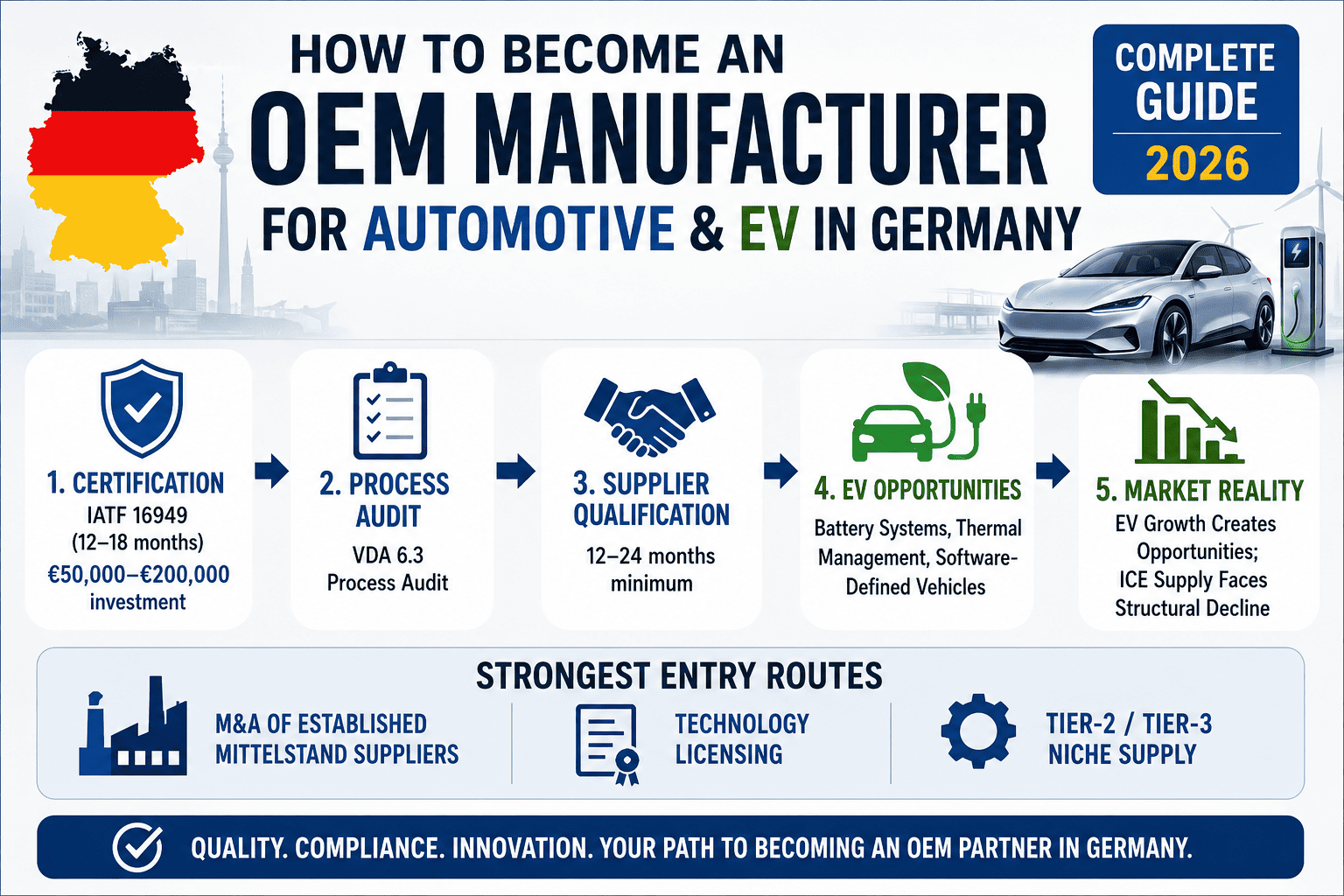
How to Become an OEM Manufacturer for Automotive & EV in Germany
Direct Answer: Becoming an automotive OEM manufacturer in Germany requires IATF 16949 certification (12-18 months to obtain, €50,000-€200,000 investment), often combined with VDA 6.3 process audits. Supplier qualification with German OEMs runs 12-24 months minimum. The EV transition is creating new opportunities in battery systems, thermal management, and software-defined vehicles, while traditional ICE component supply faces structural decline. Foreign manufacturers have the strongest entry routes through M&A of established Mittelstand suppliers, technology licensing, or tier-2/tier-3 niche supply. GTsetu connects verified manufacturers and distributors with global partners, with zero broker commissions.
📅 June 22, 2026⏱ 25 min read✍️ GT Setu Editorial Team🔄 Updated regularly
12-24 mo.
Supplier Qualification Timeline
€200k
IATF 16949 Certification Investment
#8
Germany, World’s 8th Largest Manufacturing Economy
0%
GTsetu Broker Commission
Germany is the undisputed heart of the global automotive industry, home to Volkswagen, BMW, Mercedes-Benz, and a tier-1 supplier ecosystem that includes Bosch (the world’s largest automotive supplier), Continental, ZF Friedrichshafen, and thousands of specialised Mittelstand manufacturers. For international manufacturers seeking to become OEM suppliers in this market, the opportunity is real but the barriers are substantial: IATF 16949 certification, VDA 6.3 process audits, 12-24 month qualification cycles, and a quality culture that demands excellence at every tier of the supply chain.
The EV transition is reshaping this landscape at a historically unprecedented pace. German OEMs are restructuring, plant closures are in motion, and the traditional ICE-component supply base is under immense pressure, but simultaneously, new opportunities are opening in battery systems, thermal management, software-defined vehicles, and charging infrastructure. For foreign manufacturers with EV-native capability, the German market is more accessible than it has been in decades, particularly through M&A of distressed Mittelstand suppliers or through tier-2/tier-3 niche supply. This guide covers everything you need to know to become an automotive OEM manufacturer in Germany, from certification through to partner discovery and commercial structure. See also our guides on expanding to Germany and global expansion strategy.
🇩🇪 Who Is This Guide For?
This guide is written for international manufacturers, automotive component suppliers, EV technology companies, and industrial automation firms seeking to become OEM suppliers in Germany, whether through direct tier-1 supply, tier-2/tier-3 niche manufacturing, technology licensing, joint venture, or M&A of a German supplier. It is also relevant for companies targeting the broader European automotive market who want to use Germany as their entry point. If you are evaluating multiple European markets alongside Germany, see our companion guides: Romania, Poland, Czech Republic, and Turkey.
SECTION 1
1 Why Germany for Automotive & EV OEM Manufacturing?
🎯 The Strategic Case
Germany is the world’s 8th-largest manufacturing economy, producing around €800 billion in manufacturing output annually. The automotive sector alone contributes approximately €450 billion to the German economy and employs over 800,000 people directly. The country is home to the world’s most concentrated automotive OEM and tier-1 supplier ecosystem, including Volkswagen Group, BMW, Mercedes-Benz, Bosch, Continental, ZF, and thousands of specialised Mittelstand suppliers. The EV transition is creating structural openings for foreign manufacturers with EV-native capability, while the IATF 16949 and VDA 6.3 quality regime, though demanding, provides a level playing field for international suppliers who can meet the standard. For manufacturers who can navigate the certification and qualification process, the German automotive market offers premium pricing, long-term relationships, and reference-quality customers that open doors globally.
€450B+
German automotive sector output, 13% of Germany’s GDP
800k+
Direct automotive industry employees in Germany
12-24 mo.
Supplier qualification timeline, plan accordingly
🏛️
World-Class OEM & Tier-1 Ecosystem
Germany is home to the world’s most concentrated automotive OEM and tier-1 supplier ecosystem. Direct customers include Volkswagen Group, BMW, Mercedes-Benz, Stellantis-Opel, and Ford Germany, plus tier-1 giants Bosch, Continental, ZF, Mahle, Schaeffler, and FORVIA. This density of potential customers within a single country is unmatched globally.
⚡
EV Transition Creating Openings for New Entrants
The German automotive market is undergoing the largest structural transition in its post-war history. Internal-combustion-specific suppliers face structural decline, while new opportunity areas, battery systems, thermal management, software-defined vehicles, charging infrastructure, ADAS, are opening for foreign and non-traditional suppliers with EV-native capability.
📋
IATF 16949 & VDA 6.3, A Level Playing Field
The IATF 16949 quality standard and VDA 6.3 process audits are demanding but objective. International suppliers who can meet the standard compete on an equal footing with German suppliers. Certification is expensive (€50,000-€200,000) and time-consuming (12-18 months), but it is a gate that can be passed with the right investment and commitment.
💰
Premium Pricing & Long-Term Relationships
German automotive customers pay premium prices for reliability and quality, not purely cost-minimisation. Once qualified, supplier relationships are often long-term (5-10 years or more), providing revenue stability and reference customers that support global commercial development. The “Made in Germany” quality reputation also benefits suppliers who can demonstrate German OEM approval.
🏭
Mittelstand M&A Opportunity
Germany’s Mittelstand, thousands of family-owned automotive suppliers, faces two simultaneous pressures: EV transition (their ICE components are in structural decline) and generational succession (many were founded in the 1950s-1980s). This creates acquisition opportunities at favourable valuations for foreign manufacturers with capital and complementary products. M&A bypasses the 12-24 month qualification cycle.
🌍
Access to European & Global Automotive Markets
German OEM approval is the most respected qualification in the global automotive industry. A German OEM supplier reference opens doors to customers worldwide, from North America to China to Southeast Asia. Germany’s central location and world-class logistics infrastructure also make it an ideal hub for supplying the broader European automotive market.
SECTION 2
2 German Automotive OEM & Tier-1 Landscape 2026
Understanding the German automotive OEM and tier-1 landscape is essential for any manufacturer seeking to become a supplier. The landscape is in active structural transition, plant closures, job cuts, and consolidation are ongoing as the industry repositions for the EV transition. But the major players remain the world’s most significant automotive buyers.
Category
Company
Headquarters
Key Plants & Notes
German OEMs
Volkswagen Group
Wolfsburg (Niedersachsen)
Brands: VW, Audi (Ingolstadt), Porsche (Stuttgart), Bentley, Lamborghini, Bugatti, Ducati, MAN Truck, Scania. Europe’s largest auto group by volume. Major restructuring 2024-2025.
German OEMs
BMW Group
Munich (Bayern)
Brands: BMW, Mini, Rolls-Royce. Plants: Munich, Leipzig (electric), Dingolfing. Strong premium and EV positioning.
German OEMs
Mercedes-Benz Group
Stuttgart (Baden-Württemberg)
Brands: Mercedes-Benz, Mercedes-AMG, Maybach. Plants: Sindelfingen, Bremen, Berlin (electric). Share losses in premium EV segment.
German OEMs
Stellantis Germany (Opel)
Rüsselsheim (Hessen)
Plants: Rüsselsheim, Eisenach (Thüringen), Kaiserslautern (Rheinland-Pfalz). Active restructuring underway.
German OEMs
Ford Germany
Köln (NRW)
Plants: Köln, Saarlouis (Saarland; restructuring). German operations of US-headquartered Ford Motor Company.
Major Tier-1 Suppliers
Robert Bosch GmbH
Stuttgart (Baden-Württemberg)
Germany’s largest automotive supplier by far. Diversified beyond automotive, software, electrification, automation.
Transmissions, drivetrain, e-mobility. Major TRW acquisition history. Restructuring for EV transition.
Major Tier-1 Suppliers
Mahle GmbH
Stuttgart (Baden-Württemberg)
Engine components, thermal management. Pivoting to EV thermal management.
Major Tier-1 Suppliers
Schaeffler AG
Herzogenaurach (Bayern)
Bearings, drivetrain, transmissions. Integration with INA. EV components.
Major Tier-1 Suppliers
FORVIA (Hella + Faurecia)
Lippstadt (NRW) / Nanterre (FR)
Lighting, electronics, body modules. Merged entity.
The tier-2 and tier-3 supplier base is much larger, thousands of Mittelstand companies, mostly family-owned, with deep specialisation in specific components, materials, or processes. These suppliers are concentrated in Baden-Württemberg, Bayern, and Niedersachsen, the three automotive heartland states. Many of these Mittelstand suppliers are facing EV-transition pressure and generational succession challenges, creating acquisition opportunities for foreign manufacturers.
SECTION 3
3 The EV Transition: Where the Opportunity Lies
⚡ The EV Opportunity
The single largest reshaping of the German automotive market is electrification. German OEMs are accelerating EV investment, VW’s PowerCo subsidiary (Salzgitter cell plant), BMW’s cell production, Mercedes-Benz’s battery production (Untertürkheim), and Tesla’s Gigafactory Berlin-Brandenburg are all active. The cell business itself is dominated by very large players (CATL, BYD, LG, Samsung), but tier-2 and tier-3 cell-component supply (separators, electrolytes, anode/cathode materials, casings) is more accessible to foreign manufacturers. Battery management systems (BMS) and software, thermal management for EVs, charging infrastructure, and recycling/circular supply chain are all new categories where German OEMs are actively buying from foreign and non-traditional suppliers.
🔋
Battery Systems & Cell Components
Battery cell production is dominated by giants, but tier-2 component supply, separators, electrolytes, anode/cathode materials, casings, and battery module assembly, is more accessible. German OEMs are investing heavily in battery production (VW Salzgitter, BMW, Mercedes) and need reliable tier-2 suppliers for these components.
💻
BMS & Battery Software
Battery management systems, battery analytics, lifecycle prediction, and recycling analytics are new categories that did not exist 10 years ago. German OEMs are actively buying BMS software and analytics from foreign and non-traditional suppliers. Software-defined vehicle buying cycles are materially shorter than hardware qualification (6-18 months vs. 12-24 months).
❄️
Thermal Management for EVs
EV batteries require significantly more sophisticated thermal management than ICE engines. Heat pumps, cooling systems, thermal-interface materials, and software for thermal optimisation are all growing categories where German OEMs are seeking suppliers, and where incumbent ICE suppliers have limited capability.
🔌
Charging Infrastructure
Public charging networks (Allego, Ionity, Tank & Rast, EnBW mobility+) and depot/private charging for fleets represent a large and accessible market for foreign hardware and software suppliers. This segment is less dominated by traditional automotive suppliers, creating openings for new entrants.
♻️
Recycling & Circular Supply Chain
End-of-life battery recycling, material recovery, and second-life battery applications represent a new sector being built in Germany with substantial subsidy support and direct OEM partnerships. This is a greenfield opportunity for foreign technology companies.
🚗
Software-Defined Vehicle & ADAS
OTA updates, vehicle-software architecture, and ADAS systems are active buying segments. German OEMs are investing heavily in software-defined vehicles through external partnerships. For software suppliers, the buying cycle is shorter, and IATF 16949 is not always a prerequisite (though ASPICE and ISO 21434 are increasingly required).
💡 The EV Opportunity Principle
The most commercially effective EV entry strategy for foreign manufacturers is to target areas where incumbent ICE suppliers cannot easily pivot. In battery thermal management, BMS software, charging infrastructure, and recycling, the traditional German supplier base has limited capability and OEMs are explicitly buying externally. Foreign manufacturers with EV-native capability have genuine openings in these categories, particularly through tier-2/tier-3 supply, technology licensing, or acquisition of a German supplier with complementary capabilities.
SECTION 4
4 IATF 16949 & VDA 6.3: The Certification Gateway
🏛️ The Quality Gateway
The single largest structural barrier for foreign manufacturers wanting to supply German OEMs is the quality-management framework. IATF 16949 certification is the global automotive quality standard (successor to ISO/TS 16949), mandatory for direct supply to OEMs and most tier-1 suppliers. Certification involves documenting a comprehensive quality-management system, performing internal audits, engaging an accredited certification body, and passing the initial certification audit. Typical timeline from “we want to be IATF-certified” to “we hold IATF 16949 certification” is 12-18 months for a new entrant. VDA 6.3 process audits, a German-automotive-specific standard, are often required by tier-1 buyers. Other relevant standards include VDA 6.5 (Product Audit), ISO 21434 (automotive cybersecurity), and ASPICE (Automotive SPICE for software suppliers).
Certification / Standard
Description
Typical Timeline
Investment Range
Mandatory For
IATF 16949
Global automotive quality standard (successor to ISO/TS 16949). Comprehensive QMS documentation, internal audits, certification body audit, and certification.
German-automotive-specific process audit standard published by the Verband der Automobilindustrie (VDA). Assesses specific manufacturing and quality processes against German automotive industry expectations.
2-6 months (preparation + audit)
€10,000-€40,000 (per audit)
Often required by tier-1 buyers before qualifying a tier-2 supplier
VDA 6.5 (Product Audit)
Product audit standard, verifies that manufactured products meet specified requirements.
1-3 months
€5,000-€15,000 (per product line)
OEM and tier-1 specific requirements
ISO 21434
Automotive cybersecurity standard, covers cybersecurity engineering for road vehicles.
6-12 months
€20,000-€80,000
Increasingly required for software and connected components
ASPICE (Automotive SPICE)
Software process improvement and capability determination standard for automotive software development.
6-18 months
€30,000-€150,000
Increasingly required for software suppliers to OEMs and tier-1s
PPAP (Production Part Approval Process)
Submission process where a supplier proves a new part meets all requirements and can be produced consistently. Multi-document submission; OEMs and tier-1s have specific PPAP expectations.
2-6 months (per part)
Varies, typically part of development cost
Required for every new part supplied to OEMs or tier-1s
🇩🇪 The Certification Reality
The certification regime is real, expensive, and time-consuming. Foreign manufacturers without IATF 16949 cannot sell direct to OEMs and often cannot sell to major tier-1s. The right approach is either to engage the certification process early as a planned investment (typically €50,000-€200,000 in consulting, audit fees, and internal investment) or to enter through M&A of a pre-certified German supplier. For software suppliers, the requirements are sometimes different, ASPICE and ISO 21434 may be more relevant than IATF 16949, but the principle remains: understand the quality gate and invest in it before attempting commercial engagement.
SECTION 5
5 Supplier Qualification: The 12-24 Month Reality
Even with IATF 16949 in place, supplier qualification with a German OEM is a multi-stage process running 12-24 months from first contact to series-production qualification. Foreign suppliers consistently underestimate this timeline, pricing and pipeline planning must reflect the qualification lead time.
01
Supplier Registration
Register in the OEM’s procurement system. Complete pre-qualification questionnaires and submit basic capability documentation. This is typically the first formal step, many suppliers register and never receive a nomination. Be prepared for this outcome; qualification is a numbers game.
02
Capability Audits
Site visits, financial review, capacity review, and technology review. The OEM or tier-1 will visit your manufacturing site to verify that you have the physical and organisational capacity to supply at the required volume and quality.
03
Quality-System Audit
IATF 16949 certification verified, often with a VDA 6.3 process audit performed. This is the critical gate, if your quality system does not meet German automotive expectations, the qualification process stops here.
04
Nomination for a Specific Part or Programme
You are nominated to supply a specific part or programme. This is a real milestone, many suppliers never reach this stage. If you receive a nomination, you are now in the formal development pipeline.
05
Development Phase
Engineering review, design verification, and prototyping. This phase can take 6-12 months depending on the complexity of the part. German OEMs have detailed engineering and testing requirements, meet them without shortcuts.
06
Sample Submission & PPAP
Production-representative samples submitted for approval through the PPAP (Production Part Approval Process). PPAP submission is a multi-document process, each OEM has specific PPAP expectations. Approval is not guaranteed on the first submission.
07
Ramp-Up & Capacity Validation
Production scaling is validated. The OEM or tier-1 will audit your production ramp to confirm that you can consistently produce at the required volume and quality.
08
Series Production
Full production begins. You are now a qualified supplier. Maintain quality and delivery performance, German OEMs have zero tolerance for quality failures, and de-qualification is a real risk.
💡 The Qualification Cash-Flow Reality
Don’t model German automotive supply on US-style B2B sales cycles. Plan for 12-24 months minimum to first series-production revenue. During this period, you will be investing in certification, prototyping, and development without revenue from the customer. Ensure your cash-flow planning accounts for this qualification lead time, and price your products to reflect the total cost of the qualification investment. German OEMs expect suppliers to have made the investment; they will not be sympathetic to cash-flow complaints during qualification.
SECTION 6
6 Geographic Automotive Clusters in Germany
Understanding Germany’s regional automotive clusters is essential for customer proximity, talent access, and alignment with government investment programmes. For tier-2 and tier-3 suppliers, customer-proximity is a real factor, locating in Stuttgart for Mercedes/Porsche/Bosch supply, near Ingolstadt for Audi, or in the Wolfsburg region for VW materially affects logistics, relationship development, and just-in-time capability.
Region
Main OEM Presence
Supplier Density
Cluster Character
Baden-Württemberg (Stuttgart)
Mercedes-Benz, Porsche
Highest, Bosch, ZF, Mahle, thousands of Mittelstand suppliers
Premium, engineering depth, “Land der Tüftler”
Bayern (Munich + Ingolstadt)
BMW (Munich), Audi (Ingolstadt), MAN (Munich)
Very high, dense supplier network
Premium, tech-and-electronics overlay
Niedersachsen (Wolfsburg)
Volkswagen
Very high, VW-anchored network
Largest single-OEM cluster
NRW (Köln, Rüsselsheim border)
Ford Germany, Stellantis-Opel (Rüsselsheim, Hessen)
High, diverse supplier base
Mid-market, diverse supplier base
Saarland (Saarlouis)
Ford plant
Moderate, restructuring-pressured
Smaller cluster, restructuring-pressured
Sachsen (Leipzig, Zwickau, Dresden)
Porsche Leipzig, BMW Leipzig, VW Zwickau
Growing, EV-focused
New investments, GRW-subsidy-supported
Rheinland-Pfalz (Kaiserslautern area)
Opel plant
Moderate, tied to Stellantis restructuring
Restructuring-pressured
💡 Location Strategy for New Entrants
For foreign manufacturers entering the German automotive market, locating in Baden-Württemberg (Stuttgart) provides the highest density of potential customers, Mercedes, Porsche, Bosch, ZF, and thousands of Mittelstand suppliers. But land and labour costs are also the highest in Germany. Sachsen (Leipzig/Zwickau/Dresden) offers lower costs, EV-focused investment, and GRW (Gemeinschaftsaufgabe “Verbesserung der regionalen Wirtschaftsstruktur”) subsidies for new manufacturing investment. The right location depends on your customer profile, capital budget, and target sectors.
SECTION 7
7 Entry Models for Foreign OEM Manufacturers
Germany offers multiple entry models for foreign manufacturers wanting to become automotive OEM suppliers. The right model depends on your capital, technology, timeline, and appetite for operational control. Here is the complete entry model menu.
Entry Model
How It Works
Capital Required
Time to Revenue
Best For
M&A of a German Mittelstand Supplier
Acquire an established German automotive supplier with IATF 16949 certification, OEM relationships, and active customers. Bypasses the 12-24 month qualification cycle. Access to German customer relationships and supplier network from day one.
High, valuations vary
3-6 months (deal close)
Manufacturers with capital and complementary products wanting immediate market access; succession-pressured Mittelstand suppliers are available at favourable valuations.
Tier-2 / Tier-3 Niche Supply
Supply specialised components, materials, or sub-assemblies to tier-1 suppliers (Bosch, Continental, ZF, etc.) who then supply OEMs. Qualification requirements are often less demanding than direct OEM supply, though IATF 16949 is still typically required.
Moderate
12-24 months (qualification)
Foreign manufacturers with specialised capability, precision machining, advanced materials, sensors, specialised electronics, where German tier-1s have identified supply chain gaps.
Technology Licensing to a German OEM or Tier-1
License your technology, software, or manufacturing process to a German automotive company that deploys it in their production. Revenue through royalties. Minimal operational burden. Particularly relevant for software, battery technology, and recycling technology.
Minimal
6-18 months (negotiation + deployment)
Software platforms, battery technology, recycling processes, manufacturing know-how, where German partners have the OEM relationships and you have the technology.
Joint Venture with a German Partner
Form a jointly owned German company with an established German automotive supplier, shared technology, capital, and OEM relationships. Access to German OEM network through the partner. Common in capital-intensive EV technology segments.
Shared
12-24 months (setup + qualification)
Capital-intensive EV technology (battery components, thermal management systems) where a German partner provides customer relationships and quality-system certifications.
Greenfield Manufacturing Establishment
Establish a new manufacturing facility in Germany, leasing or purchasing land, building or fitting out a factory, hiring staff, and undertaking IATF 16949 certification from scratch.
High, €5M+
24-48 months (setup + qualification)
Large-scale manufacturers with significant capital and a long-term commitment to the German market. GRW subsidies (up to 30% of investment) available in designated regions.
Distribution Partnership with a German Distributor
Appoint a German distributor to sell your automotive products to German OEMs or tier-1s. The distributor handles sales, customer relationships, and often logistics. You may not need IATF 16949 yourself if the distributor handles the quality certification (though this is increasingly unusual).
Low
3-12 months (partner selection + launch)
Automation components, aftermarket parts, test equipment, where you are not supplying direct to OEMs and the distributor manages the quality relationship.
💡 The M&A Advantage for German Market Entry
For foreign manufacturers with capital and complementary products, M&A of a distressed or succession-facing German Mittelstand supplier is often the fastest and most commercially effective entry route. The German Mittelstand, thousands of family-owned automotive suppliers, faces EV-transition cost pressure and generational succession challenges. Acquisition of an already-qualified supplier bypasses the 12-24 month qualification cycle, provides immediate customer access, and comes with existing OEM relationships. The key is to find a supplier whose product portfolio complements yours, adding EV-native capability to an ICE-focused business, and to structure the deal to retain key engineering and customer-facing talent. For M&A support, engage a German M&A advisory firm with automotive sector expertise.
SECTION 8
8 Regulatory & Compliance Requirements
Germany has one of the world’s most structured regulatory environments for manufacturing, predictable, transparent, and demanding. For automotive OEM manufacturers, the key compliance requirements span company formation, tax, product compliance, environmental, and employment law.
01
Company Formation, GmbH or UG
A GmbH (Gesellschaft mit beschränkter Haftung) is the standard German limited liability company, minimum share capital €25,000 (€12,500 paid up). A UG (Unternehmergesellschaft) is a lower-capital alternative (minimum €1) but less commercially credible. Company formation is straightforward, typically 2-4 weeks, with a German notary and commercial register registration. 100% foreign ownership is permitted. A German resident managing director is required, engage a German Geschäftsführer (managing director) for the role. Commercial register entry is mandatory; trade register entry (IHK) is required for manufacturing activities.
02
Tax Registration & Compliance
German corporate tax rate is approximately 30% (15% Körperschaftsteuer + 15-17% Gewerbesteuer depending on municipality). VAT (Umsatzsteuer) is 19% (7% reduced rate for certain goods). Tax registration with the Finanzamt is mandatory. For automotive component suppliers, consider the tax implications of cross-border supply chains, transfer pricing documentation is required for transactions with related parties. Engage a German Steuerberater (tax advisor) for tax compliance, the German tax system is complex and changing.
03
Product Compliance & CE/UKCA Marking
Products sold in Germany require CE marking for most categories (Machinery Directive, Low Voltage Directive, EMC Directive). Post-Brexit, UKCA marking is separate for UK sales, but CE remains valid in Germany. Specific automotive product regulations apply for safety-critical components, ECE regulations (UN Economic Commission for Europe) are often referenced by German OEMs. IATF 16949 certification covers many product compliance requirements, but product-specific regulatory approval may still be required for certain components (brake systems, lighting, safety-critical electronics).
04
Environmental & Building Regulations
Manufacturing operations in Germany are subject to the Bundes-Immissionsschutzgesetz (BImSchG, Federal Emission Control Act). For manufacturing with significant emissions or environmental impact, a BImSchG permit is required, a time-consuming process (6-18 months). For smaller operations (under certain thresholds), a simpler Gewerbeanmeldung (trade registration) may be sufficient. Building regulations, Bauordnung, are governed by the Länder (federal states); engage a German architect or planning consultant for site development. Industrial estate selection with pre-existing B2 or B8 zoning significantly reduces timeline risk.
05
Employment & Labour Law
German employment law is among the most regulated in the world. Works councils (Betriebsrat) are mandatory for companies with more than 5 permanent employees. Termination protection (Kündigungsschutz) is strong, dismissals require justification, notice periods are often long (up to 7 months for long-serving employees), and severance payments are common. Collective bargaining agreements (Tarifverträge) apply in some industries. For manufacturing companies, engage a German employment lawyer before hiring any staff, the cost of non-compliance is high and enforcement is rigorous.
06
Import & Customs Compliance
Post-Brexit, imports into Germany from the UK attract customs duties (unless rules of origin are met under the EU-UK Trade and Cooperation Agreement). From other countries, the EU’s Common Customs Tariff applies, customs duties vary by product category. For automotive components, many categories are zero tariff if rules of origin are met under EU trade agreements. Engage a German customs broker to manage import declarations, customs valuations, and duty reclaim. German customs enforcement is rigorous; incorrect declarations can result in significant penalties.
SECTION 9
9 Finding a Verified German Partner or Distributor
For most international manufacturers entering the German automotive market, finding the right German partner, a distributor, system integrator, technology licensor, or joint venture candidate, is the most consequential early decision. Germany has a well-developed industrial ecosystem, but quality variance is significant, verification of business identity, sector expertise, and commercial capability is essential before engagement.
What to Look for in a German Automotive Partner
✅
Verified Business Identity
Handelsregister (Commercial Register) registration, IHK membership, VAT registration, and relevant certifications, particularly IATF 16949 for automotive suppliers. GTsetu verifies all of these before any German company appears in the network. See business verification requirements.
🏭
Sector & Application Expertise
Genuine application knowledge in your target sector, automotive components, EV battery systems, thermal management, or software-defined vehicles. A partner with specific OEM customer relationships (VW, BMW, Mercedes) will dramatically outperform a generalist automotive distributor.
📋
IATF 16949 & VDA 6.3 Certification
For hardware suppliers, IATF 16949 certification is mandatory. For software suppliers, ASPICE and ISO 21434 are increasingly required. A partner with these certifications has already passed the quality gate and can help you navigate your own certification journey.
🗺️
Geographic & Customer Proximity
Does the partner have a presence in the key automotive clusters, Baden-Württemberg, Bayern, or Niedersachsen? Location matters for just-in-time supply and relationship development with OEMs and tier-1s. A partner with relationships in the Stuttgart region (Mercedes, Porsche, Bosch) is commercially different from one in the Wolfsburg region (VW).
⚡
Technical & After-Sales Capability
German automotive customers require world-class technical support and guaranteed service response times. Assess whether the partner has qualified engineers with your specific technology certifications, a service centre or spare parts inventory, and the response time SLA capability your product requires.
🔐
IP & Confidentiality Standards
Germany’s IP framework is among Europe’s strongest, but for manufacturers sharing proprietary designs, software, or manufacturing processes, execute a mutual NDA governed by German law before any sensitive technical disclosure. Use encrypted channels for all sensitive data exchange, see B2B secure collaboration standards.
Channels for Finding Verified German Partners
💻
GTsetu Verified B2B Platform
GTsetu provides access to compliance-verified German manufacturers, distributors, system integrators, and technology companies, with anonymous discovery, built-in NDA workflow, and encrypted collaboration. Zero broker commissions. The most efficient and secure channel for verified German partner discovery.
Best for Verified Discovery
🏛️
Germany Trade & Invest (GTAI)
GTAI is the German government’s official investment promotion agency, providing free advisory services to foreign investors including sector specialists, regional investment support, grant and incentive navigation, and introductions to German supply chain partners. Contact GTAI at the market research stage, their sector teams can provide specific market intelligence and connect you with German counterparts.
Government Channel
🎪
Automotive Trade Shows
IAA Mobility (Munich), Automechanika (Frankfurt), and Hanover Fair are the primary automotive and manufacturing trade shows in Germany, providing the most concentrated in-person access to German OEMs, tier-1s, and Mittelstand suppliers. See our guide on top B2B networking places.
In-Person Channel
🏢
Bilateral Chambers of Commerce
The German American Chamber of Commerce (GACC), British Chamber of Commerce in Germany, and the German-Indian Chamber of Commerce (IGCC) maintain directories of German industrial companies and facilitate international partnership introductions. The AHK (German Chambers of Commerce Abroad) network provides market entry support for foreign companies targeting Germany.
Community Channel
🔬
Fraunhofer Institutes & Automotive Research
Germany’s Fraunhofer Institutes, particularly Fraunhofer IPA (Stuttgart) and Fraunhofer IEM (Paderborn), conduct automotive manufacturing research and have active industry collaboration programmes. For manufacturers with advanced manufacturing technology, Fraunhofer partnerships provide institutional validation and introductions to German automotive industry partners.
Innovation Channel
SECTION 10
10 Step-by-Step Roadmap to Becoming an OEM Supplier
01
Market & Sector Assessment
Conduct a structured assessment: which German OEMs or tier-1s are most likely to buy your product? What is the current supplier landscape, who supplies this component now, and are they struggling with the EV transition? What is the realistic total addressable market in Germany within 3-5 years? This assessment determines your entry model, certification requirements, and investment level. See international business development consulting for assessment frameworks.
02
Entry Model Selection & Certification Planning
Based on your assessment, select your entry model: M&A, tier-2/tier-3 niche supply, technology licensing, joint venture, or greenfield. Simultaneously, develop a certification plan, IATF 16949 is the priority for hardware suppliers; ASPICE and ISO 21434 for software suppliers. For M&A, certification is acquired with the acquisition. For greenfield, start the certification process immediately, it runs in parallel with other setup steps.
03
German Legal Entity Formation
Establish a German GmbH or UG, with a German resident managing director. Register with the Commercial Register (Handelsregister), IHK, and Finanzamt. Open a German bank account. Engage a German Steuerberater (tax advisor) and Rechtsanwalt (lawyer) for compliance. Timeline: 2-4 weeks. For M&A, the acquired company already exists, you are acquiring the shares.
04
Partner Discovery & Verification
Identify potential German partners, distributors, technology licensors, joint venture candidates, or acquisition targets, through GTsetu’s verified platform, GTAI introductions, trade shows, and chamber engagement. For every candidate, verify: Handelsregister registration, IHK membership, VAT registration, and relevant certifications. GTsetu performs this verification before German companies appear in the platform, eliminating the due diligence burden from your discovery process.
05
NDA Execution & Secure Technical Exchange
Execute a mutual NDA governed by German law before sharing any proprietary technical or commercial information. German contract law provides robust protection for trade secrets. For M&A due diligence, this is especially critical, the target’s OEM relationships and technical know-how are its primary value. GTsetu’s NDA workflow activates before the encrypted workspace unlocks, ensuring all sensitive technical exchanges are protected.
06
Commercial Negotiation & Agreement
Negotiate commercial terms with German specificity: pricing in EUR (or USD with currency clauses), payment terms (typically 30-60 days for established German companies), volume commitments, exclusivity provisions, IP ownership, and termination provisions. For German automotive supply contracts, expect long-term commitments (5-10 years) with detailed quality and delivery performance specifications. Engage German legal counsel for contract review, German B2B contract law is detailed and enforcement is predictable.
07
Qualification & Sample Submission
If you are entering through tier-2/tier-3 supply or greenfield, this is when the 12-24 month qualification process begins: supplier registration, capability audits, quality-system audit, nomination, development, PPAP, and ramp-up. For M&A, this step is bypassed, the existing supplier is already qualified. This is the single biggest commercial advantage of the M&A route.
08
Series Production & Relationship Development
Once qualified, series production begins. German automotive customers expect zero-defect quality, just-in-time delivery, and continuous improvement. Develop the relationship, attend customer events, participate in supplier development programmes, and invest in engineering collaboration. The German automotive market is relationship-driven; strong customer relationships are the foundation of long-term commercial success.
SECTION 11
11 Common Challenges & How to Navigate Them
📋
Underestimating IATF 16949 & the Qualification Timeline
Founders consistently treat certification as a quick administrative step. It is not. Budget 12-24 months and €50,000-€200,000 minimum for first certification including consultancy. Start the certification process early, it runs in parallel with other setup steps. Engage an experienced IATF 16949 consultant with German automotive experience.
🇩🇪
Skipping the German-Language Investment
German automotive Mittelstand procurement runs in German. The supplier relationship runs in German. Foreign manufacturers with English-only operations consistently lose deals to comparable German-located competitors. Even one German-resident customer-facing engineer materially changes close rates. Invest in German-language capability before market entry.
📊
Assuming US-Style B2B Sales Cycles
A 6-month enterprise SaaS cycle from US-style sales motion does not work in German automotive. Plan for 12-24 months minimum to first series-production revenue. Price your products to reflect the total cost of the qualification investment, German OEMs expect suppliers to have made the investment and will not be sympathetic to cash-flow complaints during qualification.
💲
Pricing Without Understanding Total Cost of Supply
German OEMs and tier-1s evaluate total cost (quality, on-time delivery, recall risk, exit cost) not just unit price. Aggressive low-price entry rarely wins; “credibly reliable at a fair price” wins. Build your pricing model to reflect the cost of quality, certification maintenance, and the 12-24 month qualification investment.
🏢
Ignoring the M&A Entry Route
Many foreign manufacturers default to greenfield organic entry when an acquisition of a distressed or succession-facing German Mittelstand supplier would have been faster, cheaper, and provided immediate customer access. Engage German M&A advisory firms with automotive sector expertise, acquisition opportunities exist and valuations are often favourable.
🎯
Treating the Market as Monolithic
The German automotive market is not one customer. VW’s supplier expectations differ from Mercedes from BMW from Stellantis. Tier-1 expectations differ from OEM direct. Software customers differ from hardware customers. Different sub-segments require different go-to-market approaches. Segment your target customers and tailor your entry strategy accordingly.
SECTION 12
12 How GTsetu Connects You with Verified German Partners
🇩🇪 GTsetu, Verified B2B Platform for German Market Entry
Discover Verified German Manufacturers & Distributors, No Broker Commission
GTsetu provides international manufacturers with direct access to compliance-verified German manufacturers, distributors, system integrators, and technology partners, across every industrial sector and Germany’s key automotive clusters. Every company in GTsetu’s German network has been verified through Handelsregister registration, IHK membership, VAT registration, and relevant sector certifications, including IATF 16949 for automotive suppliers, before appearing in the platform. You discover, qualify, and engage, without broker intermediaries taking a percentage of your commercial economics.
🏛️
Multi-Layer Compliance Verification
Every German partner verified: Handelsregister, IHK, VAT, IATF 16949, and sector certifications, by GTsetu’s compliance team. Eliminates fraud risk and due diligence workload.
🕵️
Anonymous Discovery
Browse verified German partner profiles without revealing your own identity. Protect your German market entry strategy until you choose to engage.
📄
Built-In NDA Workflow
Digital mutual NDA under German law with timestamped signatures, activated before sensitive technical or commercial data can be exchanged. German court jurisdiction option included.
🔐
Encrypted Document Workspace
AES-256 encryption at rest, TLS in transit. Role-based access controls. Full audit trail. No unprotected email attachments for sensitive technical or commercial data.
🚫
Zero Broker Commission
GTsetu charges zero commission on any partnership formed. All commercial economics stay between you and your German partner, always.
🌏
100+ Countries Including Germany
GTsetu’s network covers Germany, Europe, and global markets, supporting your German entry today and expansion to other markets tomorrow.
QWhat does it take to become an OEM manufacturer for automotive and EV in Germany?
Becoming an automotive OEM manufacturer in Germany requires IATF 16949 certification (12-18 months to obtain, €50,000-€200,000 investment), often combined with VDA 6.3 process audits. Supplier qualification with German OEMs runs 12-24 months minimum. The EV transition is creating new opportunities in battery systems, thermal management, and software-defined vehicles, while traditional ICE component supply faces structural decline. Foreign manufacturers have the strongest entry routes through M&A of established Mittelstand suppliers, technology licensing, or tier-2/tier-3 niche supply rather than direct tier-1 relationships. See manufacturer-distributor contract structures for German market entry.
QWhat are the key certifications required to supply German automotive OEMs?
The mandatory certification is IATF 16949, the global automotive quality standard (successor to ISO/TS 16949). For direct supply to German OEMs and most tier-1 suppliers, this is non-negotiable. Additionally, VDA 6.3 process audits (German-automotive-specific) are often required by tier-1 buyers. Other relevant standards include ISO 21434 for automotive cybersecurity, ASPICE (Automotive SPICE) for software suppliers, and VDA 6.5 for product audits. Typical timeline for first IATF 16949 certification is 12-18 months with costs €50,000-€200,000 for consulting and audit fees. Understand IP ownership frameworks before sharing proprietary technology details with any German partner.
QHow does the EV transition affect opportunities for new OEM manufacturers in Germany?
The EV transition is reshaping the German automotive supplier landscape. Areas with strong opportunities include battery management systems (BMS) and software, EV battery thermal management, charging infrastructure, battery recycling and circular supply chain, software-defined vehicle platforms, and ADAS/autonomous driving components. Conversely, internal-combustion-engine-specific components (exhaust systems, fuel injection, ICE transmissions) face structural decline. Foreign suppliers with EV-native capability have genuine openings where incumbent ICE suppliers are struggling to pivot. See contract manufacturing models for EV component production.
QWhat are the major German automotive OEMs and tier-1 suppliers?
Major German OEMs: Volkswagen Group (VW, Audi, Porsche, Bentley, Lamborghini, Bugatti, Ducati, MAN Truck, Scania); BMW Group (BMW, Mini, Rolls-Royce); Mercedes-Benz Group; Stellantis Germany (Opel); and Ford Germany. Major tier-1 suppliers: Robert Bosch GmbH (Germany’s largest), Continental AG, ZF Friedrichshafen, Mahle GmbH, Schaeffler AG, FORVIA (Hella + Faurecia), Thyssenkrupp Automotive, Brose, Webasto, and Hirschvogel. The tier-2 and tier-3 layer comprises thousands of Mittelstand suppliers, mostly family-owned, concentrated in Baden-Württemberg, Bayern, and Niedersachsen. Learn how to find international distributors in the German automotive sector.
QWhat are the geographic automotive clusters in Germany?
Key German automotive clusters: Baden-Württemberg (Stuttgart), Mercedes-Benz, Porsche, Bosch, ZF, Mahle, highest supplier density. Bayern (Munich + Ingolstadt), BMW (Munich), Audi (Ingolstadt), MAN (Munich), very high supplier density. Niedersachsen (Wolfsburg), Volkswagen, largest single-OEM cluster. NRW (Köln, Rüsselsheim), Ford Germany, Stellantis-Opel, diverse supplier base. Saarland (Saarlouis), Ford plant, smaller cluster. Sachsen (Leipzig, Zwickau, Dresden), Porsche Leipzig, BMW Leipzig, VW Zwickau, growing EV-focused cluster. For market entry partnerships, locate near your target customers.
QHow long does supplier qualification with German OEMs typically take?
Supplier qualification with German OEMs runs 12-24 months minimum from first contact to series-production qualification. The process includes: supplier registration in the OEM’s procurement system, capability audits (site visits, financial review), quality-system audit (IATF 16949 verification, often VDA 6.3 process audit), nomination for a specific part or programme, development phase (engineering review, prototyping), sample submission and PPAP (Production Part Approval Process), ramp-up and capacity validation, then series production. Foreign suppliers consistently underestimate this timeline; pricing and pipeline planning must reflect the 12-24 month lead time to first series-production revenue. Use joint venture vs. strategic alliance models to accelerate qualification.
Ready to Become an OEM Manufacturer in Germany’s Automotive & EV Industry?
Connect with verified German manufacturers, tier-1 suppliers, and technology partners on GTsetu, compliance-backed verification, anonymous discovery, built-in NDA workflows, and zero broker commissions on every German market partnership you form.
They represents the product, and research team behind GTsetu, a global B2B collaboration platform built to help companies explore cross-border partnerships with clarity and trust. The team focuses on simplifying early-stage international business discovery by combining structured company profiles, verification-led access, and controlled collaboration workflows.
With a strong emphasis on trust, and disciplined engagement, Team GTsetu shares insights on global trade, partnerships, and cross-border collaboration, helping businesses make informed decisions before entering deeper commercial discussions.