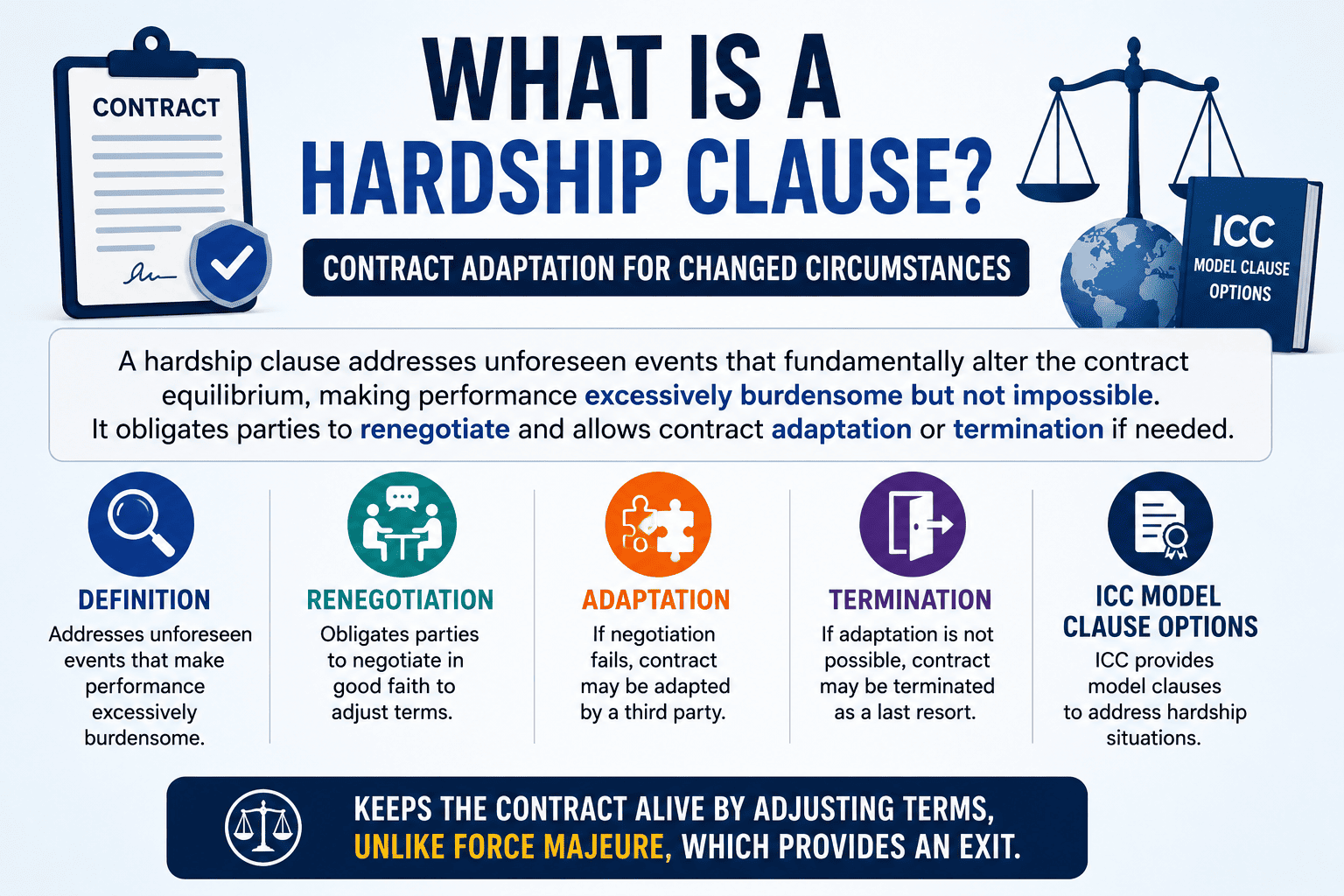
Why a Hardship Clause Matters
When performance remains possible but turns economically ruinous due to events like sudden tariffs, currency devaluation, or supply chain shocks, neither force majeure nor legal doctrines of impossibility provide a solution. Force majeure excuses performance; hardship adapts the contract. A well-drafted hardship clause provides the agreed procedure for such situations: the parties sit down to renegotiate and restore the balance, with a predefined fallback if they cannot agree.
📊 Key Statistic
Despite its importance, most commercial contracts lack a dedicated hardship clause, leaving parties to rely on uncertain statutory interpretations (e.g., Section 313 BGB in Germany) or the contested application of Article 79 CISG, which offers no duty to renegotiate or judicial adaptation.
Hardship vs. Force Majeure: The Critical Distinction
The distinction is not word-splitting; it decides the legal consequence. The difference lies in the effect on performance, not the triggering event.
| Aspect | Hardship Clause | Force Majeure Clause |
|---|
| Effect on Performance | Performance remains possible but has become excessively burdensome or economically unreasonable. | Performance becomes impossible or temporarily prevented. |
| Legal Consequence | Renegotiation and adaptation of the contract terms to restore balance. | Suspension or termination of the contract; the party is excused from performance. |
| Objective | To keep the contract alive on new, fair terms. | To provide an emergency exit from the contract. |
| Typical Trigger | Drastic economic changes, new regulations, tariff increases, currency devaluation. | Natural disasters, wars, export bans, pandemics (when making performance impossible). |
While an export ban that makes delivery absolutely impossible is force majeure, a tariff increase that merely makes the same delivery more expensive is a case for hardship and price adjustment. Both belong in the same contract, but in two separate clauses, as reflected in the ICC model clauses.
Legal Frameworks: Statutory Treatment of Hardship
Whether a hardship clause is needed depends heavily on the applicable law. The answers differ markedly across legal systems.
| Legal System | Statutory Adjustment for Hardship? | Consequence for the Clause |
|---|
| Germany (Section 313 BGB) | Yes, adjustment is possible (‘Störung der Geschäftsgrundlage’), but no statutory duty to renegotiate, applied with restraint. | The clause sharpens the threshold, defines procedure, and creates a duty to renegotiate. |
| France (Article 1195 Civil Code) | Yes, since 2016 (imprévision): renegotiation, then judicial adaptation or termination. | The clause can modify or exclude the statutory model. |
| Italy (Article 1467 Civil Code) | Yes, for eccessiva onerosità: termination in principle, adaptation only on the other side’s offer. | The clause supplies the missing adaptation mechanism by the affected party. |
| Common Law (England, USA) | No: no judicial adaptation; frustration only within narrow limits. | The clause is indispensable; it creates what the law refuses. |
| CISG (Article 79) | Contested. Even if applicable, no duty to renegotiate or judicial adaptation. | A clause is essential to create renegotiation and adaptation mechanisms. |
⚖️ Choice of Law Comes First
In common law jurisdictions, judicial adaptation of the contract is unknown. A bare duty to negotiate is often unenforceable as an ‘agreement to agree’. Therefore, English hardship clauses typically delegate the decision to a third party (arbitral tribunal or expert), making the choice of ICC Option 3B more than a nicety,it creates the power to adapt that the law itself refuses.
The ICC Model Hardship Clause (2020)
The International Chamber of Commerce (ICC) provides two coordinated model clauses,one for force majeure and one for hardship. The hardship clause follows a clear logic and offers three options for what happens when renegotiation fails.
| ICC Hardship Clause Option | Consequence if Renegotiation Fails | Best Suited For |
|---|
| Option 3A | The affected party may terminate the contract; adaptation by a judge or arbitrator is excluded without the other side’s consent. | Parties that do not want judicial adaptation and, in case of doubt, prefer a clean exit. |
| Option 3B | Either party may ask the judge or arbitrator, who adapts the contract to restore its equilibrium or terminates it, whichever is appropriate. | Parties that want to hold on to the contract, with the option of adapting it. This is the preferred option for contracts meant to be adapted. |
| Option 3C | Either party may ask the judge or arbitrator to declare the contract terminated. | Parties that want to leave termination, but not adaptation, to the court or tribunal. |
The clause is deliberately pitched above mere difficulty. It requires that performance has become excessively onerous, not merely more expensive, and that the event was neither foreseeable nor avoidable at the time of contracting. The choice of option allocates power: Option 3B gives the judge or arbitrator the strongest power,adaptation of the contract against the will of one side, which is precisely what the CISG does not provide.
Drafting Considerations & the Standard-Terms Trap
A party drafting a hardship clause should decide five questions, in this order:
1
Define the Trigger Threshold
When is performance “excessively burdensome”? Use objective indicators (e.g., cost increase of X%, material change in exchange rate) rather than vague terms like “economic difficulty.”
2
Set the Procedure
Establish a clear negotiation process: notice requirements, timeframes, and who represents each party in the renegotiation.
3
Choose the Fallback (ICC Options 3A, 3B, or 3C)
Decide who decides if negotiations fail: one of the parties, an arbitral tribunal, or an expert. Option 3B is the most robust for preserving the contract.
4
Address the Standard-Terms Risk
If the clause is imposed unilaterally (not negotiated), it may be subject to content review under national laws (e.g., German AGB review). The ICC clause is publicly available, which supports transparency, but incorporation by reference may still be risky. Writing the full text into the contract is more transparent.
5
Coordinate with Other Clauses
Ensure the hardship clause is consistent with the force majeure clause, price adjustment mechanisms, and dispute resolution provisions. Do not merge the two types of clauses.
⚠️ The Standard-Terms Trap
If a hardship clause is imposed as standard terms (not individually negotiated), it must be transparent and not unreasonably disadvantage the other party. While relevant clauses are generally recognized and take precedence over Section 313 BGB, a clause that blurs the trigger and consequences risks invalidity due to lack of transparency. The ICC clause is well-drafted and publicly available, which reduces this risk, but incorporation by reference alone may be insufficient in some jurisdictions.
Practical Application & Examples
When Is A Hardship Clause Triggered? Common Scenarios
Hardship clauses are increasingly relevant in volatile global markets. Common triggers include:
- Drastic changes in currency exchange rates (e.g., a 30% devaluation of the buyer’s currency).
- Sudden imposition of tariffs or trade barriers (e.g., the U.S. tariffs announced in April 2025).
- Significant increases in raw material or energy costs that are not covered by a price adjustment clause.
- New regulations or laws that fundamentally change the cost or feasibility of performance (e.g., environmental regulations, export controls).
- Major political or economic crises in the country of performance.
The key is that the event must be beyond the party’s control, not foreseeable at the time of contracting, and it must make performance excessively onerous,not merely more difficult or slightly more expensive.
Common Misconceptions and Pitfalls
⚠️
Confusing Hardship with Force Majeure
Mistake: Treating a cost increase as a force majeure event. Reality: If performance is still possible, force majeure does not apply. The correct tool is a hardship clause, which leads to renegotiation, not excuse.
⚠️
Assuming the Statutory Law Provides Relief
Mistake: Relying on Section 313 BGB or Article 79 CISG to solve a hardship situation. Reality: Section 313 BGB offers no duty to renegotiate, and Article 79 CISG (even if applicable) offers no judicial adaptation. A dedicated clause is essential.
⚠️
Drafting a Vague Clause
Mistake: Using ambiguous terms like “economic difficulty” or “substantial change.” Reality: Such clauses are difficult to enforce. The trigger must be objective (e.g., cost increase of X%, currency devaluation of Y%).
⚠️
Merging Force Majeure and Hardship Clauses
Mistake: Combining both into one clause. Reality: Merging them mixes two different sets of conditions with two different consequences, leading to confusion and potential invalidity. They should be drafted as two separate, coordinated clauses.
⚠️
Ignoring the Standard-Terms Risk
Mistake: Incorporating the ICC clause by reference without negotiation. Reality: The clause may be subject to content review if imposed. Writing the full text into the contract and negotiating the key terms (especially the choice of Option 3A, 3B, or 3C) is safer.
FAQ
Frequently Asked Questions, Hardship Clauses
QWhat is the difference between hardship and force majeure?
Force majeure applies when performance becomes impossible (or temporarily prevented) due to an external event, leading to suspension or termination of the contract. A hardship clause applies when performance remains possible but has become excessively burdensome or economically unreasonable, leading to renegotiation and adjustment of the contract terms. Force majeure is the ’emergency exit’; hardship is the ‘negotiating table’.
QDoes German law recognize hardship?
German law does not recognize hardship as a distinct institution. Its closest relative is the interference with the basis of the contract under Section 313 BGB (‘Störung der Geschäftsgrundlage’). This grants a right to adjustment, but no statutory duty to renegotiate, and courts apply it with restraint. The threshold is high: ordinary market fluctuations do not suffice; a fundamental change exceeding the frame of normal contractual risk is required. This is why a dedicated clause pays off.
QDoes Article 79 CISG cover hardship?
This is highly contested. One view accepts that economic unreasonableness can exceptionally be an impediment under Article 79 CISG. The prevailing view, however, argues that Article 79 should not be extended to hardship cases, and parties should instead rely on the subsidiarily applicable national law. Critically, even where Article 79 applies, it grants no duty to renegotiate and no power for a court or tribunal to adapt the contract. A dedicated hardship clause is therefore essential for international sales contracts governed by the CISG.
QWhat are the ICC Hardship Clause options?
The ICC Hardship Clause offers three options for what happens if renegotiation fails: (3A) The affected party may terminate the contract; (3B) Either party may ask a judge or arbitrator to adapt the contract or terminate it; (3C) Either party may ask a judge or arbitrator to declare the contract terminated. Option 3B is the most robust for preserving the contract through adaptation, which is particularly important in civil law and international contexts where judicial adaptation is desired.
QAre hardship clauses enforceable in common law jurisdictions?
In common law jurisdictions (like England and the USA), there is no general doctrine of judicial contract adaptation for hardship. The doctrine of frustration ends the contract only within very narrow limits and never adapts it. A bare duty to negotiate is often unenforceable as an ‘agreement to agree’. Therefore, a hardship clause is indispensable in common law contracts. To be effective, it should not merely create a duty to negotiate but should delegate the decision on adaptation or termination to a third party (e.g., an arbitral tribunal), as provided in ICC Option 3B or 3C.