Why Distribution Agreements Matter
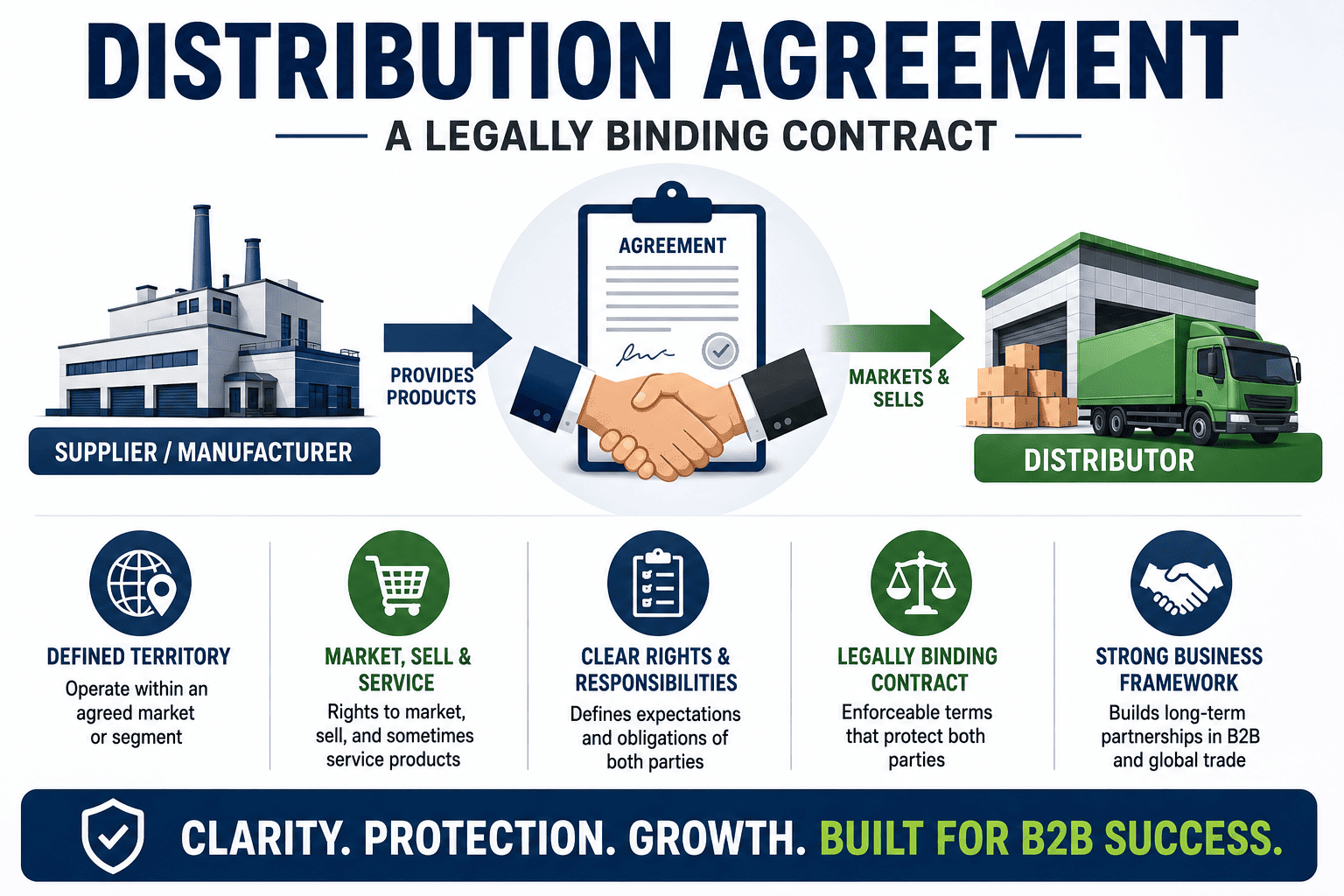
In today’s global and digitally connected economy, companies often rely on third parties to reach broader markets. A well-structured distribution agreement facilitates market penetration and efficiency, allowing vendors to scale without directly managing every market. It ensures brand consistency by governing how products are marketed, priced, and supported. Crucially, it provides risk mitigation by reducing misunderstandings and litigation risk, and ensures compliance with local regulatory standards. Without a proper agreement, vendors face challenges such as unauthorized sales practices, poor customer experiences, pricing conflicts, and loss of intellectual property control.
📊 Key Statistic
Businesses that use well-structured distribution agreements reduce channel conflicts and compliance risks by over 30%, according to industry studies. Clear contractual terms are the foundation of successful partner ecosystems.
Types of Distribution Agreements
Before entering into distributor agreements, vendors must determine which distribution strategy aligns with their business goals. Each strategy affects the legal structure and expectations outlined in the agreement.
| Distribution Type | Description | Control Level | Best For |
|---|
| Exclusive Distribution | One distributor has sole rights to sell the supplier’s products in a defined territory. | High (via performance obligations) | Luxury goods, complex B2B solutions, markets requiring significant partner investment. |
| Non-Exclusive Distribution | Suppliers may appoint multiple distributors, even competing in the same market. | Low | Consumer goods, broad market coverage, testing new markets. |
| Selective Distribution | Involves working with a limited number of vetted distributors based on specific criteria. | Moderate | Maintaining brand control and pricing integrity, B2B and luxury markets. |
| Sole Distribution | Similar to exclusive distribution, but the supplier retains the right to sell directly to customers in the territory. | Moderate | Supplier has existing direct sales but wants a partner for market expansion. |
Key Components of a Distribution Agreement
A comprehensive distribution agreement typically includes these core components to promote accountability and reduce ambiguity:
| Component | Description |
|---|
| Contract Term | Start and end dates, renewal conditions, and notice periods for termination. |
| Territorial Scope | Specific regions, countries, or market segments the distributor is authorized to serve. |
| Product Scope | Specific products or product categories covered by the agreement. |
| Exclusivity Clause | Defines whether the agreement is exclusive (sole representative), non-exclusive, or selective. |
| Sales & Marketing Rights | Guidelines for advertising, trade shows, online sales, and lead generation, including non-compete provisions. |
| Trademark & IP Licensing | How logos, trademarks, and promotional assets may be used, including indemnification for infringement. |
| Pricing and Payment Terms | Wholesale pricing, volume discounts, invoicing, payment timelines, and late payment charges. |
| Performance Obligations | Sales targets, inventory levels, service requirements, and reporting obligations. |
| Warranty Clause | Quality standards and warranties provided by the manufacturer to the distributor and end-customers. |
| Reporting & Analytics | Metrics, frequency, and methods of reporting performance or market data. |
| Termination Clauses | Circumstances under which the agreement may be canceled, including material breach, cure period, termination for convenience, and insolvency. |
| Dispute Resolution | Arbitration (arbitration clause) or legal processes, including mediation, to resolve disagreements. |
| Limitation of Liability | Caps on liability and mutual waivers of consequential damages. |
| Governing Laws and Jurisdiction | Specifies which laws govern the agreement (e.g., Indian Contract Act, 1872) and the jurisdiction for disputes. |
International & Legal Considerations
International Distribution Agreements
Many multinational companies sign international distributor agreements to expand into new markets. These contracts must address additional complexities, including:
- Import/export compliance and customs regulations.
- Currency and tax implications, including transfer pricing and withholding taxes.
- Local laws and dispute jurisdictions, which vary significantly by country.
- Language and translation accuracy to avoid misinterpretation.
- Cultural considerations in sales and marketing approaches.
Distributors often maintain subsidiaries in multiple countries to provide global logistics, market expertise, and compliance support. Engaging legal counsel familiar with the relevant jurisdictions is critical during contract negotiation and periodic reviews. The United Nations Convention on Contracts for the International Sale of Goods (CISG) may also apply to international distribution contracts, providing uniform rules for the sale of goods between parties in different countries.
Legal Considerations and Compliance
Distributor agreements must be drafted carefully to ensure they comply with national and international trade laws, especially in these areas:
| Area | Key Considerations |
|---|
| Antitrust & Competition Law | Prevent unfair monopolies, price fixing, or market allocation that could violate competition laws. |
| Export Control Regulations | Compliance with embargoes, sanctions, and restrictions on certain goods or technologies. |
| Anti-Bribery & Corruption | Particularly important when operating in high-risk jurisdictions; include clear compliance obligations. |
| Data Privacy & Cybersecurity | When customer or transaction data is shared, agreements must ensure data privacy compliance (e.g., GDPR). |
Distributor vs. Dealer
Distribution Agreement vs. Dealer Agreement
While similar, distributor agreements and dealer agreements serve different roles in the supply chain. Understanding the distinction is crucial for proper contract drafting.
| Aspect | Distributor Agreement | Dealer Agreement |
|---|
| Role | Middleman between vendor and dealers/resellers | Sells directly to end customers |
| Partner | Manufacturer/Vendor | Distributor |
| Focus | Logistics, warehousing, bulk sales | Retail sales, end-user support |
| Payment | Bulk pricing and inventory management | End-user pricing and service margins |
In a two-tier distribution model, a vendor supplies products to a distributor, which then provides goods to dealers, such as retailers, value-added resellers (VARs), or managed service providers (MSPs).
Negotiation & Selection
How to Negotiate a Distribution Agreement
Negotiating an effective distribution agreement involves careful collaboration. Key tips for success include:
1
Define goals upfront
Clarify revenue targets, expansion timelines, and territory priorities. Understand what you need from the partnership and what you’re willing to give.
3
Involve all stakeholders
Include legal, marketing, finance, and operations teams to ensure all perspectives are covered and the agreement is workable.
4
Balance control and autonomy
Ensure brand protection without micromanaging the distributor’s day-to-day operations. Use clear guidelines and performance metrics.
6
Plan for audits and accountability
Build in regular performance reviews, reporting, and training expectations. Include breach of contract provisions and remediation steps.
7
Future-proof the contract
Account for pricing adjustments, product updates, and changes in local law. Consider a commercial framework agreement for long-term relationships.
Risks & Mitigation
Common Distribution Partnership Risks & Mitigation Strategies
⚠️
Channel Conflict & Margin Erosion
Mitigation: Clearly define territories and customer segments. Use exclusivity clauses carefully and establish clear pricing and discount structures. Regularly monitor channel performance.
⚠️
Regulatory Non-Compliance by Partner
Mitigation: Explicitly allocate compliance responsibilities in the agreement. Conduct compliance audits and include indemnification clauses for regulatory fines caused by partner actions. Include material breach provisions for serious violations.
⚠️
Loss of Intellectual Property Control
Mitigation: Register IP in the territory, use strong trademark and IP licensing clauses, include confidentiality provisions, and require return of all materials upon termination.
⚠️
Poor Distributor Performance
Mitigation: Set clear performance obligations (sales targets, service standards). Include regular reporting requirements and a cure period for underperformance. Have a clear termination process.
⚠️
Dispute Resolution Complexity
Mitigation: Include a robust dispute resolution clause (arbitration clause or mediation clause) with clear governing law and jurisdiction. Consider international arbitration forums like ICC or SIAC.
FAQ
Frequently Asked Questions, Distribution Agreements
QWhat is the difference between exclusive and non-exclusive distribution?
An exclusive distribution agreement grants a single distributor sole rights to sell the supplier’s products in a defined territory. The supplier cannot appoint other distributors in that territory, and the distributor typically has higher performance obligations. A non-exclusive distribution agreement allows the supplier to appoint multiple distributors, who may compete in the same market. Exclusive agreements provide stronger partner incentives and brand control but limit market coverage; non-exclusive agreements maximize reach but can lead to channel conflict.
QWhat is the difference between a distributor and a dealer?
In a two-tier distribution model, a distributor acts as a middleman between the manufacturer and dealers (or resellers). Distributors focus on logistics, warehousing, and bulk sales, purchasing products from the manufacturer. Dealers (also called retailers or VARs) sell products directly to end customers and provide end-user support. The dealer agreement governs the relationship between the distributor and the dealer. The roles and payment structures differ: distributors operate on bulk margins, while dealers earn margins on end-user pricing.
QHow long should a distribution agreement typically last?
The term of a distribution agreement varies based on the industry and relationship. Initial terms often range from 1 to 5 years. Many agreements include automatic renewal clauses unless terminated by either party. For exclusive arrangements, longer terms (3-5 years) are common to justify the distributor’s investment. Agreements should include termination provisions for cause (e.g.,
material breach after a
cure period) and without cause (
termination for convenience) with appropriate notice periods.
QWhat happens if a distributor fails to meet regulatory requirements?
Most distribution agreements include clauses that make compliance with all applicable laws a material obligation. If a distributor fails to meet regulatory requirements (e.g., data privacy, export controls, anti-bribery), it typically constitutes a
material breach of the agreement. The supplier may issue a notice and provide a
cure period for the distributor to rectify the issue. If not cured, the supplier may terminate the agreement and claim damages. Strong
indemnification clauses protect the supplier from losses caused by the distributor’s non-compliance.
QHow do I protect my intellectual property in a distribution agreement?
Protect your IP by: (1) Registering trademarks, patents, and designs in the distributor’s territory before signing the agreement, (2) Including a strong trademark and IP licensing clause that defines how your assets may be used and prohibits any alteration, (3) Adding comprehensive confidentiality provisions to protect trade secrets and proprietary information, (4) Requiring the distributor to return or destroy all IP materials (including marketing assets, samples, and documentation) upon termination, and (5) Including an
indemnification clause where the distributor indemnifies you for any IP infringement claims arising from their actions or modifications. Consider a separate IP license agreement for clarity.