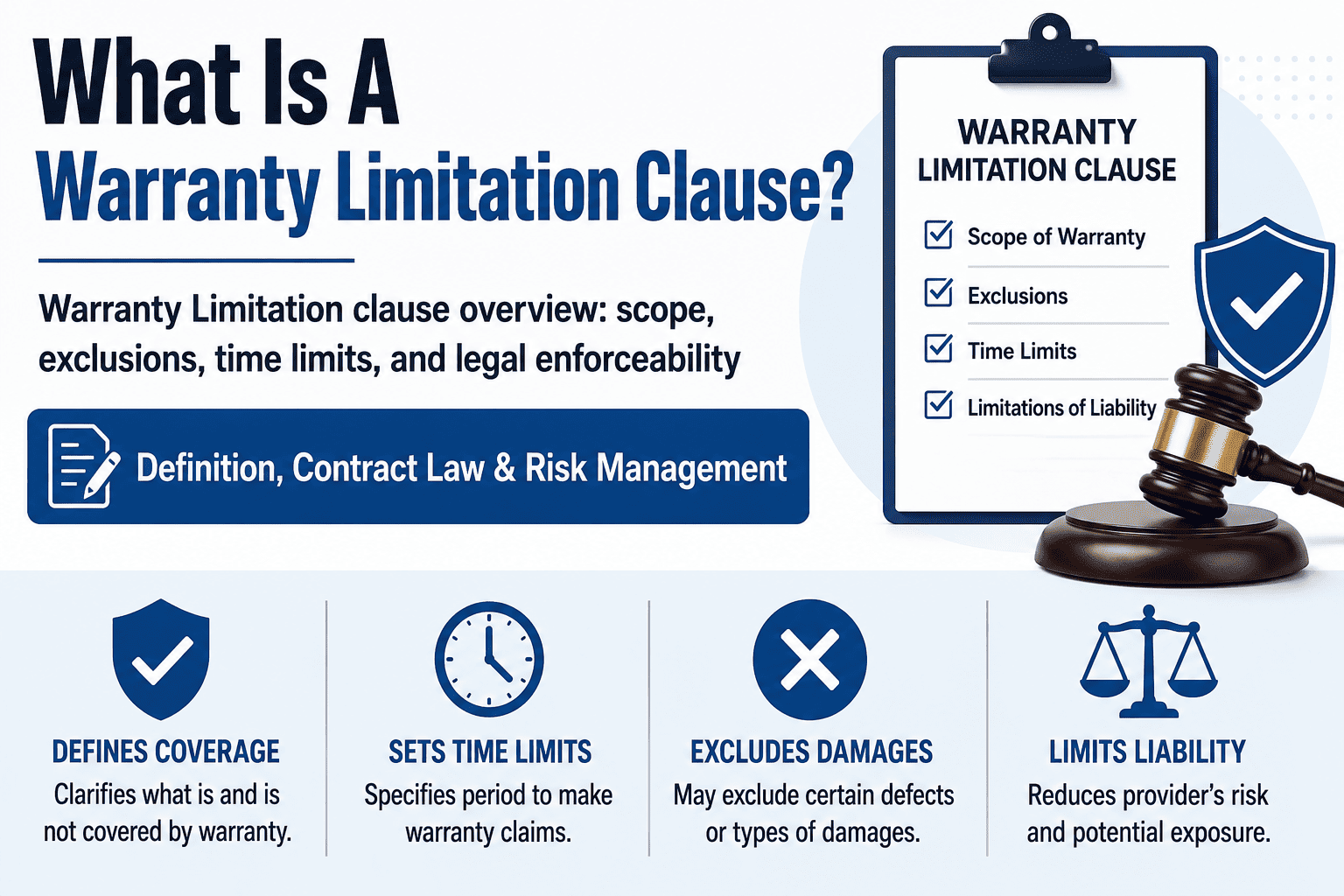
Why Warranty Limitations Matter
Warranty limitations are essential for managing risk in commercial transactions. They clarify the scope of the seller’s or service provider’s promises, preventing misunderstandings and frivolous claims. For buyers, they provide a clear understanding of what protection they have and for how long. For sellers, they cap exposure to liability, especially for indirect or consequential damages. In industries like software, manufacturing, and construction, these clauses are heavily negotiated to balance risk and reward.
📊 Key Insight
According to legal experts, clearly drafted warranty limitation clauses can reduce litigation costs by up to 40% by setting clear expectations and limiting claims to defined remedies. Ambiguity is the enemy of enforceability.
Warranty Limitation vs. Limitation of Liability: Key Differences
While often grouped together, these clauses serve distinct purposes. Understanding the difference is crucial for drafting and negotiating contracts.
| Clause Type | Focus | What It Limits | Typical Wording |
|---|
| Warranty Limitation | Scope of promises (warranties) | What is covered, exclusions, claim periods | “The warranty is limited to defects in materials and workmanship for 12 months.” |
| Limitation of Liability | Financial responsibility for breaches | Caps total damages, excludes consequential losses | “Liability is capped at the purchase price.” |
| Disclaimer of Warranties | Elimination of implied or express warranties | Completely disclaims all warranties (e.g., “as is”) | “All warranties, express or implied, are disclaimed.” |
📌 Interplay
Warranty limitations and limitation of liability clauses work together. The warranty defines the promise; the limitation of liability caps the remedy if that promise is broken. A well-drafted contract uses both to allocate risk effectively.
Essential Components
What a Warranty Limitation Clause Should Include
An effective warranty limitation clause is specific, conspicuous, and comprehensive. Below are the key components typically found in such clauses.
| Component | Description & Example |
|---|
| Scope of Warranty | Precisely defines what is covered (e.g., “defects in materials and workmanship”) and what is not (e.g., “normal wear and tear, misuse, or unauthorized modifications”). |
| Time Limitation (Survival Period) | Sets a specific period within which claims must be made (e.g., “90 days from delivery” or “12 months from installation”). |
| Exclusions | Lists specific conditions or events that void the warranty (e.g., “damage from fire, flood, lightning”, “improper installation”, “use with incompatible products”). |
| Sole Remedy | Specifies the exclusive remedy available (e.g., “repair or replacement at seller’s option” or “refund of purchase price”). |
| Disclaimer of Implied Warranties | Explicitly disclaims warranties of merchantability, fitness for a particular purpose, and non-infringement (often in all caps). |
| “As Is” / “As Available” Disclaimer | States that the product or service is provided “as is” and “as available” without any warranties beyond those expressly stated. |
| No Warranty for Errors | Often included for software or services, stating that the provider does not warrant uninterrupted or error-free operation. |
Real-World Examples
Warranty Limitation Examples from Actual Contracts
These examples illustrate how warranty limitation clauses are drafted across different industries.
📄 Software / IT Services
MSC Software: “EXCEPT AS EXPRESSLY STATED IN SECTION 10.1 OF THIS AGREEMENT AND TO THE EXTENT NOT PROHIBITED BY APPLICABLE LAW, NEITHER MSC NOR ANY SUPPLIER OF MSC MAKE ANY WARRANTIES OF ANY KIND, WITH RESPECT TO THE SOFTWARE, DOCUMENTATION, MAINTENANCE, OR SERVICES PROVIDED UNDER THIS AGREEMENT. MSC FURTHER EXPRESSLY DISCLAIMS THE WARRANTIES OF MERCHANTABILITY, FITNESS FOR A PARTICULAR PURPOSE AND NON-INFRINGEMENT. MSC MAKES NO WARRANTY THAT THE OPERATION OF THE SOFTWARE WILL BE UNINTERRUPTED OR ERROR FREE.”
📄 Electronics / Hardware
Xantrex LLC: “This Contractual Warranty does not warrant uninterrupted or error-free operation of the Product or cover normal wear and tear… The warranty claims that relate to defects caused by any of the following factors are not covered: Improper Use, Unauthorized modifications, Vandalism, Insufficient ventilation, Installation in a corrosive environment, Failure to observe safety standards, Damages during transportation, Force majeure (fire, flood, lightning).”
📄 Energy / Battery Systems
BYD: “The Limited Warranty… does not apply to any defect or deterioration resulting from: a) Product not being installed, maintained or operated in accordance with the Operating Manual; b) exposure to temperatures of more than 50°C and/or below -10°C; c) You failing to notify BYD of the defect within 30 days of becoming aware; d) operation with an inverter that is not a BYD certified inverter; e) modification or repair without approval; f) force majeure; g) damage during transportation.”
Legal Enforceability
Legal Enforceability of Warranty Limitations
The enforceability of a warranty limitation clause depends on jurisdiction, the nature of the goods/services, and how the clause is presented. Several key principles apply:
1
Conspicuousness
In many jurisdictions (e.g., under the UCC in the US), disclaimers of implied warranties must be conspicuous , typically in all capital letters, bold, or a larger font. Courts may refuse to enforce hidden or inconspicuous limitations.
2
Non-Override of Consumer Law
Warranty limitations cannot override mandatory consumer protections. For example, implied warranties of merchantability and fitness for a particular purpose often cannot be disclaimed in consumer sales. Some jurisdictions (like the UK and EU) have strong consumer rights that prevail.
3
Statutory Limitations vs. Contractual Time Bars
Parties can agree to shorten the time for notifying claims (e.g., 12 months), but they generally cannot shorten the statutory period for bringing legal proceedings (e.g., 3 years). A clause barring all legal action after a short period would likely be void as an unlawful restriction on legal remedies.
4
Unconscionability
Courts may refuse to enforce a warranty limitation if it is found to be procedurally or substantively unconscionable , e.g., a “take-it-or-leave-it” contract with excessive limitations that shock the conscience.
5
Knowledge and Awareness
If the buyer knew or should have known about a defect, they may be precluded from making a claim. Also, if the buyer had the opportunity to inspect the goods and failed to do so, this may limit claims for patent defects.
⚖️ Key Legal Reference
Under the Indian Contract Act, Section 28, any agreement that restricts a party from enforcing their rights within the statutory limitation period is void. However, contractual notice periods (e.g., 24 months for indemnity claims) are generally enforceable as long as they don’t bar legal proceedings outright. This distinction is crucial in M&A and procurement contracts.
Drafting & Negotiation Tips
How to Draft and Negotiate a Warranty Limitation Clause
Whether you’re a buyer or seller, a clear, balanced warranty limitation is in everyone’s interest. Here are practical tips for drafting and negotiating this clause.
1
Be Specific and Unambiguous
Vague language is a litigation risk. Define exactly what is covered, for how long, and the remedy. Use clear, non-legalistic language where possible.
2
Highlight Disclaimers
Place disclaimers of implied warranties in a prominent position, often in all caps and bold type, to increase enforceability.
3
Consider the Product Lifecycle
Set a warranty period that aligns with the expected useful life of the product. For complex machinery, consider extended warranties for critical components.
4
List Exclusions Comprehensively
Exclude normal wear and tear, misuse, abuse, unauthorized modifications, and external causes (fire, flood, lightning). Also exclude costs of removal, reinstallation, and troubleshooting.
5
Balance “As Is” with Customer Expectations
While “as is” is powerful, it may not be acceptable in B2B sales where the buyer relies on the product for their operations. Consider a limited warranty as a middle ground.
6
Review for Legal Compliance
Ensure the clause does not violate any applicable consumer protection laws or statutory limitations on liability. Consider using “to the fullest extent permitted by law” to provide a safety net.
FAQ
Frequently Asked Questions About Warranty Limitations
QWhat is the difference between a Warranty Limitation and a Disclaimer of Warranties?
A Warranty Limitation defines the scope and boundaries of a warranty (e.g., time limit, exclusions, remedy). A Disclaimer of Warranties completely disclaims all warranties, often using phrases like “as is” or “without any warranty of any kind.” A disclaimer is a broader, more absolute provision, while a limitation sets parameters around a still-existing warranty.
QCan a warranty limitation clause exclude liability for personal injury or death?
In most jurisdictions, no. Liability for personal injury or death caused by negligence or defective products is considered a fundamental right and cannot typically be excluded or limited by contract. Such clauses would be void as against public policy.
QWhat is a “conspicuous” warranty limitation?
A conspicuous clause is one that a reasonable person would notice. In legal terms, this often means the clause must be in a larger type, in all capital letters, or in a contrasting color or font. Under the UCC, disclaimers of implied warranties must be conspicuous to be enforceable.
QCan I extend the warranty period through negotiation?
Yes, warranty periods are a matter of commercial negotiation. Buyers often seek longer periods (e.g., 24-36 months) for critical equipment, while sellers prefer shorter periods (e.g., 12 months). Extended warranties may be offered at an additional cost.
QWhat happens if a warranty limitation clause is found unenforceable?
If a warranty limitation clause is held unenforceable (e.g., for being unconscionable or not conspicuous), the court may sever the offending part and enforce the rest of the contract, or the entire warranty provision may fail, leaving the seller exposed to broader liability under default statutory warranties. This underscores the importance of careful drafting.