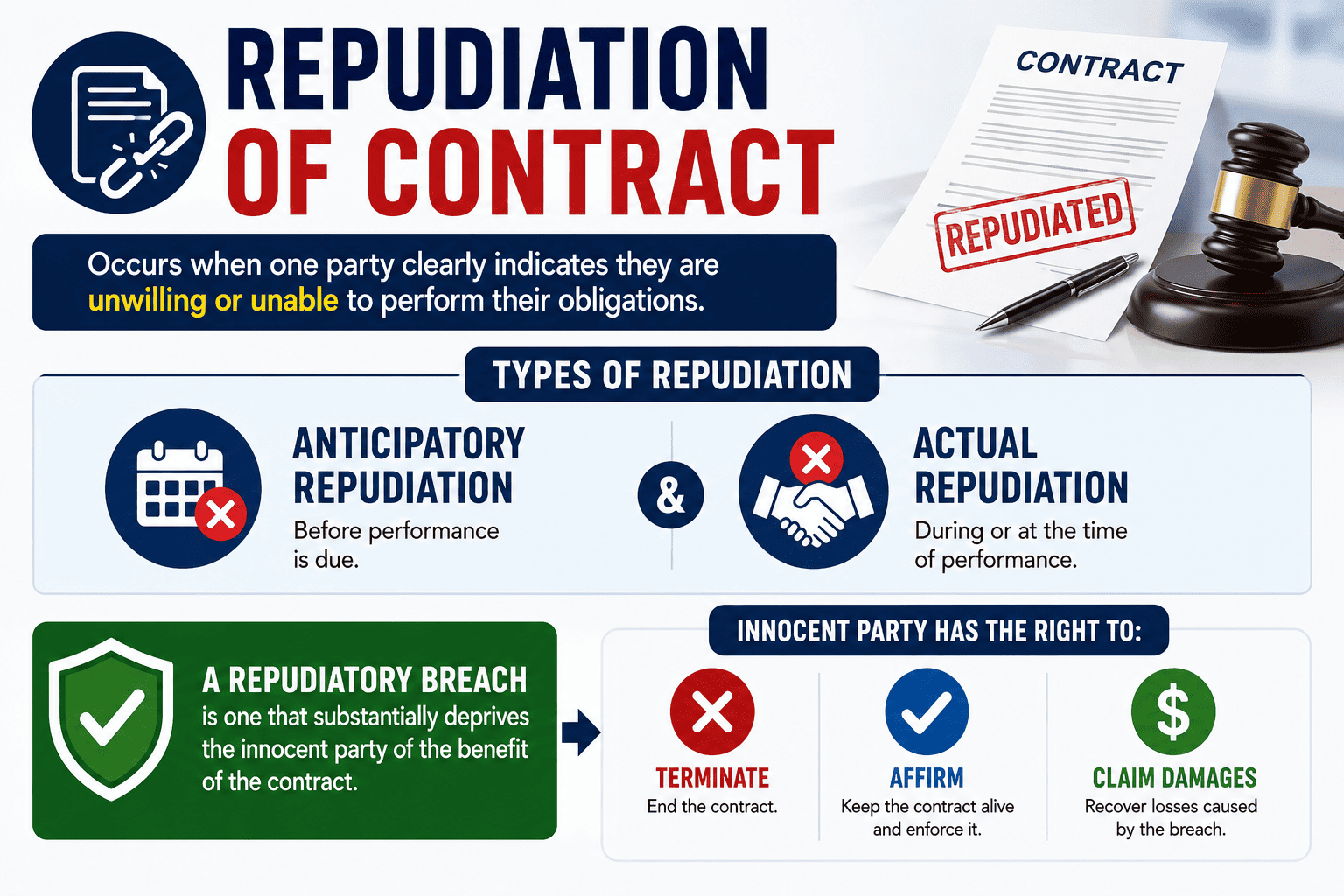
What Is Repudiation of Contract?
Repudiation is a fundamental legal concept in contract law. As defined by Cornell Law School’s Wex, repudiation is where one party of a contract clearly states or demonstrates their intention not to fulfill their contractual obligations. In order to constitute repudiation, the language or action of the breaching party must be reasonably interpreted to mean that they will not or cannot perform.
Repudiation is more than a minor breach — it is a repudiatory breach that goes to the very root of the contract, depriving the innocent party of substantially the whole benefit they were expecting. This gives the innocent party a choice: accept the repudiation and terminate, or affirm the contract and keep it alive.
📚 Key Source: LegalVision (Australia)
According to LegalVision, repudiation is a breach of a contractual term that substantially deprives the innocent party of the benefit of the contract. A minor breach would not be repudiatory. Repudiation also includes a refusal to perform a significant contractual obligation in advance (anticipatory repudiation).
Types of Repudiation: Anticipatory & Actual
| Type | Definition | Example | Timing |
|---|
| Anticipatory Repudiation |
Clear indication before performance is due that the party will not perform |
Seller says “I will not deliver the goods” before the delivery date |
Before performance date |
| Actual Repudiation |
Refusal or inability to perform at the time performance is due |
Seller fails to deliver at the agreed time and refuses to do so |
At or after performance date |
| Repudiation by Conduct |
Actions that make performance impossible, even without words |
Selling the unique goods to a third party, or ceasing to trade |
Before or at performance date |
⚖️ Anticipatory Repudiation Doctrine
Under the doctrine of anticipatory breach, the innocent party does not have to wait until the performance date. They can immediately treat the contract as repudiated, terminate, and claim damages. This allows for early mitigation of losses and prevents the innocent party from being forced to wait idly.
What Constitutes a Repudiatory Breach?
Not every breach is repudiatory. The breach must be serious enough to substantially deprive the innocent party of the benefit they expected from the contract. The law categorizes contractual terms into three types to determine whether a breach is repudiatory:
| Term Type | Definition | Breach Consequence |
|---|
| Condition |
A central term, essential to the contract’s purpose. Without it, the contract would not work. |
Breach of a condition is always repudiatory. Innocent party can terminate. |
| Warranty |
A minor, ancillary term. Not central to the contract. |
Breach of a warranty is not repudiatory. Only damages are available. |
| Intermediate (Innominate) Term |
A term that could be either condition or warranty depending on the consequences of breach. |
If the breach is severe enough to deprive substantial benefit, it is repudiatory. If minor, only damages. |
As explained by EM Law (UK), the classification gives the law the flexibility to assess the true consequences of the breach. A breach of an intermediate term may be repudiatory if it is severe enough to deprive the innocent party of the substantial benefit of the contract.
Consequences of Repudiation: Termination vs. Affirmation
When repudiation occurs, the innocent party has two distinct options. The choice is significant and must be made carefully, as it affects future rights and obligations.
A
Accept the Repudiation (Terminate)
The contract is terminated, and both parties are released from future obligations. The innocent party can immediately claim damages for the loss caused by the repudiation. This is the most common response when the relationship has broken down.
B
Affirm the Contract (Keep Alive)
The innocent party may choose to keep the contract alive, insisting on performance. The contract continues, and the innocent party can still claim damages for the breach. However, if they affirm, they lose the right to terminate based on that repudiation. Affirmation may be beneficial if performance is still valuable.
🧑⚖️ The “Legitimate Interest” Test (India & UK)
As detailed in IndiaCorpLaw’s analysis of the Simplex Infrastructure case, the right to affirm is not absolute. If the innocent party has “no substantial or legitimate interest” in continuing the contract (e.g., damages are an adequate remedy and continuation would be commercially absurd or perverse), they cannot keep the contract alive solely to increase the burden on the breaching party. This test, derived from the White & Carter case, applies in both UK and Indian law.
Key Legal Principles & Case Law
Key Principles from Case Law
| Case | Principle | Jurisdiction |
|---|
| White & Carter (Councils) Ltd v McGregor [1962] |
House of Lords held (majority) that the innocent party may keep the contract alive and claim the contract price, even if the breaching party has repudiated. However, Lord Reid’s obiter carved out the “legitimate interest” exception. |
UK |
| Simplex Infrastructure Ltd v Aban Offshore Ltd (Madras High Court) |
Applied the “legitimate interest” test. Held that the innocent party was not entitled to compensation for the entire period of the contract, but only up to the date of filing the suit, where continuation was unreasonable. |
India |
| MSC Mediterranean Shipping Company SA v Cottonex Anstalt [2015] |
Leggatt J held that the carrier had a legitimate interest in keeping the contract alive only as long as there was a realistic prospect of performance. Once that prospect vanished, affirmation was not justified. |
UK |
| Hadley v Baxendale (1854) |
Establishes the foreseeability test for consequential damages — relevant for calculating damages after repudiation. |
UK |
Practical Guidance
How to Respond to Repudiation: A Practical Guide
1
Identify the Repudiation
Determine whether the statement or conduct is a clear indication of unwillingness or inability to perform. Is it a repudiatory breach (substantial deprivation of benefit) or a minor breach?
2
Consider Your Options
Evaluate whether to accept (terminate) or affirm. Consider: is performance still valuable? Are damages adequate? Is there a legitimate interest in continuing?
3
Communicate Your Decision Clearly
If accepting repudiation, communicate this clearly to the other party. If affirming, make it known that you are keeping the contract alive and expect performance.
4
Mitigate Damages
You have a duty to mitigate losses. Take reasonable steps to reduce the financial impact of the repudiation. Failure to mitigate may reduce your claim.
5
Document Everything
Preserve all evidence: the repudiation communication, your response, mitigation efforts, and any losses incurred. Good documentation is critical for any legal claim.
Related Contract Concepts
| Concept | Relationship to Repudiation |
|---|
| Breach of Contract |
Repudiation is a specific, serious type of breach. All repudiations are breaches, but not all breaches are repudiatory. |
| Material Breach |
Repudiation is essentially a material breach that goes to the root of the contract, giving the right to terminate. |
| Cure Period |
A cure period allows the breaching party to remedy the breach. If the breach is cured within the period, it may no longer be repudiatory at the time of termination. |
| Termination for Convenience |
Unlike repudiation (which is a breach), termination for convenience is a contractual right to end the contract without breaching it. |
| Consequential Damages |
Consequential damages (e.g., lost profits) may be recoverable if they were foreseeable at the time of contracting, per Hadley v Baxendale. |
| Indemnification Clause |
Indemnification may cover losses arising from repudiation, but careful drafting is needed to avoid waiver issues. |
| Arbitration Clause |
Disputes arising from repudiation are often subject to arbitration clauses, which govern how the repudiation is resolved. |
| Mediation Clause |
A mediation clause may require the parties to attempt mediation before pursuing legal action for repudiation. |
Frequently Asked Questions
FAQ: Repudiation of Contract
QWhat is the difference between repudiation and breach of contract?
A breach of contract is any failure to perform a contractual obligation. Repudiation is a specific, serious type of breach where one party indicates (by words or conduct) that they will not perform their obligations at all, or that they intend to perform in a way that substantially deprives the other party of the benefit of the contract. Repudiation can occur before performance is due (anticipatory repudiation) or at the time of performance. Not all breaches are repudiatory; only those that go to the root of the contract give the innocent party the right to terminate.
QWhat are the two options available to the innocent party when repudiation occurs?
The innocent party has two choices: (1) Accept the repudiation and terminate the contract, releasing both parties from future obligations, and immediately claim damages for the loss suffered. (2) Affirm the contract, keeping it alive for future performance. If affirmed, the contract continues, and the innocent party may still claim damages for the breach but loses the right to terminate based on that repudiation. The choice is significant and should be made carefully, as it affects rights and obligations going forward.
QWhat is anticipatory repudiation?
Anticipatory repudiation (or anticipatory breach) occurs when one party clearly indicates, before performance is due, that they will not perform their contractual obligations. This can be by express words (e.g., “I will not deliver the goods”) or by conduct (e.g., selling the unique goods to someone else). The innocent party can immediately treat the contract as repudiated and sue for damages, without waiting for the performance date. This doctrine allows the innocent party to mitigate losses and not be forced to wait.
QWhat is the “legitimate interest” test in the context of affirmation?
The “legitimate interest” test, derived from Lord Reid’s obiter in White & Carter, limits the right to affirm. If the innocent party has no substantial or legitimate interest in continuing the contract (e.g., damages are an adequate remedy and continuation would be commercially absurd or perverse), they cannot keep the contract alive solely to increase the burden on the breaching party. This test has been applied in both UK and Indian law, as seen in the Simplex Infrastructure case.
QIs frustration the same as repudiation?
No. Frustration occurs when an unforeseen event, beyond the control of either party, makes performance impossible, illegal, or radically different from what was agreed (e.g., natural disaster, new law). It is not caused by either party’s conduct. Repudiation arises from a party’s deliberate action or decision to not perform. Frustration automatically terminates the contract without liability; repudiation gives the innocent party a choice to terminate or affirm.
QHow does the duty to mitigate apply after repudiation?
The innocent party has an affirmative duty to take reasonable steps to reduce their losses after repudiation. For example, if goods are not delivered, the buyer should attempt to purchase substitute goods (cover). If the buyer fails to mitigate, they cannot recover damages that could have been avoided. The breaching party bears the burden of proving failure to mitigate. Reasonable mitigation expenses are themselves recoverable as damages.