How to Expand Your Manufacturing & Industrial Automation Business to the United Kingdom
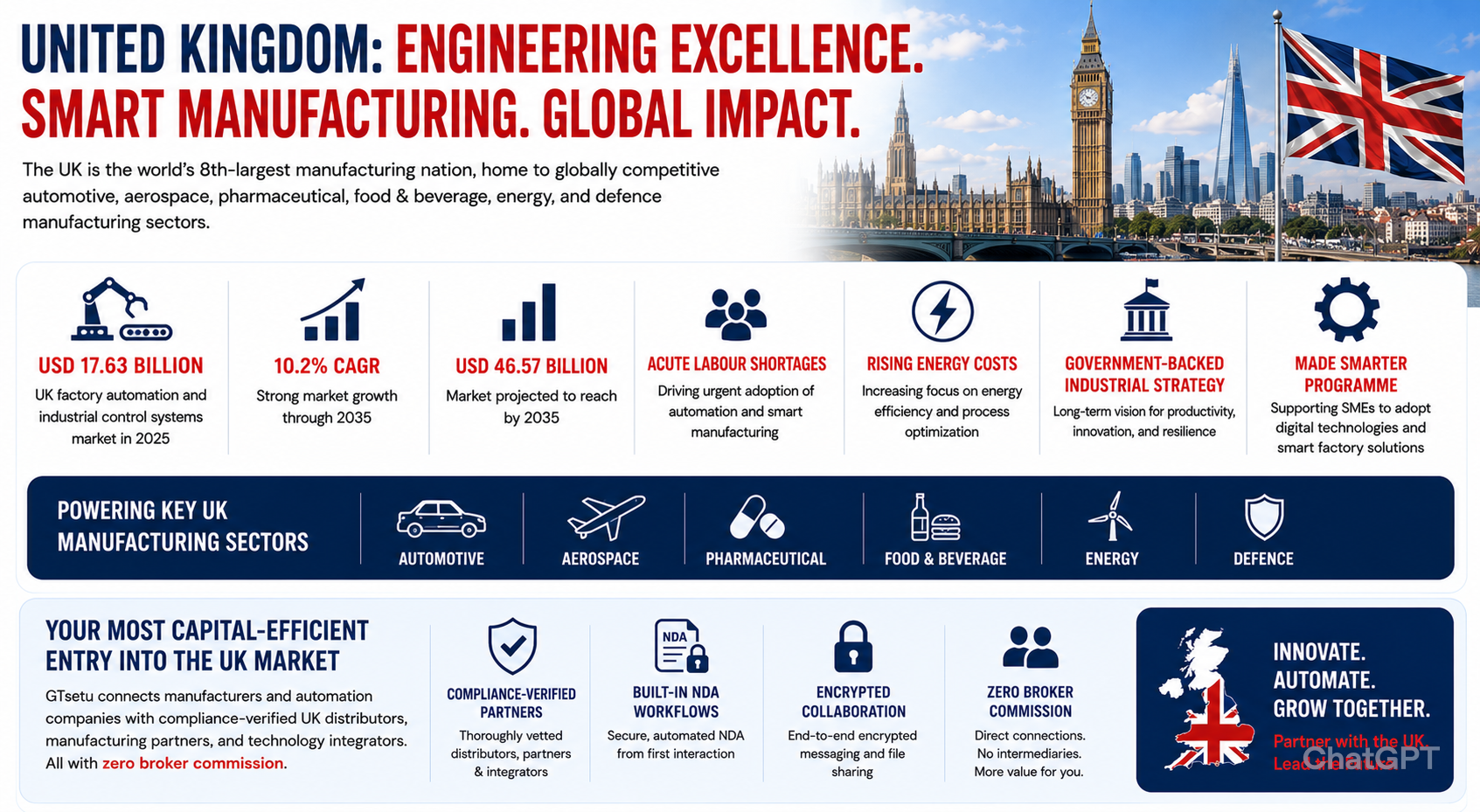
Direct Answer: The United Kingdom is the world’s 8th-largest manufacturing nation, home to globally competitive automotive, aerospace, pharmaceutical, food & beverage, energy, and defence manufacturing sectors. The UK factory automation and industrial control systems market reached USD 17.63 billion in 2025, growing at 10.2% CAGR toward USD 46.57 billion by 2035. Acute labour shortages, rising energy costs, a government-backed Industrial Strategy, and the Made Smarter programme are driving systematic smart factory adoption across both large OEMs and the UK’s extensive SME manufacturing base. GTsetu connects manufacturers and automation companies with compliance-verified UK distributors, manufacturing partners, and technology integrators, with built-in NDA workflows, encrypted collaboration, and zero broker commission.
📅 June 2026⏱ 18 min read✍️ GT Setu Editorial Team🔄 Updated regularly
$17.6B
Automation Market 2025
10.2%
Factory Automation CAGR
$46.6B
Market by 2035
#8
World Manufacturing Nation
🌍 Also Explore: Expand to Other Global Manufacturing Markets
The United Kingdom has been an industrial nation since the first Industrial Revolution began in its factories in the late 18th century. Today, it remains the world’s 8th-largest manufacturing economy, producing around GBP 192 billion of goods annually, employing approximately 2.7 million people directly in manufacturing, and leading globally in aerospace, pharmaceuticals, automotive, defence electronics, and food & beverage. For industrial automation companies and manufacturers seeking to enter or expand in the UK, this breadth of industrial activity, across 13+ distinct manufacturing sectors, creates a commercial opportunity that is both large in aggregate and commercially specific by vertical.
The UK’s automation market is in a period of structural acceleration: acute labour shortages (unemployment at 4.4% in early 2026), the government’s Industrial Strategy and Made Smarter programme, rising energy costs driving efficiency investments, and a generational shift toward smart factory operations among both multinational OEMs and the country’s large SME manufacturing base. This guide provides everything required to understand and act on the UK manufacturing and automation expansion opportunity in 2025–2026.
🇬🇧 United Kingdom at a Glance
Population: approx. 67.5 million. Capital: London. Currency: British Pound Sterling (GBP). GDP: approx. USD 3.1 trillion (2024, world’s 6th largest economy). Manufacturing share of GDP: approx. 10% (world-class value-added per worker). Unemployment: 4.4% (early 2026). Key manufacturing sectors: aerospace, automotive, pharmaceuticals, food & beverage, defence, chemicals, electronics, energy equipment. Primary trading partners (post-Brexit): USA (largest), Germany, Netherlands, France, Ireland, Belgium, China. Member of the CPTPP (Comprehensive and Progressive Agreement for Trans-Pacific Partnership) since 2023.
SECTION 1
1 Why UK for Manufacturing & Automation?
The United Kingdom’s case as a manufacturing expansion destination rests on several foundations that make it uniquely attractive for both establishing manufacturing operations and selling automation solutions into an existing industrial base: world-class sector depth across multiple high-value verticals, a structurally acute automation demand driven by demographics and energy economics, and an institutional environment, legal framework, IP protection, English language, financial infrastructure, that makes it among the operationally simplest major manufacturing markets for foreign companies to enter.
10.7%
UK industrial robotics market CAGR 2025–2030, reaching USD 1.75 billion by 2030
28.4%
Industrial robotics technology share of UK automation market in 2025 (Persistence MR)
12.3%
Energy cost increase for UK manufacturers 2022–2023, driving efficiency automation investment
The Six Strategic Drivers for UK Expansion
Driver
What It Means for Manufacturers & Automation Companies
Commercial Implication
Labour Shortage & Demographics
UK unemployment at 4.4% and an ageing manufacturing workforce creates acute and persistent labour shortages in manufacturing, making automation adoption economically necessary, not optional
Structural, multi-decade demand for labour-substitution automation, cobots, automated assembly, packaging automation, and process control, across virtually every manufacturing sector
Energy Cost Pressure
UK manufacturers faced a 12.3% energy cost increase between 2022 and 2023, among the steepest in Europe. Energy-intensive manufacturers have an acute financial incentive to adopt smart automation systems that reduce energy waste and optimise resource efficiency
Energy management systems, smart motor controls, compressed air optimisation, and AI-driven energy efficiency automation are priority investment categories with clear, rapid ROI
Government Industrial Strategy & Made Smarter
The UK government’s 2025 Industrial Strategy identifies advanced manufacturing as one of eight priority growth sectors, backed by the Made Smarter programme providing co-funded automation adoption support and technology vouchers for SMEs
Government-backed demand creation expands the addressable market by subsidising automation adoption among the UK’s 50,000+ SME manufacturers who would otherwise defer investment
World-Class Sector Depth
UK is #1 globally in per-capita aerospace manufacturing output (Airbus wings, Rolls-Royce engines, BAE Systems), a top-5 global pharmaceutical manufacturer (AstraZeneca, GSK, Pfizer UK operations), and home to Jaguar Land Rover, Nissan Sunderland, Toyota Deeside, among Europe’s most automated automotive plants
Premium automation demand from globally competitive OEMs who require best-in-class solutions, not price-competitive commodity automation. UK OEM contracts provide reference-quality cases for global commercial development
Post-Brexit Reindustrialisation Drive
Following Brexit, successive UK governments have prioritised domestic manufacturing investment and reshoring. Freeports, Levelling Up investment, and sector-specific industrial strategies are channelling capital into manufacturing regions (Midlands, North East, Wales, Scotland)
New government-backed manufacturing investments in Freeport zones and designated investment areas represent greenfield automation demand opportunities, new factories adopting automation from the outset
CPTPP Membership (since 2023)
The UK’s accession to the Comprehensive and Progressive Agreement for Trans-Pacific Partnership provides preferential trade access to 11 Pacific economies including Japan, Canada, Australia, Malaysia, and Vietnam from UK production
For manufacturers considering the UK as a production base: CPTPP membership provides additional market access advantages beyond UK domestic market and existing bilateral FTAs
💡 The Made Smarter Demand Multiplier
Made Smarter is the most commercially significant government demand-creation programme for industrial automation in the UK. By co-funding up to 50% of technology adoption costs for qualifying SME manufacturers, the programme directly addresses the primary barrier to automation investment among the UK’s 50,000+ SME manufacturers: upfront capital cost. For automation companies entering the UK, alignment with the Made Smarter programme, through technology hub partnerships, accredited solution status, and regional programme engagement, is the highest-leverage channel development activity available. See: technology partnership models for structuring government-programme-aligned commercial arrangements.
SECTION 2
2 Market Overview: Size, Growth & Key Trends
The UK industrial automation market is experiencing a period of structural acceleration, driven not by a single sector or technology trend but by a convergence of demographic, economic, and policy pressures that collectively make automation adoption economically necessary across the breadth of UK manufacturing.
Market Metric
Value
Period / Source
UK Factory Automation & Industrial Control Systems
UK industrial robotics technology holds nearly 28.4% of the total automation market share in 2025. Cobots, designed to work safely alongside human operators without extensive safety barriers, are gaining particular traction among UK SME manufacturers, where traditional industrial robots’ infrastructure requirements were prohibitive. The emergence of cobots as an accessible entry-point automation solution is expanding the addressable market significantly, with AI-enabled quality inspection and adaptive assembly applications growing fastest.
28.4% Robotics Share
☁️
Cloud-Based Automation & IIoT Adoption
UK manufacturers are increasingly adopting cloud-based automation solutions and Industrial IoT connectivity, driven by the need for remote monitoring, predictive maintenance, and real-time production visibility across multi-site operations. 5G-powered process automation is gaining traction in advanced manufacturing environments, particularly in automotive and electronics assembly. Cloud MES, digital twin deployment, and AI-driven quality control systems are the fastest-growing sub-categories of UK automation spend in 2025–2026.
Cloud & IIoT
🌱
Sustainability-Driven Automation
The UK government’s net-zero commitments and mandatory corporate sustainability reporting are driving UK manufacturers to adopt automation specifically to reduce energy consumption, material waste, and carbon footprint. Automated energy management systems, waste reduction automation, water-saving clean-in-place (CIP) systems, and smart lighting & HVAC control for factory environments are experiencing demand growth that is structurally linked to regulatory compliance obligations rather than purely ROI-driven investment cycles.
Net Zero Driver
🏭
Reshoring & Freeport Investment
The UK’s eight designated Freeports (East Midlands, Humber, Thames, Teesside, Solent, Plymouth & South Devon, Anglesey, and Forth Green Freeport in Scotland) are attracting new manufacturing investment with tax advantages, simplified customs, and streamlined planning. New factory establishments in Freeports are adopting automation from the outset, creating greenfield demand for complete smart factory solutions rather than incremental upgrades to existing systems. The Midlands Engine and Northern Powerhouse investment zones are similarly channelling reshoring manufacturing investment.
Freeports
🔒
Cybersecurity for Industrial Automation
As UK industrial control systems become more interconnected through IIoT and cloud connectivity, the UK’s National Cyber Security Centre (NCSC) has identified OT/ICS cybersecurity as a critical national infrastructure priority. UK manufacturers are increasingly required to implement secure communication protocols, OT security monitoring, and network segmentation as part of their automation deployments, creating a significant attached cybersecurity services market for automation providers.
OT Security
SECTION 3
3 Top Sectors: Where Automation Demand Is Highest
The UK’s manufacturing breadth means automation demand spans multiple verticals, each with distinct technology requirements, customer profiles, and buying dynamics. These eight sectors represent the highest commercial opportunity for automation companies entering the UK market.
🚗
Automotive & EV Manufacturing
Largest automation segment; EV transition driving new capex
The UK automotive sector, Jaguar Land Rover (Solihull, Castle Bromwich), Nissan Sunderland, Toyota Deeside, BMW MINI Oxford, and Stellantis Ellesmere Port, produces approximately 1 million vehicles annually and is undergoing the most significant capital investment cycle in a generation driven by EV transition. New EV battery gigafactories (Envision AESC in Sunderland, Verkor announced partnerships) require automated battery cell and module assembly, electrochemical testing, and BMS integration systems.
EV Battery AssemblyBody-in-White RoboticsVision InspectionQuality Systems
✈️
Aerospace & Defence Manufacturing
UK #1 globally per capita; Airbus wings, Rolls-Royce engines
The UK is the world’s second-largest aerospace manufacturing nation, with Airbus producing all A320/330/350 wings in Broughton (North Wales), Rolls-Royce manufacturing civil and defence aero engines in Derby, and BAE Systems producing Typhoon and F-35 components across multiple UK sites. UK aerospace automation, composite material handling, robotic drilling & fastening, automated non-destructive testing, and precision metrology, represents the most technically demanding and highest-value automation market category in the UK.
UK is Europe’s 2nd-largest pharma manufacturer; MHRA-driven automation
The UK is Europe’s second-largest pharmaceutical manufacturer, AstraZeneca (Cambridge & Macclesfield), GSK (Stevenage, Ware), Pfizer (Sandwich), and hundreds of CMOs and generic manufacturers. MHRA compliance requirements for serialisation, batch traceability, and GMP manufacturing drive systematic automation investment. Filling and packaging automation, environmental monitoring, serialisation & aggregation systems, and LIMS integration are priority investment areas, with the Life Sciences Vision strategy committed to significant sector growth through 2031.
UK’s largest manufacturing employer; acute labour shortage driving automation
Food & beverage is the UK’s largest manufacturing sector by employment and turnover, Princes Group, Cranswick, Associated British Foods, Britvic, and thousands of food processors and packers. Post-Brexit immigration restrictions created acute labour shortages in food processing, the sector now has among the highest automation adoption urgency of any UK manufacturing category. Automated sorting, cutting, portioning, filling, packaging, and CIP (Clean-in-Place) systems are all priority investments. A notable example: Princes Group’s automated CIP system cut water usage by 20% and cleaning cycle times by 15%.
The UK is the world’s largest offshore wind energy market, with a target of 50GW by 2030, driving significant investment in wind turbine component manufacturing (nacelles, towers, blades) in coastal regions. Nuclear new build (Hinkley Point C, Sizewell B extension) and hydrogen technology manufacturing (Siemens electrolyser gigafactory, ITM Power Sheffield) add additional clean energy manufacturing automation demand. The government’s British Energy Security Strategy commits GBP 100+ billion to clean energy manufacturing.
Wind Turbine ManufacturingHydrogen Systems AssemblyNuclear Component MfgSCADA Systems
🛡️
Defence & Security Electronics
NATO commitment increasing UK defence spend; electronics manufacturing surge
The UK government’s commitment to raise defence spending to 2.5% of GDP by 2027 is driving increased manufacturing capacity in defence electronics, ammunition production, and military vehicle manufacturing. BAE Systems, Thales UK, Leonardo (formerly Finmeccanica), and MBDA UK are expanding manufacturing capacity across radar systems, communications equipment, and precision weapons. Automated precision electronics assembly, AOI inspection, and environmental testing automation are priority investment areas.
Electronics AssemblyAOI SystemsEnvironmental TestingITAR-Compliant Systems
🏗️
Chemicals & Advanced Materials
Large legacy base undergoing Industry 4.0 transformation
The UK chemical industry, centred on Teesside, Merseyside, and Grangemouth in Scotland, produces GBP 50+ billion annually and is undergoing a systematic DCS and process automation upgrade cycle. Legacy plants with 20–30 year-old control systems are being replaced with modern SCADA, DCS, and process safety systems, creating a large brownfield automation retrofit market. Specialty chemicals, agrochemicals, and advanced materials (graphene, composites, technical ceramics) add additional precision automation demand.
UK e-commerce penetration (among the highest globally) and post-Brexit supply chain reconfiguration are driving massive warehouse automation investment. Amazon, Ocado, DHL, Wincanton, and major retailers are deploying AS/RS, AMRs, conveyor systems, and automated sortation at scale. Ocado’s Customer Fulfilment Centre technology, one of the world’s most sophisticated grocery automation deployments, is a global reference case originating from the UK, indicating the market’s openness to automation innovation.
AMR / AGV SystemsAS/RSSortation SystemsWMS Integration
SECTION 4
4 Key Manufacturing Regions
UK manufacturing is geographically distributed, with distinct regional specialisations. Understanding the regional structure is essential for customer proximity, talent access, and alignment with government investment programmes.
🚗
The Midlands, Automotive, Aerospace, Advanced Engineering
Best for: Automotive automation, aerospace components, precision engineering, advanced manufacturing. The Midlands, West Midlands (Birmingham, Coventry, Solihull) and East Midlands (Derby, Leicester, Nottingham), is the UK’s most concentrated manufacturing region. Jaguar Land Rover’s global headquarters, Rolls-Royce Aerospace, Toyota Manufacturing UK, and the world’s largest concentration of automotive Tier-1 and Tier-2 suppliers. The Midlands Engine investment corridor is backed by significant government funding. Derby is a centre for precision engineering and the site of the UK Advanced Manufacturing Research Centre (AMRC) network’s key facilities.
Automotive & Aerospace
✈️
North West England, Aerospace, Chemicals, Pharmaceuticals
Best for: Aerospace (BAE Systems Samlesbury & Warton), pharmaceuticals (AstraZeneca Macclesfield), chemicals (ICI legacy cluster in Merseyside), and digital manufacturing. The North West is home to the AMRC (Advanced Manufacturing Research Centre) at Sheffield and the Henry Royce Institute for advanced materials in Manchester. Manchester’s digital ecosystem and the University of Manchester’s industrial research partnerships make the region a technology innovation hub for smart manufacturing. The Made Smarter pilot programme originated in the North West, the region has the most developed ecosystem for SME automation adoption support in the UK.
Aerospace & Pharma
🏭
Yorkshire, Humber & North East, Chemicals, Food, Automotive
Best for: Chemicals (Teesside industrial cluster), food processing, automotive (Nissan Sunderland, UK’s largest single-site car manufacturer), offshore energy equipment. Teesside hosts one of Europe’s most concentrated chemical and process industry clusters, and is the site of the Teesside Freeport, attracting significant new manufacturing investment including clean hydrogen and offshore wind manufacturing. The Humber region is the UK’s energy estuary, significant process automation demand from both legacy fossil fuel infrastructure upgrades and new green energy manufacturing. Nissan’s Sunderland plant and the adjacent Envision AESC gigafactory are major automotive automation customers.
Chemicals & Process
🌊
Wales, Automotive, Aerospace, Food & Drink
Best for: Aerospace (Airbus wings in Broughton), automotive (Toyota engine plant Deeside, Ford engine plant Bridgend area), food & drink processing. Wales is home to Airbus’s UK wing manufacturing facility, one of Europe’s most automated aerospace manufacturing sites, and significant automotive engine manufacturing. The Welsh government operates specific manufacturing FDI incentive programmes through Business Wales. The food & drink sector, particularly in rural Wales, has significant automation upgrade opportunity supported by Welsh government digitisation grants.
Airbus Wing Manufacturing
🏴
Scotland, Whisky/Food & Drink, Energy, Defence
Best for: Food & drink (Scotch whisky, world’s #1 spirit export by value), offshore energy equipment, defence electronics, precision engineering. Scotland’s food & drink sector, particularly the Scotch whisky industry (Diageo, Pernod Ricard, Edrington, Distell), is investing significantly in distillery automation, bottling automation, and quality control systems. The offshore energy sector (Aberdeen as the North Sea oil & gas capital) provides process automation demand, complemented by growing offshore wind manufacturing in Fife and the Highlands. Forth Green Freeport is attracting new advanced manufacturing investment.
Whisky & Energy
💊
South East & East of England, Pharmaceuticals, Defence, Electronics
Best for: Pharmaceuticals (AstraZeneca Cambridge, Pfizer Sandwich, GSK Stevenage), defence electronics (Thales UK, MBDA, QinetiQ), technology manufacturing. The Cambridge-London-Oxford “golden triangle” hosts the UK’s densest concentration of life sciences and technology company headquarters and manufacturing operations. London’s surrounding counties (Kent, Surrey, Hertfordshire) combine pharma manufacturing with defence and electronics. The Solent Freeport (Southampton-Portsmouth corridor) is attracting maritime technology and advanced manufacturing investment.
Life Sciences & Defence
🇬🇧 UK Investment: DBT, Department for Business & Trade
The Department for Business and Trade (DBT), formerly UKTI and DIT, is the UK government’s official investment promotion agency. DBT provides free advisory services to foreign manufacturers including sector specialists, regional investment support, grant and incentive navigation, and introductions to UK supply chain partners. DBT has sector teams covering automotive, aerospace, defence, life sciences, energy, and advanced manufacturing. Contacting DBT at the market research stage is strongly recommended, their sector teams can provide specific market intelligence and connect you with UK counterparts. uk.gov/dbt
SECTION 5
5 Investment Incentives & Government Programmes
The UK offers a range of investment incentives for manufacturing and automation, administered at national, devolved (Scotland, Wales, Northern Ireland), and regional levels. The combination of national R&D incentives and sector-specific industrial programmes makes the UK incentive package competitive with other developed markets.
Incentive / Programme
Details
Eligibility
Made Smarter Programme
Co-funded digital technology adoption support, up to 50% cost contribution for qualifying automation and digital technology investments. Technology vouchers, leadership development, technology hub access, and demonstrator projects. Currently active in North West, West Midlands, Yorkshire, South West, and other regions
UK SME manufacturers (typically under 250 employees); must be demonstrably UK-based manufacturing operation; technology must be from the Made Smarter approved technology list
R&D Tax Credits (RDEC)
Large companies can claim a taxable credit of 20% of qualifying R&D expenditure from 1 April 2023 (up from 13%). SMEs use the SME R&D Relief scheme. The merged scheme from 2024 provides a single above-the-line credit of 20% for all companies
Companies undertaking qualifying R&D activities in the UK, including automation system development, integration engineering, and software development for industrial applications
Annual Investment Allowance (AIA)
100% first-year tax deduction on qualifying plant and machinery purchases up to GBP 1 million per year. Applies to automation equipment, robotic systems, CNC machinery, and IIoT hardware
All UK businesses; limit applies to individuals and partnerships; unlimited for companies in most cases
Full Expensing
Permanent 100% first-year capital allowance for qualifying plant and machinery for limited companies (introduced April 2023). Provides immediate full tax deduction for automation equipment investment
UK limited companies; applies to new main-rate qualifying assets including automation equipment, robotics, and manufacturing machinery
Freeport Tax Incentives
Enhanced Capital Allowances (100% on plant & machinery), Stamp Duty Land Tax relief, Business Rates relief (0% for 5 years), National Insurance Contributions relief on new employees, and simplified customs procedures
Businesses establishing new operations in UK Freeport zones (8 in England + 2 in Scotland); must be new establishment or significant expansion, not relocation of existing UK operations
Catapult Network & AMRC
The High Value Manufacturing Catapult (7 centres including AMRC Sheffield, MTC Coventry, WMG Warwick) provides access to R&D infrastructure, manufacturing demonstrators, and collaborative research at reduced cost. Technology readiness validation for automation companies entering UK market
Manufacturing companies with genuine R&D need; collaboration agreements available for UK-registered entities; accessible to foreign companies establishing UK operations
Innovate UK Smart Grants
Competition-based grants for innovative manufacturing technology projects. Typically GBP 25,000–GBP 500,000 for collaborative R&D and single-company innovation projects in advanced manufacturing, automation, and digital manufacturing
UK-registered companies; collaborative projects must include at least one SME; technology must have clear commercial application and demonstrable innovation
Devolved Incentives (Scotland, Wales, NI)
Scotland: Regional Selective Assistance (RSA) grants for manufacturing investment (typically 15–30% of capital costs). Wales: Business Wales grants and Regional Investment Wales (RIW) capital and employment grants. Northern Ireland: Invest NI grants for manufacturing investment
Manufacturing investments meeting minimum employment and investment thresholds in respective devolved regions; sector criteria vary
✅ The Full Expensing & AIA Combination
The UK’s combination of Full Expensing (permanent 100% first-year capital allowance for plant & machinery) and the Annual Investment Allowance (GBP 1 million) provides one of the most attractive tax treatment frameworks for automation equipment investment in Europe. A UK manufacturer investing GBP 2 million in automation equipment can deduct the full cost in Year 1 under Full Expensing, effectively getting a 25% tax credit on the investment (corporate tax rate). For foreign automation companies considering UK manufacturing establishment, this incentive meaningfully improves the economics of equipment-intensive operations.
SECTION 6
6 Market Entry Modes
The UK’s well-developed commercial legal framework and open investment environment make it one of the most flexible major markets for foreign manufacturers and automation companies to enter. The right mode depends on investment scale, product category, and commercial objectives.
🏭
Wholly-Owned Subsidiary (Ltd / Plc)
100% foreign ownership permitted across virtually all manufacturing sectors. A private limited company (Ltd) is the standard structure for manufacturing operations, minimum GBP 1 share capital, straightforward Companies House registration. Provides full operational control, access to UK incentives including Full Expensing and R&D Credits, and ability to employ UK staff under UK employment law. Most appropriate for substantial manufacturing investment commitments.
Full Control / Most Common
🤝
Joint Venture with UK Partner
Partnership with a UK company, sharing ownership and operations. Valuable for accessing specific UK customer relationships (particularly in defence, where UK national security considerations create preference for UK-partnered entities), for navigating Made Smarter programme access, or where a UK partner provides immediate customer credibility. Requires careful joint venture structuring including IP allocation, exit provisions, and governance.
Local Market Access
🏢
Branch Office or Representative Office
A UK branch of a foreign company can conduct limited commercial activities, including sales and market development, without incorporating a separate legal entity. Simpler and lower-cost than subsidiary formation; branch accounts are publicly filed at Companies House. Suitable for initial market entry and customer development before committing to full subsidiary establishment. Not eligible for R&D Credits or UK grant programmes.
Low Complexity Entry
🚚
Distribution Partnership
Appoint a verified UK distributor, systems integrator, or value-added reseller (VAR) to sell and support your automation products in the UK without direct entity establishment. The fastest route to UK revenue, particularly for automation equipment and solution companies. A UK-based technical distributor with existing OEM relationships and Made Smarter accreditation can provide immediate market access. See: distribution agreement guide. GTsetu provides pre-verified UK partners.
Fastest Revenue
📋
Contract Manufacturing
Engage a UK contract manufacturer to produce your products to specification, accessing UK manufacturing quality credentials (Made in UK), local supply chain integration, and proximity to UK customers without capital-intensive factory establishment. Relevant for manufacturers wanting UK-origin product for UK government procurement or defence supply chains where UK content preferences apply. See: contract manufacturing guide.
UK Origin Without Capex
🔬
Technology Licensing / Catapult Collaboration
License your automation technology to a UK partner under a formal technology transfer agreement, or collaborate with a UK Catapult centre (AMRC, MTC, CPI, Offshore Renewable Energy Catapult) to validate and deploy your technology in UK industrial environments. The Catapult network’s customer relationships and market credibility provide an institutional pathway for technology companies entering UK market without direct commercial sales infrastructure.
IP-Based Entry
SECTION 7
7 Regulatory Framework: Setting Up in the UK
The UK has one of the world’s most straightforward regulatory frameworks for business formation, consistently ranked in the top 10 globally for ease of doing business. Post-Brexit, the UK maintains its own regulatory standards (largely aligned with EU standards for a transition period, with UK-specific divergences increasing over time).
Regulatory Requirement
Description
Timeline
Key Consideration
Company Formation
Register a private limited company (Ltd) at Companies House. Minimum GBP 1 share capital. A registered UK office address is required. At least one director; no requirement for UK-resident director (unlike some jurisdictions)
24–48 hours for standard digital registration
The UK company register is public, all director information, accounts, and filings are publicly accessible on Companies House website. Consider nominee director services if public disclosure of principals is a concern
UKCA / CE Marking
Post-Brexit, products sold in Great Britain (England, Scotland, Wales) require UKCA (UK Conformity Assessed) marking rather than CE marking. Northern Ireland continues to accept both UKCA and CE. A two-year transition period (extended to 31 December 2027) allows continued CE marking in Great Britain for many product categories
Products for sale in UK market must comply before first placement on market
Automation equipment categories typically affected: Machinery Directive equivalent (UKCA), Low Voltage Directive equivalent, EMC Directive equivalent. Check the specific UKCA schedule for your product category; CE and UKCA divergence is increasing. Engage a UK product compliance specialist
Health & Safety Compliance
UK Health and Safety at Work Act 1974 and associated regulations (PUWER, LOLER, COSHH) govern machinery safety, workplace risk assessment, and equipment installation. HSE (Health and Safety Executive) is the enforcement authority
Compliance required before operational commencement
UK health and safety legislation is substantive and enforced. Machinery supplied to UK manufacturing sites must meet PUWER (Provision and Use of Work Equipment Regulations) requirements. CE-marked machinery from EU suppliers must be accompanied by Declaration of Conformity and technical file
Tax Registration
Corporation Tax (25% standard rate from April 2023; 19% for companies with profits under GBP 50,000; marginal relief between); VAT registration required if taxable turnover exceeds GBP 90,000 (2024 threshold); PAYE/NIC for employees
Corporation Tax: concurrent with company registration. VAT: when threshold reached or voluntarily from day one
Voluntary VAT registration from day one is generally advisable for B2B manufacturers, UK B2B customers can reclaim input VAT, and voluntary registration allows reclaiming input VAT on UK purchases and expenses from the outset
Planning Permission
Manufacturing and industrial use falls under Use Class B2 (general industrial) or B8 (storage and distribution). Changes of use, new builds, and significant extensions require planning permission from the Local Planning Authority (LPA)
Standard planning: 8–13 weeks. Major development: 13–26 weeks
Industrial estates with pre-existing B2 planning consent significantly reduce site establishment timeline. Enterprise Zones and Freeport sites typically have streamlined planning processes as part of their investment package
Employment Law
UK employment law governs contracts, working time (48-hour working week maximum under Working Time Regulations, with right to opt out), minimum wage (National Living Wage GBP 11.44/hour for over-21s from April 2024), statutory leave, and redundancy provisions
Ongoing compliance
Post-Brexit, EU free movement no longer applies, EU workers require a visa. The UK’s Points-Based Immigration System provides pathways for skilled workers in engineering and manufacturing roles (Skilled Worker Visa). Engage specialist HR and immigration counsel for workforce planning
SECTION 8
8 Challenges & How to Mitigate Them
Challenge
Specifics for Automation Companies
Mitigation Strategy
Skills Gap & Engineering Talent Shortage
The UK faces a structural engineering skills shortage, Make UK estimates 173,000 manufacturing vacancies in 2025. Automation companies seeking to hire PLC engineers, robotics integrators, and automation project managers compete in a very tight labour market
Partner with UK apprenticeship programmes and engineering universities (Sheffield, Coventry, Bath, Cranfield) for talent pipeline; use the Made Smarter leadership development programme for internal capability building; consider hybrid models with offshore engineering support for non-client-facing technical roles; engage specialist engineering recruitment firms with automation sector expertise
Post-Brexit Trade Complexity
Manufacturing companies exporting to or importing from EU countries now face customs declarations, rules of origin requirements, and potential tariff costs that did not exist pre-2021. UK Integrated Tariff Schedule applies to all imports
Engage a customs broker experienced with UK-EU supply chains; evaluate Freeport benefits for import-intensive manufacturing; structure supply chain contracts with appropriate Incoterms to clearly allocate customs responsibility; use HMRC’s Customs Duty Deferment Account for managing import duty cash flow
High Operating Costs
UK energy costs, business rates, and commercial property costs are among the highest in Europe, particularly in the South East. Wage levels above European comparators in manufacturing roles
Consider devolved regions (Scotland RSA grants, Wales RIW grants, Northern Ireland Invest NI) and Freeport zones where business rates and NIC reliefs significantly reduce operating cost; use Full Expensing to offset automation equipment costs; energy efficiency automation is itself a cost mitigation strategy with measurable ROI
UKCA Marking Compliance Burden
The divergence between UK UKCA and EU CE marking requirements creates product compliance costs for companies selling the same equipment in both markets. The transition period has been extended multiple times but will eventually end
Engage a UK-accredited Approved Body for UKCA assessment as early as possible; ensure technical file documentation is prepared to both EU and UK standards simultaneously; monitor UKAS/UKCA guidance updates closely; where possible, use CE marking until UKCA mandate becomes absolute
Long UK Sales Cycles
UK manufacturing companies, particularly large OEMs in automotive, aerospace, and defence, have structured procurement processes with formal approved supplier qualification, technical evaluation periods, and budget approval cycles that can extend sales cycles to 12–18 months
Engage with UK procurement processes early; pursue Catapult network validation (AMRC reference strengthens automotive and aerospace procurement qualification); use Made Smarter programme engagement as a sales channel accelerator for SMEs; appoint a distributor with existing approved supplier status at your priority OEM customers
Unverified Partner Risk
Cold outreach to UK distributors or manufacturing partners carries the same identity and credential verification risk as any other market, UK companies may overstate their customer relationships, technical capability, or financial standing
Use GTsetu’s compliance-verified UK partner network; verify business registration at Companies House (publicly accessible); execute NDA before sharing product specifications or pricing; verify existing customer relationships with reference checks before committing to distribution agreements. See: business verification
SECTION 9
9 Step-by-Step Expansion Process
01
Market Assessment & Sector Targeting
Identify the specific UK manufacturing segment that represents your primary commercial opportunity. The UK’s breadth means very different entry strategies apply: semiconductor automation (primarily Southeast England and Midlands), food processing automation (Midlands, Yorkshire, Scotland), aerospace automation (North West, Wales, South West), or pharmaceutical automation (South East). Map the competitive landscape, ABB, Siemens, Rockwell Automation, Mitsubishi Electric, and Fanuc all have established UK presences. Identify where incumbents have genuine gaps or where your technology provides differentiated value. Related: global expansion analysis and company global expansion guide.
02
DBT Engagement & Made Smarter Alignment
Contact the Department for Business and Trade (DBT), specifically the relevant sector team (advanced manufacturing, aerospace, life sciences, energy, or automotive), for market intelligence, UK customer introductions, and incentive guidance. Simultaneously, engage with the Made Smarter regional programme coordinators in your target geographic region. Made Smarter accreditation for your technology significantly accelerates SME customer engagement, SMEs actively browse the Made Smarter approved technology list for co-funded solutions. If your technology qualifies, apply for Made Smarter Technology Hub partnership.
03
Verified Partner Discovery
Identify and verify your UK distribution or integration partner before any commercial commitment. Use GTsetu’s compliance-verified platform to browse pre-vetted UK companies by sector and capability. Anonymous discovery protects your market entry strategy. Execute a mutual NDA before sharing product specifications or pricing. Assess the partner’s real customer relationships, not just claimed sector experience. Verify business registration at Companies House (publicly accessible); financial standing through credit checks; and technical capability through reference conversations with their existing customers. See: partnership evaluation criteria.
04
Product Compliance (UKCA/CE)
Initiate UK product compliance assessment concurrently with partner development. For most automation equipment, engage a UK-accredited Approved Body (or Notified Body for CE marking, which remains valid in Great Britain until UKCA mandate) for conformity assessment. Prepare your technical file and Declaration of Conformity for both UKCA and CE standards where applicable. Engage the MHRA for pharmaceutical manufacturing equipment; HSE for ATEX (hazardous area) classified equipment; and relevant EA/Defra contacts for environmentally regulated products. Don’t underestimate the UKCA compliance timeline, start this process at market research stage, not after product launch decisions.
05
Commercial Agreement Execution
Formalise commercial agreements with your UK partner: distribution agreement governed by English law (the most widely recognised commercial law in the world) with clearly defined territory, pricing, volume commitments, IP provisions, technical support obligations, and termination clauses. English courts and ICC/LCIA arbitration (London is a global arbitration centre) are the standard dispute resolution mechanisms. Document IP ownership provisions explicitly for any co-development or application engineering undertaken in the UK.
06
Catapult Network Engagement
Engage the relevant High Value Manufacturing Catapult centre for technology validation and OEM customer introductions: AMRC (Advanced Manufacturing Research Centre, Sheffield) for aerospace and high-value manufacturing; MTC (Manufacturing Technology Centre, Coventry) for automotive and general manufacturing; WMG (Warwick Manufacturing Group) for automotive and connected vehicles; CPI (Centre for Process Innovation, Teesside) for chemicals, pharma, and food processing; OGTC (Oil and Gas Technology Centre, Aberdeen) for energy. Catapult reference projects provide the most powerful commercial credibility available in UK manufacturing procurement contexts.
07
Legal Entity Establishment (When Warranted)
Once revenue generation and customer traction confirm the UK opportunity, establish your UK legal entity: register at Companies House (24–48 hours); complete HMRC tax registration; set up PAYE for employees; obtain any required local authority licences. If establishing manufacturing operations: secure appropriate premises with B2 use class planning permission; engage HSE-compliant health & safety management from day one; ensure environmental permits (Environment Agency) are in place for regulated manufacturing activities. Total company formation process: 1–3 weeks for standard Ltd; longer if planning permission for new premises is required.
08
Trade Events & UK Market Presence
Build UK market presence through targeted trade events: Advanced Engineering (Birmingham NEC, UK’s premier advanced manufacturing show), Interpack UK, PPMA (Packaging & Processing Machinery Association), Chemex, Offshore Europe (Aberdeen), and the Manufacturing Technology Centre annual conference. Register on the Made Smarter approved technology directory, the AMRC supply chain portal, and relevant UK government G-Cloud and Crown Commercial Service frameworks if public sector supply chains are relevant to your sector. See: top places to find B2B leads and industrial business collaboration.
SECTION 10
10 How GTsetu Connects You with Verified UK Partners
🇬🇧 UK Partner Discovery, GTsetu
Find Compliance-Verified UK Manufacturers, Distributors & Technology Integrators
For manufacturers and industrial automation companies entering the UK market, the fastest route to revenue is through a verified local partner, a UK-based technical distributor, systems integrator, or value-added reseller who has existing relationships with the UK OEMs, procurement teams, and Made Smarter networks you need to access. GTsetu pre-verifies every UK company on the platform against official Companies House records, trade registrations, and sector credentials, so your commercial engagement starts from verified foundations, not cold outreach.
🏛️
Companies House Verification
Every UK company verified against official Companies House records, confirming legal registration, active status, and director identity before any engagement.
🕵️
Anonymous Discovery
Browse verified UK partner profiles by sector, automotive, aerospace, pharma, food, energy, without revealing your UK market entry strategy.
📄
Built-In NDA Workflow
Mutual NDA with digital signatures and full audit trail, executed before any pricing, technical specifications, or commercial strategy is shared with a UK partner candidate.
🔐
Encrypted Document Exchange
Product documentation, pricing schedules, and integration specifications shared in AES-256 encrypted workspace, not via unprotected email.
🌍
Global Coverage Including UK
Verified manufacturers and distributors in the UK and 100+ countries, supporting your global partner and cross-border partnership strategy.
🚫
Zero Commission
GTsetu charges no success fee on any partnership formed. Your deal economics with your UK partner stay entirely between you, unlike broker-mediated introductions.
Q Why is the UK a good destination for manufacturing and automation expansion?
The United Kingdom is the world’s 8th-largest manufacturing nation, home to globally competitive automotive, aerospace, pharmaceutical, food & beverage, defence, and energy manufacturing sectors. The UK factory automation market reached USD 17.63 billion in 2025 and is growing at 10.2% CAGR, driven by acute labour shortages, rising energy costs, government-backed programmes (Made Smarter, Industrial Strategy), and EV transition investment. The UK’s English language, robust legal framework, IP protection, transparent corporate governance, CPTPP membership, and established financial infrastructure make it among the most commercially straightforward major manufacturing markets for foreign companies to enter and scale in.
Q How large is the UK’s industrial automation market?
The UK factory automation and industrial control systems market reached USD 17.63 billion in 2025 (Expert Market Research), growing at 10.2% CAGR to USD 46.57 billion by 2035. Mordor Intelligence places the market at USD 16.19 billion in 2025, growing to USD 29.23 billion by 2031 at 10.35% CAGR. The UK Industrial Automation Services Market is growing from USD 9.5 billion (2024) to USD 20.5 billion (2035) at 7.24% CAGR. The UK industrial robotics market alone is growing from USD 903 million (2024) to USD 1.75 billion by 2030 at 10.7% CAGR. Industrial robotics technology commands approximately 28.4% of total UK automation market share in 2025.
Q What is the Made Smarter programme?
Made Smarter is the UK government’s industrial digitalisation programme for UK manufacturers, particularly SMEs. It provides co-funded technology adoption support, covering up to 50% of qualifying technology costs, for industrial digital technologies including robotics, automation, AI, digital twins, and additive manufacturing. The programme includes technology vouchers, leadership development courses, and technology hub access. Originally launched in the North West, Made Smarter has expanded nationally. For foreign automation companies entering the UK, Made Smarter accreditation positions your technology as a subsidised, government-endorsed solution for UK SME manufacturers, the most significant commercial channel accelerator available for the SME segment.
Q What are the key UK investment incentives for manufacturing?
Key UK manufacturing investment incentives are: Full Expensing (permanent 100% first-year capital allowance for plant & machinery, including automation equipment, for limited companies); Annual Investment Allowance of GBP 1 million; R&D tax credit (20% above-the-line credit on qualifying R&D expenditure); Freeport benefits (Enhanced Capital Allowances, zero business rates for 5 years, NIC relief, simplified customs); Scotland RSA grants (15–30% of capital costs for qualifying investments); Wales Regional Investment Wales grants; Made Smarter co-funding (up to 50% for SME technology adoption); and Innovate UK Smart Grants for innovative manufacturing technology projects.
Q How does GTsetu help manufacturers expand into the UK?
GTsetu connects manufacturers and industrial automation companies with compliance-verified UK distributors, systems integrators, and manufacturing partners. Every UK company on GTsetu has been verified against Companies House records and trade licences before engagement, eliminating the identity fraud and credential misrepresentation risk of cold outreach. Anonymous discovery protects your UK market entry strategy during evaluation. Built-in NDA workflows ensure pricing, product specifications, and commercial strategy are protected before any information is shared. All document exchange happens in an encrypted workspace with a complete audit trail. Zero commission means no deal economics are eroded by platform fees, unlike broker-mediated introductions.
Q What is the fastest way to generate revenue in the UK for an automation company?
The fastest route to UK market revenue for an automation company is a qualified distribution partnership with a UK-based technical distributor or systems integrator who has existing customer relationships in your target manufacturing sector. This generates revenue without entity establishment overhead (saving 4–8 weeks), leverages existing OEM customer relationships, and typically includes Made Smarter programme alignment for SME channel access. The critical requirement: verify the distributor’s real existing customer relationships, not just claimed sector experience, before committing to any distribution agreement. GTsetu provides pre-verified UK distributors with documented sector credentials for this purpose.
Find Verified UK Manufacturing & Distribution Partners on GTsetu
Join 500+ verified manufacturers, distributors, and automation companies building international trade partnerships on GTsetu, with compliance-verified UK partner profiles, built-in NDA workflows, encrypted document exchange, and zero broker commission.
They represents the product, and research team behind GTsetu, a global B2B collaboration platform built to help companies explore cross-border partnerships with clarity and trust. The team focuses on simplifying early-stage international business discovery by combining structured company profiles, verification-led access, and controlled collaboration workflows.
With a strong emphasis on trust, and disciplined engagement, Team GTsetu shares insights on global trade, partnerships, and cross-border collaboration, helping businesses make informed decisions before entering deeper commercial discussions.