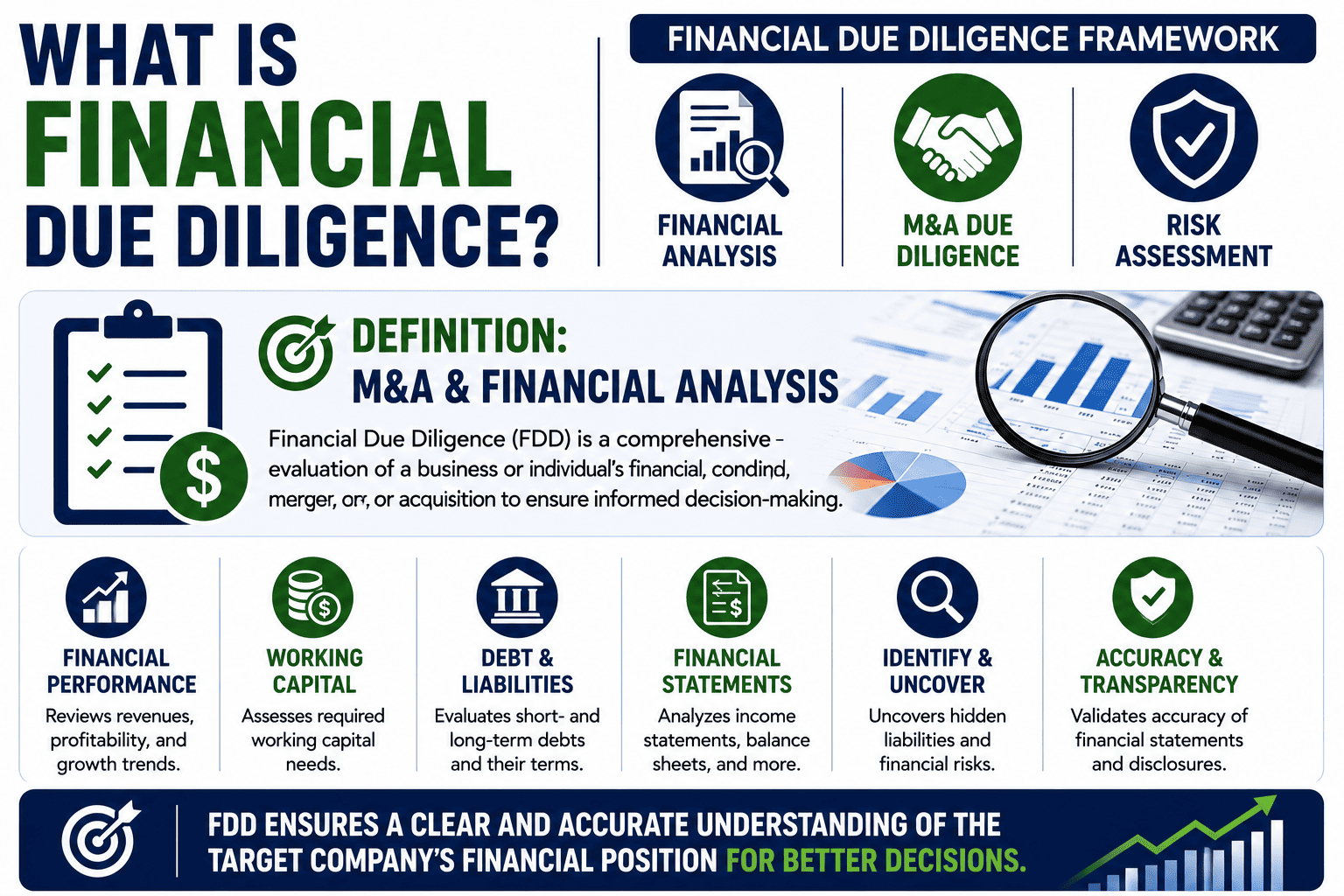
Why Financial Due Diligence Matters
Financial due diligence is arguably the most important, non-negotiable type of due diligence undertaken before a deal. It helps buyers and investors verify all relevant financial information before closing, ensuring everyone involved has a clear, shared view of the financial health and potential challenges of the target business. For the buy-side, it reduces information asymmetry and prevents overpaying. For the sell-side, it streamlines the buyer’s diligence process, enabling a faster path to closing and potentially revealing a higher fair market value.
📊 Key Statistic
46% of deals fail due to issues surfaced during the due diligence process. Skipping any aspect of due diligence could result in loss of time, money and even the deal itself. A thorough FDD process is essential for successful M&A transactions.
Financial Due Diligence vs. Financial Audit
While the approaches and analytical procedures of FDD and an audit may overlap, there are key differences. FDD is transaction-specific and strategic, while audits focus on compliance and regular assessment of financial accuracy. FDD is a recommended procedure during a transaction, while an audit is often legally required if certain criteria are met.
| Aspect | Financial Due Diligence (FDD) | Financial Audit |
|---|
| Objective | Evaluates financial condition, economic reality, and identifies risks/trends to support strategic decisions during transactions. | Ensures accuracy and compliance of financial statements with accounting standards. |
| Regulatory Requirement | Not legally required; performed at the discretion of the buyer or seller. | Mandated by law for certain types of companies based on size, revenue, and structure. |
| Scope | Tailored to the specific transaction; focuses on financial trends, forecasts, and key metrics like profitability, growth potential, and quality of assets. | Standardized process focusing on verifying historical financial data for one financial year and statutory compliance. |
| Timing | Performed during a transaction (e.g., pre-merger or acquisition) as a one-time analysis. | Conducted regularly (annually, semi-annually, or quarterly) as part of regulatory obligations. |
| Perspective | Both backward- and forward-looking, focusing on current and future risks and opportunities. | Backward-looking, focused on historical financial data and compliance. |
| Output | Provides insights and recommendations to inform negotiations, including adjustments to purchase price or SPA terms. | Issues an opinion on whether the financial statements are free from material misstatements. |
Key Components
Core Aspects of Financial Due Diligence
The specific methods employed in FDD vary based on the size and complexity of the transaction and the industry. However, several standard procedures are typically included.
| Component | Description |
|---|
| Quality of Earnings | Analyzes and validates the target company’s EBITDA, reviewing proposed adjustments and incorporating due diligence adjustments based on findings. |
| Net Working Capital | Establishes a normal level of net working capital (NWC) expected to be provided at closing and identifies debt-like items to be excluded. |
| Net Debt | Calculates net debt by subtracting cash and cash equivalents from total interest-bearing liabilities or debt-like items, directly impacting company value. |
| Management Inquiries | Conducts interviews with the target company’s management to gain deeper insights into business operations, accounting policies, estimates, and potential off-balance sheet liabilities. |
| Financial Statement Analysis | Reviews income statements, balance sheets, and cash flow statements (typically past five years) to assess financial health and identify trends. |
| Tax Due Diligence | Examines direct and indirect taxes the company is liable to pay, including tax returns and compliance status. |
Buy-Side vs Sell-Side
Buy-Side vs. Sell-Side Financial Due Diligence
From the buyer’s standpoint, engaging external advisors to perform FDD is essential to verify the reliability of all financial information and mitigate risks. While due diligence is often thought of from a buyer’s standpoint, the seller can also benefit significantly.
| Perspective | Focus | Key Benefits |
|---|
| Buy-Side | Verify financial information, assess quality of earnings, identify hidden liabilities, and validate valuation assumptions. | Reduces information asymmetry, prevents overpaying, supports confident negotiations, and provides data-driven insights for deal structuring. |
| Sell-Side | Prepare own due diligence report to support and streamline the buyer’s diligence process, identify issues before the buyer gets involved. | Enables a quicker path to closing, confirms purchase price, potentially reveals higher fair market value, and builds trust with the buyer. |
How to Conduct FDD
Financial Due Diligence Approach: Plan, Analyze, Understand Future
A structured approach ensures a comprehensive assessment of past performance, current health, and future prospects of the business.
1
Plan
Understand the business inside out, clarify deal objectives and expectations early, and conduct thorough desktop and background research.
2
Analyze History
Review past financial information and the valuation basis, assess earnings quality, asset condition, and accounting methods, and verify reliability of systems and alignment with audited numbers.
3
Understand Future
Review assumptions supporting projections, study market conditions and business drivers, compare forecasts with historical performance, and engage management to understand their outlook.
Contractual & Legal Context
Key Contractual Clauses Impacted by Financial Due Diligence
Findings from financial due diligence directly influence the terms and structure of the Sales and Purchase Agreement (SPA) and other transaction documents.
| Clause | How FDD Influences It |
|---|
| Warranty Clause | FDD findings help define the scope of warranties, identifying specific financial representations the seller must make. |
| Indemnification Clause | Identified risks and hidden liabilities are addressed through specific indemnities to protect the buyer. |
| Material Breach | FDD helps define what constitutes a material breach in the context of financial misrepresentation. |
| Termination for Convenience | FDD may reveal risks that could trigger termination provisions. |
| Limitation of Liability | FDD findings influence the negotiation of liability caps and exceptions. |
| Breach of Contract | Financial inaccuracies uncovered during FDD can be treated as a breach, with remedies specified. |
| Consequential Damages | FDD helps assess potential consequential damages from financial misrepresentation. |
Real-World Example
Financial Due Diligence Example: Cross-Border M&A
The following is a condensed example based on a typical FDD engagement, illustrating how the process works in practice.
📄 FDD Engagement: Acquisition of a European Manufacturing Company
Objective: A US-based private equity firm is acquiring a German mid-market manufacturing company. FDD is conducted to validate the financial health, identify risks, and support valuation.
Scope: Review of financial statements (5 years), quality of earnings analysis, working capital assessment, tax due diligence, and management interviews.
Key Findings: Identified €2M of non-recurring expenses, adjusted EBITDA by 8%, and flagged a €1.5M contingent liability related to a pending lawsuit.
Outcome: Purchase price was adjusted by €3.5M, and warranties were strengthened to cover the identified liability.
Challenges & Opportunities
Challenges and Opportunities in Financial Due Diligence
⚠️
Limited Access to Information
Mitigation: Establish clear expectations and data sharing protocols early. Use secure data rooms to facilitate document sharing.
⚠️
Time Constraints
Mitigation: Plan ahead, prioritize key areas, and use experienced teams that can work efficiently under pressure.
✅
Risk Identification and Mitigation
Opportunity: FDD helps uncover hidden liabilities, financial risks, or operational inefficiencies, enabling informed decision-making and mitigating risks in the transaction.
✅
Strategic Planning and Synergy Identification
Opportunity: Insights gained during due diligence can provide a clearer understanding of the target’s financial health, enabling more informed decisions and improved financial planning.
FAQ
Frequently Asked Questions About Financial Due Diligence
QWhat is the difference between financial due diligence and a financial audit?
Financial due diligence goes beyond a financial audit. While a financial audit verifies the accuracy of the income statement, balance sheet and cash flow reports, financial due diligence looks behind the numbers to discover if the figures are sustainable and whether there are any hidden liabilities or risks. FDD is transaction-specific and strategic, while audits focus on compliance and regular assessment of financial accuracy.
QWhat is the typical timeline for financial due diligence?
An average small business can expect due diligence to take around 45-60 days. For larger or more complex deals, it may take 60 to 180 days. The timeline depends on the deal’s size, complexity, access to financial records, and coordination with third parties.
QWhat are the key documents needed for financial due diligence?
Key documents include audited financial statements (income statements, balance sheets, cash flow statements), tax returns, management reports, contracts, debt agreements, details of related party transactions, and historical financial data (typically past five years).
QCan financial due diligence identify hidden liabilities or risks?
Yes, through detailed examination of financial records, related party transactions, contingent liabilities, and compliance with accounting standards, financial due diligence helps uncover risks that are not immediately visible, helping buyers avoid unpleasant surprises post-acquisition.
QWho typically conducts financial due diligence in a transaction?
Specialized financial advisors, accountants, or consultants with expertise in mergers and acquisitions usually conduct financial due diligence to provide an independent, detailed review and report to support buyer decision-making.