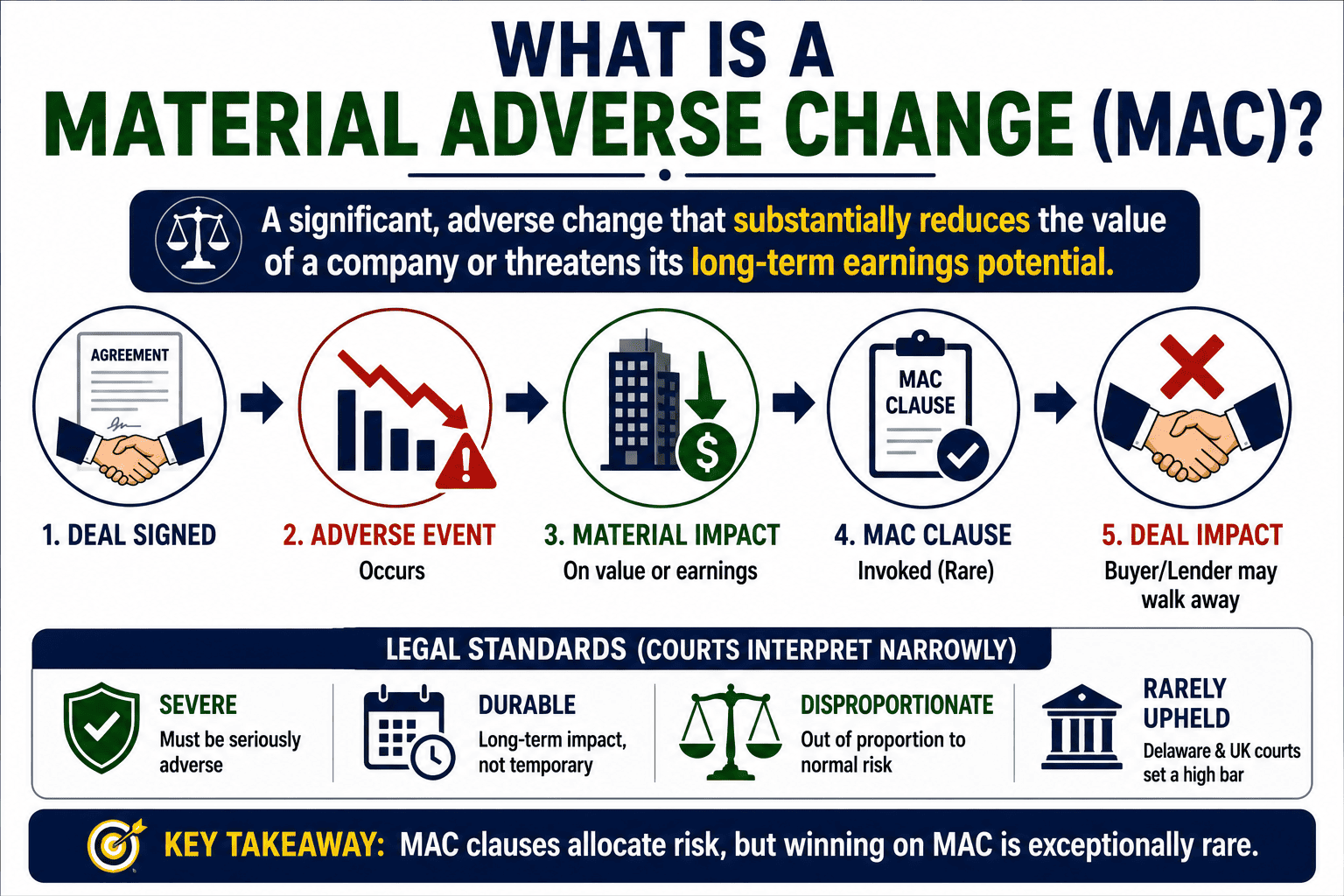
Why Material Adverse Change Clauses Matter
In M&A transactions, the period between signing and closing can be several months. During this time, a target company’s business can deteriorate due to factors such as loss of key customers, regulatory changes, or macroeconomic shocks. MAC clauses are the primary tool for buyers to protect themselves from such adverse developments. For sellers, these clauses represent a risk that the deal may collapse or be renegotiated. The allocation of risk is fundamentally structured so that systemic, industry-wide risks are borne by the buyer, while business-specific risks remain with the seller. However, the high judicial threshold for proving a MAC means that in practice, these clauses often serve more as a negotiating lever for renegotiation than a genuine walk-away right.
📊 Key Statistic
According to a study of public M&A transactions, MAC clauses are present in over 90% of deals, yet successful invocation to terminate a transaction has occurred in fewer than 1% of cases. Courts require proof of a decline in earnings of 20-40% or more, with durational significance extending over years, not months.
Anatomy of a MAC Clause: Structure and Carve-Outs
Understanding the typical structure of a MAC clause is essential for both drafting and enforcement. The clause is built around a definition, exceptions, and exceptions to exceptions, creating a complex risk allocation framework.
| Component | Description |
|---|
| Definition of MAC/MAE | Typically defined as any event, change, development, or effect that, individually or in the aggregate, has a material adverse effect on the target’s business, financial condition, or operations. Often left intentionally undefined to create negotiating leverage, though this increases litigation risk. |
| Carve-Outs (Exceptions) | Events specifically excluded from constituting a MAC. Common carve-outs include: general economic conditions, changes in law, industry-wide changes, acts of terrorism, war, pandemics, and matters disclosed at signing. These allocate systemic risks to the buyer. |
| Disproportionate Effect Exception | A buyer-favorable provision that “brings back” an otherwise carved-out event if the target is materially and disproportionately affected compared to its industry peers. This ensures that systemic events that hit the target uniquely hard can still trigger a MAC. |
| Quantitative vs. Qualitative Triggers | Quantitative triggers set specific financial thresholds (e.g., EBITDA decline of 20%). Qualitative triggers are broader and subjective, offering flexibility but increasing the risk of disputes and judicial scrutiny. |
| Forward-Looking Language | Words like “…or reasonably be expected to result in a MAC” allow invocation based on anticipated effects. Courts apply a high standard, requiring the expected impact to be so likely that it is akin to “a person falling out of an aircraft” before hitting the ground. |
📌 Drafting Tip
To increase enforceability, parties are advised to draft MAC clauses with clear quantitative thresholds (e.g., a 25% decline in EBITDA), defined comparative periods, and explicit forward-looking time limits. Avoiding purely subjective or self-referential language can reduce litigation risk and provide greater certainty.
Legal Standards & Judicial Precedents
How Courts Evaluate MAC Clauses: The Delaware and UK Standards
Given the scarcity of direct precedent in many jurisdictions, courts in the US (Delaware) and UK have established key principles that define what constitutes a material adverse change.
| Legal Principle | Description & Court Guidance |
|---|
| Durationally Significant Impact | A MAC requires an adverse change that substantially threatens the target’s overall earnings potential over a commercially reasonable period, measured in years, not months. Short-term hiccups in earnings are insufficient (Akorn v. Fresenius). |
| Unknown at Signing | The change must be caused by an event not known to the buyer at the time of signing. Courts assume parties contracted with known risks in mind (IBP v. Tyson). |
| Disproportionate Effect | Even if a systemic event is carved out, it can constitute a MAC if the target is materially worse affected than its industry peers (disproportionate effect exception). |
| Quantitative Materiality | Courts have considered declines in EBITDA or equity value in the range of 20-40% as indicative of materiality. The Sibanye case noted that a 20% reduction in equity value would be material, with 15% possibly sufficient. |
| High Burden of Proof | The party invoking a MAC bears the heavy burden of proving the change meets the contractual definition. Mere speculation is insufficient; factual and expert testimony is required (Hexion v. Huntsman). |
| Forward-Looking Test | For clauses including expected changes, courts require a high likelihood that the impact will occur. The appropriate forward-looking period remains an unresolved issue, with no natural limit established in case law. |
Landmark Case Law
Landmark MAC Clause Disputes: IBP v. Tyson, Akorn v. Fresenius, and Beyond
These cases illustrate the high bar courts set for invoking a MAC clause and the critical importance of the specific factual and contractual context.
| Case | Key Facts | Court Ruling |
|---|
| IBP v. Tyson (2001) | Tyson sought to terminate its $3.2B acquisition of IBP after a 64% quarterly earnings decline, citing an SEC investigation into IBP’s accounting. Tyson argued the decline was a MAC. | Court ruled against Tyson, finding the decline was industry-wide (due to severe weather), not durationally significant, and Tyson had prior knowledge of the accounting issues. Tyson’s motive was deemed “buyer’s remorse” for overpaying. |
| Akorn v. Fresenius (2018) | Fresenius terminated its $4.3B acquisition of Akorn after four consecutive quarters of revenue and earnings declines, plus evidence of data fabrication and regulatory compliance failures. Fresenius argued a MAC had occurred. | Court ruled for Fresenius, finding the declines were severe, durationally significant, specific to Akorn, and the data issues (including potential FDA fraud) were unknown at signing, meeting the high MAC standard. |
| Mayne Pharma v. Cosette (Ongoing) | Cosette attempted to terminate its acquisition of Mayne Pharma citing an EBITDA decline exceeding a $10.76 million quantitative threshold, as well as litigation and regulatory issues. | Dispute ongoing. Key question: whether the identified events met the specific quantitative trigger. Illustrates the intense scrutiny applied to quantitative MAC thresholds. |
| Woolworths v. Grace Bros (1980s) | Woolworths terminated its takeover offer for Grace Bros citing a significant financial deterioration. | Australian court upheld the termination, noting the clause allowed termination based on Woolworths’ opinion. However, subsequent cases have applied much stricter standards. |
| Paladin Energy v. NGM Resources (2010) | Paladin sought to abandon its takeover of NGM after the abduction of NGM personnel near its assets in Niger, citing both MAC and force majeure. | Australian Takeovers Panel ruled against Paladin, finding no material adverse effect had been demonstrated, reinforcing the high threshold for invoking a MAC. |
⚖️ Key Takeaway from Precedent
Across jurisdictions, courts consistently emphasize that a MAC requires an event that is severe, durationally significant, and specific to the target. The burden of proof is exceptionally high, and successful invocation is rare. In practice, MAC clauses are more often used to renegotiate deal terms than to terminate agreements outright.
Strategic Drafting & Enforcement
Best Practices for Drafting and Enforcing MAC Clauses
Given the judicial reluctance to allow MAC-based terminations, careful drafting is essential for parties seeking to preserve their rights. The following steps provide a roadmap for both buyers and sellers.
1
Define Clear Quantitative Thresholds
Specify objective financial metrics, such as a percentage decline in EBITDA, revenue, or net assets. Avoid purely subjective language. For example: “a diminution in consolidated EBITDA of 20% or more compared to the same period in the prior year.”
2
Set a Forward-Looking Period
If including a forward-looking test, define the time frame for the expected effect (e.g., “reasonably expected to have such effect within 12 months”). This prevents open-ended interpretation.
3
Specify Comparative Periods
Define the period for comparison (e.g., “compared to the same period in the prior fiscal year”). This ensures like-for-like analysis and reduces ambiguity.
4
Clearly List Carve-Outs and the Disproportionate Effect Exception
Explicitly carve out systemic risks, but include a “disproportionate effect” clause to bring them back if the target is uniquely affected. This balances risk allocation.
5
Consider a Monetary Threshold
Include a specific monetary threshold (e.g., a $10 million reduction in net assets) as a clear trigger. This provides a measurable standard that courts can easily apply.
6
Define Materiality Clearly
Avoid undefined terms like “material” without context. Use specific financial or operational metrics to define what is considered material for the purposes of the clause.
7
Conduct Thorough Due Diligence and Document Everything
For buyers, maintaining a clear record of what was known at signing is crucial to avoid claims of prior knowledge. Sellers should carefully assess and disclose all known risks.
Risks & Mitigation
Common Risks in Invoking a MAC Clause & How to Mitigate Them
⚠️
High Burden of Proof
Courts require severe, durationally significant, and disproportionate impact. Mitigation: Draft specific quantitative thresholds and preserve detailed evidence of the change’s impact to meet the evidentiary burden.
⚠️
Claim of Prior Knowledge
If a buyer was aware of risks at signing, invoking a MAC is very difficult. Mitigation: Conduct thorough due diligence and clearly document all disclosures. Avoid broad carve-outs that may be interpreted as covering known issues.
⚠️
Ambiguous or Subjective Language
Vague terms are open to interpretation and make enforcement difficult. Mitigation: Use precise, objective language. Define “material” and “adverse effect” with specific financial metrics and timeframes.
⚠️
Regulatory Scrutiny in Public M&A
Regulators like ASIC and SEBI scrutinize MAC clauses, requiring objective standards. Mitigation: Ensure MAC clauses are clearly quantifiable and disclose risks transparently to avoid regulatory pushback or confusion for shareholders.
FAQ
Frequently Asked Questions About Material Adverse Change Clauses
QWhat is a Material Adverse Change (MAC) clause?
A Material Adverse Change (MAC) clause, also known as a Material Adverse Effect (MAE) clause, is a contractual provision commonly found in mergers and acquisitions (M&A) and financing agreements. It allows a party, typically the buyer or lender, to terminate or renegotiate the transaction if a significant, adverse event or change occurs after signing that substantially impacts the target company’s business, financial condition, or operations, making the deal fundamentally different from what was originally agreed.
QWhat are the key legal standards for proving a Material Adverse Change?
Courts, particularly in Delaware, have established that a MAC requires: (1) an event or change that is not known to the buyer at signing; (2) a severe and durationally significant impact, threatening the target’s overall long-term earnings power (typically measured in years, not months); (3) a disproportionate effect on the target compared to its industry peers; and (4) an impact that is objectively material, often demonstrated by a significant percentage decline in financial metrics like EBITDA, often in the 20-40% range.
QWhat are common carve-outs or exceptions to MAC clauses?
Common carve-outs exclude general economic downturns, changes in law, industry-wide changes, acts of war or terrorism, pandemics, and matters disclosed at signing. However, buyers often negotiate a ‘disproportionate effect’ exception, which brings the event back into scope if the target is materially harder hit than its peers. These carve-outs allocate systemic risks to the buyer and business-specific risks to the seller.
QHow have courts ruled on MAC clause disputes?
Notable cases include Akorn v. Fresenius, where the court upheld termination after four consecutive quarters of decline, and IBP v. Tyson, where a 64% quarterly earnings drop was deemed insufficient as it was industry-wide and not durationally significant. Courts generally hold MAC clauses to a very high standard, rarely permitting termination and often viewing them as tools for renegotiation rather than walk-away rights.
QWhat are best practices for drafting an effective MAC clause?
Best practices include: (1) define clear quantitative thresholds (e.g., EBITDA decline of 20-30%), (2) specify comparative fiscal periods, (3) include a forward-looking test but set a reasonable time limit, (4) clearly list carve-outs and any ‘disproportionate effect’ exceptions, (5) define materiality with specific metrics, and (6) avoid purely subjective or self-referential language to increase enforceability and reduce litigation risk.