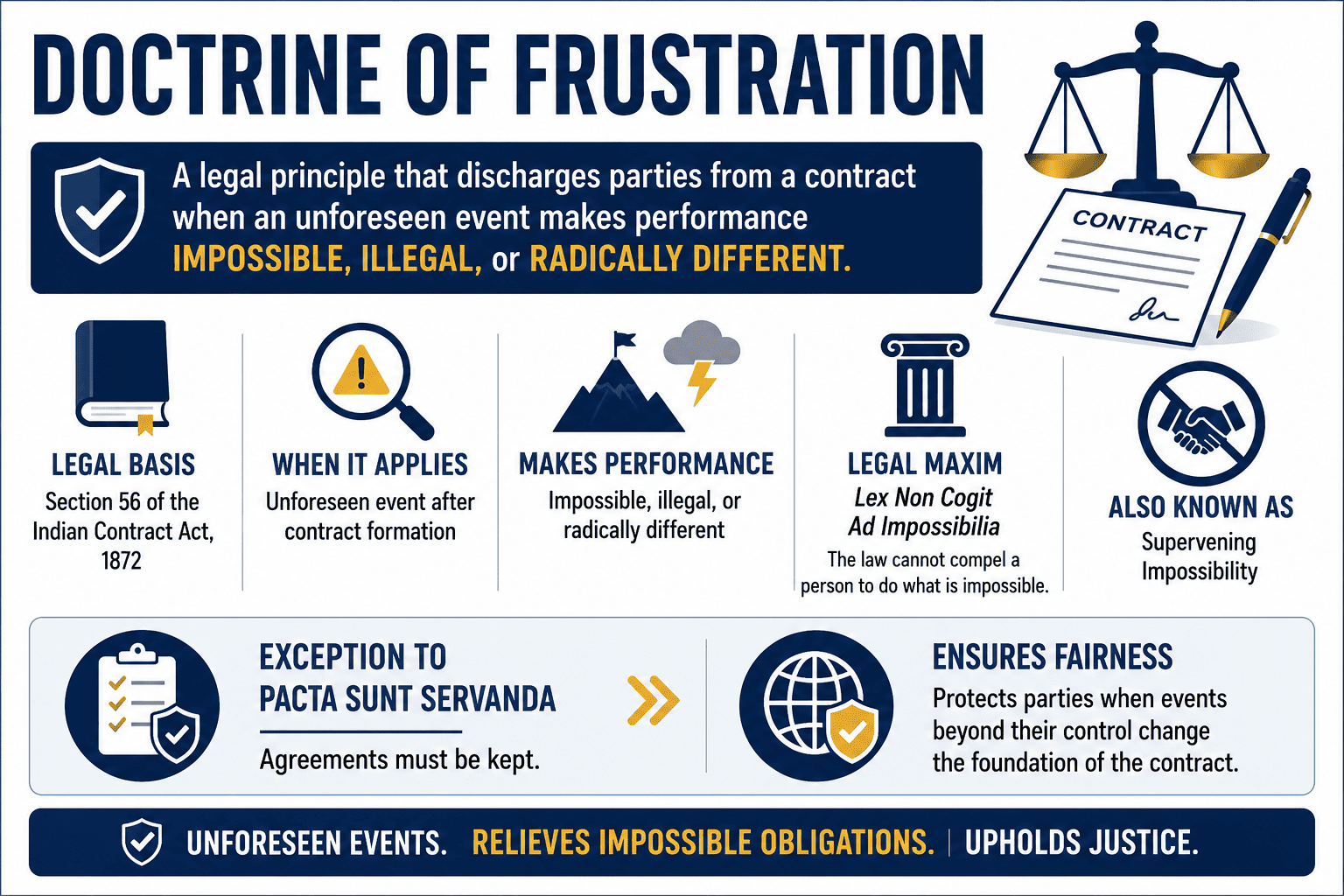
Why the Doctrine of Frustration Matters
The Doctrine of Frustration is a vital safety valve in contract law. It prevents injustice when an unexpected event, completely beyond the control of either party, makes the contract impossible to perform or destroys its very foundation. Without this doctrine, parties would be bound to perform impossible acts or would be held liable for breach through no fault of their own. It balances the need for contractual certainty with the practical realities of an uncertain world. The doctrine ensures that parties are not penalised for events like war, natural disasters, or sudden changes in law that fundamentally alter the nature of their bargain.
📊 Key Principle
The doctrine does not apply merely because a contract has become more difficult or expensive to perform. There must be a radical change in circumstances that makes the performance something entirely different from what was agreed. Commercial hardship, on its own, does not amount to frustration.
Section 56 of the Indian Contract Act, 1872
Section 56 of the ICA is the statutory basis for the doctrine of frustration in India. It is divided into two parts that address both initial impossibility and supervening impossibility.
| Paragraph | Provision | Effect |
|---|
| Paragraph 1 | An agreement to do an act impossible in itself is void. | Initial Impossibility: If the act is impossible from the very beginning (ab initio), the contract is void ab initio. |
| Paragraph 2 | A contract becomes void when an act becomes impossible or unlawful after the contract is made, by reason of some event which the promisor could not prevent. | Supervening Impossibility (Frustration): If performance becomes impossible or unlawful after the contract is formed due to an unforeseen event, the contract becomes void. |
📌 Note on Terminology
In Indian law, the doctrine is often referred to as ‘supervening impossibility’ to distinguish it from initial impossibility. The Supreme Court in Satyabrata Ghose v. Mugneeram Bangur & Co. (1954) clarified that frustration applies when the event fundamentally alters the nature of the contract, not merely when it becomes difficult to perform.
Key Elements & Grounds for Frustration
Key Elements of the Doctrine of Frustration
For the doctrine to apply and discharge a contract, the following essential elements must be present:
| Element | Description |
|---|
| Unforeseen Event | An event must occur after the contract is formed that was not and could not have been reasonably anticipated by the parties at the time of contracting. |
| Radical Change in Circumstances | The event must result in a fundamental change, making the performance radically different from what was originally contemplated. |
| No Fault of Either Party | The frustrating event must not be caused by the fault, negligence, or act of either party. It must be external to both. |
| Impossibility of Performance | The event must render performance objectively impossible, illegal, or commercially meaningless. |
| No Existing Contract Provision | The contract must not contain a force majeure or other clause that explicitly covers the event. If such a clause exists, the doctrine may not apply. |
Grounds for Frustration of Contract
Frustration can arise from several types of events. The following are the most commonly recognised grounds under Indian and English case law.
| Ground | Description | Leading Case |
|---|
| Destruction of Subject Matter | The specific object or subject essential for performance is destroyed or lost. | Taylor v. Caldwell (1863), Music hall destroyed by fire; contract for hire discharged. |
| Death or Incapacity of Party | Performance depends on a specific person, and that person dies or becomes incapable. | Robinson v. Davison (1871), Pianist’s illness; contract for performance discharged. |
| Change in Law | A change in legislation or government policy makes performance illegal or impossible. | Rozan Mian v. Tahera Begum, New law rendered tenancy agreement void. |
| Failure of Ultimate Purpose (Frustration of Purpose) | The fundamental reason for the contract ceases to exist. | Krell v. Henry (1903), Coronation procession cancelled; room rental for viewing discharged. |
| Outbreak of War or Civil Unrest | War or political upheaval makes performance commercially impossible or illegal. | Contracts with enemy aliens become void; trade embargoes may frustrate supply contracts. |
| Government Requisition | Government takes control of the subject matter (e.g., property, goods) for public use. | Murlidhar Chiranjilal v. Harishchandra Dwarkadas (1962), Requisition of property under wartime regulations frustrated sale contract. |
When Frustration Does NOT Apply
Courts are careful not to allow the doctrine to be used as an easy escape from bad bargains. Frustration does not apply in the following situations:
- Mere Difficulty or Hardship: Performance becoming more expensive, onerous, or inconvenient is not frustration.
- Self-Caused Impossibility: Where a party’s own act or default causes the impossibility, frustration does not apply.
- Failure of a Third Party: A supplier’s failure to deliver to the promisor does not frustrate the contract with the buyer.
- Strikes or Lockouts: Unless specifically covered, these are generally not grounds for frustration.
- Commercial Impracticability: A mere rise or fall in prices, even if dramatic, does not frustrate a contract (as held in Energy Watchdog v. CERC, 2017).
Effects & Consequences
Effects of Frustration on the Contract
When a contract is frustrated, it is automatically discharged (terminated) from the point of the frustrating event. The parties are released from their future obligations and cannot be held liable for non-performance. The law also provides for restitution to prevent unjust enrichment.
1
Automatic Discharge
The contract ends automatically by operation of law. No party needs to terminate it. Obligations that were due before the frustrating event remain enforceable.
2
No Liability for Breach
Neither party is liable for breach of contract. Frustration is a defence to non-performance, and the parties are excused from damages.
3
Restitution (Section 65)
Section 65 of the ICA requires that any benefit received under the contract must be restored to the party who provided it, if the contract becomes void.
4
Compensation for Loss
If the promisor knew or had reason to know that the contract was impossible or unlawful, they may be liable to compensate the promisee for any loss under Section 56.
Frustration vs. Breach vs. Force Majeure
Key Distinctions: Frustration, Breach, and Force Majeure
These three concepts are often confused but serve different functions in contract law. Understanding the differences is essential for choosing the right legal strategy.
| Aspect | Doctrine of Frustration | Breach of Contract | Force Majeure |
|---|
| Cause | External, unforeseen events beyond party control. | Party’s failure to perform obligations (non-performance, defective performance, delay). | Specific events listed in the contract (e.g., natural disasters, war, strikes). |
| Source | Legal doctrine under Section 56 of ICA. | Party’s action or inaction. | Contractual clause agreed by parties. |
| Effect | Contract is automatically discharged (terminated). | Breaching party is liable for damages; contract may continue. | Performance is suspended or excused as per clause terms; notice usually required. |
| Remedies | No damages for non-performance; restitution of benefits. | Damages, specific performance, rescission. | Excused performance, suspension, or renegotiation as per clause. |
| Fault Required | No fault of either party. | Fault or responsibility of the breaching party. | No fault; event must be beyond control. |
| Scope | Applies to events that make performance radically different or impossible. | Applies to any failure to comply with terms. | Applies only to events expressly listed or defined. |
📌 Practical Takeaway
If a contract includes a comprehensive force majeure clause covering the event in question, the doctrine of frustration is unlikely to apply. Frustration fills the gap where the contract is silent and an unforeseen event makes performance fundamentally impossible.
Landmark Case Laws
Landmark Cases on the Doctrine of Frustration
Indian and English courts have shaped the doctrine through several seminal decisions. These cases illustrate how the principles are applied in practice.
📄 Satyabrata Ghose v. Mugneeram Bangur & Co. (1954)
Facts: A contract for sale of land was entered into. Government requisitioned the land under wartime regulations, making it impossible to transfer possession.
Held: The Supreme Court held that for frustration to apply, there must be a fundamental change in circumstances that makes performance impossible. The contract was not frustrated because the requisition was temporary, and the seller could still transfer title. The court emphasized that mere inconvenience or financial loss does not constitute frustration.
📄 Taylor v. Caldwell (1863), English Case
Facts: The defendant agreed to let a music hall for concerts. Before the concerts, the hall was destroyed by fire through no fault of either party.
Held: The contract was held to be discharged because the continued existence of the hall was the foundation of the contract. This case established the doctrine of frustration through destruction of the subject matter.
📄 Energy Watchdog v. CERC (2017)
Facts: A power purchase agreement (PPA) became more expensive due to a sharp rise in coal prices. The party sought to invoke force majeure and frustration.
Held: The Supreme Court ruled that a mere increase in price, even if significant, does not constitute a force majeure event or frustration. Commercial hardship is not a ground for discharge. The court stated that there must be a break in identity between the contract as contemplated and its performance in the new circumstances.
📄 Murlidhar Chiranjilal v. Harishchandra Dwarkadas (1962)
Facts: A property was requisitioned by the government under wartime regulations after a sale agreement was executed.
Held: The Supreme Court held that the contract was frustrated because the government’s requisition made it impossible for the seller to deliver possession and title as agreed. The contract was discharged.
Risks & Practical Guidance
Common Risks & How to Address Them
⚠️
Over-Reliance on Frustration to Exit Bad Deals
Mitigation: Courts apply the doctrine narrowly. Mere financial hardship, increased costs, or even significant price rises are not enough. Parties should not assume frustration will apply. Instead, negotiate specific force majeure and hardship clauses in the contract.
⚠️
Unclear Force Majeure Clauses
Mitigation: Draft clear, comprehensive force majeure clauses that list specific events (pandemics, war, government actions, etc.) and include a catch-all provision. This provides contractual certainty and reduces reliance on the unpredictable doctrine of frustration.
⚠️
Restitution Obligations Overlooked
Mitigation: On frustration, Section 65 of the ICA requires restitution of any benefit received. Parties should be prepared to repay advances, deposits, or other benefits. Review the contract for specific provisions on how prepayments are handled in case of frustration.
FAQ
Frequently Asked Questions About the Doctrine of Frustration
QWhat is the Doctrine of Frustration under contract law?
The Doctrine of Frustration is a legal principle under Section 56 of the Indian Contract Act, 1872, that discharges parties from a contract when an unforeseen event occurs after formation, making performance impossible, illegal, or radically different from what was originally intended.
QWhat are the key grounds for frustration of a contract?
Key grounds include: destruction of subject matter, death or incapacity of a party, change in law, failure of ultimate purpose (frustration of purpose), outbreak of war or civil unrest, and government requisition. These events must be unforeseen and beyond the control of the parties.
QWhat is the difference between frustration and breach of contract?
Frustration is caused by external, unforeseen events beyond the parties’ control, making performance impossible. It automatically discharges the contract. Breach is caused by a party’s failure to perform their obligations and gives rise to a claim for damages. Frustration is not a breach, and neither party is held liable for non-performance.
QHow does the Doctrine of Frustration differ from Force Majeure?
Force Majeure is a contractual clause that specifies events (like natural disasters) that excuse performance, often requiring notice. Frustration is a legal doctrine under Section 56 that applies when an unforeseen event is not covered by a force majeure clause and makes performance radically different or impossible. Frustration is a legal concept; force majeure is a contractual one.
QWhat is the effect of frustration on a contract?
When a contract is frustrated, it is automatically discharged (terminated) from that point forward. The parties are released from their future obligations. They are not held liable for non-performance. Under Section 65 of the ICA, any benefit received from the other party must be restored (restitution).