Why the Invitation to Tender Process Matters
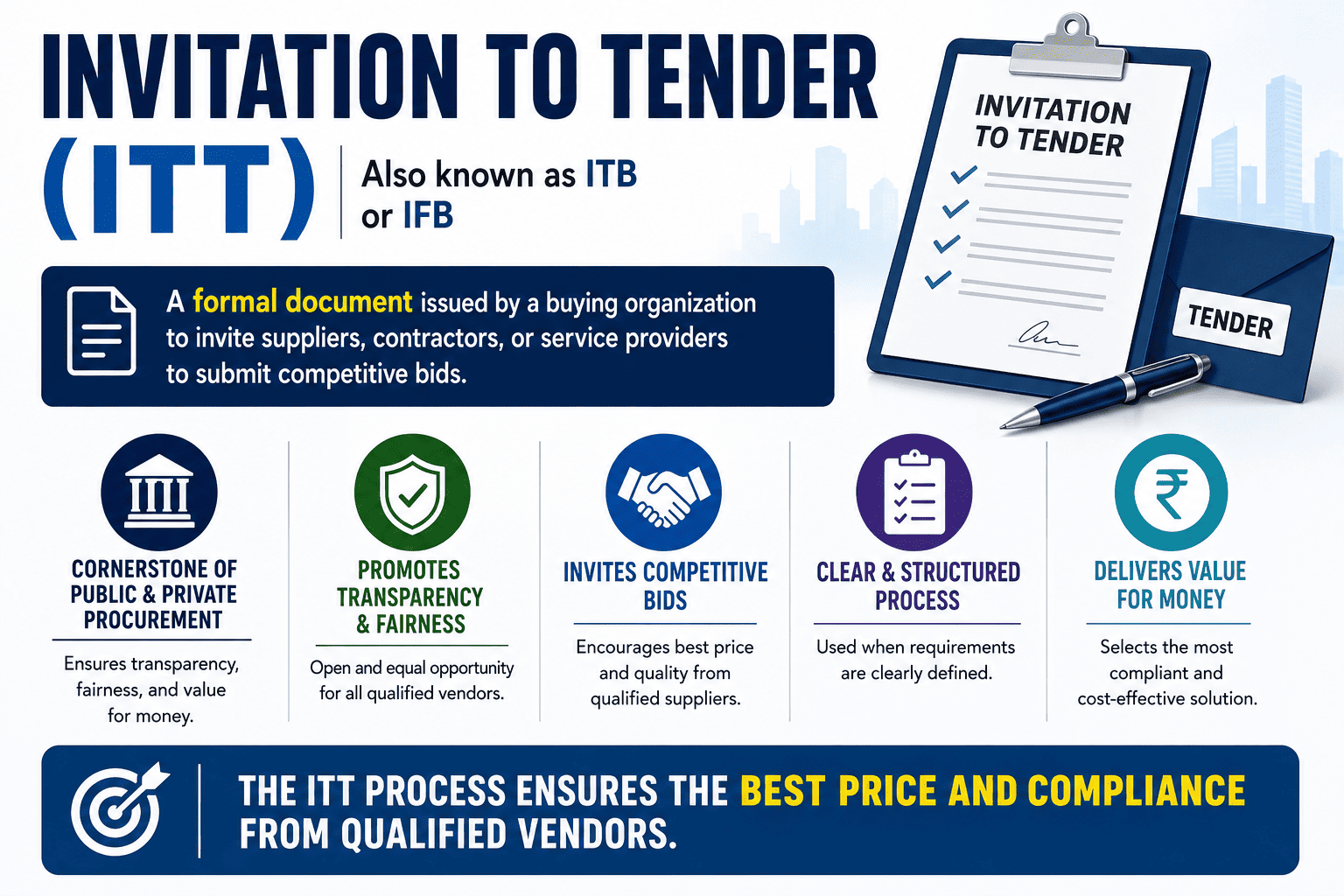
The ITT is the engine of competitive procurement. It levels the playing field, giving all qualified suppliers an equal opportunity to bid for contracts. For the buying organization, it ensures that public or private funds are spent efficiently, with a transparent and auditable selection process. For suppliers, it provides a clear framework to present their best offer. In industries like construction, infrastructure, government, and IT services, the ITT is the primary vehicle for awarding major contracts.
📊 Key Statistic
Organizations that follow a structured ITT process report up to 30% cost savings compared to sole-source procurement, according to procurement benchmarking studies. The competitive tension drives innovation and better pricing.
ITT vs. RFP vs. RFQ: Understanding the Differences
While often used interchangeably, ITT, RFP, and RFQ serve distinct purposes. The choice depends on how well-defined the requirements are and what the buyer seeks from the supplier.
| Procurement Tool | Best Used When | Focus | Supplier Input |
|---|
| Invitation to Tender (ITT) | Requirements are clear and detailed; buyer knows exactly what they want | Price and compliance | Minimal; supplier fills a well-specified role |
| Request for Proposal (RFP) | Requirements are complex or open-ended; buyer seeks solutions | Methodology, innovation, and expertise | High; supplier proposes creative solutions |
| Request for Quote (RFQ) | Straightforward, standard products or services; price is the main differentiator | Price and availability | Very low; supplier quotes a price for specified items |
📌 Note on Terminology
In practice, buyers may use these terms loosely. An ITT can sometimes request creative input, and an RFP can be very prescriptive. Always read the specific instructions in the procurement documents rather than relying solely on the acronym.
Essential ITT Components
What Should Be Included in an Invitation to Tender Pack
A well-structured ITT pack provides all the information a bidder needs to submit a compliant and competitive offer. Missing or ambiguous sections are a common source of bidder questions and disqualifications.
| Section | Description |
|---|
| Introduction & Background | Overview of the issuing organization, project purpose, and business context. |
| Scope of Work (Specification) | Detailed description of tasks, deliverables, performance standards, and technical requirements. |
| Instructions to Tenderers | Submission process, formatting, deadlines, contact for queries, and protocol for site visits. |
| Evaluation Criteria & Weightings | How bids will be assessed (e.g., price 60%, quality 30%, experience 10%). |
| Contract Terms & Conditions | Legal framework: payment terms, liabilities, warranties, confidentiality, and governing law. |
| Required Documentation | List of forms, certificates, financial statements, insurance, and references to be submitted. |
| Pricing Schedule | How pricing should be presented (e.g., spreadsheet format with fixed and variable costs). |
| Tender Timeline | Key dates: release, Q&A deadline, submission deadline, evaluation period, and award announcement. |
How to Respond Successfully
Step-by-Step Guide to Responding to an ITT
Responding to an ITT requires a systematic approach. Rushing or missing details can lead to disqualification. Follow these steps to maximize your chances of success.
1
Read and Understand All Documents
Review every section thoroughly. Note the scope, evaluation criteria, and all mandatory requirements. Create a checklist to ensure nothing is missed.
2
Check Compliance and Eligibility
Ensure your company meets all minimum requirements (e.g., turnover, experience, certifications). Non-compliance with even one requirement can disqualify you.
3
Clarify Ambiguities (Ask Questions)
Submit any questions before the deadline. Buyers are required to answer all questions transparently, often publishing responses for all bidders to see.
4
Draft a Clear and Professional Response
Follow the prescribed format. Address all technical requirements with evidence. Use plain language, avoid jargon, and structure your proposal for easy reading.
5
Propose Competitive but Realistic Pricing
Use the provided pricing schedule. Ensure all costs are included, and be transparent about any assumptions. The buyer will scrutinize pricing for value for money.
6
Include References and Testimonials
Provide case studies and client references that demonstrate your track record in similar projects. Relevant experience is a key differentiator.
7
Proofread, Quality Check, and Submit on Time
Review for errors, ensure all attachments are included, and submit well before the deadline. Late submissions are almost always disqualified.
Contractual & Legal Considerations
Key Contractual Clauses in ITT-Related Agreements
Once the ITT process concludes, the successful bidder will enter into a contract. Understanding common clauses is essential for risk management.
| Clause | Why It Matters |
|---|
| Master Services Agreement (MSA) | Sets the foundation for the long-term relationship, defining the scope, payment, and governance structure. |
| Conditional Agreement | Specifies conditions that must be met before the contract becomes binding (e.g., board approval, financing). |
| Non-Compete Clause | Prevents the supplier from taking on similar projects with competitors during or after the contract term. |
| Condition Precedent | A specific event that must occur before a party’s obligation to perform begins (e.g., obtaining a permit). |
| Commercial Framework Agreement | Sets the terms for future purchases, often used in recurring procurement from a preferred supplier. |
| Arbitration Clause | Specifies how disputes will be resolved (e.g., through ICC arbitration), avoiding court litigation. |
| Mediation Clause | Requires the parties to attempt mediation before initiating arbitration or litigation. |
| Warranty Clause | Guarantees that goods/services meet specified standards and outlines the remedy for defects. |
| Material Breach | Defines what constitutes a serious failure that allows the other party to terminate the contract. |
| Cure Period | A time window given to a party to fix a breach before the other party can terminate the contract. |
| Termination for Convenience | Allows the buyer to terminate the contract without cause, typically paying for work completed. |
| Indemnification Clause | Shifts liability for third-party claims (e.g., for IP infringement or personal injury) from one party to the other. |
| Exclusivity Clause | May require the supplier to provide the goods/services exclusively to the buyer within a defined scope. |
| Breach of Contract | Defines the consequences when a party fails to perform its obligations, including remedies and termination. |
| Consequential Damages | Indirect losses from a breach (e.g., lost profits), often waived or limited in commercial contracts. |
| Limitation of Liability Clause | Caps the total liability a party can incur (e.g., to the contract value), a critical risk management tool. |
Real-World Example
Invitation to Tender Example: Renewable Energy Start-Up Kits
The following is a condensed example based on a real ITT issued by Windle International Somalia for the EU IMPACT Project. This illustrates how the components come together in practice.
📄 ITT Reference: WISOM/JUNE/017/2026
Objective: Procure and supply renewable energy start-up kits for 380 trained youth beneficiaries in Puntland, Somalia.
Scope: Supply solar panels, batteries, inverters, and installation tools. Delivery to designated locations, with inspection and warranty requirements.
Submission: Bids must be submitted via email to rfq-in-som@windle.org by 21st July 2026, 1600hrs. No physical submissions.
Evaluation: Based on technical compliance, price, delivery timeline, and past performance.
Risks & Mitigation
Common Risks in the ITT Process & How to Mitigate Them
⚠️
Disqualification on Technicality
Mitigation: Use a compliance checklist. Have a second team member review the submission for completeness and correct formatting.
⚠️
Unclear or Ambiguous Requirements
Mitigation: Ask questions during the Q&A period. Review all buyer clarifications and incorporate them into your response.
⚠️
Inadequate Due Diligence on Buyer
Mitigation: Conduct Commercial Due Diligence on the buyer’s payment history and reputation. Understand their financial stability.
FAQ
Frequently Asked Questions About Invitations to Tender
QWhat is the difference between an ITT and an RFP?
An ITT is used when the buyer has a clear and detailed specification and the primary focus is on price and compliance. An RFP is used when the requirements are complex or open-ended, and the buyer seeks vendor expertise and creative solutions. RFPs are more flexible, while ITTs are more rigid and standardized.
QWhat documents should I expect in an ITT pack?
Typically, an ITT pack includes: instructions to tenderers, the specification (Scope of Work), a pricing schedule, the form of tender, contract terms and conditions, evaluation criteria, and any supporting documents like questionnaires or SPDs (Supplier Pre-Qualification Documents).
QHow can I increase my chances of winning an ITT?
Read all documents carefully and ensure full compliance. Ask clarifying questions. Tailor your response to the specific evaluation criteria. Provide clear, evidence-based answers to technical requirements. Offer competitive pricing that reflects the value you bring. Submit on time, in the correct format.
QWhat is the typical timeline for an ITT process?
From release to award, an ITT process can take 4-12 weeks, depending on the complexity of the contract and the market. The timeline includes the tender period (bidders prepare responses), Q&A period, evaluation, and award announcement.
QCan I negotiate the terms after being awarded the contract?
Generally, the terms and conditions in the ITT are non-negotiable, as they form the basis of the contract. However, minor clarifications or adjustments may be possible if both parties agree. Major changes would likely require a new tender process.