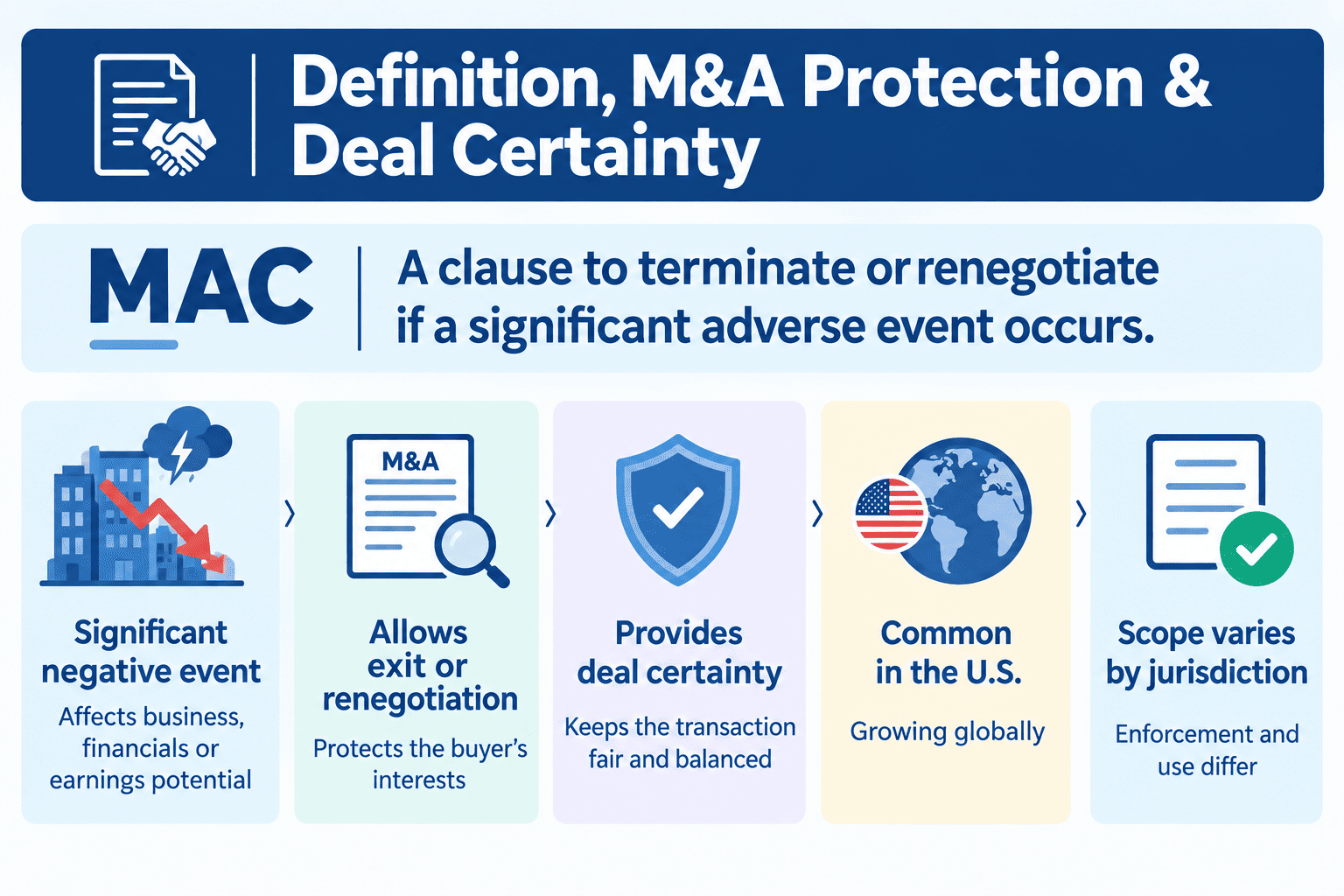
Why MAC Clauses Matter in M&A
The period of time between when an M&A (or financing) agreement is executed and when it is scheduled to close can be quite long , often several months. During this period, a variety of circumstances can affect the buyer, seller, or creditor. Some changes are severe and enduring, so much so that the outcome can shift the expectations of the agreement. Such an effect may be so undesirable that the parties may not have entered into the deal in the first place. MAC clauses outline circumstances in which parties to an agreement may terminate a contract. As a result, there is a strong interest in negotiating these clauses, and they are among the most heavily negotiated provisions in any M&A agreement.
📊 Key Principle
MAC clauses are a common means of mitigating the risks faced by a purchaser due to adverse business or economic developments. The broader or more subjective the clause, the more open it is to interpretation by the legal system , making it less likely a party can avoid completing the contract. The more specific or objective the clause, the more likely a party can terminate if a triggering change occurs.
MAC vs. MAE: Understanding the Terminology
MAC (Material Adverse Change) and MAE (Material Adverse Effect) are often used interchangeably, but there is a subtle technical distinction. In practice, most contracts define both terms together and use them synonymously.
| Term | Focus | Typical Usage |
|---|
| MAC (Material Adverse Change) | The event or change itself , the occurrence that triggers the clause. | Used in conditions precedent and termination provisions; focuses on what happened. |
| MAE (Material Adverse Effect) | The effect or consequence of the change , the impact on the business. | Used in representations and warranties; focuses on the result of the event. |
| Combined Definition | Most modern contracts define both terms in a single sentence, treating them as equivalent. | “Material Adverse Change (or Material Adverse Effect) means any event, change, circumstance, effect or state of facts that…” |
📌 Practical Note
While technically distinct, MAC and MAE are used interchangeably in most commercial practice. When reviewing a contract, focus on the substance of the definition rather than the label. The scope of the definition , and its exceptions , determines the actual protection.
Drafting & Negotiation
Pro-Buyer vs. Pro-Seller MAC Clauses
A MAC clause can be defined and crafted into two different versions, either pro-buyer or pro-seller. The choice reflects the relative bargaining power of the parties and the market conditions at the time of negotiation.
| Aspect | Pro-Buyer MAC Clause | Pro-Seller MAC Clause |
|---|
| Scope | Wide net; broad language to give maximum protection to the purchaser. | Narrow definition with extensive carve-outs and exceptions. |
| Language | Forward-looking; includes long-term protection after acquisition. | Backward-looking; focuses on specific, identifiable events. |
| Exceptions | Few exceptions; limited carve-outs for industry-wide or market-wide events. | Long list of exceptions limiting the possibility of any adverse change triggering the clause. |
| Effect | Maximises buyer’s ability to walk away or renegotiate. | Protects seller’s interest in completing the transaction. |
| Market Conditions | Common in buyer’s markets or when the buyer has strong leverage. | Common in seller’s markets, competitive auctions, or when the target is highly sought after. |
Essential Elements of a MAC Clause
A well-drafted MAC clause clearly defines the triggering event, the scope of the adverse change, and the exceptions. Key elements include:
| Element | Description |
|---|
| Triggering Event | Define what constitutes a “change” or “effect” , e.g., any event, change, circumstance, effect, or state of facts. |
| Subject Matter | Specify what the change must affect , e.g., the business, assets, liabilities, financial condition, or results of operations of the target. |
| Materiality Threshold | Define “material” , often equated to “substantial” or “significant” in the context of the factual matrix of the contract. |
| Duration | Specify whether the change must be enduring (durationally significant) or whether a short-term hiccup suffices. Courts generally require long-term impact. |
| Carve-Outs / Exceptions | List events that will not trigger the clause , e.g., general economic conditions, industry-wide changes, acts of war, changes in law, natural disasters. |
| Disproportionate Impact Qualifier | Provide that industry-wide or market-wide events will not trigger the clause unless the target is disproportionately affected compared to its peers. |
Judicial Interpretation
How Courts Interpret MAC Clauses
Notwithstanding the length and scope of the MAC definition, courts have their own approach to interpreting the clauses depending on the circumstances of the transaction. Two famous case laws from the UK jurisdiction , Grupo Hotelero Urvasco SA v Carey Value Added and Decura IM Investments LLP v UBS AG , establish key principles.
| Principle | Explanation |
|---|
| Objective Meaning | The meaning of “material” is objective and does not depend on what the claimant (purchaser) believed to be material. |
| Assessment at Relevant Time | Materiality must be assessed at the relevant time, considering the circumstances then existing. |
| Equated to “Substantial” | The phrase “material” could be equated to “substantial” or “significant” in the context of the factual matrix of the contract. |
| Very High Threshold | The meaning of “material” refers to a “very high threshold,” and the onus is on the claimant to prove that there is an actual material adverse change. It is a difficult uphill task for the claimant. |
| Contextual Reading | A MAC clause will not be read on its own but will be viewed in the context of the entire agreement, alongside the intention of the parties and the overall transaction. |
| Durationally Significant | The impact of changes must be considered over a “commercially reasonable period” measured in years rather than months. A short-term hiccup in profit or earnings should not suffice. |
Landmark Cases
Landmark MAC Case Laws
Two U.S. cases , IBP v. Tyson Foods and Akorn v. Fresenius Kabi , provide the most detailed judicial analysis of MAC clauses in modern M&A practice.
📄 IBP, Inc. v. Tyson Foods, Inc. (2001)
Facts: In 2001, IBP agreed to be acquired by Tyson Foods for $3.2 billion. Before closing, Tyson withdrew, citing a material adverse event due to an SEC investigation of IBP’s accounting practices.
Held: The court found that although a 64% quarterly decline in sales was severe, it may not be enduring. The issue affecting IBP was industry-wide (severe winter conditions). Tyson had prior knowledge of potential financial issues and accepted the uncertainty at the onset of the deal. The court decided that Tyson was required to complete the contract.
Key Takeaway: A buyer must prove the change is durationally significant and that it lacked prior knowledge. The MAC clause is a backstop protecting the acquiror from unknown events that substantially threaten the overall earnings potential of the target in a durationally significant manner.
📄 Akorn, Inc. v. Fresenius Kabi AG (2017)
Facts: In 2017, Akorn agreed to be acquired by Fresenius for $4.3 billion. Before closing, Fresenius terminated, stating that Akorn misrepresented its financial health and regulatory compliance, and that a MAC existed.
Held: The court found that four consecutive quarters of revenue, operating income, and EPS declines were severe and enduring. The issue affecting Akorn was specific to the company, not industry-wide. There was severe doubt in the data provided by Akorn (evidence that submissions to the FDA were potentially fabricated). Fresenius had no prior knowledge. The court decided that Fresenius’s termination was legal and justified.
Key Takeaway: A MAC clause can be successfully invoked where the adverse change is company-specific, durationally significant, and the buyer had no prior knowledge. The burden of proof is high, but not insurmountable.
Risks & Practical Guidance
Common Risks & How to Mitigate Them
⚠️
Vague or Subjective MAC Definition
Mitigation: Draft the MAC clause with objective, specific criteria. Avoid broad language like “any adverse change.” Define materiality thresholds and include specific carve-outs. Objective clauses are more enforceable.
⚠️
Over-Reliance on MAC as an Exit Right
Mitigation: Courts are reluctant to void contracts. MAC clauses are more likely used to renegotiate terms than to terminate outright. Buyers should not assume the clause will provide an easy exit. Consider price adjustment mechanisms instead.
⚠️
Insufficient Due Diligence
Mitigation: Conduct thorough Due Diligence and Commercial Due Diligence before signing. A buyer who had prior knowledge of a risk cannot rely on the MAC clause if that risk materialises.
⚠️
Failure to Align Carve-Outs with Business Reality
Mitigation: Tailor carve-outs to the specific industry and business of the target. Industry-wide events should not trigger the clause unless the target is disproportionately affected. Review carve-outs against the target’s actual risk profile.
Real-World MAC Clause Language
Different transactions use different formulations. Here are illustrative examples:
📄 Example 1: Pro-Buyer MAC Definition
“Material Adverse Effect” means any event, change, circumstance, effect or state of facts that is or would reasonably be expected to be materially adverse to the business, assets, liabilities, financial condition or results of operations of the Company and its subsidiaries, taken as a whole.
📄 Example 2: Pro-Seller MAC Definition with Carve-Outs
“Material Adverse Effect” means any event, change, circumstance, effect or state of facts that is or would reasonably be expected to be materially adverse to the business, assets, liabilities, financial condition or results of operations of the Company and its subsidiaries, taken as a whole; provided, however, that none of the following shall be deemed to constitute a Material Adverse Effect: (i) changes in general economic or political conditions; (ii) changes in the industries in which the Company operates; (iii) changes in law or accounting principles; (iv) acts of war, terrorism, or natural disasters; or (v) any change resulting from the announcement of the transaction, except in each case to the extent the Company is disproportionately affected relative to other participants in the industries in which it operates.
📄 Example 3: MAC as a Condition to Closing
“The obligation of Buyer to consummate the transactions contemplated by this Agreement is subject to the satisfaction (or waiver by Buyer) of the following conditions: … (c) Since the date of this Agreement, there shall not have occurred any Material Adverse Effect.”
FAQ
Frequently Asked Questions About Material Adverse Change
QWhat is a Material Adverse Change (MAC) clause?
A Material Adverse Change (MAC) clause, also called a Material Adverse Effect (MAE) clause, is a contractual provision used in M&A and financing agreements that allows a party to terminate or renegotiate the deal if a significant, enduring adverse event affects the target company’s business, financial condition, or earnings potential between signing and closing.
QWhat is the difference between MAC and MAE?
MAC (Material Adverse Change) and MAE (Material Adverse Effect) are often used interchangeably. Technically, MAC refers to the event or change itself, while MAE refers to the effect or consequence of that change. In practice, most contracts define both terms together and use them synonymously.
QWhat are the key elements courts consider when enforcing a MAC clause?
Courts focus on three key facts: (1) whether the circumstance is severe and enduring (durationally significant); (2) whether the change affects the business more significantly than its industry peers; and (3) whether the petitioning party lacked prior knowledge despite proper due diligence. The burden of proof is high, and judgments are rare.
QWhat is the difference between a pro-buyer and pro-seller MAC clause?
A pro-buyer MAC clause casts a wide net to give maximum protection to the purchaser, often using broad forward-looking language and few exceptions. A pro-seller MAC clause is narrow and includes a long list of exceptions (carve-outs) limiting the possibility that adverse changes will trigger the clause, protecting the seller’s interest in completing the transaction.
QWhat happens if a MAC clause is triggered?
If a MAC clause is validly triggered, the buyer may have the right to terminate the agreement (walk away) or, more commonly in practice, to renegotiate the purchase price or other material terms. Courts are reluctant to void contracts, so MAC clauses are often used as leverage to renegotiate rather than as a definitive exit right.