Why Hold Harmless Agreements Matter
In business contracts, risk does not disappear , it is allocated. The hold harmless agreement is one of the primary tools for allocating that risk. It determines who will bear responsibility if losses, claims, or liabilities arise during a project or service engagement. For businesses, understanding how these provisions work is essential before signing any contract. A well-drafted hold harmless clause protects one party from financial exposure while clarifying the other party’s obligations. However, an overly broad clause can create unlimited liability, responsibility for another party’s negligence, and financial exposure beyond insurance coverage. Careful drafting and review are essential.
📊 Key Principle
Hold harmless clauses are powerful risk allocation tools. They define who bears financial responsibility when problems arise. While they can protect one party, they can also create significant exposure for the other. A balanced approach involves careful drafting, realistic risk allocation, and alignment with insurance coverage.
Types of Hold Harmless Agreements
Hold harmless provisions are generally structured in several ways, depending on how risk is allocated between the parties.
| Type | Description | Risk Allocation |
|---|
| Broad Form | One party assumes responsibility for all losses, including those caused partly or entirely by the other party’s negligence. | Widest protection for the protected party; may not be enforceable in certain jurisdictions (especially construction). |
| Intermediate Form | One party agrees to cover losses arising from joint negligence or its own negligence but not for the sole negligence of the other party. | Balanced; most common form in construction contracts. |
| Limited Form | Each party is responsible only for losses resulting from its own negligence or misconduct. | Most commercially balanced and generally enforceable. |
| Unilateral | Only one party agrees not to hold the other responsible. | One-sided; common in service contracts, vendor agreements. |
| Reciprocal | Both parties agree not to hold the other responsible. | Mutual; common in joint ventures and strategic partnerships. |
Hold Harmless vs. Indemnity Clauses
Although often used together, hold harmless and indemnity provisions are not identical. Understanding the distinction is important for interpreting financial obligations and legal defence responsibilities.
| Aspect | Hold Harmless Clause | Indemnity Clause |
|---|
| Primary Function | Prevents one party from being held liable for specific losses , a release from liability. | Requires one party to compensate the other for losses incurred , a promise to reimburse. |
| Effect | Shields the protected party from financial responsibility. | Shifts the financial burden of losses to the indemnifying party. |
| Trigger | A claim or loss occurs; the protected party is not held responsible. | A claim or loss occurs; the indemnifying party pays the indemnified party. |
| Typical Language | “Party A shall not hold Party B liable for…” or “Party A waives all claims against Party B…” | “Party B shall indemnify, defend, and hold harmless Party A from and against any and all claims…” |
| Relationship | Often combined with indemnity in a single clause. | Often combined with hold harmless in a single clause. |
📌 Practical Note
In practice, many contracts combine both elements using language such as “indemnify and hold harmless.” The distinction becomes important when interpreting financial obligations and legal defence responsibilities. Always read the specific wording carefully.
Key Components & Scope
Essential Elements of a Hold Harmless Agreement
A well-drafted hold harmless agreement is concise but precise. It should address the following elements:
| Element | Description |
|---|
| Names & Addresses | Identify the party signing the agreement and the party being held harmless. |
| Date of Creation & Effective Date | Specify when the agreement is created and when it becomes effective. |
| Location & Protected Events | Describe the location and the specific events or activities covered by the agreement. |
| Scope of Protection | Define exactly which risks are covered (third-party claims, injury, property damage, professional negligence, etc.). |
| Liability Caps & Limitations | Include caps on liability, exclusions for gross negligence or willful misconduct, and any carve-outs. |
| Insurance Requirements | Specify the types and amounts of insurance the promisor must carry. |
| Signatures | Signature of all involved parties and the date signed. |
Common Industries Where Hold Harmless Agreements Are Used
Hold harmless agreements are frequently found in sectors where third-party claims and operational risks are more likely to arise.
| Industry | Typical Use Case |
|---|
| Construction & Infrastructure | General contractor and subcontractor agreements; protection against injury and property damage claims. |
| IT & Software Development | Implementation agreements, SaaS contracts, and consulting engagements where data or system failures could cause losses. |
| Consulting & Advisory Services | Professional services agreements where advice could lead to third-party claims. |
| Event Management | Venue rental, event production, and vendor agreements; protection against injury or property damage during events. |
| Vendor & Supplier Agreements | Product supply, distribution, and logistics contracts where goods could cause injury or damage. |
| Real Estate & Property Management | Lease agreements, contractor access, and property maintenance contracts. |
Enforceability & Legal Framework
Enforceability of Hold Harmless Agreements
Courts generally enforce hold harmless agreements if the wording is clear and specific, the agreement does not violate statutory restrictions, and it does not attempt to shield fraud or willful misconduct. However, enforceability varies by jurisdiction and contract type.
| Jurisdiction | Enforceability & Key Considerations |
|---|
| United States (General) | Enforceable if clear and specific. Broad form clauses are restricted or void in many states, especially in construction (anti-indemnity statutes). Courts interpret ambiguous clauses narrowly. |
| United Kingdom | Enforceable if clearly drafted. The Unfair Contract Terms Act 1977 restricts clauses that exclude liability for death or personal injury caused by negligence. |
| India | Enforceable under the Indian Contract Act, 1872, if the clause is clear and not against public policy. Section 23 voids agreements that are immoral or opposed to public policy. Courts scrutinize broad form clauses. |
| European Union | Subject to national laws and the Unfair Contract Terms Directive. Clauses that are unfair to consumers may be unenforceable. Broad form clauses in B2B contracts are generally enforceable if clear. |
| Australia | Enforceable if clear. The Australian Consumer Law restricts clauses that exclude liability for death, personal injury, or breach of consumer guarantees. |
Insurance & Risk Management
Interaction with Insurance Coverage
Professional Indemnity Insurance (or General Liability Insurance) may respond when hold harmless obligations arise from professional negligence. However, coverage depends on policy wording, and there are common gaps.
| Coverage Aspect | Typical Position |
|---|
| Negligence-Based Claims | Generally covered if the claim arises from professional negligence or bodily injury/property damage covered by the policy. |
| Contractual Liability | Often excluded or limited. Insurers may not cover liabilities that exceed common law obligations or that are assumed voluntarily. |
| Broad Form Obligations | May not be covered because they extend beyond the insured’s own negligence to cover the other party’s negligence. |
| Defence Costs | Often covered, but subject to policy limits and deductibles. |
| Alignment with Contract | Businesses should ensure that contractual risk transfer aligns with insurance coverage limits and conditions. Review both side by side before signing. |
📌 Practical Tip
Before signing a contract with a hold harmless clause, review it alongside your insurance policy. Check whether the clause creates obligations that exceed your coverage. If so, negotiate a cap, a carve-out, or additional insurance.
Drafting Best Practices
Drafting a Hold Harmless Agreement: Best Practices
Simplicity, clarity, and alignment with insurance are the hallmarks of an effective hold harmless clause. Consider the following:
1
Be Specific About the Scope
Clearly define what risks are covered. Avoid vague language like “any and all claims.” Specify whether the clause covers third-party claims only or also direct claims between the parties.
2
Define the Trigger
State exactly what triggers the hold harmless obligation (e.g., negligence, breach of contract, specific activities). The trigger determines when the protection applies.
3
Include Liability Caps
Negotiate a cap on liability to avoid unlimited exposure. A common approach is to cap liability to the contract value or fees paid. Exclude consequential damages where possible.
4
Align with Insurance
Ensure the clause does not create obligations that exceed your insurance coverage. If the clause requires broad form protection, check whether your policy covers it. Consider additional insured endorsements.
5
Exclude Gross Negligence & Willful Misconduct
Most jurisdictions will not enforce clauses that attempt to shield a party from liability for its own gross negligence, recklessness, or intentional misconduct. Explicitly exclude these from the scope.
Real-World Examples of Hold Harmless Clauses
Different organizations draft hold harmless clauses in various ways. Here are some illustrative examples:
📄 Example 1: Simple Unilateral Hold Harmless (Service Contract)
“Client agrees to hold harmless and indemnify the Consultant from and against any and all claims, losses, damages, liabilities, and expenses (including reasonable attorneys’ fees) arising out of or relating to Client’s use of the deliverables, except to the extent caused by the Consultant’s gross negligence or willful misconduct.”
📄 Example 2: Reciprocal Hold Harmless (Joint Venture)
“Each party shall hold harmless and indemnify the other party from and against any and all claims, losses, damages, liabilities, and expenses arising out of or relating to (a) any breach of this Agreement by the indemnifying party, (b) any negligent act or omission of the indemnifying party, or (c) any violation of applicable law by the indemnifying party.”
📄 Example 3: Broad Form Hold Harmless (Construction , Use with Caution)
“Subcontractor agrees to hold harmless and indemnify the General Contractor from and against any and all claims, losses, damages, liabilities, and expenses arising out of or relating to the Work, including any claims caused by the General Contractor’s own negligence.”
Risks & Practical Guidance
Common Risks & How to Mitigate Them
⚠️
Accepting Overly Broad Clauses
Mitigation: Review the clause carefully. Negotiate limits on scope, include liability caps, and exclude gross negligence or willful misconduct. Do not accept broad form clauses that make you responsible for the other party’s negligence.
⚠️
Insurance Gaps
Mitigation: Review the clause alongside your insurance policy. Ensure contractual obligations align with coverage. Consider additional insurance or endorsements. Do not assume your policy covers broad contractual liabilities.
⚠️
Unlimited Liability
Mitigation: Negotiate a liability cap. Common approaches include capping at the contract value, fees paid, or a fixed sum. Exclude consequential damages (lost profits, business interruption) where possible.
⚠️
Ambiguous Language
Mitigation: Use clear, specific language. Avoid vague terms like “any and all claims.” Define the scope, trigger, and exclusions. Ambiguous clauses are interpreted narrowly by courts, reducing intended protection.
FAQ
Frequently Asked Questions About Hold Harmless Agreements
QWhat is a hold harmless agreement?
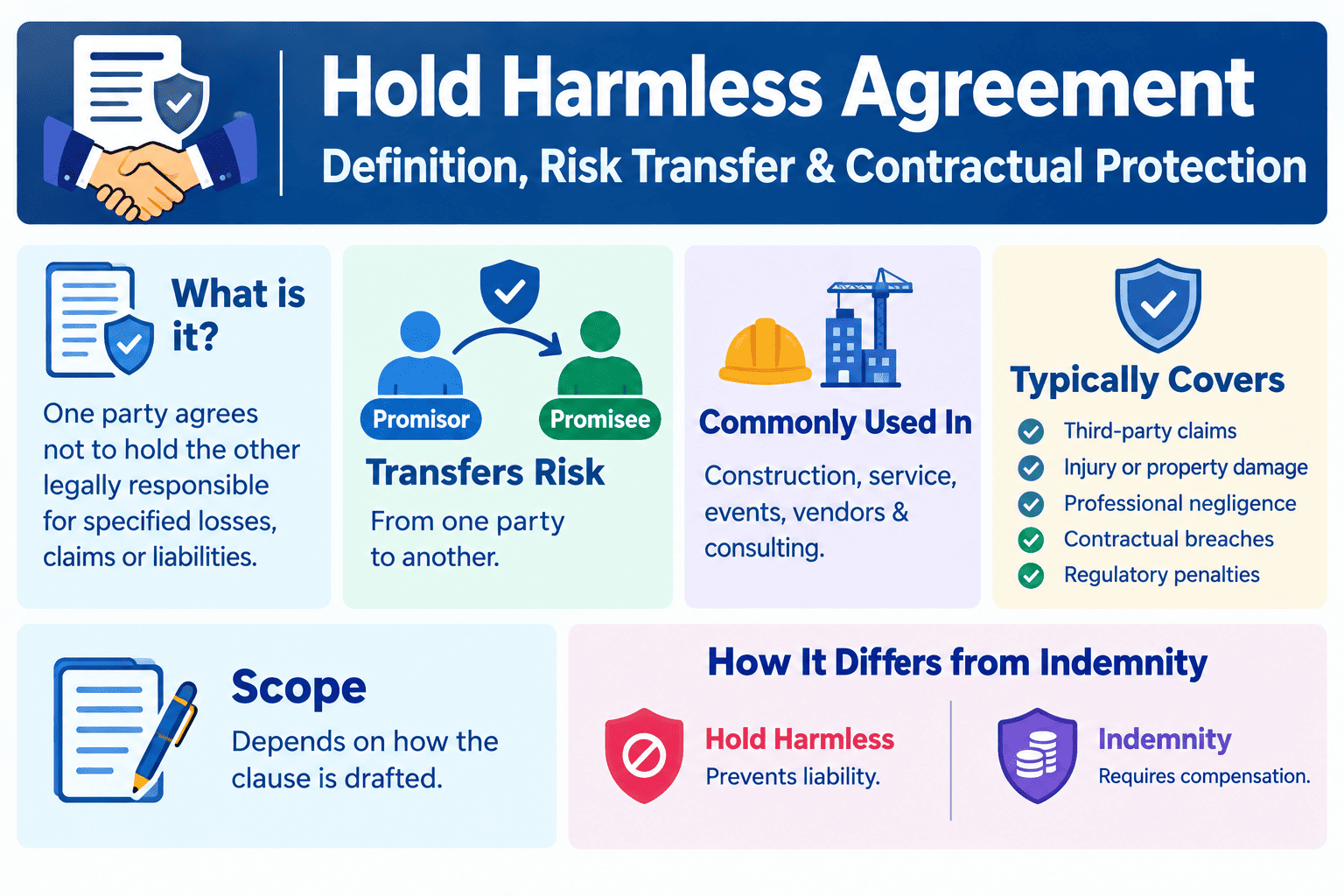
A hold harmless agreement is a contractual provision where one party agrees not to hold the other party legally responsible for specified losses, claims, or liabilities. It transfers risk from one party to another and is commonly used in construction, service contracts, event management, and vendor agreements.
QWhat are the types of hold harmless agreements?
There are three main types: (1) Broad form , one party assumes all liability, including for the other party’s negligence; (2) Intermediate form , one party covers losses from joint negligence or its own negligence, but not the sole negligence of the other; (3) Limited form , each party is responsible only for its own negligence. There are also unilateral (one-sided) and reciprocal (mutual) agreements.
QWhat is the difference between a hold harmless agreement and an indemnity clause?
A hold harmless clause prevents one party from being held liable for specific losses , it is a release from liability. An indemnity clause requires one party to compensate the other for losses incurred , it is a promise to reimburse. In practice, many contracts combine both elements using language such as ‘indemnify and hold harmless.’
QAre hold harmless agreements legally enforceable?
Courts generally enforce hold harmless agreements if the wording is clear and specific, the agreement does not violate statutory restrictions, and it does not attempt to shield fraud or willful misconduct. However, some jurisdictions restrict broad form clauses, especially in construction or public contracts. Ambiguous language is interpreted narrowly.
QWhat should be included in a hold harmless agreement?
Key elements include: names and addresses of the parties, date of creation and effective date, location and description of protected events, scope of the clause (what risks are covered), liability caps or limitations, insurance requirements, and signatures of all involved parties.