U.S.–Ecuador Agreement on Reciprocal Trade: What It Covers and What It Means for Business
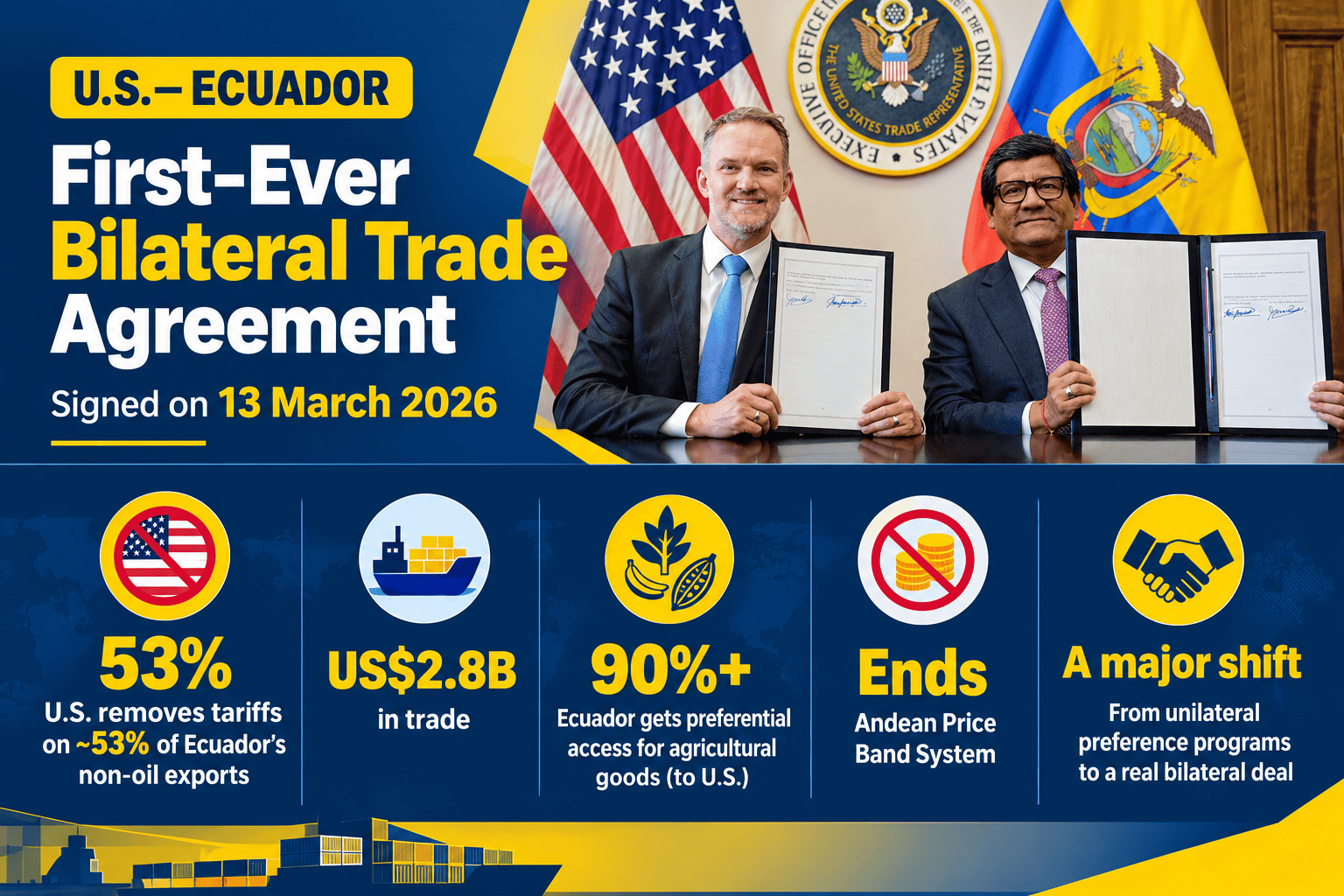
On 13 March 2026, the United States and Ecuador signed their first-ever bilateral trade agreement, the U.S.–Ecuador Agreement on Reciprocal Trade, following a framework announced by Presidents Donald Trump and Daniel Noboa the previous November. The deal removes U.S. tariffs on roughly 53% of Ecuador’s non-oil exports, around US$2.8 billion in trade, while Ecuador extends preferential access across more than 90% of its agricultural tariff schedule to U.S. goods and dismantles its decades-old Andean Price Band System. For a country that has relied on temporary, unilateral preference programs rather than a genuine bilateral deal since the early 2000s, this agreement is a significant structural shift. This article walks through what it actually covers, who gains the most, the real risks still hanging over it, and how to prepare a cross-border business partnership before it enters into force.
📅 Signed March 13, 2026⏱ 12 min read✍️ GTsetu Editorial🔄 Updated October 1, 2026
Date Signed
13 Mar 2026
Parties
🇺🇸 USA – 🇪🇨 Ecuador
Agreement
U.S.–Ecuador Agreement on Reciprocal Trade
Type
Reciprocal Trade Agreement
Current Status
Signed; not yet in force
Ecuador has been trying to secure durable, preferential access to the U.S. market since the early 2000s, first through a failed Andean regional FTA push, then through a series of temporary unilateral preference programs that left its exporters, particularly in bananas, shrimp, and flowers, facing unpredictable market access and complicating long-term investment decisions. This agreement finally gives Ecuador the bilateral deal that neighbours like Colombia and Peru have held for years. What it actually changes, and what risks remain even after signature, is what matters for any business on either side planning around it, whether that’s through international sourcing or building a long-term supply chain partnership, a pattern visible across the UAE’s own expanding CEPA network with the UAE-Sierra Leone CEPA and UAE-DRC CEPA.
Section 1
The Agreement in Numbers
The United States is already Ecuador’s largest trading partner by a wide margin, which is exactly why a bilateral deal with Washington has been such a long-standing national priority in Quito.
27.5%
Share of Ecuador’s total exports that go to the United States, its largest single export market
US$17.6B
Total U.S.-Ecuador trade in goods in 2025, underscoring the scale of the bilateral relationship
53%
Of Ecuador’s non-oil exports, roughly US$2.8 billion, gain removed or reduced U.S. tariffs under the deal
90%+
Of Ecuador’s agricultural tariff schedule now offers preferential treatment to U.S. exporters
Agriculture sits at the centre of why this deal matters so much for Ecuador specifically: agricultural goods make up over half of all Ecuadorian exports and roughly 85% of its non-oil exports, meaning the country’s broader trade health depends heavily on stable, predictable access to the U.S. market rather than the patchwork of temporary preference schemes it has relied on until now.
💡 “Signed” is not “in force”
Signature on 13 March 2026 means both governments have formally agreed to the text. It does not mean tariff lines have already changed. Both countries still need to complete domestic procedures to fully operationalize the agreement’s tariff reductions, regulatory alignment, and transparency measures, and both sides will track implementation progress through joint review systems. A business that waits for the deal to simply “switch on” risks missing the preparation window entirely.
Section 2
Timeline: From Framework to Signature
Date
Milestone
Early 2000s
Ecuador participates in failed Andean regional FTA talks with the United States
2002–2025
Ecuador relies on temporary frameworks such as the Andean Trade Preference Act rather than a lasting bilateral deal
13 Nov 2025
Presidents Trump and Noboa issue a Joint Statement on a Framework for the Agreement on Reciprocal Trade
Mar 2026 (prior weeks)
Final rounds of negotiation complete the agreement text
13 Mar 2026
The Agreement on Reciprocal Trade is formally signed, Ecuador’s first-ever bilateral trade deal with the U.S.
Current status
Signed; domestic procedures underway in both countries ahead of entry into force
Roughly $2.8 billion in trade gains preferential, often zero-tariff, access
Market Access
The United States removes tariffs on about 53% of Ecuador’s non-oil exports. Bananas, flowers, cacao, and other agricultural products benefit directly, entering the U.S. market under reduced or zero-tariff conditions compared to the standard rates they faced previously, a meaningful shift for a country where agriculture makes up the overwhelming majority of non-oil trade.
🎯
Why it matters: For exporters in these categories, this converts an unpredictable, preference-program-dependent relationship into something closer to the durable market access neighbouring Andean exporters have had for years.
2
Reciprocal Tariff Removal on Qualifying Goods
Products the U.S. cannot grow, mine, or produce domestically in sufficient quantity
Structural
Beyond the headline percentage, the U.S. has separately committed to remove its reciprocal tariffs on certain qualifying Ecuadorian exports that cannot be grown, mined, or naturally produced domestically in sufficient quantities, recognising Ecuador’s commitments to advance a more balanced trade relationship.
🎯
Why it matters: This category-specific commitment is structural rather than discretionary, meaning it is tied to genuine supply gaps in the U.S. market rather than a negotiable concession that could easily be reversed.
Section 4
What the United States Gains
1
Tariff Reduction Across Key U.S. Export Sectors
Machinery, health products, ICT goods, chemicals, motor vehicles, agriculture
Core Commitment
Ecuador has committed to reduce or eliminate tariffs on U.S. machinery, health products, ICT goods, chemicals, motor vehicles, and certain agricultural products, with tariff-rate quotas established for a number of other agricultural categories rather than outright elimination.
🎯
Why it matters: These are sectors where U.S. exporters previously faced a meaningful cost disadvantage entering Ecuador relative to competitors from countries with existing trade agreements there.
2
Dismantling the Andean Price Band System
90%+ of Ecuador’s agricultural tariff schedule now offers fixed, predictable preferential access
Regulatory Reform
Ecuador agreed to extend preferential treatment across more than 90% of its agricultural tariff schedule by removing the Andean Price Band System, a decades-old variable tariff mechanism that adjusted duties based on world market prices to protect local producers. For sensitive products such as sorghum, poultry, pork, dairy, and soybean oil, the agreement establishes quota-based, duty-free access instead.
🎯
Why it matters: A variable price-band tariff makes landed cost genuinely unpredictable for exporters, since the duty itself changes with world prices. Replacing it with fixed, generally lower tariffs is a structural improvement in predictability, not just a one-time cost cut.
Beyond tariffs, Ecuador has committed to a wide set of non-tariff and regulatory reforms: accelerating import licensing and facility registration, ending pre-shipment inspection mandates, expanding its Authorized Economic Operator programme to express delivery carriers, accepting U.S. standards for vehicles, pharmaceuticals, and medical devices, and strengthening enforcement of labour and environmental laws, including a new prohibition on importing goods made with forced or compulsory labour. The agreement also covers intellectual property transparency around geographical indications, digital trade commitments including a pledge not to impose discriminatory digital service taxes, and cooperation on supply chain resilience and investment security, relevant to anyone evaluating manufacturing certifications for international trade in either direction, a compliance pattern echoed in agreements like the UAE-Gabon CEPA.
Section 5
What Could Still Go Wrong
A signed agreement is a genuine milestone, but it is not an unconditional guarantee of the benefits described above. Two risks in particular are worth tracking closely.
Section 301 forced-labor scrutiny. Ecuador is among 60 countries currently facing U.S. Section 301 investigations over failures to prevent goods produced with forced labor. Should that investigation result in new tariffs, particularly on agricultural goods where prior risk assessments have flagged potential vulnerabilities in parts of Ecuador’s supply chains, the anticipated gains of this agreement could be meaningfully constrained.
Major export sectors sitting outside the deal’s scope. Ecuador’s shrimp exports reached roughly US$8.4 billion in 2025, about 23% of it bound for the United States, and tuna and canned fish exports reached nearly US$1.7 billion, making Ecuador the world’s top shrimp exporter and Latin America’s leading seafood exporter. Much of this falls outside the current agreement’s scope, meaning a significant share of Ecuador’s export economy still needs separate attention.
Implementation still pending. Both governments must complete domestic procedures to operationalize tariff reductions, regulatory alignment, and transparency commitments before benefits are realised in practice, and the timeline for that process has not been definitively set.
📌 The honest read
This agreement genuinely changes Ecuador’s trade position with the United States, from unpredictable preference programs to a structural, bilateral deal. But the labor compliance overlay sitting on top of it means the deal’s full value is not yet guaranteed, and businesses in agricultural supply chains specifically should treat forced-labor compliance as a live, ongoing requirement rather than a box already checked.
Section 6
What Happens Next, and How to Prepare
With the agreement signed but not yet in force, there is a genuine window to prepare rather than react once tariff lines actually move.
🗺️
Map your specific tariff lines
Identify exactly which products qualify under the new tariff schedules on each side, rather than assuming blanket coverage.
HS code mapping
📄
Review forced-labor compliance now
Agricultural supply chains especially should get ahead of Section 301 scrutiny before it affects preferential access.
Labor compliance
🔍
Vet a prospective partner now
Use the lead time before entry into force to verify legal registration and standing on the other side of the deal.
Partner verification
📜
Check regulatory standard alignment
Confirm whether your products already meet the U.S. vehicle, pharmaceutical, or medical device standards Ecuador is adopting.
Standards review
⚖️
Build disruption terms into contracts
Address how force majeure and disruption scenarios are handled while the agreement’s implementation remains in transition.
Contract terms
🤝
Compare notes against similar deals
Study how comparable agreements, like the UAE-Nigeria CEPA, have played out in their early implementation months.
Precedent review
🤝 For Verified U.S.–Ecuador Business Partnerships
GTsetu: Verified Discovery and Secure Engagement for Manufacturers, Distributors, and Raw Material Suppliers
A signed trade agreement tells you the tariff and regulatory rules are changing. It does not tell you whether a specific agricultural exporter in Ecuador or a specific machinery supplier in the United States is who they claim to be, or whether your product specifications and pricing will stay confidential while you explore a new cross-border relationship ahead of entry into force. That gap is what GTsetu is built to close. It is a structured partnership platform, not a directory or a general marketplace, where every company is verified on 6 government-sourced points before engagement, where discovery is anonymous until mutual interest is confirmed, where NDAs are executed digitally before any commercial information changes hands, and where document exchange happens through an encrypted workspace rather than email attachments.
GTsetu is used by industrial manufacturers, distributors, and raw material suppliers across 100+ countries, including the United States and Ecuador, to build out a distributor network, source international wholesale distribution partners, or find manufacturing and technology partnership relationships positioned to benefit from this agreement the moment it enters into force. It complements, rather than replaces, the compliance and customs preparation above, but it removes much of the identity and documentation risk before that deeper diligence even begins.
🏛️
6-Point Government-Sourced Verification
Name, Address, Registration Number, Company Status, Company Type, and Date of Incorporation, verified using government tie-ups before any engagement.
🕵️
Anonymous Discovery
Browse verified manufacturer and distributor profiles across 100+ countries without revealing your own identity or sourcing strategy until you choose to engage.
📄
Built-In NDA Workflow
Digital NDA with timestamped signatures before any pricing, formulations, or product specs are shared. No sensitive information exposed without protection.
🔐
Encrypted Document Workspace
All commercial documents shared through encrypted channels with a full access audit trail, not email attachments.
🌍
100+ Countries
Verified manufacturers and distributors across Asia, the Middle East, Europe, Africa, Australia, and the Americas. Built for cross-border partnership formation, not one-off quotes.
🚫
Zero Commission
No success fee, no broker commission, ever. Your partnership economics remain entirely between you and your partner.
Whichever side of the deal you’re on, the discipline that converts a signed trade agreement into actual revenue stays the same: verifying a partner’s legal registration and standing, confirming relevant certifications, and putting a formal agreement in place before sensitive specifications or pricing are shared. This pattern of reciprocal and comprehensive trade deals is reshaping sourcing options well beyond Ecuador, from the India-New Zealand Free Trade Agreement and the India-EU Free Trade Agreement to the US-India trade deal, the EU-Mercosur Trade Agreement, the EU-Mexico Modernised Trade Agreement, and the Canada-Ecuador Free Trade Agreement, which gives Ecuador preferential access on a third major front alongside its U.S. and UAE deals.
FAQ
Frequently Asked Questions
QWhen was the U.S.-Ecuador Agreement on Reciprocal Trade signed?
The agreement was signed on 13 March 2026, following a joint framework statement issued by Presidents Donald Trump and Daniel Noboa on 13 November 2025. As of the most recent status update, the agreement is signed but not yet in force, pending domestic procedures in both countries to fully operationalize its terms.
QWhat does Ecuador gain from the agreement?
The United States removes tariffs on roughly 53% of Ecuador’s non-oil exports, covering approximately $2.8 billion in trade, including bananas, flowers, cacao, and other agricultural goods that will enter the U.S. market under preferential, often zero-tariff, conditions compared to standard rates.
QWhat does the United States gain from the agreement?
Ecuador has committed to reduce or eliminate tariffs on key U.S. sectors including machinery, health products, ICT goods, chemicals, motor vehicles, and agricultural products, and to extend preferential treatment across more than 90% of its agricultural tariff schedule by removing its Andean Price Band System, a variable tariff mechanism that previously adjusted duties based on world prices.
QWhat risks could affect the agreement’s benefits?
Ecuador is among 60 countries currently facing U.S. Section 301 investigations over failures to prevent goods produced with forced labor. If that investigation results in tariffs, particularly on agricultural goods where risk assessments have flagged potential forced-labor vulnerabilities, the anticipated gains of the reciprocal trade agreement could be significantly constrained.
QIs this Ecuador’s first trade agreement with the United States?
Yes. This marks the first-ever bilateral trade agreement between Ecuador and the United States. Ecuador has historically lacked a comparable accord to those held by neighbouring Andean countries like Colombia and Peru, relying instead on temporary, unilateral preference frameworks such as the Andean Trade Preference Act, which left Ecuadorian exporters facing less predictable market access than their regional competitors.
Preparing for the U.S.-Ecuador Deal to Enter Into Force?
GTsetu is purpose-built for manufacturers, distributors, and raw material suppliers in industrial sectors seeking verified long-term trade partnerships, across 100+ countries including the United States and Ecuador, with government-sourced partner verification, built-in NDA workflows, and zero commission.
They represents the product, and research team behind GTsetu, a global B2B collaboration platform built to help companies explore cross-border partnerships with clarity and trust. The team focuses on simplifying early-stage international business discovery by combining structured company profiles, verification-led access, and controlled collaboration workflows.
With a strong emphasis on trust, and disciplined engagement, Team GTsetu shares insights on global trade, partnerships, and cross-border collaboration, helping businesses make informed decisions before entering deeper commercial discussions.