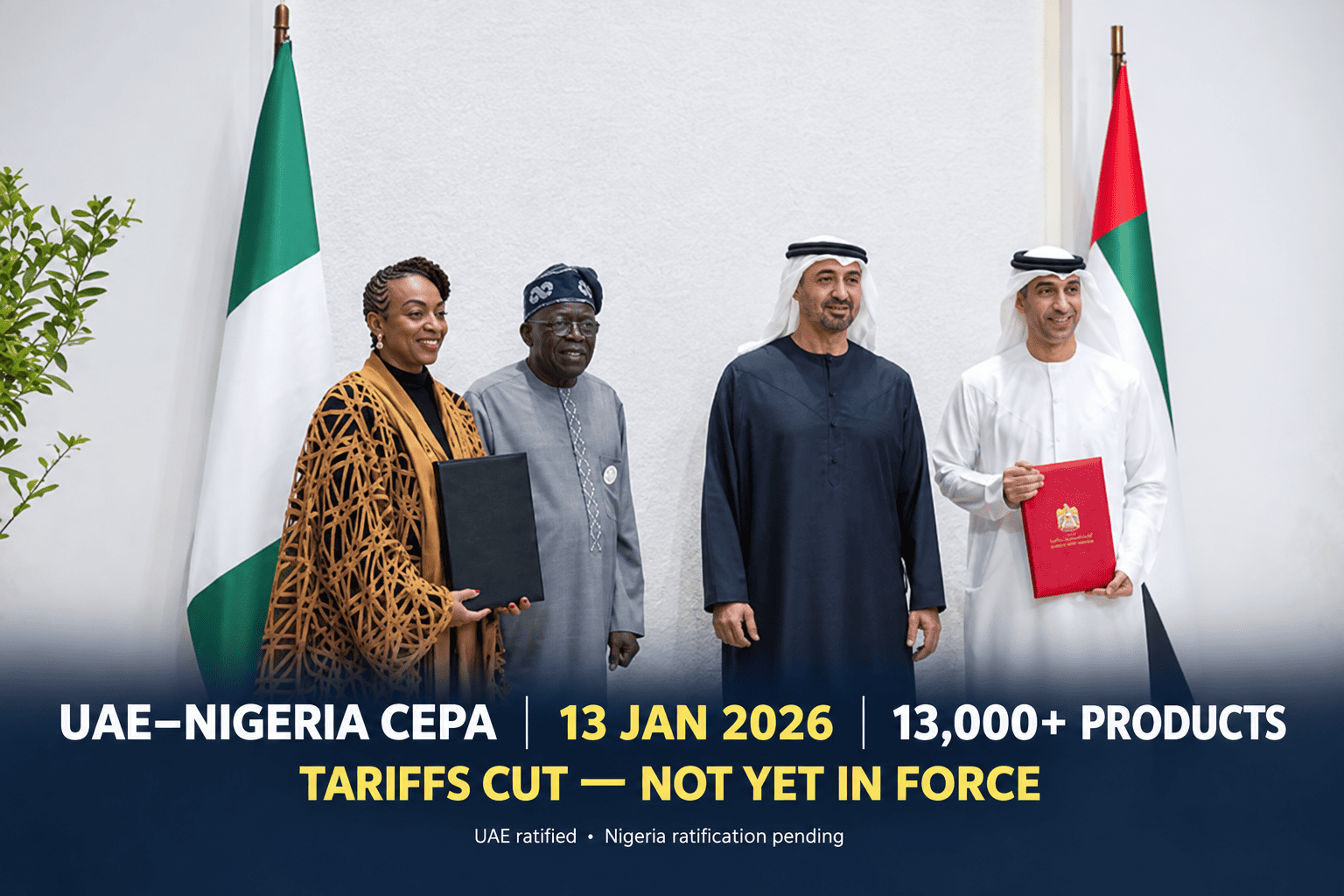
The United Arab Emirates and Nigeria signed a Comprehensive Economic Partnership Agreement (CEPA) in Abu Dhabi on 13 January 2026, on the sidelines of Abu Dhabi Sustainability Week, in the presence of President Sheikh Mohamed bin Zayed Al Nahyan and Nigerian President Bola Ahmed Tinubu. The deal was signed by Dr Thani bin Ahmed Al Zeyoudi, UAE Minister of Foreign Trade, and Dr Jumoke Oduwole, Nigeria’s Minister of Industry, Trade and Investment. The UAE will eliminate tariffs on more than 7,000 Nigerian products, while Nigeria will eliminate tariffs on around 6,000 UAE products, covering over 13,000 products combined. The UAE has completed its domestic ratification; the agreement is not yet in force pending Nigeria’s own ratification process.
📅 Signed 13 January 2026📍 Abu Dhabi, UAE📋 CEPA / FTA⏳ Status: Signed, not in force
The UAE-Nigeria CEPA is, by most measures, the most consequential Africa agreement in the UAE’s Comprehensive Economic Partnership programme to date. Nigeria is Africa’s largest economy by population and one of its fastest-growing, and analysts have described the signing as a watershed moment in the country’s international economic relations, a shift from how Nigeria has historically been perceived in global trade, from a difficult market to a structured, credible, and investable economy.
This explainer covers what was actually signed, who signed it, what sectors it touches, where it stands in the ratification process, and, most importantly, what it means in practice for manufacturers, distributors, and raw material suppliers weighing up whether and how to act on the new corridor it opens between the UAE and West Africa’s largest market. This page is part of GTsetu’s wider FTA Tracker, which follows CEPAs and reciprocal trade agreements as they are signed around the world.
💡 How to read this page
Sections 2 to 5 cover the facts of the agreement itself: what was signed, the numbers behind it, the sectors it targets, and its current legal status. Section 6 places the deal in the context of other recent FTAs and CEPAs our tracker is following. Section 7 moves from the agreement to practical next steps for anyone sourcing from, selling into, or partnering across the UAE-Nigeria trade lane.
Section 1
What Is the UAE-Nigeria CEPA?
A Comprehensive Economic Partnership Agreement is the UAE’s standard format for bilateral free trade deals, going beyond simple tariff reduction to also cover investment facilitation, services trade, and private-sector cooperation. The UAE-Nigeria CEPA was signed in Abu Dhabi on 13 January 2026, witnessed by UAE President Sheikh Mohamed bin Zayed Al Nahyan and Nigerian President Bola Ahmed Tinubu, and formally signed on behalf of the two governments by Dr Thani bin Ahmed Al Zeyoudi and Dr Jumoke Oduwole.
The agreement was negotiated under the direction of Nigeria’s Federal Ministry of Industry, Trade and Investment, with Dr Oduwole serving as Nigeria’s Chief Negotiator. It builds on an investment promotion and protection agreement the two countries ratified in 2024, which already gave Emirati investors a stable legal framework to operate in Nigeria. Officials on both sides described the CEPA as a central pillar of deepening economic ties, with the UAE citing Nigeria as one of the African continent’s largest and fastest-growing economies, and Nigeria framing the deal as core to its Renewed Hope Agenda and economic diversification push away from oil.
Section 2
Key Facts at a Glance
Deal Snapshot
The cards below summarise the core facts of the agreement as confirmed in official statements and coverage at the time of signing.
1
Signing Details
Who signed, where, and in whose presence
Abu Dhabi13 Jan 2026
The CEPA was signed in Abu Dhabi by Dr Thani bin Ahmed Al Zeyoudi, UAE Minister of Foreign Trade, and Dr Jumoke Oduwole, Nigeria’s Minister of Industry, Trade and Investment, in the presence of UAE President Sheikh Mohamed bin Zayed Al Nahyan and Nigerian President Bola Ahmed Tinubu.
Signed on the sidelines of Abu Dhabi Sustainability Week 2026
Built on a 2024 investment promotion and protection agreement
Nigeria announced co-hosting Investopia with the UAE in February 2026
Key agencies (Customs, NEPC, NIPC) tasked with implementation readiness
2
Tariffs & Trade Numbers
Products covered and bilateral trade volume
13,000+ products+66.7% trade
The CEPA is one of the most expansive tariff-elimination packages in the UAE’s Africa CEPA programme to date, covering goods, services, and investment.
UAE eliminates tariffs on 7,315 (over 7,000) Nigerian products
Nigeria eliminates tariffs on 6,243 (around 6,000) UAE products
Bilateral trade: ~USD 5 billion in 2025, up 66.7% from ~USD 3 billion in 2024
Forecast to add USD 2.4 billion to UAE GDP by 2032
Nigeria’s Import Prohibition List remains in effect
3
Legal Status
Where the agreement stands in the ratification process
SignedNot in Force
The UAE has formally ratified the CEPA. Nigeria’s domestic ratification process is still under way, and both governments have called for an early meeting of a Nigeria-UAE Joint Commission to resolve outstanding implementation issues.
Signed: 13 January 2026, Abu Dhabi
UAE ratification: completed
Nigeria ratification: in progress, not yet completed
Nigeria-UAE Joint Commission: planned, not yet convened
📌 Signed is not the same as in force
A CEPA being “signed” means both governments have agreed and formalised the text. The UAE-Nigeria CEPA illustrates this well: one party (the UAE) has already ratified its side, while the other (Nigeria) is still completing domestic processes. Preferential tariffs are not active until both sides have finished ratification, so businesses should track Nigeria’s ratification progress closely rather than assume benefits are live.
Section 3
Why Nigeria, Why Now
Nigeria’s economy remains Africa’s largest by population and one of its fastest-growing, but it has also faced a history of trade friction, FDI hesitancy, and policy unpredictability. Officials on both sides framed the CEPA as addressing these longstanding impediments directly, giving UAE investors clarity and confidence to deploy capital into Nigeria’s productive sectors. The timing coincides with a broader surge in UAE-Nigeria engagement, including interest from institutional investors like First Abu Dhabi Bank in infrastructure projects such as the Lagos-Calabar Coastal Road, and UAE-backed financing tied to the USD 18.5 billion Centenary City development in Abuja.
President Tinubu also used the signing to announce Nigeria is seeking roughly USD 30 billion in green finance, tying the CEPA to the country’s climate-resilient infrastructure and energy-transition ambitions. The deal sits alongside the UAE’s wider push into Africa, including CEPAs with the Democratic Republic of Congo, Gabon, and Sierra Leone, and was announced within hours of the UAE’s separate CEPA with the Philippines, underlining how aggressively the UAE has been expanding its trade-agreement network in early 2026.
Section 4
Sectors Covered
Priority Areas Named in the Agreement
Officials and coverage of the signing consistently named the following as priority sectors for investment and trade cooperation under the agreement:
Technology and digital trade. Named explicitly by both governments, with digital banking, fintech, and AI flagged as areas of particular Nigerian interest.
Agriculture. A core sector for both tariff elimination and investment inflows, tied to Nigeria’s broader industrialisation agenda.
Precious metals and energy. Including renewable energy, cited by Tinubu as central to expanding opportunities for Nigerian exporters and manufacturers.
Infrastructure and logistics. Covering projects like the Lagos-Calabar Coastal Road, with UAE institutional capital already showing interest.
Manufacturing and industrial inputs. Nigeria’s tariff cuts are concentrated on machinery, vehicles, and industrial inputs, intended to lower input costs for domestic manufacturers.
Financial services and real estate. Flagged as sectors expected to see qualitative job creation, particularly for Nigeria’s young population.
Section 5
Timeline: Signed vs. In Force
Understanding where the UAE-Nigeria CEPA sits in its lifecycle matters for anyone planning around it. The table below lays out the sequence as it has unfolded so far.
Stage
Status
Date / Notes
Investment protection agreement
✓ Completed
Ratified by both countries in 2024, ahead of the CEPA
Negotiation
✓ Completed
Led by Nigeria’s Federal Ministry of Industry, Trade and Investment
Signing
✓ Completed
13 January 2026, Abu Dhabi, on the sidelines of Abu Dhabi Sustainability Week
Domestic ratification (UAE)
✓ Completed
Confirmed by the UAE Ambassador to Nigeria in mid-2026
Domestic ratification (Nigeria)
⚠ In progress
Ongoing as of mid-2026; no confirmed completion date
Nigeria-UAE Joint Commission
⚠ Pending
Both sides have called for an early convening to resolve outstanding issues
Entry into force
✗ Not yet in force
Awaits completion of Nigeria’s domestic ratification process
Section 6
How It Fits the Wider Global FTA Landscape
The UAE-Nigeria CEPA is one entry in a much larger wave of trade-agreement activity moving through 2026. The UAE alone has been signing CEPAs at pace across Africa and Asia, while the US has pursued a parallel track of reciprocal trade agreements with partners across Latin America and Asia, and the EU and other blocs have been finalising long-running negotiations of their own. The table below places Nigeria’s agreement alongside a selection of other deals our FTA Tracker is following.
Two patterns stand out. First, the UAE-Nigeria CEPA was signed within hours of the UAE-Philippines CEPA, both on 13 January 2026, showing how the UAE has been bundling signings across continents during high-profile events like Abu Dhabi Sustainability Week. Second, Nigeria’s position as West Africa’s largest economy sits alongside a cluster of other UAE-Africa deals, the DRC, Gabon, and Sierra Leone CEPAs, all moving through similar signed-but-not-in-force stages within weeks of each other, reshaping the regulatory landscape across the region in a short window.
Section 7
What It Means for Manufacturers & Distributors
A signed CEPA is a signal, not yet a set of active preferential terms, and the UAE-Nigeria deal makes that especially clear since one party has ratified and the other has not. For manufacturers, distributors, and raw material suppliers watching this corridor, the practical question is what to do in the window between signing and entry into force, and that comes down to groundwork: identifying real counterparties, verifying them properly, and preparing commercial and legal terms before tariff eliminations actually activate. The same groundwork applies whether the corridor in question is UAE-Nigeria, the UAE-Philippines CEPA, or any of the reciprocal agreements the US has been signing, such as the US-El Salvador and US-Guatemala agreements.
🔍
Scope the Nigerian market before committing
Understand demand, local competition, and Nigeria’s Import Prohibition List before assuming tariff access.
Market research first
🤝
Identify a verified distributor or supply partner
Build relationships with Nigerian or UAE-based intermediaries now, so you are ready when terms activate.
Verified partner search
📄
Prepare partnership and supply contracts in advance
Draft terms, NDAs, and agreements ahead of time so you can move quickly once ratification completes.
Contract readiness
🏭
Check which of your products fall on the tariff lists
With over 13,000 products covered, verify your specific HS codes against the agreed elimination schedules.
Tariff-line check
🚢
Map logistics and supply chain routes early
Infrastructure and logistics are named CEPA priorities; plan routing through projects like the Lagos-Calabar Coastal Road.
Supply chain mapping
🌐
Watch parallel corridors, not just this one
Agreements like the UAE-DRC CEPA and UAE-Gabon CEPA may open adjacent regional opportunities worth tracking together.
Regional tracking
Businesses with existing exposure to other active or pending FTAs should also keep an eye on how multiple corridors intersect. A manufacturer already tracking the India-EU FTA or the US-India trade deal, for instance, may find that sourcing or distribution strategies built around the UAE-Nigeria corridor complement rather than compete with those wider plans. Likewise, businesses active in Southeast Asia may want to compare this agreement against the pace of the US-Indonesia, US-Taiwan, and Japan-Bangladesh agreements moving through similar stages on our tracker.
🤝 For Long-Term Industrial Partnerships
GTsetu: Verified Partner Discovery for the UAE-Nigeria Corridor and Beyond
New CEPAs and FTAs open a trade corridor on paper, but someone still has to find, verify, and formally engage the actual company on the other end, whether that is a Nigerian distributor, a UAE-based intermediary, or a raw material supplier in any of the markets covered on our FTA Tracker. GTsetu is built specifically for that step. It is not a directory and not a government trade portal. It is a structured partnership platform where every company is verified on 6 government-sourced points before engagement, where discovery is anonymous until mutual interest is confirmed, where NDAs are executed digitally before any commercial information changes hands, and where all document exchange happens through an encrypted workspace.
GTsetu is used by industrial manufacturers, distribution companies, and raw material suppliers across 100+ countries, including markets covered by agreements like the UAE-Gabon CEPA and UAE-DRC CEPA, to find, vet, and formally engage trade partners ahead of, during, and after a corridor comes fully into force.
🏛️
6-Point Government-Sourced Verification
Name, Address, Registration Number, Company Status, Company Type, and Date of Incorporation, verified using government tie-ups before any engagement.
🕵️
Anonymous Discovery
Browse verified partner profiles across 100+ countries without revealing your own identity or commercial strategy until you choose to engage.
📄
Built-In NDA Workflow
Digital NDA with timestamped signatures before any pricing, supply terms, or product specs are shared. No sensitive information exposed without protection.
🔐
Encrypted Document Workspace
All commercial documents shared through encrypted channels with a full access audit trail, not email attachments.
🌍
100+ Countries
Verified manufacturers and distributors across Asia, Middle East, Europe, Africa, Australia, and the Americas. Built for cross-border partnership formation, not raw record volume.
🚫
Zero Commission
No success fee, no broker commission, ever. Your partnership economics remain entirely between you and your partner.
📌 GTsetu tracks the deal; you build the relationship
Trade agreements lower the barriers between markets, but they do not pre-vet the specific company you end up doing business with. Many manufacturers planning around the UAE-Nigeria CEPA, or any of the other agreements on our FTA Tracker, use this window to identify and verify partners on GTsetu, so that by the time preferential terms are active, the commercial relationship, contract, and documentation are already in place.
FAQ
Frequently Asked Questions
QIs the UAE-Nigeria CEPA in force yet?
No. The agreement was signed in Abu Dhabi on 13 January 2026. The UAE has completed its domestic ratification, but Nigeria’s own ratification process is still ongoing, so the agreement has not yet formally entered into force for both parties.
QWhat does the UAE-Nigeria CEPA cover?
The UAE will eliminate tariffs on more than 7,000 Nigerian products, while Nigeria will eliminate tariffs on around 6,000 UAE products, together covering over 13,000 products. Beyond goods, the agreement covers services and investment, and targets cooperation in technology, agriculture, precious metals, energy, infrastructure, logistics and digital trade.
QHow big is UAE-Nigeria trade?
Bilateral trade between Nigeria and the UAE rose 66.7 percent to roughly USD 5 billion in 2025, up from about USD 3 billion in 2024. Separately, WAM reported non-oil bilateral trade of USD 3.1 billion for the first nine months of 2025. The CEPA is expected to accelerate this growth further.
QWho signed the UAE-Nigeria CEPA?
The agreement was signed by Dr Thani bin Ahmed Al Zeyoudi, UAE Minister of Foreign Trade, and Dr Jumoke Oduwole, Nigeria’s Minister of Industry, Trade and Investment, in the presence of UAE President Sheikh Mohamed bin Zayed Al Nahyan and Nigerian President Bola Ahmed Tinubu.
QHow does the Nigeria CEPA fit with the UAE’s other African trade agreements?
The UAE-Nigeria CEPA is one of several agreements the UAE has signed with African economies in this window, including the UAE-Gabon CEPA, the UAE-DRC CEPA, and the UAE-Sierra Leone CEPA. Together these form part of a broader UAE strategy to deepen economic ties across Africa as part of its 2031 non-oil trade target of USD 1.1 trillion.
QWhat should a manufacturer do now, before the agreement enters into force?
The signing-to-force window is best used for groundwork: researching the Nigerian market, identifying and verifying potential distributors or supply partners, checking which products fall under the agreed tariff elimination schedules, mapping logistics routes, and preparing contract terms in advance. Acting during this period means a business is ready to move as soon as Nigeria completes ratification, rather than starting due diligence from scratch once the deal is in force. The same applies to other pending agreements tracked on our FTA Tracker, such as the UAE-Ecuador CEPA or the EU-Mercosur agreement.
Planning Ahead of the UAE-Nigeria CEPA Entering Into Force?
GTsetu is purpose-built for manufacturers, distributors, and raw material suppliers in industrial sectors seeking verified long-term trade partnerships, across 100+ countries, with government-sourced partner verification, built-in NDA workflows, and zero commission.
They represents the product, and research team behind GTsetu, a global B2B collaboration platform built to help companies explore cross-border partnerships with clarity and trust. The team focuses on simplifying early-stage international business discovery by combining structured company profiles, verification-led access, and controlled collaboration workflows.
With a strong emphasis on trust, and disciplined engagement, Team GTsetu shares insights on global trade, partnerships, and cross-border collaboration, helping businesses make informed decisions before entering deeper commercial discussions.