U.S.–Guatemala Agreement on Reciprocal Trade: What It Covers and What It Means for Business
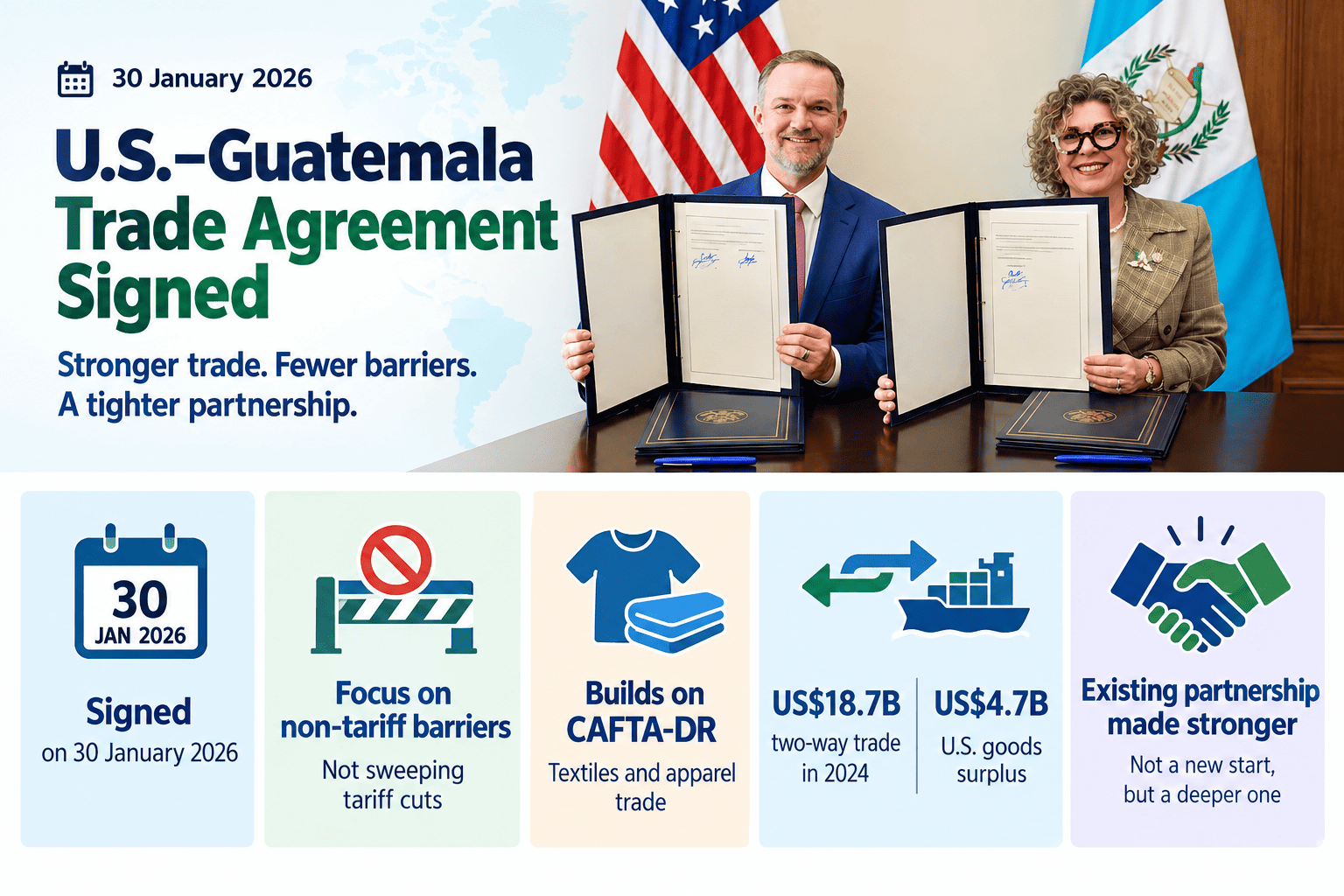
On 30 January 2026, U.S. Trade Representative Jamieson Greer and Guatemala’s Minister of Economy Adriana Gabriela Garcia signed the United States–Guatemala Agreement on Reciprocal Trade, building on a framework announced by both governments on 13 November 2025. The deal does not centre on sweeping new tariff cuts; it centres on dismantling the non-tariff barriers that have long complicated U.S. access to Guatemala’s market, while reinforcing the CAFTA-DR textile and apparel trade that already anchors much of the bilateral relationship. With two-way trade of almost US$18.7 billion in 2024 and a U.S. goods surplus of $4.7 billion, this is not a greenfield relationship being built from scratch, it’s an established one being tightened. This article walks through what the agreement actually covers, who gains the most, and how to prepare a cross-border business partnership before it enters into force.
📅 Signed January 30, 2026⏱ 12 min read✍️ GTsetu Editorial🔄 Updated October 1, 2026
Date Signed
30 Jan 2026
Parties
🇺🇸 USA – 🇬🇹 Guatemala
Agreement
U.S.–Guatemala Agreement on Reciprocal Trade
Type
Reciprocal Trade Agreement
Current Status
Signed; not yet in force
Most trade agreement coverage focuses on tariff schedules because they’re the easiest number to headline. The US-Guatemala Agreement on Reciprocal Trade is a useful reminder that tariffs are often not where the real friction lives. For a relationship this mature, the practical obstacles to doing more business were regulatory, not tariff-based, mismatched vehicle safety standards, duplicate product certifications, inconsistent IP enforcement, and this agreement is built almost entirely around removing exactly that kind of friction, relevant to anyone evaluating cross-border manufacturing partnerships in Central America.
Section 1
The Agreement in Numbers
The scale of the existing U.S.-Guatemala trade relationship is exactly why this agreement matters: it isn’t opening a new market, it’s reinforcing and expanding one that’s already substantial.
$18.7B
Two-way trade in goods and services between the U.S. and Guatemala in 2024
$12.3B
U.S. goods and services exports to Guatemala in 2024, the figure this agreement is designed to grow
$4.7B
Current U.S. goods trade surplus with Guatemala
30 days
Period after mutual written notification of completed legal procedures before the agreement enters into force
💡 “Signed” is not “in force”
The agreement explicitly states it will take effect 30 days after both countries notify each other in writing that their respective domestic legal procedures are complete. That is a clear, defined trigger, but it still requires action on both sides. A business tracking this deal should watch for that notification, not assume the signing date itself changed anything operationally.
Section 2
Timeline: From Framework to Signature
Date
Milestone
13 Nov 2025
Presidents Trump and Guatemala’s government issue a Joint Statement on a Framework for the Agreement on Reciprocal Trade
Nov 2025 – Jan 2026
Both sides finalize the Agreement text and prepare it for signature
30 Jan 2026
Ambassador Jamieson Greer and Minister Adriana Gabriela Garcia formally sign the Agreement in Washington
Current status
Signed; both countries completing domestic legal procedures ahead of entry into force
Next
Mutual written notification of completed procedures, followed by entry into force 30 days later
Non-Tariff Barrier Removal Across Industrial and Agricultural Exports
1
Breaking Down Barriers for U.S. Industrial Exports
Vehicles, medical devices, remanufactured goods, and streamlined certification
Regulatory Reform
Guatemala will accept vehicles and automotive parts built to U.S. motor vehicle safety and emissions standards, accept FDA certificates and prior marketing authorizations for medical devices and pharmaceuticals, accept remanufactured goods from the U.S., and accept electronic certificates while removing apostille requirements and streamlining certificate-of-free-sale and product registration requirements.
🎯
Why it matters: Each of these is a genuine duplicate-compliance cost eliminated, not a tariff line changed. For manufacturers and exporters across sectors, accepted certification standards are often worth more than a percentage point of tariff relief.
2
Breaking Down Barriers for U.S. Agricultural Exports
Science-based regulation and protected use of common cheese and meat terms
Agriculture
Guatemala has committed to maintain science- and risk-based regulatory frameworks and efficient authorization processes for U.S. agricultural products, and to ensure market access is not restricted due to the use of common cheese and meat terms, including parmesan, gruyere, mozzarella, feta, asiago, salami, and prosciutto, among others.
🎯
Why it matters: Naming-rights disputes over generic food terms have quietly blocked market access in other trade relationships. Resolving it explicitly here removes a recurring friction point before it becomes a dispute.
3
Trade Facilitation, Good Regulatory Practice, and IP Enforcement
Faster express shipments, public rulemaking consultation, stronger IP protection
Process Reform
Guatemala commits to advancing trade-facilitating measures for express delivery shipments, publishing proposed regulatory measures and conducting public consultations, and strengthening intellectual property enforcement, including joining key international IP treaties, increasing criminal prosecutions of IP cases, and addressing issues flagged in the 2025 Special 301 Report.
🎯
Why it matters: Predictable rulemaking and stronger IP enforcement reduce the regulatory surprise risk that often deters smaller exporters from committing to a market in the first place, relevant for anyone considering a technology partnership abroad.
Section 4
What Guatemala Gains
Commitment
What It Covers
Why It Matters for Guatemala
Reciprocal tariff removal on unique exports
Products the U.S. cannot grow, mine, or produce domestically in sufficient quantities
Structural, supply-gap-based access rather than a negotiable discretionary concession
CAFTA-DR textile and apparel preference
Reciprocal tariffs removed from qualifying textile and apparel products
Reinforces Guatemala’s role in regional textile and apparel supply chains
Regulatory certainty and modernisation
Good regulatory practice and trade facilitation commitments apply reciprocally
Reduces Guatemala’s own compliance costs when exporting to the U.S.
Strengthened economic security ties
Joint action on supply chain resilience, duty evasion, and investment security
Positions Guatemala as a trusted node in U.S.-aligned regional supply chains
The textile and apparel provision deserves particular attention. By removing reciprocal tariffs from products already qualifying under CAFTA-DR, the agreement is explicitly framed by USTR as strengthening the resilience of textile and apparel supply chains, a sector where Guatemala competes directly for sourcing decisions against other textile-exporting economies like Bangladesh.
Section 5
Labor, IP, and Economic Security Commitments
Beyond market access, the agreement folds in a set of commitments that extend well past conventional trade terms, reflecting a broader template now showing up across the U.S.’s 2025-2026 wave of reciprocal trade deals.
Labor standards: Guatemala commits to protecting internationally recognized labor rights and prohibiting the importation of goods produced by forced or compulsory labor.
Environmental protections: Guatemala commits to maintaining high levels of environmental protection, improving forest sector governance, combating illegal logging and illegal wildlife trade, and fully implementing the WTO Agreement on Fisheries Subsidies.
Digital trade: Guatemala will prevent barriers to services and digital trade, refrain from discriminatory digital services taxes, and support a permanent WTO moratorium on customs duties on electronic transmissions.
Government procurement restrictions: Guatemala commits to restricting access to central-level procurement covered by free trade agreement commitments for suppliers from non-FTA partners, mirroring U.S. procurement restrictions.
State-owned enterprise discipline: Both sides commit to addressing potentially distortionary actions by state-owned enterprises or industrial subsidies affecting the bilateral trading relationship.
📌 The honest read
This agreement is dense with commitments that sound procedural but carry real commercial weight, data transfer adequacy, technology transfer prohibitions, digital tax restrictions. Businesses in services, software, and digital products should read Annex III as closely as the tariff schedule, since that’s where a meaningful share of the agreement’s practical value for non-physical-goods exporters actually sits.
Section 6
What Happens Next, and How to Prepare
With the agreement signed and a clear 30-day trigger mechanism defined for entry into force, there is a genuine preparation window before domestic legal procedures conclude on both sides.
🧵
Review your CAFTA-DR origin status
Confirm whether your textile and apparel products already qualify, since this is where the clearest reciprocal tariff benefit sits.
Origin verification
📋
Map your regulatory acceptance gains
Identify whether your products fall under the new vehicle, pharmaceutical, or medical device standard acceptances.
Compliance mapping
🔍
Vet a prospective partner now
Use the lead time before entry into force to verify legal registration and standing on the other side of the deal.
Partner verification
💻
Review digital trade provisions
Services and software businesses should check Annex III’s data transfer and technology transfer commitments closely.
Digital trade review
⚖️
Build disruption terms into contracts
Address how force majeure and disruption scenarios are handled while implementation remains in transition.
Contract terms
🤝
Compare notes against similar deals
Study how comparable agreements, like the UAE-Nigeria CEPA, have played out in their early implementation months.
Precedent review
🤝 For Verified U.S.–Guatemala Business Partnerships
GTsetu: Verified Discovery and Secure Engagement for Manufacturers, Distributors, and Raw Material Suppliers
A signed trade agreement tells you the regulatory and non-tariff barriers are changing. It does not tell you whether a specific textile manufacturer in Guatemala City or a specific agricultural exporter in the U.S. is who they claim to be, or whether your product specifications and pricing will stay confidential while you explore a new cross-border relationship ahead of entry into force. That gap is what GTsetu is built to close. It is a structured partnership platform, not a directory or a general marketplace, where every company is verified on 6 government-sourced points before engagement, where discovery is anonymous until mutual interest is confirmed, where NDAs are executed digitally before any commercial information changes hands, and where document exchange happens through an encrypted workspace rather than email attachments.
GTsetu is used by industrial manufacturers, distributors, and raw material suppliers across 100+ countries, including the United States and Guatemala, to build out a distributor network, source international wholesale distribution partners, or find manufacturing and technology partnership relationships positioned to benefit from this agreement the moment it enters into force. It complements, rather than replaces, the compliance and customs preparation above, but it removes much of the identity and documentation risk before that deeper diligence even begins.
🏛️
6-Point Government-Sourced Verification
Name, Address, Registration Number, Company Status, Company Type, and Date of Incorporation, verified using government tie-ups before any engagement.
🕵️
Anonymous Discovery
Browse verified manufacturer and distributor profiles across 100+ countries without revealing your own identity or sourcing strategy until you choose to engage.
📄
Built-In NDA Workflow
Digital NDA with timestamped signatures before any pricing, formulations, or product specs are shared. No sensitive information exposed without protection.
🔐
Encrypted Document Workspace
All commercial documents shared through encrypted channels with a full access audit trail, not email attachments.
🌍
100+ Countries
Verified manufacturers and distributors across Asia, the Middle East, Europe, Africa, Australia, and the Americas. Built for cross-border partnership formation, not one-off quotes.
🚫
Zero Commission
No success fee, no broker commission, ever. Your partnership economics remain entirely between you and your partner.
QWhen was the U.S.-Guatemala Agreement on Reciprocal Trade signed?
The agreement was signed on 30 January 2026 by U.S. Trade Representative Jamieson Greer and Guatemala’s Minister of Economy Adriana Gabriela Garcia, following a framework agreement announced on 13 November 2025. The agreement is signed but not yet in force; it will take effect 30 days after both countries notify each other in writing of the completion of their respective domestic legal procedures.
QWhat does the United States gain from the agreement?
Guatemala commits to removing a wide range of non-tariff barriers for U.S. industrial and agricultural exports, including accepting U.S. vehicle safety and emissions standards, FDA certificates for medical devices and pharmaceuticals, and science-based regulatory frameworks for agricultural products, alongside stronger intellectual property enforcement and a prohibition on discriminatory digital services taxes. U.S. goods and services exports to Guatemala reached $12.3 billion in 2024, and the agreement is designed to expand that further.
QWhat does Guatemala gain from the agreement?
The United States will remove reciprocal tariffs on certain Guatemalan exports that cannot be grown, mined, or naturally produced in the U.S. in sufficient quantities, and will remove reciprocal tariffs from textile and apparel products qualifying under CAFTA-DR, reinforcing Guatemala’s role in regional textile and apparel supply chains. The U.S. currently runs a $4.7 billion goods trade surplus with Guatemala, underscoring how central U.S. market access already is to Guatemala’s trade position.
QHow should a business prepare for the US-Guatemala agreement before it enters into force?
Businesses should review whether their products qualify under CAFTA-DR rules of origin, prepare for Guatemala’s new regulatory acceptance of U.S. certificates and standards, verify a prospective partner’s legal registration and compliance standing, and put formal agreements in place covering pricing, delivery, and disruption terms ahead of entry into force, so they are ready to act as soon as both governments complete their domestic legal procedures.
QHow does this agreement relate to Guatemala’s existing CAFTA-DR membership?
Rather than replacing CAFTA-DR, the new agreement builds on it. The United States will remove reciprocal tariffs from textile and apparel products that already qualify under CAFTA-DR rules of origin, meaning the new deal effectively layers additional, broader commitments, covering regulatory acceptance, IP enforcement, digital trade, and labor standards, on top of the existing CAFTA-DR framework rather than starting the trade relationship over.
Preparing for the U.S.-Guatemala Deal to Enter Into Force?
GTsetu is purpose-built for manufacturers, distributors, and raw material suppliers in industrial sectors seeking verified long-term trade partnerships, across 100+ countries including the United States and Guatemala, with government-sourced partner verification, built-in NDA workflows, and zero commission.
They represents the product, and research team behind GTsetu, a global B2B collaboration platform built to help companies explore cross-border partnerships with clarity and trust. The team focuses on simplifying early-stage international business discovery by combining structured company profiles, verification-led access, and controlled collaboration workflows.
With a strong emphasis on trust, and disciplined engagement, Team GTsetu shares insights on global trade, partnerships, and cross-border collaboration, helping businesses make informed decisions before entering deeper commercial discussions.