U.S.–El Salvador Agreement on Reciprocal Trade: What’s in It and When It Takes Effect | GTsetu Blog
Home ›
FTAs ›
U.S.-El Salvador Reciprocal Trade Agreement
🇺🇸 🇸🇻 Reciprocal Trade Agreement · 2026
U.S.–El Salvador Agreement on Reciprocal Trade: What’s in It and When It Takes Effect
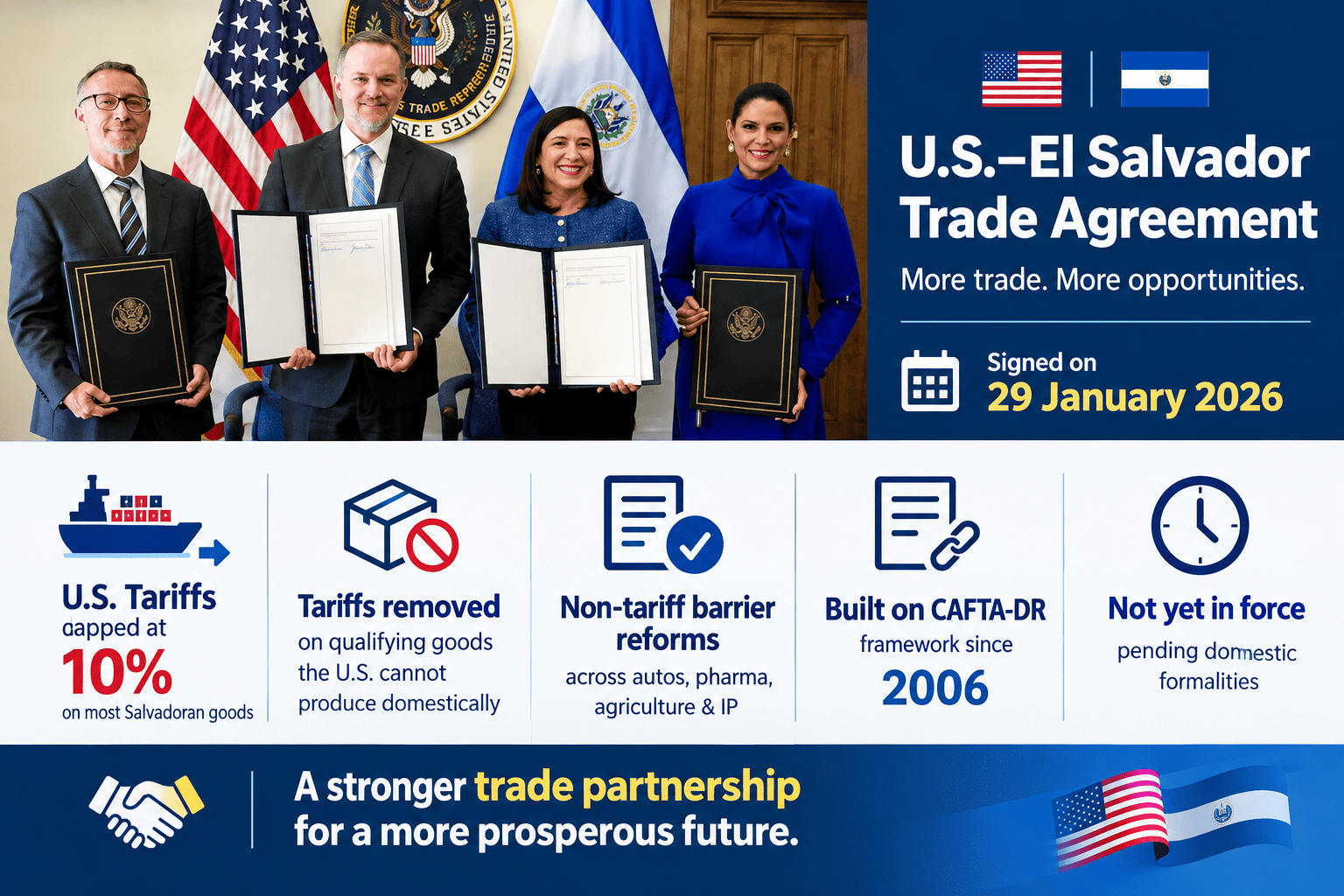
On 29 January 2026, U.S. Trade Representative Jamieson Greer and El Salvador’s Minister of Economy María Luisa Hayem signed the U.S.–El Salvador Agreement on Reciprocal Trade, which Salvadoran President Nayib Bukele described as “the first reciprocal trade agreement in the entire Western Hemisphere.” The deal caps U.S. reciprocal tariffs on most Salvadoran goods at a maximum of 10 percent, removes tariffs entirely on qualifying goods the U.S. cannot produce domestically, and commits El Salvador to a wide range of non-tariff barrier reforms spanning autos, pharmaceuticals, agriculture, and intellectual property. Built on top of the existing CAFTA-DR framework in place since 2006, the agreement had not yet entered into force as of the signing, with both governments still completing domestic formalities. This article lays out what the agreement actually covers, its timeline, and what it means for businesses trading between the two countries.
📅 Signed January 29, 2026⏱ 11 min read✍️ GTsetu Editorial🔄 Updated October 1, 2026
Date Signed
29 Jan 2026
Parties
🇺🇸 USA – 🇸🇻 El Salvador
Agreement
Agreement on Reciprocal Trade
Type
Reciprocal Trade Agreement
Status
Signed; not yet in force
Trade agreements this size rarely move from framework to signature in under three months, but the U.S.-El Salvador deal did exactly that: a framework announced on 13 November 2025, followed by a signed agreement on 29 January 2026. The speed reflects a broader pattern in 2025-2026 U.S. trade policy, where reciprocal trade frameworks with Guatemala, Ecuador, and Argentina moved through similar compressed timelines. What makes the El Salvador deal distinct is the symbolism Bukele attached to it, framing the signing as a regional first rather than simply another bilateral update.
Section 1
The Agreement in Numbers
The deal’s core terms center on a tariff cap, a broad non-tariff barrier package, and the existing trade volume it builds on.
10%
Maximum additional reciprocal tariff rate on El Salvador-origin goods not otherwise exempted
$6.7B
U.S. goods and services exports to El Salvador in 2024, the base the agreement aims to expand
$10.7B
Total two-way trade in goods and services between the U.S. and El Salvador in 2024
$2.2B
U.S. goods trade surplus with El Salvador, a factor cited in framing the agreement’s terms
💡 “First in the Western Hemisphere” is about structure, not size
President Bukele’s framing of the deal as the region’s first reciprocal trade agreement refers to its structure, a framework explicitly built around reciprocal, two-way commitments on tariffs and regulatory barriers, rather than its economic scale. Several larger Western Hemisphere trade relationships predate it; what’s new is the specific reciprocal-trade format the U.S. has been rolling out to multiple partners since late 2025.
Section 2
Tariff Terms: What Changes for Goods
The agreement’s tariff structure, set out in its annexes, works on three tracks. First, reciprocal tariffs are removed entirely on qualifying El Salvador-origin goods that the United States cannot grow, mine, or otherwise produce domestically in sufficient quantities, listed in Schedule 1A. Second, a 0 percent reciprocal tariff rate applies to agricultural products set out in Schedule 1B, consistent with a related November 2025 executive order on agricultural product tariffs. Third, for all other El Salvador-origin goods not otherwise covered, the additional reciprocal tariff is capped at a maximum of 10 percent, on top of any existing CAFTA-DR tariff treatment.
Textile and apparel products qualifying under CAFTA-DR receive specific treatment: the U.S. will remove reciprocal tariffs from and extend preferential treatment to qualifying textile and apparel goods, a provision the National Council of Textile Organizations specifically welcomed as strengthening an integrated co-production supply chain linking El Salvador’s textile sector to the U.S. market.
Section 3
What’s in the Agreement: Core Provisions
Beyond Tariffs: Regulatory, IP, and Security Commitments
The agreement’s substance goes well beyond the tariff schedule, covering a broad set of regulatory and structural commitments El Salvador has made as part of the deal.
1
Breaking Down Non-Tariff Barriers
Autos, pharmaceuticals, medical devices, agriculture, and product registration
Market Access
El Salvador commits to accepting vehicles and automotive parts built to U.S. motor vehicle safety and emissions standards, accepting FDA certificates and prior marketing authorizations for medical devices and pharmaceuticals, accepting remanufactured goods from the United States, and streamlining certificate of free sale and product registration requirements, including removing apostille requirements. On agriculture, El Salvador commits to addressing fumigation and facility registration barriers and has specifically agreed that market access for U.S. products will not be restricted over the use of certain cheese and meat terms, including parmesan, gruyere, mozzarella, feta, asiago, salami, and prosciutto.
🎯
Why it matters: These regulatory acceptance provisions often matter more commercially than tariff lines, since they remove the duplicate certification and testing costs that otherwise block market entry entirely.
2
Intellectual Property Reform Commitments
Accession to international IP treaties within two years of entry into force
IP Protection
El Salvador has committed to presenting formal accession requests before its Legislative Assembly for several international IP instruments, including the Patent Law Treaty and the Singapore Treaty on the Law of Trademarks, with a deadline of no more than two years from the agreement’s entry into force. The agreement also sets robust standards for transparency and fairness around geographic indications, directly tied to the cheese and meat terminology protections described above.
🎯
Why it matters: Tying trade benefits to concrete, time-bound IP reforms creates real incentive for implementation, a higher standard than many prior framework agreements required, relevant to any technology partnership considering El Salvador.
3
Labor, Environment, and Digital Trade Standards
Forced labor prohibitions, fisheries and logging enforcement, no digital services taxes
Standards
El Salvador commits to protecting internationally recognized labor rights and prohibiting imports of goods produced by forced or compulsory labor. On the environment, commitments include improving forest sector governance, combating illegal logging and illegal wildlife trade, working toward accepting the WTO Agreement on Fisheries Subsidies, and strengthening fisheries enforcement. On digital trade, El Salvador will refrain from imposing discriminatory digital services taxes and will support a permanent multilateral moratorium on customs duties on electronic transmissions.
🎯
Why it matters: These standards are increasingly a prerequisite for due diligence in any cross-border manufacturing partnership, and their inclusion signals where compliance expectations are heading across the region.
4
Economic Security and State-Owned Enterprise Provisions
Supply chain resilience, duty evasion, export controls, SOE fair dealing
Economic Security
The two countries commit to strengthening economic and national security cooperation to enhance supply chain resilience, addressing non-market policies of other countries, combating duty evasion, and cooperating on government procurement, investment security, and export controls. El Salvador has also committed to addressing potential distortionary actions by state-owned enterprises or industrial subsidies affecting the bilateral trading relationship.
🎯
Why it matters: This positions the relationship as part of a broader U.S. strategy to build economic-security-aligned supply chains in the Western Hemisphere, not just a tariff adjustment.
Section 4
How This Builds on CAFTA-DR
El Salvador has had free trade access to the U.S. market since 2006 under the Dominican Republic-Central America-United States Free Trade Agreement (CAFTA-DR), a multilateral pact spanning the U.S., the Dominican Republic, and five Central American nations. The new Agreement on Reciprocal Trade does not replace CAFTA-DR, it layers additional, more specific commitments on top of it.
Dimension
CAFTA-DR (since 2006)
New Reciprocal Trade Agreement (2026)
Scope
Multilateral: U.S., Dominican Republic, 5 Central American states
Bilateral: U.S. and El Salvador specifically
Tariff structure
Phased tariff elimination schedule
Tariff cap (10%) plus targeted exemptions on top of CAFTA-DR
Non-tariff barriers
General provisions
Specific commitments: autos, pharma, medical devices, certifications
Intellectual property
Baseline IP chapter
Time-bound accession commitments to specific international treaties
Digital trade
Not comprehensively addressed
Explicit digital services tax and e-transmission duty provisions
Section 5
Timeline: From Framework to Signature
2 Apr 2025
U.S. declares a national emergency over trade deficits
President Trump cites a large, persistent U.S. trade deficit and lack of reciprocity in bilateral trade relationships, setting the policy basis for the reciprocal trade framework rolled out to multiple partners.
13 Nov 2025
Joint Statement on framework announced
The White House and USTR announce the Framework for a United States-El Salvador Agreement on Reciprocal Trade, alongside parallel frameworks announced the same week with Guatemala, Ecuador, and Argentina.
14 Nov 2025
Executive Order on agricultural tariff scope
Executive Order 14360 modifies the scope of reciprocal tariffs with respect to certain agricultural products, underpinning the 0% rate later applied to Schedule 1B goods in the El Salvador agreement.
29 Jan 2026
Agreement formally signed
USTR Jamieson Greer and El Salvador’s Minister of Economy María Luisa Hayem sign the U.S.-El Salvador Agreement on Reciprocal Trade in Washington. President Bukele calls it the first such agreement in the Western Hemisphere. Guatemala signs its own parallel agreement the following day.
TBD
Entry into force, pending domestic formalities
Per USTR’s own announcement, the agreement enters into force at a future date still to be confirmed, once both countries complete domestic formalities required to implement its terms.
📌 Status as of 1 October 2026
The agreement remains signed but not yet in force. USTR’s own fact sheet language describes entry into force as a “future” event with the date “to be announced,” pending domestic formalities on both sides. Businesses should track official USTR and Salvadoran government channels for the implementation date, since tariff and non-tariff commitments become legally operative only once the agreement formally enters into force.
Section 6
What This Means for Businesses on Both Sides
For a business already trading under CAFTA-DR, the new agreement is additive rather than disruptive, existing preferential access continues while new provisions on certification, IP, and digital trade phase in once the agreement enters into force. For a business newly considering El Salvador, particularly in textiles, automotive parts, pharmaceuticals, or agriculture, the practical step is to track the entry-into-force date closely, since many of the most commercially useful provisions, regulatory acceptance, IP protections, digital trade rules, only become enforceable at that point.
🏛️
Verify partner registration independently
Confirm a Salvadoran counterpart’s legal registration and standing before committing, regardless of when the agreement formally takes effect.
🤝 For Verified U.S.–El Salvador Trade Partnerships
GTsetu: Verified Discovery and Secure Engagement Ahead of Entry Into Force
A signed trade agreement sets the rules of engagement. It does not verify who you are actually doing business with, protect your specifications during early negotiations, or give you a formal record if a dispute arises once implementation begins. That gap is what GTsetu is built to close. It is a structured partnership platform, not a directory or a general marketplace, where every company is verified on 6 government-sourced points before engagement, where discovery is anonymous until mutual interest is confirmed, where NDAs are executed digitally before any commercial information changes hands, and where document exchange happens through an encrypted workspace rather than email attachments.
GTsetu is used by industrial manufacturers, distributors, and raw material suppliers across 100+ countries, including both the United States and El Salvador, to build out a distributor network, source international wholesale distribution partners, or find manufacturing and technology partnerships they intend to keep for years, positioned to move quickly once this agreement is fully in force.
🏛️
6-Point Government-Sourced Verification
Name, Address, Registration Number, Company Status, Company Type, and Date of Incorporation, verified using government tie-ups before any engagement.
🕵️
Anonymous Discovery
Browse verified manufacturer and distributor profiles across 100+ countries without revealing your own identity or sourcing strategy until you choose to engage.
📄
Built-In NDA Workflow
Digital NDA with timestamped signatures before any pricing, formulations, or product specs are shared.
🔐
Encrypted Document Workspace
All commercial documents shared through encrypted channels with a full access audit trail, not email attachments.
🌍
100+ Countries, Including the U.S. and El Salvador
Verified manufacturers and distributors across the Americas, Asia, the Middle East, Europe, Africa, and Australia.
🚫
Zero Commission
No success fee, no broker commission, ever. Your partnership economics remain entirely between you and your partner.
The U.S.-El Salvador agreement is one of several reciprocal trade agreements the U.S. finalised in the same window, alongside parallel deals with Guatemala, Ecuador, and Argentina, part of a broader wave that also includes agreements with Indonesia, Bangladesh, and Taiwan, as well as the evolving U.S.-India trade framework. Businesses tracking this shifting landscape, applying consistent partnership evaluation criteria through a B2B matchmaking platform, often find it easier to stay current than re-researching each bilateral development individually.
FAQ
Frequently Asked Questions
QHas the U.S.-El Salvador trade agreement entered into force?
No. The U.S.-El Salvador Agreement on Reciprocal Trade was signed on 29 January 2026 by USTR Jamieson Greer and El Salvador’s Minister of Economy María Luisa Hayem, but as of the signing announcement, the agreement’s entry into force date had not yet been set, pending domestic formalities on both sides. President Nayib Bukele described it as the first reciprocal trade agreement in the entire Western Hemisphere.
QWhat tariff terms does the agreement set?
The agreement removes U.S. reciprocal tariffs on certain qualifying Salvadoran exports that cannot be grown, mined, or naturally produced in the United States in sufficient quantities, and caps the additional reciprocal tariff on all other El Salvador-origin goods at a maximum of 10%. Textile and apparel products qualifying under CAFTA-DR also gain preferential treatment and removal of reciprocal tariffs.
QWhat does El Salvador commit to under the agreement?
El Salvador commits to addressing a wide range of non-tariff barriers affecting U.S. industrial and agricultural exports, including accepting U.S. motor vehicle safety and emissions standards, FDA certificates for medical devices and pharmaceuticals, remanufactured goods, and streamlined certification requirements. El Salvador also commits to strengthening intellectual property protection, including advancing accession to international IP treaties, improving labor and environmental enforcement, and preventing digital trade barriers.
QHow does this agreement relate to CAFTA-DR?
El Salvador has had free trade access with the United States since 2006 under the Dominican Republic-Central America-United States Free Trade Agreement (CAFTA-DR). The new Agreement on Reciprocal Trade builds on and expands that existing relationship, adding specific commitments on non-tariff barriers, intellectual property, digital trade, and economic security that go beyond what CAFTA-DR originally covered.
GTsetu is purpose-built for manufacturers, distributors, and raw material suppliers in industrial sectors seeking verified long-term trade partnerships, across 100+ countries including the U.S. and El Salvador, with government-sourced partner verification, built-in NDA workflows, and zero commission.
They represents the product, and research team behind GTsetu, a global B2B collaboration platform built to help companies explore cross-border partnerships with clarity and trust. The team focuses on simplifying early-stage international business discovery by combining structured company profiles, verification-led access, and controlled collaboration workflows.
With a strong emphasis on trust, and disciplined engagement, Team GTsetu shares insights on global trade, partnerships, and cross-border collaboration, helping businesses make informed decisions before entering deeper commercial discussions.