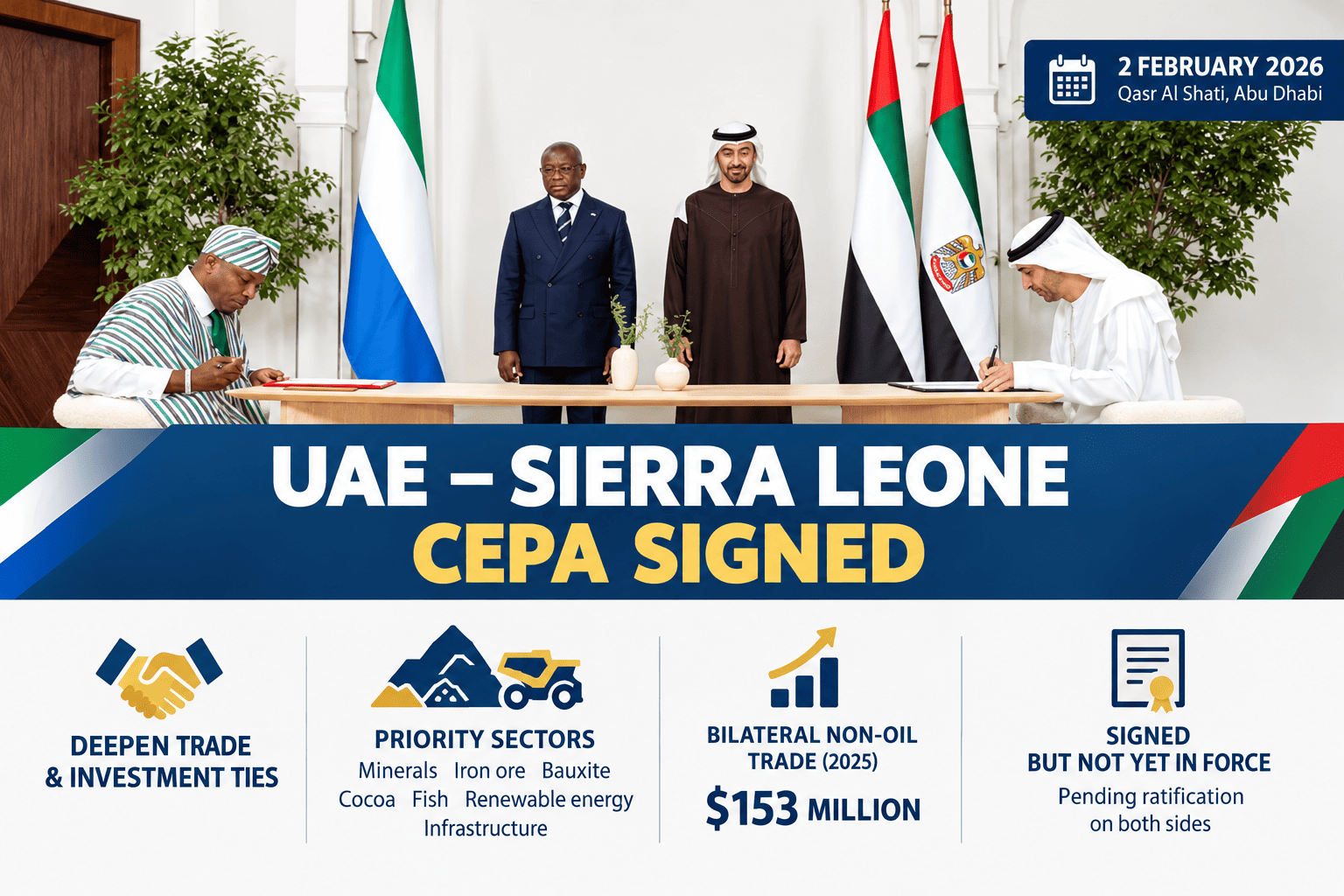
On 2 February 2026, the United Arab Emirates and the Republic of Sierra Leone signed a Comprehensive Economic Partnership Agreement (CEPA) at Qasr Al Shati in Abu Dhabi, witnessed by UAE President Sheikh Mohamed bin Zayed Al Nahyan and Sierra Leone President Julius Maada Bio. The agreement is aimed at deepening bilateral trade and investment ties, with UAE officials specifically flagging minerals, iron ore, bauxite, and agricultural products such as cocoa and fish as priority sectors, alongside renewable energy and infrastructure. Bilateral non-oil trade reached $153 million in 2025. The agreement is signed but not yet in force, pending domestic ratification on both sides.
📅 Signed February 2, 2026⏱ 12 min read✍️ GTsetu Editorial🔄 Updated September 10, 2026
The UAE–Sierra Leone CEPA is the latest addition to the UAE’s fast-expanding portfolio of Comprehensive Economic Partnership Agreements, a programme launched in 2021 to cut tariffs and remove trade bottlenecks with partner countries through simplified customs procedures. For Sierra Leone, a major global producer of rutile, diamonds, and iron ore, the agreement is positioned as a route to attract more foreign investment and widen export markets. For the UAE, it extends a West Africa strategy that already includes agreements such as the UAE–Nigeria CEPA and the UAE–Gabon CEPA.
This page breaks down what the agreement covers, what remains pending, and how it fits alongside the broader run of CEPAs and reciprocal trade agreements signed around the same period, including the UAE–DRC CEPA and the UAE–Philippines CEPA.
💡 How to read this page
Sections 3 and 4 cover the substantive sector and provision scope as currently disclosed. Section 5 covers where implementation currently stands, since the agreement is signed but not yet in force. Section 6 places this CEPA alongside the UAE’s wider Africa agreement network and other major 2026 deals, and Section 7 is the practical section for businesses deciding how to act on the new terms.
Section 1
Agreement Overview
The CEPA was formally signed by Dr Thani bin Ahmed Al Zeyoudi, UAE Minister of Foreign Trade, and Ibrahim Alpha Sesay, Sierra Leone’s Minister of Trade and Industry, during a ceremony attended by both heads of state. Sheikh Mohamed bin Zayed described the agreement as a significant step forward in deepening economic ties with Sierra Leone across a broad range of priority sectors. Ahead of the signing, the two presidents met to discuss enhancing bilateral cooperation in support of both countries’ development ambitions.
Al Zeyoudi noted that the agreement strengthens the UAE’s presence in West Africa and opens new horizons for trade and investment cooperation with one of the continent’s promising economies, highlighting minerals, iron ore, bauxite, and agricultural products such as cocoa and fish as the areas expected to see the biggest near-term boost in bilateral trade.
📌 Part of a programme, not a one-off deal
The UAE’s CEPA programme, launched in 2021, had produced 37 signed agreements by mid-2026, with 18 already in force. The Sierra Leone agreement follows the same template as other recent UAE CEPAs: a comprehensive trade and investment framework signed at head-of-state level, followed by a domestic ratification process before entry into force.
Section 2
Key Numbers at a Glance
$153M
Bilateral non-oil trade between the UAE and Sierra Leone in 2025
14%
Sierra Leone’s share of global rutile production
37
Total CEPAs signed by the UAE as of mid-2026
18
Of those UAE CEPAs already in force
$110B+
UAE investment across Africa since 2019
$1.089T
UAE’s non-oil foreign trade target by 2031
Section 3
Priority Sectors & Scope
Unlike a narrowly scoped tariff-reduction deal, the UAE–Sierra Leone CEPA is framed as a broad economic partnership spanning goods trade, investment flows, and private sector collaboration. Officials on both sides have pointed to a specific set of sectors expected to benefit first.
Sector
Sierra Leone’s Position
Expected CEPA Impact
Minerals & Iron Ore
Established exporter of iron ore
Named priority sector for boosting bilateral trade
Rutile
~14% of global production
Among the world’s leading producers, a key export anchor
Diamonds
Significant global exporter
Existing export strength, expected trade and investment growth
Bauxite
Growing extraction sector
Named priority sector alongside iron ore and minerals
Agriculture (Cocoa & Fish)
Traditional export crops and fisheries
Specifically flagged by UAE officials as a growth area
Renewable Energy
Developing sector
Investment flows and infrastructure cooperation expected
Infrastructure
Ongoing development needs
Private sector collaboration and investment promotion
💡 Why the sector focus matters
CEPAs in the UAE’s programme typically combine goods-trade liberalisation with investment protection and services chapters, rather than a narrow tariff schedule alone. Businesses in minerals, agriculture, and infrastructure should treat the named priority sectors as the clearest early signal of where trade facilitation and investment promotion will move fastest, a pattern also visible in the UAE–Ecuador CEPA.
The agreement is explicitly framed by both governments as reducing trade barriers between the two sides, consistent with the UAE CEPA programme’s founding goal of cutting tariffs and removing trade bottlenecks through simplified customs procedures.
Key commitments
Reduction of trade barriers on priority goods categories
Simplified customs procedures, consistent with the UAE’s standard CEPA template
Framework intended to boost bilateral trade in minerals and agricultural products specifically
🎯
Relevance: Exporters in iron ore, bauxite, cocoa, and fish stand to benefit first once the detailed tariff schedule is published and the agreement enters into force.
2
Investment Flows & Protection
Enhanced two-way investment, building on the UAE’s Africa FDI position
Investment
The CEPA is designed to enhance investment flows alongside trade, reflecting the UAE’s position as Africa’s largest new source of foreign direct investment, having invested more than $110 billion across the continent since 2019.
Key commitments
Framework to enhance bilateral investment flows
UNCTAD-tracked investment provisions under the treaty’s international investment agreement classification
Positions Sierra Leone to attract additional foreign investment in mining and agriculture
🎯
Relevance: Investors and manufacturers evaluating a Sierra Leone entry should track the agreement’s investment protection provisions once published in full, alongside comparable terms in the UAE–DRC CEPA.
3
Private Sector Collaboration
Business-to-business cooperation across priority sectors
Private Sector
Beyond state-to-state terms, the agreement explicitly aims to promote private sector collaboration, a recurring feature of UAE CEPAs that typically includes business councils, trade missions, and sector-specific working groups.
Key commitments
Promotion of private sector collaboration in key sectors
Complementary agreements covering specific collaboration areas alongside the core CEPA
Support for diversified, mutually beneficial economic growth
🎯
Relevance: This is the clause most directly relevant to manufacturers and distributors looking for an actual commercial counterpart rather than a government-to-government framework.
Section 5
Implementation Timeline & Status
Date
Milestone
Status
2 February 2026
CEPA signed at Qasr Al Shati, Abu Dhabi, witnessed by both presidents
⚠ Signed, not yet in force
Pending
Domestic ratification procedures in the UAE and Sierra Leone
⚠ Pending
Pending
Publication of the detailed tariff schedule and investment chapter
⚠ Not yet published in full
Ongoing (mid-2026)
UAE continuing to negotiate and sign further CEPAs, targeting up to seven more by year-end
✓ Programme actively expanding
Pending
CEPA provisions enter into force once both sides complete ratification
✗ Not yet in force
As with most agreements in the UAE’s CEPA programme, the gap between signature and entry into force is primarily administrative rather than politically contested, UAE CEPAs have generally moved from signature to force within a matter of months once both governments complete their domestic procedures. Even so, businesses should treat the agreement as directional rather than operative until an official entry-into-force date and tariff schedule are published.
📌 Practical takeaway on timing
Until the UAE–Sierra Leone CEPA is confirmed in force, current MFN tariff rates and standard customs procedures remain the operative terms for trade between the two countries. This is the same caution worth applying to other recently signed but not-yet-in-force CEPAs, including the UAE–Gabon CEPA and the UAE–Ecuador CEPA.
Section 6
Where This CEPA Fits in the UAE’s Africa Strategy & the Wider 2026 Trade Wave
The Sierra Leone CEPA is one piece of a much larger UAE push into African markets. The country has become Africa’s fourth-largest global investor and continues to add CEPAs with West and Central African partners at pace, including the UAE–Nigeria CEPA, the UAE–DRC CEPA, and the UAE–Gabon CEPA. Outside Africa, the same CEPA programme has produced agreements such as the UAE–Philippines CEPA and the UAE–Ecuador CEPA, part of a stated UAE goal of growing non-oil foreign trade to $1.089 trillion by 2031.
A trade agreement between two governments does not, by itself, connect a mining equipment supplier in Dubai with a buyer in Freetown, or a cocoa processor in Sierra Leone with a UAE-based distributor. Even once the CEPA enters into force and tariff lines move, the practical work of finding, vetting, and formally engaging a counterparty on the other side remains entirely a private-sector task, one that applies equally to businesses positioning around the UAE–Nigeria CEPA or the UAE–DRC CEPA.
A UAE-based trading house interested in Sierra Leone’s rutile, iron ore, or cocoa exports still needs a verified supplier or distribution partner on the ground. A Sierra Leonean agricultural exporter benefiting from improved market access into the UAE still needs to confirm standards recognition and find a reliable buyer or distributor in the Gulf. None of that changes because two governments signed a framework agreement.
⛏️
Minerals & mining equipment traders
Iron ore, bauxite, and rutile are explicitly named priority sectors, with Sierra Leone supplying 14% of global rutile.
Verify mining-sector counterparts
🍫
Cocoa & fish importers/exporters
Named as priority agricultural categories for bilateral trade growth under the CEPA.
Check standards recognition terms
💎
Diamond & gemstone trade
Sierra Leone is a significant global diamond exporter with existing trade links to the Gulf.
Confirm certification chain
⚡
Renewable energy & infrastructure
Flagged for investment flows and private sector collaboration under the agreement.
Approach via verified local partners
🏗️
UAE investors entering West Africa
Builds on the UAE’s position as Africa’s largest new FDI source, over $110B invested since 2019.
Verify partners before scaling
🤝
Finding a distributor once the CEPA is in force
Lower trade barriers create new demand, but someone still has to find, vet, and formalise the relationship on the other side.
GTsetu
🤝 Acting on the Agreement, Not Just Reading About It
GTsetu: Verified Partner Discovery for Manufacturers and Distributors Positioning Around the UAE–Sierra Leone CEPA
Trade agreements open doors; they do not vet who is standing on the other side of them. If you are a manufacturer, distributor, or raw material supplier planning to act on the CEPA’s priority sectors, whether sourcing Sierra Leonean minerals, cocoa, or fish, or finding a UAE distributor for goods entering under the new framework, GTsetu is built for the step that comes after the headline: finding a verified, long-term partner rather than a one-off buyer.
Companies weighing a move into Sierra Leone or the UAE under this CEPA use the same platform to evaluate opportunities opening up under parallel agreements, whether that is the UAE–Gabon CEPA, the UAE–Ecuador CEPA, or the UAE–Philippines CEPA, verifying counterparties across 100+ countries before any commercial information changes hands.
🏛️
6-Point Government-Sourced Verification
Name, Address, Registration Number, Company Status, Company Type, and Date of Incorporation, verified before any engagement.
🕵️
Anonymous Discovery
Browse verified manufacturers and distributors in Sierra Leone, the UAE, and 100+ other countries without revealing your identity until you choose to engage.
📄
Built-In NDA Workflow
Digital NDA with timestamped signatures before pricing, specifications, or supply terms are shared.
🔐
Encrypted Document Workspace
Share certifications, commercial terms, and shipment documentation through an encrypted channel with a full audit trail.
🌍
100+ Countries
Verified manufacturers and distributors across Africa, the Middle East, Asia, Europe, and the Americas.
🚫
Zero Commission
No success fee or broker commission on any partnership formed through the platform.
📌 Confirm terms before committing to long-term agreements
Because the full tariff schedule and investment chapter have not yet been published in detail, any long-term supply or distribution agreement built around this CEPA should be structured with enough flexibility to adjust once the final ratified terms are known, the same caution that applies to other recently signed but not-yet-in-force deals such as the Korea–Serbia CEPA.
FAQ
Frequently Asked Questions
QWhat is the UAE–Sierra Leone CEPA?
The UAE–Sierra Leone Comprehensive Economic Partnership Agreement (CEPA) is a bilateral trade and investment agreement signed on 2 February 2026 at Qasr Al Shati in Abu Dhabi, witnessed by UAE President Sheikh Mohamed bin Zayed Al Nahyan and Sierra Leone President Julius Maada Bio. It is aimed at reducing trade barriers, enhancing investment flows, and promoting private sector collaboration in sectors including minerals, agriculture, renewable energy, and infrastructure.
QIs the UAE–Sierra Leone CEPA in force yet?
No. As of this writing the CEPA has been signed but is not yet in force. Like other agreements in the UAE’s CEPA programme, it requires domestic ratification procedures in both countries before its tariff and market-access provisions take effect.
QWhat sectors does the UAE–Sierra Leone CEPA prioritise?
UAE officials have specifically named minerals, iron ore, bauxite, and agricultural products such as cocoa and fish as priority sectors, alongside renewable energy and infrastructure development. Sierra Leone is one of the world’s leading producers of rutile, accounting for roughly 14 percent of global production, and is also a significant exporter of diamonds and iron ore.
QHow much is bilateral trade between the UAE and Sierra Leone currently worth?
Bilateral non-oil foreign trade between the UAE and Sierra Leone reached $153 million in 2025, showing steady growth in recent years. The CEPA is expected to accelerate this figure, particularly in the minerals and agricultural sectors specifically flagged by UAE officials.
QHow does the UAE–Sierra Leone CEPA fit into the UAE’s wider trade strategy?
The agreement is one of several CEPAs the UAE has signed with African nations as part of a broader strategy to deepen economic ties across the continent. As of mid-2026, the UAE had signed 37 CEPAs globally, with 18 already in force, and has invested more than $110 billion in Africa since 2019, making it the continent’s largest new source of foreign direct investment. The UAE has signalled it expects to conclude up to seven more CEPAs by the end of the year.
QWhat does the agreement mean for manufacturers and distributors right now?
Reduced trade barriers and enhanced investment flows will open new sourcing and distribution opportunities between the UAE and Sierra Leone across minerals, agriculture, and infrastructure once the CEPA enters into force. In the meantime, businesses on both sides evaluating new suppliers, distributors, or investment partners under the agreement still need standard due diligence: verifying counterparties, formalising terms in a proper contract, and protecting commercial information before committing to a long-term relationship.
GTsetu is purpose-built for manufacturers, distributors, and raw material suppliers seeking verified long-term trade partnerships in the UAE, Sierra Leone, and 100+ other countries, with government-sourced partner verification, built-in NDA workflows, and zero commission.
They represents the product, and research team behind GTsetu, a global B2B collaboration platform built to help companies explore cross-border partnerships with clarity and trust. The team focuses on simplifying early-stage international business discovery by combining structured company profiles, verification-led access, and controlled collaboration workflows.
With a strong emphasis on trust, and disciplined engagement, Team GTsetu shares insights on global trade, partnerships, and cross-border collaboration, helping businesses make informed decisions before entering deeper commercial discussions.