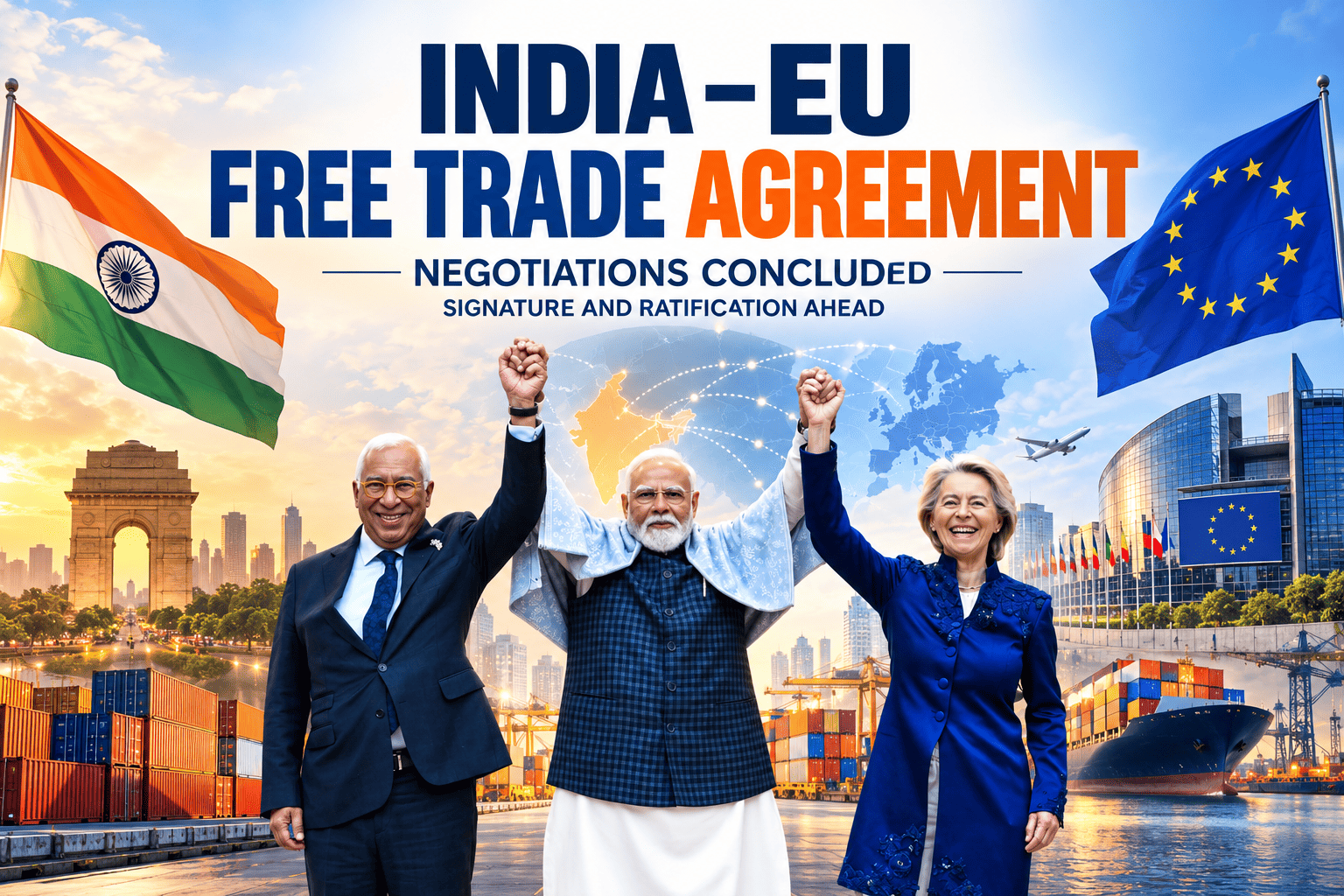
India–EU Free Trade Agreement: What It Covers and What It Means for Business
On 27 January 2026, Prime Minister Narendra Modi and European Commission President Ursula von der Leyen jointly announced the conclusion of the India–European Union Free Trade Agreement at the 16th India-EU Summit. India, the world’s 4th largest economy, and the EU, the 2nd largest, together account for a quarter of global GDP and a third of global trade, and the deal gives over 99% of Indian exports by value preferential entry into the EU market. As of 1 October 2026, negotiations are concluded but the agreement is not yet signed, meaning legal review, signature, and ratification still lie ahead. This article walks through what the agreement actually covers, chapter by chapter, who stands to gain the most, what remains protected on both sides, and how to prepare a cross-border business partnership for the day it takes effect.
📅 Concluded January 27, 2026⏱ 13 min read✍️ GTsetu Editorial🔄 Updated October 1, 2026
Date Concluded
27 Jan 2026
Parties
🇮🇳 India – 🇪🇺 EU
Agreement
India–EU FTA
Type
Free Trade Agreement
Status (as of 1 Oct 2026)
Concluded; not yet signed
Trade agreement announcements tend to arrive with a flood of superlatives, “historic,” “landmark,” “game-changing,” and the India-EU FTA has earned its share. But the number that actually matters for a business is narrower: which tariff lines move, on what schedule, under what rules of origin, and what stays off the table entirely. This article sets the headline numbers aside in favour of that detail, and looks at what a manufacturer, distributor, or services exporter on either side should actually be doing right now, while the deal sits concluded but unsigned.
Section 1
The Agreement in Numbers
The scale of the India-EU relationship explains why this agreement has been nearly two decades in the making, first proposed in 2007, stalled for years, and relaunched in 2022 before reaching conclusion in January 2026.
99%+
Of Indian exports by trade value gain preferential entry into the EU under the agreement
€120B
Bilateral trade in goods between the EU and India in 2024, with a further €59.8bn in services trade
96.6% / 99.3%
Overall trade liberalisation coverage for India and the EU respectively, once partial liberalisation is included
25%
Share of global GDP represented by India and the EU together, accounting for roughly a third of global trade
On goods specifically, the EU will eliminate tariffs on over 90% of its tariff lines, 91% by value, while India will eliminate tariffs on 86% of its tariff lines, 93% by value. The gap between those headline elimination figures and the higher overall liberalisation percentages reflects partial tariff reductions, staged phase-outs, and tariff-rate quotas applied to more sensitive categories rather than outright elimination from day one.
💡 Why “concluded” doesn’t mean “in force”
A concluded negotiation means both sides have agreed on the substance of every chapter. It does not mean the agreement is legally binding yet. Legal scrubbing (verifying the text is precise and consistent across all official languages), formal signature, and ratification through India’s and the EU’s respective domestic processes all still need to happen before a single tariff line actually changes. Businesses that wait for entry into force to start preparing will be starting late.
Section 2
Timeline: From Relaunch to Conclusion
Date
Milestone
2007
India-EU trade negotiations first launched
2013
Talks stall over market access and investment protection disagreements
2022
Negotiations formally relaunched
27 Jan 2026
Negotiations concluded and jointly announced at the 16th India-EU Summit
1 Oct 2026 (current status)
Legal scrubbing underway; agreement concluded but not yet signed
Next
Signature, followed by ratification in India and across the EU’s 27 member states
The EU becomes India’s 22nd FTA partner with this deal. India has been notably active on the trade agreement front since 2014, signing deals with Mauritius, the UAE, the UK, EFTA, Oman, and Australia, and announcing a concluded agreement with New Zealand in 2025. Combined with its separate agreements with the UK and EFTA, the India-EU FTA effectively opens the entire European market to Indian businesses, exporters, and entrepreneurs, a pattern of accelerating trade diplomacy visible elsewhere too, from the India-New Zealand Free Trade Agreement to ongoing work on a US-India trade deal.
Section 3
What the Agreement Actually Covers
The Core Chapters
The India-EU FTA spans conventional trade chapters alongside a number of emerging areas not always found in older trade agreements. A handful of chapters carry the most direct relevance for businesses on either side.
1
Trade in Goods
Tariff elimination across industrial products, textiles, and agri-food
Core Chapter
India will remove high industrial tariffs, which average above 16%, on chemicals (up to 22%), cosmetics (up to 22%), plastics, car parts, textiles and apparel, ceramics, machinery, and boats, with staging periods ranging from entry into force up to 10 years depending on the product. Tariffs on labour-intensive Indian exports including textiles, leather, marine products, and gems and jewellery, covering roughly US$33 billion in trade, fall to zero on entry into force.
🎯
Why it matters: The staging schedules matter as much as the eventual zero-tariff outcome. A business should map exactly when its specific tariff lines liberalise, not assume every benefit arrives on day one.
2
Automobile Liberalisation
A carefully calibrated, quota-based opening in both directions
Quota-Based
Rather than an open-ended tariff cut, the automotive chapter uses a quota-based liberalisation package, allowing EU automakers to introduce models in higher price bands in India while opening reciprocal access for India-made automobiles into the EU market, alongside longer staging on car parts tariffs of 5 to 10 years.
🎯
Why it matters: This calibrated structure is designed to support Make in India manufacturing while still opening genuine two-way competition, rather than a one-sided market opening in either direction.
3
Services and Professional Mobility
144 EU subsectors open to India, 102 Indian subsectors open to the EU
High Value
India secures predictable access to 144 EU services subsectors including IT and IT-enabled services, professional services, other business services, and education, while the EU gains access to 102 Indian subsectors. A dedicated mobility framework covers Intra-Corporate Transferees and Business Visitors in both directions, with EU commitments spanning 37 subsectors for Contractual Service Suppliers and 17 for Independent Professionals.
🎯
Why it matters: For India’s large services export base, particularly IT, this may ultimately matter more commercially than goods tariffs, since services and digitally delivered trade are the faster-growing part of both economies.
Rules of origin are aligned with the EU’s recent FTA practice, and proof of origin moves to a self-certification model: exporters submit a statement on origin via a portal that importing customs authorities can verify directly, rather than relying on third-party certificates. The customs chapter adds advance rulings, simplified procedures, and expedited release provisions intended to cut red tape, particularly valuable for smaller exporters.
🎯
Why it matters: Self-certification shifts real responsibility onto the exporting business. Getting the origin documentation right from the first shipment, following the manufacturing certifications for international trade this requires, is what actually captures the tariff preference rather than losing it to a paperwork error.
Beyond these four, the agreement covers trade remedies (including a bilateral safeguard mechanism for import surges), digital trade (including software source code protection), intellectual property enforcement aligned with TRIPS, a dedicated SME chapter, transparency and good regulatory practice commitments, sustainable food systems cooperation, and a Trade and Sustainable Development chapter with enforceable labour, environmental, and gender equality commitments. A separate CBAM provision secures a forward-looking most-favoured-nation assurance for India, extending any flexibilities the EU grants to third countries under its Carbon Border Adjustment Mechanism.
Section 4
Which Sectors Gain the Most
Side
Sectors Gaining Most
Key Detail
India (exports to EU)
Textiles, apparel, leather, footwear, marine products, gems and jewellery
~US$33bn in exports, tariffs up to 10% falling to zero at entry into force
India (exports to EU)
Tea, coffee, spices, fresh fruits and vegetables, processed foods
Enhanced competitiveness for agrarian enterprises and rural livelihoods
India (services)
IT/ITeS, professional services, other business services, education
Tariffs above 16% on average removed over staged timelines
EU (exports to India)
Wine, spirits, beer, olive oil, processed foods, fruit juices
Tariffs as high as 150% reduced over time, e.g. to 30% for most wines
EU (exports to India)
Automotive, avionics, medical devices, pharmaceuticals
Calibrated quota-based access alongside reciprocal openings for India
Section 5
What Stays Protected on Both Sides
A balanced agreement is defined as much by what it excludes as by what it opens, and both India and the EU drew clear lines around their most politically sensitive sectors.
India’s protected sectors: Dairy, cereals, poultry, soymeal, and certain fruits and vegetables remain safeguarded, with no market access granted in dairy specifically, a sector India has consistently protected across its trade agreements.
EU’s protected sectors: Sugar and ethanol, rice and soft wheat, beef and poultry, milk powders, bananas, and honey receive no concessions, while table grapes and cucumbers are subject to well-calibrated import quotas rather than open access.
SPS standards unchanged: The EU retains its full sanitary and phytosanitary standards on all imports from India with no exception, including the right to provisionally adopt protective measures where scientific evidence is insufficient.
Auto liberalisation stays calibrated: Rather than an open market, automobile access on both sides is quota-based and carefully staged, reflecting the sensitivity of domestic manufacturing on each side.
📌 The honest read
These exclusions are not oversights; they are the negotiated outcome of nearly two decades of back-and-forth over each side’s most sensitive domestic industries. A business operating in an excluded category shouldn’t expect this agreement to change its market access, and should plan accordingly rather than assuming blanket liberalisation across every product line.
Section 6
What Happens Next, and How to Prepare
Between conclusion and entry into force lies a gap that businesses can use productively rather than waiting out passively. The steps that matter most now are the same discipline that applies to any serious cross-border manufacturing partnership, just with a clearer deadline attached.
🗺️
Map your specific tariff lines
Identify exactly which of your products fall under which staging schedule, rather than assuming uniform day-one liberalisation.
HS code mapping
📄
Prepare for self-certified origin
Understand the new statement-on-origin portal requirements before your first shipment under preferential treatment.
Origin documentation
🔍
Vet a prospective partner now
Use the lead time before entry into force to verify legal registration and standing on the other side of the deal.
Partner verification
📜
Review certification gaps
Check whether your products already meet SPS, TBT, and conformity assessment requirements that remain fully in force.
GTsetu: Verified Discovery and Secure Engagement for Manufacturers, Distributors, and Raw Material Suppliers
A concluded trade agreement tells you the tariff and market access rules are changing. It does not tell you whether a specific manufacturer in Germany or a specific distributor in Maharashtra is who they claim to be, or whether your product specifications will stay confidential while you explore a new cross-border relationship ahead of entry into force. That gap is what GTsetu is built to close. It is a structured partnership platform, not a directory or a general marketplace, where every company is verified on 6 government-sourced points before engagement, where discovery is anonymous until mutual interest is confirmed, where NDAs are executed digitally before any commercial information changes hands, and where document exchange happens through an encrypted workspace rather than email attachments.
GTsetu is used by industrial manufacturers, distributors, and raw material suppliers across 100+ countries, including India and the EU’s member states, to build out a distributor network, source international wholesale distribution partners, or find manufacturing and technology partnership relationships positioned to benefit from this agreement the moment it enters into force. It complements, rather than replaces, the legal and customs preparation above, but it removes much of the identity and documentation risk before that deeper diligence even begins.
🏛️
6-Point Government-Sourced Verification
Name, Address, Registration Number, Company Status, Company Type, and Date of Incorporation, verified using government tie-ups before any engagement.
🕵️
Anonymous Discovery
Browse verified manufacturer and distributor profiles across 100+ countries without revealing your own identity or sourcing strategy until you choose to engage.
📄
Built-In NDA Workflow
Digital NDA with timestamped signatures before any pricing, formulations, or product specs are shared. No sensitive information exposed without protection.
🔐
Encrypted Document Workspace
All commercial documents shared through encrypted channels with a full access audit trail, not email attachments.
🌍
100+ Countries
Verified manufacturers and distributors across Asia, the Middle East, Europe, Africa, Australia, and the Americas. Built for cross-border partnership formation, not one-off quotes.
🚫
Zero Commission
No success fee, no broker commission, ever. Your partnership economics remain entirely between you and your partner.
Whichever side of the deal you’re on, the discipline that converts a trade agreement’s promise into an actual revenue line stays constant: verifying a partner’s legal registration and standing, confirming relevant certifications, and putting a formal business partnership contract in place before sensitive specifications or pricing are shared. Companies planning a first move into the other market as part of a wider global expansion strategy often benefit from thorough market research for manufacturers and a consistent B2B matchmaking process to identify the right suppliers and distributors well before the agreement is signed, using the same partnership evaluation criteria that apply to any serious cross-border relationship, in India and the EU or in any of the other markets actively reshaping global trade right now, from the EU-Mercosur Trade Agreement to the EU-Mexico Modernised Trade Agreement and EU-Philippines Free Trade Agreement.
FAQ
Frequently Asked Questions
QWhen was the India-EU Free Trade Agreement concluded?
Negotiations were concluded on 27 January 2026, jointly announced by Indian Prime Minister Narendra Modi and European Commission President Ursula von der Leyen at the 16th India-EU Summit in India. As of 1 October 2026, the agreement has not yet been signed, and it still requires legal scrubbing, signature, and ratification processes on both sides before it enters into force.
QWhat market access does the India-EU FTA provide?
Over 99% of Indian exports by trade value gain preferential entry into the EU. The EU will eliminate tariffs on over 90% of tariff lines (91% by value), while India will eliminate tariffs on 86% of tariff lines (93% by value), with further partial liberalisation bringing overall coverage to 96.6% for India and 99.3% for the EU.
QWhat sectors are excluded or protected under the India-EU FTA?
India has safeguarded sensitive sectors including dairy, cereals, poultry, soymeal, and certain fruits and vegetables, with no market access granted in dairy. The EU, in turn, has excluded sugar and ethanol, rice and soft wheat, beef and poultry, milk powders, bananas, and honey from concessions, and has placed calibrated quotas on table grapes and cucumbers.
QHow should a business prepare for the India-EU FTA before it enters into force?
Businesses should map which of their products fall under the agreement’s tariff lines and staging schedules, review the self-certification rules of origin requirements, verify a prospective partner’s legal registration and compliance standing on the other side of the deal, and put formal agreements in place covering pricing, delivery, and disruption terms ahead of entry into force, so the business is ready to act from day one rather than scrambling once the agreement is ratified.
QHow does the India-EU FTA compare to India’s other recent trade agreements?
The EU becomes India’s 22nd FTA partner, following a run of agreements signed or concluded since 2014 with Mauritius, the UAE, the UK, EFTA, Oman, Australia, and a 2025 agreement with New Zealand. Combined with India’s separate deals with the UK and EFTA, the India-EU FTA effectively opens the entire European market to Indian exporters, making it one of the most consequential agreements in that sequence given the scale of the EU economy alone.
Preparing for the India-EU FTA to Enter Into Force?
GTsetu is purpose-built for manufacturers, distributors, and raw material suppliers in industrial sectors seeking verified long-term trade partnerships, across 100+ countries including India and the EU, with government-sourced partner verification, built-in NDA workflows, and zero commission.
They represents the product, and research team behind GTsetu, a global B2B collaboration platform built to help companies explore cross-border partnerships with clarity and trust. The team focuses on simplifying early-stage international business discovery by combining structured company profiles, verification-led access, and controlled collaboration workflows.
With a strong emphasis on trust, and disciplined engagement, Team GTsetu shares insights on global trade, partnerships, and cross-border collaboration, helping businesses make informed decisions before entering deeper commercial discussions.