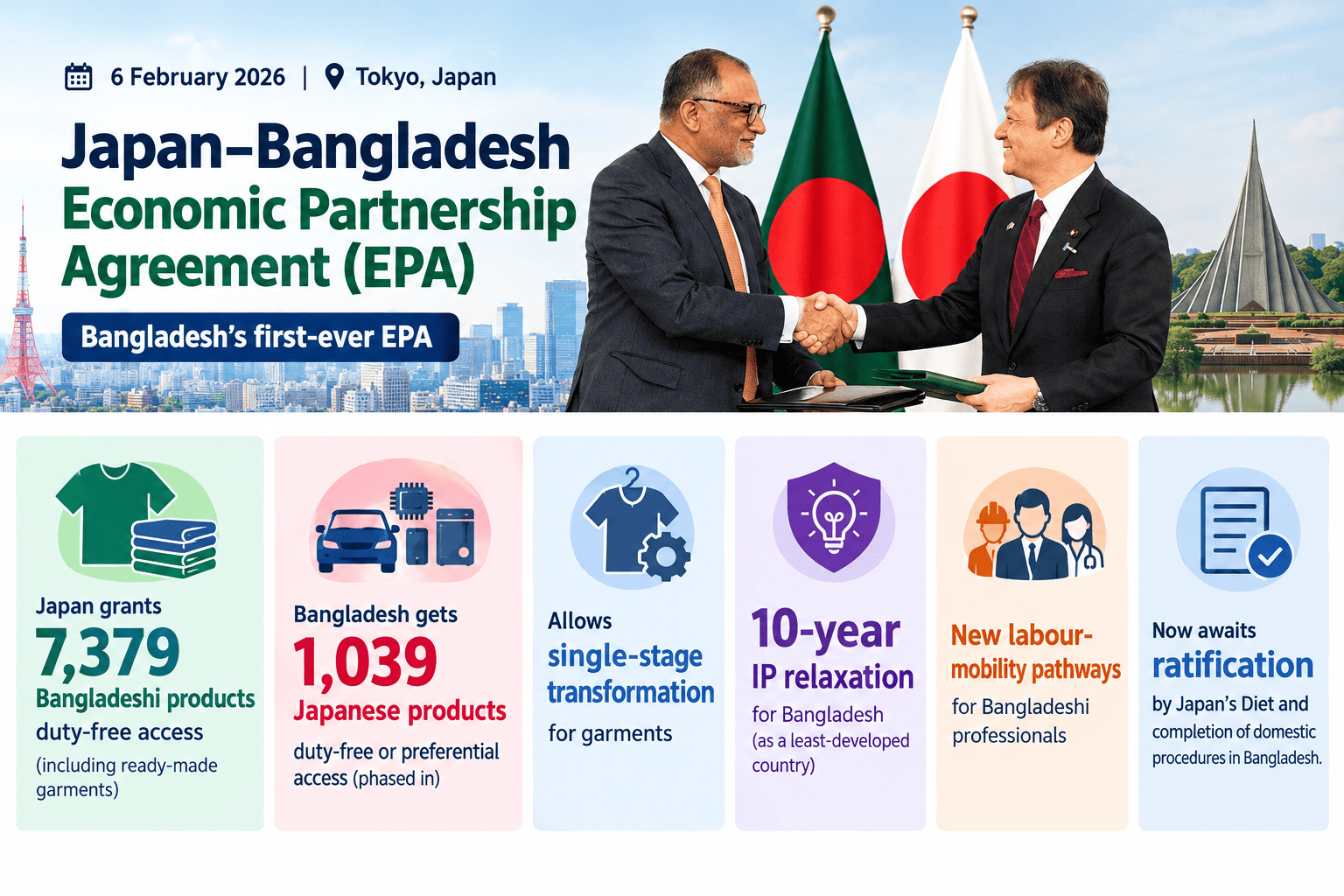
Direct Answer: On 6 February 2026, in Tokyo, Japan and Bangladesh signed the Japan–Bangladesh Economic Partnership Agreement (EPA), Bangladesh’s first-ever Economic Partnership Agreement, concluded after seven rounds of negotiations that began in March 2024. Under the deal, Japan will provide immediate duty-free access to 7,379 Bangladeshi products, including ready-made garments, while Bangladesh will phase in duty-free or preferential access for 1,039 Japanese products. The agreement permits single-stage transformation for garments, grants Bangladesh a 10-year IP relaxation as a least-developed country, and opens new labour-mobility pathways for Bangladeshi professionals. It now awaits ratification by Japan’s Diet and completion of domestic procedures in Bangladesh.
📅 September 5, 2026⏱ 13 min read✍️ GT Setu Editorial Team🔄 Updated regularly
7,379
Bangladeshi Products Get Immediate Duty-Free Access to Japan
1,039
Japanese Products Get Phased Access to Bangladesh
1st
EPA Ever Signed by Bangladesh With Any Country
97–98
Services Sub-Sectors Bangladesh Opens to Japan
For a country whose trade diplomacy has long run through preferential schemes like the GSP rather than negotiated bilateral deals, the Japan–Bangladesh Economic Partnership Agreement marks a genuine first. Signed in Tokyo on 6 February 2026 by Japan’s State Minister for Foreign Affairs Iwao Horii and Bangladesh’s Commerce Adviser Sheikh Bashir Uddin, it is Bangladesh’s first-ever Economic Partnership Agreement with any country, and its first comprehensive bilateral trade deal with a developed economy.
The agreement arrives at a pivotal moment: Bangladesh is preparing to graduate from Least Developed Country (LDC) status, a transition that will strip away many of the trade preferences it currently relies on, including GSP access to Japan. The EPA is designed to replace that preferential access with a negotiated, durable framework, while also opening new ground in services, investment, and labour mobility that GSP never covered. This guide covers what the agreement contains, its tariff provisions, sector impact, and what remains before it enters into force.
🇯🇵🇧🇩 Who Is This Guide For?
This guide is written for Bangladeshi garment and textile exporters, Japanese manufacturers and investors with or considering Bangladesh operations, and trade and compliance teams tracking Bangladesh’s post-LDC trade policy shift.
Looking to source or export between Japan and Bangladesh?Find verified manufacturing and sourcing partners through GTsetu.
Signed; pending ratification by Japan’s Diet and domestic procedures in Bangladesh
Negotiations
Launched March 2024; concluded after 7 negotiation rounds; Agreement in Principle reached 22 December 2025
Bilateral Trade (FY2024–25)
Bangladesh imported $1.8745B from Japan; exported $1.4115B to Japan
SECTION 2
2 What Is the Japan–Bangladesh EPA?
🎯 The Core Definition
The Japan–Bangladesh Economic Partnership Agreement is Bangladesh’s first-ever bilateral Economic Partnership Agreement with any country, and its first comprehensive trade deal with a developed economy. Beyond tariff elimination, the EPA establishes rules across investment, trade in services, e-commerce, intellectual property, customs procedures, and trade facilitation, intended to let Japanese companies operating in Bangladesh conduct business smoothly, while giving Bangladeshi exporters durable, negotiated market access to Japan.
Under the agreement, tariffs will be eliminated on a wide range of goods currently subject to high tariffs, including steel, automobile parts, textiles, and electronic components. Japan’s Ministry of Economy, Trade and Industry (METI) has framed the deal as both a tariff-reduction measure and a rules-establishment exercise, a combination that distinguishes it from the one-sided preferential access Bangladesh has relied on until now.
🥇
Bangladesh’s First EPA
This is the first Economic Partnership Agreement Bangladesh has ever signed with any country, a landmark shift from preference-dependent to negotiated trade diplomacy.
⚡
Concluded in Four Years
From the December 2022 joint study group to the February 2026 signing, the agreement was completed in roughly four years, relatively fast by international EPA standards.
🤝
Beyond Tariffs: Full Rulebook
The EPA establishes rules for investment, services trade, e-commerce, IP, and customs procedures, not just tariff schedules, giving it far broader scope than GSP preferences ever offered.
SECTION 3
3 Timeline: From Joint Study to Signature
Dec 2022
Joint Study Group Launched
Japan and Bangladesh launch a joint study group to examine the possibility of an Economic Partnership Agreement between the two countries.
Mar 2024
Negotiations Launched
Formal negotiations for the Japan–Bangladesh EPA are launched on 12 March 2024.
Nov 2024 – Sep 2025
Seven Rounds of Negotiation
Negotiators conduct seven rounds of talks between November 2024 and September 2025, covering tariffs, services, investment, and rules.
22 Dec 2025
Agreement in Principle
Japan and Bangladesh reach an Agreement in Principle on the EPA, signalling that the core terms have been settled ahead of formal signature.
6 Feb 2026
Formal Signing in Tokyo
State Minister Horii and Adviser Bashir Uddin sign the Japan-Bangladesh EPA in Tokyo, Bangladesh’s first-ever such agreement.
Ongoing
Ratification Pending
The agreement now awaits ratification by Japan’s parliament, the Diet, and completion of domestic procedures in Bangladesh before it enters into force.
SECTION 4
4 Tariff Access: Who Gets What
The agreement’s market-access provisions are notably asymmetric in Bangladesh’s favour, a common design feature of EPAs between a developed and a developing economy, and one that reflects Japan’s position as a long-standing ODA donor to Bangladesh.
ProvisionJapan → BangladeshBangladesh → Japan
Products covered
7,379 products
1,039 products
Duty-free timing
Immediate, upon implementation
Phased / gradual, by category
Key categories
Ready-made garments, textiles
Steel, automobile parts (gradual)
Services sub-sectors opened
120 sub-sectors to Bangladesh
97–98 sub-sectors to Japan
Fiscal impact
—
Under BDT 20 crore/year in forgone import duties for Bangladesh
Bangladesh will gradually abolish tariffs on items such as steel and automobile parts, while Japan immediately eliminates tariffs on textile products and other items upon implementation. According to Bangladesh Bank data, the two countries traded roughly $3.29 billion combined in FY2024–25, with Bangladesh importing $1.8745 billion from Japan and exporting $1.4115 billion in return.
SECTION 5
5 The Garment Sector: Single-Stage Transformation
Ready-made garments, Bangladesh’s single largest export category, are the agreement’s standout beneficiary. Garments will enter Japan duty-free immediately upon implementation, and critically, the agreement permits single-stage transformation, allowing Bangladeshi exporters to qualify for zero-duty treatment even when using imported fabrics rather than fabric woven domestically.
💡 Why Single-Stage Transformation Matters
Many trade agreements require “yarn-forward” or double-stage transformation rules of origin for garments, meaning the fabric itself must originate in the exporting country to qualify for preferential tariffs. Bangladesh’s garment industry relies heavily on imported fabric, particularly from China. A single-stage transformation rule means cut-and-sew operations in Bangladesh are enough to qualify for Japan’s zero-duty treatment, regardless of where the fabric came from, a materially easier bar to clear.
The opportunity is significant but currently underexploited: in FY2024–25, Bangladesh exported USD 1,411.6 million worth of garments to Japan, while Japan’s total global garment imports stood at approximately USD 23 billion. Despite that scale, Japan currently accounts for only about 3% of Bangladesh’s total garment exports, far below Bangladesh’s share of the EU or US markets. Industry body BGMEA has described the EPA as the start of a needed shift to capture more of that gap, building on duty-free access Bangladesh currently enjoys under Japan’s GSP scheme but with the added durability and broader coverage of a negotiated agreement.
Exporting garments or textiles to Japan?Find verified Japanese buyers and import partners through GTsetu.
Immediate duty-free access to Japan with single-stage transformation rules, Bangladesh’s flagship export category and the agreement’s primary beneficiary.
🏗️Gradual Liberalisation
Steel & Automobile Parts
Bangladesh will gradually abolish tariffs on Japanese steel and automobile parts, categories currently subject to high Bangladeshi tariffs.
💻Tariff Elimination
Electronic Components
Tariffs eliminated on electronic components currently subject to high duties, supporting Japanese electronics trade and investment in Bangladesh.
🏢New Ground
Services & Investment
Bangladesh opens 97–98 services sub-sectors to Japan; Japan opens 120 sub-sectors to Bangladesh through four distinct mechanisms, alongside new investment protection rules.
💻New Ground
E-Commerce & Digital Trade
New rules for e-commerce are established for the first time in a Bangladesh trade agreement, supporting digital trade between the two economies.
📦Facilitation
Customs & Trade Facilitation
Streamlined customs procedures and trade facilitation rules are designed to let Japanese companies operating in Bangladesh conduct business smoothly.
SECTION 7
7 Labour Mobility & IP Relaxation
👩⚕️
Labour Mobility for Skilled Professionals
The EPA expands opportunities for Bangladeshi professionals, including doctors, nurses, caregivers, and domestic helpers, to work in Japan’s labour-constrained economy.
📜
10-Year IP Relaxation
As a Least Developed Country, Bangladesh secured a 10-year relaxation in intellectual property rights, under which Japan will not seek patent rights on goods from the agreement’s date of enforcement.
🎓
Technology Transfer & Skills Development
The agreement is expected to accelerate Japanese investment, technology transfer, and the development of skilled human resources in Bangladesh.
💰
Existing Japanese Investment Base
As of 2025, Japan’s cumulative foreign direct investment in Bangladesh reached $469.6 million, a base the EPA is designed to help grow further.
SECTION 8
8 Ratification: What Happens Next
⏳ Current Status
The EPA was signed on 6 February 2026 but will take effect only once domestic procedures are completed in both countries. On Japan’s side, that means ratification by Japan’s parliament, the Diet. On Bangladesh’s side, it means completion of the relevant domestic legal and procedural steps under the country’s Interim Government. No official date for entry into force had been confirmed as of the signing.
The timing carries added significance because Bangladesh is preparing to graduate from Least Developed Country (LDC) status later in 2026, a transition that will reduce or eliminate many of the trade preferences, including GSP access, that Bangladesh has relied on with partners like Japan. The EPA is explicitly designed to provide a durable, negotiated replacement for that preferential access ahead of LDC graduation, giving its ratification timeline particular urgency for Bangladeshi exporters.
SECTION 9
9 Why This Agreement Matters Strategically
Japan has long been Bangladesh’s largest development partner and its largest ODA provider, with decades of contributions to Bangladesh’s infrastructure development and industrial expansion. The EPA represents the natural progression of that relationship from aid and preference-based ties toward a negotiated, reciprocal trade framework, one that Bangladeshi officials hope will serve as a template for future agreements with other developed economies.
The deal also lands alongside Bangladesh’s parallel efforts to secure trade arrangements with other major partners, including the US–Bangladesh Reciprocal Trade Agreement, as Dhaka works to diversify its trade relationships ahead of LDC graduation. Taken together with other recent EPAs and reciprocal trade deals across Asia, such as the India–EU Free Trade Agreement talks and the EU–Philippines Free Trade Agreement, the Japan-Bangladesh EPA fits a broader regional pattern of developing Asian economies locking in durable market access with developed-economy partners.
FAQ
? Frequently Asked Questions
QWhen was the Japan-Bangladesh Economic Partnership Agreement signed?
The Japan-Bangladesh Economic Partnership Agreement (EPA) was signed on 6 February 2026 in Tokyo by Iwao Horii, Japan’s State Minister for Foreign Affairs, and Sheikh Bashir Uddin, Adviser for Commerce of Bangladesh’s Interim Government. It is Bangladesh’s first-ever Economic Partnership Agreement, concluded after seven rounds of negotiations that began in March 2024.
QWhat tariff benefits does the Japan-Bangladesh EPA provide?
Under the EPA, Japan will provide immediate duty-free access to 7,379 Bangladeshi products, including ready-made garments, upon implementation. In return, Bangladesh will provide duty-free or preferential access to 1,039 Japanese products in a phased manner, with Bangladesh gradually abolishing tariffs on items such as steel and automobile parts while Japan immediately eliminates tariffs on textile products.
QHow does the EPA benefit Bangladesh’s garment industry?
The agreement permits single-stage transformation for the garment sector, allowing Bangladeshi exporters to qualify for zero-duty treatment in Japan even when using imported fabrics. Bangladesh’s ready-made garments will enter Japan duty-free immediately upon implementation, a significant upgrade from the existing GSP scheme, at a time when Japan accounts for only about 3% of Bangladesh’s total garment exports despite importing roughly USD 23 billion in garments globally.
QHas the Japan-Bangladesh EPA entered into force?
No. As of its signing on 6 February 2026, the agreement awaits ratification by Japan’s parliament, the Diet, as well as completion of domestic procedures in Bangladesh. The EPA will take effect once these domestic ratification processes are completed in both countries.
QWhy is this agreement significant for Bangladesh beyond tariffs?
Bangladesh secured a 10-year intellectual property relaxation as a Least Developed Country, meaning Japan will not seek patent rights on goods from the agreement’s enforcement date. The EPA also opens labour mobility pathways for Bangladeshi doctors, nurses, caregivers, and domestic helpers in Japan’s labour-constrained economy, and establishes rules for investment, services, and e-commerce that go well beyond what Bangladesh’s prior GSP-based access to Japan ever covered.
🌍 GTsetu — Verified Partner Discovery for Japan–Bangladesh Trade
Find Verified Partners to Act on the Japan–Bangladesh EPA
As duty-free access opens for 7,379 Bangladeshi products, with garments leading the way, the exporters, importers, and manufacturers who move first on verified partnerships stand to benefit most. GTsetu pre-verifies companies on both sides of the corridor, so you can discover and engage credible partners with confidence.
🏭
Verified Manufacturers & Buyers
Pre-verified companies across garments, textiles, steel, auto parts and electronics in Japan and Bangladesh.
🕵️
Anonymous Discovery
Evaluate potential partners without revealing your plans until you choose to engage.
📄
NDA Before Specifications
A digital mutual NDA is in place before sensitive product or pricing details are shared.
🚫
Zero Broker Commission
No commission on any partnership formed through the platform.
They represents the product, and research team behind GTsetu, a global B2B collaboration platform built to help companies explore cross-border partnerships with clarity and trust. The team focuses on simplifying early-stage international business discovery by combining structured company profiles, verification-led access, and controlled collaboration workflows.
With a strong emphasis on trust, and disciplined engagement, Team GTsetu shares insights on global trade, partnerships, and cross-border collaboration, helping businesses make informed decisions before entering deeper commercial discussions.