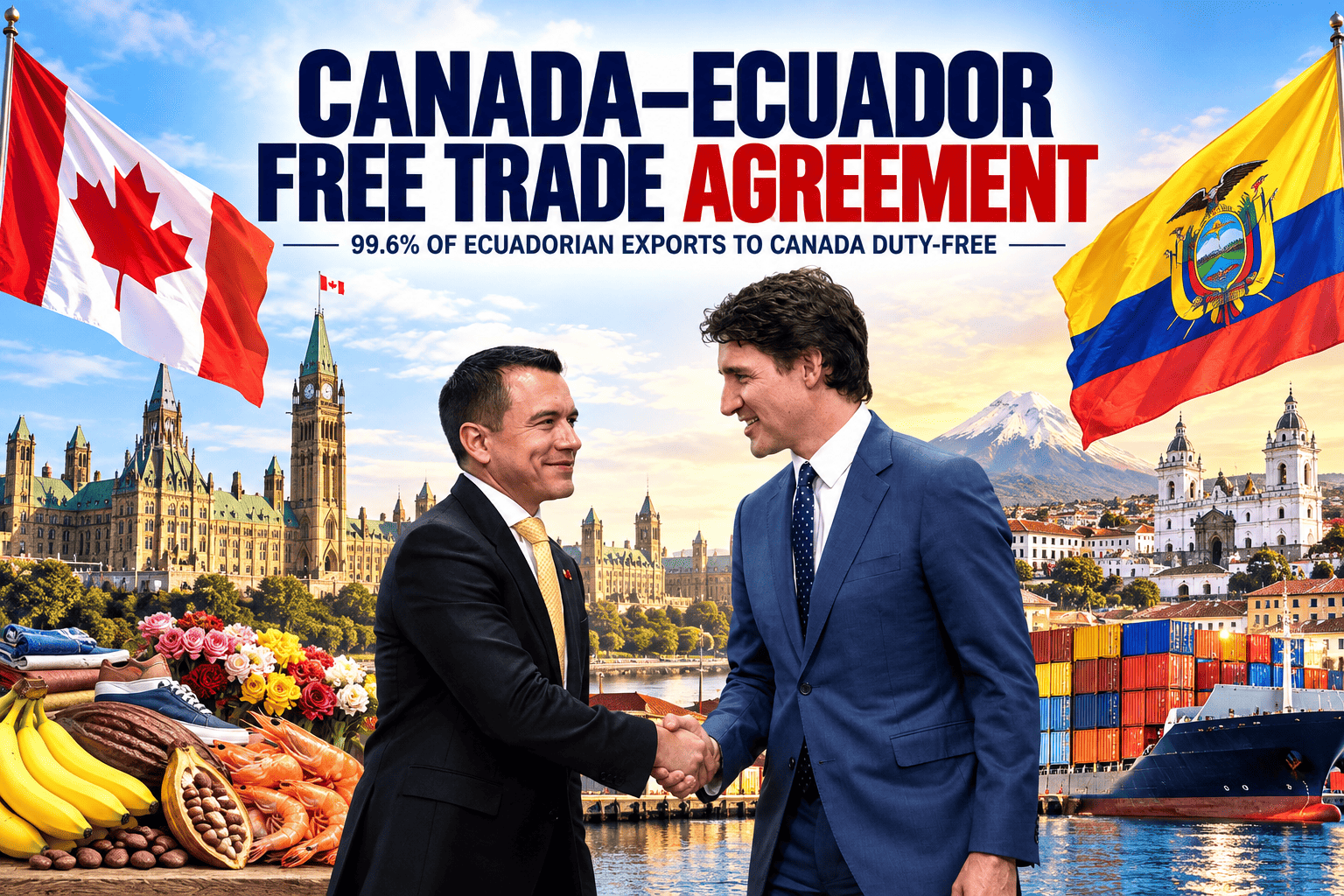
Canada and Ecuador signed a comprehensive Free Trade Agreement in Ottawa on July 24, 2026, concluding more than two years of negotiations that began in April 2024. Once ratified and in force, the agreement will make 99.6% of Ecuador’s exportable goods duty-free in the Canadian market, covering more than 600 products from bananas and cacao to shrimp, flowers, textiles, and footwear, while Canada gains improved access across 97.2% of Ecuadorian tariff lines. The deal is currently signed but not yet in force, pending domestic ratification in both countries.
📅 Signed July 24, 2026📍 Signed in Ottawa, Canada📊 Status: Pending Ratification🔄 Page updated September 13, 2026
Ecuador is Canada’s sixth-largest merchandise trading partner in South America, with two-way merchandise trade reaching roughly C$2 billion in 2025. The new FTA is designed to formalise and expand that relationship, bringing Ecuador’s access to the Canadian market in line with regional competitors Colombia and Peru, who already benefit from their own agreements with Canada. For manufacturers, distributors, and exporters on both sides, the agreement is a significant signal, even before it formally enters into force, for planning around global expansion and new cross-border business partnerships.
Section 1
Agreement Overview
99.6%
Of Ecuador’s exportable goods will enter Canada duty-free once the agreement is in force
97.2%
Of Ecuadorian tariff lines Ecuador will eliminate for Canadian exports, covering effectively all Canadian goods
600+
Ecuadorian products gaining tariff-free access, including bananas, cacao, and shrimp
C$2B
Two-way merchandise trade between Canada and Ecuador in 2025, up 2.9% year-on-year
Beyond tariffs, the Canada–Ecuador FTA is a comprehensive agreement covering trade in goods and services, investment, e-commerce, labour, environmental cooperation, Indigenous peoples, and dispute resolution. It was signed by Ecuador’s Minister of Production, Foreign Trade and Investment, Luis Alberto Jaramillo, and Canada’s Minister of International Trade, Maninder Sidhu. With this agreement, Canada becomes Ecuador’s latest free trade partner, joining Ecuador’s existing agreements with the European Union, the United Kingdom, China, and the European Free Trade Association.
📌 Signed does not mean in force
A signed FTA is a completed negotiation, not yet an operative trade regime. The Canada–Ecuador FTA must still pass through domestic ratification processes in both Canada’s and Ecuador’s legislatures before its tariff reductions and other provisions take legal effect. Unofficial industry estimates from shortly after signing projected entry into force by late 2026 or early 2027, though this remains unconfirmed and businesses should treat it as directional rather than fixed.
Section 2
Timeline: From Negotiation to Signing
✓
April 2024 — Negotiations begin
Canada and Ecuador formally launched FTA negotiations following successful exploratory talks that identified strong trade policy alignment.
✓
February 4, 2025 — Negotiations technically concluded
After six rounds of intensive consultations, the two countries declared the substance of the agreement technically concluded.
✓
May 24, 2025 — Joint statement to accelerate signing
During the inauguration of Ecuadorian President Daniel Noboa, both countries signed a joint statement committing to accelerate the formal signing process.
✓
July 24, 2026 — Agreement formally signed
The FTA was signed in Ottawa, marking the conclusion of more than two years of negotiations and formalising the agreement’s text.
⏳
Pending — Domestic ratification
Both Canada and Ecuador must complete their respective domestic ratification processes before the agreement can enter into force.
⏳
Pending — Entry into force
Once ratified by both parties, the agreement’s tariff schedules and other provisions become legally operative. No official date has been confirmed as of this page’s last update.
Section 3
Tariff Elimination: What Changes
The agreement’s tariff schedules are phased, with some categories becoming duty-free immediately upon entry into force and others phasing out over several years. Understanding this phasing matters for any business planning a cross-border manufacturing or supply relationship around the agreement.
Category
Duty-Free at Entry Into Force
Full Phase-Out Timeline
Fish & seafood (Ecuador exports to Canada)
95%+ of tariff lines
Immediate for the large majority of lines
Forest products (Ecuador exports to Canada)
75% of tariff lines
13% more within 7 years; remaining 12% within 9 years
Industrial goods (Ecuador exports to Canada)
89%+ of tariff lines
Remaining lines phased over the agreement’s schedule
Overall Ecuadorian exports to Canada
Majority immediate
99.6% duty-free once fully implemented
Overall Canadian exports to Ecuador
Majority immediate
97.2% of tariff lines duty-free once fully implemented
💡 Rules of origin will determine eligibility
Preferential tariff treatment under the FTA will not apply automatically to every shipment, it will depend on meeting the agreement’s rules of origin, administered through a dedicated Origin Procedures chapter. Businesses planning to rely on the agreement’s tariff benefits should factor rules-of-origin compliance into their sourcing and documentation processes well before entry into force, alongside standard manufacturing certifications for international trade.
Section 4
Sectors That Stand to Benefit
Both countries identified specific sectors expected to see the most significant gains once the agreement takes effect.
Ecuador’s agricultural and seafood export base, long a cornerstone of its economy, gains the most direct benefit, with bananas, cacao, shrimp, tropical fruits and vegetables, and prepared tuna products all securing tariff-free access to Canada, matching terms already held by regional competitors Colombia and Peru.
🎯
Why it matters: Ecuadorian exporters in these categories gain cost parity with established regional suppliers already selling into Canada duty-free.
2
Ecuadorian Manufactured & Light Industrial Goods
Textiles, footwear, cosmetics, ceramics, furniture, auto parts, tires
New Market Access
Beyond agriculture, the agreement opens new opportunities for Ecuadorian sectors that currently face tariffs in Canada, including flowers, chocolates and confectionery, fruit juices, palm oil, mineral water, textiles, apparel, ceramics, furniture, wood products, auto parts, tires, footwear, and cosmetics.
🎯
Why it matters: These categories represent genuine diversification beyond Ecuador’s traditional commodity export base, aligning with the agreement’s stated goal of diversifying the country’s exports.
3
Canadian Grain, Cereals & Industrial Exports
Wheat, agricultural inputs, machinery, and industrial goods into Ecuador
Canadian Export Gain
Ecuador is a longstanding customer for Canadian wheat, and industry groups such as Cereals Canada have highlighted the agreement as a strong signal for the future of that trading relationship. More broadly, Canada will see 97.2% of Ecuadorian tariff lines eliminated, covering effectively all Canadian exports, with particular gains expected in industrial and agricultural input categories.
🎯
Why it matters: Canadian exporters gain improved cost competitiveness into an 18-million-person market that previously carried tariff barriers on many goods.
Section 5
What Remains Protected or Excluded
Like most comprehensive FTAs, the agreement carves out protections for politically sensitive sectors on both sides, a pattern worth understanding before assuming blanket tariff elimination applies to every product category.
Canadian supply-managed products. No additional market access was given to Ecuador for Canada’s supply-managed dairy, poultry, and egg products, which remain protected under Canada’s existing supply management system.
227 sensitive Ecuadorian agricultural products. Ecuador excluded or protected 227 agricultural products from the agreement, including rice, corn, meat, milk, and sugar, categories considered sensitive for domestic production and food security.
Limited quotas for certain livestock products. The agreement includes tariff rate quotas rather than full tariff elimination for a number of sensitive products, aimed at managing the pace of market opening for domestic producers on both sides.
SME support provisions. The agreement includes specific measures intended to support small and medium enterprises in competing effectively in the new market, reflecting a deliberate effort to ensure benefits extend beyond the largest exporters.
Section 6
What This Means for Businesses
For manufacturers, distributors, and raw material suppliers on both sides, a signed-but-not-yet-ratified FTA is exactly the right moment to begin positioning, research, and partner discovery, rather than waiting for entry into force to start the process from scratch.
🌱
Ecuadorian exporters preparing for the Canadian market
Research Canadian buyer demand and distribution structures now through proper market research for manufacturers, ahead of ratification.
Early market research
🤝
Finding a Canadian distribution partner
Begin building relationships with verified Canadian distributors now, so a formal distributor network is ready once tariffs drop.
GTsetu: Verified Discovery and Secure Engagement Ahead of the Canada–Ecuador FTA
An FTA creates the economic conditions for new trade, but it does not, on its own, connect you with a trustworthy partner on the other side of the agreement. GTsetu is built to close that gap. It is a structured partnership platform, not a directory or a general marketplace, where every company is verified on 6 government-sourced points before engagement, where discovery is anonymous until mutual interest is confirmed, where NDAs are executed digitally before any commercial information changes hands, and where document exchange happens through an encrypted workspace with a full audit trail.
Manufacturers, distributors, and raw material suppliers in Canada and Ecuador can use GTsetu to start building verified relationships now, ahead of the agreement’s entry into force, rather than scrambling to find a trustworthy partner once tariffs actually drop. GTsetu is used by industrial businesses across 100+ countries to formalise technology partnership and international wholesale distribution relationships, applying the same rigorous partnership evaluation criteria to every new market an FTA opens up.
🏛️
6-Point Government-Sourced Verification
Name, Address, Registration Number, Company Status, Company Type, and Date of Incorporation, verified using government tie-ups before any engagement.
🕵️
Anonymous Discovery
Browse verified Canadian and Ecuadorian partner profiles without revealing your own identity or sourcing strategy until you choose to engage.
📄
Built-In NDA Workflow
Digital NDA with timestamped signatures before any pricing, formulations, or product specs are shared.
🔐
Encrypted Document Workspace
All commercial documents shared through encrypted channels with a full access audit trail, not email attachments.
🌍
100+ Countries
Verified manufacturers and distributors across Asia, the Middle East, Europe, Africa, Australia, and the Americas, including Canada and Ecuador.
🚫
Zero Commission
No success fee, no broker commission, ever. Your partnership economics remain entirely between you and your partner.
The Canada–Ecuador Free Trade Agreement is a comprehensive bilateral trade deal covering goods, services, investment, e-commerce, labour, environmental cooperation, Indigenous peoples, and dispute resolution. It was signed in Ottawa on July 24, 2026, by Canada’s Minister of International Trade and Ecuador’s Minister of Production, Foreign Trade and Investment, following negotiations that began in April 2024.
QWhen will the Canada–Ecuador FTA take effect?
The agreement was signed on July 24, 2026 but has not yet entered into force. It must first complete domestic ratification processes in both Canada and Ecuador. As of the agreement’s current status, ratification is pending, and entry into force is expected to follow once both legislatures complete the required approval steps.
QHow much of Ecuador’s exports will become tariff-free under the agreement?
Once fully implemented, 99.6% of Ecuador’s exportable goods will enter Canada duty-free, covering more than 600 Ecuadorian products including bananas, cacao, shrimp, tropical fruits and vegetables, flowers, tuna preparations, textiles, footwear, and cosmetics. On the Canadian side, Ecuador will eliminate tariffs on 97.2% of tariff lines, covering effectively all Canadian exports to Ecuador.
QWhich products are excluded or protected under the Canada–Ecuador FTA?
The agreement excludes or protects 227 sensitive agricultural products on the Ecuadorian side, including rice, corn, milk, meat, and sugar. On the Canadian side, no additional market access was granted for supply-managed products such as dairy, poultry, and eggs, which remain protected under Canada’s existing supply management system.
QShould businesses start preparing before the agreement enters into force?
Yes. The period between signing and ratification is typically the best window to research the target market, identify and begin vetting potential distribution or manufacturing partners, and understand rules-of-origin and certification requirements, so a business is ready to act immediately once the agreement takes legal effect rather than starting that process from scratch after ratification.
GTsetu is purpose-built for manufacturers, distributors, and raw material suppliers in industrial sectors seeking verified long-term trade partnerships, across 100+ countries including Canada and Ecuador, with government-sourced partner verification, built-in NDA workflows, and zero commission.
They represents the product, and research team behind GTsetu, a global B2B collaboration platform built to help companies explore cross-border partnerships with clarity and trust. The team focuses on simplifying early-stage international business discovery by combining structured company profiles, verification-led access, and controlled collaboration workflows.
With a strong emphasis on trust, and disciplined engagement, Team GTsetu shares insights on global trade, partnerships, and cross-border collaboration, helping businesses make informed decisions before entering deeper commercial discussions.