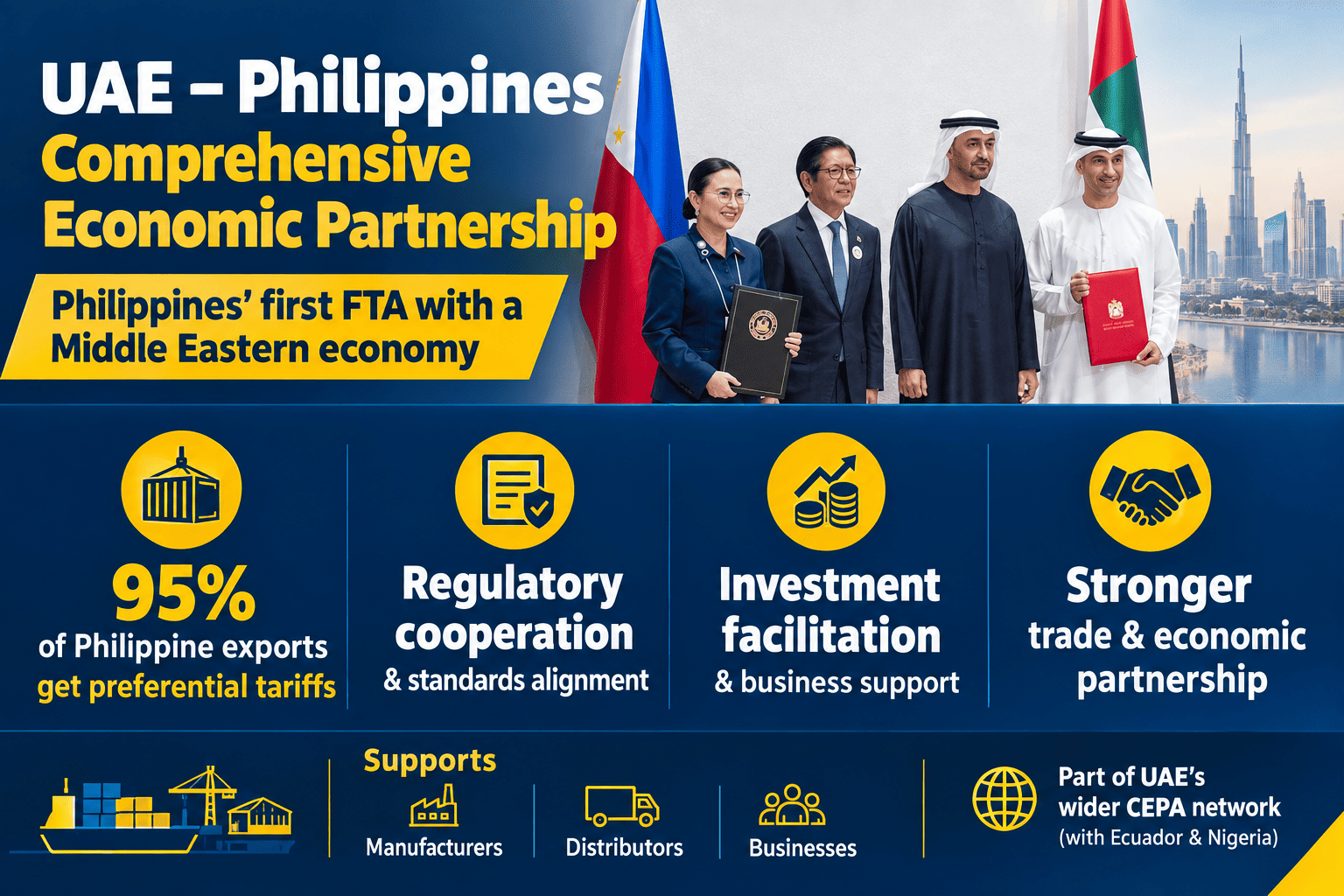
UAE–Philippines CEPA: Full Summary & What It Means for Business
In January 2026, the United Arab Emirates and the Philippines signed a Comprehensive Economic Partnership Agreement, the Philippines’ first free trade agreement with a Middle Eastern economy. The deal introduces preferential tariff treatment for approximately 95% of Philippine exports to the UAE, alongside regulatory cooperation and investment facilitation measures. Here is what has been agreed, what it covers, and what it means for manufacturers, distributors, and businesses weighing it alongside the UAE’s wider CEPA network, including its agreements with Ecuador and Nigeria.
The UAE–Philippines Comprehensive Economic Partnership Agreement is a trade and investment deal between the United Arab Emirates and the Philippines, signed in January 2026. It is the Philippines’ first free trade agreement with a Middle Eastern economy, and establishes a framework to deepen economic ties between Southeast Asia and the Gulf region. The agreement sits alongside the UAE’s growing CEPA network across Latin America and Africa, including deals with Sierra Leone, the DRC, and Gabon.
The UAE is already the Philippines’ largest trading partner in the Arab world and a key entry point for Philippine exports entering Gulf markets. Total bilateral trade reached approximately US$1.83 billion in the latest full-year estimate, with Philippine exports to the UAE at US$390.4 million and non-oil bilateral trade at US$940 million. The CEPA is designed to expand these existing commercial flows through preferential tariff access.
💡 How to read this page
This page summarises the terms confirmed in official UAE and Philippine government statements and reporting around the signing. The agreement has been signed but is not yet in force, so some implementation details may be refined as each side completes ratification. Section 8 places the deal alongside the Philippines’ other recent trade negotiations and the UAE’s broader partnership network.
Section 1
Overview: What Was Signed
The CEPA is a comprehensive trade and investment framework covering goods, services, and investment, signed with a focus on preferential tariff treatment, regulatory cooperation, and investment facilitation. A few headline features stand out:
Preferential tariff treatment on ~95% of Philippine exports. Philippine officials have indicated that approximately 95 percent of Philippine exports to the UAE will receive preferential tariff treatment once the agreement enters into force, covering a wide range of agricultural and industrial products.
First Middle East FTA for the Philippines. The agreement is the Philippines’ first free trade agreement with a Middle Eastern economy, establishing a framework to deepen economic ties between Southeast Asia and the Gulf region.
Provisions beyond tariffs. The agreement includes provisions covering customs cooperation, regulatory transparency, and investment facilitation, designed to reduce administrative barriers affecting companies operating across both markets.
A Gulf–ASEAN trade corridor. The deal positions the UAE as a gateway for Philippine exports entering Gulf markets, while strengthening economic links between Southeast Asia and the Middle East.
Estimated export growth. The Philippine government estimates approximately 9.13 percent export growth under the CEPA, expanding existing commercial flows.
Section 2
Why This Deal Matters
For the Philippines, the agreement opens preferential access to one of the Middle East’s most important logistics and distribution hubs. Dubai’s Jebel Ali Port handles more than 13 million TEUs annually, making it the largest container port in the region and a major gateway for goods entering Gulf markets. Imports arriving in the UAE are frequently redistributed across the Gulf Cooperation Council (GCC) economies, including Saudi Arabia, Qatar, Kuwait, Bahrain, and Oman—a combined market of more than 58 million consumers. For exporters in Southeast Asia, the UAE’s logistics infrastructure allows a single market entry point to serve multiple Middle Eastern markets.
For the UAE, the agreement extends a growing CEPA network across Southeast Asia, following its agreements with other regional partners. The deal supports the UAE’s broader strategy of positioning itself as a global trade hub connecting high-growth regions, much as its agreements with Ecuador and Nigeria reflect a similar logic in Latin America and Africa.
The Philippines’ economy continues to expand, with a population exceeding 115 million making it one of the largest consumer markets in Southeast Asia. Economic growth reached 5.6 percent in 2024, with medium-term projections expected to remain within the 5.5–6.5 percent range. These conditions support continued expansion in manufacturing capacity and export production, and improved market access to Gulf economies through the UAE may influence supply chain planning and regional market strategy for foreign investors evaluating export-oriented manufacturing locations in Southeast Asia.
Section 3
Trade Structure & Bilateral Flows
Indicator
Value
Notes
Total bilateral trade
US$1.83 billion
Latest full-year estimate
Philippine exports to UAE
US$390.4 million
Largest Philippine export market in the Arab world
Philippine imports from UAE
US$1.44 billion
Primarily petroleum products
Non-oil bilateral trade
US$940 million
Reflects diversified trade activity
Estimated export growth under CEPA
~9.13 percent
Philippine government estimate
Share of Philippine exports with preferential access
~95%
Once the agreement enters into force
Section 4
Goods Market Access & Tariffs
The headline outcome of the agreement is preferential tariff treatment for the large majority of Philippine exports to the UAE. While the full tariff schedules are being finalised, the key features confirmed at signing include:
Preferential tariff treatment under the CEPA will not apply automatically to every shipment; it will depend on meeting the agreement’s rules of origin. Businesses planning to rely on the agreement’s tariff benefits should factor rules-of-origin compliance into their sourcing and documentation processes well before entry into force, alongside standard manufacturing certifications for international trade.
Section 5
Investment, Sovereign Wealth & Priority Sectors
Economic cooperation between the Philippines and the UAE is also shaped by the scale of Gulf investment capital. The UAE hosts several of the world’s largest sovereign wealth funds investing globally in infrastructure, logistics, energy, and industrial sectors. Together, these funds manage more than US$1.7 trillion in assets, providing substantial capital capacity for infrastructure and industrial investments worldwide.
💰
Abu Dhabi Investment Authority
~US$993 billion in assets under management
Sovereign Wealth
Invests globally across infrastructure, equities, and real estate, providing capital capacity for large-scale industrial and infrastructure projects.
🏗️
Mubadala Investment Company
~US$302 billion in assets under management
Sovereign Wealth
Focuses on technology, energy, and industrial investments, with a mandate to drive economic diversification and create long-term value.
🚢
ADQ
~US$157 billion in assets under management
Sovereign Wealth
Invests in logistics, infrastructure, and food security, aligning with the UAE’s strategic priorities and the CEPA’s focus on supply chain resilience.
🏗️
Philippine Infrastructure Programme
200+ flagship projects valued at ~US$178 billion under Build Better More
Investment Opportunity
Infrastructure development remains one of the Philippines’ largest economic priorities. Under the government’s Build Better More program, more than 200 infrastructure flagship projects have been identified with a combined estimated value of approximately US$178 billion, spanning transport and rail, airports, roads and bridges, energy, and digital infrastructure. Projects of this scale require long-term financing, engineering expertise, and operational management, creating opportunities for international infrastructure investors and development partners.
Section 6
Timeline: From Negotiation to Signature
2024–2025
CEPA negotiations progress
The UAE and the Philippines advance negotiations toward a Comprehensive Economic Partnership Agreement, building on existing trade and investment ties.
January 2026
CEPA formally signed
The agreement is signed, establishing the Philippines’ first free trade agreement with a Middle Eastern economy and introducing preferential tariff treatment for approximately 95% of Philippine exports to the UAE.
In progress
Domestic ratification
Both sides must complete domestic ratification procedures before the agreement enters into force.
Pending
Entry into force
The CEPA’s tariff schedule and market access commitments take effect once ratification is complete on both sides.
📌 Current status
The agreement has been signed but has not yet entered into force. There is no confirmed entry-into-force date at this stage. Businesses planning around the deal should track official UAE Ministry of Foreign Trade and Philippine Department of Trade and Industry communications for updates, rather than assuming tariff preferences already apply.
Section 7
What It Means by Sector
The Philippines’ export structure helps identify which industries could benefit most from improved access to Gulf markets under the CEPA.
💻
Electronics & Semiconductors
The Philippines’ largest export industry, with electronics shipments reaching approximately US$45.96 billion and semiconductor exports alone totaling approximately US$34.62 billion. More than 500 electronics and semiconductor firms operate in export processing zones.
Largest export sector
🌾
Agribusiness & Food Processing
Agriculture employs approximately 24% of the national workforce and contributes around 8.9% of GDP. The Philippines exports more than 2.3 million metric tons of bananas annually, generating roughly US$1 billion in export revenues. The UAE imports 85–90% of its food consumption, supporting demand for Philippine agricultural exports.
High demand in UAE
⚙️
Industrial Machinery & Infrastructure Components
Machinery and electrical equipment exports exceed US$30 billion annually. Infrastructure expansion across Gulf economies continues to generate demand for construction equipment, electrical machinery, and industrial components.
Growing demand
✈️
Aerospace & Aviation Supply Chains
The Philippines hosts more than 40 aerospace manufacturing and maintenance firms producing aircraft wiring systems, avionics components, and structural assemblies. The aerospace parts manufacturing market is projected to reach nearly US$3.9 billion by 2030.
Specialized sector
🖥️
IT-BPM & Digital Services
The IT-BPM industry generated US$38 billion in revenue in 2024 and employed approximately 1.82 million workers. Digital transformation across Gulf economies is accelerating, with the UAE aiming to increase the digital economy’s share of GDP from 9.7% in 2022 to 19.4% by 2031.
High growth potential
📦
Other Manufactured Goods
Other manufactured goods exports reach approximately US$18–20 billion, including industrial equipment and consumer goods, benefiting from preferential access to the UAE and GCC markets.
Diversified exports
⛏️
Mineral Products
Mineral products exports reach approximately US$3–4 billion, including nickel and other mineral exports, with potential for expanded trade under the agreement.
Resource sector
🧪
Chemicals & Specialty Goods
Other exports including chemicals and specialty goods reach approximately US$8–10 billion, with potential for expanded market access under the CEPA.
Specialty exports
Section 8
Philippines’ Wider Trade Agreement Network
The UAE CEPA is one strand in a broader push by the Philippines to expand its trading relationships beyond its traditional partners. The Philippines is also pursuing an EU-Philippines Free Trade Agreement, which would replace the current GSP+ preference scheme with a reciprocal, negotiated framework, placing the UAE deal alongside a wider set of market-access efforts rather than a one-off arrangement.
GTsetu: Verified Long-Term Collaboration for Manufacturers, Distributors, and Raw Material Suppliers Entering UAE and Philippine Markets
As the UAE-Philippines corridor opens up to lower tariffs, the practical challenge shifts from market access to finding the right partner. GTsetu is a structured partnership platform, not a marketplace or directory, where every company is verified on 6 government-sourced points before engagement, where discovery is anonymous until mutual interest is confirmed, where NDAs are executed digitally before any commercial information changes hands, and where all document exchange happens through an encrypted workspace, supporting genuine long-term supply chain relationships rather than one-off transactions.
GTsetu is used by industrial manufacturers, distribution companies, and raw material suppliers across 100+ countries, including the UAE and the Philippines, to find, vet, and formally engage with trade partners they intend to work with for the long term, whichever trade agreement, from this CEPA to any of the other deals tracked above, ultimately governs the tariffs on their shipment.
🏛️
6-Point Government-Sourced Verification
Name, Address, Registration Number, Company Status, Company Type, and Date of Incorporation, verified using government tie-ups before any engagement.
🕵️
Anonymous Discovery
Browse verified partner profiles across 100+ countries without revealing your own identity or commercial strategy until you choose to engage.
📄
Built-In NDA Workflow
Digital NDA with timestamped signatures before any pricing, formulations, or product specs are shared.
🔐
Encrypted Document Workspace
All commercial documents shared through encrypted channels with a full access audit trail, not email attachments.
🌍
100+ Countries, Including the UAE & Philippines
Verified manufacturers and distributors across the Gulf, Southeast Asia, Asia, Europe, Africa, and the Americas.
🚫
Zero Commission
No success fee, no broker commission, ever. Your partnership economics remain entirely between you and your partner.
The UAE-Philippines Comprehensive Economic Partnership Agreement is a trade and investment agreement signed in January 2026. It is the Philippines’ first free trade agreement with a Middle Eastern economy. The agreement covers trade in goods, services, and investment, introducing preferential tariff treatment, regulatory cooperation, and investment facilitation measures to expand Philippine access to Gulf markets.
QHas the UAE-Philippines CEPA entered into force?
No. As of the latest update, the agreement has been signed but has not yet entered into force. It must still complete domestic ratification procedures in both the UAE and the Philippines before its tariff and market access commitments take effect.
QWhat tariffs does the UAE-Philippines CEPA eliminate?
Approximately 95% of Philippine exports to the UAE will receive preferential tariff treatment once the agreement enters into force. The agreement includes provisions covering customs cooperation, regulatory transparency, and investment facilitation, designed to reduce administrative barriers for companies operating across both markets.
QWhat does the UAE-Philippines CEPA mean for manufacturers and distributors?
The agreement expands cooperation across trade in goods, services, and investment, opening new opportunities in electronics, agribusiness, industrial machinery, aerospace, and IT-BPM services. For manufacturers and distributors, this reduces the cost of entering each other’s markets, but finding and formally engaging a verified long-term distributor or manufacturing partner still requires separate due diligence beyond what the CEPA itself provides.
Planning to Enter the UAE or Philippine Market Once the CEPA Takes Effect?
GTsetu is purpose-built for manufacturers, distributors, and raw material suppliers seeking verified long-term trade partnerships across 100+ countries, including the UAE and the Philippines, with government-sourced partner verification, built-in NDA workflows, and zero commission.
They represents the product, and research team behind GTsetu, a global B2B collaboration platform built to help companies explore cross-border partnerships with clarity and trust. The team focuses on simplifying early-stage international business discovery by combining structured company profiles, verification-led access, and controlled collaboration workflows.
With a strong emphasis on trust, and disciplined engagement, Team GTsetu shares insights on global trade, partnerships, and cross-border collaboration, helping businesses make informed decisions before entering deeper commercial discussions.