Best Alternative to TradeKey for International B2B Sourcing
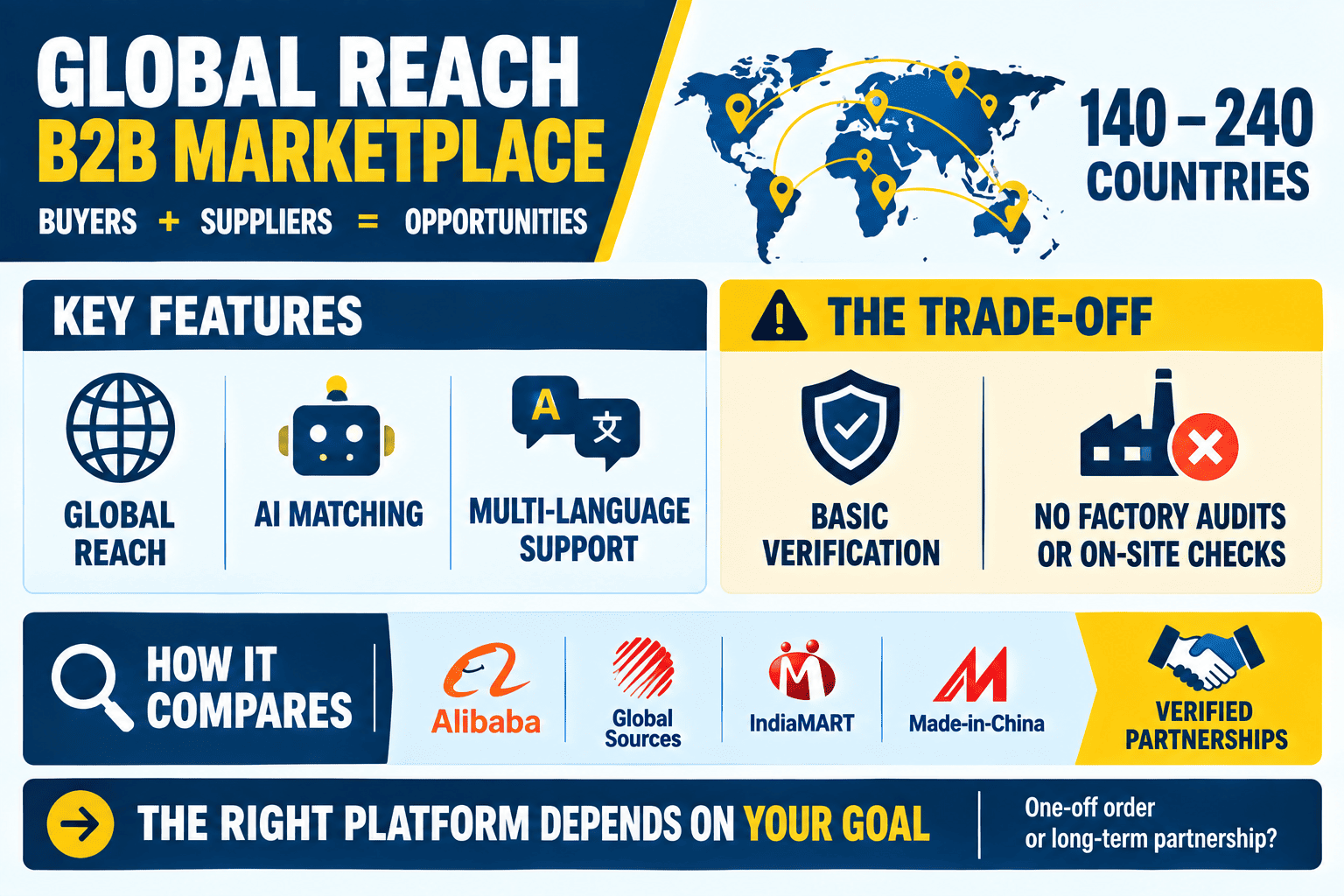
TradeKey’s pitch has always been reach: a global B2B marketplace connecting buyers and suppliers across anywhere from 140 to 240 countries depending on the source, with AI-powered matching and multi-language support. That breadth is real, and it’s also exactly where the trade-off shows up. Independent platform comparisons consistently place TradeKey’s verification at “basic” next to platforms that run factory audits or on-site checks, the same limitation that applies to most open, anyone-can-join B2B directories. This article looks at how TradeKey actually compares to Alibaba, Global Sources, IndiaMART, Made-in-China, and verified-partnership platforms like GTsetu, and what should actually decide where you source from next, whether that’s a cross-border manufacturing partnership or a one-off order.
📅 Published July 23, 2026⏱ 12 min read✍️ GTsetu Editorial🔄 Updated September 8, 2026
No single platform is the right answer for every sourcing need, and that includes TradeKey. The better question isn’t “what beats TradeKey” in the abstract, it’s which platform’s verification depth, geographic focus, and engagement model actually match what you’re buying and how much is riding on getting the supplier right.
Section 1
Where TradeKey Fits, and Where Buyers Feel the Gap
Wonnda’s platform roundup describes TradeKey as an international B2B marketplace, headquartered in Saudi Arabia, connecting buyers and suppliers worldwide with a notably strong Middle East presence and a broad mix of categories. Global Sources’ independent comparison adds detail: TradeKey operates across more than 140 countries, spanning South Asia, the Middle East, Europe, and Latin America, offering geographic diversity that’s genuinely valuable for buyers trying to move beyond a single-country supplier base.
140+
countries TradeKey connects buyers and suppliers across, per Global Sources’ platform comparison
Basic
how Global Sources’ side-by-side comparison table rates TradeKey’s verification system relative to audit-based platforms
6+
B2B marketplaces most sourcing guides recommend comparing before committing to one platform, including Alibaba, Global Sources, and IndiaMART
80%
of B2B buyers now use digital sourcing channels like marketplaces, per Gartner research cited by Wonnda
The gap buyers most often report isn’t reach, it’s assurance. Global Sources’ own guidance on evaluating sourcing platforms is blunt about what should matter most: prioritize platforms that implement rigorous verification processes, including factory audits and certification checks, rather than merely accepting supplier registrations without scrutiny. That’s precisely the axis on which open, broad-reach directories tend to lag behind more selective, audit-driven or verification-first platforms.
💡 Reach and verification are usually a trade-off, not a bundle
The platforms with the widest supplier reach tend to keep listing barriers low, which is exactly what makes that reach possible. The platforms with the deepest verification tend to be narrower in scope, by industry, region, or engagement model. Knowing which one matters more for a specific purchase is the actual decision, not just picking whichever platform has the biggest number of listed suppliers.
Section 2
Six Alternatives to TradeKey Worth Comparing
Different Strengths, Different Fits
Drawing on independent platform comparisons from Global Sources, Wonnda, and UPKAIZEN, here’s how the most commonly recommended TradeKey alternatives actually differ.
1
Alibaba — The Largest Supplier Base
China-heavy, virtually every product category, Trade Assurance escrow
Scale
UPKAIZEN calls Alibaba the undisputed global giant in cross-border B2B sourcing, connecting over 40 million buyers with more than 200,000 verified suppliers, with Trade Assurance and Alibaba.com Select providing escrow protection and automated RFQ matching. Wonnda notes the trade-off directly: Alibaba is geographically concentrated on Chinese factories, with fewer Western suppliers represented.
🎯
Best for: High-volume orders and the widest possible product selection when China-based manufacturing fits your sourcing strategy.
2
Global Sources — Hybrid Online-and-Trade-Show Verification
Digital sourcing plus in-person factory audits and trade shows
Verification
Global Sources’ own research describes its model as uniquely combining digital marketplace capabilities with face-to-face trade show experiences, with suppliers undergoing strict verification processes and on-site audits. Its comparison table rates this as “Strict Verification + On-site Audits,” a materially deeper standard than the “Basic Verification” it assigns to TradeKey in the same table.
🎯
Best for: Buyers who want online research combined with the option of face-to-face supplier verification before committing to larger orders.
3
Made-in-China — China Manufacturing Specialist
Factory audits, verified-supplier badges, detailed capacity data
Manufacturing Depth
Global Sources describes Made-in-China as emphasizing manufacturing capabilities specifically, with detailed factory profiles, production capacity information, and certification documentation. Supplier verification includes factory audits, with “Verified Supplier” badges marking companies that underwent additional scrutiny, particularly strong in machinery, industrial equipment, and building materials.
🎯
Best for: Industrial and machinery sourcing where detailed production-capacity data matters more than category breadth.
UPKAIZEN describes IndiaMART as India’s largest B2B marketplace, linking over 7 million suppliers with global buyers across industrial machinery, raw chemicals, textiles, and construction materials. Global Sources adds that its verification includes business legitimacy checks and supplier ratings based on transaction history, offering significant value for categories where India holds a manufacturing advantage.
🎯
Best for: Indian supplier sourcing specifically, textiles, generic pharmaceuticals, and artisan goods where India’s base is deepest.
5
ThomasNet — North American Manufacturing Focus
US and Canada suppliers, ISO certifications, Western standards
Regional Leader
Global Sources notes ThomasNet specializes in North American manufacturers, with detailed supplier profiles including ISO certifications, production capabilities, and case studies, serving buyers who prioritize domestic sourcing, shorter supply chains, or Western certification standards. Wonnda’s comparison echoes this as a trusted resource specifically for engineering and procurement teams sourcing in the US and Canada.
🎯
Best for: Buyers prioritizing North American manufacturing standards, shorter supply chains, or domestic sourcing over lowest-cost global options.
6
Verified-Partnership Platforms — GTsetu and Similar Models
A different category entirely from open directories: platforms built around verifying every listed company before engagement rather than letting anyone list freely. Global Sources’ own guidance names exactly this priority for serious buyers: platforms that combine digital verification with structured protection, NDA workflows, and documented compliance, before any commercial data changes hands.
🎯
Best for: Higher-stakes sourcing decisions, formal long-term partnerships, or any relationship where specifications and pricing need protection before a deal is confirmed.
Verified Asian suppliers, hybrid online/trade-show sourcing
Made-in-China
China
Factory Audits + Badges
Industrial and machinery manufacturing
IndiaMART
India
Business Legitimacy Checks
Textiles, pharma, handicrafts from India
ThomasNet
North America
ISO Certifications Listed
Domestic US/Canada manufacturing standards
Verified-Partnership Platforms (GTsetu)
100+ countries
Government-Sourced, 6-Point
Formal, long-term, higher-stakes partnerships
None of this makes TradeKey a bad platform for its intended purpose, casting a wide net for initial supplier discovery across many regions at once. It does mean that verification depth, not geographic reach, is usually the deciding factor once a buyer moves from browsing to actually committing volume, capital, or specifications to a specific supplier.
Section 4
Open Directories vs. Verified-Partnership Platforms
The deeper distinction isn’t really “TradeKey vs. Alibaba vs. Global Sources,” it’s open-directory platforms versus verification-first platforms, and most of TradeKey’s named alternatives, including several on this list, fall on the open-directory side of that line to varying degrees. Global Sources’ own FAQ guidance names the core factors that separate them: supplier verification systems, industry specialization, communication and negotiation tools, and payment protection mechanisms.
Listing barrier. Open directories generally let most companies register with limited independent checks; verification-first platforms confirm legal identity before a listing goes live or before two parties can engage.
Discovery model. Open directories typically show full company details to anyone browsing; verification-first platforms often keep discovery anonymous until both sides confirm mutual interest.
Protection before disclosure. Open messaging on a directory rarely includes a formal NDA step; verification-first platforms build that step into the workflow before specifications or pricing are shared.
Document handling. Directories mostly rely on open messaging or email for sharing files; more secure platforms route documents through an encrypted workspace with an access trail.
📌 Neither model is automatically wrong
An open directory’s low barrier to entry is exactly what gives it breadth, more suppliers, more regions, more categories to browse. That breadth is a genuine advantage for early-stage, exploratory sourcing. It becomes a liability only when a buyer treats a directory listing as equivalent to a verified relationship, without doing the additional diligence a lower-friction platform doesn’t do for them.
Section 5
Choosing the Right Platform for What You’re Sourcing
Global Sources’ guidance on selecting a sourcing platform boils down to matching capabilities to specific business needs: product categories and geographic focus, order volume flexibility, and supplier verification standards. Applied to a TradeKey-vs-alternatives decision, that translates into a few practical questions.
If You’re…
Lean Toward
Exploring many regions at once, low commitment per lead
TradeKey or another broad, open directory
Sourcing high volume from China with escrow protection
Alibaba
Wanting to verify a supplier in person before a large order
Global Sources
Sourcing industrial or machinery components
Made-in-China
Sourcing textiles, pharma inputs, or handicrafts from India
IndiaMART
Prioritizing North American manufacturing standards
ThomasNet
Forming a long-term, higher-stakes manufacturing partnership
Whichever platform surfaces a promising supplier, the platform’s job ends at discovery. What happens next, verification, protection, and formal terms, is where trust in global deals most often breaks down, regardless of which directory or marketplace the introduction came from.
🏛️
Independently verify legal registration
A platform listing, however detailed, isn’t the same as independent confirmation. Verify registration and standing before committing to volume.
Government-sourced verification
📄
Move from platform messaging to a formal contract
Translate any promising conversation into an actual business partnership contract, not just an ongoing thread on whichever platform you found them through.
Contract-first engagement
📜
Confirm certifications independently of the listing
A badge on a directory profile isn’t the same as a verified certificate. Confirm what a supplier actually holds before relying on it.
🤝 For Verified Long-Term Manufacturing Partnerships
GTsetu: Verified Discovery and Secure Engagement for Manufacturers, Distributors, and Raw Material Suppliers
TradeKey and most of its named alternatives are built for open discovery, casting the widest possible net so buyers and suppliers can find each other. GTsetu is built for the step most open directories skip: verifying who you’re actually about to negotiate with before you share anything that matters. It is a structured partnership platform, not a directory or a general marketplace, where every company is verified on 6 government-sourced points before engagement, where discovery is anonymous until mutual interest is confirmed, where NDAs are executed digitally before any commercial information changes hands, and where document exchange happens through an encrypted workspace rather than email attachments.
GTsetu is used by industrial manufacturers, distributors, and raw material suppliers across 100+ countries as the verified starting point for a relationship they intend to keep for years, not a single order cycle, whether the goal is building out a distributor network, sourcing international wholesale distribution partners, or forming a technology partnership. It complements the broad-reach discovery a platform like TradeKey offers rather than replacing it, but it removes much of the identity and documentation risk once a buyer is ready to move past browsing.
🏛️
6-Point Government-Sourced Verification
Name, Address, Registration Number, Company Status, Company Type, and Date of Incorporation, verified using government tie-ups before any engagement.
🕵️
Anonymous Discovery
Browse verified manufacturer and distributor profiles across 100+ countries without revealing your identity or sourcing strategy until you choose to engage.
📄
Built-In NDA Workflow
Digital NDA with timestamped signatures before any pricing, formulations, or product specs are shared, unlike open directory messaging.
🔐
Encrypted Document Workspace
All commercial documents shared through encrypted channels with a full access audit trail, not open messages or email attachments.
🌍
100+ Countries, Verified
Verified manufacturers and distributors across Asia, Europe, the Middle East, Africa, Australia, and the Americas, built for cross-border partnership formation.
🚫
Zero Commission
No success fee, no broker commission, ever. Your partnership economics remain entirely between you and your partner.
Whichever platform you start with, the same discipline applies once you’ve found a promising lead: evaluate the relationship with the same partnership evaluation criteria you’d use anywhere, whether it’s a supply chain partner found through an open directory or one matched through a B2B matchmaking tool built specifically for verified discovery. Platform choice sets where you find a lead; verification and formal terms are what turn that lead into something a broader global expansion plan can actually rely on, and what makes any resulting cross-border business partnership defensible later.
FAQ
Frequently Asked Questions
QWhat is the best alternative to TradeKey for international B2B sourcing?
There isn’t a single universal answer, since the right alternative depends on what you’re sourcing and where. Alibaba offers the largest supplier base for China-heavy sourcing, Global Sources adds hybrid online-and-trade-show verification for Asian suppliers, IndiaMART leads for Indian manufacturing, and verified-partnership platforms like GTsetu focus on government-sourced identity verification and NDA-protected discovery across 100+ countries for buyers who want a formal, vetted relationship rather than an open directory.
QWhy do buyers look for a TradeKey alternative?
TradeKey’s core strength is geographic breadth, connecting buyers and suppliers across more than 140 to 240 countries depending on the source. Independent comparisons note that its verification is comparatively basic next to platforms that run factory audits or on-site checks, and the same broad-reach model applies to other members-anyone-can-join directories. Buyers sourcing higher-value or higher-risk categories often want deeper identity and capability verification than an open directory model provides.
QIs TradeKey safe to use for sourcing?
TradeKey, like most open B2B directories, provides basic verification services and standard communication tools, but does not run the same depth of factory audits or on-site checks as hybrid platforms such as Global Sources. That doesn’t make it unusable, but it does mean buyers should treat any supplier found there, or on any similarly open directory, as unverified until they independently confirm legal registration, certifications, and production capacity.
QHow is GTsetu different from TradeKey and similar B2B directories?
TradeKey and comparable directories are largely open: most companies can list themselves with limited independent checks. GTsetu verifies every company on 6 government-sourced points before they can engage, keeps discovery anonymous until both sides confirm interest, requires a digital NDA before any commercial information is shared, and routes documents through an encrypted workspace rather than open messaging or email. It is built for formal, long-term partnership formation rather than open-directory browsing.
Ready to Source From Verified Manufacturers and Distributors?
GTsetu is purpose-built for manufacturers, distributors, and raw material suppliers in industrial sectors seeking verified long-term trade partnerships, across 100+ countries, with government-sourced partner verification, built-in NDA workflows, and zero commission.
They represents the product, and research team behind GTsetu, a global B2B collaboration platform built to help companies explore cross-border partnerships with clarity and trust. The team focuses on simplifying early-stage international business discovery by combining structured company profiles, verification-led access, and controlled collaboration workflows.
With a strong emphasis on trust, and disciplined engagement, Team GTsetu shares insights on global trade, partnerships, and cross-border collaboration, helping businesses make informed decisions before entering deeper commercial discussions.